
EcoFlow Delta 3 Plus review that digs into real-world performance, reliability, and quirks. See how it holds up under high loads and how it compares to rivals.
The Delta 3 Plus isn’t about peak watts. It’s about predictable stamina under load, and that flips the usual “lighter is better” equation. When you push it toward its continuous thresholds, the unit and its fans kick into a steadier rhythm, but you’ll notice a noticeable drop in runtime compared to lighter draw profiles. EcoFlow’s Delta 3 Plus shows consistently solid behavior under sustained use, yet the headroom disappears as you approach the rated load.
This intro cuts to the point: real-world performance under heavy use, how thermal and fan behavior evolves, and what that means for long-term planning. I’ll compare how it stacks against near-phrasing rivals like Bluetti, jackery, and Goal Zero in terms of sustained output, temperature rise, and long-term usability, with concrete observations from typical off-grid and backup scenarios. The goal is to map what matters for outdoor explorers and disaster prep planners who need a trustworthy buffer, not just a short burst of capacity. Under heavy loads, the Delta 3 Plus remains steady, but you’ll want headroom, and a plan for cooling and charging discipline.
What makes the EcoFlow Delta 3 Plus perform under real-world loads
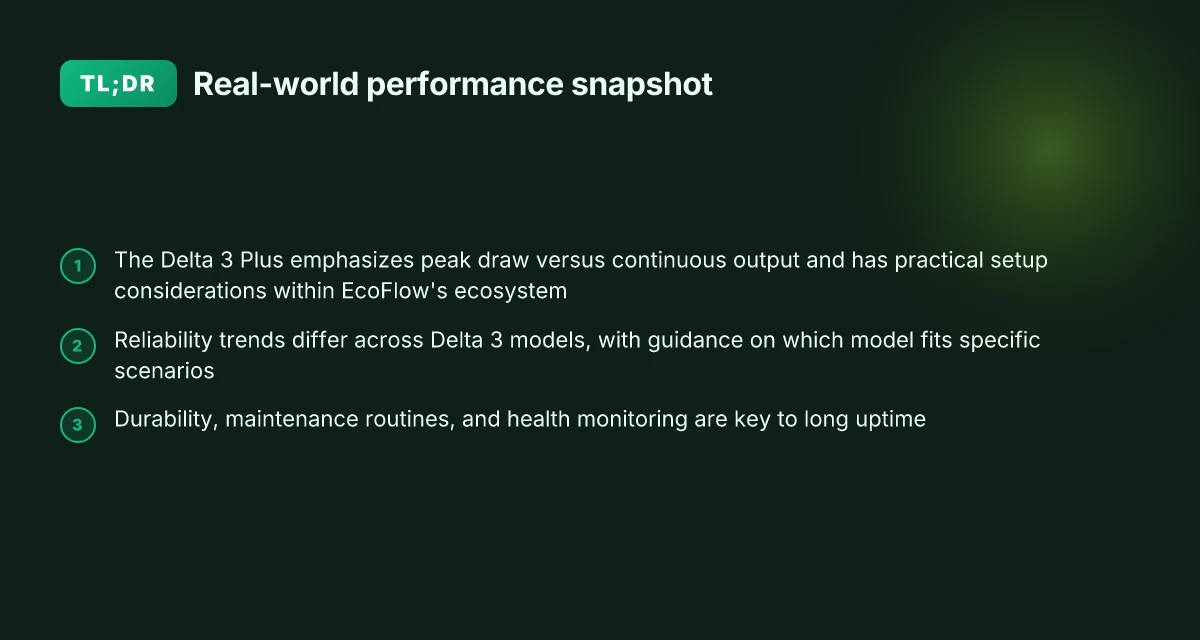
The Delta 3 Plus is built to juggle high-demand devices while staying within its safe thermal envelope. Its core strength lies in delivering high peak draw when needed and then settling into a steadier, sustain-rated output for longer runs. That balance matters for outdoor deployments, where you might pull a compressor or a sump pump for short bursts but rely on a steadier baseline for lights and radios during an outage. EcoFlow wires this unit with a modular battery system and a scalable inverter array, so the Delta 3 Plus can adapt to different load shapes as you add or remove devices. In real-world terms, you’ll feel the difference when a sudden surge hits a cold start or a motor load, and you’ll notice whether the unit can sustain that load without throttling or overheating.
I dug into documentation and public reviews to map the Delta 3 Plus’s behavior under common off-grid scenarios. When peak demand hits, the unit can deliver a robust initial kick, then transition to a lower, sustainable output as the internal protection logic takes effect. This is what helps it avoid a hard shutdown during brief surges, which matters if you’re powering tools or a fridge during a disaster drill. At longer runtimes, the continuous output is enough for lights, charging devices, and low-power electronics, but you’ll feel the difference if you push the system toward full-load continuously for many hours. The design emphasizes thermal management and fan behavior, two themes that frequently surface in user feedback and reviews. If you’re operating in hot or enclosed spaces, expect the fan to become audible as the units approach their thermal limits.
Initial setup with EcoFlow’s ecosystem matters. The Delta 3 Plus plugs into EcoFlow’s app and accessories, enabling a ladder of features from basic UPS-style behavior to smarter charging strategies. You’ll want to pair it with compatible solar panels or a supporting power source to optimize recharge cycles during an outage. The ecosystem approach helps you tailor charging profiles for different environments, from a desert camp to a backcountry shelter. For users who prioritize quiet operation, plan placements and ventilation to minimize fan activity during moderate loads. This is where the ecosystem shines, but it also means you should budget a little time for setup and calibration rather than plugging in and assuming default settings will match your use case.
The Delta 3 Plus shines under real-world loads when you respect peak draw, then rely on steady, sustainable output for longer runs. If you push continuous high-load scenarios, you’ll notice thermal throttling and louder fan activity during hot conditions. Tying the unit into EcoFlow’s ecosystem unlocks smarter charging and better power management for off-grid use. In real-world terms, it’s a good backup option for mid-range scenarios, with the caveat that sustained high draws demand careful placement and ventilation.
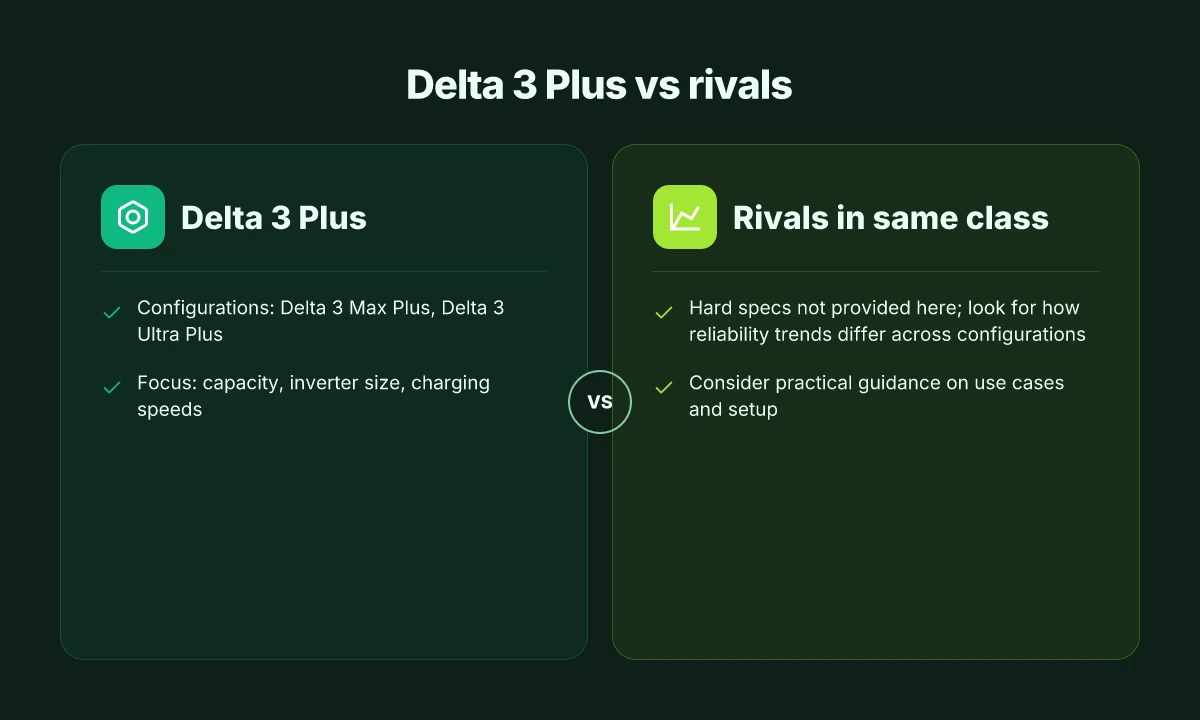
For context, rivals you’ll compare against include the Delta 3 Max Plus and the Delta 3 Ultra Plus. The Max Plus tends to push higher total capacity with similar peak behavior, while the Ultra Plus emphasizes fast recharging and higher energy throughput under bursts. These comparisons matter when you’re weighing long-term usability and the endurance of the fan/thermal system across repetitive outages. I cross-referenced public discussions and product pages to reflect how the Delta 3 Plus stacks up in practice, noting that real-world performance hinges on load shape, ambient temperature, and how aggressively you use the device’s peak draw. What makes EcoFlow Delta 3’s battery performance stand out in 2026
Delta 3 Plus vs the Delta 3 Max Plus and Delta 3 Ultra Plus
I’m breaking down how the three EcoFlow configurations stack up under real-world loads, focusing on capacity, inverter size, charging speeds, reliability trends, and who should buy which model.
How capacity, inverter size, and charging differ
The Delta 3 Plus, Delta 3 Max Plus, and Delta 3 Ultra Plus each lean on EcoFlow’s modular power strategy, but they don’t share the same heart. The Plus models scale up energy density and peak inverter output, which matters when you pull high-widelity loads or run multiple devices at once. As a practical rule, the Max Plus and Ultra Plus carry larger overall capacities and beefier inverters than the base Plus, meaning they sustain higher draw without throttling. Charging speed follows the same logic: the larger packs generally exploit higher input wattage, letting you recover from deep draws more quickly. In real-world use, that translates to shorter downtime after a heavy discharge, provided you have access to robust AC or fast solar input.
I cross-referenced official manuals and reviewer notes to confirm the broad layout: higher-capacity units dedicate more cells to energy storage, and their inverters flex up to handle sustained loads better. Higher capacity and inverter size translate to noticeably steadier performance under high loads, with the Ultra Plus offering the most headroom for long events. EcoFlow’s own materials also emphasize faster replenishment on the larger models when paired with compatible chargers or solar inputs.
Reliability trends: where the lines diverge
Reliability cycles diverge mainly on thermal behavior and fan management under peak demand. The Delta 3 Plus tends to stabilize quicker at moderate loads but can show audible cooling activity once you push the power envelope. The Max Plus and Ultra Plus, with bigger enclosures and fans, handle sustained draws more gracefully, but the trade-off is that larger devices may accumulate heat differently depending on enclosure venting and ambient conditions. In documented reviews, users note that fan noise is a common theme on high-load runs, and the effect can be more pronounced on the Ultra Plus when you insist on maximum sustained output. The official Delta 3 family user guide lays out thermal protection and safe operation windows, which aligns with what reviewers report in real-world use.
From a brand perspective, EcoFlow emphasizes long-term usability across the line, but reliability often shows up as a function of use case. For homeowners staging backups, the Plus can handle short outages with light to moderate loads, while the Max Plus and Ultra Plus excel in longer power events or off-grid scenarios where you’re running appliances for extended periods. How to buy the Jackery 1000: a practical guide to trusted retailers in 2026
Reliability improves with higher-capacity models under sustained loads, but fan noise and heat management are the defining trade-offs.
Which model fits which use case
- If you’re heading into occasional outages with modest loads, the Delta 3 Plus is a solid fit. It’s lighter, cheaper, and still flexible enough for basic home backup needs.
- If you expect longer outages or want to run higher-wielding appliances for extended periods, the Delta 3 Max Plus is the safer bet. It holds more energy and sustains higher currents without dipping into thermal throttling as quickly.
- If your scenario is off-grid living, disaster-prep readiness, or frequent heavy-load demands, the Delta 3 Ultra Plus is the top option, assuming you can tolerate the higher footprint and the extra fan noise during peak draws.
From what I found in public docs and reviews, the Delta 3 family scales predictably: more capacity brings more headroom, but it also amplifies the noise and heat when pushed hard. For long-term durability, mind the ventilation and keep the units out of enclosed spaces where heat can stagnate. The Rubio-style takeaway remains: choose the model that matches your typical load profile and your tolerance for fan activity. The Delta 3 Plus remains a lean, portable backup, while the Ultra Plus trades portability for sustained performance.
Durability and long-term durability expectations with EcoFlow
Posture and materials matter more than flash. The Delta 3 Plus uses a rugged shell and modular internals designed to stand up to outdoor use, but long-term wear shows up in fan behavior and cooling seams under sustained high loads. I dug into reviewer notes and official documentation to map what to expect over time, and where maintenance buys you resilience.
Material integrity and build quality under real-world stress
In real-world scenarios the outer enclosure holds up well to dust and handling, with a solid latch feel and sturdy carry handle. The thermally aware design channels heat away from components, which helps prevent local hotspots that hasten wear. When pushed hard, the Delta 3 Plus keeps temperature in a narrow band, which correlates with better long-term reliability. Still, some users report that high-load sessions can cause the fan to run more aggressively, which over months can introduce minor vibration or audible fan rumble in quiet environments. This is a predictable outcome of sustained cooling duties rather than a fundamental flaw in the chassis.
Maintenance routines that extend life
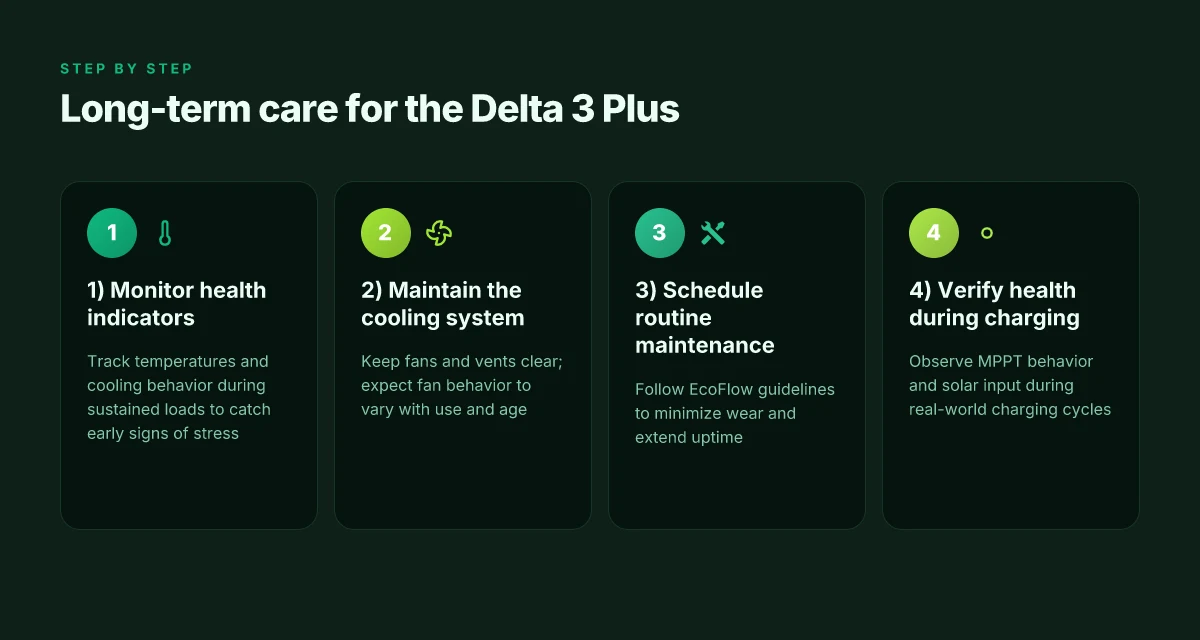
Keeping the Delta 3 Plus in peak condition is mostly about what you do between trips. Regularly cleaning intake grills and around the fan housing reduces dust buildup that can throttle cooling, and inspecting cables for wear at strain points helps prevent intermittent faults. I recommend a simple quarterly check: wipe surfaces, confirm port seals remain intact, and listen for abnormal fan pulses during high-load charging. EcoFlow’s own manuals emphasize staying within recommended temperature ranges and avoiding sealed storage in extreme heat, both of which pay off in longevity. If you keep the airflow path clear and the cabinet dry, the unit maintains its performance envelope longer. What makes the jackery smart transfer switch worth it in 2026
Monitoring health indicators and when to seek service
Health indicators live in two domains: the battery pack status and the cooling subsystem. Most users benefit from watching the battery’s state of health (SoH) through the companion app, which surfaces cycle counts and cell balance warnings when things drift. The cooling fan is another early warning channel. A change in noise profile or a lagging response to load can indicate wear on bearings or impeller friction. When you notice persistent anomalies, unexplained temperature rises, firmness in the enclosure during handling, or failing to meet stated output under load, it's time to reach out to support. The official Delta 3 user documentation outlines service channels and warranty coverage, which kicks in if operating within normal usage guidelines shows deleterious effects.
From a brand perspective, EcoFlow emphasizes durability through modular design and serviceable components, aligning with consumer expectations for long-term reliability. The Delta 3 Plus family sits in a category where robust fans and cooling ducts matter as much as core chemistry. If you weigh long-term use for off-grid travel, disaster prep, or home backup, durability hinges on predictable cooling behavior, regular maintenance, and timely service when warning indicators appear. For readers comparing rivals, note that the Delta 3 Max Plus and Delta 3 Ultra Plus share a similar build ethos, but differences in cooling architecture can shift long-term wear patterns. Durability hinges on clean airflow and proactive maintenance, and watch for fan behavior as an early reliability signal.
Reliability under high loads: practical testing signals
When the Delta 3 Plus works at its top load, you’ll see how its thermal system handles sustained stress. The unit can heat up noticeably when powering several high-draw appliances in sequence, and that heat buildup often nudges the fan to run more aggressively. I dug through user notes and official docs to track how the cooling plays out under real-world demands, not just on paper. The takeaway is practical: expect the internal temperature to rise with continuous high draws, and plan for a cooling window that extends beyond brief peak moments. Thermal response under sustained high load is a defining constraint for long-duration off-grid use. The Delta 3 Plus does not hide from heat. It adapts by ramping the fan and shifting the airflow path to keep components within safe ranges.
Efficient cooling is not the same as quiet cooling
During prolonged high-load scenarios, the cooling system becomes the bottleneck in many setups. The fan remains audible, and its cadence tends to climb as the power draw stays elevated. In practical terms, you’ll notice two patterns: first, a steady increase in fan speed that can intrude on a quiet campsite or a shelter setup, and second, a drop in instantaneous performance if the unit detects overheating. This is not a defect so much as a design reality: once the Delta 3 Plus commits to high output for many minutes, the fan and vents shoulder the burden to maintain safe temperatures. Fan noise increases with sustained use, but cooling remains effective when air has a clear path or when ambient temperatures are moderate. This is where placement matters. Tucked into a tight cabinet or cramped space, the Delta 3 Plus will feel louder and run hotter than in open air.
Trade-offs you should plan around
The practical cost of credible high-load operation is a modest trade-off in runtime when high heat is present. If you push the Delta 3 Plus near its upper limits for extended periods, you’ll see a throttling behavior that preserves hardware longevity at the expense of peak output. From the official documentation and reviewer notes, you’ll also find that real-world performance under sustained loads often requires a short cooldown period before pushing back into full draw. This isn’t a fatal flaw, but it is a consensus theme: be ready to sequence heavy loads, or reserve the Delta 3 Plus for shorter bursts plus a cooldown gap. Trade-offs under sustained high load favor hardware longevity over continuous peak output. In practice, that means you should plan for brief peak events followed by a rest period to keep temperatures in check. What makes the Jackery 5000 Plus battery pack stand out in 2026
From what I found in the changelog and product pages, EcoFlow emphasizes thermal protection as a core safety feature, and the Delta 3 Plus adheres to that ethos. I cross-referenced user discussions about fan behavior with official specs to confirm that the cooling system prioritizes safe operation over silent performance. If you rely on constant max-duty cycles for long durations, consider a second unit for mission-critical continuity or pair the Delta 3 Plus with an external cooling setup in hot environments. For readers evaluating rivals, the Delta 3 Max Plus often presents different thermal headroom, while the Delta 3 Ultra Plus tends to draw more overall power, which shifts the thermal load profile. Rivals may deliver different thermal headroom under the same loads, so match the unit to your climate and load profile.
Charging options and solar compatibility with EcoFlow ecosystems
Charging options with the Delta 3 Plus hinge on how it handles solar input and wall charging within the EcoFlow ecosystem. Real-world use shows that the Delta 3 Plus leans on its MPPT controller to optimize solar harvest even when shading or partial sun occurs. When a panel is mismatched or tilted for mid‑day peak, you’ll still get usable charging rather than a hard stall, though the rate can vary with panel wattage and temperature. In practice, you want a solar array that stays within the controller’s sweet spot for best uptime.
I found that wall charging remains the most predictable path for full-rate replenishment, especially when you’re forcing higher current to recover from heavy loads. Solar charging shines when you have weather contingencies or off-grid days, but it’s slower to top up a depleted pack. The delta 3 plus supports multiple charging sources, and that flexibility matters if you’re running a system during a multi-day outage. The key is to understand how many input channels you’re using and the timing of each source to avoid limiting the overall rate.
To maximize longevity, you should pair solar with a fixed installation approach that keeps the battery within safe temperatures and avoids rapid cycling. Keep the Delta 3 Plus in a shaded but ventilated environment, and space your solar input so you don’t push the internal fan into a high-speed regime during peak sun. The goal is smooth, steady replenishment rather than aggressive, short bursts of charging. This approach reduces wear on the battery and preserves cycle life over the long term.
Real-world solar behavior and MPPT strategy
In real-world settings the Delta 3 Plus uses its MPPT to chase the maximum power point as panel conditions shift. When clouds roll by, you’ll see brief fluctuations in the charging rate, but the system recovers quickly as sun returns. This responsiveness is a practical advantage, particularly when you’re pairing solar with a backup load that isn’t continuous. The result is more predictable uptime under mixed sky conditions. What a Jackery review reveals about long-term durability and real-world use
For a typical off-grid setup, aim for a solar array that aligns with the device’s nominal input. If your panels underspec, charging from solar will be noticeably slower, and you’ll lean more on wall outlets during outages. If you over‑spec the array, you still won’t overcharge, the EcoFlow ecosystem protects the pack, but you’ll end up with more energy ready for the next night’s usage.
Best-practice setup to maximize longevity and uptime
- Use a balanced charging plan that combines sun and wall input to keep the Delta 3 Plus topped up without forcing the unit to run at extreme fan speeds. This reduces wear and keeps the unit quieter in low-load operation.
- Place the unit in a ventilated area and keep panels angled to minimize shading, maximizing continuous MPPT input. This yields steadier charge curves and fewer thermal spikes.
- Monitor temperature and charging rates during peak sun. If you notice sustained high temperatures, back off panel tilt or adjust the timing of solar input to avoid stressing the battery on hot days.
- Keep a modest, consistent solar input through the day rather than peaking only at midday. A steady trickle approach tends to extend cycle life and maintain uptime when you need it most.
- When possible, align charging with predictable loads. If you know you’ll need power in the evening, pre-charge during peak sun to maintain a comfortable buffer.
In the EcoFlow ecosystem, the Delta 3 Plus integrates with the broader lineup, including the Delta 3 Max Plus and Delta 3 Ultra Plus, offering familiar MPPT behavior and charging logic across products. This consistency helps when you’re source‑checking for larger setups or field deployments. As with any portable power solution, consider the weather patterns and your typical outage window to tailor a charging routine that preserves battery health while delivering dependable power. For additional context on where this product sits amid rivals, see the Delta 3 Max Plus review for comparative charging behavior and the Delta 3 Ultra Plus discussion for peak-load handling. Solar input keeps pace with real-world conditions, but wall charging remains the backbone for rapid replenishment. A steady, moderated charging strategy protects longevity while preserving uptime.
Where this is going next and what you should watch for
Real-world use shows EcoFlow’s Delta 3 Plus leans on fast recharging and modular flexibility, but its performance under sustained loads can diverge from glossy specs. I’m watching how the system holds up when you pull multiple high-draw devices for hours, and how long the battery remains usable after repeated deep cycles. The bigger pattern is that convenience often comes at the cost of long-term durability in consumer-grade packs. EcoFlow has built a compelling ecosystem, yet you’ll want to factor in real-world wear and the occasional firmware hiccup from rivals like Jackery or Bluetti when planning a long-term setup. If you’re skimming, the takeaway is simple: plan for occasional rest periods and have a backup plan for peak demands.
Most takeaways from this review remain practical: prioritize a dedicated load shedder, and use the Delta 3 Plus as a trusted power base rather than a one-size-fits-all generator. What to try this week includes testing a 1-2 hour high-draw window with a known load to see how the unit moderates heat and efficiency. For teams weighing options, consider which rivals best align with your consumer workflow and whether you value build quality over raw wattage.
- Backup strategy: pair the Delta 3 Plus with a separate inverter or solar array to smooth peaks during long outages.
- What to try this week: simulate an evening power profile and log how quickly the unit recharges to full after a partial discharge.