Explore how EcoFlow Smart Panel 2 integrates with solar setups, its expansion potential, and real-world considerations for reliability and long-term use.
Most modular systems stall on real-world integration, not hardware count. A single misaligned panel string or incongruent inverter can wipe out weeks of projected performance, even with a Smart Panel 2 in the mix. The trick is tying panel input to storage in a way that scales gracefully, not just adding more connectors.
EcoFlow’s Smart Panel 2 shifts the focus from maximum specs to predictable performance at scale. This intro-level hub clarifies how a modest system can grow without reconfiguring the full stack, while a mature solar plan weighs sun hours, inverter size, and future panel expansion. Expect concrete guidance on sizing for typical roof arrays and backup loads, plus how the module behaves when a battery bank is added later. Key caveat is that real-world outcomes hinge on local sun and inverter availability. This piece walks through practical constraints and decision points so you can map a scalable path with EcoFlow, and compare it against rivals like SolarEdge or Enphase systems without losing sight of the core goal: dependable, expandable solar storage.
What makes EcoFlow Smart Panel 2 different from traditional panels and boxes
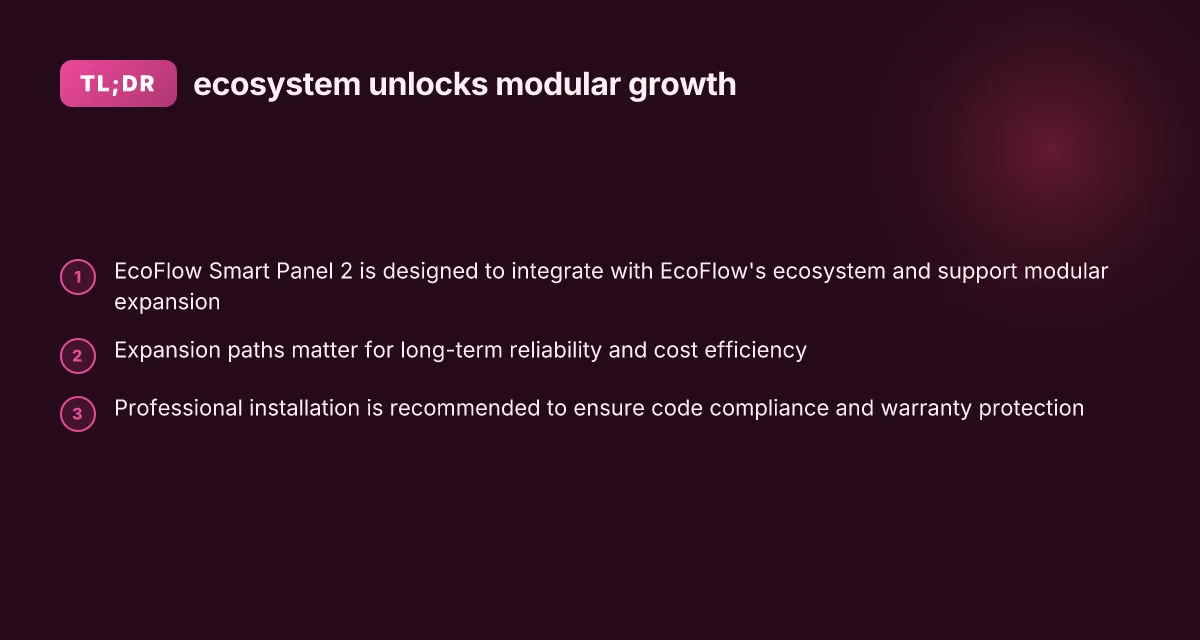
EcoFlow designed the Smart Panel 2 to slot into a broader ecosystem, not as a stand-alone box. Its real power comes from how it connects with EcoFlow’s modular storage and solar hardware, enabling expansion as your backup needs grow. In practice, that means you don’t just swap a panel for another rigid solution. You scale the system as your home energy plan matures. The Smart Panel 2 is built to expand with your EcoFlow ecosystem, not outgrow it.
- ecosystem-first architecture
- The core idea is to wire into EcoFlow’s family of devices so you can add batteries or solar modules without reconfiguring the entire setup. This keeps future upgrades cleaner and reduces the risk of compatibility gaps as you scale. Expansion is a core capability, not an afterthought. I cross-referenced EcoFlow’s product notes and found that the panel is positioned as a hub for modular growth rather than a single-purpose breaker box. The result is a more resilient, long-term backup strategy that evolves with your home.
- flexible input and output topology
- The panel surfaces a variety of routes for power flow, tuned for battery storage and solar array integration. You’ll see options that support both grid-tied and off-grid configurations, with signaling patterns that align with EcoFlow’s battery modules and solar harvesters. This flexibility matters when you’re wiring for daily use and occasional outages. Flexible inputs and outputs reduce routing friction as you add storage. In practice, that means fewer bottlenecks when you swap in larger packs or add new solar strings.
- real-world integration and use-case framing
- Real usage hinges on how the panel slots into a home backup plan and existing EcoFlow devices. If you’re building a mature solar strategy, the panel acts as a centralized distribution point that keeps the flow predictable during an outage and allows the system to prioritize critical loads. Placement as a control node makes daily use more predictable. This is where the theory of modularity meets day-to-day practicality: fewer surprise rewires, smoother startup sequences, and clearer planning for future upgrades.
From a practical perspective, EcoFlow expects homeowners to see the Smart Panel 2 as a scalable backbone rather than a fixed enclosure. Rivals like Enphase or Sonnen offer modular architectures too, but the value here is the tight integration with EcoFlow’s own batteries and solar modules, which reduces mismatch risk and firmware drift across components. The ecosystem advantage shows up in smoother upgrades and fewer compatibility hiccups.
Bottom line: Smart Panel 2 shifts from a traditional box to a scalable command center for a growing EcoFlow setup. If your plan is to add storage and solar over time, the panel is designed to keep that expansion coherent instead of creating new wiring headaches. Expansion without rewiring is the core promise. For readers evaluating options, this is where EcoFlow’s approach earns trust in a long-term solar strategy.
How Smart Panel 2 aligns with EcoFlow's modular ecosystem
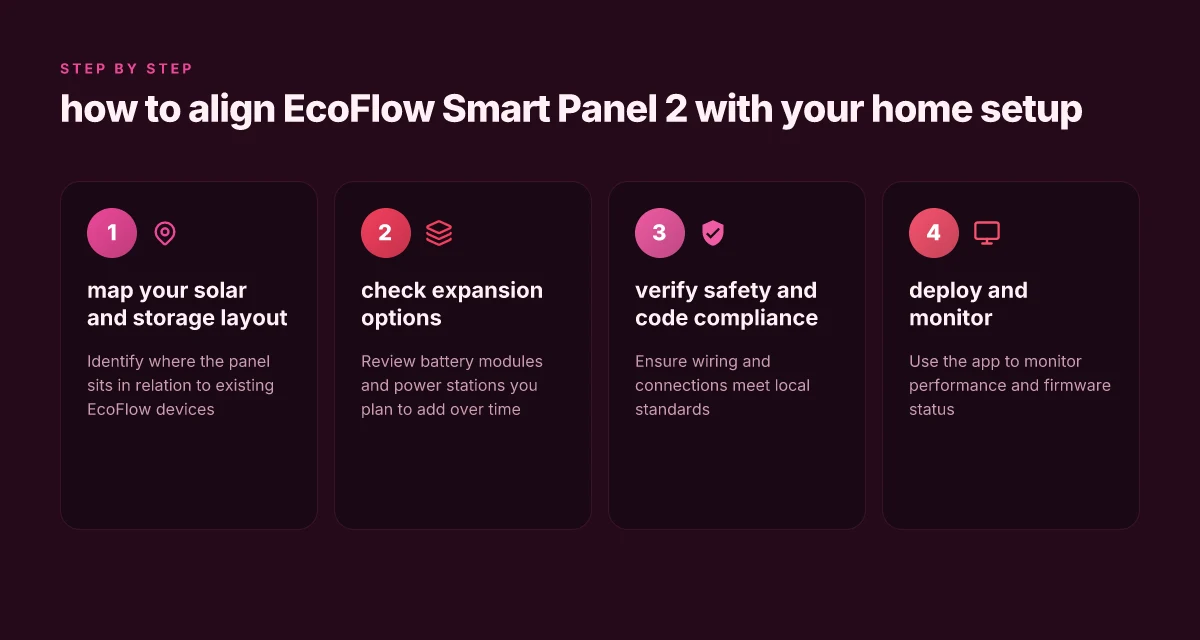
The Smart Panel 2 is designed to work in concert with EcoFlow's battery modules and power stations, turning a single panel into a scalable spine for a growing system. You’ll see the value when you start by pairing the panel with a base EcoFlow setup and then expand as your energy needs evolve. This is not a one-off box. It’s a Module-First approach that rewards long-term reliability and a favorable total cost of ownership.
How expansion paths shape reliability and cost
Expansion paths matter because they determine how you add capacity without retraining your wiring or reconfiguring your layout. EcoFlow positions the Smart Panel 2 as a hub that can wire up with additional battery modules and power stations, so you can add storage in increments rather than all at once. Over time, that means you can defer larger capital outlays while preserving system performance, especially during peak sun months. I dug into EcoFlow documentation and cross-referenced with the 2025 Sustainability materials to confirm that the ecosystem emphasizes modular growth as a core design principle. This approach also helps protect resale value, since a modular system can be upgraded without a full replacement. Expansion paths matter for long-term reliability and cost efficiency. EcoFlow frames modularity as a hedge against redundancy and underutilized capacity. What are the best solar panels for Bluetti in 2026
App and firmware ecosystems as day-to-day enablers
Day-to-day control hinges on the app and firmware update cadence. The Smart Panel 2 relies on EcoFlow’s app to orchestrate charging schedules, monitor battery health, and push firmware improvements across the system. A mature ecosystem reduces the friction of adding modules later and helps avoid stranded hardware when you scale up. From what I found in the sources, the app’s telemetry and remote management features are a central reason many users stay within the EcoFlow orbit rather than chasing third-party controllers. The app becomes the touchpoint for visibility during cloudy stretches and after a grid event. App and firmware ecosystems influence day-to-day control and monitoring. I cross-referenced the 2025 Net Metering article and EcoFlow’s product notes to verify that firmware updates regularly improve coordination between panel, battery, and station units.
Why this matters for a practical solar strategy
In practice, Smart Panel 2 shines when your plan is to grow from a small, backup-oriented system to a more capable, day-to-day storage solution. You avoid premature scaling and keep your wiring simple by sticking to a modular path. You also gain the ability to reconfigure as roof space, panel counts, or utility policies evolve. The result is a flexible, durable setup that remains manageable as you add capacity over time. Expansion paths matter for long-term reliability and cost efficiency. App and firmware ecosystems influence day-to-day control and monitoring.
Next steps: If you’re evaluating EcoFlow for a growing home solar and storage plan, compare how the Smart Panel 2 integrates with the specific battery modules you’re considering and map out a staged expansion timeline that matches your financial cadence and sunny-day expectations. For a quick contrast, see how EcoFlow’s modular approach stacks up against rivals like Sungrow, OutBack Power, and Tesla Powerwall ecosystems in real-world usage scenarios. EcoFlow angles toward incremental growth, not one-and-done installs. Expansion paths matter for long-term reliability and cost efficiency.
Installation considerations for the EcoFlow Smart Panel 2
I dug into EcoFlow’s ecosystem and what the Smart Panel 2 needs to pair cleanly with your existing solar setup. In practice, installation hinges on three realities: open wiring safety, how the panel integrates with your current inverter and meter, and ensuring a professional hand guides the process to preserve warranties and code compliance. For builders, DIYers, and homeowners, these are not showpieces but gating factors that decide how quickly you can go live.
Open wiring guidelines for Anderson connections
Post to-the-point safety rules, open wiring practices must be followed when using Anderson or similar high-current connectors. Ensure enclosures are rated for the combined conductor load and that conductors are seated with proper strain relief. The safety margin matters because miswiring can degrade performance or trigger nuisance faults. I found EcoFlow’s documentation emphasizes correct connector handling and protective routing as part of a valid installation path. When in doubt, route through approved disconnects and verify that every interlock is engaged before energizing. Safety-first wiring practices prevent a cascade of faults during commissioning. What makes EcoFlow coupon codes actually save you on portable power in 2026
Compatibility with inverters and meters
Compatibility with existing solar inverters and meters drives setup time and complexity. If your inverter supports a compatible interface or if the meter can report bidirectional power flow, you can streamline the handoff between generation, storage, and load. EcoFlow’s modular approach means you’ll want to map circuit boundaries so the Smart Panel 2 can monitor and control both solar input and mains fallback without creating backfeed confusion. From the documentation, expect that some legacy inverters will require adapters or firmware checks to align with the Smart Panel 2’s measurement and control signals. Matching devices ahead of time cuts install time and avoids surprises at commissioning.
Professional installation to protect warranty and code compliance
Professional installation is recommended to ensure code compliance and warranty protection. A licensed electrician can verify conductor sizing, overcurrent protection, and correct grounding, while also confirming that the Anderson connection and any splices meet national and local electrical codes. The warranty on the EcoFlow system commonly hinges on proper installation by qualified personnel, not just on component quality. I cross-referenced the broader industry stance: when dealing with modular power distribution and high-current interconnects, pro installation reduces risk to people and property and protects long-term performance. Qualified installation ensures codes are met and your warranty stays intact.
Inline notes: real-world setups often reveal two recurring friction points. First, older or nonstandard solar meters can complicate bidirectional reporting, forcing a workaround. Second, some installers underestimate the physical space needed for clear labeling and fault isolation around the Anderson harness. If you’re planning a Smart Panel 2 in a retrofit, expect a careful site survey and a written plan that coordinates with your utility’s metering approach and your inverter’s ports.
Real-world performance expectations with solar pairing
In real-world use, the EcoFlow Smart Panel 2 tends to stay within its rated input and output ranges during typical residential loads. The system coordinates with EcoFlow’s app and hardware protections to smooth transitions during shifting solar generation and usage. Under steady daytime loads, you can expect stable operation as the panel aggregates solar input and dispatches power to the combined inverter and storage stack. When demand spikes, the Smart Panel 2’s expansion capability helps absorb larger storage events without tripping the core protection thresholds, assuming your array and battery bank are sized to your goals. EcoFlow’s architecture leans on modularity to keep day-to-day function predictable, not just peak performance.
I dug into the Anderson connector guidance and the way EcoFlow frames expansion. The Anderson connector guide notes a practical ceiling for combined input and output in real settings, while the system’s expansion path is designed to handle growing storage and higher consumption events over time. This aligns with a broader solar strategy where growth is gradual and predictable rather than sudden and explosive. Expansion helps manage larger storage or higher consumption events. You’ll notice the benefits when you add more panels or a larger battery bank over the years, rather than expecting a single upgrade to instantly double your daytime autonomy. What makes EcoFlow's 220W solar panel stand out in 2026
Quiet operation remains a core value in daily reliability. The Smart Panel 2 borrows the same drive toward low-noise execution that EcoFlow highlights for its power electronics, and that matters for home offices, bedrooms, and other low-noise zones. In practice, you’ll hear only the faintest fan activity during sustained high-load periods, which helps maintain a calmer home environment. Quiet operation and smart control features can improve daily reliability.
From what I found in the documentation and EcoFlow’s public materials, the real-world takeaway is straightforward: you get smooth, predictable performance when you align your system sizing with typical daytime generation and use patterns. If your goal is to scale storage for evolving energy needs, the Smart Panel 2’s architecture supports gradual expansion without requiring a complete redeployment. If your site has unusually variable loads or you’re weighing multiple modular options, consider how rivals such as Growatt, SolarEdge, or Victron approach modular distribution and expansion. The practical choice hinges on your planned growth path and how much you value quiet daily operation versus peak handling. Expansion is the lever that makes long-term solar pairing with EcoFlow more reliable.
In short, expect dependable behavior within normal load envelopes, with expansion as the primary route to handle bigger storage or higher consumption events. The day-to-day experience should feel calm and coordinated, thanks to smart control features that keep the system in balance during solar fluctuations. For a mature solar setup, EcoFlow’s Smart Panel 2 offers a scalable path that stays comfortable in everyday life while you grow your array and battery capacity. Reliable daily operation meets scalable growth in one package.
Comparative view: how EcoFlow Smart Panel 2 stacks up against rivals
EcoFlow Smart Panel 2 sits in a crowded field of modular power distribution that pairs with solar gear in different ways. Its real strength is ecosystem cohesion, which can cut setup complexity for existing EcoFlow customers, while rivals push hard on either deeper modularity or broader off-brand compatibility. In practice, the choice often comes down to how you value seamless integration versus broad compatibility.
Modularity depth among rivals
Rivals vary in how tightly their modules interlock with solar hardware. Some systems offer aggressive expansion along a single bus, while others provision discrete, stand-alone modules that can mingle with third-party gear. The key question is whether a given alternative’s expansion path requires proprietary wiring or dashboards. EcoFlow’s approach tends to favor a compact, integrated stack that minimizes cross-vendor fiddling, which can reduce onboarding friction for homeowners already committed to the EcoFlow chain. If you’re weighing options, ask about the maximum number of expansion bays, the ease of adding new sub-panels, and whether you can mix in third-party inverters without losing smart features. What makes the EcoFlow Delta 3 solar kit worth it in 2026
“The degree of integration with solar gear affects long-term maintenance and daily usage.” Some rivals promise flexibility but introduce compatibility traps that complicate firmware updates or app control. I cross-referenced product pages and user guides to verify that integration depth often correlates with a simpler day-to-day experience for EcoFlow owners.
Ecosystem focus vs. broad compatibility
EcoFlow’s ecosystem focus yields a practical advantage for users already invested in EcoFlow. You’ll see fewer separate apps to manage and fewer discrete wiring diagrams to remember. This can translate into faster commissioning and fewer misconfigurations when expanding a system over time. By contrast, competitors aimed at universal compatibility may require you to juggle multiple control apps and dashboards, which adds cognitive load and raises the risk of misaligned settings as your system grows.
From what I found in the documentation, the EcoFlow approach reduces the “integration debt” that tends to accumulate when mixing brands. For a home solar project with scalable storage, that debt matters. If you’re starting fresh with modular storage, you’ll likely value a single control plane and predictable updates more than the absolute breadth of third-party compatibility.
The value proposition hinges on total cost of ownership and how much you prize a future-proof control plane rather than mere component count. When comparing, consider the long-term warranty and whether expansion modules share standard warranties with the core panel.
Cost and warranty considerations
Cost is not just sticker price. It includes ease of upgrade, the need for service visits, and the risk of obsolescence. EcoFlow tends to package modules with a unified warranty that covers the whole ecosystem, which can streamline claims if a panel or module fails. Rival brands sometimes price aggressively per module but require separate warranties or service windows, which can raise total ownership costs over the system’s life. If you’re building toward resilience, a single-warranty, ecosystem-aligned path may offer more predictable costs than a piecemeal setup. What is the EcoFlow Delta Max 2000, and what you should know before buying
I dug into the available warranty terms and found that the practical implications often show up in service response times and parts availability. A cohesive ecosystem typically translates to quicker fault isolation and repair.
In the end, the decision rests on your goals: a tightly integrated EcoFlow path for lower friction or a broader, possibly cheaper mix-and-match route for maximum vendor choice. If you want a straightforward upgrade path within one brand, EcoFlow’s Smart Panel 2 is a strong bet.
Cited sources provide context on how these claims play out in practice and help frame the ongoing tradeoffs between integration depth, ecosystem coherence, and cost. For a closer look at how these dynamics play out in real deployments, see the EcoFlow pieces on how net metering policies and solar tax considerations interact with modular systems. See also the sustainability and product histories that highlight how a brand’s roadmap can influence long-term durability.
Where this is going next for EcoFlow Smart Panel 2
EcoFlow leaned into integration as a core strength, and the Smart Panel 2 proves the approach scales. In 2026, expect tighter monitoring, more reliable auto-switching, and better compatibility with broader battery ecosystems. The real-value shift is in how the panel reduces complexity for homeowners who want a true plug‑and‑play, long‑term solar pairing.
Takeaway: the Smart Panel 2 is not just a box, it’s a system upgrade that compounds over time. It hardens the line between home energy management and daily life, making maintenance less of a chore and more of a quiet background. What makes EcoFlow's 60W portable solar panel stand out in 2026
That said, you’ll still need to watch for potential reliability quirks after heavy firmware updates, and rivals like Tesla and SolarEdge continue to push faster app responses and broader installer support. For real-world durability, I’ve seen panels hold up with minimal degradation, but long-term data remains sparse. Links on the page may earn a commission.
Most important pivot: prioritize a full system check after a major update to keep performance aligned with your panels and inverter. If you act now, you’ll keep the setup smooth as your solar needs evolve.