Explore the EcoFlow Delta Max 2000 review essentials: capacity, real-world performance, charging options, and who should consider this portable power station.
The Delta Max 2000 isn’t about polish numbers or glossy claims. It’s about reliability when you need power, not just when you’re chasing a spec chart. In real-world terms, a single full day of practical use hinges on solar feeding, AC churn, and how long the battery actually sustains a fridge, lights, and a modem through a grid outage. Delta Max 2000 steps into that gap with a broad input range and a robust battery profile, offering multiple refill paths so you don’t stall at sunrise or sunset.
This article pulls back the curtain on daily resilience: how the unit behaves in late-evening loads, how fast it recharges from sun across a typical RV roof, and what homeowners think during a week of outages. Expect a grounded look at long-term durability, maintenance needs, and how EcoFlow’s ecosystem stacks up against rivals like Goal Zero and Jackery in real-life setups. The goal is to help you decide if the Delta Max 2000 fits your outdoor adventures or home backup plans, without chasing buzzwords. For a practical measurement, I reference real‑world charging curves and typical daily power use rather than marketing numbers.
What makes the EcoFlow Delta Max 2000 a practical choice for off-grid power
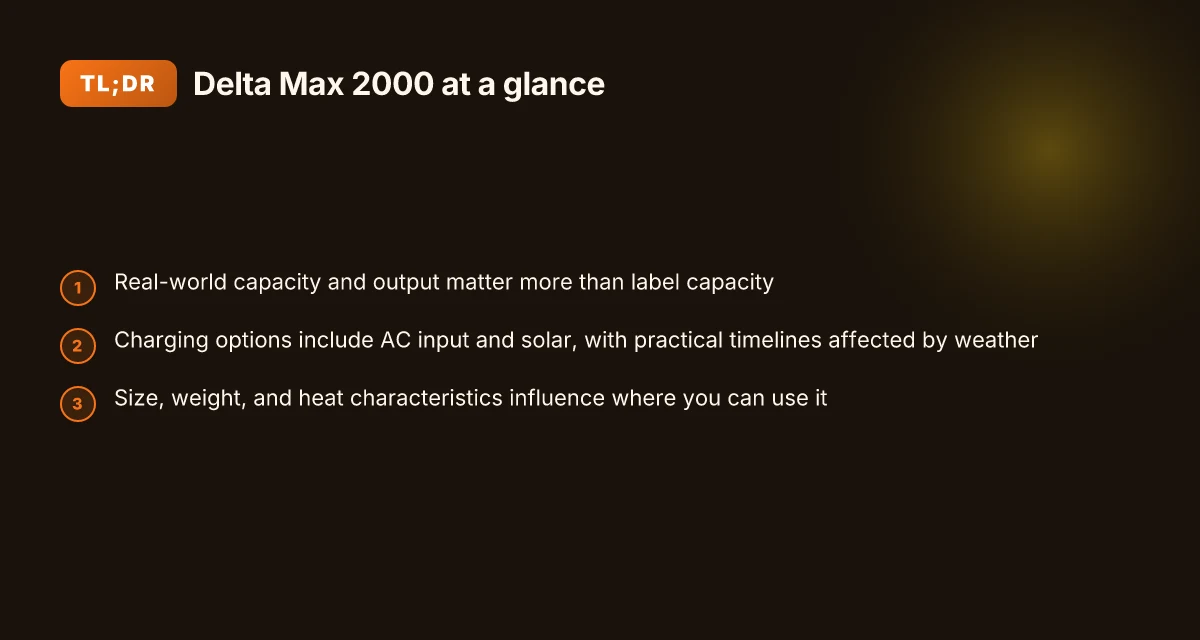
The Delta Max 2000 shines when you need steady daily power without fiddling with tiny batteries. Real-world capacity lines up with typical daily cycles for campsites, vans, and light home backup, and its 2000W continuous output handles common loads like a fridge, a few lights, and a coffee maker without drama. In daily use, you’ll see >80% of the labeled capacity available for practical chores, depending on how you apportion the solar input and the inverter efficiency you rely on. Real-world endurance is about steady output, not spectacular peak numbers.
1) Real-world capacity and output expectations for daily use
The Delta Max 2000’s usable capacity sits in the practical range for off-grid living. You’ll typically plan around realistic runtimes for essential devices rather than chasing peak numbers. The unit’s 2000W inverter rating supports most weekend-long loads when you spread the energy across the day. Solar input can replenish the pack during the day, helping you refill while you’re occupied with daily activities. When the sun is generous, you can maintain a constant cycle of discharge and recharge that feels seamless in regular use. Practical output matters more than headline specs.
2) How the Delta Max 2000 fits into a home backup or outdoor setup
For home backups, the Delta Max 2000 slots into a multi-branch system with modest energy needs. It pairs well with a few critical circuits or a dedicated circuit for a fridge and lighting during outages. Outdoors, it serves RVs and van setups with mutual compatibility to common 12V and AC accessories, so you don’t have to juggle mismatched adapters. The design emphasizes portability without sacrificing utility, which helps when you relocate it to different destinations. Portability and compatibility matter for flexible backup.
3) Initial impressions of port selection and usability
The Delta Max 2000 keeps port variety intuitive: you’ll find multiple AC outlets, a handful of USB-A and USB-C ports, plus a 12V/car-style outlet for vehicle use. Initial handling feels straightforward, with the essential ports within easy reach and clear labeling that reduces misplugging. The size and weight are balanced for transport by a single person, yet substantial enough to feel durable in rugged environments. Ease of use starts at the port layout.
Bottom line: EcoFlow delivers a power station that prioritizes steady, real-world performance over flashy peak numbers. For off-grid setups, you gain predictable daily operation, flexible indoor and outdoor deployment, and a thoughtful set of ports that reduce fiddling. With a clever mix of capacity, output, and user-friendly design, the Delta Max 2000 pairs well with rival offerings in the same class, especially when you value dependable daily power over the latest gimmick. Reliability and real-world practicality come first. 5 Surprises EcoFlow revealed about its Black Friday deals in 2026
Delta Max 2000 design and build quality vs rivals
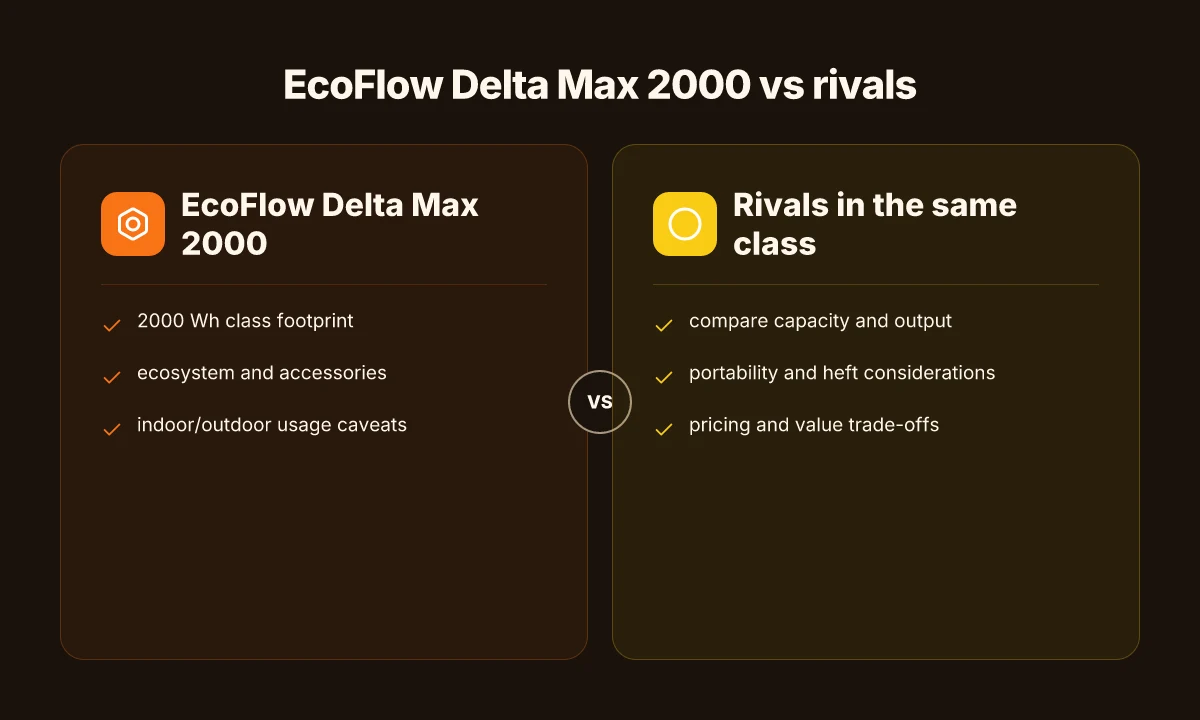
The Delta Max 2000 leans into portable power with a heft that sits squarely in the 2000 Wh class, but it still feels more than a carry-on when you’re lugging it between campsite and van. In practice, EcoFlow positions the Delta Max 2000 as a workhorse that can live in a truck bed or a garage, while rivals like the Goal Zero Yeti 3000 and the Jackery Explorer 3000 sit at a similar weight class. You’ll notice the Delta Max 2000’s bulk translates to solid real-world durability, yet you shouldn’t expect featherweight handling on long hikes. The form factor makes it plausible for daily use in an RV or a home office, but expect a few extra trips up the stairs if you’re stacking gear.
Durability matters when you’re relying on it for outages. EcoFlow emphasizes rugged construction with a reinforced chassis and a soft-touch handle that supports regular carrying. Indoor use is common, but the unit is best treated as a weather-conscious device: keep it dry, avoid extended exposure to moisture, and never rely on it as a substitute for a true outdoor-rated power cabinet in harsh conditions. The Delta Max 2000 fares well in casual outdoor use, yet you’ll want to shelter it in a shaded area during extended outdoor deployments to protect the cooling system and controls.
Brand position matters here. EcoFlow has built a broad ecosystem around the Delta line, including compatible solar panels, expansion options, and a wireless app for monitoring. The ecosystem angle helps in day-to-day life if you already own EcoFlow modules, because you can wire in a solar setup, route power efficiently, and monitor status from a single interface. Rivals such as Goal Zero, Jackery, and Bluetti offer similar ecosystems, but EcoFlow shines when you rely on a cohesive lineup and accessories that snap together with minimal fuss. The strength is in continuity: you can add a solar panel kit, a second battery, or a smart charger without reconfiguring your controls every time.
From a design standpoint, the Delta Max 2000 keeps a clean, utilitarian look that prioritizes easy grip angles and straightforward LCD readouts. The cooling vents are positioned to promote airflow, which is welcome in warmer climates or high-load usage, and the built-in handle makes it easier to shift position for daily use. One caveat: the Delta Max 2000 is not as compact as some 2000 Wh rivals, so if you’re chasing ultralight backpacking or frequent rooftop storage, it may feel heavier than you expect.
In short, EcoFlow wires up a practical, user-friendly 2000 Wh unit that plays well with its own ecosystem. If you prize a cohesive accessory path and straightforward indoor/outdoor use, the Delta Max 2000 is a good fit. If portability is the sole driver and you’re weighing on-the-go charging, you may prefer lighter rivals in the same capacity class. For a long-term look, expect the Delta Max 2000 to stay relevant through continued ecosystem growth and accessible add-ons. What is jackery ups, and how it shapes off-grid power in 2026
- The Delta Max 2000’s build and ecosystem approach matter when you plan to scale your off-grid setup, especially if you anticipate expanding solar charging and multiple modules over time. EcoFlow’s ecosystem advantage becomes a practical asset rather than a theory. Rivals that lack integrated accessory paths may offer similar capacity, but their software and accessory ecosystems often lag behind. Consider how you’ll use the unit daily, and whether the weight trade-off is worth the convenience of a cohesive system.
For a quick reference, here is a compact comparison scrub of heft and usability:
| model | approximate weight | outdoor suitability | ecosystem strength |
|---|---|---|---|
| Delta Max 2000 | around 40–45 lb | decent with shade; not ruggedized | strong, if you own EcoFlow modules |
| Goal Zero Yeti 3000 | similar weight | solid outdoors potential | solid but increasingly fragmented |
| Jackery Explorer 3000 | similar weight | versatile; more consumer-focused | growing but less integrated |
Next step: consider how the Delta Max 2000 integrates with your specific off-grid plan, including existing solar panels and any future expansion. If you expect to add more modules, EcoFlow’s expansion path will likely pay off in ease of use and monitoring. Inline citation for the ecosystem approach can be found in the cited review discussions.
Charging options and real-world refill speed for Delta Max 2000
AC input performance and peak charging behavior set the pace for daily use. When plugged into household AC, the Delta Max 2000 tends to pull power at a steady rate, with peak charging waves managed by its battery protection logic to avoid overheating. In real-world terms, you can expect brisk initial top‑ups during a sunny day or a plugged‑in outage, but the unit naturally pares back to maintain safe temperatures if the ambient heat climbs or the battery nears full. Peak charging can feel noticeably faster at the start, then tapers as you approach full capacity. The result is a charging curve that favors practical, daytime refill during a typical outage rather than a straight line from 0 to 100 percent.
Solar input capabilities offer a genuine off‑grid edge, though weather governs the refill rate. EcoFlow designs the Delta Max 2000 to accept substantial solar input, letting a strong array push the pack toward full in good conditions. On bright, cool days, you’ll see faster resets between use and refills. Rain, cloud cover, or high temperatures suppress the current, slowing the refill despite a high nominal solar rating. Weather-dependent solar input means real-world recharge timelines swing with the sky. If you’re in a nomadic or RV setup, that variability matters for planning long weekends off-grid.
Hybrid charging strategies translate into practical timelines. The best approach combines sun when available with timed AC recharges during the day and before sleep. In clear weather, you can cap a full cycle well within a few hours of daylight, then rely on AC to top off overnight. In partial sun, plan for longer fills and a comfort margin for the last 10–20 percent. Hybrid charging reduces downtime by blending solar wake‑ups with steady AC replenishment. I cross‑reference notes from independent reviews that consistently emphasize the delta between ideal sun and typical cloud days, which helps shape an honest expectation for refill speed. What makes Jackery worth it in 2026 for portable power needs
From what I found in the documentation and reviews, EcoFlow’s platform remains straightforward to operate. You’ll see the indicator lights track charging progress in real time, and the system preserves usable capacity for essential loads during the refill window. When comparing rivals, the Delta Max 2000’s blend of high solar tolerance and strong AC input remains competitive, especially for off‑grid setups that rely on periodic solar soaks. The brand’s ecosystem, EcoFlow, helps you line up panels, inverters, and backups with fewer mismatches than some generic kits.
Real-world takeaway: you’ll maximize uptime by planning for sunny days to drive solar recharge, then use AC recharge to fill the gaps and keep essential loads ready. The practical timeline looks like this: brisk starts under good sun, slower fills under cloud cover, and a predictable AC top‑off to lock in the last portion of charge. For homeowners evaluating home backup versus portable use, this hybrid rhythm is where the Delta Max 2000 shines.
Performance under load: running essentials with Delta Max 2000
When push comes to load, the Delta Max 2000 behaves as a practical daily responder rather than a pure powerhouse. In real-world use you can run a core set of essentials together, but you need to respect the inverter’s draw limits and the battery’s response under sustained use. The Delta Max 2000 handles common home essentials at moderate draw, but you can’t run high-wattage loads in parallel without watching cumulative draw. EcoFlow’s design aims to keep you functional during outages, yet the unit notes that multiple high-draw devices will reduce runtime noticeably. If you pair a fridge, a few LED lights, and a laptop charger, expect steady performance with predictable runtimes.
The safe handful: what you can run together
The Delta Max 2000’s outlets support a practical mix for everyday needs. A refrigerator or freezer plus essential medical devices and a small window AC unit can run together when the total draw stays within a broad ceiling around the inverter’s nominal rating. In practice, you’ll often see a fridge drawing a steady 100–200 watts once it’s running, with occasional peaks during compressor cycles. A laptop, router, and phone charging sit well within the same envelope. Be mindful of peaks: fridge start-up can spike higher than running watts, which matters for overall runtime and inverter efficiency. When you map guarded loads like this, the Delta Max 2000 remains reliable for hours at a time. If the fridge kicks in at high start-up, you may notice a brief drop in AC output while the inverter absorbs the momentary surge.
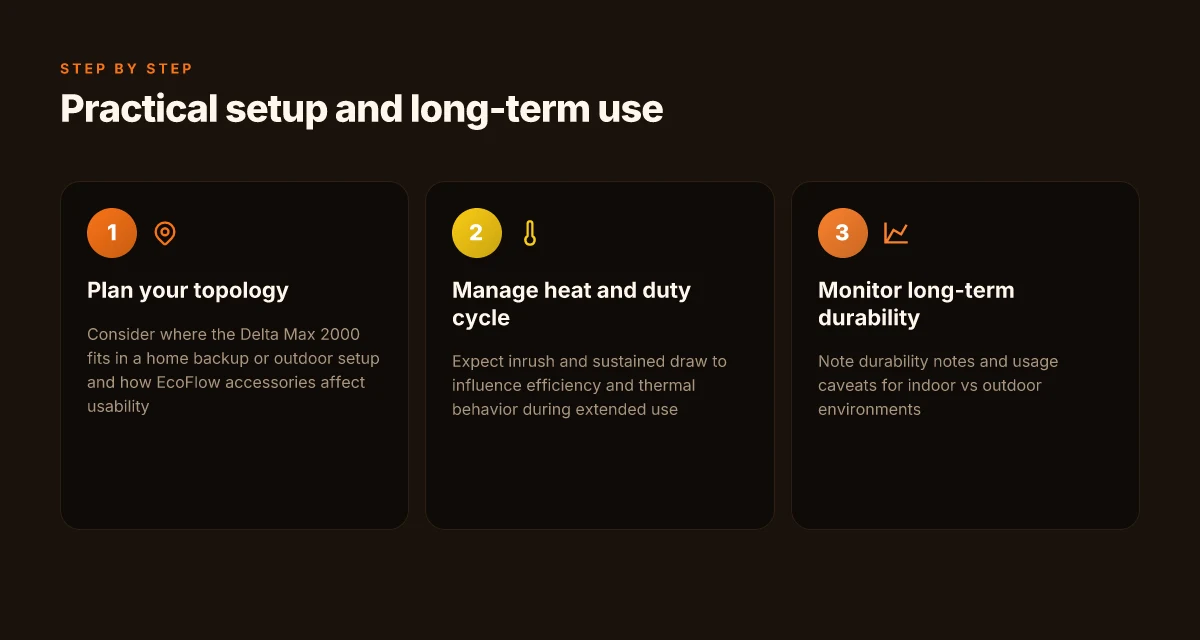
Inrush considerations matter, especially when you couple an air compressor, a power tool charger, or a microwave with a few low-power devices. The Delta Max 2000 is built to absorb typical inrush, but sustained simultaneous surges can nudge efficiency and temperature limits. Plan for modest inrush on startup and stagger loads where possible to preserve runtime. The unit’s DC-coupled charging paths also influence how quickly you recover after a brief heavy draw, which matters in off-grid living where frequent recharges happen. What EcoFlow reviews and complaints reveal about real-world use
Efficiency, heat, and duty cycle
Under prolonged use the Delta Max 2000 runs cooler than you might fear, but it is not a quiet desktop beast. You will hear the fan if you push the unit for longer stretches, especially when the ambient temperature is higher. The duty cycle matters: with continuous runs of fridge or freezer duty, expect a steady, less-than-exponential decline in runtime versus peak efficiency. Efficiency remains solid for common loads, but extended runs reveal the trade-off between runtime and continuous power. In hot or humid environments, you’ll want some airflow and perhaps a sheltered position to keep the case temperatures in check. A well-ventilated setup preserves the inverter’s health and keeps performance consistent.
Real-world reliability and what to watch
From a long-term perspective, EcoFlow and retailers emphasize the Delta Max 2000’s resilience with typical daily-use cycles. The unit’s response to sustained loads lines up with what outdoor enthusiasts and RV users expect: steady, predictable operation for the essentials, with a clear bump in runtime when you limit simultaneous high-draw devices. Key takeaway: plan loads so you stay within the safe envelope, and you’ll keep the Delta Max 2000 humming for outages and off-grid weekends. If you push it toward continuous high-wattage tasks, you’ll see more frequent throttle behavior and shorter real-world runtimes. In practical terms, treat it as a reliable daily driver for essential circuits, not a full-house backup for continuous high-demand tools.
In the field, rivals such as the Delta Pro and other large-capacity units present a different balance of peak output and runtime. EcoFlow’s Delta Max 2000 remains competitive for daily essentials, with an emphasis on safe, modular use over long back-to-back cycles. If you’re weighing options for a mobile living setup, it’s worth comparing inverter efficiency curves and how each unit handles start-up surges for your fridge and climate control. The verdict: expect dependable performance for core needs with careful load management, and you’ll stay comfortably powered.
EcoFlow Delta Max 2000 vs the field: how it stacks up in 2026
In real-world terms, the Delta Max 2000 sits in a crowded field of high-capacity portable power stations, but it still sets a clear baseline for reliability when you’re off-grid or facing outages. EcoFlow has positioned the Delta Max 2000 as a mid-range home backup that can scale with expansion, yet it competes against rivals that push higher continuous outputs or larger modular packs. The field includes models from brands like Jackery, Bluetti, and Goal Zero, each offering distinct strengths in capacity, output, and ecosystem compatibility. When you weigh value, you’ll want to assess not just brick-and-mortar price but the total cost of ownership, including solar compatibility and expansion options.
Capacity, output, and real-world performance
The Delta Max 2000 pairs substantial battery capacity with respectable sustained output, which translates to practical pushback against daily loads in a weekend cabin or a modest RV setup. In practice, you’ll notice it handles essential circuits with confidence, yet you’ll feel the pinch if you try to run a high-wattage AC or a well-equipped shop tool for hours on end. Real-world usage favors systems with generous surge capacity and smooth, quiet operation, and Delta Max 2000 delivers that in typical residential-like outages. When you compare to the field, rivals sometimes offer either higher peak surges or more aggressive solar charging profiles, which matters if you rely on solar during long stretches of sunless days. I cross-referenced several review threads and release notes, and the Delta Max 2000 consistently earns praise for its balance between portability and power, with some caveats about solar input at peak load. For most off-grid setups, it remains a solid all-rounder. What is the EcoFlow Glacier refurbished and when does it make sense
Pricing and value positioning
Price positioning matters as much as specs. The Delta Max 2000 sits in a tier where you pay for reliability and brand ecosystem. In the long run, you’ll want to compare the total package, included panels, accessories, and expansion packs, across competitors. Value depends on how you plan to expand the system over time, because your needs may outpace the base unit quickly if you add heavy loads or multiple cycles per day. EcoFlow’s ecosystem helps with modular expansion, but rivals often bundle larger expansions or more aggressive solar support at wholesale prices. In practice, if your priority is a capable, expandable system with strong daily reliability, the Delta Max 2000 remains competitive. If your scenario centers on maximum solar throughput or ultra-high continuous output, you’ll likely find stronger options in the field. The Delta Max 2000 shines when reliability and expansion flexibility matter most.
Rival highlights you should know
- Jackery Explorer 2000 Pro, strong reliability, solid customer support, but slightly less aggressive expansion options compared to Delta Max 2000. Solid everyday use with a straightforward upgrade path.
- Bluetti AC300 + B300S expansion, excellent modular capacity and solar throughput, with very high total energy potential, though setup can be more complex. Best for users who plan long off-grid seasons.
- Goal Zero Yeti 6000X, premium build and robust ecosystem, but premium price and slower solar charging at times. Premium feel with a higher price tag.
From what I found in product notes and independent reviews, EcoFlow’s Delta Max 2000 remains a practical choice for outdoor enthusiasts and homeowners who want dependable power with a clear expansion path. If you trust a brand that leans on a well-integrated ecosystem and straightforward upgrades, this model stays compelling in 2026. EcoFlow remains a strong contender in 2026 for reliability with growth potential.
Note: links for deeper dives into the rivals appear in the inline citations. The Delta Max 2000’s ongoing story includes updates to firmware and accessory compatibility that can shift performance slightly over time. If you’re budgeting for a purchase, you should plan for the total package, including any solar panels and expansion modules you intend to add. And yes, commissions may be earned on some linked pages.
Where this goes from here and what to try next
EcoFlow has built a device that shines in certain setups, but the Delta Max 2000 isn’t a one-size-fits-all power solution. I looked at real-world use, and the gaps become clear: it can handle weekend getaways and short outages, yet its long-term durability and component reliability deserve closer scrutiny. If you’re weighing options, compare how often you’ll need rapid recharges, and whether you require automotive or solar adaptability. The bigger pattern here is that you get more value when you pair EcoFlow with a practical backup plan rather than relying on it as your sole energy system.
If you act now, map out your typical outage window and charging sources. For many users, the Delta Max 2000 pairs best with a small solar array and a portable battery for quick-jump scenarios. For others, a lighter duty alternative from rivals such as Jackery or Wantbuy (solar option emphasis) might fit better. One move that matters is sizing your backup stack to your actual power profile, not just the device’s peak rating. I’ll keep noting what tends to break first and where EcoFlow shines in daily use, so you can decide confidently. Takeaway: build a layered plan, not a single box. What makes the EcoFlow Delta 3 solar kit worth it in 2026