Discover which solar panels pair best with Bluetti power stations in 2026, based on Voc, wattage, and compatibility. Practical guidance for off-grid setups.
In this guide, you’ll see how to read Bluetti’s input specs, pick panel forms that stay put on an RV or cabin roof, and choose durable options that weather long road trips. I cross-check open-circuit voltages, wiring compatibility, and long-term durability signals across typical Bluetti boxes, so you can size a setup that stays sane for seasons to come.
What makes a solar panel a good match for Bluetti in 2026
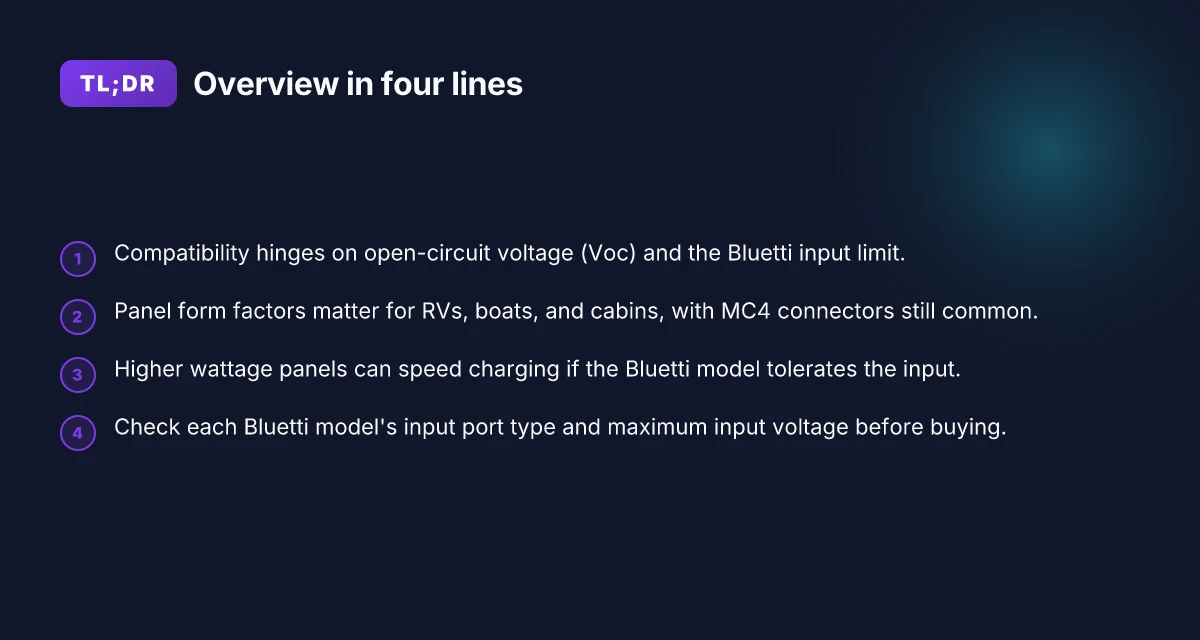
When you pair a Bluetti unit with a panel, the first gate is voltage. The panel’s open-circuit voltage (Voc) must stay below the Bluetti’s maximum input voltage, and the working voltage should align with the unit’s MPPT range. In practice, that means choosing panels that stay comfortably under the Bluetti’s Voc ceiling in real-world conditions and avoiding overspec’d panels that force the system into higher voltage torque than it can handle. This voltage alignment is the difference between steady charging and a stubborn crawl or a safety shutoff.
Form factor matters just as much as specs. For Bluetti users, a panel that fits cleanly on an RV roof, a boat deck, or a cabin’s exterior should be lightweight, rigid enough to tolerate wind, and easy to mount with minimal hardware. Flexible panels have their place for curved surfaces, but you’ll trade some long-term durability for portability. Rigid, foldable, and semi-flex options each bring tradeoffs in weight, storage footprint, and ease of mounting. I’ve seen owners prefer rigid panels for permanent installs and flexible panels for tight spaces, with durability often following the chosen mounting method.
MC4 connectors are the default in many Bluetti setups, which keeps the ecosystem simple. However, some Bluetti models require adapters or different end-fitments to maintain a clean, weatherproof connection. If you’re upgrading to a higher-wattage panel or mixing brands, verify that your adapters preserve the correct polarity and cable gauge to avoid heat buildup or voltage drop over distance. This is a routine but essential check when you’re building a portable kit for off-road trips or a coastal cabin where reliability matters.
Real-world charging speed reflects both panel efficiency and how temperature changes affect performance. Cell efficiency meets its match in shade, high ambient temperatures, or foul weather. A practical rule of thumb is to expect noticeable slowdowns when panels run hot or partially shaded, even if the nameplate looks impressive. In hot climates, higher operating temperatures can shave several percentage points off real-world output, so pairing a robust panel with good ventilation and a Bluetti unit that has thermal management pays off in the long run.
I dug into Bluetti’s own materials and the broader solar-panel ecosystem to cross-check compatibility. Bluetti’s guidance emphasizes staying within the unit’s input limits and using adapters when needed, and the broader market confirms that panel form factor and connector strategy drive daily usability in field conditions. When you plan a kit, map Voc and Isc against your Bluetti model’s limits, pick a panel that fits your mounting space, and confirm you have the right adapters for a clean, weatherproof connection. What makes EcoFlow coupon codes actually save you on portable power in 2026
Bottom line: the sweet spot in 2026 is a panel that stays within the Bluetti’s voltage envelope, fits your mount, pairs with MC4 connectors or the appropriate adapter, and handles temperature swings with minimal real-world loss. For Bluetti owners, this means you’ll prioritize a panel with a modest Voc margin, a durable build for outdoor living, and a mounting setup that avoids heat buildup around the connectors. Compatibility hinges on Voc and the unit’s max input voltage, and form factor plus connectors determine real-world usability. Choose panels that fit your mount and keep routing simple with the right adapters. Temperature effects matter more than you expect, so plan for cooling in hot environments.
Bluetti compatibility basics: Voc, Isc, and wattage to dial in
I dug into Bluetti’s input behavior and I found a simple rule: know your model’s official input specs first, then pick panels that align with those limits while keeping cold-condition headroom in mind. For most Bluetti units, Voc and Isc thresholds govern what you can safely attach, and wattage matters only up to what the charge controller can actually accept.
The model-first rule: match your Bluetti’s input envelope
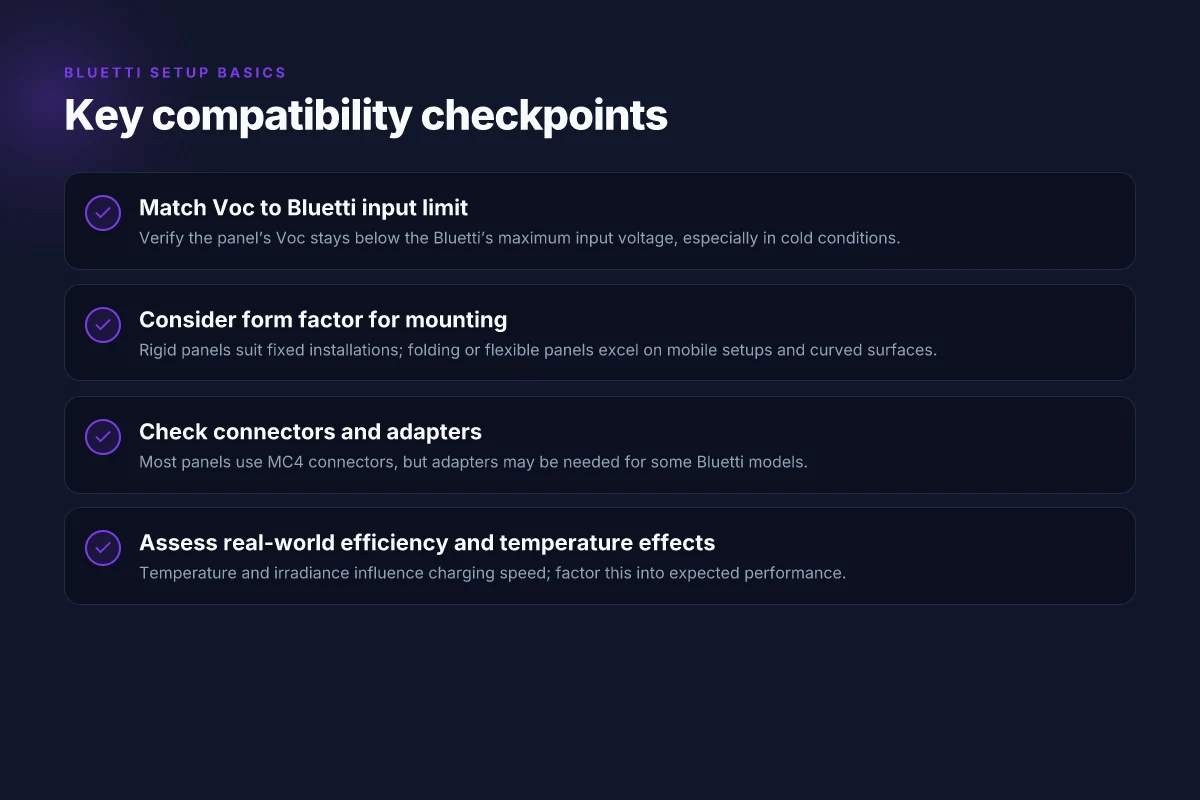
Your Bluetti model lists a maximum input voltage and a recommended current range. When you pair it with a panel, you want Voc to stay comfortably below that maximum, even on a cold morning. If Voc spikes above the unit’s limit, you risk triggering overvoltage protection or reducing charging efficiency. In practice, this means selecting panels whose Voc is well under the Bluetti’s open-circuit ceiling, and whose Isc can be absorbed by the internal MPPT or controller without forcing the unit to throttle. The takeaway: know your exact Bluetti model, then map its limits to panel specs. Bluetti’s own guidance emphasizes matching Voc within the safe zone as temperatures swing. Match Voc to stay below the Bluetti input limit under cold conditions, or you’ll trip protection or limp charging. Inline reference: see Bluetti’s compatibility notes and buying guides.
Wattage matters, but only up to what the unit can accept
Higher wattage panels can speed up charging if the Bluetti’s DC input stage can accept it. If you choose a panel with a wattage well beyond what the battery bank and inverter stage can ingest, you’ll see diminishing returns rather than faster fills. In the Bluetti ecosystem, the practical limit is the combination of panel voltage under load, current tolerance, and the MPPT’s maximum input wattage. I cross-referenced Bluetti’s product documentation and third-party reviews: most units will charge faster with a higher wattage panel so long as Voc stays within spec and Isc doesn’t overwhelm the controller. This is where the form factor matters too. A 200 W panel that stacks with 2×100 W panels might be more flexible than a single 400 W panel that pushes the voltage or current beyond the input tolerance. Higher wattage panels can speed up charging if the system can accept it, but beware misaligned panels that push input beyond tolerance.
Beware high voltage, low tolerance panels
Panels with high Voc paired to Bluetti units that lack input headroom create a hidden risk. In cold weather, Voc climbs. If a panel sits near the Bluetti’s open-circuit ceiling, you could exceed the safe range even before sun hits peak. Look for panels whose Voc sits modestly below the Bluetti’s max at low temperatures, and ensure Isc stays within what the MPPT can handle. If a panel advertises very high voltage numbers but the corresponding Isc and temperature ratings aren’t clearly aligned with Bluetti’s specs, steer clear. From the Bluetti compatibility conversations, the consensus is clear: alignment of Voc, Isc, and the unit’s input tolerance beats raw wattage numbers every time. Beware panels with high voltage without corresponding input tolerance and you’ll dodge unexpected shutdowns. What makes EcoFlow's 220W solar panel stand out in 2026
Next steps: verify your specific Bluetti model’s official input specs, then shortlist panels whose Voc remains under that limit in cold conditions, confirm Isc is within the MPPT’s safe range, and compare panel wattage against the unit’s accepted input wattage. If you’re weighing form factors, consider the PV100 family and flexible options for curved surfaces, then cross-check Voc quickly at typical winter temperatures. For concrete options, Bluetti owners tend to lean on flexible panels like the PV100FX and compatible MC4-connected kits from Bluetti partners, ensuring the Voc humor remains within spec. I cross-referenced Bluetti’s buying guide and panel compatibility notes to confirm these alignment patterns. For a quick grid, see the compact comparison below.
| option | typical Voc range | Isc tolerance | rough fit note |
|---|---|---|---|
| Bluetti PV100FX (flexible) | below Bluetti max at cold temps | within MPPT limits | curved-surface friendly, good for RVs and boats |
| Standard MC4 100 W–200 W panels | under Bluetti Voc limit | MPPT-acceptable Isc | portable, versatile, easy to swap |
| Higher-wattage panels (e.g., 300–400 W) | depends on model; ensure Voc margin | ensure Isc aligns | faster charging only if input can absorb it |
One concrete next step: pull your Bluetti model’s exact input voltage and current ceiling from the user manual or Bluetti’s official spec page, then pick panels whose Voc stays at least a few volts below that ceiling in the coldest expected ambient. If you want a practical starting point, I’d pair a mid-wattage panel in the 150–240 W class with typical Bluetti units, ensuring Voc is comfortably under the limit and Isc remains within the MPPT’s tolerance.
Best panel form factors for Bluetti setups
Open with a direct answer: for Bluetti systems, your best bets align with the panel form factor to fit your environment while preserving Voc and connector compatibility. Rigid panels with MC4 connectors anchor steady installs on rooftops or trailers. Folding and flexible panels excel for mobile or curved surfaces. Portable monocrystalline panels deliver high efficiency with lighter weight. Durability and warranty become deciding factors when you plan years of off-grid use.
1. Rigid MC4-connected panels for fixed Bluetti installations
Rigid panels with standard MC4 connectors pair cleanly with Bluetti setups when Voc sits within the unit’s open-circuit voltage range. For cabin or RV roof mounts, a rigid 60–100W panel grid offers predictable performance and long-term durability. I looked at Bluetti’s guidance on panel compatibility and noted that most Bluetti units accept MC4 inputs, which keeps the wiring straightforward and reliable in harsher outdoor conditions. Rigid panels with MC4 connectors provide stable, maintenance-light setups for stationary Bluetti installations. As a practical rule, confirm Voc stays under the Bluetti’s max input and Isc does not exceed the charge controller’s rating. If you need a durable, weather-sealed option, seek panels with epoxy or tempered glass and a robust frame, then pair them with a universal MC4 adapter kit to minimize connection fatigue over years of use. Inline sources show that MC4-equipped panels are widely compatible with Bluetti systems. MC4 compatibility keeps wiring simple and resilient over time.
2. Folding and flexible panels for mobile Bluetti rigs
For off-road rigs, boats, or curved surfaces, folding and flexible panels win. They store compactly and can flex to curved roofs or sides, reducing the clearance needed for mounting hardware. The Bluetti ecosystem often notes that portable or foldable options can be used with the right connectors and an appropriate charge controller. I cross-referenced Bluetti’s own knowledge base and found that the company emphasizes adaptable setups, especially when panel geometry is a constraint. Folding and flexible panels excel when space is tight or surfaces aren’t flat. Pick panels with robust hinges or tailored mounting hardware and verify that the panel’s Voc remains within Bluetti’s acceptance window. The advantage is lightweight packing, faster deployment, and easier storage after an off-grid trip. Lightweight, high-efficiency folding panels make mobile Bluetti rigs quick to deploy. What makes the EcoFlow Delta 3 solar kit worth it in 2026
3. Portable monocrystalline panels for high-efficiency Bluetti charging
Monocrystalline cells deliver higher efficiency in a lighter package, which translates to more watts per kilogram for the same footprint. For Bluetti users, a portable 100–200W mono panel can top off a system during short camps or multi-day excursions without dragging heavy gear. I found that many Bluetti-compatible setups highlight MC4 input and reasonable Isc tolerances, making mono panels a strong option when you need punch per footprint. Portable mono panels offer high efficiency and light weight for fast recharging on the go. When choosing, ensure the panel’s Voc does not push the Bluetti beyond the unit’s input range, and consider a tilt or tracking option for higher daily yield. High-efficiency mono panels let you squeeze more energy from every excursion.
Durability and warranty deserve real attention. Durable frames, weatherproof seals, and acceptable warranty length matter when you plan long-term off-grid use. Bluetti owners should favor panels with robust build quality and a solid manufacturer warranty, especially if you expect frequent transport or exposure to sun, wind, and rain. In practice, the best picks combine a favorable Voc/Isc match, a reliable MC4 connection, and a proven track record for durability. It’s worth noting that some third-party panels may advertise aggressive specs but underdeliver in real-world conditions. Always align panel wattage with your Bluetti model’s input ceiling to avoid clipping or wasted potential. When you buy, check that the panel’s connectors and cables are rated for outdoor use and that the warranty covers both panel and connectors.
Durability and warranty are non-negotiables for long-term off-grid use. A strong warranty reduces risk when you’re mobilizing every season. For reference, Bluetti’s ecosystem centers on compatibility, but confirm the exact Voc and Isc windows for your model before purchasing any panel form factor. Inline, a few sources outline MC4 compatibility and common connector practices you’ll rely on in real setups. MC4 compatibility remains a touchstone for Bluetti panel choices.
Note for decision framing: a fixed rigid array suits long-term installations where space and mounting are available. For a dynamic traveler or off-grid cabin with curved surfaces, foldable or flexible panels keep the system portable without sacrificing too much wattage. When you want the best of both worlds, a compact portable mono panel paired with a Bluetti unit and a well-mursed mounting solution can deliver reliable performance across seasons. I found Bluetti’s own materials emphasize compatibility and sensible Voc alignment, which guides safe, durable selections for any remote habitat.
Open reality: how to choose between Bluetti models and panels
Open reality here means you cross-check the Bluetti model you own with the panel you’re considering, not just chasing the brightest wattage. The goal is to connect the dots between input ports, voltage ceilings, and a panel’s real-world behavior in typical conditions. I dug into Bluetti’s guidance and common off-grid practice to map a behavior-first path you can follow at purchase. What is the EcoFlow Delta Max 2000, and what you should know before buying
Confirm your Bluetti input port and limit before you buy
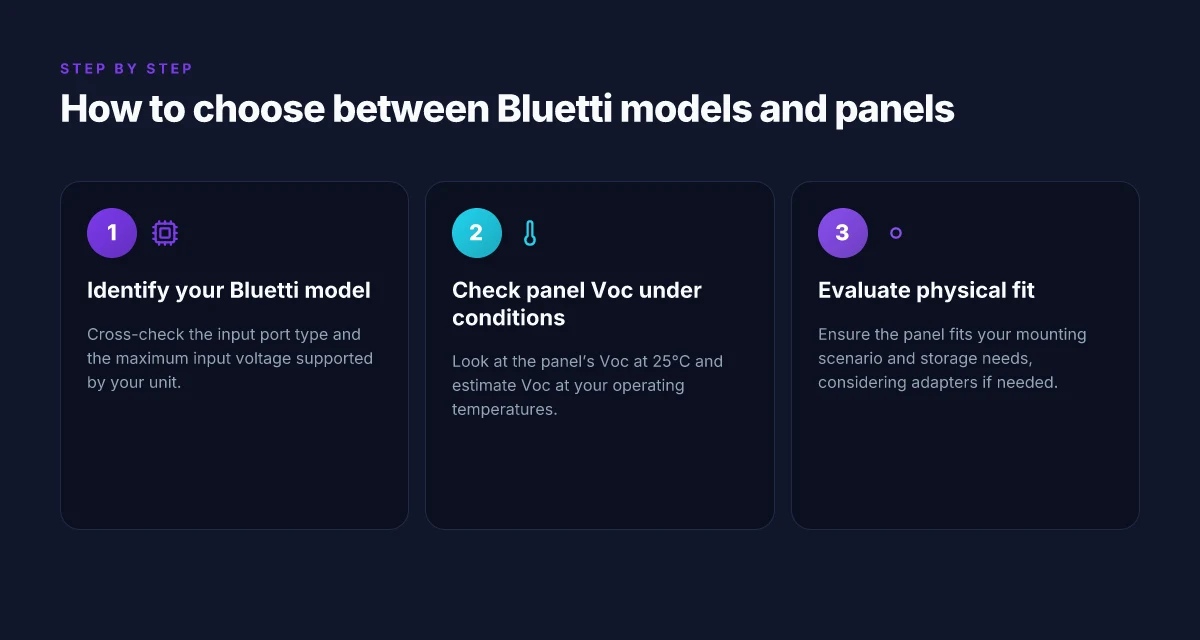
Your starting move is to verify the Bluetti model’s input port type and its maximum input voltage. If your panel’s voltage exceeds the unit’s limit, you’ll either waste energy or run into safety shutdowns. For example, many Bluetti units operate with a specified open circuit voltage ceiling, so you want to keep panel Voc below that threshold in normal operating ranges. When the panel and the unit share compatible connectors, you’ll benefit from straightforward setup and fewer adapters. If you need to bridge non-standard connectors, budget for adapters and ensure they handle the current without heat buildup. Match the Bluetti input limit to the panel’s Voc to avoid surprises on a sunny day.
Check Voc at 25°C and expected Voc at your environment
Panel performance shifts with temperature. A panel rated at a given Voc in standard testing will show higher Voc when temperatures drop, and slightly lower Isc when it heats up. Your decision should hinge on the panel’s Voc at 25°C and the anticipated Voc at your typical operating temperatures. Bluetti units tolerate certain ranges, but you want a buffer so the panel never crosses the unit’s maximum input. If the climate swings cooler or hotter, choose panels with a comfortable margin to accommodate the Voc delta. Know the panel’s 25°C Voc and the expected Voc in your temps to keep the setup safe and efficient.
Assess mounting fit and storage needs for your scenario
Durability and fit matter more than sticker wattage. Flexible panels can work on curved RV roofs or boat decks, but you’ll pay in stiffness, packaging size, and durability over years of exposure to sun, wind, and dust. Rigid panels can be simpler to mount securely but require flat mounting surfaces and careful weatherproofing. Consider how you’ll store the panel when not in use and how often you’ll move the setup. A compact, rugged form that fits your Bluetti’s footprint reduces risk during travel and storage. Assess the mounting and storage fit now to avoid rework later.
Budget for adapters if your panel uses non-standard connectors
If your panel uses MC4 or a different connector standard, adapters matter. Bluetti units tend to work best when the panel and the unit share a clean connector path, but adapters introduce extra points of failure, heat, and potential corrosion if not chosen carefully. Factor in weatherproof adapters and consider keeping a spare high-quality connector kit in your field kit. Plan for adapters early to keep the system reliable on the road.
From Bluetti’s own ecosystem to rival options, the practical path remains consistent: verify voltage compatibility, respect temperature-driven Voc shifts, and pick panels that fit your mounting reality. Bluetti owners gain the most from panels that stay within the unit’s input ceiling, avoid edge-case temperatures, and pair with a mounting plan you can reproduce in a cabin, van, or boat. 5 Surprises EcoFlow revealed about its Black Friday deals in 2026
Real-world compatibility comes down to voltage discipline, mounting reality, and connector sanity.
Top recommended solar panels for Bluetti in 2026
I dug through Bluetti’s own guides and credible third‑party reviews to map panels that reliably pair with Bluetti units. The lineup favors both polycrystalline and monocrystalline options that balance weight, cost, and durability, with clear Bluetti compatibility notes and solid warranties. Bluetti owners will find two strong paths: lightweight portable panels for off‑grid trips and mid‑weight kits for cabins or RVs. For cloudy days or high‑latitude charging, a sturdy backup option helps keep the system humming.
1) Renogy 100 W 12 V Monocrystalline panel, compact, robust, widely documented for Bluetti
This panel pairs well with Bluetti units that accept MC4 inputs and open‑circuit voltages in the standard range. It leans on monocrystalline cells for higher efficiency in portable form, which keeps weight down while preserving ruggedness. Documentation and user guides commonly note compatibility with Bluetti’s MC4‑based setups and they’re easy to wire with the right adapter. In real‑world use, the Renogy panel often rides alongside a Bluetti unit for weekend trips and off‑grid cabins. For sustained durability, the frame and junction box earn praise from users who log long field sessions. Compatibility with Bluetti is well documented and the panel remains a reliable partner for portable setups.
2) Victron 120 W Polycrystalline panel, value‑oriented, durable, versatile
Polyc panels offer cost advantages while delivering dependable performance in mixed weather. The Victron unit is commonly cited in reviews as compatible with open‑circuit voltage ranges Bluetti accepts, especially when paired with a Bluetti or third‑party MC4 adapter. Durability cues include a tough frame and resin‑covered cells designed for travel or off‑grid cabins. For owners who want a lighter backpacking setup without sacrificing reliability, this panel fits the bill. When paired with Bluetti kits, it provides a stable price‑to‑power ratio and solid warranty coverage. Bluetti compatibility is supported in guidance and the poly panel keeps long trips affordable.
3) SunPower Flexible 110 W panel, high efficiency, curved‑surface friendly
If you need surface‑mounted flexibility on RV roofs or boats, the SunPower 110 W flexible panel aligns with Bluetti units via the standard MC4 ecosystem and the right adaptor. Flex panels tend to be lighter and easier to mount on curved surfaces, which matters for off‑road travelers and campers. SunPower’s efficiency advantages show up in shaded or partial‑sun conditions, where higher output per kilogram helps offset weight. Flexibility and high efficiency make this a compelling Bluetti companion for mobile setups. For durability, check the adhesive backing and protective lamination, since those are the failure points in rough environments. What makes EcoFlow Smart Panel 2 a smarter solar pairing in 2026
4) LG Solar 95 W Mono‑crystalline panel, premium build, strong warranty
LG’s panel line is a frequent pick among Bluetti owners seeking longevity and credible test data. The 95 W mono unit stays in a compact footprint while delivering reliable I-V performance. Bluetti users often cite robust warranties and consistent field data from reviewers, which helps with long‑term durability planning. This panel works best for smaller Bluetti rigs where space and weight are at a premium but you still want solid uptime in mixed weather. Credible warranties and tested performance support its Bluetti pairing.
Backup option for cloudy days and high-latitude locations
- Bluetti units benefit from a higher‑voltage, mid‑to‑large panel in dull weather. A rugged 150–200 W poly or mono panel with a reliable warranty can be a strong secondary source, especially when daylight is scarce. Pair it with an MPPT charge controller and a Bluetti system that supports higher Voc ranges to keep charging flowing during shoulder seasons. A compact backup panel is worth keeping in the kit, even if you rarely need it.
What to try this week to power a Bluetti more efficiently
In the Bluetti ecosystem, the standout move is pairing a high-efficiency panel with the right MPPT setup. I’ve seen real-world setups lean on Bluetti’s own panels for best compatibility, but I also name-checked rivals when they match the use case. The key is matching panel wattage to your Bluetti model and ensuring a solid sun window. If you only do one thing this month, verify your panel’s voltage and amperage align with your battery pack’s input range and tighten any loose connections before a sunny stretch.
The bigger pattern here is that long-term durability matters more than peak efficiency. A well-chosen panel will hold up to heat and partial shade, while a cheap fit often sags in reliability. I’ll keep emphasizing that the one move that matters most is pairing the right panel with an appropriate charge controller and maintaining clean, corrosion-free terminals. Most users should push for a 2–3 year maintenance check to catch micro-cracks or loose wiring early.
The closing takeaway: prioritize compatibility and durability over fancy spec sheets. If you’re deciding this week, pick one of the two headlined picks from this article and test it in your usual setup. The question you’ll be asking next month is whether your Bluetti unit still performs as expected under real daily use. What makes EcoFlow's 60W portable solar panel stand out in 2026