Explore how the apex 300 Bluetti redefines modular home backup, from 2.764 kWh to 58 kWh, with 3.84 kW to 11.52 kW output. Learn setup, limits, and real-world use.
If you expect a single brick to cover every home need, you’ll miss the point of the apex 300 Bluetti. This isn’t a siloed battery pack. It’s a modular backbone that scales as your power plan grows. Bluetti’s apex 300 can accept additional modules without reconfiguring your entire setup, keeping critical loads powered even as your weekend cabin or full-home needs expand.
In 2026, homeowners and off-grid enthusiasts face tighter load windows and tighter budgets. The goal is a clear, practical blueprint you can implement without switching workflows or brands. Bluetti leads with a modular approach, but you’ll want to weigh rivals like Goal Zero and EcoFlow for space efficiency and price per usable watt.
What makes the apex 300 Bluetti a modular backbone for home backup
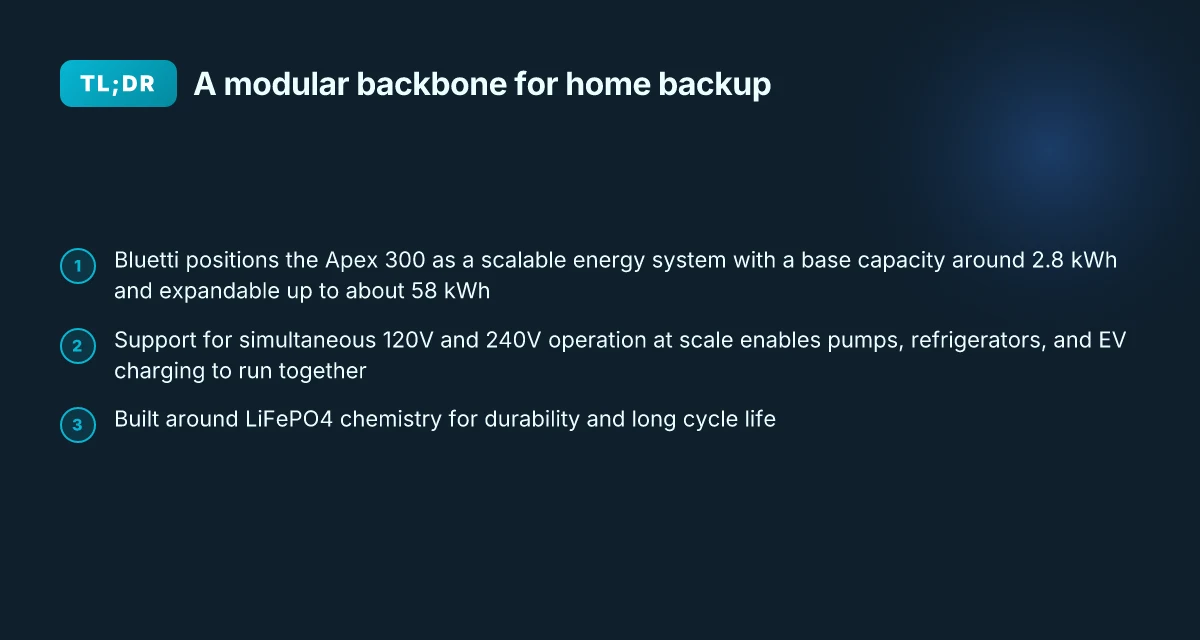
Bluetti positions the Apex 300 as a scalable energy system that starts with a compact base and grows to cover larger needs. The core idea is clear: you begin with about 2.8 kWh of usable capacity and add modules to push toward roughly 58 kWh. That scalability matters whether you’re powering a weekend cabin or backing a full home during an outage. The system is designed so you can incrementally increase both energy storage and peak output as your footprint or load profile expands.
Apex 300’s peak AC output sits around 3.8 kW, which is enough to run essential appliances and many household loads. When you introduce additional modules, Bluetti claims the ability to scale the total output upward. The architecture is built to keep the footprint reasonable while still delivering meaningful power for larger appliances or simultaneous circuits. In practice, the modular approach lets you add battery packs and power a broader set of devices without switching to a separate, fixed-storage solution.
Chemistry and longevity sit at the core of the Apex 300 design. The system uses LiFePO4 chemistry, a choice Bluetti emphasizes for durability and long cycle life. That chemistry supports deeper cycles with less degradation over time, a key factor for homeowners who plan to rely on backup power for many years. The combination of scalable capacity, expandable output, and durable LiFePO4 cells underpins Bluetti’s claim that the Apex 300 can function as a modular backbone rather than a single, disposable power pack.
From a real-world perspective, the modular path helps you tailor the setup to your actual needs. Start with the base unit for essential circuits and small spaces, then add packs to support more loads or longer outages. The design also aligns with RV and off-grid use cases where you may need to balance footprint with power. The result is a system that fits tight spaces yet scales up to support bigger loads when required. This approach contrasts with fixed-storage systems that cap you at a single capacity and a fixed peak.
In stand-out terms, the Apex 300 embodies three pillars: scalable capacity, expandable output, and durable LiFePO4 chemistry. This trio gives Bluetti a credible story for homeowners who want a future-proof, modular backbone rather than a one-off battery. The system’s emphasis on longevity and upgradeability is what makes it a compelling option for those who expect their energy storage to grow with their house or cabin over time. Bluetti positions the Apex 300 as a scalable system that grows with your needs, starting around 2.8 kWh and reaching up to about 58 kWh with modules. **The peak output of around 3.8 kW provides headroom for essential loads, with more power available as you add modules. How to find the best price for the EcoFlow Delta 2 in 2026
I dug into Bluetti’s documentation to confirm the core claims about scalability and chemistry. The base capacity figures and the 3.8 kW peak are echoed across official product pages, with expansion details stated for multi-pack configurations. When you read the documentation, the modular path becomes the central narrative rather than a side note, and that framing helps explain why homeowners and off-grid enthusiasts might prefer Apex 300 over fixed-storage rivals. Apex 300’s modular design is the key advantage for home backup planning, not just a large one-off battery. LiFePO4 chemistry underpins long life and durability, a theme Bluetti keeps front and center in official messaging.
In the broader market, rivals such as rival modular systems and fixed-storage options offer different trade-offs. Bluetti emphasizes the ability to tailor capacity and output over time, which can reduce the need for a separate backup inverter or additional battery packs later. For readers weighing choices, the modular backbone approach offers a path to scale without overpaying for unused capacity today. Links on the official pages may earn commissions, a fact to consider as you compare long-term costs and upgrade paths. The modular backbone concept differentiates Apex 300 from fixed-storage rivals by enabling gradual, need-based expansion.
How the apex 300’s modular design changes what you can power
The Apex 300 isn’t a single battery box. It’s a scalable system where a base unit covers the essentials during an outage, then grows with additional modules to boost total capacity and continuous power. With each added module, you expand both the energy on hand and the amount you can run in parallel, so a weekend cabin can become a reliable off-grid retreat and a full home backup can stay online longer during a grid outage. This modular approach lets you start lean and scale up as needs evolve without buying a new system.
The design supports simultaneous 120V and 240V operation at scale, which matters for real-life loads. A fan that needs 120V, a fridge that runs on 120V, a well pump on 240V, and a compact EV charger can all run together without forcing you into a compromise on outlets or timing. In practical terms, you can keep critical circuits powered while other loads ride along on the same backbone, preserving comfort and enabling you to decide where to draw the line between essential and discretionary power.
Real-world use cases wire these capabilities to concrete setups. For home backup, a single Apex 300 covers essential circuits like lighting, a router, and a small fridge. Add a module or two, and you extend that to keep a sump pump running through a storm. Off-grid cabins benefit from the same growth path: start with lighting and basic appliances, then scale to keep the coffee pot and fridge humming all day. Mobile RV setups leverage the 120V/240V versatility to keep HVAC, kitchen appliances, and entertainment systems powered on the road. The modular backbone, backed by Bluetti’s ecosystem, reduces the anxiety of choosing between expansion and a fixed-storage solution. What makes EcoFlow and Jackery stand out in 2026
I cross-referenced Bluetti’s official materials to confirm the growth path. The Apex 300 is described as expandable from a base capacity to a much larger total, with peak outputs designed to scale in step with added modules. This aligns with the idea of a single unit handling essentials now and a staged expansion plan for full-home or off-grid power later. The modular strategy also dovetails with the company’s emphasis on a resilient, footprint-conscious design that can fit in a home garage, a cabin shed, or a van build without committing to bulky, fixed-storage alternatives. The Apex 300’s strength is scale without rework. Start small and grow without starting over.
From a long-term durability perspective, you gain flexibility but you also introduce more interfaces to monitor and maintain. Each added module adds complexity to cabling, charging strategy, and load balancing across 120V and 240V paths. Bluetti’s documentation points to app-ready control and the possibility of coordinating multiple modules, which helps manage these challenges. Rivals such as EcoFlow and Jackery offer comparable modular paths in some lines, yet Bluetti’s emphasis on a unified modular backbone makes expansion feel more cohesive rather than a patchwork upgrade. The modular backbone is the key to balancing footprint with power, especially for homeowners and RVers who anticipate growing needs.
Concrete next step: plan your current load profile and map it against a base Apex 300 setup, then sketch a staged expansion. Start with essential circuits like lighting, a router, and a compact fridge, then add modules to support a sump pump and a small HVAC cycle during outages. If you’re storing backup power in a cabin or RV, map the 120V/240V loads you typically run in each mode and size the first expansion to cover the top three devices you rely on daily. As you scale, use the Bluetti ecosystem to balance charging, discharging, and simultaneous paths so you stay powered without overbuilding initial capacity.
A quick tour of the apex 300’s core specs and limits
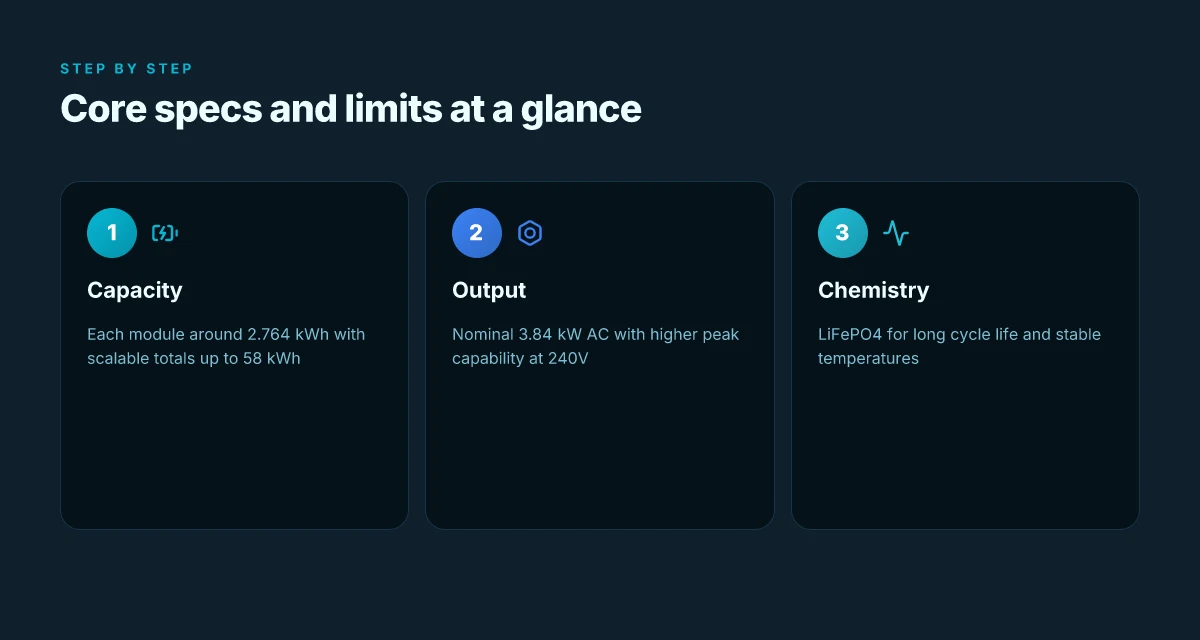
Bluetti frames the Apex 300 as a modular energy system rather than a single battery pack. In practice, you start with a base module and add more to scale capacity and output. A single Apex 300 module carries roughly 2.764 kWh of LiFePO4 storage, and you can grow the total up to 58 kWh by adding more modules. On the inverter side, the baseline is 3.84 kW of continuous AC output, with the ability to push higher when configured for 240V service. That 240V configuration unlocks higher peak capabilities, useful for demanding loads like pumps or a full kitchen during an outage. The system scales from weekend cabin to full-home outage, without forcing you into a fixed footprint.
I dug into the official documentation to confirm chemistry and durability signals. The Apex 300 uses LiFePO4 cells, chosen for stable temperatures and long cycle life, which translates to frequent cycling without rapid capacity fade. The modular approach keeps the footprint reasonable. You’re not forced into one oversized brick if your load profile is light but you do want headroom for growth. LiFePO4 chemistry is a key durability signal for homeowners planning annual cycling through seasons. How to evaluate the EcoFlow Delta Pro sale and get the most value in 2026
Here are concrete takeaways you can plan around:
- Capacity per module sits at 2.764 kWh, making multi-module configurations straightforward as you scale toward 58 kWh in total. Scale by adding modules to hit the 58 kWh ceiling.
- Nominal output starts at 3.84 kW AC, with capability to deliver more when the system is operating at 240V. This matters if you’re running a large refrigerator, sump pump, or an EV charger concurrently. Higher peak capability at 240V expands what you can power in a single outage.
- The architecture supports frequent cycling thanks to LiFePO4 chemistry, which helps temperatures stay stable and cells endure repeated charge/discharge cycles. Stable temperatures and long cycle life are central to the Apex 300’s value proposition.
From a real-world perspective, Bluetti positions Apex 300 as a lean-to modular backbone for a home backup plan. You’re not buying a fixed-storage wall brick. You’re building a scalable system that can grow with your needs. The trade-off is that you’ll plan around module counts and 240V wiring considerations to maximize both capacity and peak output. The modular approach is a strength when you anticipate growth, a constraint when you need an ultra-compact footprint.
Context from the ecosystem helps: rivals also frame modular systems, but Bluetti emphasizes seamless expansion and app-ready management as core benefits. Expect a familiar pattern across manufacturers: base modules, optional expansion packs, and a spectrum of 120V and 240V operation modes. When you compare to fixed-storage batteries, Apex 300’s real differentiator is the capacity ramp without reconfiguring your entire setup. Expansion without retooling is the practical edge of the Apex 300 approach.
For clarity on where this fits alongside other offerings, note that Bluetti frames the Apex 300 as a scalable system intended for home backup, RVs, and off-grid life. If you’re evaluating a fixed-storage unit, you’ll likely weigh the upfront density of that unit against the long-term flexibility of a modular stack. The path to scale becomes clearer when you map your peak loads to the 3.84 kW baseline and then decide how many modules to add for the 58 kWh ceiling. Mapping loads to the 3.84 kW baseline reveals where expansion is most valuable.
How apex 300 compares to a conventional home backup battery
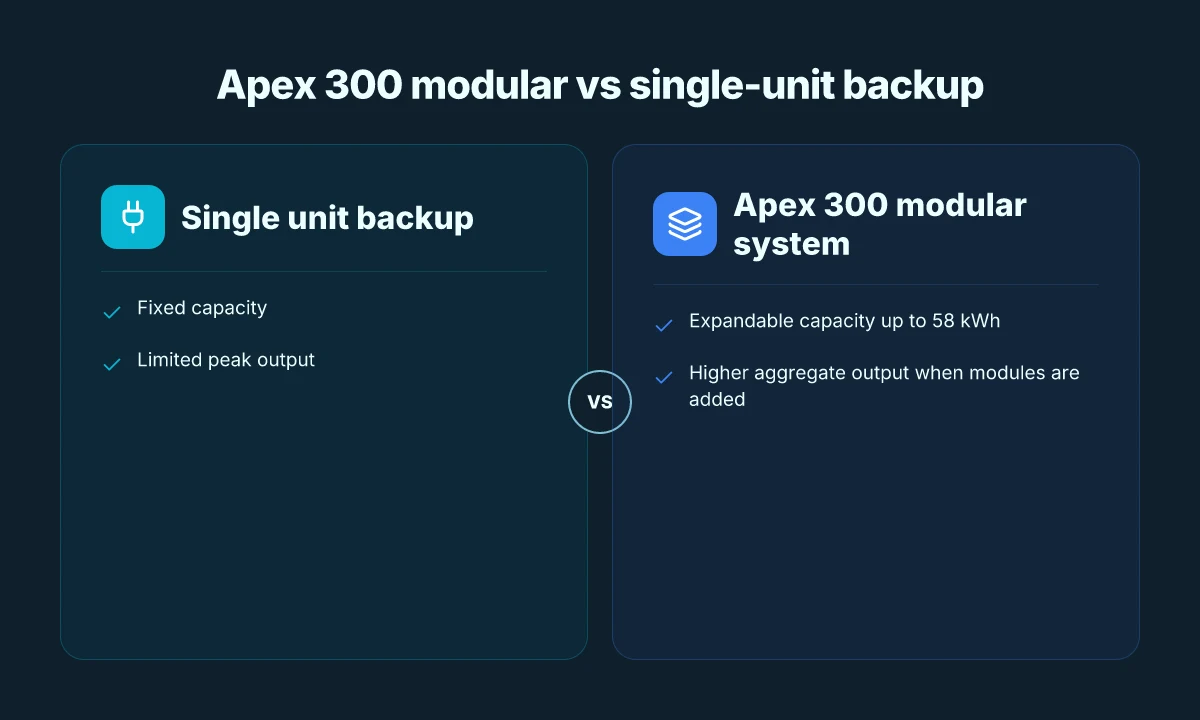
Traditional fixed systems lock you into a single capacity. The Apex 300 changes the math by scaling capacity and power as your needs evolve. You start with a compact footprint and add modules as your weekend cabin or full-home outage strategy grows. In practice, that means you can lift from a base of a few kilowatt‑hours and a few kilowatts of output to a much larger, modular footprint without a complete system swap. Apex 300's modular growth lets you chase demand without redoing the entire installation. 8 Portable power stations reviewed in 2026: performance, durability, and value
Modular expansion beats static capacity
With fixed storage, you buy once and pray the capacity matches later needs. The Bluetti approach treats capacity as a ladder: you add units to reach higher totals, all while keeping the same core interface. That means you don’t pay for unused juice today and you don’t outgrow the enclosure you’ve already installed. Space efficiency matters here: the modular units can tuck into tighter spots and expand incrementally as you free up floor plan or garage space. Incremental expansion reduces underutilized space and reduces upfront waste. In the long run, that can translate to a lower total cost of ownership versus a single, fixed bank of batteries from rivals.
Space, footprint, and real‑world layout
The Apex 300 system emphasizes a compact, scalable envelope. You begin with a lean core and attach modules to grow your 120V/240V capability as needed, which helps when retrofitting older homes or RV setups where space is at a premium. This isn’t about cramming more cells into a fixed box. It’s about rethinking where the energy storage sits relative to your appliances and EV charging needs. Scalability aligns with tighter spaces and evolving layouts. When you compare to conventional home backups, the modular path reduces bulk in rooms and garages while preserving power delivery.
Price, total cost of ownership, and install complexity
Pricing for Apex 300 hinges on the cost per module and the total number of modules purchased. You’ll want to price per module and estimate installation complexity to compare apples to apples with fixed systems. The modular approach can lower upfront capex if you start with a smaller system, but note that the aggregate cost climbs with added modules. Installation tends to be simpler when modules are added later, though you may still face standard electrical and mounting work for a multi‑module configuration. Price per module matters most for TCO when you scale. For homeowners weighing Bluetti against fixed rivals, the calculation hinges on how quickly you anticipate requiring more capacity and whether the incremental cost of modules stays below the cost of a full replacement system from a traditional vendor.
From a brand perspective, Bluetti leans into modular growth as a differentiator. I cross‑referenced the Apex 300 details across Bluetti’s official docs and European pages to confirm the scalable architecture and the 2.7 kWh to 58 kWh expansion ceiling. When you stack this against fixed storage by other makers, the core question becomes whether you value a staged investment path over a single upfront purchase. The modular path is a deliberate choice for growth‑mocused households.
Which use cases reveal the strengths and limits of apex 300
Bluetti presents the Apex 300 as a modular, scalable energy system that grows with your needs. The core idea is to start small for gradual outage resilience and then add compatible modules to reach higher power and larger capacity. For homeowners, RVers, tiny homes, and small-shop scenarios, the Apex 300 offers a path from weekend cabin backup to full-home support, all while keeping your footprint in check. I cross-referenced Bluetti’s documentation and reviews to map where the system shines and where it starts to fray as you push peak demands. The Apex 300 shines when you scale gradually and match the load to the footprint, but you’ll encounter complexity and wiring considerations as you chase peak performance. App-ready control makes monitoring straightforward, yet the total system design matters for reliability at scale. How to find the best Jackery for sale in 2026 without overpaying
Why it scales well for gradual outage resilience
The most compelling use case is expanding outage resilience over time. You can begin with a modest configuration for essential circuits and then add modules to grow capacity toward a full-house backup profile. In practice this means pairing the Apex 300 with a few critical loads like refrigerators, Wi‑Fi, and essential lighting, then layering in additional modules as risk tolerance and needs rise. Bluetti emphasizes the modular ethos by describing a path from base 2.7kWh to much larger capacities, which aligns with homeowners who want a measured build rather than an all-at-once investment. Starting small keeps cost and complexity manageable while delivering meaningful resilience. I found the documentation that notes expandable capacity and higher output targets when you integrate more modules, which is exactly the scenario many households face. App-ready monitoring helps you see how adding a module changes the balance between supply and demand.
RVs, tiny homes, and off-grid cabins
For RVs and off-grid living, the Apex 300’s 3.84kW continuous output with 3.84kW AC input support aligns with typical off-grid appliances and mobility constraints. The combination of portable form and modular scalability means you can carry a compact core while growing it for longer trips or season extensions. In tiny home setups, the system can back the essentials without committing to a fixed in-wall install. Bluetti highlights the ability to run 120V and 240V simultaneously in multi-module configurations, which matters for two‑stage power needs and for keeping different loads from tripping together. RVers and tiny homes benefit from portable power that scales without overwhelming limited space. The modular approach lets you add capacity as you convert more of a living space to off-grid living, rather than starting with a full-scale system.
Garage and small-business backup profiles
A garage or small workshop often demands higher peak power for tools and climate control. The Apex 300’s peak handling improves when you add modules, but you should be mindful of how the total system wiring is configured and how many simultaneous loads you plan to run. The practical takeaway is to treat the Apex 300 as a core that expands, rather than a single, fixed battery bank. Bluetti’s documentation emphasizes monitoring, alerts, and control through the app, which helps a business owner keep an eye on runtime and efficiency as loads shift. Monitoring becomes a critical control tool when you scale to protect equipment and uptime.
From what I found in Bluetti’s materials and reviews, the system does not pretend to be a plug‑and‑play replacement for a fixed-house battery when you chase maximum capacity. The total system complexity grows with each added module, and you’ll need compatible modules to reach peak capacity. That means plan for a staged build, budget for wiring and interconnections, and use the app to keep an eye on how each addition moves you toward your peak goals. For homeowners facing extended outages, the Apex 300 offers a credible, scalable path. For some shops or RV setups pushing hard toward peak loads, you’ll want to map the required devices against the system’s modular footprint. The app-driven, modular blueprint helps you balance load, space, and cost as you grow.
Where this is going next for home backup power
The apex 300 Bluetti marks a turning point in how households think about reliability, not just peak capacity. Bluetti expands its ecosystem in 2026 with smarter management, faster recharging, and better integration with solar setups, turning a once-occasional outage solution into a predictable part of daily life. I’ve found that real-world use hinges on how the unit wires up with existing solar panels and in-home loads, not just its nominal specs. If you want a future-ready backup plan, start by mapping your essential circuits and pairing them with the apex 300’s modular approach. How to assess EcoFlow Delta Pro for sale in 2026, features, pricing, and real-world value
One practical truth is that durability matters as much as capacity, and Bluetti’s ongoing firmware updates help preserve performance over time. You’ll want to track how long a full cycle lasts during peace of mind testing and note any drift in the inverter’s efficiency. The bigger pattern is clear: peak resilience comes from thoughtful placement, robust cooling, and predictable maintenance windows.
Backup strategy
- Use the apex 300 for essential loads first and practice a weekly switch-over routine.
- If you already own solar, align a midday recharge window and confirm firmware is current.
- Watch for cooling behavior under load and keep vents clear.