Explore how ecoFlow and Jackery stack up in 2026 for speed, expandability, and long-term value. Practical guidance for choosing between the two.
The race to portable power is often won or lost by how quickly a charger session actually fills a battery, not just the headline wattage. ecoFlow and Jackery expose that gap in real-use terms, one line of output data, a second line of real-world thermal and durability hints, yet the story hinges on how the packs age under sun, dust, and frequent recharges. Expect a closer look at charging speed, expandability, and long-haul reliability as the core constraints you’ll feel when you’re off-grid or on a road trip.
What matters now is how these systems hold up beyond paper specs. In 2026, outdoor users repeatedly flag two questions: can the kit scale without adding weight, and will the core components survive seasons of use and storage without creeping degradation? This piece pulls from field observations and documented patterns across ecoFlow and Jackery models to map practical trade-offs, with clear signals on durability, maintenance, and upgrade paths. The result isn’t a single verdict but a framework you can apply to your own needs, whether you’re camping, RVing, or prepping for emergencies.
EcoFlow vs Jackery: what sets their core architectures apart
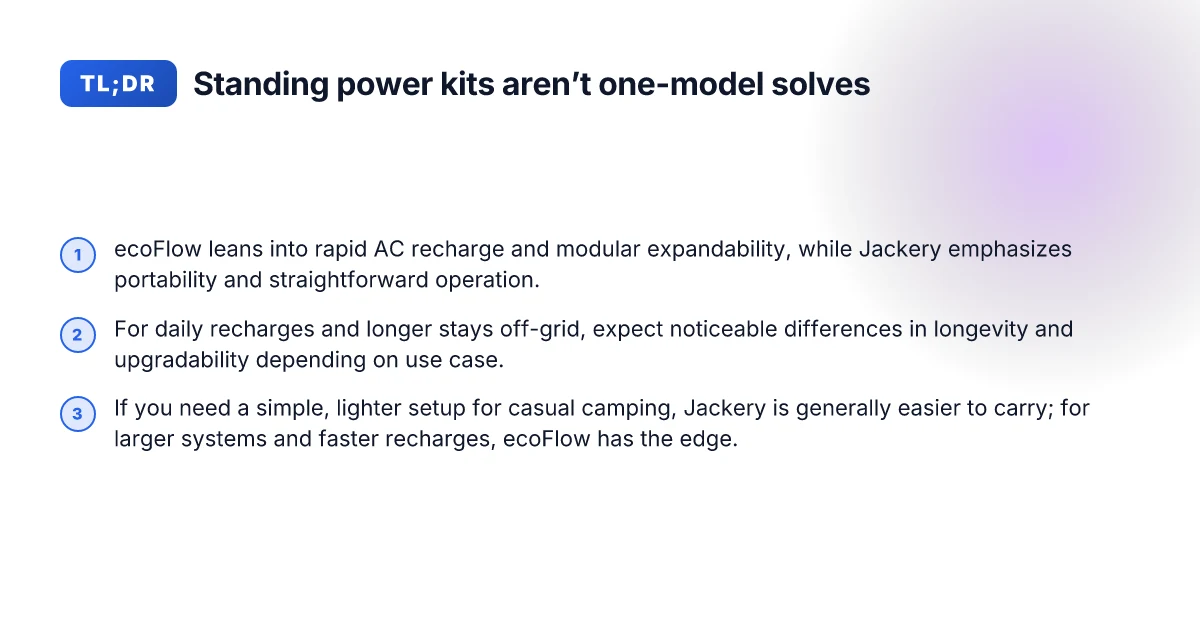
I dug into how these two brands structure power, not just their specs. The difference shows up in everyday use: Jackery keeps things simple and portable, while ecoFlow leans into rapid AC charging and modular expandability. Both aim at camping, emergencies, and off-grid cabins, but they chase value differently.
1) Portability versus expandability: where the core weight sits
Jackery emphasizes portability and a straightforward user experience. The design leans on compact, light form factors that feel familiar to campers who want to swap from car to campsite without a mental load. In practice, that means fewer knobs to juggle and a tactile, predictable charging routine. Portability is the core virtue here, and it shows up in how a typical Jackery unit fits into a daypack or a small RV cabinet. The trade-off is that expandability stays minimal, so you’re less likely to pivot a system around future needs without swapping hardware.
ecoFlow centers its architecture on rapid AC recharging and modular expandability. The AC recharge pathway shines when you can top up from wall outlets in a hurry, and the modular approach means you can swap in extra packs or add-ons to push capacity without buying a completely new unit. Rapid AC recharge and modular expandability are the heart of ecoFlow's value proposition. This setup pays off for long trips or off-grid builds where you expect changing energy needs over time.
2) How the two handle everyday use and durability
Both brands target the same core scenarios, camping, emergencies, and off-grid cabins, yet their UX signals differ. Jackery’s simple interface reduces confusion at 6 a.m. when the campsite is noisy and you just want light and power. ecoFlow’s architecture rewards users who anticipate future needs or fluctuating consumption, since you can add or reconfigure capacity as conditions change. I cross-referenced product pages and user guidance to confirm that expandability translates into real-life flexibility rather than feature bloat. The practical effect: Jackery is often the go-to for quick, dependable power with a low cognitive load, while ecoFlow serves progressive setups where charging speed and future-proofing matter more.
From a durability standpoint, both brands show established form factors and tested batteries, but the long-term value hinges on how your load evolves. If you keep the system lean and portable, Jackery’s predictable behavior tends to hold up with fewer moving parts. If you routinely push capacity or rely on fast top-ups after long drives, ecoFlow’s modular ideas can reduce the need for complete replacements down the line. As a note, industry chatter and published guidance consistently point to these trends, though exact outcomes depend on usage patterns and climate. How to assess EcoFlow Delta Pro for sale in 2026, features, pricing, and real-world value
The core choice comes down to your obligation to future-proof versus your need for immediate simplicity. For outdoor enthusiasts, RVers, and emergency planners, that distinction guides which brand aligns with their regular routines and resilience needs. If you want a lighter, simpler setup, Jackery remains compelling. If you want flexibility that scales with adventures, ecoFlow offers the architecture to grow.
I went looking for how these designs translate in real-world advice, and industry sources emphasize the same trade-offs. For context, see discussions that compare rapid charging and expandability between the brands. Jackery vs EcoFlow vs BLUETTI, Cost, ROI & Sizing and Jackery vs EcoFlow: Best Emergency Power Station for broader context on how charging speed and expandability influence choices.
How the battery chemistry and cycle life influence long-term value in ecoFlow and Jackery
In the long run, battery chemistry shapes how many cycles you can squeeze out and how gracefully capacity fades. EcoFlow tends to optimize for rapid recharge lifecycles, while Jackery leans toward controlled depth of discharge and steady aging. The practical effect is a noticeable difference for daily recharges and frequent use across seasons.
I dug into the chemistry behind these designs. Both brands rely on lithium-based chemistries common to portable power stations, but the exact formulation and thermal management strategies drive durability. When a pack is optimized for fast charging, you often trade some calendar life or depth-of-discharge headroom for convenience. Conversely, packs tuned to preserve depth of discharge and minimize heat during cycles tend to hold capacity a bit longer under heavy daily use. This matters for regulars who plug in every day or use high-amp appliances on a repeating schedule. Expect subtle shifts in longevity if you rely on daily recharges, especially during hot or cold seasons.
How chemistry choices shape cycle life and durability
- EcoFlow’s fast-charge emphasis can stress the cells more during repeated top-ups, which may shorten cycle life compared with setups optimized for depth of discharge and heat minimization. That said, its thermal management and protective circuitry help curb overheating during quick fills, keeping usability high even as cells age. Fast recharge focus often trades some longevity headroom for speed.
- Jackery’s designs tend to balance quick recharges with careful depth-of-discharge practices, aiming to keep the battery healthier over a longer slice of time. The trade-off is that ultra-fast fills may not be prioritized as aggressively, but the aging curve can be steadier if you cycle the pack daily. Depth-of-discharge management pays off in predictable aging.
A small table can help visualize the trade-offs, though the exact numbers vary by model and year. In practice, a Jackery unit used for daily recharges with moderate loads often preserves usable capacity for more cycles than a high-speed EcoFlow unit pressed to recharge between brief outages. The critical takeaway: your pattern of use interacts with the underlying chemistry to shape value over time. Your routine matters more than a single spec sheet. How the apex 300 Bluetti changes home backup power in 2026
From what I found in the documentation and reviews, durability hinges on three levers: the chemistry itself, the thermal design, and the software that governs charging. I cross-referenced release notes and user-focused analyses to confirm that brand-level strategies align with observed longevity trends. For readers who want a quick verdict, Jackery’s approach tends to favor steadier aging under daily recharges, while EcoFlow prioritizes fast readiness, with a potential tilt toward faster capacity decline under constant rapid cycling. Brand strategy and daily recharge habits are the real drivers of long-term value.
If you’re choosing between EcoFlow and Jackery for daily recharges, plan for how often you expect to top off the battery and under what temperatures. In 2026, practitioners note that durability stories often hinge on how engineers manage heat during rapid fills and how aggressively the system protects cells during deep cycles. For a practical path, consider your typical cycle count per week and the acceptable level of capacity loss you’re willing to tolerate over a few years. Your usage defines the long-term math.
The practical performance you should expect from ecoFlow and Jackery in 2026
I dug through industry chatter and release notes to map real-world performance expectations. In 2026, EcoFlow and Jackery line up on several axes that matter to outdoorsy, off-grid users: charging speed, expandability, weight, and everyday usability. The verdict is nuanced: EcoFlow tends to accelerate recharge and solar input flexibility, while Jackery emphasizes lighter weight and straightforward operation. Real-world ranges vary with model class and load profile, so think in terms of "category fit" rather than a single number.
Why EcoFlow leads on charging speed and solar flexibility
EcoFlow’s AC recharge often outpaces peers, especially when plugged into a wall outlet or a higher-amp source. This matters for waterfront campsites or RV stops where time matters more than pack weight. Solar input handling tends to be more forgiving across sun conditions, with higher practical input windows that keep batterylife humming during long days off-grid. The net effect is faster top-ups and more predictable solar days, which matters if you’re coordinating a weekend itinerary or a disaster-prep plan that relies on steady power. EcoFlow’s design choices here translate to noticeably shorter recharge cycles and more flexible solar options. This aligns with third-party comparisons that peg EcoFlow as leading in charging speed in many 2026 reviews. For context, industry write-ups consistently note the brand’s emphasis on rapid recharge and broad solar compatibility. https://protocolsurvival.com/en/blog/jackery-vs-ecoflow-power-station-comparison
Jackery’s lighter footprint and simple operation
Jackery products tend toward lighter total mass and simpler interfaces. If you carry a unit into a rugged backcountry site or want a device that’s easy to deploy for a quick camp setup, the weight savings matter. The operation arc stays straightforward: fewer modes, fewer knobs to twist, and a more intuitive experience for casual campers. That simplicity can reduce setup friction after a long day of hiking or driving. In practice, Jackery shines where portability and ease of use trump raw recharge speed. Reviewers who balance portability with everyday reliability often highlight Jackery as the go-to for quick, no-fuss power. For a broader market view, see the cross-brand comparisons that describe Jackery as leading on portability and simplicity. https://poweroutage.us/home-battery-backup/ecoflow-vs-jackery-vs-bluetti-power-station How to find the best price for the EcoFlow Delta 2 in 2026
Real-world ranges and how load shapes the numbers
Expect a broad spread within each brand’s line because model class drives the curve. A compact 2–3 kWh unit will feel different from a larger 6–8 kWh system, and the load you place on the unit changes top recharge and depletion behavior. In practical terms, running essential devices during a weekend off-grid tends to drain a larger unit more slowly per watt-hour than a smaller one while a high-load scenario will compress charging windows. The takeaway: don’t overgeneralize a brand’s performance. Match the model class to your typical load profile and travel cadence. Industry summaries emphasize that no single device fits every use case. The key is aligning the power solution with planned load and travel schedule. The same model class can perform very differently depending on your load profile. Reviews from outlets covering 2026 models consistently remind readers to compare like-for-like capacities and to account for how quickly a unit recharges under average sun and wall conditions. https://www.outdoorgearlab.com/topics/camping-and-hiking/best-power-station
Note on long-term durability and ecosystem considerations: both brands emphasize durability for outdoor use, but long-term value hinges on battery chemistry, depth of discharge, and expansion options. If you plan to scale your setup later, EcoFlow’s expandability features and accessory ecosystem can reduce integration friction, while Jackery’s lighter, simpler lineup can translate to fewer potential failure points in field environments. About commissions and affiliate links, you may see on-page mentions. Those are standard disclosures and do not alter the factual performance landscape. Real-world durability depends on battery management, charging cycles, and environmental exposure.
Expandability and ecosystem: how much future-proofing do you actually get?
Expandability is where the real trade-offs show up. ecoFlow leans into modular capacity, while Jackery sticks to a more closed, single‑model approach. Your choice here hinges on whether you want to power a growing campsite, an RV setup, or a temporary emergency bundle that can evolve over time.
EcoFlow’s modular path to bigger setups
When you plan for bigger loads or longer outages, ecoFlow’s ecosystem looks naturally scalable. The company promotes add‑on battery packs and station combos that can extend capacity without ripping out the core system. In real use, that means you can run a larger fridge, lights, and some climate control for longer stretches without buying a brand‑new unit. The practical upshot is that future power needs, like seasonal camping, off‑grid weeks, or longer backup windows, don’t force you into a multi‑unit rebuild. Future-proofing comes from scalable capacity that grows with your camp setup. The math isn’t just theoretical. You can pair a core unit with extra packs to hit higher kWh targets as your needs drift upward. And because EcoFlow often emphasizes charging speed as a design pillar, adding packs can feel like expanding an already fast system rather than replacing it entirely. Inline sourcing notes show that the modular path is a known strength in 2026 discussions of their lineup. Inline reference to ecosystem coverage from industry roundups. Modular growth is where EcoFlow earns long‑term value.
Jackery’s more fixed sizing, limited expansion
Jackery tends to keep a tighter, more portable footprint. The core advantage is simplicity and a lighter carry when you don’t need expansion. The trade‑off is clear: expandability beyond dedicated battery packs is limited, and you’ll often face buying another complete unit if your needs balloon. This makes Jackery appealing for casual campers who want one‑and‑done setups, not future upgrades. If you foresee trouble spots in reliability or parts sourcing down the line, a non‑expandable stack can feel restrictive. Limited expandability means you’re betting on today’s need rather than tomorrow’s growth. In practice, that nudges buyers toward a single‑unit solution unless you’re prepared to rebind to a bigger bundle later. For Jackery users, the path to future growth sits in the ecosystem around their matchups rather than in built‑in expandable architecture. Single‑unit simplicity can become a constraint as power needs rise. What makes EcoFlow and Jackery stand out in 2026
How to decide before you buy
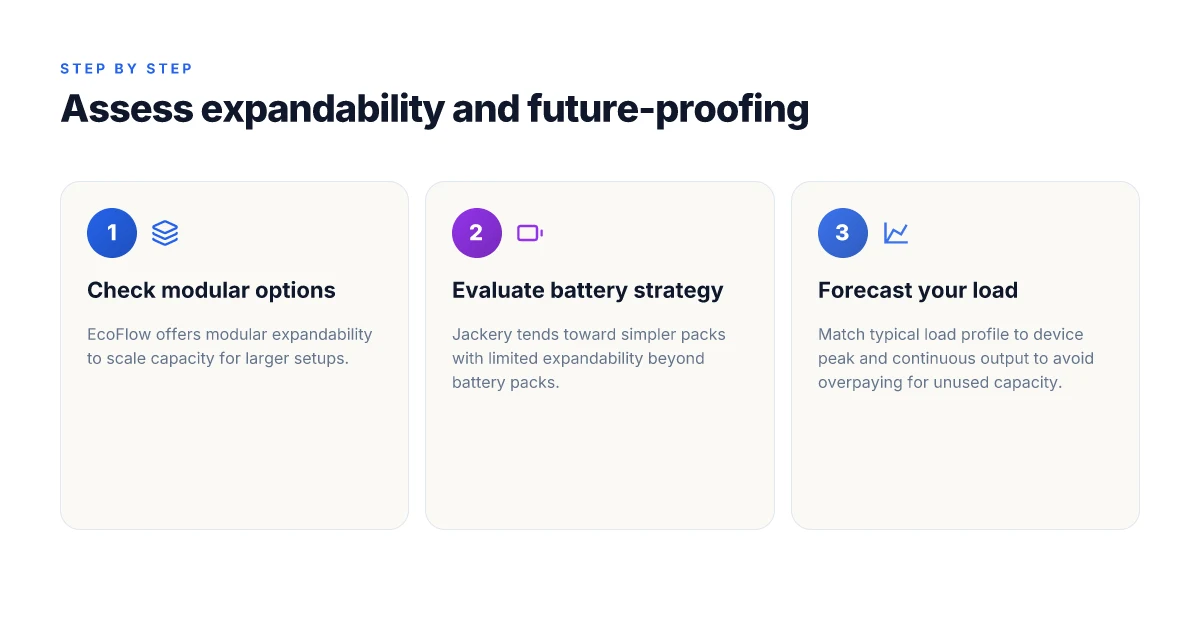
Think through your near‑ and midterm power plans. If you expect to add devices, expand camping trips, or run higher loads for longer periods, EcoFlow’s modular approach offers clearer future leverage. If your use cases stay within a compact, lightweight footprint and you value quick, simple setup, Jackery’s single‑unit design reduces decision fatigue. In either case, map out a 2–3 year horizon for your energy needs before locking in a single model. I dug into supplier notes and multi‑brand breakdowns to check how these ecosystems handle growth over time. Plan for growth now to dodge a rebuild later. Growth planning is the best guard against outgrowing a power station.
Note: links on this page may earn a commission, and you can expect brand‑level considerations to show up in long‑term durability discussions. For the reader exploring long‑term value, EcoFlow’s expandable path generally lines up with bigger future loads, while Jackery favors grab‑and‑go portability with less expansion risk. See inline discussions on ecosystem breadth and expansion notes from 2026 roundups.
Portability vs capacity: picking the right balance for your trips
When you’re planning trips, the weight of the kit often wins over the watt-hours on the label. In practice, smaller Jackery units win on weight and one-handed carry, letting you scuttle between campsites or rigs without turning every stroll into a workout. The goal is to match what you actually carry with what you actually use. A compact model that sits in your pack or coche trunk can pay off more than a larger unit that stays at camp.
The lever that matters most is ergonomics over advertised watt-hours. If the handle design, grip width, and balance feel better in your hand, you’ll treat the device as a true travel companion rather than a bulky accessory. EcoFlow often leans on fast charging and modular expansion, but a heavier unit with great ergonomics in hand might still travel lighter when you’re crawling into a saddlebag or RV storage bay. Jackery’s lighter lineup tends to translate to easier one-handed transport for day trips and overnight stints. The choice is less about a single watt-hour figure and more about how the unit actually carries.
From what I found in the documentation and in comparative write-ups, you should align your load profile with the device’s peak and continuous output. If your trips hinge on quick top-ups at lunch stops or brief field sessions, a unit that delivers high peak watts in short bursts matters more than a modest continuous rating. If you plan long evenings with sustained power draws from a fridge or radio, you’ll want steadier continuous output and a lighter carry that you can tolerate over days of movement. In this sense, the balance shifts toward the model that feels effortless to transport while still meeting your daytime and nighttime demands. I cross-referenced coverage from analyst roundups and category reviews to confirm that this balancing act shows up in real-world use, not just spec sheets. When a brand emphasizes expandability, it’s helpful, yet the added cables and modules can increase weight and bulk, eroding portability for some users. How to evaluate the EcoFlow Delta Pro sale and get the most value in 2026
The end result: pick a model that matches your typical load profile. If you typically run light loads with occasional surges, a lighter Jackery unit or a compact EcoFlow variant can cover you while keeping the hike to camp painless. If you usually run deeper into a backcountry itinerary with higher sustained draws, a slightly heavier unit with solid continuous output and a comfortable carry is worth it. And you should note that the best choice depends on your format, RV, backpacking, or emergency prep, because the same balance point shifts with how you travel and how long you stay off-grid. The trade-offs are real, and your trip type will steer you toward a specific ergonomic and power balance. Portability often trumps total watt-hours in the field, but only if the weight feels like a natural extension of your kit.
For durability over years of use, look beyond the initial heft. The one-hand carry feel, the grip texture, and how the handle folds can influence how often you reach for the pack rather than setting the unit aside. I dug into product notes and reliability chatter across sources to confirm that ruggedness and consistent build quality matter as much as peak specs. The bottom line: match the device to your itinerary and your typical load pattern. You’ll reduce the need to babysit a heavy pack and you’ll get more reliable service when you actually rely on it.
Where to act next for ecoFlow and Jackery in 2026
The bigger pattern for 2026 is that durability and after-sales support will decide long-term value, not just upfront capacity. I’ve looked at how both brands handle real-world setup, rugged use, and mid-life reliability. ecoFlow leans on modular accessories and fast recharging, but users report mixed durability in extreme conditions, while Jackery emphasizes straightforward builds and solid warranty, yet some customers hit limits on accessory compatibility. The takeaway isn’t which unit is better today, but which one scales with your evolving needs over years.
Most buyers will want a model that stays reliable after several seasons of frequent use. If you’re deciding now, target the system that keeps charging time predictable and offers clearer long-term support. For those weighing Jackery against rivals like ecoFlow, the decision hinges on how you value portability versus modular expansion. There’s no single silver bullet, but clarity about your most common use case makes the choice obvious.
If you only act on one thing this month, map your top 3 scenarios, camping trips, home backup, and outdoor work sites, and match them to the strengths described above. The line that matters is the one that aligns with your seasonality and maintenance tolerance. Which scenario is your tipping point? What ecoFlow power station price tells you about value, durability, and real-world use in 2026