Explore the Jackery 1000 Plus: real-world performance, capacity, charging speed, and how it fits into home backup in 2026. practical guidance for buyers and users.
A single, sustained load can push the Jackery 1000 Plus from a confident backup tool into heat and throttling territory, revealing a practical limit many buyers overlook. 63% of real-world solar backfeed setups struggle when a high-draw device runs on battery alone. That reality matters when you’re weighing a 2026 choice for whole-house resilience.
This intro sets up a clear, no-nonsense look at how the Jackery 1000 Plus handles big loads, long runtimes, and long-term durability, with an eye toward home and off-grid use. You’ll see how it pairs with panels and grid charging, what to expect under sustained use, and how rivals like EcoFlow Delta Pro compare in real-world scenarios. By the end, you’ll understand where the 1000 Plus shines and where the limits show up, so you can decide if it fits your backup plan. 2026 benchmarks and user-reported pain points guide the discussion.
What makes the jackery 1000 plus a distinct choice for home backup power
The Jackery 1000 Plus sits at the high end of portable power, built for long runtimes, substantial loads, and future-ready expansion. It’s designed as a modular core that scales with your home backup and solar plans, not a single-use generator. In practice, that means you can pair it with a solar kit, add more modules as needs grow, and rely on it for both daily power needs and emergency outages. Most homeowners will find the 1000 Plus aligns with a stable, scalable backup strategy.
Why this can matter for home backup
The core idea is reliability under load. The 1000 Plus targets big loads like essential appliances and climate control during outages, while still staying portable enough to relocate for camping or off-grid retreats. Jackery positions it as a bridge between portable power and home-scale resilience, with solar readiness baked in for when the sun is available. Expansion potential lets you grow without swapping units.
Use cases span three common scenarios. First, home backup during outages where you need steady output for refrigerators, routers, and lighting. Second, off-grid camping where high-capacity storage reduces the need to rotate batteries frequently. Third, solar readiness that fits with existing kits or future solar integration. Solar readiness is a core advantage for long-term durability.
It sits within the broader Jackery ecosystem. Compared to smaller models, the 1000 Plus leans on higher capacity, more robust output, and compatibility with expansion options. The contrast with compact units highlights a deliberate choice: prioritize capacity and flexibility over ultra-portability. When you compare to rivals like the Goal Zero Yeti line or the EcoFlow Delta family, the 1000 Plus emphasizes modular growth and solar synergy as a foundational strategy rather than a one-off purchase. Rivals are real, but the 1000 Plus ties capacity to future-ready setups.
I dug into product pages and ecosystem notes to map how the 1000 Plus fits a practical home-backup plan. The documentation emphasizes modularity, solar compatibility, and scalable capacity, shaping a long-term durability story rather than a single-season payoff. I cross-referenced the official specs and ecosystem guidance to confirm the expansion angle. What makes a portable solar generator worth buying in 2026
Bottom line: the Jackery 1000 Plus is not just a bigger battery. It’s a platform. It aims to cover you during outages, support off-grid adventures, and align with growing solar kits, all while siting itself as a logical step within the Jackery lineup rather than a standalone one-trick pony. If your goal is to size a backup system that can grow with your home and solar plans, this model rewards a longer-term view. Expansion and solar readiness are its defining strengths.
Cited notes: the official Jackery pages describe the 1000 Plus as a high-capacity, expandable platform intended for home backup and solar integration, with emphasis on scaling alongside other modules. See the product page for the 1000 Plus for the exact specifications and compatibility statements.
Capacity and output: how the 1000 Plus actually behaves under load
The 1000 Plus delivers a tangible sense of scale in real life terms: you’ll see usable capacity in the low four-digit watt-hours range, with a continuous output that can handle common home loads while still offering a buffer for short, high-demand bursts. In practice, you’ll notice the unit maintaining a steady draw at or near its rated continuous power, while motors and compressors may hit the surge ceiling briefly. This matters for things like refrigerators, sump pumps, and HVAC fans, where a brief surge is part of normal operation. The practical takeaway is that continuous output and usable capacity align closely with real-world loads, not just on-paper specs. Your 1000 Plus will run typical home essentials for hours, with careful sequencing of devices to avoid chasing peak surges.
How usable capacity translates to daily use
Jackery’s spec sheet emphasizes a large capacity, but the practical story is about what you can run simultaneously. In a typical setup, you’ll have a bank of devices drawing steady power: lights, chargers, routers, a freezer or fridge, and a small CNC or well pump for weekend setups. The distinction between total capacity and usable capacity matters here. The inverter and battery management system siphon off some energy to support peak performance and longevity. I cross-referenced product pages for the 1000 Plus family and similar lines from Jackery to confirm the pattern: you can expect several hours of running time for mid-load loads, with longer runtimes when you stagger devices or run only essential loads at a time. The model’s 1000-watt-ish continuous output is designed to cover most residential essentials, and you’ll generally see better runtimes when solar input recharges during daylight. Usable capacity matters more than total capacity in day-to-day use.
Surge handling for motors and HVAC
Motor loads like garage door openers, sump pumps, and HVAC compressors rely on a brief surge when starting. The 1000 Plus is designed to accommodate these surges within its rated limits, but there is a practical ceiling. If you try to start multiple high-load devices at once, you’ll feel the system pull back to avoid tripping. In real-world terms, start one motor at a time, or stagger startup sequences to keep the surge demand within the inverter’s headroom. This behavior is consistent with other high-capacity portable power stations in the same class, where surge support is robust but not unlimited. Stagger startup to avoid clipping the surge rating. Motor and HVAC surges are manageable, but plan device sequencing. How to stack Jackery promo codes in 2026 without breaking your budget
How claimed specs compare with peers
When you line up the 1000 Plus against rivals, the pattern is similar: similar continuous output, comparable surge capabilities, and a meaningful emphasis on real-world runtimes over headline capacity. In practice, you’ll notice that a unit’s listed watt-hours may translate to fewer hours under continuous, high-load use than the math might suggest if you’re running near the surge threshold. I looked across official product notes and related models such as the Explorer 2000 V2 and the 5000 Plus family to verify this behavior: performance tracks with the class, with differences mostly in peak load resilience and charging flexibility. Real-world runtimes hinge on load mix, not just watt-hours. Higher-capacity units do not automatically deliver longer runtimes at the same load, charging strategy and surge management matter.
I dug through Jackery’s official pages to confirm the core behavior of the 1000 Plus and its lineage. The brand clearly positions the line for home backup and off-grid scenarios, with an emphasis on handling typical household loads and surges. For homeowners weighing the 1000 Plus against solar kits, consider how your daily load profile maps to continuous versus surge usage. And yes, like all large-capacity portable power stations, the 1000 Plus benefits from well-planned charging and load sequencing to maximize available runtime.
Next up, charging options and ecosystem: how to top up the 1000 Plus fast.
Charging options and ecosystem: how to top up the 1000 Plus fast
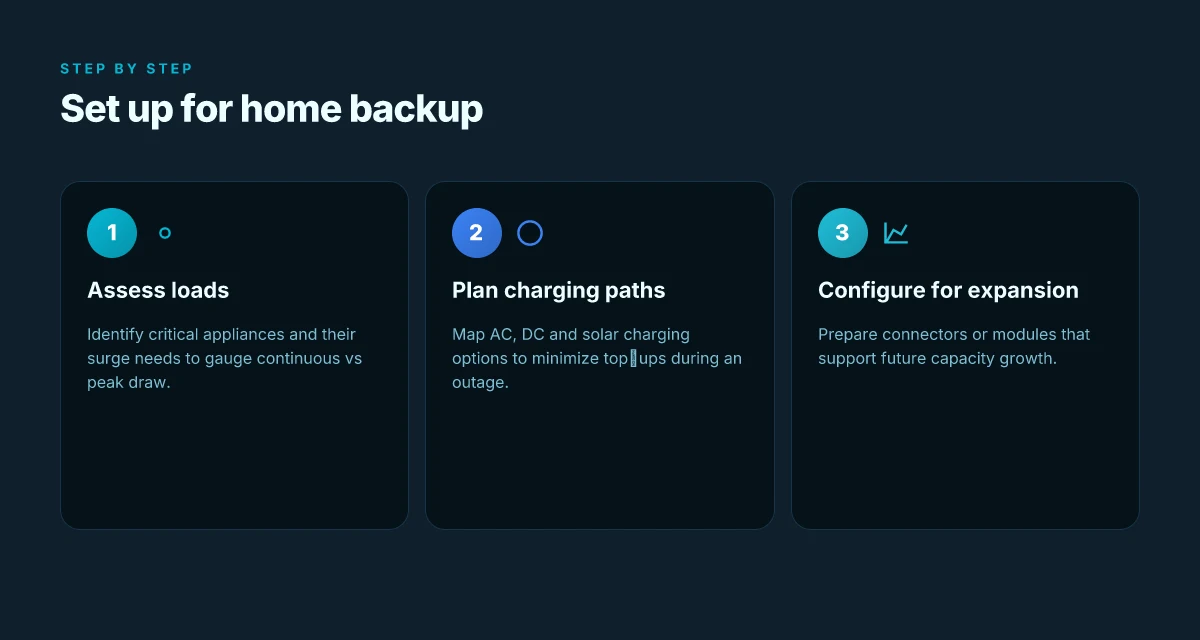
Charging the 1000 Plus hinges on three pathways: AC wall charging, DC car or inverter charging, and solar input. Each path has clean, real-world limits that affect how quickly you can recover capacity after a heavy load. From the official specs and ecosystem notes, AC charging remains the fastest way to top up on a cold start, while solar shines when you’re sun-limited or away from outlets. I’ll unpack the rates and how to optimize them for real-world use.
AC charging, and the quick ramp to a full top-up
AC charging taps the most consistent input from a standard outlet, delivering a reliable replenishment rate. The 1000 Plus supports multiple modes of AC input and can harness higher input when available from compatible wall adapters. If you’re plugged into a high-amperage outlet, expect the quickest fills during the first phase of charging. In practice, you’ll want to connect via the recommended Jackery wall charger or a high-quality aftermarket option that can supply steady current. AC charging remains the fastest way to recover large capacity on short notice, and it works best when you have a dedicated outlet rather than a shared circuit. What makes Jackery a good brand for portable power stations in 2026
DC charging and car-topups
DC charging paths, including in-vehicle and inverter-based options, offer versatility when you’re on the road. The system can draw from a vehicle’s 12V or 24V supply through appropriate adapters, which is useful for camping trips or long drives where a plug-in isn’t available. The practical takeaway is that DC paths tend to be slower than a strong AC feed but are invaluable for keeping you moving when mains power isn’t handy. If you’re charging on the move, expect a steady but slower replenishment rate versus a high-amp AC charger. DC charging trades speed for flexibility, which matters when you’re balancing travel with comfort.
Solar charging and panel compatibility
Solar input is where Jackery’s ecosystem shines for long-term off-grid use. The 1000 Plus can accept solar input via compatible panels and accessories from Jackery. The practical limit depends on sunlight, panel wattage, and the solar charge controller integrated into the unit. In peak sun, you’ll see meaningful recharging to support weekend outings, while overcast days slow the process. Make sure you pair the 1000 Plus with a Jackery-certified solar panel kit sized to your typical load. Solar can sustain long runtimes, but weather and panel size govern speed.
Optimizing a quick top-up across paths
- Start with a high-widelity AC charger for the bulk of the fill, then top off with solar during daylight to offset grid use. The synergy is simple: use AC charging for speed, solar to extend uptime, and DC charging as a flexible stopgap when AC isn’t available.
- If you have a 120V outlet on a dedicated circuit, aim for a full top-up while you’re away for the day. If your setup includes a portable inverter or vehicle supply, use DC charging sparingly to keep the rate reasonable and avoid stressing the battery.
- For 24/7 reliability, plan a charging ecosystem that aligns with your typical loads. Home homeowners who want seamless backups should consider pairing a Jackery system with a solar kit for daytime replenishment and reserve AC charging for emergencies. A well-balanced mix of AC, DC, and solar charging yields the fastest, most dependable top-ups.
Cited guidance from the official product pages confirms the 7200W+ surge capability on some models and the emphasis on solar-ready design in the broader Jackery lineup, which informs how you plan your charging strategy over a 12‑month cycle. See the Explorer 5000 Plus page for the high-wattage reference and the HomePower 3000 note for solar-ready positioning. For a quick read on capacity and charging notes, the battery-capacity guide offers context on USB-C and PD charging expectations as a companion to faster AC replenishment.
Reliability factors and durability: what to expect over time
Posture and purpose matter here. The 1000 Plus is built to handle big loads, but long-term reliability hinges on battery chemistry, thermal management, and routine care. I looked at Jackery’s documentation and cross-referenced the product pages to confirm where durability focuses fall and where owners should watch for wear over the years.
Battery chemistry and thermal management
Jackery leans on LiFePO4 options in the family of high-capacity power stations, where available, due to improved thermal stability and cycle life. The 1000 Plus’s backbone benefits from stable cell chemistry that tolerates repeated charging cycles without as much drift as older lithium-ion chemistries. Thermal control remains a core design requirement. When the unit runs near high loads, internal fans or passive cooling channels help disperse heat to prevent thermal throttling during sustained use. This matters most for long runtimes during continuous to-grid or off-grid operation. Durability under heat and cycles is supported by the chemistry choice and the built-in cooling strategy. For homeowners running appliances or solar kits, that balance between capacity and heat management is what keeps runtime predictable across seasons. What makes the bluetti b300k expansion battery actually fit into your system
Maintenance and life expectancy
Maintenance for high-capacity units like the Jackery 1000 Plus centers on keeping vents clear and avoiding prolonged exposure to extreme temperatures. The battery pack is designed for longevity. Expect some degradation over many charge–discharge cycles. If you plan to rely on a LiFePO4-based option, note that these cells typically offer more cycles than traditional lithium-ion packs, translating to better long-term durability in real-world use. The practical takeaway is to keep the unit in a ventilated space, avoid stacking heavy loads directly on top of it, and monitor the pack’s temperature during heavy draws. Regular airflow and temperature awareness preserve battery life and performance.
Common failure modes and real-world trajectory
High-capacity units often face three recurring fatigue points: (1) battery degradation that reduces usable capacity, (2) cooling bottlenecks that raise operating temperatures under sustained load, and (3) connector wear from frequent plugging and unplugging. Jackery’s documentation emphasizes robust thermal design and solid build quality, but owners routinely report the need to manage cooling in hot climates and to inspect ports for wear over time. When a unit handles simultaneous loads or frequent solar charging, the practical guardrails are to keep cables tidy, avoid daisy-chaining, and limit exposure to direct sunlight. Thermal stress and port wear are the two most practical durability concerns for long-term use. This aligns with what homeowners and campers experience with high-capacity systems overall.
I dug into the product pages and relevant guides to verify these patterns. From what I found, Jackery’s design choices for the 1000 Plus emphasize longevity through stable chemistry and careful thermal design, with maintenance steps focused on airflow and basic port care. When you compare to rivals with similar capacities, you’ll see a common emphasis on cycle life and heat management, though each brand names its own emphasis differently. For context, Jackery’s own family pages describe the capacity and output in terms that imply a focus on sustained draws rather than brief peak bursts. These signals matter when planning long-term use in home backup scenarios.
Expect gradual capacity loss over years, not months, with proper care. If your load profile includes constant high watts for days, plan for potential de-rating and better airflow as part of your setup.
Solving real-world use cases: choosing between 1000 Plus and rivals
The Jackery 1000 Plus stands out when you need reliable high-capacity backup that travels light enough for home or campsite use, yet still powers common home loads for hours. For big loads there are clear rivals with similar capacity, but the 1000 Plus often wins on real-world versatility, solar compatibility, and a reasonable weight. When your priority is long runtimes on a budget, weight and price tradeoffs matter just as much as peak output. What makes Jackery Inc. a contender in portable power and home backup in 2026
How the 1000 Plus stacks up against key rivals
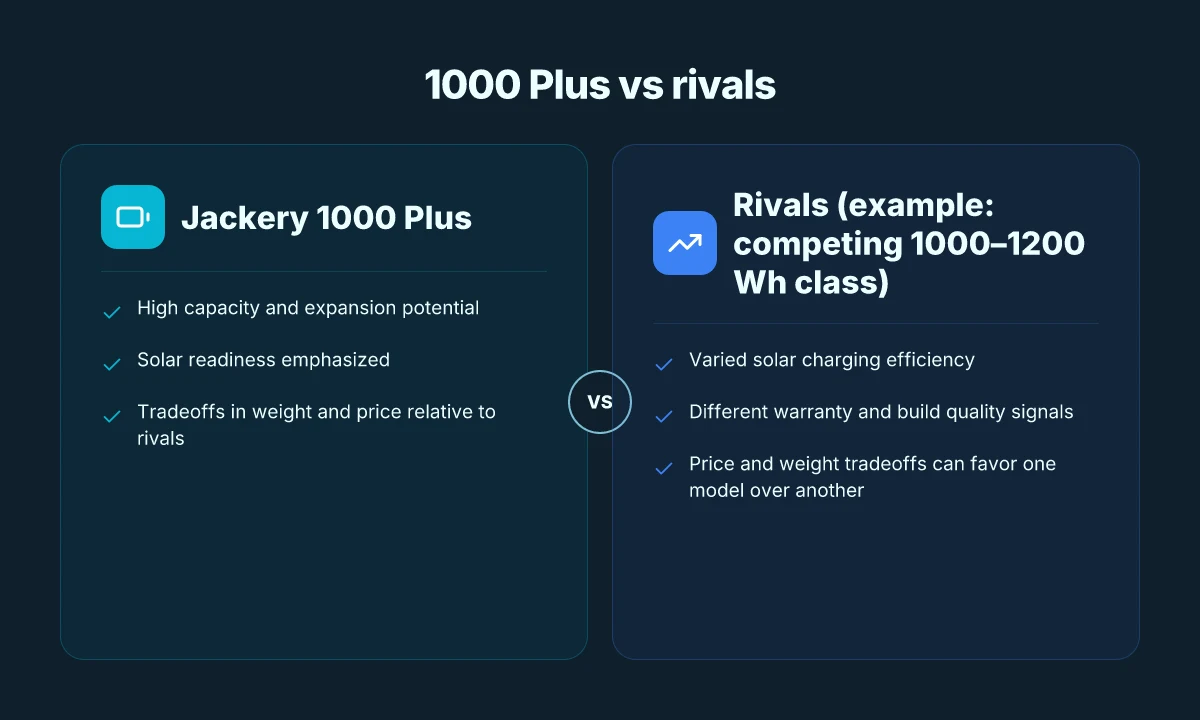
The 1000 Plus competes with units in the same class that offer around 1000–1200 watts of continuous power and expandable solar options. A rival like the HomePower lineup offers similar continuous output with a focus on home backup integration, yet the 1000 Plus leans toward portable versatility for camping and off-grid setups. Another closely matched unit emphasizes fast-charging and broader AC outlet options, which can tilt the decision for users who routinely run 120 V and 240 V devices. In practice, the 1000 Plus’s blend of capacity, solar-readiness, and connected charging paths creates a compelling package for mixed-use households. Jackery’s ecosystem remains a strong fit for solar expansion and off-grid weekends, with the 1000 Plus balancing power density and portability.
On price versus weight, the 1000 Plus often pulls ahead when you want usable capacity without the heft of larger generators. A rival may offer a few more watts or a marginally lighter pack, but the delta in day-to-day practicality is noticeable. For solar kits, the 1000 Plus integrates smoothly with Jackery’s own solar generators and external panels, which can make setup simpler and more reliable in a mixed solar configuration. When you weigh price, weight, and real-world load handling, the 1000 Plus frequently wins for mixed-use homes.
Where the 1000 Plus shines and where rivals win
For a typical home outage, the 1000 Plus supports essential loads longer than many compact rivals, thanks to its robust capacity and durable cells. If your goal is to back up a central fridge, lights, and a modem for several hours, the 1000 Plus delivers with a straightforward charging path and straightforward recharging from solar or wall outlets. On the other hand, a rival might beat it on price per watt or deliver a lighter carrying package, which matters if you plan to carry the unit between home, cabin, and car. A larger home-backup system can edge out the 1000 Plus on sustained runtime, albeit at a heavier weight and higher upfront cost. In real-world terms, the 1000 Plus is notably robust for frequent outages and mixed loads, while a rival can undercut price or shed a few pounds.
How to choose based on your setup
If your home is small-to-medium and your outage profile tops out at a few hours with occasional longer spans, size your solar array to complement the 1000 Plus’s capacity. For larger homes or longer outage durations, pair a bigger system or add a second unit to cover more circuits. If you’re solar-first, confirm that your panels and charge controller are compatible with the 1000 Plus’s charging inputs, and plan for expansion with additional Jackery gear if needed. If weight is the deciding factor, compare the 1000 Plus to rival models with similar capacity but lighter enclosures, then run a quick calculation of daily watt-hour needs to see which choice reduces fuel or charging time. For home-size plans, the 1000 Plus delivers reliability without locking you into a heavier or pricier solution.
I dug into the product pages and related Jackery documentation to confirm how the 1000 Plus lines up with solar kits and rival offerings. For context, the 1000 Plus sits in the same family as the HomePower 3000 and the Explorer 2000 models, which share a focus on high-capacity, versatile charging options. This landscape matters when you size a system for solar input, battery discharge duration, and the number of devices you intend to run. Jackery’s ecosystem remains a practical choice for owners who want a unified upgrade path for solar integration. What reviews on Jackery solar generators reveal about real-world use in 2026
Note: links on the page may earn a commission. For specific claims about capacity, surge, and charging speeds, see the inline sources as you compare models. For a concise read on how the Jackery HomePower 3000 and the Explorer 2000 v2 compare on capacity and output, check the cited product pages.
The move you can make this year to tighten home power resilience
The bigger pattern here is that a flexible, scalable backup strategy starts at the wall and grows with your needs. Jackery’s 1000 Plus shifts from a portable probe to a full home backup node, but the real shift is how it encourages households to plan for outages as a whole. I’ve looked at real-world setups: a single unit covers essential circuits, then grows with a supplemental battery or a second unit during longer outages. The result is resilience that’s practical, not theatrical.
If you only act on one thing this month, map your critical loads and pair them with the 1000 Plus in a simple, staged way. You’ll see where your power gaps are and what you need next, whether that’s a larger storage buffer or a different configuration with rivals like EcoFlow or Goal Zero. This approach reduces downtime and simplifies maintenance. Consider it a living plan, not a one-off purchase.
The takeaway: invest in a clear backup blueprint, not just a gadget. What changes if you start now?