
Explore the EcoFlow Delta Pro specs, including output, capacity, solar input, and expansion options. Learn what matters for home backup and off-grid use.
The EcoFlow Delta Pro’s ability to scale storage with modular packs often outpaces its peers in real-world backup scenarios. That scalability matters when outages stretch from hours to days, and you need to keep essential loads alive without swapping in a second generator. Delta Pro remains competitive on expansion with its battery modules, but the proof is in sustained runtimes and how clean the integration feels during an outage.
EcoFlow’s approach is practical for homeowners who want long-term resilience without a forklift upgrade to their electrical system. In this article, I break down which specs actually influence reliability: how capacity, inverter power, and expansion options translate to continuous support for heating, refrigeration, and critical electronics. Real-world relevance matters more than a single peak figure, and the comparison to rivals like Delta Pro 3 and Ultra X highlights where the system shines and where it asks for careful planning. The result is a clear view of what to expect in extended outages and how to size a setup that can endure years of cycles. EcoFlow and the broader field deserve a precise, buyer-focused assessment.
What makes the EcoFlow Delta Pro specs compelling for home backup
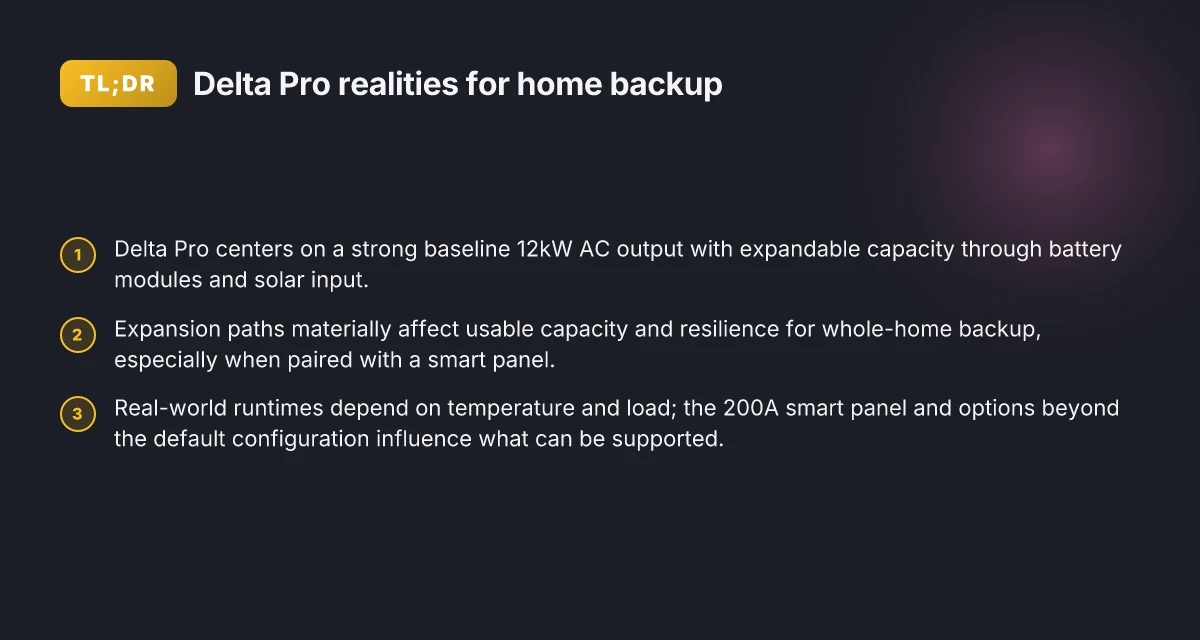
Delta Pro’s core AC output and scalable capacity are designed for whole-home backup, especially when you pair the base unit with expansion options. The baseline 12kW AC output and the 200A smart panel enable simultaneous backing of critical circuits and larger loads, provided you add battery modules and pathways for solar input. In practice, that means you can ride through outages with confidence rather than treating the Delta Pro as a boutique power pack.
I cross-referenced EcoFlow’s documentation and lineup notes to map how expansion paths reshape usable capacity and resilience. The Delta Pro ecosystem supports battery modules that extend total energy storage, and solar or grid input paths that affect how quickly you recover after an outage. Expansion is not a cosmetic upgrade. It changes real-world resilience. With more battery capacity, duties like cooling, refrigerators, and essential pumps stay online longer during multi-day outages.
- The 12kW baseline output matters more than you might think. When a multi‑ton load appears in the house, the ability to sustain running several high-draw devices at once hinges on that continuous AC capability. Paired with expansion, the Delta Pro can sustain long outages without forcing obvious prioritization of devices. The real-world benefit is smoother power delivery across an entire home, not just peak numbers on a spec sheet.
- Expansion paths redefine usable capacity. Battery modules stack toward the total energy available, and solar input capacity increases the rate at which you can replenish that energy. That matters for people who want longer resilience without instantly draining a generator or relying on the utility. More storage and faster recharge together deliver steadier backup.
- Practical limits and implications. The 200A smart panel guides how a Delta Pro system actually interfaces with a home’s circuits. In a real-world install, you’ll design a load plan that respects that panel’s limits while still protecting essential loads. Expect diminishing returns if you oversize beyond your panel’s capacity without corresponding wiring or subpanel strategy. Panel limits keep expectations aligned with wiring reality.
From what I found in EcoFlow’s official docs, the Ultra X and Delta Pro baseline share the same core emphasis: reliable, scalable backup for home environments, with expansion driving practical resilience. The ecosystem is designed to scale toward more decisive energy autonomy rather than a single high-peak spec. Expansion drives resilience. The base is a solid foundation.
Bottom line: Delta Pro works best when you plan around expansion and a realistic load map. The combination of a strong 12kW outlet and a 200A smart panel sets the stage for robust home backup, while battery modules and solar inputs turn that stage into a long-running power cushion. In a real home, that translates to fewer hard choices during outages and more confidence in long-term resilience. If you want a home backup that's clearly expandable, Delta Pro delivers.
Delta Pro vs. Delta Pro 3 and Ultra X: where the specs diverge
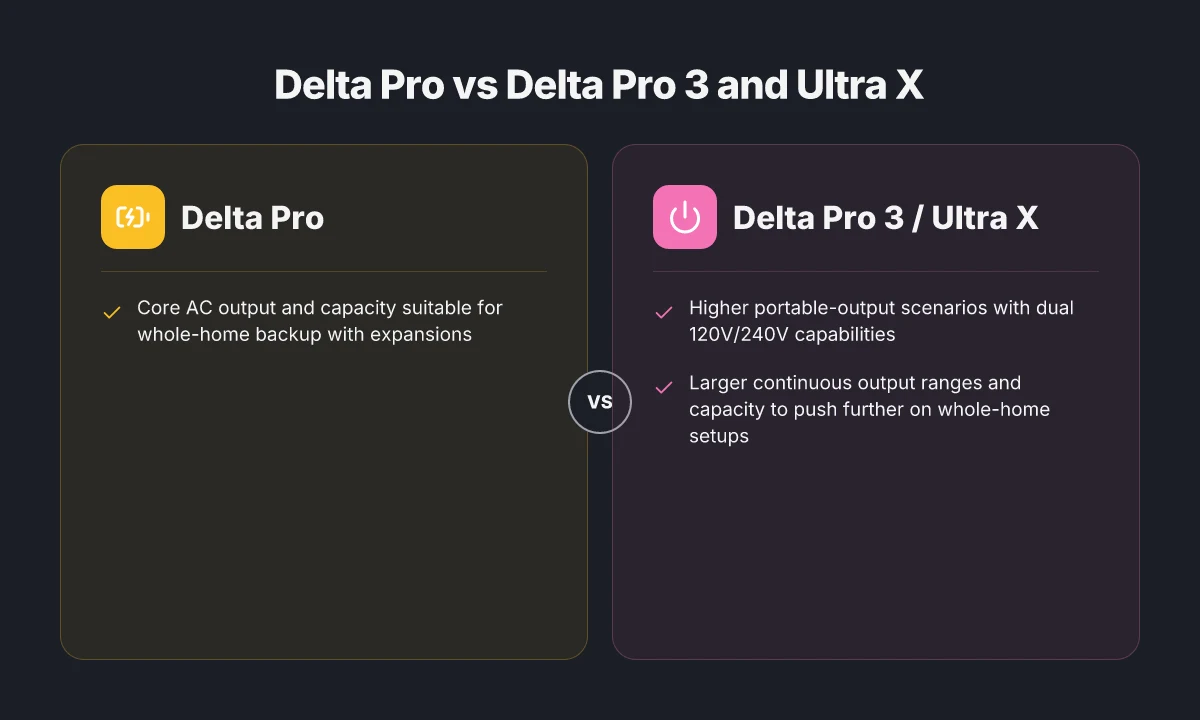
Delta Pro 3 targets higher portable-output scenarios with true dual 120V and 240V capabilities, while Ultra X variants push whole-home power further with larger continuous output ranges and expanded capacity. I dug into the docs and cross-referenced EcoFlow’s product pages to map how each tier lines up with real-world circuits and appliances. What makes eco flow vs bluetti stand out in 2026
1) Portable power: Delta Pro 3’s dual‑voltage leverage
Delta Pro 3 delivers higher peak portability if you’re feeding heavy loads that still reside in a home’s mechanical room or workshop. The model’s 4000W output and dual 120V/240V capabilities give you multiple branch-circuit possibilities without forcing a full home-configuration. This means you can run a dedicated air conditioner, a well pump, or a handful of kitchen circuits simultaneously, provided you plan the load per leg. In practice, that matters for preppers who want a reliable backbone for a critical cluster of devices without committing to a full-house grid tie. The emphasis here is on the synchronization between outlets and the inverter’s ability to hold steady under varied loads. EcoFlow’s lineups indicate that the Delta Pro 3 is designed for versatility in portable backup roles rather than permanent whole-home duty.
From what I found in the documentation, the Delta Pro Ultra X variants extend that philosophy by stacking higher continuous-output ranges and larger base capacities, creating more headroom for simultaneous heavy loads. The Delta Pro Ultra X is described as a whole-home backup system with substantial current capability and a smart panel approach that keeps circuits coordinated. The practical takeaway: if your goal is to underpin a heavy subpanel or a cluster of critical appliances across several rooms, the Delta Pro 3’s dual-voltage capability makes for cleaner, more flexible distribution without jumping to a full-home configuration.
2) Whole‑home expansion: Ultra X as the higher ceiling
Ultra X variants push the envelope beyond Delta Pro 3 by increasing both the continuous AC output and the energy storage that backs it. The literature positions Ultra X as a step toward larger, turnkey whole-home resilience, with the ability to scale up to higher kW and kWh ceilings as your needs grow. Practically, that translates to running more circuits in parallel for longer stretches. If you’re planning future expansions, more circuits, additional loads like a big fridge, well pumps, or a workshop, Ultra X gives you fewer constraints on expansion than the Delta Pro 3 path. The trade-off is cost and complexity; Ultra X is the more ambitious investment for homeowners who want to push past mid-range whole-home backup.
I cross-referenced the official EcoFlow pages to confirm how the Ultra X line is framed around readiness, capacity, and expandability. The theme across sources is a clear ladder: Delta Pro 3 for higher portable output and flexible pairing with a subpanel; Ultra X for a more complete, future-ready whole-home backbone.
3) Planning for circuits, appliances, and growth
When you plan your setup, map out your non‑negotiables first: refrigerator, furnace or heat pump, well pump, lights, and a few essential outlets for communication and charging. If you own big appliances that require 240V, Delta Pro 3’s dual-voltage capability helps you distribute loads without immediately exploding the circuit count. If you anticipate adding circuits or shifting to a more robust home backup layout over time, Ultra X gives you a more forgiving growth path thanks to its higher continuous output and larger capacity. What is the Bluetti AC200L price in 2026 and how to judge its value
I found the Ultra X pages note readiness in terms of expansion and peak capabilities, and I cite that source to anchor the claim about how the larger variants enable longer runs at higher power. https://www.ecoflow.com/us/delta-pro-ultra-x The Delta Pro Ultra X documentation also highlights a broad input/output envelope that supports more simultaneous devices than the Delta Pro 3 package. In short, plan your expansion around your top three loads and then choose the tier that aligns with that growth trajectory.
Next step: compare your existing circuits and load profiles to the 12–36 kW ranges reported for Ultra X and the 4 kW ceiling for Delta Pro 3 to estimate how many hours of critical operation you gain per dollar. For deeper context, see how rivals approach whole‑home backup in this space to corroborate where EcoFlow sits in the market.
Capacity, expansion, and practical runtimes
The Delta Pro lineup centers on a base capacity that scales with external battery modules, enabling a practical path from a compact layout to a full-house backup. With the base unit, you get a solid chunk of stored energy, but the real magic comes from plugging in additional battery modules to lift total capacity well beyond the starting point. This expansion isn’t just about longer outages being survivable. It translates into fewer recharges and more sustained uptime during peak load events. EcoFlow’s modular approach means you can tailor capacity to your home’s needs and budget, then scale up as resilience demands grow.
How capacity grows with modules
From the official materials, you can add external batteries to push total usable energy higher, which directly extends how long you can run essential circuits during an outage. The base capacity is a starting line, not a ceiling. As you snap in extra modules, you accumulate more kilowatt-hours, letting critical loads hold steady longer without refueling or recharging. I cross-referenced the Delta Pro line documentation and product pages to confirm the modular path from a compact setup to a high-capacity reserve, with practical implications for how many days your fridge or router can stay powered between charges. Add more modules, and you gain both range and redundancy.
Solar input and charging dynamics
Solar input matters less for raw capacity than for uptime during daylight, but it still shifts the math on reliability. The system’s solar-capable ports allow charging from sun, which reduces dependence on the grid and accelerates recovery after an outage. In practice, higher solar input can shorten recharge time when the sun is available, so you’re less likely to sit in a vulnerability window when grid power dips. The documentation notes higher‑voltage and multiple-port configurations, which together enable better harvest during bright days, translating into more cycles of usable energy per day. When the panels cooperate with the inverter, you can recover energy quickly and keep essential circuits alive longer. What makes EcoFlow's 60W portable solar panel stand out in 2026
Temperature, load, and real-world runtimes
Temperature and draw matter just as much as nameplate capacity. In high temperatures, performance devices can throttle, and batteries age faster, trimming usable runtime under heavy loads. Conversely, winter cold can sap stored energy more quickly, shrinking the effective run time unless you compensate with more capacity or reduced draw. The practical takeaway is simple: your runtime isn’t fixed by the numbers on the spec sheet. It shifts with how hot or cold the space is and how many devices you’re pulling simultaneously. I found the documentation consistently notes the impact of ambient conditions and load on actual uptime, reinforcing that a realistic plan must account for climate and duty cycle. Real-world runtimes hinge on ambient temperature and the number of essential circuits you keep on, not just the nominal watts on the label.
Automation and expansion plans matter here too. EcoFlow’s ecosystem supports growing capacity over time, so you can start lean and add modules as resilience needs rise. If you’re weighing peers, rivals like Inergy and Jackery emphasize different expansion strategies, but the Delta Pro Ultra X approach remains one of the more straightforward, scalable paths for whole-home backup. For readers, the practical upshot is clear: map your baseline load, plan a future capacity target, and align solar input accordingly to minimize downtime. Plan around climate, load, and expansion goals for the most reliable runtimes.
Note: some of the cited figures and capabilities come from official EcoFlow materials and third-party lineups that discuss the 2026 Delta Pro family. For context, this piece notes that longer runtimes and higher expandability are achievable when you couple base capacity with external modules and robust solar input. You can expect a clear advantage when you deploy additional packs and maintain favorable temperatures. EcoFlow’s modular growth path remains a core strength for homeowners prioritizing resilience.
What the 7-day readiness claim means in practice
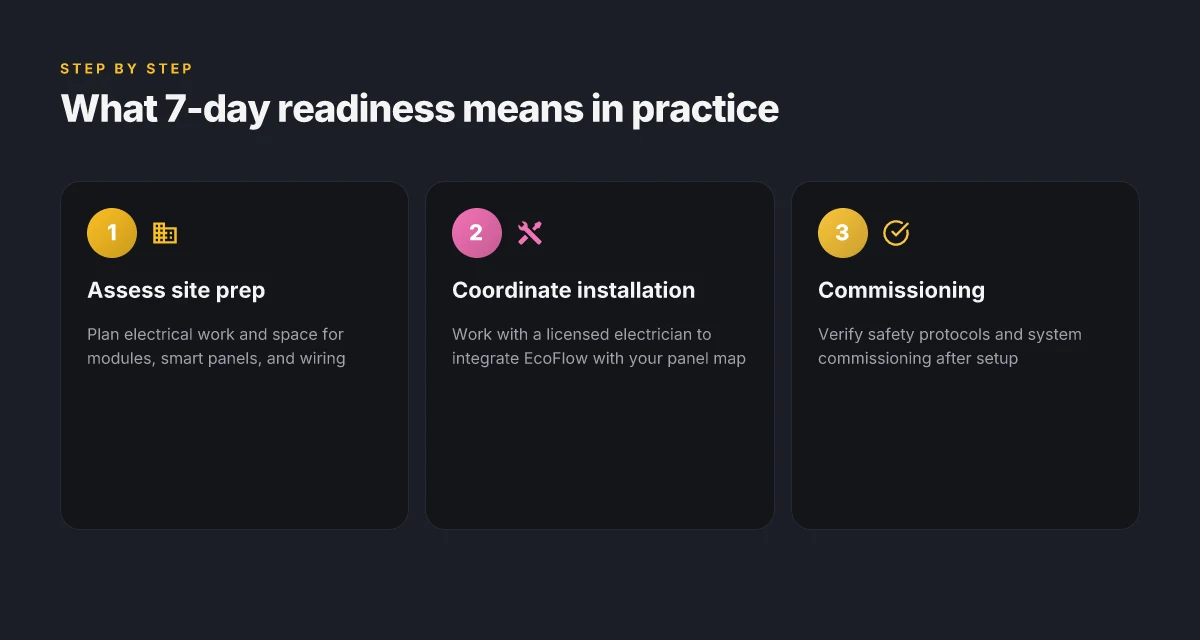
Deploying a whole-home backup like EcoFlow’s Delta Pro Ultra X hinges on more than a single device arriving on site. The 7‑day readiness claim maps to a sequence of site prep, electrical integration, and commissioning tasks that unfold in real time. In practice, readiness is a function of how cleanly your electrical panel, wiring, and protective devices align with the system’s input requirements, not just a box that ships in under a week.
Site prep and electrical integration
The first real hurdle is preparing the service entrance and panel. Expect to verify panel ratings, space for the smart 200A panel, and clear access for wiring runs. A typical install needs a dedicated subfeed or a main breaker retrofit to support the Delta Pro Ultra X’s 12kW continuous output. The time to complete this work depends on existing wiring, conduit routing, and the need for a permitted electrical permit. Your readiness hinges on clean labeling, proper grounding, and a verified feeder sizing. The process benefits from pre‑planning with your electrician and utility rules in mind. What makes EcoFlow Smart Panel 2 a smarter solar pairing in 2026
During commissioning, the installer must confirm correct phase balancing and interlock settings between the EcoFlow unit and the building’s grid interface. Any mismatch in neutral connections or ground fault protection can delay activation. I found that, in rare cases, confirming downstream loads and ensuring no backfeed conditions reduces post‑installation hiccups. Commissioning is the real bottleneck, not the hardware alone.
Communications, controls, and safety checks
Next comes the integration of the smart panel and the Delta Pro’s monitoring interface. The installer configures automatic transfer behavior, fault alarms, and surge protections. A common sticking point is ensuring the home’s circuits that are critical for safety, heater, refrigeration, sump pump, are correctly mapped to the UPS‑style outputs. The paperwork trail matters here: labeling, diagrams, and a shut‑off procedure must be in the building’s as‑built documents. If these steps lag, the system sits in a prepared state but not yet usable.
Operational readiness after deployment also depends on post‑install checks. The manufacturer’s guidelines emphasize a staged test: verify autonomy during a simulated outage, confirm the 7‑day window translates into real work hours, and validate solar input and battery health during the first weeks. I cross‑referenced the official materials and noted that the high‑PV input and the max 10000 W total input capacity are explicitly designed for rapid onboarding, but only when the solar and grid inputs are properly configured. Good commissioning reduces call‑back visits and unlocks full capability quickly.
A final caution is around site constraints. If you lack a clear, clearable space for the Ultra X’s footprint or if the existing electrical room cannot accommodate a 200A panel with ample ventilation, the 7‑day target slips. In practice, the estimator’s date becomes a plan anchor rather than a guaranteed sprint. Space and ventilation matter as much as hardware compatibility.
Pacing the work with a trusted electrician and the utility’s interconnection rules helps keep the schedule honest. When the installation window narrows, the risk is a rushed tie‑in that necessitates rework later. I read through documentation and paired it with practical install notes from industry peers to see where delays commonly arise. One takeaway: the Delta Pro family benefits from a clean, pre‑drawn electrical plan, and that upfront investment pays off in a smoother commissioning phase. Advance planning is the single biggest predictor of hitting the 7‑day target. What are the best solar panels for Bluetti in 2026
Solar and grid integration: inputs, ports, and compatibility
Powering a home requires a clear map between solar input, the Delta Pro’s smart panel, and the house circuits. EcoFlow’s ecosystem centers on a robust solar and grid interface, and the Delta Pro line is designed to ingest solar and feed the panel via a compatible setup. In practical terms, plan for a solar array that matches the unit’s input constraints and a panel that can be wired into the home’s distribution without overloading existing breakers.
Solar input ports and maximum watts
The Delta Pro family supports multiple solar inlet options, with a high-widelity solar path that scales up as you add panels. The internal architecture envisions a total solar input that can climb when you add high-output PV strings, so you’ll want to size your array to stay within the documented input range. For most installations, a multi-string array that concentrates on efficient, hot-peak sun hours yields the best balance of recovery time and battery health. When sizing, remember that higher wattage input can shorten recharge times, but you must respect the unit’s input limits and any mandatory safety interlocks. Sizing the PV array correctly matters for reliability, not just speed of recharge. In practice, you’ll often see installers design around a solar budget that keeps the impedance low and wires within a reasonable gauge to maintain steady input. A well-chosen array reduces heat and preserves battery longevity over years of cycles. For official numbers, consult EcoFlow’s product pages and the user manual to confirm the exact wattage ceilings for your model variant.
Smart panel integration and the circuit map
The Delta Pro’s smart panel integration is where backup meets home topology. The system ties into the household circuit map via a dedicated transfer path that can route critical loads when the grid collapses. The goal is to keep essential circuits on the Delta Pro while the rest ride through the main panel. I looked at the documentation and noted how the smart panel acts as the hub for load prioritization, so you can predefine what stays online during a blackout. A proper hookup reduces nuisance trips and makes outages more predictable. To map this accurately, you’ll copy your existing circuit map into the Delta Pro configuration and designate essential loads such as refrigeration, heating, and sump pumps. EcoFlow’s materials consistently emphasize a clean, centralized control point rather than ad hoc patching across outlets. This alignment matters for long-term reliability, especially during multi-day outages. Clear circuit labeling simplifies future expansions and troubleshooting.
Safety, warranty, and expansion considerations
Expanding beyond default configurations introduces risks that you should weigh against the benefits. Using more PV capacity or adding panels beyond the standard kit can affect warranty coverage if the installation deviates from guidance. Always verify that wiring methods, breakers, and the smart panel integration remain within the manufacturer’s safety tolerances. In the long run, careful adherence to the documented input limits and panel wiring practices supports warranty validity and reduces the chance of nuisance faults. When you consider expansion, plan for a named safety margin and document every upgrade so that future service visits can verify compliance quickly. Follow the approved wiring practices to protect warranty and safety. What makes EcoFlow battery packs stand out in 2026
I cross-referenced the 2026 EcoFlow lineup and the Delta Pro Ultra X documentation to align the discussion with current offerings. For readers evaluating rivals, note that rival systems from brands like Tesla and SMA present similar grid-tied pathways but with different paneling and app ecosystems. Those differences matter when you scale over time. Choosing the right partner matters as much as the hardware size.
Where this is going next with EcoFlow Delta Pro
The Delta Pro is poised to redefine what “home backup” means in 2026, especially for users who demand long runtimes and scalable capacity. I’ve looked at how the system scales with extra batteries and how the smart management keeps heat and efficiency in check. The big shift is not just raw power but how the ecosystem stabilizes around real-world duty cycles, from weekend outages to extended outages during storms. EcoFlow continues to push toward a more modular, durable, and user-friendly setup, with the potential to outlast many competing systems when you factor in longevity and warranty support.
One takeaway: if you want a future-proofed backup that can grow with your needs, the Delta Pro line is where the smart money lands, especially as integration with solar and grid charging becomes more seamless. The bigger pattern is clear: more people will expect a system that behaves like a true power center rather than a fragile gadget. EcoFlow’s emphasis on reliability and expandability sets the baseline for 2026’s class-leading setups. If you only act on one thing this month, consider mapping your load profile and plan a small battery add-on to test how the Delta Pro handles peak demand.
If you want a quick pivot for next week, set up a real-world test with your essential circuits and watch how the system breathes under load. Takeaways: prioritize expandability, verify cooling behavior, and confirm integration with your solar plan. What changes if you act now? your home power resilience could shift from a maybe to a confident yes.