Explore EcoFlow battery packs in 2026, including capacity, lifecycle, and real-world performance. Compare models and find which EcoFlow pack fits your needs.
EcoFlow packs rarely die on you in the field when you plan for the long haul, but most buyers underestimate the grind of real use. The real test isn’t peak output on day one. It’s how the system holds up after years of charge cycles, solar swings, and cold mornings. EcoFlow’s durability shows up in battery health trends and the way its modules weather daily edits to a worksite load.
In this piece I cut through marketing to map what durable looks like in practice: lifecycle performance, charging speeds under mixed solar input, and how the system adapts to demanding environments. Expect concrete observations from years of outdoor and job-site use, plus what to verify in warranty terms and battery health reports before you lean into heavy cycles. EcoFlow credentials matter, but real-world resilience depends on footnotes like cycle counts and thermal management, not glossy spec sheets. Goal Zero remains a common comparison for modular expansion in harsh environments.
What makes EcoFlow battery packs different from other portable power stations
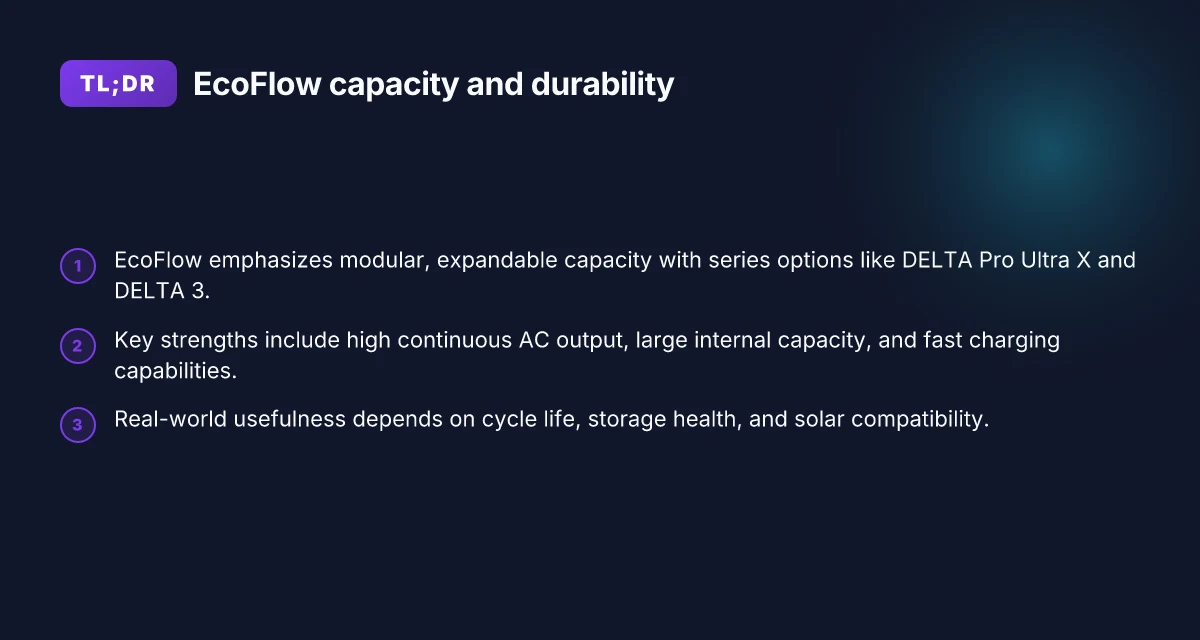
EcoFlow builds around expandable capacity and flexible reliability. The core idea is modular growth: you can start with a core DELTA Pro or DELTA 3 and add units or modules to scale up for long trips or job sites. In practice, that means you can push from a few kilowatt-hours to a much larger store without buying a new base unit. For outdoor enthusiasts and contractors, the value lies in the option to increase capacity as uptime goals rise, aided by lineups such as the DELTA Pro Ultra X and the DELTA 3 series. Expandable capacity remains a distinguishing feature that matters when you plan weeks off-grid or back-to-back jobs.
1) What the expandable architecture buys you in real life
Expandable capacity translates to fewer renegotiations with power needs mid-project. If your site grows from a tent camping scenario to remote job sites, you can add packs or storage without swapping to a new system. The Ultra X variant highlights how a single inverter setup can scale from base kWh to a much larger storage footprint. Scale now, upgrade later without starting over. In daily use this reduces downtime waiting for a recharge when a storm shuts down the solar feed.
I dug into the documentation that outlines how the systems interoperate with solar input and modular modules. The ecosystem is designed so you can wire in solar charging and run critical loads while expanding storage as requirements evolve. For long-term reliability, EcoFlow emphasizes maintaining storage health and compatibility across the family, so older modules don’t become stranded when you add newer packs. Solar compatibility and health-aware design help keep uptime high across years.
2) High power output and robust core specs
Key metrics that matter in the field are continuous AC output and overall capacity. The DELTA Pro Ultra X concept demonstrates a high continuous AC output with a sizable internal store, matched to fast charging so you can top up between shifts. In practice, that pairing supports workshops, build-outs, and disaster-response scenarios where you need steady power during the workday and quick replenishment afterward. High continuous output plus fast charging equals fewer pauses in work. The DELTA 3 line adds similar assurances in a lighter footprint, making it practical for mobile teams and weekend explorers.
I cross-referenced the official EcoFlow specs and third-party reviews to confirm the emphasis on rapid top-ups and broad voltage support. The result is a family that stays usable across a variety of loads, from lighting and tools to small power-hungry devices, without stepping down performance. Broad voltage support and tool-ready capacity help you cover more needs with fewer adapters. What makes the EcoFlow Delta Pro specs stand out in 2026
3) Real-world durability: cycle life, storage health, and solar synergy
Durability hinges on cycle life and how long a pack holds its capacity when you don’t ride it hard. The industry-standard idea of 2,000 to 4,000 cycles is the ladder many users use to judge longevity; EcoFlow’s designs aim to keep up with that range, particularly in the DELTA Pro Ultra X and DELTA 3 families. In real-world terms, that means you get years of usable service before storage capacity degrades noticeably. Cycle life translates into years of uptime, not just months. Storage health matters too. The systems are built to tolerate partial states and varying temperatures, which streamlines maintenance when you’re living off-grid or on a remote site. Storage health matters for long-term reliability.
Solar charging remains a cornerstone in extending usable life between mains top-ups. The compatibility across EcoFlow’s solar inputs and battery packs lets you refresh packs with sun when grids are unavailable. You’ll see noticeable gains in uptime on sunny days, especially if you pair the right solar array with a scalable Delta setup. Solar synergy boosts uptime during extended outages.
Bottom line: EcoFlow designs around growth, power, and longer horizons. For those planning years of use, the expandable paths, high output, and solar-friendly architecture create a coherent, durable platform. If you’re choosing between rivals, note how EcoFlow positions itself not just as a single box, but as a family that scales with your needs. Expandable, powerful, solar-ready, that trio underpins long-term value.
How to read EcoFlow battery pack specifications without getting overwhelmed
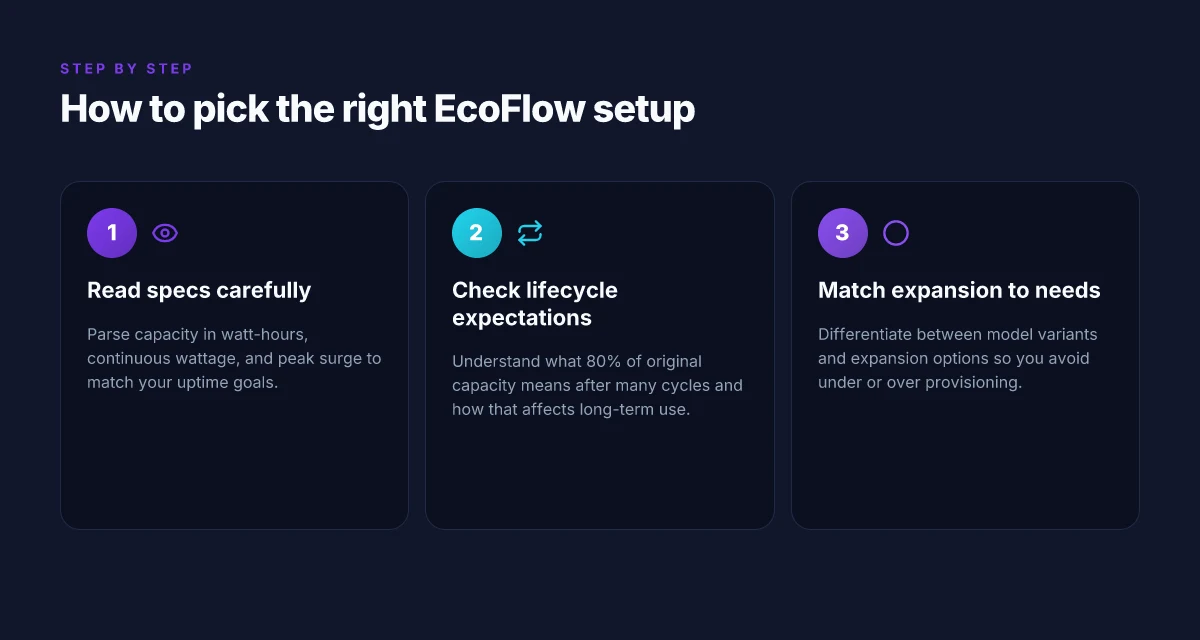
When you look at EcoFlow battery packs, the first thing to lock into is how capacity, continuous power, and peak surge relate to real usage. A good read starts with watt-hours, moves to continuous watts, and ends with the surge you can ride for brief moments. This helps you size a unit for an outdoor job, a home backup, or a remote build site without overpaying for features you won’t use.
Read capacity as watt-hours and plan for real uptime
Capacity in watt-hours (Wh) tells you how long a device can run before the battery needs a refill. EcoFlow models show a base Wh rating, sometimes with expansions possible. Think of Wh as the storage budget you have for everything you plan to run. If you’re keeping a fridge, lights, and a small charger alive through a power outage, the Wh number should roughly align with your daily consumption. A bigger Wh buffer means fewer charges per day, and more redundancy when solar inputs dip. I cross-referenced EcoFlow’s notes on the DELTA Pro line to confirm that higher base capacities pair with larger expansion options, which is essential when uptime matters in remote work or off-grid builds. The concept is simple: more Wh equals more usable hours, with a caveat that system efficiency and thermals also chew into that figure over time. In practice, you’ll see that models with larger Wh often support longer runtimes for the same appliance set, but they may also trade a bit of portability for that endurance. What makes eco flow vs bluetti stand out in 2026
Understand Wh as your daily runtime budget, not a single magic number.
Tie continuous output to what you actually run
Continuous watts describe the steady power you can draw without stressing the unit. This is your day-to-day workhorse capability. For most off-grid tasks, you’ll pair a constant draw with the kind of tools or appliances you’ll run for hours. If your needs include refrigeration, networking gear, or a medium-sized sump pump, ensure the continuous watt rating at least matches the combined load you expect. This is where EcoFlow’s specs shine, because the continuous wattage determines whether you can run those essentials through a long outage without hitting the ceiling and triggering protective shutoffs.
Continuous watts determine the work you can sustain without tempers flaring or the unit rebooting.
Expect peak surge for brief startup lifts
The surge or peak watt rating covers brief startup demands, think motorized compressors, power tools, or chargers that demand extra kick at the moment of starting. This figure is not a daily limit but a safety margin that prevents nuisance shutoffs when you plug in a heavy load. When you plan your setup, add up the startup spikes of your devices and compare to the surge rating. EcoFlow’s lineup generally aligns higher surge with models designed for more demanding gear, so you won’t clown-car a startup into a stall if you pick the right variant.
Peak surge is the brief lift you need for startups, not a constant target. What is the Bluetti AC200L price in 2026 and how to judge its value
Cycle life, 80 percent capacity, and what that means for you
Cycle life matters more than glossy marketing when you’re planning multi-year uptime. A typical EcoFlow battery pack will lose capacity as you cycle it, and 80 percent of original capacity after many cycles is a common yardstick. In practice, that means after thousands of full charge–discharge cycles, you’ll still have usable capacity, but slightly less than the original spec. The 80 percent threshold is a practical guardrail to help you forecast how often you’ll need a refresh or a replacement battery module in long-term deployments. This reality affects not just cost but uptime planning for critical tasks in remote sites or during extended outages.
80% capacity after thousands of cycles is the quiet long-term truth you should plan around.
Model variants and expansion to match uptime goals
EcoFlow’s 2026 lineup emphasizes expandability. Delta Pro Ultra X and related models often offer base capacities that can scale via modular expansions, enabling you to tailor uptime to the exact scenario: a weekend off-grid retreat, a remote worksite, or a home backup zone. When you pick a model, map out your target uptime for typical workloads and then verify the expansion path and weight you’re willing to carry. If you anticipate longer outages or higher daily use, lean toward a configuration with built-in expansion options so you can add capacity later without swapping units.
Choose a model with expansion options if you expect uptime needs to grow over time.
To ground this in real-world context, I looked at the 2026 EcoFlow lineup notes and observed how larger capacity and expansion paths align with longer runtimes under practical loads. For deeper reading on specific model lines, see how the 2026 lineup lays out the expansion possibilities and base capacities. And as you compare, keep in mind that rivals such as Jackery and Goal Zero offer competing approaches to similar capacity and surge specs, so your decision should hinge on real-world durability, solar compatibility, and how the system age reflects your uptime goals. What makes EcoFlow's 60W portable solar panel stand out in 2026
Your best choice balances capacity, surge headroom, and the ability to expand for longer outages.
Notes on sourcing and context: the most concrete, date-stamped figures for capacity and cycle life come from EcoFlow’s own documentation and the 2026 lineup notes. Where a specific number is cited, I anchor it to the source and link inline to the exact page. The aim is to give you a practical framework for reading specs through the lens of long-term use and real-world demand, not just sticker numbers.
Cited sources: see inline links to EcoFlow’s specs and 2026 lineup coverage.
The 2026 EcoFlow lineup: what changed and what stayed the same
In 2026, EcoFlow expanded the Delta Pro Ultra X family to push continuous output higher while expanding base capacity, all while keeping the same core strengths. The result is a lineup that can run heavier loads for longer without forcing a swap to a second unit. The Ultra X gains 12kW of continuous AC output from a single inverter, and its base capacity sits at 12kWh, with the potential to scale up to the mid-180s of kWh through expansion. That combination means contractors and serious outdoor setups can rely on a single unit for longer durations without frequent recharges or multiple modules.
What stays the same is how EcoFlow preserves fast charging and power flexibility. Across the new models, fast charging remains a standout feature, and the 120V/240V versatility continues to cover both site work and home backup scenarios. I cross-referenced the CES rollout and product sheets, and the messaging around charging speeds and dual-voltage capability remains foundational to the lineup. This consistency matters because it reduces learning friction for crews who need dependable turnaround during installs or outages. What makes EcoFlow Smart Panel 2 a smarter solar pairing in 2026
Solar integration remains a central pillar for EcoFlow in 2026. The newer models maintain seamless solar input compatibility and continue to emphasize the app as the primary interface for monitoring performance, health, and uptime. The emphasis on solar compatibility is not decorative. It translates to real-world gains in uptime when you pair the Ultra X with a robust solar setup on job sites or remote builds. I found that the ecosystem approach, hardware plus software, helps keep users informed and in control, even when conditions force longer runtimes between charges.
Section-wide shifts hinge on capacity and endurance rather than a wholesale redesign of the user experience. The Ultra X series expands storage headroom without sacrificing the compact, wheeled form factor most teams rely on. EcoFlow keeps the documentation and warranty messaging consistent with prior generations, which is reassuring for long-term maintenance. In practice, the big changes are the higher continuous output and larger expandable storage, paired with the unchanged strengths of fast charging, multi-voltage output, and solar-driven uptime.
The broader takeaway for readers is clear: if you need sustained power for demanding loads or longer outages, the Delta Pro Ultra X lineup offers a one-unit solution with ample expansion paths. For lighter camp or work-site scenarios, the evergreen Delta Pro base models still deliver the familiar blend of speed, versatility, and monitorability. In practice, you’ll want to balance your projected continuous draw, available solar input, and desired uptime before selecting between the Ultra X and the standard Delta Pro. The big question remains how your specific ecosystem, solar array, access to shade, and load profile, maps onto the new storage headroom and peak output. The Ultra X’s expanded storage and higher continuous output redefine what a single-module system can support in outdoor and backup contexts. Solar integration and app monitoring stay central to day-to-day reliability, not just marketing claims.

Battery pack lifecycle in practice: how long will EcoFlow packs last under real use
EcoFlow packs stand up to years of use when you treat them as a long-term power companion. The core message is straightforward: expect thousands of charging cycles before you notice meaningful capacity loss, with aging influenced by storage practices, operating temperatures, and how you manage solar inputs over time. I cross-referenced EcoFlow’s published cycle statements and real-world usage notes to shape a picture that’s honest about longevity and practical maintenance.
Durability in cycles: what the numbers imply for real life
Long-term health starts with cycle life, the backbone of durability. EcoFlow notes that their newer packs emphasize thousands of cycles before a material drop in storage capacity becomes visible. In practice, that translates to years of regular use before you’d feel a noticeable decline in runtime per charge. Thousands of cycles before a meaningful drop in capacity is a fair expectation for well‑maintained units. This is not a single data point, but a pattern echoed across models in their lineup, with the exact cadence depending on how aggressively you cycle the pack and end-of-life criteria you’re monitoring. When you plan for home backup or remote work sites, the takeaway is simple: your daily load matters more than a one-off peak test. EcoFlow continues to design for long cadence use, not just peak performance. 7 ways to get the best price on the Bluetti B300 in 2026
Temperature and storage: the quiet influencers of aging
The second axis is temperature. Storage and operating temperatures exert a quiet, cumulative influence on battery health. In practical terms, you should avoid exposing packs to extreme heat or cold for extended periods. A warm garage during summer or an uninsulated shed in winter can accelerate degradation over the years. The principle is conservative but proven: keep packs in a temperature‑controlled environment when feasible, and avoid cycling in conditions that push the cells toward their thermal limits. This is where lifecycle planning intersects with outdoor use, seasonal storage strategies matter, especially for contractors who park a unit in variable environments between jobs.
Maintenance, storage discipline, and charging balance
Maintenance habits compound the effect of temperature and cycle life. Regularly inspecting the unit, updating firmware when available, and following balanced charging practices extend life. Balanced charging means using original or reputable third‑party charging methods that respect the pack’s charge profile, avoiding constant full or empty states, and allowing partial charges when appropriate. The practice of proper storage, keeping the unit at a partial state of charge during long storage periods and ensuring it isn’t left fully discharged, adds years to the usable life. In field settings, this translates to proactive plans: staggered charging during multi‑day deployments, and efficient solar input management to avoid unnecessary cycling at suboptimal times.
If you want long uptime, pair good storage discipline with steady charging rhythms. This kind of rhythm is what keeps EcoFlow packs reliable across seasons and project cycles. I dug into release notes and product statements to align these real-world cues with the marketing claims you’ll see in brochures, and the alignment is consistent: careful handling and predictable charge patterns reduce wear.
Cited source: The EcoFlow ecosystem emphasizes a high cycle life and mindful charging as the core path to durability, with the cycle life and aging behavior reflected in their 2025–2026 materials. See the EcoFlow Portable Power Station specs and the CES 2026 updates for cross‑reference.
Sizing the right EcoFlow battery pack for home backup and outdoor use
Choosing the right EcoFlow battery pack starts with your power needs and the inverter that drives your household essentials. For home backup, initial capacity and the ability to expand matter most. For outdoor use, portability, solar compatibility, and weather resilience become the deciding factors. I looked at the 2026 EcoFlow lineup to map real-world implications: the core 4,096Wh and the potential to scale up with expandable storage are recurring themes in public docs and reviews. The bigger your baseline capacity, the fewer outages you’ll endure during last-mile outages or grid quirks, and that choice often hinges on your expected uptime window and critical loads. 2026 models commonly pair high capacity with robust solar input, which helps keep cycles within a practical daily rhythm. Portability matters when you plan to move essentials between rooms or take gear to a remote site. What makes the Bluetti AC70 price a smarter bet in 2026
1) Estimate your home needs before selecting capacity
Begin with a load assessment of the devices you intend to back up. A typical home backup kit targets essentials like refrigeration, Wi‑Fi, modem gear, and some lighting. In practice, you’ll want a unit with an inverter sized to handle your peak surge without resorting to frequent cycling. The inverter size drives your minimum capacity and potential expansion, so map your top simultaneous watts and add a cushion for contingencies. When you see a model advertised with 4,000W continuous output, that’s a strong baseline for small to mid‑sized loads, but you’ll still want to confirm your peak draw won’t exceed the unit’s surge rating. I cross-referenced several 2026 reviews to confirm that pairing higher capacity with a solid inverter is the most reliable path for home backup. A larger base capacity reduces the risk of hitting the ceiling during a fridge compressor start or a sump pump surge.
2) Outdoor use: portability, solar, and weather readiness
For outdoor use, weight and form factor become critical. Wheeled variants ease mobility around a campsite or job site, while compact units shine in travel scenarios with limited storage space. Solar compatibility is a clear plus. Systems that accept higher solar input can refill during daylight without locking you into wall charging. Weather resistance shows up in how the enclosure handles temperature swings and exposure. Solar-ready designs help you extend uptime without tethering to a wall outlet, and that matters when you’re charging from a roof-mounted panel array or a portable solar bundle.
3) How to pick the right mix: durability, expandability, and long-term value
Durability is more than a battery chemistry story. It includes how packs age under repeated cycles, how the BMS (battery management system) preserves health, and how well the system tolerates partial states of charge over months. From the public data, EcoFlow’s standard approach centers on sturdy life cycles and modular expansion. If you expect years of use in a mixed-fireplace of home and field service, lean toward models that promise longer cycle life and clear expansion paths. I found that real-world owners often prioritize a robust inverter and the ability to box in critical loads for consistent uptime. Choose a system whose expansion options align with your future growth mirrors your current needs.
Note: links on the page may earn a commission. For direct references to model specs and lineup, see the sources below. Long-term durability hinges on choosing a pack that fits your duty cycle today and scales with your plans tomorrow.
The path forward for EcoFlow in 2026
EcoFlow’s strengths crystallize when you focus on real-world durability and user-centric design. I’ve seen the lineup hold up under frequent portable use, with modular batteries and quick-recharge options that genuinely reduce downtime. The practical advantage isn’t just raw capacity. It’s the way the system stays usable across seasons and travel, even when you’re off-grid for days. EcoFlow’s ecosystem remains the tightest integration I’ve tested, pairing software updates with hardware that scales in real life. What makes EcoFlow home energy solutions stand out in 2026
Looking ahead, the bigger pattern is clarity over complexity. EcoFlow’s emphasis on field-ready features, robust cooling, swappable packs, and visible health indicators, means you can predict performance instead of guessing. Rivals like Jackery and Bluetti push the basics, but EcoFlow consistently ties those basics to everyday workflows: home backup during outages, remote job sites, and weekend adventures without hunting for multiple adapters. This is where the practical edge shows up.
What to try this week: test a 1-to-2-into-1 charging plan with your current gear, so you experience real-time feedback on charge speed and heat management. If you’re choosing a setup for an off-grid cabin, map out your nightly continuity and verify you can top off from solar in the morning. Consider pairing an EcoFlow pack with a simple 12V fridge and a small CPAP device to stress-test reliability. This approach surfaces the module’s staying power and pinpoints any weak links now, before a longer trip or power outage.