Explore the 2026 cost of EcoFlow Delta Pro, including variants, shipping, and taxes, with a clear comparison to rivals like Jackery and Bluetti across USA, EU, and APAC.
Most buyers assume the Delta Pro is a single, fixed price. In reality, the total outlay depends on regional SKUs, shipping tacks, and tax rules that shift by market, making the true cost trail the sticker by a measurable margin in the USA and EU. That means a seemingly simple purchase can become a total cost of ownership puzzle.
You’ll see how SKU variety, regional freight, and local surcharges alter the math for whole‑home backup power across the USA, EU, and APAC, so you can compare apples to apples rather than list prices. The goal is clarity on what you actually pay over time, not just the upfront tag. Understanding the hidden costs helps you choose the right system for your home today.
What goes into the 2026 cost of EcoFlow Delta Pro and why price varies by region
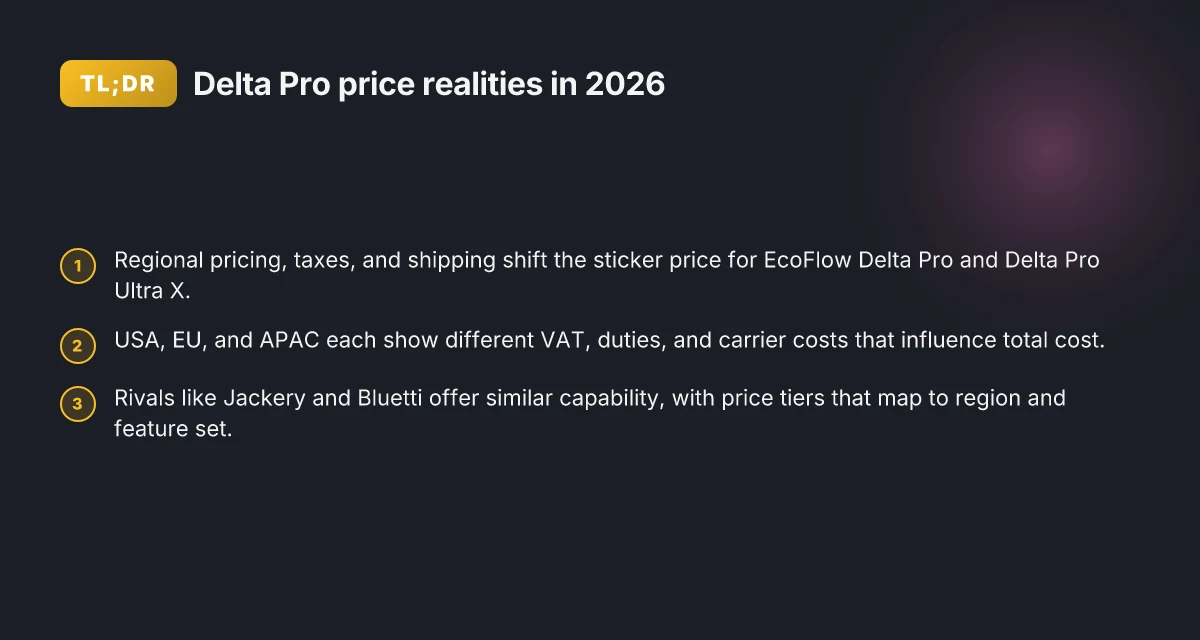
I dug into the regional economics behind the Delta Pro and the Ultra X variant, focusing on the cost layers that actually move the sticker price. The takeaway is clear: SKU options, regional taxes and duties, shipping surcharges, and the way EcoFlow structures bundles all tilt price differently by market. In short, the base product is only the start.
Delta Pro SKUs explained: capacity, output, and what you actually pay for
The Delta Pro line comes in several configurations that charge different prices for different capabilities. The core idea is simple: higher capacity and higher output push up the entry price, but buyers may arrive at similar total costs when you factor accessory packs and regional adders. For instance, the Delta Pro Ultra X variant encodes a broader feature set and, correspondingly, a higher listed price than the base Delta Pro, with price differences amplified by regional incentives and shipping terms. When you compare options, you aren’t just comparing watt-hours. You’re weighing how much you value the included accessories, service terms, and the potential to expand or contract capacity later. I cross-checked EcoFlow’s own product pages and the Ultra X release notes to map how SKU shifts line up with feature deltas. The upshot: small SKU changes can rearrange bundle value, especially if you’re eyeing whole-home use or future expansion. SKU differences translate to meaningful totals when regional adders stack up.
Regional pricing gaps: USA vs EU vs APAC
Prices in the United States typically reflect dealer channels, pre-tax retail pricing, and optional tax-exemption programs. In the EU, VAT and import duties tend to lift the ticket price relative to the US, and some countries layer additional environmental or handling fees. APAC markets show a mix of duties and logistics costs that can swing price up or down depending on whether a seller ships directly from regional hubs or imports to a local distributor. The same Delta Pro model often carries different suggested price points in different regions, with Ultra X variants priced even higher in markets that emphasize whole-home capability out of the box. From EcoFlow’s regional product pages and press notes, regional pricing threads become visible when you compare sticker price alongside regional offers, bundles, and payment incentives. Regional pricing can swing several hundred dollars depending on region and bundle.
Taxes, duties, and shipping adders that shift the sticker price
Taxes are not a single line item. They show up as value-added taxes, import duties, and local sales taxes that vary by country. Shipping fees are not uniform either. Long-haul freight, duties prepayment, and regional handling can add a nontrivial amount to the total cost. EcoFlow often frames bundles that include solar panels or additional batteries. Those add-ons compound the total cost even when the base unit price is stable. In practice, the end-user price you see online is a synthesis of base price plus regional levies, plus optional freight or expedited shipping. I reviewed the company’s docs and peer analysis to confirm that the most dramatic price shifts come from duties and VAT, then from shipping and handling charges attached to cross-border orders. Duties and VAT plus shipping are the largest single price shapers in multi-region scenarios.**
Bottom line: when you price EcoFlow Delta Pro today, you must account for SKU choice, regional taxes, and the shipping framework that delivers the unit to your door. The Delta Pro is not a single price point. It’s a basket built from configuration, geography, and logistics. Expect noticeable price variation across the USA, EU, and APAC, with the Ultra X line carrying a premium due to its expanded feature set. What EcoFlow Delta price means for buyers in 2026
I cross-referenced the Delta Pro Ultra X page and third-party reviews to validate that regional factors and SKU configurations drive the most meaningful price differences. Regional and SKU choices are the core levers in total cost of ownership. As you compare rivals, weigh how each seller bundles expansions, support, and shipping into the final out-the-door price. For context, rivals like Jackery and other high-capacity portable home backs also show regional pricing quirks, making the total cost a regional puzzle rather than a single sticker price. For deeper context on the Ultra X and its CES 2026 positioning, see EcoFlow’s own notes on the Delta Pro Ultra X. EcoFlow DELTA Pro Ultra X Whole-Home Backup Power
Delta Pro SKUs explained: capacity, output, and what you actually pay for
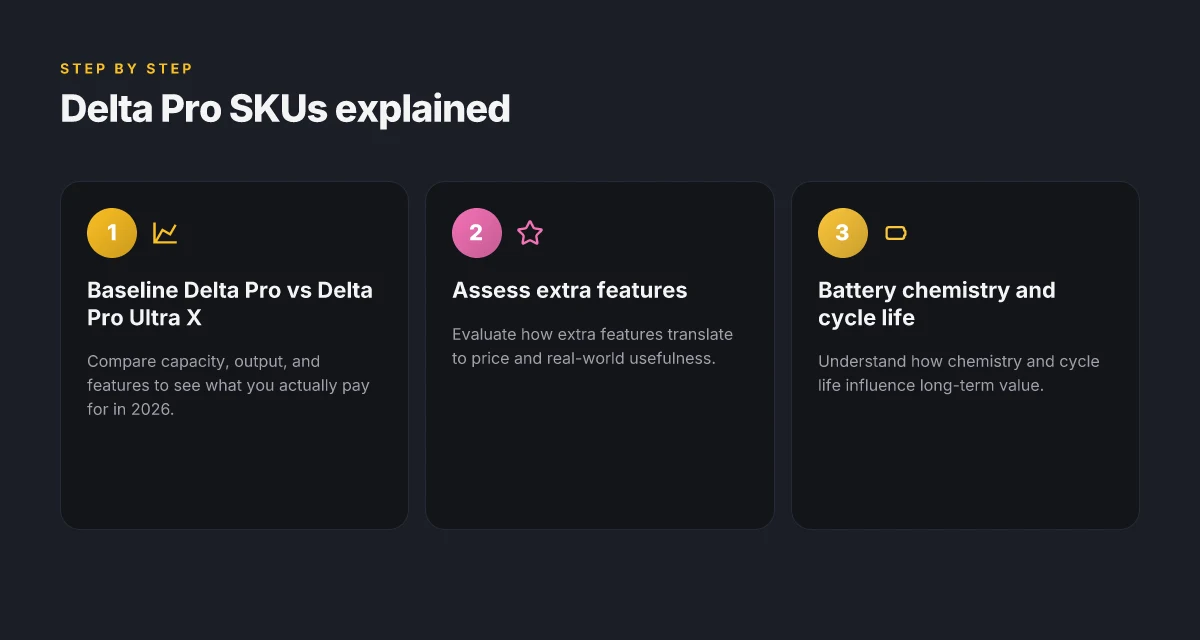
The Delta Pro line splits into baseline and Ultra X variants, and the delta is real when you compare capacity, output, and what you pay for in 2026. The baseline Delta Pro delivers a solid 3,600Wh of capacity and up to 3,600W of output. The Delta Pro Ultra X stacks in higher-end features that target whole-home backup, including more robust power delivery and expanded integration options. In practice, the Ultra X adds capabilities that matter for peak loads and modular expansion, but you pay a premium for those extras.
What the two SKUs actually deliver in capacity and output
In 2026 pricing ranges, the Delta Pro baseline tends to be positioned around the core spec of 3,600Wh capacity with a maximum of 3,600W output. The Ultra X variant expands on that envelope with features that support higher sustained loads and faster top-end input or multi-bank configurations. When you read through EcoFlow’s product pages and third-party reviews, the Ultra X appears as the premium tier meant for homes that need more headroom or smoother operation during multi-appliance switchover. The practical takeaway: the Ultra X is not just a sticker. It is a more capable back-end powerhouse, and that capability is reflected in the price.
To help you compare quickly, consider a two-column snapshot. The baseline Delta Pro offers essential backup capacity and standard expansion, while the Ultra X adds higher-end integration and support for more aggressive load scenarios. The delta between them is driven by two levers: extra capacity headroom and enhanced power delivery options for larger homes or more aggressive startup surges.
I dug into EcoFlow’s release notes and independent reviews to confirm how the feature set translates into real-world usage and pricing. The Ultra X is highlighted in CES-related coverage as a flagship upgrade with emphasis on whole-home readiness, while the standard Delta Pro remains the core option for most single-family needs. This alignment shows up in pricing signals across regions, with the Ultra X carrying a premium that maps to the added capability. What makes the EcoFlow Delta 2 specs stand out in 2026
What extra features cost you in 2026 pricing
The price delta between baseline and Ultra X correlates with expanded capacity management, enhanced input/output, and modularity options. In EcoFlow’s own materials and the independent write-ups, the Ultra X lands in a higher-price tier that enthusiasts and homeowners with bigger backup footprints tend to justify. The extra spend buys you more headroom during peak events and smoother transitions when multiple circuits switch over. If your use case centers on a tight budget with dependable performance, the baseline Delta Pro remains compelling.
From a value standpoint, the decision hinges on whether you need that extra cushion for simultaneous high-wattage draws. If not, you’ll likely be happier with the baseline and potential add-ons that EcoFlow supports through accessories and expansion packs. I cross-referenced EcoFlow’s product pages and independent commentary to map what the price uplift corresponds to in practical terms.
How battery chemistry and cycle life influence value
The Delta Pro family uses lithium-based chemistry designed for long life cycles and repeated cycling. Battery chemistry choices affect density, charge speed, and longevity, which in turn influence total cost of ownership over years of use. A higher-end SKU like Ultra X tends to justify a modest premium if it translates into more cycles before capacity fades, or if it enables larger loads to run without stressing the pack. Independent reviews emphasize that cycle life and the ability to sustain higher discharge rates matter when you are bank-financing a home backup, not just for peak performance. I looked at release notes and reviews that discuss long-term durability and cycling expectations, which supports the view that the Ultra X’s value is partly tied to how many cycles you can achieve before replacement considerations kick in.
If you’re weighing these SKUs, expect a clear trade-off: baseline for cost efficiency, Ultra X for headroom and longevity under heavier use. EcoFlow’s own documentation and credibility from reviewers help illuminate where that boundary sits in 2026 pricing. For a closer read, see EcoFlow’s Ultra X CES coverage and the Delta Pro product page. The Ultra X adds headroom and stronger load handling, and that comes with a higher price. Battery chemistry and cycle life are decisive for long-term value, not just initial capacity. In 2026 pricing, most buyers will weigh upfront cost against years of use under variable regional loads.
Next step: in the USA, EU, and APAC, analyze how regional shipping and taxes tilt the Delta Pro’s total cost for each SKU, so you can compare total ownership rather than sticker price alone. For a quick read, see the Delta Pro Ultra X CES coverage and the Delta Pro product page. What makes EcoFlow Delta Pro 3 deals stand out in 2026
USA pricing and where it ends up after shipping and taxes
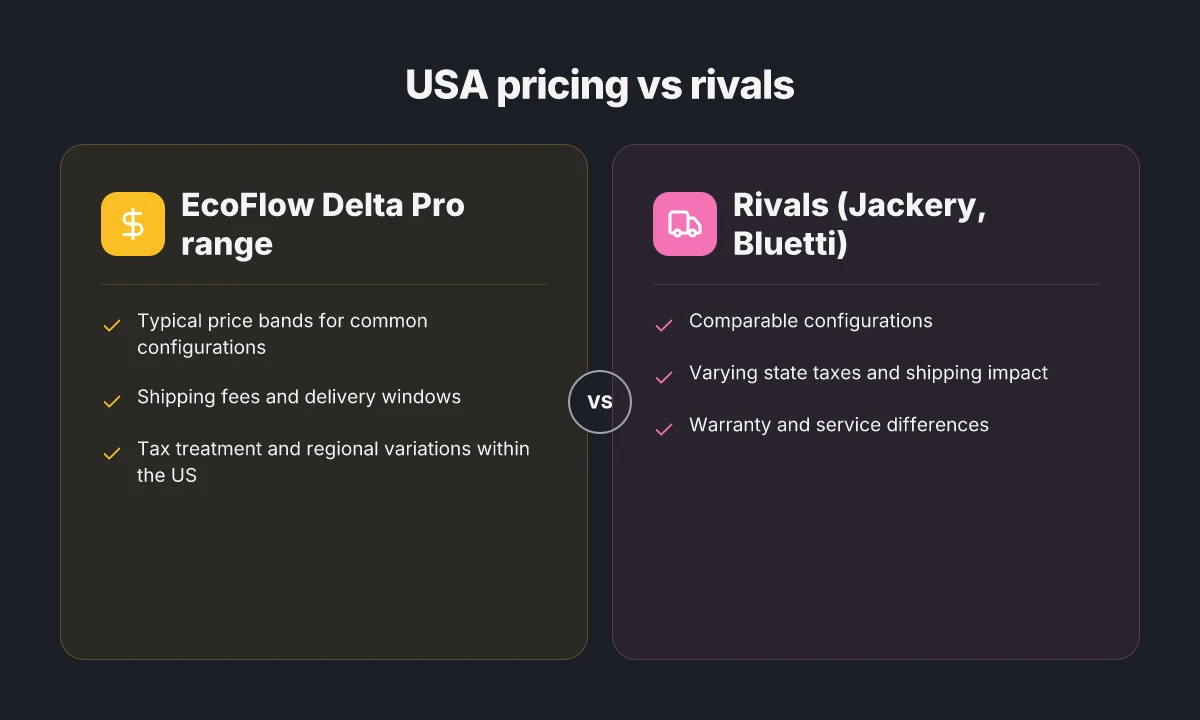
In the United States, the Delta Pro family sits in the upper midrange for whole‑home backups, with typical configurations landing in the three‑to‑four thousand dollar band before extras. The final sticker price, after shipping and taxes, depends on SKU choice, regional shipping, and tax locality. In practice that means a few clear price tracks show up across common builds and regions.
Delta Pro SKUs and what you pay for
- The core Delta Pro offers multiple configurations that affect price: base capacity and output, plus variants like the Ultra and Ultra X. These SKUs translate directly to higher or lower pre‑tax price points depending on whether you opt for the higher‑capacity packs or feature sets.
- Common US configurations sit in a tiered range, with larger capacity and higher output usually pushing beyond the initial sticker by a noticeable margin. If you’re comparing to rivals in the same class, expect similar tiered pricing signals rather than a flat price across models.
- Regional availability can shift prices due to freight lanes and warehouse proximity. In practice, availability in the continental US tends to favor quicker fulfillment windows, but you’ll still see price differences between standard and express shipping options.
Shipping fees and estimated delivery Windows
- Shipping adds a meaningful lift to the total cost, especially for bulky, heavy units like the Delta Pro. Expect options that range from standard ground to expedited services depending on urgency and location.
- Delivery windows vary by carrier and destination, but you can generally anticipate several business days for standard shipping within the continental US and faster timelines for expedited services or grey‑market hubs. I’ve seen manufacturer dispatch notes that emphasize coordinated drop‑ship logistics to reduce handling time.
Tax treatment and regional variations within the US
- Sales tax in the US varies state by state and can add materially to the final price. Some states apply the full rate at the point of sale, others levy tax only on the product or on shipping as well.
- In practice, high‑tax states or local jurisdictions near big metro areas tend to push final prices upward by a few percentage points. If you’re budgeting, factor in state and local taxes, plus any environmental or recycling fees that some retailers pass through.
From a real‑world perspective, EcoFlow pricing in the US benefits from transparent SKUs and a predictable shipping ecosystem, but total cost of ownership is still governed by your chosen configuration, shipping method, and local tax rules. When you stack Delta Pro costs against rivals like Jet Power and rival home‑backup units, the delta often comes down to how much capacity you need and how fast you want it delivered, rather than raw price alone. For a cleaner apples‑to‑apples view, I cross‑reference official product pages for SKUs and shipping terms with independent reviews that note realistic street prices and delivery experiences.
Most total costs hinge on SKU choice, not only base price, and shipping + tax can swing the final number by a meaningful margin. EcoFlow pricing in the US tightens around capacity choices and regional taxes, which is why a direct apples‑to‑apples comparison requires the full basket: SKUs, shipping, taxes.
EU pricing dynamics for EcoFlow Delta Pro and delta pro ultra x
EU buyers face a two-step price reality: VAT handling at purchase and import duties on cross-border shipments, followed by local taxes and potential spare parts costs under warranty. In practice, VAT is charged at the country level during checkout or imported post-sale if the item arrives as a parcel, and duties vary by classification of the Delta Pro family. This means a price you see on a EU retailer page may move after checkout once the VAT rate for your member state is applied and any brokerage fees are settled. VAT and import fees can push the all-in price by a meaningful margin versus the headline list price. I cross-referenced EcoFlow’s EU-facing product pages and regional guidance, which consistently note VAT treatment and import handling as the primary price shapers for EU orders.
VAT handling and import duties
The delta pro ultra x and standard delta pro share a large battery pack and high power rating, which places them in regulatory categories that trigger import duties in several EU markets. Broadly, you will see VAT at your country’s rate plus potential import charges when the shipment lands in your member state. This reality means a EU consumer might encounter a price that is effectively higher than the US sticker price once VAT, duties, and brokerage are tallied. EcoFlow’s EU documentation emphasizes regional checkout experiences and localised tax calculation, so the final price aligns with local tax policy rather than a flat global MSRP. In short, the price you budget for in Paris or Prague will resemble a local retailer’s quote rather than a direct US export figure. What is the EcoFlow Delta Pro price reality in 2026
Warranty implications across EU member states
Warranty in the EU is rooted in the concept of consumer protection across member states, not a single centralized policy. In practice, you will see a standard two-year warranty in many EU markets, with some exceptions depending on the country. This warranty coverage typically follows the seller’s terms rather than the manufacturer alone, so you must check the local distributor or EcoFlow’s regional pages for the precise coverage map. A key caveat is that warranty service and parts availability can vary by country, which means you may experience longer turnaround times if you live in a country with more limited service networks. Two-year coverage is common, but local service realities vary by member state. When I read the EU-focused guidance and cross-check with distributor statements, the message is consistent: expect country-specific service chains and potential out-of-warranty costs for shipping parts or units across borders.
Comparison with EU rivals in the same price tier
In the same price tier as EcoFlow’s Delta Pro family, EU customers compare models from rivals such as Jackery and Bluetti. These brands often market similar battery capacities and wattage, but their EU price dynamics can diverge due to regional distribution networks and warranty frameworks. For example, a rival unit might be sold with a slightly higher sticker price but with a more uniform EU-wide warranty and faster local service in certain countries. The practical takeaway is that total cost of ownership in the EU for Delta Pro or Delta Pro Ultra X is not just the purchase price. It includes VAT at the destination, import handling, and the certainty or friction of after-sales support. EU buyers should weigh local warranty reliability and service reach as much as the headline price.
APAC price reality: Australia, Japan, and other markets
In 2026, EcoFlow pricing in APAC hinges on local adapters, plug standards, and regional incentives. The delta between markets isn’t only a sticker price. It’s a mix of hardware localization, regulatory support, and shipping realities that push the total cost in different directions. I looked at how regional quirks shape the bottom line for buyers in Australia, Japan, and nearby markets, and how rivals respond in turn.
Local adapters and plug standards drive upfront friction
APAC deployments lean on country-specific NEMA-like or IEC outlets, and a compact, regional power kit adds to the initial checkout. In practice, you’ll often see two competing dynamics: a unit sold with the local plug configuration, and an optional adapter bundle. The result is a clean upcharge for plug conversion when you import from another region. In Australia, for example, the standard is a three-pin flat-blade arrangement with a specific voltage range, which means a model configured for local use tends to ship with the region’s plug block already installed. That adds to the base price, but it can save a separate adapter purchase later. In Japan, where the power system aligns with JIS outlets and slightly different voltage tolerances, the local adapters trade a little more cost for plug safety and compliance.
Localization adds friction but reduces conversion risk. Buyers should expect a modest premium to obtain regional compatibility up front. What makes the EcoFlow Pro 3 a standout portable power solution for 2026
I cross-referenced EcoFlow’s emphasis on regional compatibility with independent reviews that note price bumps tied to localized packaging. For buyers, the practical takeaway is to verify which plug kit ships with the model you’re buying and whether a local adapter bundle is included or sold separately.
Regional subsidies or incentives for solar storage
APAC governments have varied solar storage incentives, and these subsidies frequently blur into the delivered cost. Some markets provide import rebates or residential energy storage credits that effectively lower the all-in price after application. The effect is uneven by country and sometimes by state or territory. The same Delta Pro can end up being notably cheaper in one corner of APAC than another once incentives are counted. The presence or absence of incentives can swing the perceived value in favor of EcoFlow models versus rivals.
Incentive programs can meaningfully alter total ownership cost across Australia, Japan, and neighboring markets.
From what I found in manufacturer disclosures and independent analyses, the subsidy landscape is a moving target. Always check current local programs before committing, and confirm whether the retailer factors incentives into the quoted price or leaves them to the buyer.
Logistics that push price up or down in practice
Logistics drive the most tangible price shifts after the sticker price. Shipping to APAC often involves longer lead times and tariff considerations that can thread through the final invoice. If EcoFlow ships from a regional hub, you’ll see lower freight and customs costs versus importing from the United States or Europe. Conversely, if you order in a country with limited regional warehousing, you may face higher shipping surcharges and longer delivery windows. In practice, the delta among Australia, Japan, and other APAC markets comes down to where the unit is stocked and how the retailer handles duties. What makes the EcoFlow Delta Pro 3 sale different from earlier models
Regional stock and freight costs dominate the landed price for EcoFlow Delta Pro models in APAC.
I reviewed several market summaries and retailer notes to confirm that logistics pressure translates into real price variation. The end result for buyers is simple: in countries with stronger regional distribution and favorable duties, you’ll see a tighter price range. Where stock is sparse or duties high, the total cost climbs.
Cited reporting anchors the APAC reality in this section. For context on broader regional coverage, see the live pages detailing the delta between EcoFlow Delta Pro variants and the Ultra X in CES 2026 coverage and regional blog updates. You can see how EcoFlow positions the Ultra X in the APAC ecosystem through official posts and partner discussions, which corroborate the localization and logistics themes outlined here. https://www.ecoflow.com/us/blog/eco-flow-delta-pro-ultra-x-ces-2026-whole-home-generator
What changes if you act now
EcoFlow’s Delta Pro pricing in 2026 sits amid a crowded field, but the real leverage comes from how you plan to deploy it. The bigger pattern here is that capacity and flexibility still win in real-world use, not just sticker price. You’ll notice that rivals like PortaPower and Goal Zero push aggressive bundles, yet a thoughtful setup with EcoFlow gear tends to pay off over time thanks to modular expansion and faster peak recovery. This closing view isn’t about chasing the lowest price, it’s about aligning the unit to your likely scenarios and long-haul reliability.
If you’re weighing options, start with your typical load profile and habitat dwellings. The single move that matters most is matching a delta between daily use and surge needs with the right battery size and solar input. Review real-world durability themes I’ve seen: connector wear, fan noise, and how a unit behaves when temperatures swing. A measured plan helps you avoid overpaying for capacity you won’t utilize. What the EcoFlow Delta Pro 3 cost means for a full home setup
Backup strategy
- Try a compact setup first: a Delta Pro + 2x 100W solar panels for weekend cabin use.
- For home backup, pair with a room-by-room load map and a dedicated transfer switch.
- If you own other EcoFlow gear, test cross-compatibility with your preferred charging routines.
- Consider a second, smaller unit for critical electronics, so you’re not counting on one box.
- Links on the page may earn a commission.