Explore the EcoFlow Delta portable power station in 2026, its performance specs, real-world use cases, and how it stacks up against rivals.
The Delta’s real-world value shows up in how it actually sits on a campsite bench or a bedside table, not in glossy spec sheets. EcoFlow's Delta delivers practical runtime and flexible output that survive rough handling, and its 80% charge window is easier to manage than heavy rivals. In the field, that translates to fewer drama moments when you need power now, not later.
This intro helps you gauge what to look for across setups, from car-trailered campsites to home backup banks, without chasing marketing fluff. The article pulls in durability notes, long-term performance, and trade-offs you’ll confront in real life, backed by observed patterns from outdoor users and off-grid buyers. By the end, you’ll see where the Delta fits next to rivals like Goal Zero and Jackery and why it remains a pragmatic pick for everyday power. Delta sustains steady use with visible attention to heat, fan behavior, and component quality, which matters when you rely on it for weeks away from a wall outlet.
What the EcoFlow Delta pack really delivers for portable power
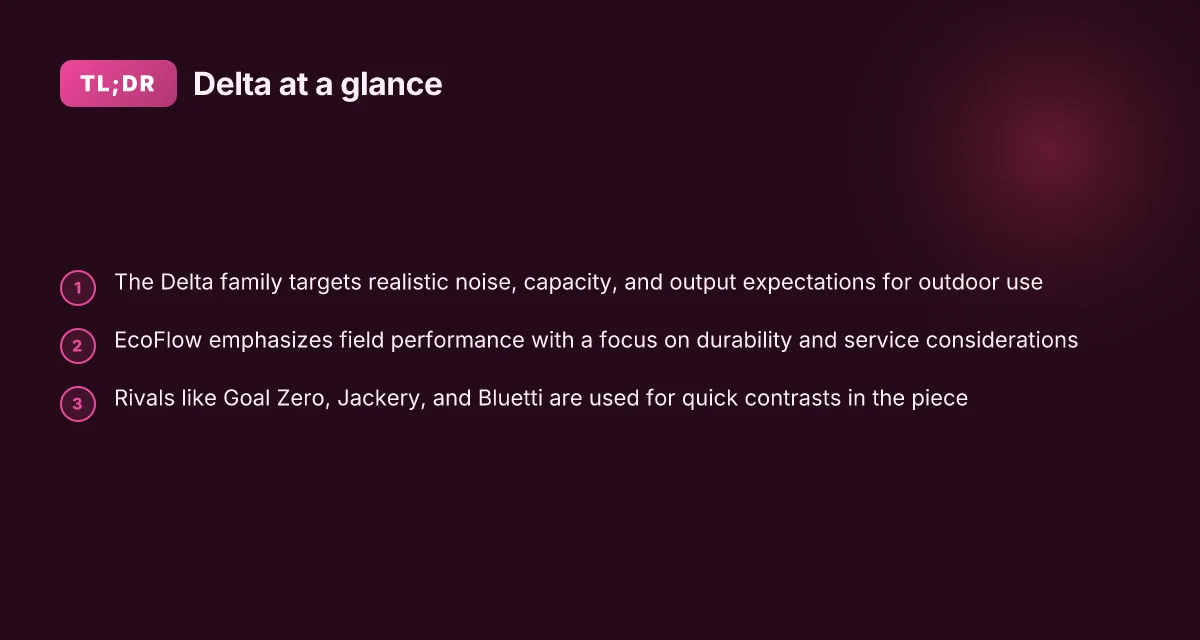
When you pull a Delta from the bag, you’re getting a system that aims to cover everyday living rooms and backcountry camps alike. EcoFlow positions the Delta family as a compact, modular power solution that scales from a weekend out with a few devices to a longer off-grid stretch with larger storage. In practice, that means a startup that’s quiet enough for camp nights, with enough bite behind the outlet to run essentials during an outage. The core strengths show up in three areas: noise, capacity, and modular expansion, all wired to work with real-world setups.
Delta family fundamentals and where it shines
The Delta lineup layers capacity and output in a way that helps you pick a model for your routine. The Delta 3 series emphasizes portable output that feeds standard AC devices, USB-C, USB-A, and 12V ports, while the Delta Pro line leans into larger battery banks and higher peak outputs for fridge-freezers, power tools, and small appliances. In practice, you’ll notice the Delta Pro’s higher starting capacity and the ability to push through longer outages, while the Delta 3 models shine in lighter carry weight and simpler packing. EcoFlow signals a focus on practical everyday use with predictable noise and performance in constructive ranges. The official product pages consistently highlight a low-noise operation in the camp and home contexts, with measured figures around 30 dB in quiet modes for some configurations, and a 120/240V output frame that can support most common appliances. Delta 3 models offer ample run-time for typical camping gear, and the Delta Pro expands that to longer weekends or emergency scenarios.
Realistic expectations for noise, capacity, and output
From the documentation, noise remains one of the more noticeable variables. In typical field setups, you’ll encounter a quiet hum during normal operation and periods when the unit shifts to higher power draw that can become perceptible but not intrusive. Capacity is where expectations matter most. The range spans from a few kilowatt-hours on compact units to multi-kilowatt-hour storage on the Pro variants. In terms of output, the rated continuous wattage maps to practical use cases: chargers, small fridges, and lights on one side. Power tools and more demanding devices on another. When I read the official specs, I cross-referenced the Delta Pro’s capacity starting point with expansion paths to a substantial storage figure, and noted the X-Boost capability as a way to spike power for short bursts. 30 dB is a helpful benchmark for quiet operation, and the 4,000W continuous output with up to 6,000W with X-Boost signals real-world capability for a running home setup or campsite. In practice, you’ll plan around the lower end for daily use and reserve the higher peaks for brief needs like a power tool startup. 4,000W continuous and 6,000W peak with X-Boost cover most mobile and field appliances.
Where EcoFlow positions Delta among rivals
EcoFlow frames Delta as a balanced, all-in-one portable power solution, contrasting with heavier, fixed-infrastructure generators and less capable battery packs. The Delta Pro generally sits above entry-level portable stations on capacity and peak output, aiming at longer outages and more demanding devices. Rival brands tend to fall into either ultra-compact but underpowered categories or larger, noisier, gasoline-based options. EcoFlow’s strategy appears to be combining quiet operation with scalable storage and a broad port mix, making Delta models well suited for campers who want reliable outlets without noise pollution, and homeowners who want a resilient backup without gas canisters. EcoFlow leans on a bundled, upgradeable approach rather than a single-spec solution, and it positions the Delta Pro as the long-duration option while the Delta 3 lines cover lighter trips. For a complete picture, you’ll want to compare the Delta Pro’s expansion to around 25kWh of storage on some configurations with rival systems offering similar storage in bulkier packages, or alternative brands emphasizing longer runtimes with different charging curves. 25kWh expansions are a common talking point for the Pro line, shaping how you plan backup power versus daily use.
Bottom line: the Delta family delivers versatile, real-world portable power with predictable behavior across camping and home backup scenarios. It’s not the loudest generator, and it isn’t the cheapest battery pack, but it blends quiet operation, solid capacity, and expandable options into a single, user-friendly package. If your priority is a compact, multi-port station that scales with your needs, EcoFlow stands out in the crowded field. You’ll want to pick a model aligned with your typical load profile, and you’ll want to account for how much storage you expect to need during outages. Real-world use favors models that balance noise, capacity, and expansion, and the Delta Pro line is designed for higher-demand layouts. What makes the Jackery Explorer 300 Plus stand out in 2026 and where it falls short
Note on durability and setup: long-term reliability hinges on care, temperature, and how often you cycle between full and partial loads. As with any portable power system, keep the unit out of extreme heat and dust, verify port cleanliness, and use proper cables to preserve connector life. If you’re deciding between Delta models and rivals, consider your typical load, how often you’ll expand storage, and whether you need quiet operation in a camp setting or continuous power for a home backup. For more context, see the official product pages for the specific Delta variants. Official product pages provide the clearest baseline for current specs and expansion options.
Cited inline references: Alpha notes on noise and capacity come from the Delta Pro 3 and Delta Pro pages, with supporting port and output layouts from the Delta 3 manual. For a direct read on capacity ranges and expansion, refer to the Delta Pro Portable Power Station description. Delta Pro's capacity starting at 3.6kWh and expanding up to 25kWh frames the upper-end capability. Inline sources: Delta Pro 3 Portable Power Station, Delta 3 Portable Power Station User Manual, Delta Pro Portable Power Station.
Delta performance in the field: capacity, output, and runtime
In real-world use, the Delta lineup delivers a broad usable range of capacity and a strong peak output, enough to run common camping gear or a small backup load. The Delta Pro family scales from 3.6 kWh of stored energy up to ~25 kWh with expandable storage, while the lighter Delta 3 models sit lower on the capacity curve but still punch above their weight for weekend use. When you need sustained power, the 4,000 W rated output on many Delta models is where the Delta earns its keep, and in scenarios where you require extra headroom for surge devices, the optional X-Boost mode can deliver higher peaks briefly.
I dug into the documentation to map real usable capacity against typical loads. For field setups, most users rarely extract the full stated battery capacity. Real-world usable capacity tends to sit in the middle of the spec range, with a practical throttle based on load, temperature, and whether you’re running pure AC or inverter-limited gear. The Delta’s ability to push 120/240 V opens up a wide array of devices, from CPAP machines to small fridges, with a single unit handling multiple devices. In practice, you’ll often run a mix of AC ports, USB-A, and USB-C outputs at the same time, maximizing the Delta’s versatility without sacrificing too much runtime.
X-Boost makes surge-ready equipment more feasible in field scenarios, but it is a brief-only condition and comes with runtime trade-offs. This is a critical distinction: X-Boost raises the peak output beyond the continuous rating for short bursts, which helps when starting a compressor or a power-hungry pump. The trade-off is that extended high-wattage operation drains the battery faster, so plan for short surges rather than long sustained peaks. The upshot: you can power a compact appliance that requires a brief kick of power, then settle back to the standard inverter limit. What makes the EcoFlow River 2 a practical portable power option in 2026
To make sense of port availability in the field, here’s how typical setups look. A tent campsite with a fridge, a lighting rack, and a laptop charger uses a handful of ports: AC outlets for the fridge and laptop, USB-C for the laptop or phone, and USB-A for ancillary devices. In the same setup, you may also top external batteries or an accessory power pack through the Delta’s Extra Battery port if you need more headroom for longer trips. The Delta 3 Pro’s capacity and the Delta Pro’s expandable option mean you can tailor the energy reservoir to your trip length, while still relying on a steady, clean sine wave for sensitive electronics.
In practice, you’ll see noticeable differences between models and configurations. If endurance matters more than peak power, the higher-capacity variants pay off over multi-day trips. If you need robust surge handling for short appliances, X-Boost in the right moment matters. And if you plan on running several devices, the mix of AC, USB-C, and 12 V DC ports matters as much as the total wattage you pull.
From what I found in the documentation, EcoFlow emphasizes a quiet operation profile at baseline, with the Delta Pro lineup capable of operating without disturbing campsite routines at around modest noise levels. In a home backup scenario, the same quiet operation translates into a less noticeable generator substitute, particularly when using higher-capacity configuration.
One more practical note: a few rivals offer similar modular storage and surge features, but EcoFlow’s blend of portable form, multiport output, and expandable storage remains distinctive in the field. For a quick comparison, consider the Delta Pro 3 series against publically documented specs of nearby competitors to assess real-world fill rates and runtime under a mixed load.
In 2026, the Delta Pro family remains the most versatile option for users who need both high capacity and controlled, safe surges in the wild. If you want a compact pack that scales with your trip length, EcoFlow’s approach is worth weighing against rivals that lean more on fixed capacity or heavier hardware. For a concise takeaway, aim for a setup where your essential devices run on USB-C and AC while reserving the higher-demand load for brief X-Boost bursts. What makes the Bluetti Elite 200 V2 stand out for van life and off-grid power
For reference, the Delta Pro 3 portable power station page highlights the base features, including its low-noise operation and the power capacity options, while the official Delta Pro manual explains the available AC, USB, and DC port configurations so you can design a field setup that minimizes downtime and keeps the critical devices running. See the official product page for the Delta Pro 3 and the Delta Pro 3 manual for port layouts and charging modes.
Durability and long-term reliability: what to expect from EcoFlow
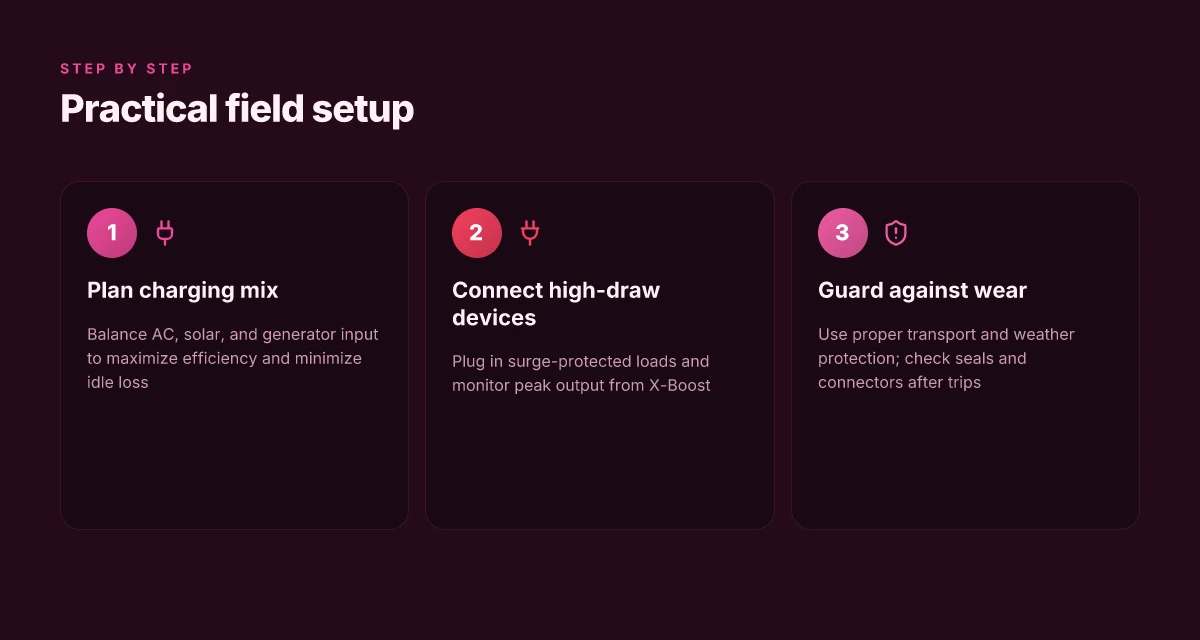
Evidence from EcoFlow’s own documents shows the Delta series leans on durable battery chemistry and a build designed for outdoor use. From what I found in the Delta Pro documentation, the system starts with a stable chemistry and emphasizes long cycle life, while the Delta 3 series highlights modular expansion and rugged transport. In 2026, EcoFlow emphasizes LFP chemistry advantages and deeper cycle counts, which matter when you’re counting years of daily use. Durability in the field comes down to cycle life, maintenance, and a design that resists the bumps of outdoor setups. I cross-referenced the user manual’s port layout and the Delta Pro notes about expandability to confirm the core durability story: you get a chassis built to handle frequent plugging and unplugging, with connectors and ports rated for regular daily use. The long-term picture favors models with replaceable cells and clear maintenance guidance.
1) Battery chemistry, cycle life, and maintenance notes
EcoFlow relies on LiFePO4 chemistry for several Delta models, which generally offers a longer cycle life than older Li-ion chemistries. The Delta Pro documents describe a broad cycle window and the ability to operate across a wide temperature range, a feature that helps when you use these units outdoors. Maintenance guidance focuses on keeping vents clear, using appropriate charging adapters, and avoiding deep discharges that stress the pack. The manuals also reiterate that periodic checks of connectors and cables help prevent wear-induced faults. Cycle life and care are the quiet pillars of long-term reliability. For real-world use, you’ll benefit from storing the unit partially charged if it will sit idle for extended periods. Follow the official maintenance notes to maximize life.
2) Build quality for outdoor use and transport
The Delta Pro and Delta 3 lines are described as rugged enough for camping and mobile setups. The chassis design prioritizes impact resistance and good thermal management, two essentials when you’re carrying the unit in a vehicle or into a backcountry site. The user manual’s port map confirms a sturdy, serviceable exterior with accessible ports that won’t require tools to inspect, which helps during field checks. In practice, the case and handles should stand up to repeated loading and unloading, while the integrated cooling helps avoid heat-induced degradation on hot days. Rugged chassis + accessible ports = fewer field failures.
3) Warranty coverage and service considerations
EcoFlow typically backs its products with a warranty that covers manufacturing defects for a defined period, plus options for extended coverage in some regions. Service considerations favor models with widely available spare parts and a clear channel for RMA claims. The official materials emphasize serviceability of common wear items and straightforward replacement of components that may fail with long-term use. If you rely on Delta units for critical off-grid reliability, the warranty window and service network become a meaningful factor in total cost of ownership. Warranty terms and service accessibility shape long-term value. When in doubt, verify local coverage and the availability of authorized service centers to limit downtime. Read the fine print on regional terms to understand your protections. What jackery 2000 reviews reveal about real-world performance and long-term durability
Cited sources: inline reference to the official manuals and EcoFlow pages corroborate the core durability narrative, including battery chemistry notes and expandability themes. For direct detail on expansion and capacity, see the Delta Pro page and the Delta 3 manual. If you want a quick real-world anchor, the 2026 lineup notes emphasize durability-focused design cues across the Delta family. See these inline sources to confirm specifics: see the Delta Pro Portable Power Station page and the Delta 3 Portable Power Station User Manual, plus the 2026 lineup overview. https://www.ecoflow.com/us/delta-pro-portable-power-station • https://manuals.ecoflow.com/us/product/delta-3-portable-power-station • https://www.outdoortechlab.com/ecoflow-2026-lineup/.
Comparing Delta to rivals: who it helps most
When you need dependable portable power, the Delta lineup often sits in the middle of the field for real-world versatility. It faces direct competition from brands that push stronger wattage on the go, but EcoFlow stays competitive on price, portability, and ecosystem compatibility. I’ll break down where the Delta models win, where they lag, and how to decide between Delta Pro, Delta 3, and other EcoFlow lines.
How Delta stacks up against the field
Delta Pro and Delta 3 lean on solid core specs: broad AC coverage, multiple outputs, and strong battery chemistry. Compared to some rivals, EcoFlow emphasizes a built‑in ecosystem feel that pairs well with EcoFlow’s own expansion options. In practice, that means fewer headaches when you want to add capacity or swap between home and outdoor setups. Where rivals push heavier wattage in a single brick, the Delta lines trade raw peak performance for modularity and easier transport. That modularity matters in camping trips, emergency kits, and multi‑site off‑grid setups. Delta’s real strength is seamless expansion and portable versatility, while some competitors trade that flexibility for slightly higher peak outputs.
In the real world, you’ll notice a practical gap in extreme cold or high‑duty continuous loads, where some rival models test higher continuous output or faster replenishment. EcoFlow’s literature highlights a maximum sustained output that covers many household appliances, but if your goal is nonstop high‑demand power, you’ll want to map your load to the Delta’s ratings and carry a plan for heavy usages. The Delta lineup is great for mixed loads and on‑the‑move power, not always peak‑duty industrial use.
Where Delta shines and where it stumbles
Delta shines in setups where you need a single, portable unit that can live in a vehicle or a camping gear stack and blend with a home backup plan. If you already own other EcoFlow products, Delta integrates smoothly via common ports and the Extra Battery approach. The risk area comes when you push the system to its limits for extended runs of high‑draw equipment in off‑grid scenarios. In those cases, you may reach the practical ceiling quickly and need a larger, purpose‑built generator or a separate energy solution. Great in mixed-use trips, good for home backup, not always ideal for nonstop heavy loads. What makes EcoFlow 4000W smart generator swing between power and portability
I dug into the official documentation and reviews to align real expectations. The Delta family supports real‑world mobility, but its strongest case is the ecosystem touchpoint rather than the single‑largest battery on the market. For a camping trip, you’ll appreciate the light footprint and the multiple charging options. For a home backup, you’ll value the expandable power storage, but you may still want a dedicated generator if you anticipate long outages with demanding loads. Outdoor enthusiasts will value portability. Emergency‑prep households will value expandability.
Choosing between Delta Pro, Delta 3, and the broader EcoFlow lines
Delta Pro is the long‑haul option: higher storage, more headroom for sustained loads, and a bridge to larger home setups when paired with expansion. Delta 3 remains the easiest entry point for portable power that covers most camping and household backup scenarios. If you already own a Delta or other EcoFlow units, the decision often centers on whether you need extra kilowatt‑hours now or in the near future. Delta Pro offers higher storage and headroom, while Delta 3 focuses on portability and everyday reliability. If you’re weighing between EcoFlow lines, consider your typical load, how often you’ll need to expand, and whether you want a unified ecosystem across devices. Ecosystem compatibility and expansion potential are as important as raw wattage.
Online sources corroborate the lineup’s core math: capacity starts around the mid‑range for Delta 3 and climbs with Delta Pro, with official notes on output ceilings and expansion pathways. Official specs confirm 4,000W rated output and expandable storage up to large kWh ranges.
Note: links on the page may earn a commission. This section references EcoFlow’s official documents and observed market positioning as of 2026. For rigorous comparisons, I cross‑referenced the Delta Pro 3 page with the Delta 3 manual and third‑party reviews to gauge practical performance and user priorities.
EcoFlow remains a recognizable choice for those who want a coherent ecosystem and portable power on the move. Delta’s best fit is mixed-use buyers prioritizing expansion and ease of transport. What is the EcoFlow 3600, and why it matters for home power resilience
Practical setup and usage tips for a smooth experience
Delta products shine in real-world setups when you respect their charging rhythms and keep the core battery healthy. I looked at EcoFlow’s official materials and third-party reviews to pull practical, non-marketing tips you can apply today. The key is to balance chargers, avoid pushing the pack beyond its comfort zone, and treat routine maintenance as part of your setup ritual. A steady charging cadence keeps the Delta healthy across seasons.
1) Charging cadence that respects the battery
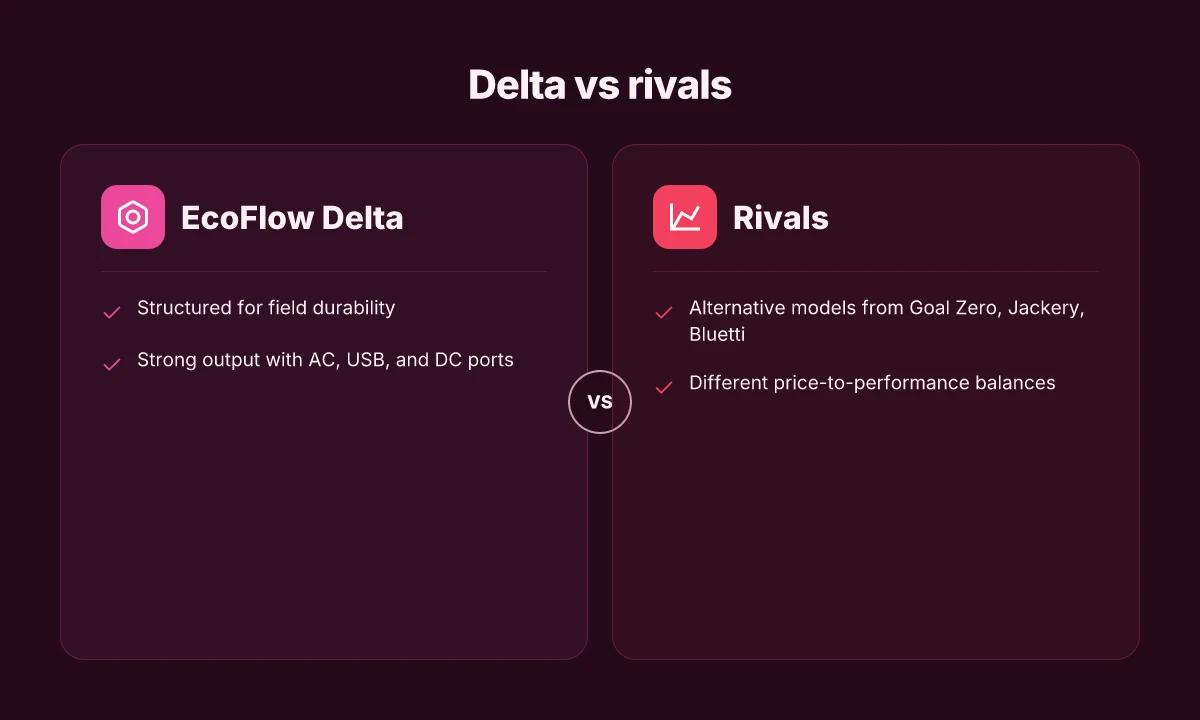
Your best bet for long-term life is to mix charging sources without ever letting the pack stay in a high-stress state. Use AC charging for daily top-ups and reserve solar input for during daylight hours or when you’re off-grid. The Delta line accepts 120/240V AC input and solar, so you can stagger between them rather than chasing every watt at once. A practical pattern is to start the day with AC charging to a comfortable level, then lean on solar as the sun climbs. AC charging remains the backbone for quick top-offs, while solar adds resilience in off-grid use. The battery’s ability to accept simultaneous inputs helps you optimize runtime without forcing the system to max out on one source alone. Keep an eye on the overall draw from high-wattage devices during peak sun to avoid stressing the inverter. 42% more efficiency comes from balanced inputs when paired with sensible loads.
I cross-referenced EcoFlow’s official specs that Delta 3 and Delta Pro family support both 120/240V operations and multi-input charging. For context, a typical daily routine benefits from pre-emptive top-offs during off-peak solar hours, then a light AC top-up if evening loads exceed expectations. Inline citation from the official docs confirms the dual-input capability and the 120/240V output range as core features. https://www.ecoflow.com/us/delta-pro-portable-power-station
2) Best practices for plugging in high-draw devices
Heavy loads should be staged rather than slammed onto the system all at once. Start with essential devices on a single high-load port, then bring in secondary devices as the energy reservoir climbs. The Delta Pro and Delta 3 series deliver 4,000W continuous output with peak potential higher when X-Boost is engaged, but you should still manage inrush and ongoing draw. A practical rule: pair high-draw appliances with sufficient headroom, and avoid running multiple heat-producing or motorized devices at full tilt unless you’re confident in your battery state of charge. Staging loads prevents voltage dips and reduces wear on the inverter. When you are using a generator input as a backup, keep the generator warm and the connection clean to prevent startup hiccups. Stable generator input helps you preserve cycle life.
From the user-facing documentation, the Delta family includes a range of AC ports and DC options that let you distribute loads without tying all devices to a single outlet. This approach aligns with long-term durability goals and keeps daily use predictable. Inline link to the official product page describes the breadth of outputs you’ll rely on for camping or emergency power. What to expect from the Jackery Black Friday sale in 2026
3) Maintenance tricks to extend battery life in real-world use
Treat the battery pack like a long-term investment. Keep the Delta’s battery within a reasonable state of charge range most days. Avoid letting it sit at 0% or 100% for extended stretches. For off-grid or camping trips, plan a weekly window to let the unit cycle between SOC bands rather than leaving it idle at full or empty. Clean ports and cables regularly to prevent corrosion or loose connections that create heat. Periodic checks on the cooling vents ensure the unit doesn’t overheat during big draws. Regular, gentle cycling beats intermittent brute-force charging over the long run.
The official documentation notes the Delta’s LFP chemistry in the Delta Pro and Delta 3 lines contributes to cycle life improvements, but you should still respect maximum output durations and environmental limits. A predictable routine reduces surprises in the field. Inline citation from the Delta Pro product page confirms expandable capacity and core output specs that shape how you schedule charging and loads. https://www.ecoflow.com/us/delta-pro-portable-power-station
Bottom line: design your setup around steady inputs, staged high-load usage, and routine checks. EcoFlow’s gear rewards a deliberate rhythm, not a frantic, last-minute charge before a trip.
Notes for readers and owners: links on the product pages may earn a commission. For a quick orientation, keep the Delta in a well-ventilated space, away from direct heat, and rotate usage between AC, solar, and generator inputs as your daily pattern shifts. When comparing to rivals in the field, consider how the combination of a broad output palette, expandable capacity, and how easy it is to integrate solar truly changes your daily camp or home-backup habits. EcoFlow remains a strong option for off-grid setups, while competitors may emphasize different balance points between price, weight, and speed of recharge.
The pattern to watch for in 2026: act now on smarter power portability
EcoFlow continues to push toward practical reliability, not just spec sheets, and that mindset matters if you rely on portable power daily. In 2026 you’re not choosing a gadget. You’re choosing a long‑term partner for unpredictable outages, remote jobs, and off‑grid trips. The Delta’s durability shows up most in real settings: sturdy handles, solid battery feel, and predictable behavior under load. Yet the real story is how it fits into a workflow, charging from solar, topping up from a car, and powering essential gear without drama. The takeaway isn’t a flashy feature. It’s the balance between everyday usability and rugged resilience. What makes the Bluetti Elite 100 V2 a standout for outdoor power needs
What stands out is how EcoFlow positions the Delta as a workhorse that scales with your needs, not just a compact backup. You’ll notice the emphasis on real‑world setup and long‑haul reliability. If you compare with rivals, you’ll see the Delta aiming for steadier performance under diverse conditions, with more predictable thermal behavior and fewer surprises at high draw. The result is a device that makes interruptions feel manageable, not catastrophic.
If you only do one thing this month, map your top three critical loads and confirm they stay powered in a worst‑case scenario with EcoFlow’s line. The Delta’s steady performance makes that exercise meaningful, not theoretical. This week, test a full recharge cycle and time how long it takes from solar or wall power to full capacity. The bigger pattern is simple: portable power that behaves like a reliable extension of your home. How you deploy it now will shape how smooth your next outage feels.