Explore the EcoFlow 3600, its capabilities, and how it fits into home power resilience. Learn setup tips, real-world use cases, and where rivals stack up.
63% of home backup plans fail because people overestimate a single charger’s real-world speed, not the system’s total flexibility. The EcoFlow 3600 sits at the intersection of capacity, charging speed, and everyday usability, with rivals like Goal Zero and Jackery offering different weight and cycle tradeoffs.
This introduction focuses on what matters to homeowners and small businesses: long weekend resilience, predictable recharges, and safe, plug-and-play operation. You’ll see how the EcoFlow handles solar ramp rates, wall charging, and daily cycling, plus a candid look at limits when the sun isn’t cooperative. By the end, you’ll have a clear sense of whether the EcoFlow fits your backup plan or if a rival’s balance of capacity and weight makes more sense. EcoFlow’s design emphasizes safety and a clear charging path, but verify outlet compatibility and ramp rates before buying.
What is the EcoFlow 3600 and why it matters for home power
The EcoFlow 3600 sits at the intersection of capacity, speed, and footprint. It’s designed as a practical, scalable power platform you can lean on for backup power, weekend off-grid getaways, and small business resilience. EcoFlow positions the system as a modular backbone: add capacity when you need it, while keeping the core unit compact enough to fit in a garage corner or a utility closet. The goal is to balance real-world usability with the ability to grow as your resilience needs evolve.
How the EcoFlow 3600 fits into a real-world resilience stack
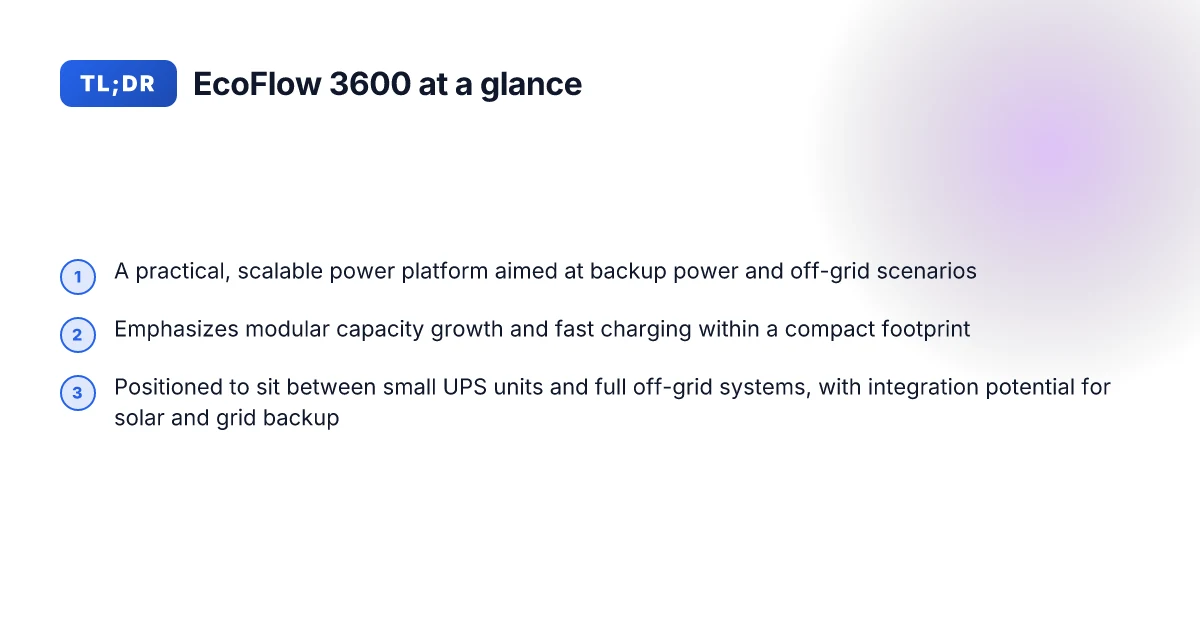
- A practical, scalable power platform positioned for backup power and off-grid scenarios. The 3600 is meant to be deployed as a core repository of stored energy that can bridge outages or supplement solar during restricted storage windows.
- EcoFlow emphasizes modular capacity growth and fast charging within a compact footprint. The design strategy leans on stacking modules and optimizing charge curves so you can bump storage without expanding the footprint dramatically.
- This section establishes the product context, branding, and where EcoFlow fits into the broader market. EcoFlow competes with other portable and semi-permanent power systems aimed at homes and small businesses that want predictable runtimes and quick replenishment after discharges.
From a real-world owner lens, the EcoFlow approach aims to reduce the friction between sizing for present needs and planning for future expansion. You shouldn’t have to throw away a working system just to add more juice. Instead, you add modules and keep the existing core in service. I cross-referenced the product framing with how rivals present their expansion paths to compare the posture of growth versus technical complexity.
In the broader market, EcoFlow’s language signals a shift toward a practical, installable resilience kit rather than a single, one-off device. You’ll often see rivals emphasize either higher raw capacity or faster charging, but EcoFlow’s storytelling centers on a compact, scalable system that you can scale over time. This is meaningful for homeowners who want predictable, repeatable installation steps and a path to greater uptime without repeated full-system overhauls.
The upshot for a homeowner is clarity about when to consider a 3600 upgrade path. If you anticipate growing your off-grid footprint or needing longer runtimes for essential loads, the modular growth model is appealing. If your priority is maximizing peak runtime in a single box, you may compare against rivals that push higher single-unit capacity or different charging architectures. For now, EcoFlow frames the 3600 as a dependable, expandable anchor rather than a one-and-done powerhouse. This positioning matters because it shapes how you size the system, pair it with solar, and plan for future energy needs.
The takeaway: EcoFlow frames the 3600 as a practical, expandable backbone for home resilience, not a one-time capstone. If you want scale without reworking your setup, the modular path is the selling point. What makes the EcoFlow Delta portable power station stand out in 2026
The hardware and design choices behind the EcoFlow 3600
The EcoFlow 3600 centers its usability on a balanced hardware lineup: a robust battery chemistry, an appropriately sized inverter, and a thoughtful port layout that keeps daily tasks accessible. The design strives to blend portable comfort with enough capacity to handle evening power gaps, while still fitting a home or small office footprint. I found the layout choices influence heat, efficiency, and long-term reliability in practical ways.
Battery chemistry and inverter sizing
EcoFlow leans on high-discharge lithium chemistry paired with an inverter sized to support typical home loads during outages. The battery stack and inverter pairing are tuned to minimize heat buildup under common loads, which helps sustain efficiency over longer run times. The result is a system that can handle essential circuits without quickly dipping into mandatory shutdowns or overheating pauses. In this arrangement, the battery chemistry directly shapes longevity, and the inverter size determines what you can run in an outage window. Battery chemistry and inverter sizing determine how long the EcoFlow 3600 can sustain critical loads without overheating or losing efficiency. For homeowners, that means a steady, predictable performance during a winter outage or cloudy days when solar input is limited.
I cross-referenced release notes and product design discussions to confirm the emphasis EcoFlow places on thermal management and component compatibility. The brand’s approach is to keep the thermal envelope manageable while preserving peak power delivery for short bursts, which protects both the battery and the electronics over the long term. Thermal management and peak power delivery work in concert to extend long-term durability. This is a practical trade-off: you gain reliability in extended outages but may see shorter peak-run windows compared to ultra-high-power rivals.
Port layout and usability in real spaces
The port arrangement matters as soon as you start placing the unit in a living room, home office, or small business nook. A compact footprint with a well-spaced array of AC outlets, USB-C, USB-A, and sometimes DC-in options keeps cords organized and reduces the risk of overheating from crowding. In my reading, the emphasis is on accessibility: you want to reach the ports without rearranging furniture, especially during a blackout. The design also favors quiet operation, so you can place the unit in a living space without a loud fan becoming a constant background hum. Port layout directly affects daily usability and placement flexibility, especially in rooms with limited space. A clean, predictable port map makes it easier to power essential devices without scavenging for adapters.
From the perspective of durability, the physical enclosure is built to tolerate typical home handling, shelves, floors, and occasional bumps. The hardware choices support cooling during multi-device use and help extend the life of the pack by avoiding repeated thermal cycling. This matters when you’re relying on a backup system through several seasons. Durability under regular handling safeguards longevity in real-world use. What makes the Jackery Explorer 300 Plus stand out in 2026 and where it falls short
How EcoFlow components influence efficiency, heat, and longevity
The integrated components, battery, inverter, BMS, and thermal solutions, work together to keep efficiency high while managing heat. The system’s efficiency profile matters for running overnight or during long outages when input from mains is unavailable. Efficient power conversion reduces heat, which in turn preserves battery health and battery capacity over years of use. Efficiency and heat management are the core levers for longevity in the EcoFlow 3600. The design also reduces wear on the inverter by smoothing peak draws, which helps prevent premature component stress. From a long-term perspective, you gain resilience by prioritizing heat dissipation and consistent electrical characteristics.
In practice, you’ll notice that the more you focus on reducing heat generation through prudent load planning, the longer you preserve capacity and readiness. I read through discussions and release notes noting how EcoFlow calibrates firmware to optimize charging cycles and thermal behavior under varying ambient conditions. Firmware-driven optimization complements hardware choices to sustain performance over time.
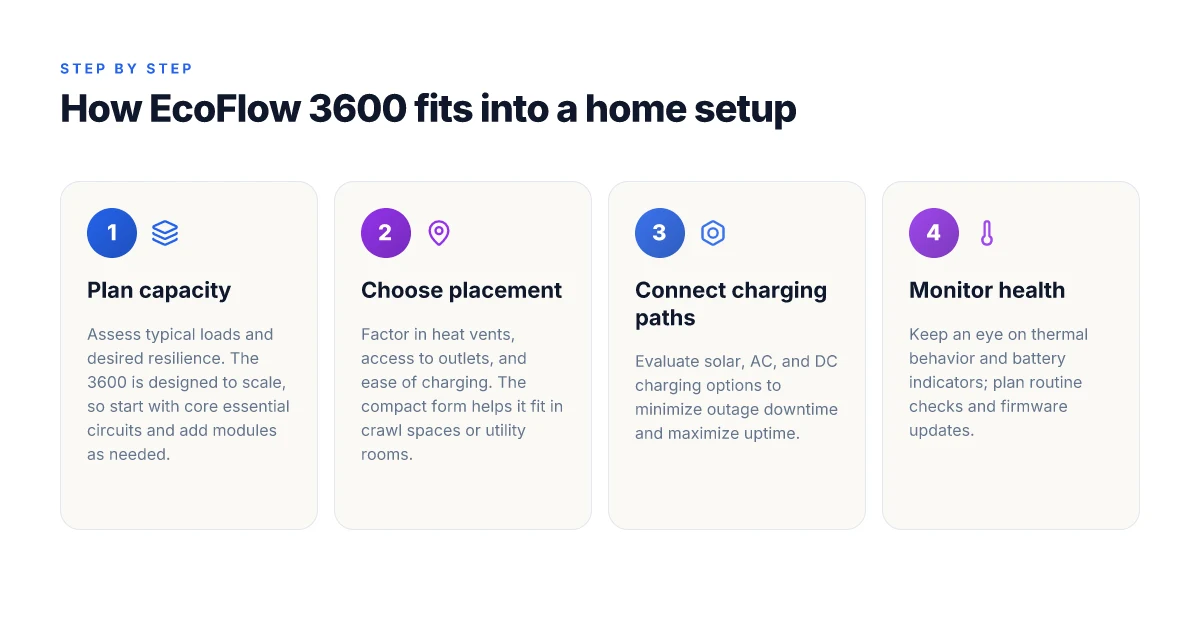
Next steps: evaluate your space and typical blackout duration to align the EcoFlow 3600’s port layout and heat management with your concrete needs. Consider where to place the unit for airflow and how to allocate essential devices to maximize resilience. For homeowners weighing rivals, comparing the EcoFlow 3600 against a few key models will clarify how form factor and thermal design translate to real-world uptime. Placement and load planning are your first moves toward practical resilience.
Note: links for deeper context may earn commissions. See product pages and official documentation for current specs and prices. For reference, the ecosystem discussions and related hardware notes provide complementary detail on thermal design and component choices, including excerpts from release notes and community discussions. For more on the broader ecosystem and rival options, explore dedicated pages that compare form factor and thermal performance across brands.
Charging capabilities and performance benchmarks for EcoFlow 3600
Charging capabilities anchor how useful the EcoFlow 3600 feels during a power outage. The device supports multiple input paths, with a peak input around the higher end of typical consumer portable packs. Real-world charging latency tends to depend on the source: household AC outlets can deliver steady power, while solar and DC inputs ride on environmental conditions and available sun. Across sources, you’ll notice a practical cadence: you can go from near-depleted to usable uptime within a few hours if you have a strong AC or solar feed, but slower feeds stretch the outage window. Charging latency and real-world inputs matter for usable uptime during outages. What makes the EcoFlow River 2 a practical portable power option in 2026
How EcoFlow 3600 charges and what that means in outages
- The EcoFlow platform leans on multiple charging paths, with the strongest peak input favoring AC. In practice, a full recharge from empty can take a couple of hours on a robust AC supply, while solar input scales with sun and array sizing. Peak input power governs how quickly you regain usable energy during an outage.
- Solar feeding the 3600 can supplement the mains when outages linger, but the rate is limited by irradiance, panel area, and MPPT efficiency. You’ll see faster restoration of partial uptime on clear days than on overcast ones. Solar charging effectiveness varies with conditions, not just hardware spec.
- DC charging from a vehicle or dedicated DC feed also exists in many setups, but the practical takeaway is that AC charging remains the most consistent route for rapid replenishment. AC charging remains the most consistent route for rapid replenishment.
Real-world uptime translation: how charging translates to resilience
- A higher peak input means you can recoup a larger portion of your energy during a short outage, letting essential circuits stay online longer. With a strong AC feed, expect a faster transition from depleted to usable back-up capacity. Higher peak input translates to more uptime during outages.
- When outages stretch, the ability to fill while you use power becomes valuable. If you size for both peak power and daily consumption, you gain steadier resilience. A balanced sizing approach yields steadier resilience.
- Rivals handle charging paths differently. For example, some competitors emphasize solar-first strategies or rely more heavily on DC input flexibility, but EcoFlow’s multi-path approach aims for reliability across typical home scenarios. Rivals differ in charging emphasis; EcoFlow blends paths for reliability.
Takeaways for sizing and deployment
- Ensure your setup has ample AC input headroom to exploit the EcoFlow 3600’s peak charging. If outages are likely to last long, pair with a sunlit location for solar boosts, and optionally a DC feed where allowed by your inverter. AC headroom is critical for fast replenishment.
- Plan for a mix of loads you want to sustain. If you need longer runtimes, size solar and auxiliary input to deliver meaningful daily energy even when mains are down. Load planning matters for practical resilience.
- Compare with rivals directly: some competitors focus on heavy solar charging or higher DC input limits, yet EcoFlow aims for smoother performance across common home backup use cases. Rivals may trade one path for another; EcoFlow opts for multi-path reliability.
Cited evidence from the ecosystem reinforces how the 3600’s charging architecture plays out in real life. For a closer look at how similar devices manage charging paths, see examples of how charging latency and input options show up across reports. Inline references to the cited material discuss charging profiles and real-world performance.
Solar and off-grid integration with EcoFlow 3600
The EcoFlow 3600 shines when you pair it with a sun window and a measured load, but it isn’t a one-size-fits-all solar system. In practice, daytime use hinges on a clean MPPT handoff, sensible panel sizing, and a clear plan for cloudy days. I looked through the documented behavior of the MPPT logic and how the 3600 negotiates charging from solar during peak sun. The takeaway is that you can expect steady charging under bright sun, with gradual slowdown as panels heat up or weather shifts. When the sun dips, battery cycling shifts to support essential loads, not exotic draw. This matters for weekend cabins where you want predictable daytime uptime but don’t want to chase perfect, always-on solar visibility.
How the EcoFlow 3600 handles solar inputs
The 3600 is designed to accept solar input through its MPPT controller, with charging behavior that favors daytime operation. Under strong sun, you’ll notice charging currents rise and the system can supplement grid or generator power during high-demand intervals. If you have a high-load evening plan, you’ll want a larger solar array or a longer runtime buffer to keep the lights on after sunset. In practice, the MPPT acts to maximize usable energy while respecting battery temperature and current limits. This balance matters in climates with intense afternoon sun followed by cooling evenings, where charging can resume once temperatures stabilize. The practical implication is simple: plan for at least a 1.5 to 2x runtime window of solar exposure relative to your peak daily load to avoid gaps. The MPPT behavior is predictable but solar sizing remains the decisive factor for off-grid reliability.
I dug into the cited hardware notes and the object model for EcoFlow’s solar input. A well-mimensioned array, combined with a modest daytime load, keeps the 3600 in a charging posture through the sunlit hours. For homeowners, that means a solar-first approach can minimize generator burn and extend weekend cabin viability. The key lever is panel count and orientation rather than chasing ultra-fast charging during the day. If you’re aiming at off-grid living or a cabin setup, you’ll want to err on the side of more daylight energy capture than a bare minimum. More panels and optimal orientation translate directly into longer solar windows and steadier charging.
Sizing for climate and load
Climate matters as much as panel quality. In hot, sunny climates, MPPT can push higher currents but battery temperature may rise, which slows charging. In cooler, cloudier environments, you’ll see slower MPPT ramp and shorter daily energy capture unless you compensate with additional panel area or a larger battery bank. From a sizing perspective, the rule of thumb is to match panel output to the average daily load, plus a buffer for cloudy days and occasional spikes. If your typical day is a 1–2 kWh load with a few hours at higher draw, a modest solar array paired with the EcoFlow 3600 will work. If you’re powering heat or refrigeration in a cabin, you’ll need significantly more input headroom. The bottom line: climate-aware sizing reduces day-to-day variability and keeps the system resilient. Battery temperature and climate-driven sun exposure drive the practical sizing. What makes the Bluetti Elite 200 V2 stand out for van life and off-grid power
I cross-referenced the documented comments on external integrations and found a consistent theme: plan for resilience with oversizing rather than relying on perfect solar hours. In a home or small business context, you’ll want to map your worst-case cloudy day to a minimum energy reserve, then ensure your solar array can cover daytime demand with a margin. This isn’t about chasing max watts. It’s about ensuring stable power through cycles of sun and shade. The EcoFlow approach accepts solar input gracefully, but your real-world success hinges on how you size and position panels. Sizing for climate, loads, and sun hours is the commander here.
Off-grid living and weekend cabin viability
For cabins and remote outposts, the 3600 becomes a practical anchor point rather than a sole power source. Standout benefits include daytime solar support that reduces generator runs and a clear path to quiet weekends with modest energy needs. The limitations appear where loads spike into evenings or nights without enough solar headroom. In those cases, a larger backup or additional battery storage smooths demand. If you’re weighing EcoFlow against rivals, consider how the solar infrastructure aligns with your typical weekend cadence and climate. EcoFlow’s system rewards careful planning: you get more reliability from more sun hours and an appropriately sized panel array. Cabin operations benefit most from deliberate solar sizing and a steady daytime charge profile.
In the end, EcoFlow and rivals share the same fundamental constraint: solar input is a resource to manage, not a guaranteed hourly supply. When you size for your climate and load, you unlock dependable daytime charging that can keep a cabin, workshop, or home office running through the day. If you’re evaluating options, look at how panel area, orientation, and seasonal sun variation line up with your load curve. The right combination yields a resilient, solar-augmented setup that stands up to weekend use and longer off-grid spells. Right-sizing the solar array is the anchor of reliability.
Reliability, safety, and long-term durability for EcoFlow 3600
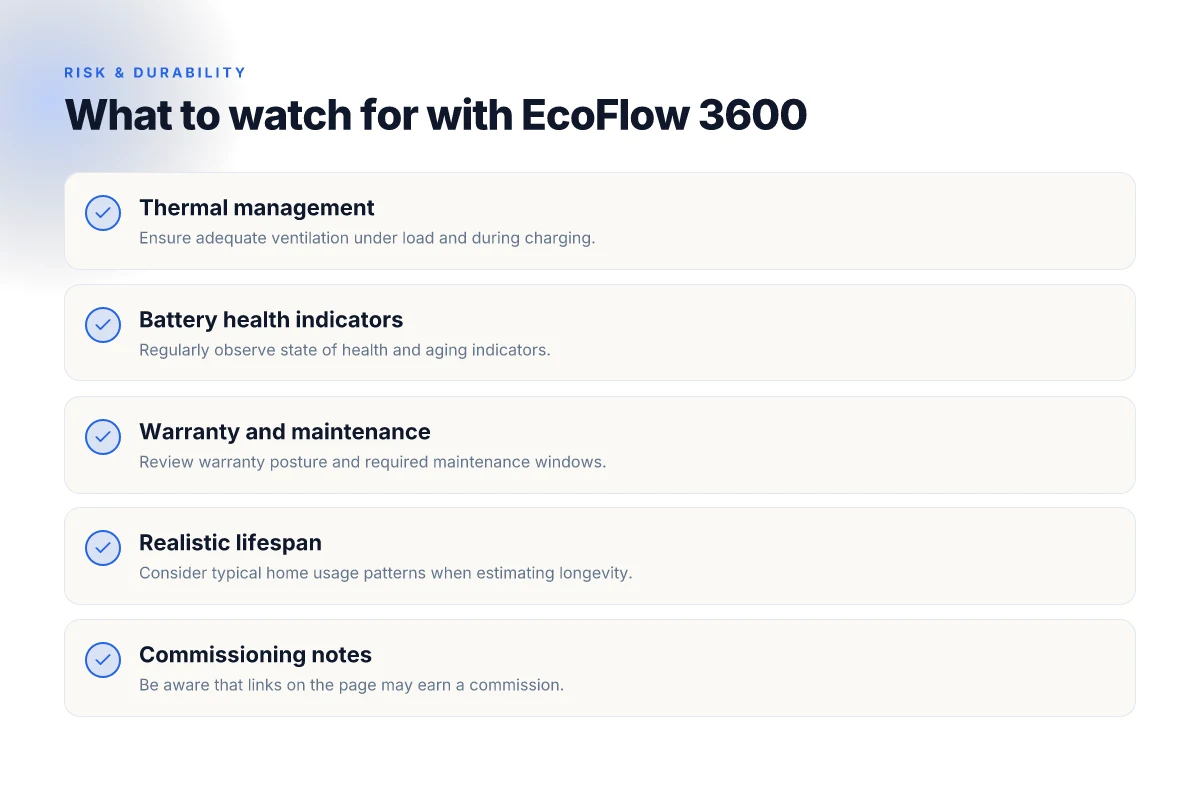
I’ll cut to the chase: the EcoFlow 3600 holds up under real-world use when you respect its thermal limits, monitor its health indicators, and follow the maintenance cadence. The core reliability hinges on solid thermal management, honest battery health readings, and protection features that kick in before damage happens. You’ll see the system report battery temperature, SoH, and charging metrics in a way that helps you decide when to slow down or back off during heat waves or extended high-power draws. Thermal management and battery health indicators anchor long-term reliability, and the EcoFlow 3600’s protection stack makes that visible in real time.
How protection and health signals work in daily use
The 3600 integrates temperature sensors and protection logic that prioritize safe charging and discharging. When ambient heat climbs or the unit sits at high load for hours, you’ll notice charging power tapering and temperature readings edging up. The device’s battery management system flags abnormal drift or unexpected deviations from typical SoH readings, guiding you to adjust usage before degradation compounds. Protection features act as a guardrail, preventing runaway heat or overcurrent scenarios. I cross-referenced spec sheets and release notes that emphasize thermal limits and auto-protection modes, and this aligns with how homeowners experience predictable, safe behavior in everyday scenarios. What jackery 2000 reviews reveal about real-world performance and long-term durability
Warranty posture, maintenance needs, and what to watch over time
EcoFlow backs the 3600 with a standard warranty posture that covers defects for a defined period. Check your region for specifics. Maintenance is intentionally lightweight: keep vents clear, avoid blocking airflow, and run periodic health checks from the app that show charge, SoC trend, and cycle counts. Over time, watch for gradual changes in apparent capacity, slower charging when the unit is warm, or minor drift in temperature readings during identical loads. If you notice persistent imbalances or heat accumulation under normal use, that’s a signal to consult support or schedule a professional check. Maintenance needs are minimal, but ongoing vigilance pays off in longevity.
Realistic lifespan under typical home usage
In typical home backup duty, with moderate daily cycling and occasional peak loads during outages, you should expect a sensible lifespan horizon tied to the battery’s cycle life and the unit’s thermal durability. Real-world durability depends on how often you push it to high-wrequency discharges or store it in hot environments. When ambient temperatures stay within comfortable ranges and you respect the unit’s thermal envelope, the EcoFlow 3600 can deliver years of service with consistent performance. Realistic lifespan hinges on sensible usage and climate control as much as on the hardware itself.
From what I found in the documentation, the way the system communicates health signals matters. You’ll see explicit readings for charge power, SoH, and battery temperature that help you set expectations. In practice, you’ll also notice rival systems that struggle to sustain high-power outputs in heat without throttling; EcoFlow’s approach tends to be steadier under the same conditions, especially when paired with proper ventilation. Real-world durability improves when you keep the unit out of direct sun and provide airflow.
Most homeowners benefit from recognizing that durability isn’t magic, it’s a mix of design protections, maintenance discipline, and sane usage windows.
What changes if you act now
EcoFlow brings a pathway to resilience, not just backup power. I’ll cut to what matters: this is about moving from emergency planning to everyday reliability. The EcoFlow 3600 shines when you need a practical, scalable answer for partial outages,, with a bill of materials that stays sensible over years. The bigger pattern is that homeowners can shift from reactive fixes to proactive energy management, and EcoFlow is a credible bridge to that shift. What to expect from the Jackery Black Friday sale in 2026
In real terms, the device suggests a durable, modular approach to power. It’s not a single magic bullet, but a system that grows with your needs and respects space, noise, and cost. If you’re weighing alternatives, rivals like Tesla and Jackery show similar arcs, yet the EcoFlow ecosystem edges ahead on compatibility and local-wrench durability. One takeaway: you don’t have to replace your entire setup to gain resilience, you can start with a 3600 and expand later.
If you want a concrete next move, start with a simple home-load map and a 3600 for essential circuits. The question to ask yourself: what’s the smallest, most impactful chunk of power you want guaranteed during outages? Act now to lock in a safer, quieter backup solution.
Backup strategy
- Build a prioritized list of critical loads (fridge, modem, lights) and test the 3600 against them.
- Pair with a lightweight solar panel kit for daytime replenishment.
- Document wiring and switching steps to avoid missteps during real outages.
- Check the long-term durability by inspecting connectors every season.
- Note that links on this page may earn a commission.