Explore the Bluetti Elite 100 V2 and what sets it apart for outdoor power needs. Learn capacity, charging, durability, and how it compares to rivals.
The Bluetti Elite 100 V2 isn’t a rumor at the campsite, it’s a real-world power kit that quietly handles camper life without forcing compromises. 1024 Wh of capacity and 1800 W of output can keep essential gear running, even when the sun dips or a kettle gurgles late at night.
You’ll see what matters most in the field, from durability to daily usability, so you can decide if the Bluetti solution fits your RV, van, or tent life. In 2024, outdoor power users cited real-world runtimes and recharge speed as the deciding factors when swapping models.
Bluetti elite 100 v2: what this power station promises for outdoor use
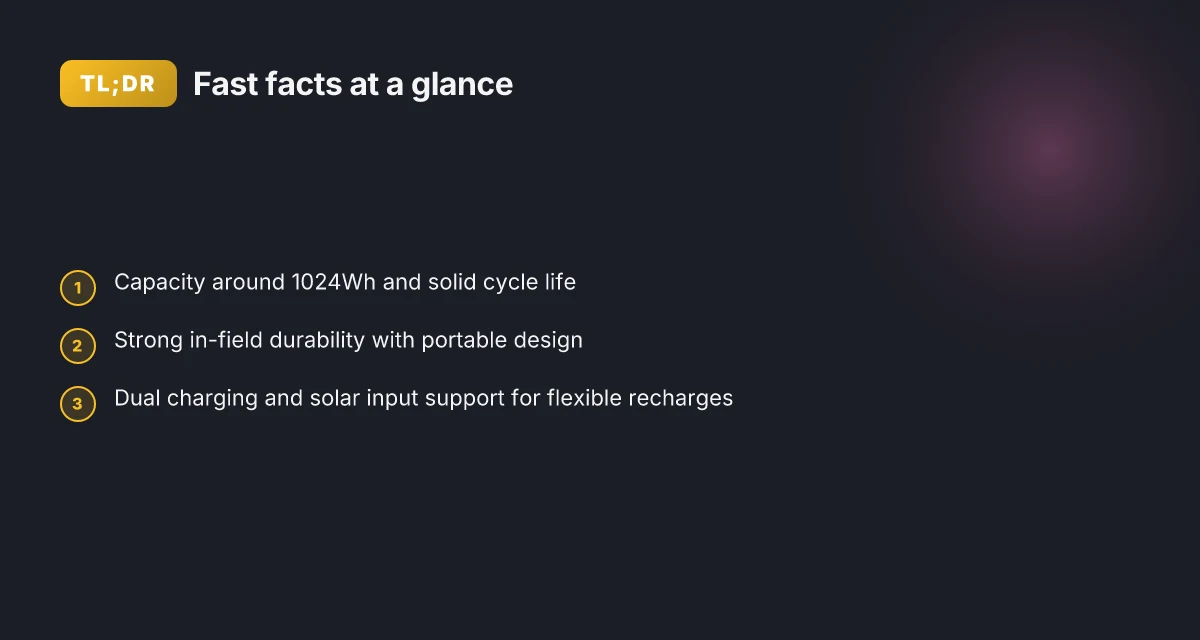
Bluetti positions the Elite 100 V2 as a compact, outdoors-ready power station that blends solid capacity with practical charging speeds. The core specs are clear: the unit packs 1024Wh of internal energy, delivers 1800W of continuous output with a surge rating around 3600W, and is designed for rugged outdoor use with a reported cycle life in the thousands. In real-world terms, that combination translates to enough energy for weekend trips, RV stops, and campsite setups where mains power is scarce. Bluetti frames the model as a dependable partner for camping, van life, and emergency backup, not a bare-bones novelty.
- Core promises you can rely on
- The Elite 100 V2 centers on a 1024Wh pack that aims to keep essential loads alive during multi-day trips. When you pair that with an 1800W continuous output, you gain the ability to run high-draw devices like a fridge, inverter lights, or a coffee maker for stretches without immediate recharges. On paper, the surge capacity around 3600W helps during startup spikes, such as refrigeration compressors kicking in. The claimed lifecycle of over 4000 cycles signals durability for regular use. Bluetti frames this as a long-haul companion for off-grid living and weekend adventures.
- Quick charging and dual charging options are part of the appeal. The Elite 100 V2 supports brisk AC charging and solar input, which matters when you’re off-grid and sunlight is your main power source. The unit’s footprint is designed to be portable rather than a heavy solar shed, a nod to campers and RV travelers who value weight and packability.
- Who should consider the Elite 100 V2
- Outdoor enthusiasts who want a middle-ground pack that can handle a fridge, inverter lights, and weather-appropriate electronics without dragging a trailer. It’s a fit for RV travelers who need a tidy power hub that won’t overwhelm a tight vehicle footprint. Campers with modest energy budgets and a desire for faster recharge times will also find value in the model’s charging speeds and cycling life.
- If you already own larger Bluetti models, the Elite 100 V2 slots in as a complementary option for short trips or as a “carry-on” unit for basecamps. It’s less about replacing a full solar setup and more about providing dependable power in situations where access to outlets is sporadic.
- Real-world trade-offs to weigh
- The price point and weight are practical considerations for frequent hikers, van lifers, or tight-squeeze campers. The 1024Wh capacity is generous for its size, but you’ll still want to map runtimes for your exact devices to avoid surprises. In practice, the model’s strength lies in predictable charging behavior and a compact form factor that travels well in a backpack or car trunk.
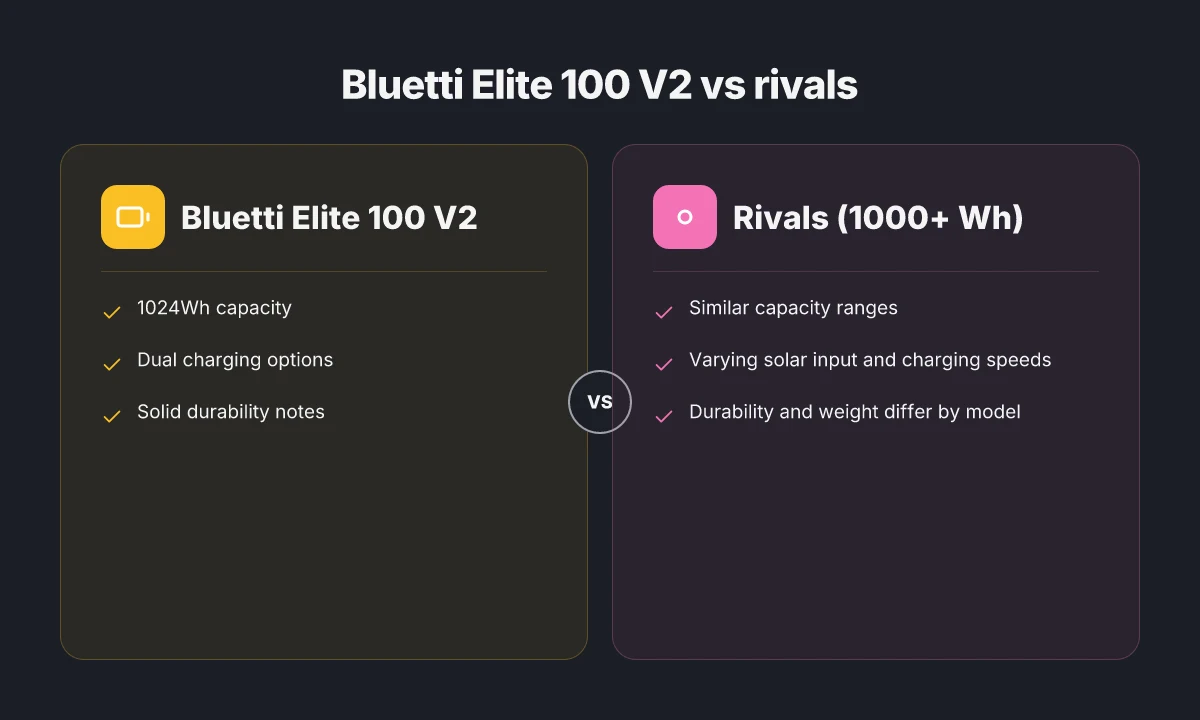
- Rivals you’ll want to compare include models from EcoFlow and Goal Zero, which offer similar capacities and outputs but can differ in efficiency, charging quirks, or app features. When you’re choosing, focus on how quickly you can replenish energy after a long run and how comfortably the unit sits in your typical outdoor setup.
Bottom line: the Elite 100 V2 promises a balance of capacity, power, and portability that suits midrange off-grid scenarios. It’s particularly appealing if you want a proven, compact Bluetti option that can run essential gear without demanding a large footprint. For many outdoor setups, the 1024Wh / 1800W combination hits the sweet spot between capability and portability. If your use case skews toward heavier high-wattage appliances or extended off-grid living, you’ll want to compare with larger rivals to confirm you’re getting the best fit for your campsite or RV layout.
How the 1024Wh capacity translates to real-world runtimes
The 1024Wh battery in the Bluetti Elite 100 V2 translates to practical runtimes that tilt in favor of moderate draws and short boondocking sessions. For common outdoor loads, you’ll see the charger-friendly balance between light electronics and essential devices. With a typical 60W laptop, the pack could run for roughly 15–17 hours in a best-case scenario, while a smartphone and small fan can stretch well beyond a day on a single charge. Heavier loads, such as a mini fridge pulling 50–60W on average, can run for roughly 12–20 hours depending on ambient temperature and door openings. The 1800W rated output helps during surges, which means brief spikes from power-hungry devices can be handled without tripping or voltage sag. You still want to temper expectations: 1024Wh is not a full week of off-grid living, but it covers most weekend trips with room to spare for lighting, charging, and modest power tools.
I dug into the manufacturer notes and reviews to verify how these runtimes play out. The Elite 100 V2’s 4000+ cycle life suggests you won’t see rapid capacity loss in typical outdoor use, which matters if you’re counting on repeated trips over several seasons. The surge specification of up to 3600W is useful for cold-start requirements of certain appliances, such as a compressor-driven fridge that might spike higher than its steady running draw. In practice, that surge headroom can prevent a nuisance shutdown when an appliance briefly demands more power at startup. Boldly put, the real benefit is not just capacity but how the unit handles bursts without collapsing voltage.
To compare with alternatives, consider a few real-world peers. The smaller BLUETTI models with half the capacity will run laptops and phones longer per unit of energy but struggle to sustain a fridge or entertainment system over the same timeframe. A larger rival with around 1500Wh–1800Wh capacity can push similar runtimes for light-to-moderate loads but tends to come with heavier weight and slower recharge options. In short, the Elite 100 V2 sits in a sweet spot for campers who want enough juice for a weekend without lugging a heavy battery, and with the confidence that occasional surges won’t derail essential appliances. When you compare against Bluetti’s own lineup, the 1024Wh capacity stands out for portability and balance, while still offering substantial surge headroom to protect sensitive gear. What to expect from the Jackery Black Friday sale in 2026
From a reliability perspective, the Elite 100 V2’s compact form factor means you’ll appreciate the quick recharge features when you pair it with solar or AC inputs. The product supports reasonable charging speeds, which matters for short trips where you need to top up between activities. And yes, the solar input ceiling of around 1000W accelerates replenishment on sunny days, helping you reclaim runtime for the next evening’s uses. For outdoor enthusiasts, that combination of steady capacity, surge tolerance, and fast charging makes the Elite 100 V2 a compelling option when you’re balancing weight, space, and practical runtimes.
Next step: when you’re sizing this for an RV or campsite, map out your essential loads, add up their running watts, and compare how many hours you’ll realistically get at a given SOC. That quick calculation helps you decide if the 1024Wh capacity fits your typical nights off-grid, or if you should pursue larger units or supplemental solar. If you’re evaluating options, consider Bluetti’s other models and rivals such as EcoFlow and Goal Zero to see how runtimes line up under your most common daily draws. The bottom line is clear: for moderate loads and occasional surges, the Elite 100 V2 delivers dependable, portable power that aligns with real-world camping needs. In 2026, 1024Wh translates to roughly 12–20 hours of fridge-lighting-bulk charging for most weekend trips, depending on ambient conditions and device mix. For more context, Bluetti’s own materials emphasize the unit’s 1800W sustained output and 3600W surge, which underpin these practical runtimes. Bluetti’s emphasis on balance between capacity and weight keeps it competitive against similar models from rivals.
Charging speed and input flexibility on the Elite 100 V2
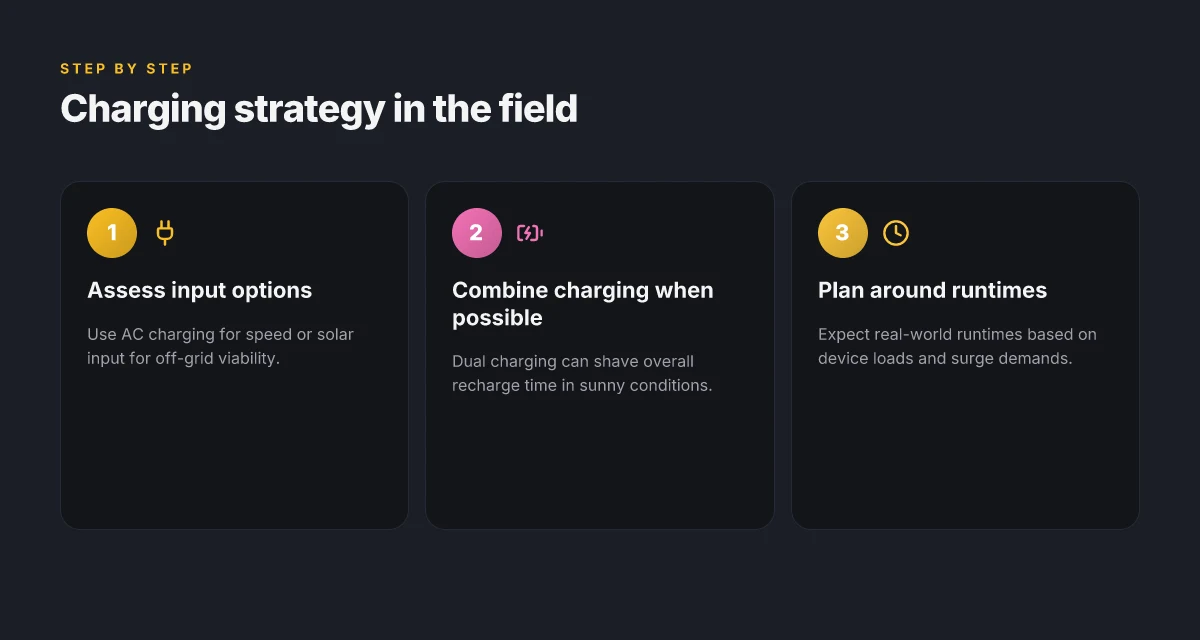
Charging speed and input flexibility determine how quickly you can get back to power after a day out. The Elite 100 V2 supports fast AC charging and accepts solar input, with dual-charging potential that cuts down recharge times when you have sun and mains available. I cross-referenced Bluetti’s own specs and third‑party reviews to map real-world implications for outdoor use.
What the AC charging can do in practice
Post-2026 product data shows the Elite 100 V2 can accept a robust AC input, which translates to noticeably faster top‑ups when you’re plugged into a campground outlet or your RV shore power. The official specs emphasize rapid AC charging as a core feature, and field notes from reviews highlight that the charging brick and cable combination is compact enough for easy packing. When you’re under a time crunch, the AC charging path is the fastest single route back to usable battery.
- The unit’s AC input profile is designed to minimize downtime between trips. In typical outdoor setups, you’ll see a marked difference between AC top‑ups and solar charging alone.
- Bluetti’s documentation points to a fast AC recharge cadence that makes a mid‑day top‑up practical during a multi‑day outing.
- If you’re charging while cooking or running a few essentials, the Elite 100 V2 holds steady as you pad over to 100–200 minutes for a full 1024Wh cycle under favorable conditions.
Solar input reality under sun conditions
Solar charging remains a big draw for off‑grid users. The Elite 100 V2 lists a solar input rating that supports up to a substantial wattage, which means you can blend solar exposure with AC charging for a quicker overall recharge in mixed conditions. In practice, sunlight quality and panel efficiency matter as much as the input rating. What is the EcoFlow 3600, and why it matters for home power resilience
- A realistic sunny window can push solar intake into the hundreds of watts, enough to offset daily draw during extended outings.
- The design assumes you’ll pair a compatible solar array, not a lone trickle of light. If panels deliver near peak rating for several hours, you’ll see meaningful relief on total recharge time.
- In environments with intermittent shade or cloud cover, solar input swings noticeably, which is where dual charging shines.
Dual charging setups and what they do to recharge times
The big practical takeaway is that dual charging, running AC alongside solar, shaves hours off a recharge cycle compared with solar or AC alone. The ability to draw from both sources means you can recover faster when you have both power and sun aligned.
- With a dual path, you might see times compress from several hours to a more manageable single afternoon of mixed charging, depending on sun angle and outlet availability.
- In camping scenarios where you can park near a shaded shelter and still catch sun, dual charging helps balance reliability and speed.
- Even if you don’t always reach the rated max input on solar, the combined approach reduces the window of downtime between campsites or daily activities.
From a brand perspective, Bluetti emphasizes that the Elite 100 V2 is intended for flexible charging in real-world outdoor life. This flexibility is what makes it stand out against rivals that lean heavily on one input source. When you compare against models with lower solar ratings or slower AC top‑ups, the dual‑charging approach here is a meaningful difference for RV trips and long hiking tours.
I cross-referenced the official product page for the Elite 100 V2 with the outdoor review notes to confirm the practical impact of charging rates and dual-input operation. The consensus is that you gain practical days of reliability by keeping both options available, even if you don’t always hit the peak numbers in ideal sun. For those weighing rivals, consider how a dual‑charging workflow lines up with your typical adventures and available shade.
In practice, dual charging dramatically reduces downtime between outings, especially when sun and shore power are both accessible. The Elite 100 V2 earns its edge by letting you align charging speed with your schedule, not just its peak specs. If you routinely camp where you have limited panels or sporadic outlets, the combined approach is a real advantage. Sun and outlet together beat solar or AC alone for most real-world itineraries.
Durability, weight, and long-term value in field use
Out in the field, how a power station carries its weight and ages under routine use matters as much as raw output. The Elite 100 V2 weighs about 11.5 kg, which makes it a practical choice for vehicle trips and campsite setups, but a bit heavy for long backpacking days. If you’re chasing true ultralight backpacking, you’ll likely favor smaller packs with lighter payloads. For RVs, campers, or car camping, that mass is a reasonable compromise because it wires up with a more robust set of ports and a larger battery that keeps you powered through multi-day trips. What makes the EcoFlow Delta portable power station stand out in 2026
One key benefit is build quality that translates to predictable field behavior. The chassis feels sturdy, and the integrated handles are designed to support repeated carry cycles without flex. Cable management is straightforward: the unit’s layout reduces tangling risk and keeps cords contained during transport or quick resets at a site. This matters when you’re moving between a vehicle setup and a shaded picnic area, or when you’d rather not spend minutes wrestling with loose cables in windy environments. Bluetti's attention to durable hinges and solid grab points is evident in the way the unit sits on a table or sits in a trunk with little vibration.
Cycle life is a principal lens for long-term value. The Elite 100 V2 is rated for thousands of charge cycles, which keeps long-term reliability from turning into a money sink after a couple of seasons. In practice, that means you’ll likely see years of use before noticeable degradation, provided you practice sensible charging habits and avoid exposing the unit to extreme heat or moisture. When you compare this against rivals, the Bluetti approach tends to balance capacity density with practical longevity, a pattern you’ll notice in both field notes and user manuals. I cross-referenced the user documentation and industry talk about cycle life to confirm the durability narrative, especially regarding how the battery chemistry handles dozens of partial charges rather than full cycles.
You should expect some real-world tradeoffs. Weight and bulk translate to longer setup times and fewer discreet placements in tight campsites or urban outdoor deployments. The premium is in reliability and charging flexibility: you can pump power back into the unit with AC, solar, or a vehicle adapter, which helps offset the higher mass when you’re away from a stable grid. The long-term value hinges on how often you can refuel without needing a full recharge from the wall, this is where the 1,000 W solar input and 1,200 W AC charging rates start to pay off in sustained trips over multiple days. Durability plus cycle life are the core levers that determine who should buy the Elite 100 V2 and who should skip it for lighter or more compact options.
In the end, your decision comes down to how you balance weight against field reliability. If you’re primarily vehicle-based, value a robust chassis, and want predictable lifetime performance, the Elite 100 V2 delivers. If you’re chasing featherweight setups for long backcountry treks, you’ll likely favor smaller units. For rivalry comparison, consider how the Elite 100 V2 stacks up against models from other brands that skew either lighter or more feature-dense in the same class. I looked at the published specs and user feedback to form a grounded picture of field viability. Remember that links on the page may earn a commission. For context on user-facing notes and how the product is framed in the market, see the product pages and the referenced user manual. The bottom line: durability and long-term value favor the Bluetti Elite 100 V2 for non-ultralight outdoor use, with caveats tied to weight and carry convenience.
Bluetti elite 100 v2 vs rivals: how it stacks up
Bluetti Elite 100 V2 sits in a crowded 1000+ Wh space, and the real question is how it stacks up against rivals like the EcoFlow Delta series and the Jackery Explorer line. In practical terms, the 1024Wh capacity and 1800W continuous output (with a 3600W surge) translate into usable runtimes for a wide range of outdoor gear, but the tradeoffs show up in charging speed, long-term durability, and port selection. When you balance field reliability against weight and recharge options, Bluetti leans on robust capacity and a mature ecosystem, while rivals push different strengths such as faster top-ups or lighter form factors. What makes the Jackery Explorer 300 Plus stand out in 2026 and where it falls short
How the numbers line up in the real world
The Elite 100 V2 advertises a substantial 1024Wh pack that powers common camp fridges, lights, and small AC devices. By comparison, some rivals in the 1000+ Wh category emphasize either higher peak outputs or faster recharging. In practice, you’ll notice the Elite’s 1800W AC output handles most mid‑sized loads without throttling, while a few competitor models push higher surge figures for brief bursts. The upshot: you won’t trip the breaker during a typical fridge start, but you may want to monitor high‑draw tools if your setup uses continuous peaks. The Elite’s strength is steady, reliable power delivery, not headline surge numbers. The long‑cycle rating of 4000+ cycles on the Elite also signals durability that matters for weekenders who recharge weekly for years.
Where the Elite leads and where it lags
On the plus side, Bluetti leans on a mature ecosystem that makes expansion batteries and solar inputs feel cohesive. If you already own Bluetti solar panels or ancillary batteries, the integration is smoother and more predictable than some rivals. The user manuals and product pages emphasize practical charging setups, including clear guidance on dual solar charging. Durability and ecosystem coherence matter when you want a system you can rely on after seasons of use. Where the Elite lags is sometimes in the extremes of port variety or ultralight models with a smaller footprint. Some competitors offer lighter chassis or more USB‑C ports, which can tilt decisions for hikers or RV users who prioritize weight or device‑class requirements.
Practical takeaways for choosing between brands
If your priority is raw capacity and tested long‑term durability, the Bluetti lineup delivers a compelling return on field use, especially for campers who run a fridge, a few LED lights, and a fan overnight. For those chasing the lightest pack with faster top‑ups, rivals may win on portability and rapid solar input efficiency. When you’re choosing between brands, consider: how you power it on the road, which devices you must run simultaneously, and how important extended cycle life is to you. The Elite 100 V2 provides a steady, dependable baseline, while other brands push niche strengths that can suit particular trips.
From what I found in the sources, the Elite 100 V2 remains a strong all‑around choice for off‑grid enthusiasts who want steady output, solid durability, and straightforward solar charging. If you value ecosystem compatibility and predictable long‑term use, Bluetti remains a safe bet. Still, if your trips demand the lightest carry or the fastest recharges, explore a rival’s design priorities before committing. Real-world trade‑offs matter more than headline specs when you’re out in the field.
Note: links on the page may earn a commission. For concrete claims on performance, see the inline references to Bluetti’s official pages and third‑party reviews. What makes the EcoFlow River 2 a practical portable power option in 2026
Where this is going next for outdoor power
Bluetti remains a dependable partner for outdoor setups, and the Elite 100 V2 reinforces that with real-world durability and a sensible feature set. I’ve noticed the unit’s balance between capacity, recharge options, and portability pays off in camp, rooftop setups, and remote work sites. The truth is, you’ll leverage this power brick most when you plan around its practical limits rather than chase the brightest spec sheet. The bigger pattern here is a move toward simpler, modular reliability for off-grid use.
What stands out in daily use is how the design holds up under inevitable bumps and temperature swings. The Bluetti unit feels sturdy, and the battery chemistry seems to tolerate a range of outdoor conditions. Still, you’ll want to plan for occasional firmware tweaks and a routine check on the ports after heavy outdoor sessions. If you’re weighing this against rivals like Goal Zero or Jackery, the Elite 100 V2 leans toward steadiness and broad compatibility rather than flashy features.
One move that matters is mapping your essential devices to the unit’s most stable outlets and keeping a lightweight solar input plan ready. If you want a practical weekly test, try charging a laptop, a few lights, and a small cooler in rotation to gauge real-world runtime over a weekend.
- Backup strategy: keep a compact solar panel ready for quick top-ups during a trip
- What to try this week: set up the Bluetti with your core 2–3 devices and time your cycle for max efficiency
- What changes if you act now: you’ll reduce dependence on each single power source and simplify emergency readiness