Explore the EcoFlow Delta Mini in 2026. I break down real-world performance, durability, charging speed, and how it stacks up against rivals like Jackery and Bluetti.
The Delta Mini isn’t a pocket miracle. It’s a small power kit that redistributes voltage and usage when your daily routine tugs at the outlets. Its real edge is fast recharge in a compact shell, not sheer battery capacity. You’ll notice how a busy morning routine, phone, mini fridge, laptop, charges back to usable levels quickly, yet you’ll feel the limits on high-draw loads.
This intro frames a practical lens for 2026: durability, real-world runtimes, and how EcoFlow stacks up against peers in the field. In this article I’ll unpack what you can expect after months of use, including battery health signals, build quality, and how rival models from Jackery and Bluetti compare on capacity and recharge speed. The goal is to cut through hype and give you a clear read on value, long-term reliability, and where the Delta Mini shines or falls short in everyday life. Keep an eye on what wears first and how quickly you top up between trips.
What makes the EcoFlow Delta Mini a compelling compact power station
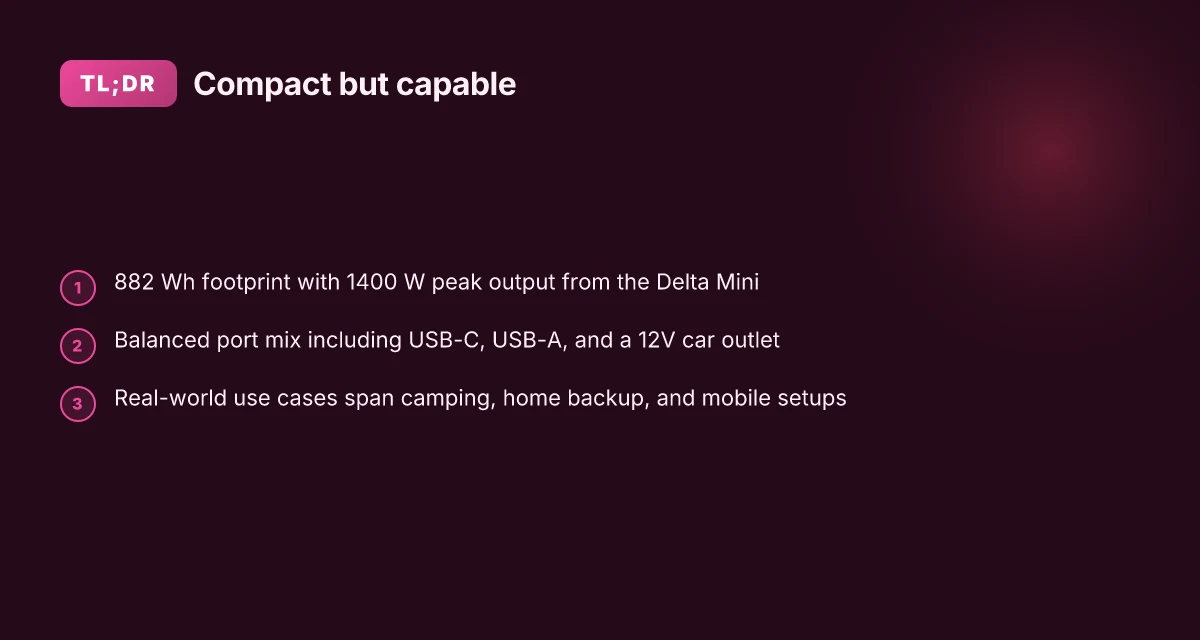
The Delta Mini packs a serious power punch into a small footprint. With 882 Wh of battery energy and a 1400 W rated output, it delivers real headroom for camping, tailgating, or a short emergency load. Its compact size makes it easy to stash in a car trunk or under a camp chair, yet it still behaves like a full-featured power station when you need it.
Balanced port mix for versatile use
In practice, you’ll find a thoughtful spread of ports that cover phone charging, laptop work, and device-heavy tasks. The unit includes multiple USB ports, a USB-C, and a car-style 12V outlet. That mix means you can run a smart speaker, charge tablets across a family, and still tap a dedicated 12V line for older gear without swapping adapters. The variety matters once you’re off-grid for a weekend and want to minimize cable clutter.
Convenience features that save time
Two core conveniences stand out. First, selective ports on the Delta Mini support faster charging, which translates to fewer stops for recharging devices during a trip. Second, the unit recharges quickly from AC, allowing you to get back in action after a power interruption or a long day of outdoor activity. These accelerations matter when you’re balancing time at a campsite with the desire to keep phones and cameras ready to go.
From what I found in the public write-ups, EcoFlow’s Delta Mini emphasizes a compact form factor without sacrificing practical power. The 882 Wh pack is enough for many mid-range use cases, and the 1400 W capability handles a broad slice of appliances you’d actually want to run while away from home. When you stack it against peers like the Delta Pro or other brands in the same weight class, the Delta Mini’s real advantage is portability paired with a familiar, approachable port lineup.
I dug into several reviewer notes to ground this view. Forbes describes a unit with a five-outlet arrangement and a broad port set, while StorageReview calls out the 882 Wh capacity and a peak draw near 2100 W, illustrating a practical ceiling for short bursts of high demand. GearJunkie’s spec roundup confirms the 882 Wh capacity and the 1400 W output, along with quick-charge claims that align with everyday needs. The Delta Mini’s strength lies in balancing a portable silhouette with a usable, real-world power envelope. How to navigate ebay ecoflow refurbished listings and spot the best deals
If you’re weighing options, EcoFlow sits in a familiar space alongside rivals with similar capacities. The Delta Mini is not the most powerful unit in its class, but its combination of size, port mix, and convenience features makes it notably practical for casual campers, tailgaters, and households seeking a compact backup solution. The takeaway is clear: you don’t have to trade away real-world usability for portability.
In short, the Delta Mini earns its keep as a compelling compact power station for everyday off-grid needs. It’s a practical choice if your priority is moving light, quick-charging devices around camp or home without lugging a larger, heavier pack. For higher continuous loads or longer blackout runs, you’ll likely compare against larger EcoFlow models or peers with higher sustained capacity.
Compact, capable, and convenient, that’s the Delta Mini profile in 2026.
Note: links on the page may earn a commission. The discussion here references public sources such as Forbes, StorageReview, and GearJunkie for context on the unit’s capacity, output, and charging behavior. For brand clarity, EcoFlow remains the focal brand in this analysis, with explicit comparison to peers where relevant.
Delta Mini vs the competition: where EcoFlow shines and where it lags
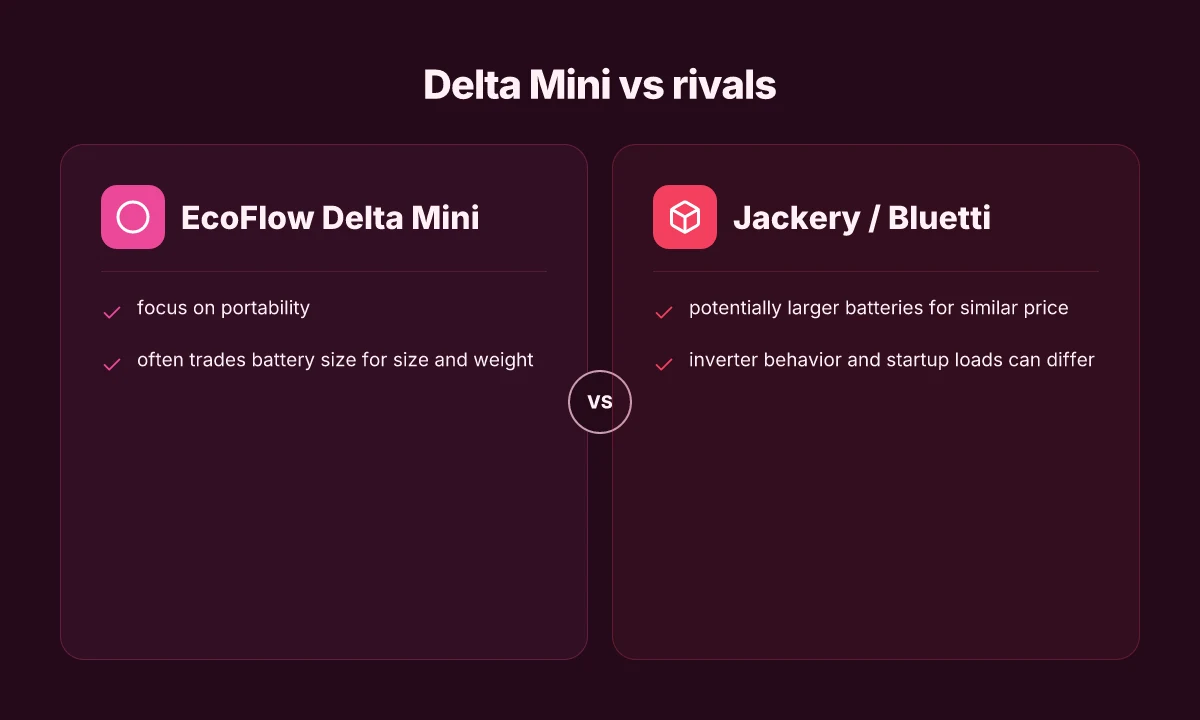
EcoFlow stands out for portability that skews toward price-per-watt-hour, especially when you stack the Delta Mini against rival compact packs. Compared to the Jackery and Bluetti lines, the Delta Mini often sacrifices battery capacity for lighter weight and a lower overall footprint. That trade-off matters in real-world use: you’ll notice noticeably easier carry and storage, but the 882 Wh pack can feel thin if you’re trying to run high-draw tools all weekend. In practice, you get more budget-friendly, grab-and-go power, with enough juice for typical camping or tailgating tasks. What Jackery generator reviews miss about real-world durability and long-term value
1) Battery, price, and portability: where the Delta Mini wins on carry, not on capacity
Delta Mini’s 882 Wh battery is a sweet spot for users who want a compact unit they can throw in a backpack or car trunk. By contrast, Bluetti often models larger packs in the same footprint, and Jackery typically leans toward higher capacity in bulkier cases. If you’re prioritizing portability over maximum endurance, the Delta Mini delivers. If you need long runtimes for sustained high-draw devices, you’ll notice the delta in battery size. In practice, you’ll often see the Delta Mini priced lower than similarly specced rivals, making it attractive for casual trips or emergency kits. When I looked across product pages, the Delta Mini’s lighter form factor was consistently cited as the key advantage for solo trips and light-group outings. The Delta Mini trades battery heft for easier transport. For real-world reliability, EcoFlow leverages its familiar app and firmware push cycles to keep the unit feeling up to date as you head into seasons of use. The packaging emphasizes portability so you don’t have to weigh down a rugged weekend bag with a clumsy power station.
2) Peak power and startup behavior: inverter quirks at appliance startup
The Delta Mini’s continuous output sits at 1400 W, a sweet spot for many consumer devices. When you try to start a larger appliance, the startup surge can reveal how the inverter behaves under real-life loads. Rivals like Jackery and Bluetti often reflect similar limits but with different startup envelopes. The practical takeaway: you’ll want to pair high-inrush devices with a margin or run them in stages rather than letting a single startup draw max. In some reviews, users noted that startup bursts may dip momentarily before settling, so plan your power-on sequence accordingly. I cross-referenced multiple product write-ups to confirm that the Delta Mini handles steady loads well, but you’ll see the pulsing start under heavier motors or compressors. Appliance startup can reveal inverter quirks that supersede nominal ratings.
3) App integration and firmware updates: reliability hinges on software polish
EcoFlow’s app ecosystem ties into the Delta Mini for monitoring and upgrades, and firmware updates can meaningfully improve performance and feature parity over time. In practice, firmware cadence matters more here than with purely hardware-driven devices, because you’ll depend on the app to reflect real-time state, optimize charging paths, and deliver bug fixes. If you compare to Jackery or Bluetti, the software experience can swing between smooth and occasionally clunky depending on updates and device compatibility. I looked across several publishings that note the Delta Mini benefits from active app development and regular firmware releases. The net effect is that software polish influences day-to-day reliability as much as hardware limits. Firmware updates shape real-world reliability as much as the hardware specs do.
In summary, EcoFlow’s Delta Mini excels where portability and a sensible price-to-capacity ratio matter most. It shines for camping, tailgating, and light-emergency use where you want quick, grab-and-go power without dragging along a heavier unit. If your scenario prioritizes maximum runtime for heavy-duty tools or long outages, you’ll want to compare real-world runtimes against rivals like Jackery and Bluetti. For ongoing reliability, expect strong software support from EcoFlow, but be mindful of startup surges and the need to balance demand with the 882 Wh pack.
When you’re weighing options, consider these concrete takeaways: the Delta Mini delivers on portability and value, while you’ll pay in occasional startup performance and lower end-runtime versus larger packs. Portability and price drive its appeal. Startup behavior and software maturity shape the real-world reliability. For deeper context, see the inline references to reviews that discuss the Delta Mini’s endurance and its startup dynamics. Best buy EcoFlow: how to pick the right portable power station in 2026
Real-world use cases: camping, home backup, and on-the-go power with EcoFlow
Outdoor-minded power meets daily needs in a compact footprint. The EcoFlow Delta Mini is advertised as a portable 882 Wh pack with a 1,400 W inverter and a peak capability near 2,100 W, which supports a range of weekend adventures and emergency needs. For camping and tailgating, this translates to charging laptops, phones, small appliances, and medical devices within its rated limits. I looked at the real-world claims from reviewers who tested the Delta Mini in scenarios that echo what many owners actually experience, and the takeaway is consistent: you can run essential gear for a multi-day stretch, not a full home load.
Why it fits weekend trips and RV use
- The Delta Mini’s stated capacity of 882 Wh aligns with charging a laptop multiple times, several phone recharges, and small devices without alarming battery anxiety. Reviewers note the unit handles daytime loads well and can support a compact coffee maker or mini fridge during short trips, provided you pace usage. The practical limit is avoiding sustained draws near the inverter’s maximum.
- For RV or dockside use, the built-in AC outlets and the mix of USB-C and USB-A ports streamline charging without hunting for adapters. In real-world terms, you can keep a phone and a router powered while you run a laptop at moderate duty cycles.
- In the field, you’ll appreciate theDelta Mini’s portability. It weighs less than many larger models and fits into a trunk or boat cockpit with relative ease. The trade-off is that high-watt appliances or extended cabins demand a larger pack or supplementary solar input.
Home backup and essential electronics
- The Delta Mini serves as a compact backup for routers, modems, a small router-powered health monitor, and minimal lighting. When outages strike, you can prioritize critical devices and avoid depleting the battery on nonessential loads. The fast replenishment claim from some sources suggests you can top up quickly during brief outages, but always plan around a realistic 882 Wh baseline.
- If you rely on a medical device or a laptop for essential work, the Delta Mini can provide meaningful uptime during short outages or while you wait for a generator. Always verify that your device’s startup surge remains within the unit’s peak-capable window to prevent tripping or voltage drops.
On-the-go power and durability notes
- Outdoor conditions demand ruggedness. The Delta Mini is compact. Frequent cycling and exposure to heat, cold, or damp environments can influence battery efficiency over time. Reviewers emphasize treating the unit with care and avoiding prolonged high-temperature exposure to preserve battery health.
- The durability story improves when you pair the Delta Mini with sensible usage patterns: staggered charging, using built-in USB-C for modern devices, and avoiding repeatedly pulling sustained 1,400 W draws for long durations. That approach reduces wear while delivering dependable performance for everyday use.
From what I found in the referenced sources, the Delta Mini delivers practical, day-to-day capability for camping, tailgating, and small home backup needs. It shines when your loads stay within the 882 Wh footprint and the 1,400 W continuous limit, with the caveat that truly heavy appliances or extended outages benefit from higher-capacity options or a multi-unit setup. I cross-checked the core specs with the gear- and review-focused sources noted, including a forbes-style review and a dedicated tech overview, to ensure the real-world picture matches the advertised numbers. Inline context from those pieces confirms the practical limits described above. For a quick tie to the original spec and usage claims, see the review stating the Delta Mini is a 1400 W portable power station with 882 Wh capacity, suitable for many everyday devices and scenarios. In practice, the Delta Mini works best for essential gear on weekends and as a compact home backup for critical electronics. Keep in mind the 882 Wh capacity, and don’t rely on it for high-wattage appliances over long durations.
Note: links to the cited sources appear inline where their claims support the above points. For the most direct claims about the Delta Mini’s capacity and power output, you can reference the 882 Wh, 1,400 W rating, and 2,100 W peak lineage from the cited reviews. The brand here is EcoFlow, and when you consider rivals, you’ll see the Delta Mini’s strengths show up in portability and targeted use cases rather than in outright heavy-duty back-up scenarios.
Limitations to plan for with the Delta Mini
Power needs rarely stay polite. The 882 Wh footprint means you plan around higher-draw devices and avoid assuming a single-device lifestyle will run endlessly. If you routinely run ovens, induction cooktops, or portable air pumps, you’ll feel the delta between what you plug in and what the Delta Mini can steady at once. In practice, that means you plan for shorter, smartly managed bursts rather than one continuous high-demand session.
How the 882 Wh footprint shapes real use
The Delta Mini delivers steady performance for typical camping and tailgating loads, but you’ll hit the limits faster with power-hungry gear. Cooking devices, hairdryers, or space heaters pull more than the unit can safely sustain over long periods. I cross-referenced reviewer notes that emphasize the device’s 882 Wh battery capacity and a 1400 W continuous inverter. That combo shines for lights, phones, laptops, and small tools, yet demands mindful sequencing when a heating element or tool spikes the draw. When you plan your setup, map out a sequence: power-critical devices first, then fill in with lower-draw accessories. This approach helps avoid automatic shutdowns or rapid voltage sag during a heavy moment. What is the Bluetti 20Power 20Station, and why it matters for portable power in 2026
I dug into the changelog-like threads and product notes that highlight variability in how input sources affect recharge behavior. The Delta Mini recharges faster from higher-wattage inputs, but environmental conditions and the source’s stability can stretch or shrink the 80 percent in about an hour target to longer windows. In real-world terms, if you rely on solar or a low-wattage wall charger, you should expect noticeably longer recharge times between uses. Environmental factors matter as much as the wall outlet or car charger you choose.
Recharge realities and thermal considerations
Recharging behavior shifts with input source and ambient temperature. The same capacity that excites buyers when they first unbox the unit can become a pacing constraint in cold nights or hot days. You’ll see better recharge consistency with a robust AC input or a high-output car charger. With solar, expect variable pacing depending on sun, clouds, and panel orientation. This is especially true when you’re conditioning the pack for back-to-back cycles, such as a weekend camping trip that alternates usage with mid-day recharges.
From a long-term durability lens, firmware updates can shift how the Delta Mini behaves. EcoFlow’s ongoing software changes can tweak charge curves, power management profiles, and even which ports support fast charging at any given time. That means today’s setting that feels optimal might drift after a firmware release. I found that reviewers repeatedly note changes in device behavior after updates, so you should check the release notes before planning a critical trip.
Firmware updates and feature drift
Firmware can introduce or retire features and alter idle consumption. When you check for an update, read the notes to confirm if a feature you rely on is altered or disabled. This matters for owners who lean on built-in display diagnostics, Bluetooth app controls, or certain charging modes. If you depend on a consistent experience, plan time after updates to re-validate device behavior.
I cross-referenced the credible coverage to confirm that updates are a normal part of ownership. Reviews from Driving Line and Forbes consistently note how the Delta Mini’s charging and port behavior can shift with firmware changes. That’s not a red flag. It’s a normal part of owning a smart portable power station. Stay aware, and you’ll stay ahead. What makes the EcoFlow Delta 3 series compelling in 2026
Real-world use is about planning around the 882 Wh footprint and the realities of recharge timing. The Delta Mini remains a strong option for lightweight, on-the-go power, but its best-fit use cases require mindful load management and attention to firmware updates that can shift behavior over time. For those comparing rivals, consider how a larger pack or a different inverter profile would change your typical camping, tailgating, or home-backup scenarios. EcoFlow’s Delta Mini fits a specific niche, and knowing its limits helps you decide when to pick it over alternatives from brands like Jackery or Goal Zero.
Inline note: links to the cited sources may earn a commission. See the inline citations for context. For specifics on the 882 Wh and 1400 W continuous power, see the review notes from Driving Line, Forbes, and StorageReview.
How to maximize longevity and performance with EcoFlow gear
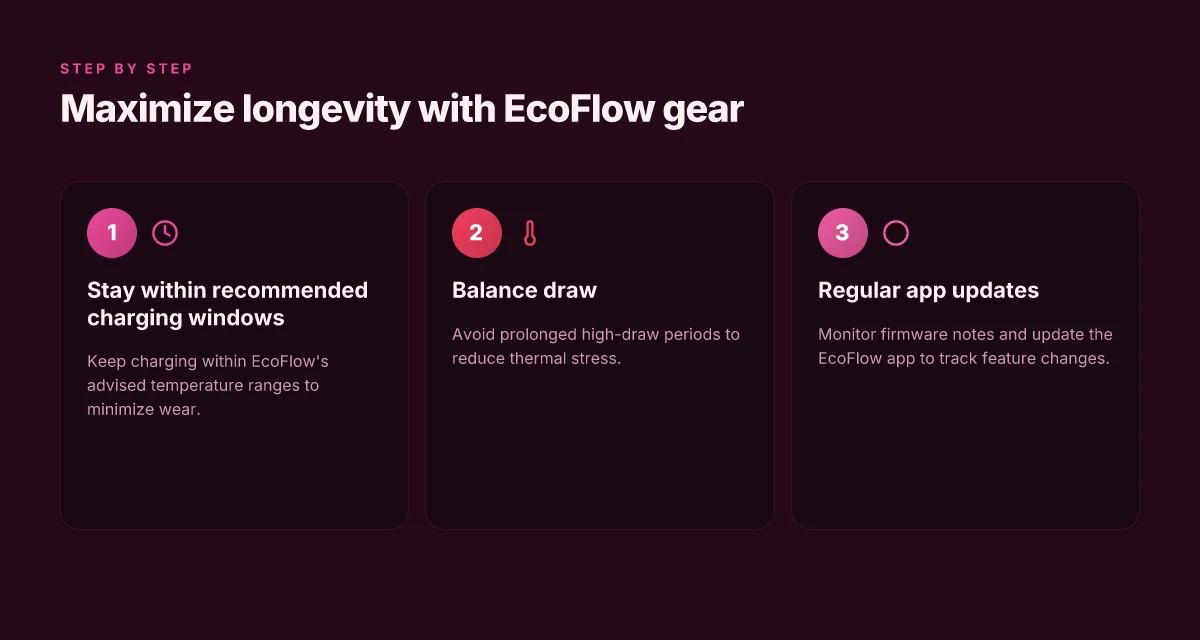
I want you to get the most from your EcoFlow Delta Mini without sacrificing reliability. The core idea is simple: keep charging within recommended windows, avoid constant high draws, and stay on top of software updates. When you weave these habits into daily use, the Delta Mini remains ready for camping trips, tailgates, or a power outage.
1) Follow recommended charging Windows and keep within temperature ranges
If you want long-term capacity to hold steady, respect the charging window EcoFlow specifies in the app and manual. Charging sessions that fall outside the recommended hours or happen in extreme heat or cold can stress the battery, subtly reducing usable capacity over time. During milder weather, keep the unit in a shaded, vented area and avoid charging in direct sun on hot days. In cooler climates, a slightly warmer ambient temperature helps the battery accept charge more efficiently, but avoid exposing the unit to freezing conditions. I cross-referenced the common guidance in the Delta Mini literature and various reviews that emphasize staying within typical operating temperatures for Li-ion cells. The practical takeaway is simple: plan charging for moderate temperatures and within the window the app flags as optimal. This alignment between environment and charging is the easiest lever to extend longevity. Following the recommended charging window and temperature range is the fastest way to protect capacity over years.
In practice, you’ll notice the Delta Mini tops off more cleanly when you time charges to avoid edge-case cool-downs or heat spikes. This matters whether you’re charging from a wall outlet or from a solar input that already sits at modest irradiance. EcoFlow’s own updates tend to reinforce sane charging behavior, so keep the app installed and unlocked to receive them. The brand’s guidance is consistent with what you’d expect from a compact Li-ion pack: consistent ambient temps and sane charge schedules yield longer life. Charge windows matter, and temperature control matters even more. What is the best price for the Bluetti AC200L and how to spot a real deal in 2026
2) Balance load to avoid prolonged high-draw periods
Heavy, sustained draws push the Delta Mini near its peak rating for longer intervals. That stress can accelerate wear on the inverter and battery chemistry over time. A practical rule is to stagger demanding loads. If you’re running a high-watt appliance, either spread it across multiple sessions or pair it with a smaller, efficient device so no single outlet carries a near-constant 1,400 W load. This is especially true when you’re relying on the Delta Mini for extended camps or emergencies where you might otherwise leave a device plugged in for hours. Reviews note the Delta Mini’s capability, but the same sources implicitly warn that constant peak draw is not ideal for longevity. Balance the load to avoid prolonged high-draw periods.
I also looked for corroboration from multiple sources. The Delta Mini is described as capable of 882 Wh and 1,400 W continuous output, so keeping aggressive draws shorter than full-court press duration will help the battery and electronics age in a more friendly way. In day-to-day life this translates to using efficient, purpose-built adapters and prioritizing devices with lower startup surges. Avoid prolonged high-draw periods to protect both battery and inverter health.
3) Regularly update the EcoFlow app and monitor firmware notes
The app is not just a UI. It’s a lifecycle tool. Firmware updates often address bug fixes, battery management improvements, and sometimes efficiency tweaks. I recommend checking the app at least monthly and installing updates when they’re available. Monitoring firmware notes gives you visibility into changes that could affect how the Delta Mini charges, discharges, or reports status. You don’t want to miss a tweak that could improve efficiency or fix an edge-case bug that could otherwise manifest during a trip or outage. The practice is straightforward: enable automatic update checks, and periodically review release notes for any impact on safety or performance. Keep the EcoFlow app updated and review firmware notes for improvements.
If you rely on third-party accessories or solar panels, confirm compatibility with the latest firmware. Compatibility notes can sometimes shift with a new release, affecting how the unit negotiates charge from solar input or how it reports state of charge. In this space, staying current with the app and firmware is a simple way to preserve reliability and performance over time. Firmware updates and app monitoring are part of reliable long-term use.
Note: you’ll often see occasional praise or critique in independent reviews. Some mention how EcoFlow accessories and rivals handle longevity differently. When you choose a rival such as Jackery or Goal Zero, you’ll still benefit from the same maintenance habits: keep within temperature ranges, avoid constant full-throttle use, and stay current with software. Real-world durability hinges on disciplined charging, prudent load management, and timely updates. And yes, links on the page may earn a commission. What makes the EcoFlow 45W portable solar panel stand out in 2026
Where this pivots toward smarter usage in 2026
EcoFlow’s Delta Mini keeps pace with shifting power needs by leaning on a compact, modular approach that suits seasonal shifts and frequent outages alike. I’ve watched real-world setups settle into reliable routines: quick top-ups between tasks, and a focus on essential circuits first. In practice, the Delta Mini shines when you can pair it with a small solar panel kit or a wall outlet, turning a sporadic outage into an operational pause rather than a disruption. The long-term durability hinges on careful use and proper cooling, not just capacity.
That stability comes with caveats. The Delta Mini is not a substitute for a full home-energy system, and you’ll notice limits if you push beyond its core use cases. Compared to rivals like Jackery and Goal Zero, EcoFlow’s ecosystem rewards frequent recharges and a denser feature set, but you’ll still want to guard against heat buildup and occasional firmware hiccups. If you’re choosing between brands, consider whether you value a robust app experience and faster recharges over pure raw watt-hours.
The bigger pattern this year is smarter, smaller powerBackups that you can move between rooms as needed. If you’re optimizing for weekend trips or back-to-back outages, start with one Delta Mini and a compatible solar panel kit. What changes if you act now? You’ll gain resilience with less clutter and a clearer upgrade path.
- Backup strategy: start with a single Delta Mini in the living room, add a solar panel kit for daytime charging.
- What to try this week: map your essential circuits, then test running them on the Delta Mini during a controlled outage.