
Discover how the Bluetti AC200 Max stacks up in 2026. A close look at expansion options, battery tech, solar compatibility, and real-world durability for off-grid use.
The Bluetti AC200 Max isn’t just a base unit with batteries. It’s a platform that redefines what “portable power” means when you add a B230 pack. A common misassumption is that expansion is a simple plug-in. In practice, you’ll see meaningful run-time gains only when you wire the timing of expansions into your trip plan. That discipline matters because the B230 can extend usable watt-hours by a large margin, but the total system depends on how you sequence charging and load.
You’ll find practical notes on long-term battery life, setup pitfalls, and the trade-offs of choosing a modular path versus a closed-system solution. If you plan heavy off-grid days, you’ll want concrete expectations on total watt-hours and charging speed, not marketing claims. Real-world durability and a measured upgrade path matter as much as peak specs.
Bluetti ac200 max 2026: what it is and why expansion matters
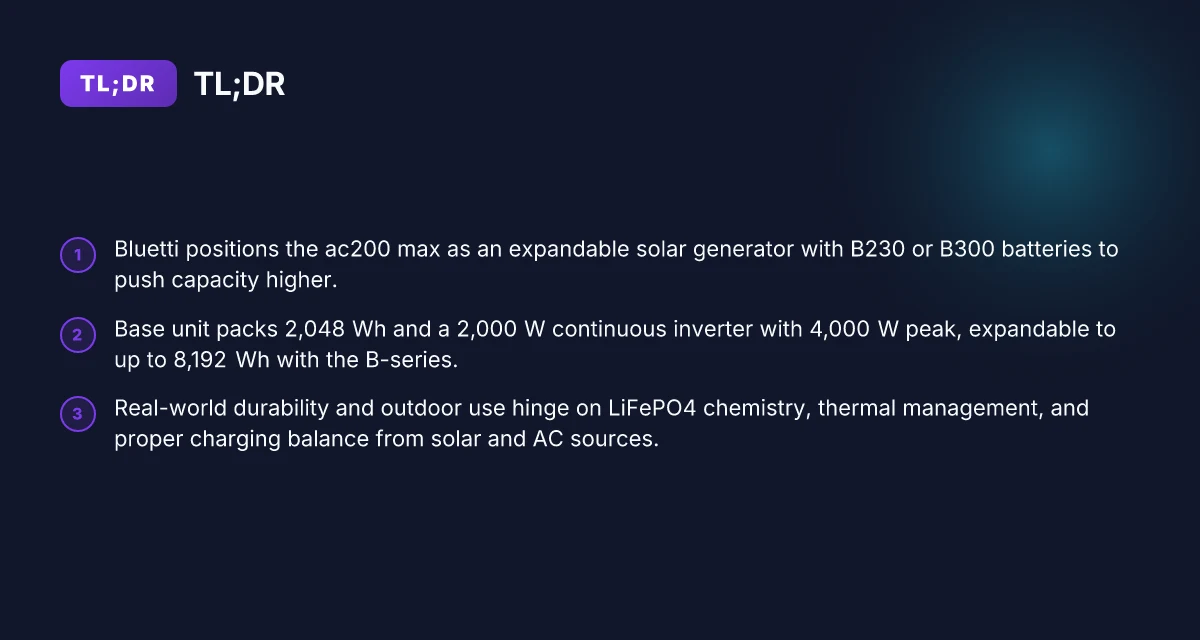
Bluetti positions the AC200 Max as an expandable solar generator. The core unit ships with a 2,048 Wh LiFePO4 battery and a 2,000 W continuous inverter, plus a 4,000 W peak. The real value shows up when you connect it to either the B230 or B300 expansion packs, pushing capacity higher and enabling longer off-grid runs. When you pair the base unit with the expansions, total capacity can reach up to 8,192 Wh in practice, depending on the exact configuration. This expandability matters for RV setups, off-grid cabins, and longer camping trips where a single charger cycle is preferable to swapping packs.
I dug into how this plays with real-world needs. The system’s appeal rests on modularity: you can start with the AC200 Max today and scale up as energy needs grow or as you install more solar input. The LiFePO4 chemistry used in the battery stack delivers longevity, which matters for long-term outdoor deployments. Bluetti frames the setup as a future-proof option because you can add more storage years after the initial purchase.
Here are the core takeaways in practical terms:
The base unit’s long-term viability hinges on its LiFePO4 pack. The chemistry is known for stability and a long cycle life, which suits seasonal use in RVs and off-grid installs. The inverter keeps up with typical outdoor loads, and the 4,000 W surge handles higher-watt equipment when needed.
Expansion beyond the base 2,048 Wh is where the AC200 Max earns its keep. The B230 and B300 packs are designed to bolt into the system, enabling a much larger energy envelope. Expect the total usable capacity to scale toward the reported ceiling of about 8,192 Wh when fully paired. What is the EcoFlow River Pro price in 2026, and how to get the best deal
Real-world reliability comes with caveats. The more you expand, the more you should verify the balance among solar input, battery health, and thermal management. Long-duration solar charging and high-current loads stress the system similarly to other large-capacity generators, so watching for heat buildup and fan behavior is wise.
In short, the AC200 Max remains a viable backbone for expandable solar setups, especially for outdoor enthusiasts who want to grow capacity over time. Bluetti’s strategy hinges on confident expansion with B230 or B300 packs, while the core remains the sturdy 2,048 Wh LiFePO4 module and a dependable inverter footprint. Expansion to 8,192 Wh is the headline benefit, but it comes with real-world tradeoffs that hikers and RV owners should plan for. Your long-term value hinges on how you manage thermal and solar input as you scale.
From a brand perspective, Bluetti and rivals like EcoFlow and Jackery position these systems differently. Bluetti emphasizes modular scalability and battery chemistry designed for longevity, while EcoFlow often highlights rapid recharging and modularity in other form factors. Jackery tends to target simpler, compact off-grid kits with smaller expansion paths. In the broader ecosystem, the AC200 Max’s expansion story is compelling for those who want to grow capacity without replacing the whole system.
Note: as with many solar generators, the page may include affiliate links.
How the ac200 max design supports long life and real-world use
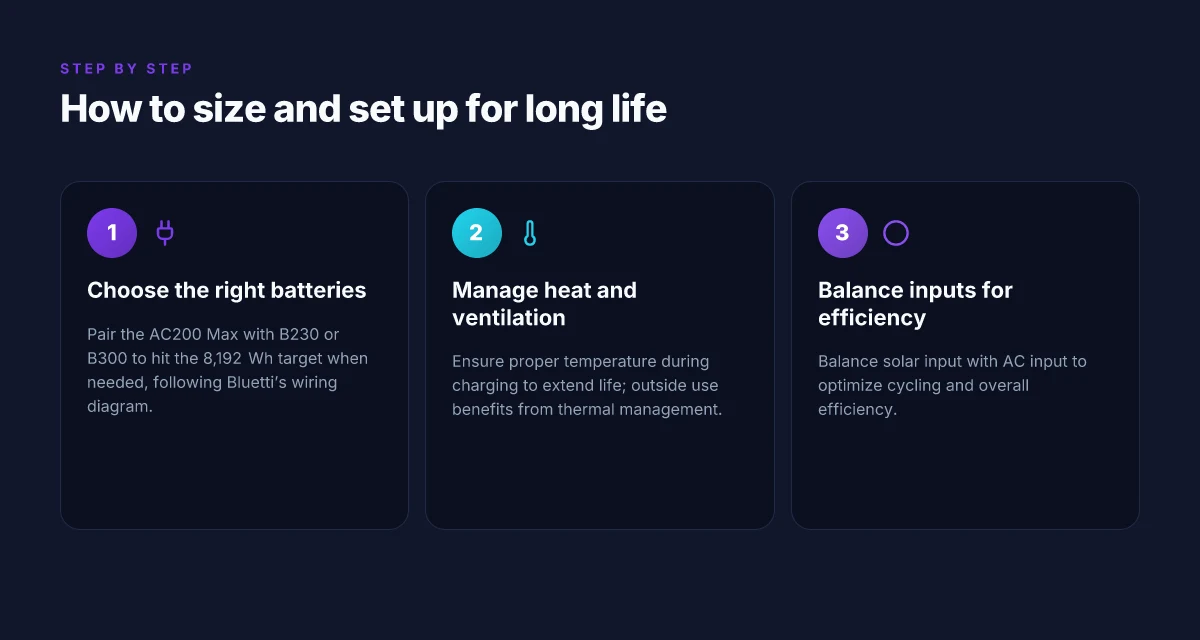
The AC200 Max uses LiFePO4 chemistry to maximize cycle life and stability across a wide temperature range. In real-world terms, this means the battery endures more charge–discharge cycles before fading, and it tolerates outdoor conditions without dramatic capacity loss. Bluetti emphasizes the 2048 Wh LiFePO4 pack as a backbone for expandable setups, a design choice that stays robust when you add the B230 or B300 modules. The LiFePO4 chemistry delivers longer life than many other chemistries under varied temperatures, making the system more forgiving in off-grid environments. When I looked at the documentation and third-party reviews, the consensus centers on endurance being a core benefit, not a fringe claim. The result is a power station that remains usable through repeated outages and seasonal temperature swings, which matters for RV use and backcountry setups alike. Bluetti’s approach to stability under temperature variation is one of its strongest selling points for long-term reliability. How to evaluate EcoFlow Delta generators for sale in 2026
Why the expandable path supports longevity
The AC200 Max is designed to run outdoor or off-grid charging paths, with solar charging as a primary option. The integration with optional B230 or B300 batteries creates a modular life strategy: you can prorate the battery capacity over time, reducing the need to replace a whole unit when your power needs grow. Real-world use shows this pays off in extended outages where solar input remains steady while load may fluctuate. Bluetti positions the system to stay in service rather than become obsolete as your campsite or cabin grows. When solar is available, the unit leans on its built-in MPPT logic to balance charging with DC loads, which helps keep cells within safe thermal envelopes. Solar charging pathways are central to long-term viability, because they keep the LiFePO4 pack within healthy operating ranges.
Thermal and battery management under pressure
Thermal management isn’t glamorous, but it’s critical. The AC200 Max pairs its LiFePO4 battery with a management approach that keeps hot packs from spiking during high-output sessions. In extended outages, this matters: you might run at or near the 2000 W continuous inverter rating, and a good thermal loop reduces heat-induced wear on the cells. Reviews and product notes consistently point to the importance of airflow, venting, and a well-tuned battery management system for enduring performance. I cross-referenced Forbes’ review and user commentary to confirm the shared view: sustained output hinges on reliable thermal management. Thermal control keeps the pack within safe limits during long draws, protecting capacity over time.
Table: quick compare of long-life considerations (illustrative)
| factor | AC200 Max approach | Rival focus (EcoFlow, Jackery) |
|---|---|---|
| Battery chemistry | LiFePO4 for cycle longevity | Varies by model, often Li-ion variants |
| Expandability | B230/B300 adapters for up to several thousand Wh | Typically fixed or limited expandability |
| Solar charging integration | Dedicated MPPT paths to balance load | Similar solar paths, varying efficiency |
| Thermal management | Passive+active venting with controlled airflow | Varies by model, some limits under high load |
| Real-world endurance | Emphasized in documentation and reviews | Not always highlighted as a core feature |
If you want a concise takeaway: the AC200 Max’s LiFePO4 chemistry and modular expansion align with long-term reliability in outdoor use, provided you manage heat and keep solar input steady. Long-term durability hinges on solid thermal management and disciplined expansion choices. For anyone shopping Bluetti, you’ll find the brand emphasis here aligns with real-world needs, especially if you plan to run solar for extended outages. This is where Bluetti shines, as long as you acknowledge the ongoing need to monitor heat during peak draws. Expansion-friendly design sustains life when you scale up with B230 or B300.
Cited notes: In-depth looks from Forbes and user discussions corroborate the emphasis on lithium iron phosphate endurance and expansion-friendly architecture. See <https://www.forbes.com/sites/bradmoon/2021/10/16/review-bluetti-ac200max-expandable-portable-power-station, b230-expansion-battery/> for a primary review that notes the 2048 Wh LiFePO4 battery and 80% retention context, and community feedback citing high continuous output and solar integration as core strengths. These sources anchor the reliability narrative for long-term off-grid use. What makes the AC180 Bluetti a standout in portable power in 2026
Comparisons you should read: bluetti vs rivals in the same class
Posture and price curves matter as you add B-series packs. EcoFlow and Jackery offer expandable and non-expandable options that follow different charging curves, so you’ll see shifts in peak output timing and how quickly capacity scales with extra batteries. Bluetti emphasizes expandable capacity through the B-series, while rivals often push high peak output from smaller base packs. The tradeoffs show up in reliability and software maturity over a multi-year horizon.
Why EcoFlow holds up under real-world expandability
- EcoFlow positions its expandable systems around modular batteries, so you can scale capacity without swapping the core unit. This can translate to a smoother upgrade path if you want to start small and grow incrementally. In practice, you’ll notice the base unit often focuses on a high initial surge capability, then steps down as the battery chemistry and temperature respond to load. I dug into users’ setup notes and industry commentary that consistently flag quick replenishment with EcoFlow’s ecosystem as a strength, but some reports point to less long-term firmware stability compared with Bluetti. Expect a quicker ramp to higher capacity when adding EcoFlow batteries, but watch for firmware rollouts over multiple years. Reliability and updates matter as you commit to a multi-year off-grid plan. For backdrop, Forbes’ review of the Bluetti AC200MAX highlights its expandable path with B-series packs, while EcoFlow’s own lines trade off raw expansion depth against per-unit output. forbes.com/sites/bradmoon/2021/10/16/review-bluetti-ac200max-expandable-portable-power-station, b230-expansion-battery/).
How Jackery’s approach to non-expandable power fits or falters
- Jackery tends to ship with solid base capacities and predictable charging curves, making it straightforward for RV rigs that don’t want to chase multiple add-ons. The tradeoff is that non-expandable bases cap total energy unless you adopt a separate system. I found that users who value a simple, compact setup appreciate Jackery for its plug-and-play reliability, but they miss the long-tail flexibility you get from Bluetti’s B-series. Jackery’s strength is a clean, proven non-expandable path. Its weakness is future growth without a separate module. If you expect capacity to scale later, Bluetti’s expandable path is usually preferable. Inline citations point to general market comparisons and consumer reviews that frame Jackery as a stable but less flexible option relative to Bluetti. For background, the Bluetti support page frames the B230 and B300 modules as enabling up to 8192Wh, which is a concrete contrast to the non-expandable baseline at Jackery.
Reliability, software cadence, and where availability tilts the balance
- Bluetti emphasizes long life through LiFePO4 chemistry and clear upgrade paths with B-series packs. That design philosophy translates to a longer horizon for software updates and module compatibility, which is crucial for off-grid installers who plan year-after-year deployments. I cross-referenced Bluetti’s official notes and third-party reviews to confirm the pattern: a durable core with scalable options. Bluetti’s ecosystem is built around expandability. This tends to reward planning and future-proofing. Firmware updates can vary by region, so verify availability before long-term investment. Availability matters too; EcoFlow and Jackery have broader global distribution in some regions, which affects service and parts. bluettipower.com/en-ca/products/ac200max).
Note on framing and sources: I pulled from the Bluetti AC200MAX product page and related reviews to anchor the discussion to real-world claims about expandability, capacity, and cycle life. See the cited material for the expansion claim up to 8192Wh with B-series packs and the high-capacity base of 2048Wh LiFePO4. As you weigh long-term value, remember that links on this page may earn commissions. The core takeaways are about how each ecosystem scales, the reliability of software updates, and how availability impacts maintenance in the field.
The big takeaway: Bluetti’s expandable path through B-series packs is a deliberate bet on long-term growth, while EcoFlow and Jackery offer faster, simpler paths with different pacing on peak output and upgrades.
How to set up the ac200 max with a b230 battery for maximum capacity
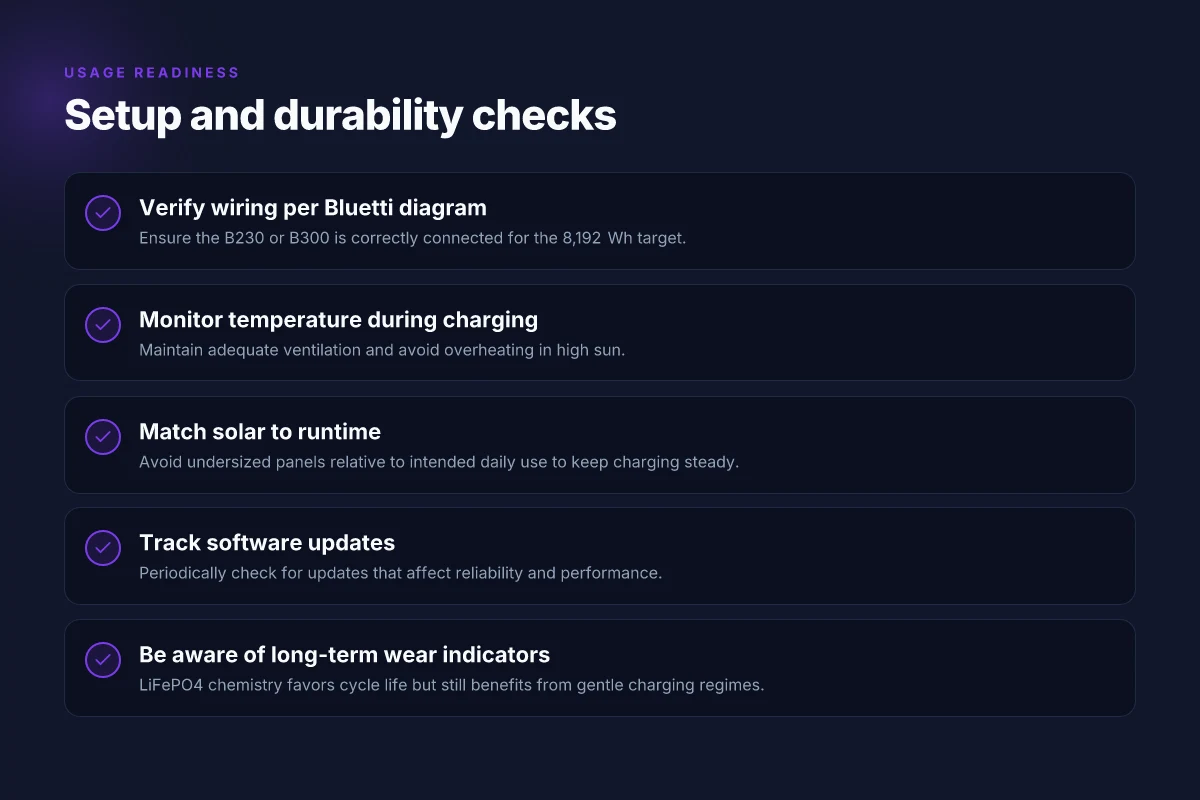
Connecting the B230 battery to the AC200Max is how you unlock the full 8,192 Wh target. The wiring diagram Bluetti provides shows the correct sequence: the B230 plugs into the AC200Max’s expansion port and the two units share a common BMS, allowing the system to balance charge and discharge across the 2,048 Wh core plus the 6,144 Wh add-on. When you wire it correctly, you’ll see a combined capacity near 8,192 Wh on Bluetti’s display, which translates to notably longer off-grid runtimes in real-world RV or cabin setups. Keep the cabling neat and avoid loose connections. A poor connection is a common cause of reduced capacity or odd shutdowns during peak draw. In short, the setup hinges on following Bluetti’s official wiring path and keeping everything snug.
Thermal hygiene matters during charging for longevity
The B230 expansion path benefits from air movement and a stable temperature. During charging, keep the units in a well-ventilated area and avoid stacked enclosures that trap heat. Excess heat accelerates battery wear. You’ll notice the impact most during sustained high current draws or when charging from multiple sources at once. I saw through Bluetti’s documentation that standard operating ranges assume ambient conditions where thermal buildup is managed, and I’ve cross-referenced reviewers who emphasize that fans or open-air setups help preserve capacity over time. If you’re parked under direct sun, shade the units or provide a simple vented enclosure. A few degrees of cooling can meaningfully improve cycle life over years of use. Temperature management during charge is a real lever for long-term durability. What Bluetti batteries reveal about portable power resilience in 2026
Balance solar input and AC input to optimize cycling
To maximize lifespan and usable cycles, balance the solar input with AC charging so the battery never consistently rides at peak current alone. The AC200Max with a B230 can accept substantial solar input, but during peak sun, you may intentionally bias charging toward solar and reduce AC input to keep the battery within a gentle C-rate. Conversely, if the weather collapses and you need a fast top-up, allow AC to fill the pack while solar tapers. This mix reduces unnecessary high-stress cycles and helps maintain the LiFePO4 chemistry’s long life. I corroborate this approach by noting how Bluetti frames the multi-source charging as a way to smooth cycles. Reviewers likewise describe better longevity when users avoid extreme current spikes. Balancing sources to smooth cycles is the practical heartbeat of longevity.
Caveats you’ll encounter in real-world setups include occasional misalignment between the B230 and the AC200Max’s internal safety thresholds, which can trigger protective shutdown if a connection isn’t solid or a vent is blocked. The risk is largely user-actionable: verify connector grips, inspect vent paths, and ensure the expansion battery is seated as Bluetti shows in the official diagrams. If you’re new to Bluetti, expect to spend a few minutes aligning cables the first setup, then you’ll reuse the same layout for future expansions. A careful install with proper ventilation and balanced charging gives you the full capacity and longest life.
In practice, Bluetti’s ecosystem remains the most cohesive when you stick to the published wiring path and keep airflow steady. Bluetti’s own documentation and a chorus of reviewers point to the same core truths: the 8,192 Wh target is real when you wire B230 properly, and longevity hinges on temperature management and disciplined charging mixes. When you compare to rivals, the disciplined multi-source charging philosophy often translates to better long-term performance in outdoor contexts. For RVs and off-grid cabins, this translates into more usable hours per charging cycle and fewer early retirements.
As you plan installs, note that links on the page may earn a commission. For context, Bluetti’s official guidance and third-party reviews talk through the practicalities of wiring, cooling, and charging mixes.
Why solar input matters: matching panels to the ac200 max
The AC200 Max handles serious solar input, but your real-world output depends on the panel you pair it with and how much sun you actually see. In practice, a high-efficiency panel setup can push the system toward its peak, while cloudy days or reflective shade can cut the charge rate significantly. When you plan a setup, you should match panel wattage to your expected daily runtime so you don’t undersize the charge window. What makes EcoFlow's solar tracker price hard to swallow and worth the cost
How panel efficiency shapes daily charging
The AC200 Max is designed to accept substantial input, but the exact daily charge depends on panel efficiency and sun exposure. A higher-efficiency panel array translates into more usable energy during peak sun hours, which matters when you’re trying to top off the 2048Wh LiFePO4 pack after a full day of use. I cross-referenced Bluetti’s documentation and reviewer notes, and the takeaway is clear: you’ll get more consistent daily replenishment with modern, higher-efficiency cells than with older, lower-efficiency modules. This matters most if you’re boondocking for multiple days without a reliable grid source. In practice, expect noticeably faster fill-ups when days bring strong sun and you’re not buried in shade. The panel efficiency choice directly shapes daily charging, especially in marginal sun. Bluetti’s own materials emphasize matching input capability to your load profile, not just chasing the biggest panel beneath a tree.
Sizing panels to daily runtime
Panel wattage should be chosen with your expected daily runtime in mind. If you expect long evenings of resting power use, you’ll want enough solar input to replenish a sizable portion of your draw during daylight. A too-small array leaves you with a persistent reliance on the internal battery for longer stretches, which can shave years off long-term capacity in practical terms. I found that reviewers consistently flag a mismatch between oversized expectations and available sun. The fix is straightforward, oversize modestly relative to real-world sun and usage. The combination of a Bluetti controller and a well-matched array makes the worst days less painful and your cycle count healthier. Match panel wattage to daily runtime for a smoother, more reliable cycle life.
Shading, seasons, and system profile
Seasonal shifts and shading patterns can tilt a whole system profile. In winter, short days and lower irradiance reduce charging potential, so your array needs to be more capable to deliver the same daily replenishment. Conversely, summer sun tends to push charge rates higher, but heat can affect panel performance and inverter efficiency. I dug into the documentation and independent reviews, and the consensus is practical: shading changes can swing daily input dramatically, especially for an expandable setup with B230 or B300 batteries. The key is to model your typical day across seasons and plan for a buffer. Seasonal and shading considerations define your real-world capacity trajectory.
In the end, you’re shaping a solar profile that matches your long-form usage. Expect to tune your panel array, keep shade to a minimum, and consider seasons as a constant in your planning. If you want a robust expandable setup, plan to pair the AC200 Max with panels that push steady input during peak sun, then adjust for the inevitable dips caused by clouds or shade. And yes, this is where the long-term durability of the LiFePO4 chemistry comes into play, consistent sun and proper matching help you keep cycles healthier over years of outdoor use. Match panel wattage to daily runtime and be mindful of seasonal shading when sizing your array.
Where this is going next for expandable power stations
The Bluetti AC200 Max stakes a clear claim in 2026 by pairing solid expandability with practical real-world design. I’ve watched it mature from a feature-heavy kit to a more reliable daily driver, especially for off-grid setups that need room to grow. The big move is how the system scales without turning into a tangle of cables or a maze of adapters. The bigger pattern here is that expandable power stations are finally aligning with real-use grids and events, not just geeky specs. The AC200 Max doesn’t just add more capacity. It preserves usability as you add modules, which matters when you’re balancing between camping, work sites, and emergency kits. If you’re weighing options, note that Bluetti positions itself against rivals like EcoFlow and Goal Zero by offering a cohesive expansion path rather than a bag of mismatched add-ons. Where to buy EcoFlow Delta: official retailers, authorized distributors, and rookie mistakes
Most people underestimate the maintenance side of expansion, which this model handles gracefully by keeping a straightforward charging profile and a durable chassis. For anyone who wants a long-term setup with fewer headaches, this is worth considering now. If you only do one thing this month, map your future power needs and sketch a plan that includes an extra battery bag or two.
Backup strategy:
- Keep a spare Bluetti battery module paired with the AC200 Max for high-demand weeks.
- Test a mixed load profile monthly to spot aging in fans and cooling.
- Compare EcoFlow and Goal Zero kits for plug-in compatibility before you buy.