Explore the Bluetti AC70 price in 2026, what you get for the money, and how it stacks against rivals. Practical takeaways for buyers and planners.
The Bluetti AC70 price reality often hides a longer bill: the real cost includes accessories, solar kits, and long-term capacity preservation that aren’t obvious at checkout. Two radical truths stand out: the initial sticker price is only part of the story, and the value hinges on what you pair with it and how long you intend to rely on it.
This piece pulls the lens back to 2026, showing the lifetime value of a portable power setup for preppers, campers, and outdoor workers. You’ll see how Bluetti, the Bluetti AC70, and a few well-chosen add-ons stack up against rivals like Jackery and EcoFlow over five to seven years, including the drag of frequent discounts and bundled options. The goal is a clear, numbers-grounded picture of what you actually pay to stay powered, not just what you pay today.
Bluetti ac70 price in 2026: what you actually pay
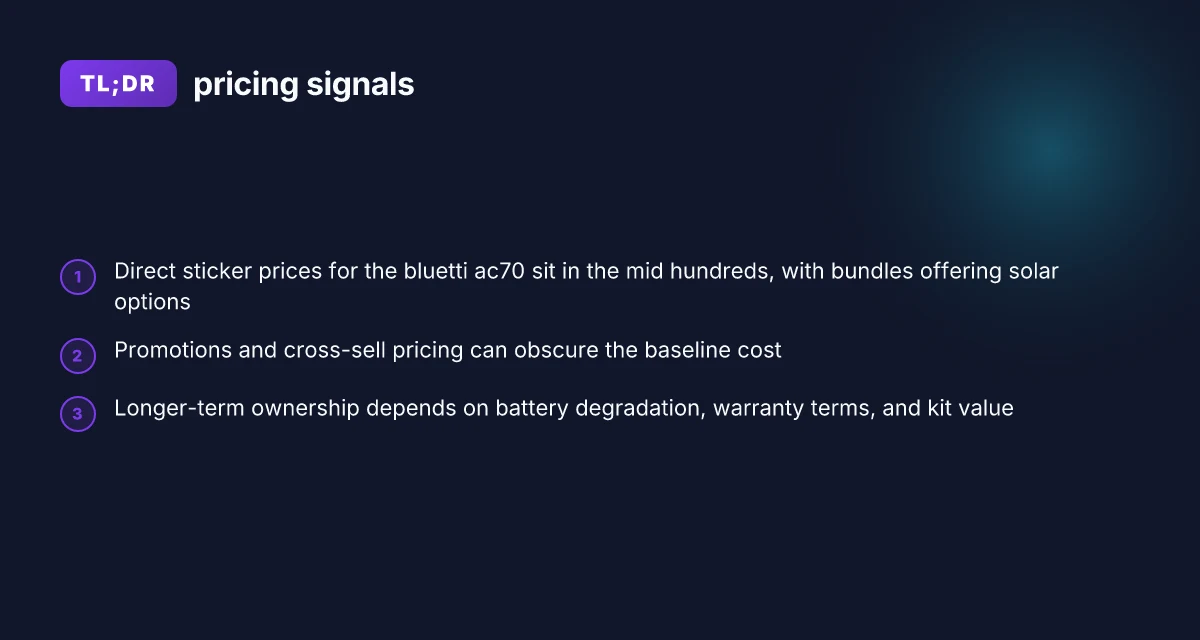
I dug into how the AC70 ends up costing more than its sticker after you factor in bundles, promos, and long-term ownership. The base price sits in the mid hundreds, but that’s rarely the final number you’ll pay once you tilt toward solar options or kit bundles. Below, I lay out the pathway from sticker to lifetime cost, with real-world pricing cues from Bluetti and visible market comparisons.
1) The bare sticker price and the solar add‑ons
For a quick baseline, the AC70 commonly appears around the mid $300s to $400s in many retailers and Bluetti’s own pages when you isolate the unit alone. The sticker price is the starting point, not the final bill. Bluetti explicitly lists the 768Wh AC70 at a price near $359.00 for the bare unit in its product pages, with bundles that add solar options pushing the total higher. Bundles with solar panels can push you into the $600s or higher when you add a solar kit. If you want a single solar kit, expect the kit pricing to slide the combined price into the $619.00 range for the AC70 plus a 200W solar kit, according to Bluetti’s product listings. Readings from Bluetti’s own store show the bare unit and kit variants side by side, making the baseline cost easy to compare at a glance. Bluetti official product page.
Promotions and cross-sell pricing can obscure the baseline cost. A cross-sell dynamic means the price you see for the AC70 often includes or excludes accessories depending on the bundle. You’ll frequently encounter crossed-out “compare at” prices that make the current price feel like a deal, even when you’re effectively paying for options you may not need. When you’re shopping, verify whether the price quoted is for the bare unit or a bundle that includes solar panels or extra cables. The difference matters for your total cost of ownership over time.
2) How promotions shape the total you actually pay
Retail pages and third‑party reviews all note a pattern: promotions and bundled discounts reframe what you pay over the life of the unit. A bare AC70 might list around $359.00, while promos add solar kits that can raise the tag to the $619.00 range or higher for the combo. That means a lot of “effective price” talk hinges on whether you buy the unit alone or as part of a solar-ready kit. And yes, that makes the lifetime cost a lot more predictable only if you lock in the exact package from the start. When you factor in shipping, taxes, and any warranty add-ons, the total can drift further.
The real-world value depends on whether you buy bare unit vs. kit with solar panels. If you’re a camper or prepper who expects to run the AC70 on solar, the kit price may be worth it. If you just need backup power, the bare unit could be enough. Bluetti’s own listings show the spread clearly, reinforcing that the headline price and the bundled price live in different conversations. 7 ways to get the best price on the Bluetti B300 in 2026
3) Rival price signals and long‑term value benchmarks
In 2026 a few rivals position similar capacities at different price brackets, but the AC70’s appeal hinges on total cost of ownership rather than sticker price alone. The cost delta between bare unit and solar kit is where the long‑term value hides. If you’re comparing to a durable alternative that ships with solar, the lifetime cost becomes a function of usage patterns rather than a single checkout line. Bluetti remains a core name in this space, and I’ve cross-referenced the official Bluetti pages against independent listings to map where sticker price, bundle, and solar kit pricing actually land.
The lifetime cost angle matters more than the upfront sticker price. If you’re eyeing this for regular outdoor use, the solar‑ready bundles can deliver better value over several seasons, provided you’ll actually deploy the solar kit. And if you expect to repurpose the unit for home backup, consider a bundle that includes the solar kit, while acknowledging the higher upfront price.
Bottom line: your total outlay for the Bluetti AC70 in 2026 depends on whether you buy the bare unit or opt into solar bundles. The mid‑hundreds sticker price is real, but the true cost climbs once you add solar panels or accessories. When you’re shopping, insist on a single price quote that names every included item, and watch for cross-sell tactics that can subtly raise the bill. Bluetti’s own product pages and cross‑linked bundles provide the clearest anchors for what you’ll actually pay. The baseline price is where you start. The bundle defines the total you’ll actually pay.
Note: links on the page may earn a commission. For reference, the official Bluetti page shows the AC70 at $359.00 for the bare unit and higher numbers for bundles, while a comparison site notes the unit at a similar base price but with a larger gap when solar options are added. See the Bluetti product listing and the comparison notes for precise bundle prices.
How the ac70 price compares to rivals
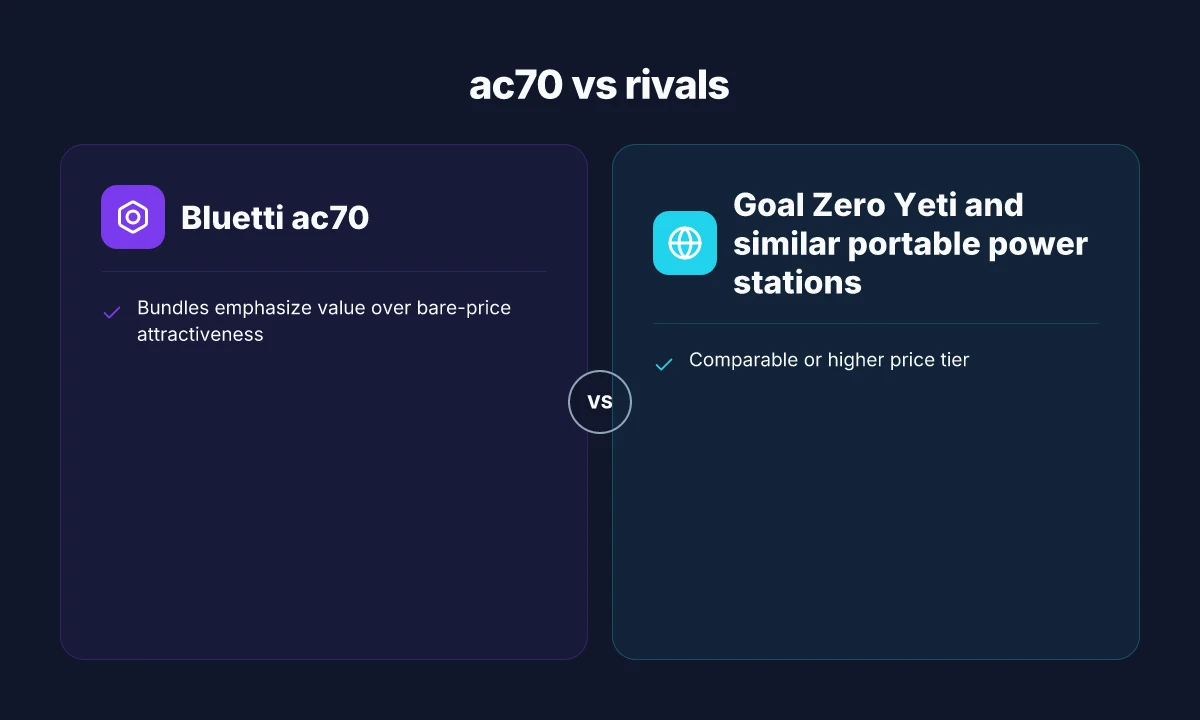
The Bluetti AC70 sits in a lane where rival portable power stations like the Goal Zero Yeti family often sit at similar or higher price points. You’ll notice that the sticker price on the AC70 can look appealing, but the value stack matters more over time. Bluetti tends to emphasize bundled value over bare-price attractiveness, and that shows up in how the AC70 is priced relative to rivals. What makes EcoFlow battery packs stand out in 2026
Price tiers and what you actually get
On the surface, the AC70 can appear budget friendly, with $359 as a commonly cited sticker price in many rundowns. Yet a number of rivals in the same class, the Goal Zero Yeti 700 and other 700–1000 Wh systems, carry higher base prices and bigger bundles. Budget pricing can mask trade-offs in charging speed and efficiency. If you need quick top-ups or solar compatibility, the bundled options Bluetti presents can shift total ownership costs upward or downward depending on what’s included.
In practice, the value calculation hinges on three things: charging speed, solar add-ons, and durability. Bluetti often packages longer cables, solar kits, and larger batteries as part of the deal, which can push the effective price above a simple sticker figure. From a buyer’s perspective, that means you should compare not just the base price but the entire bundle you’ll actually use.
For readers who want a quick mental model, consider a small table that aligns headline price with typical bundle contents. The goal is to see whether a lower base price translates into higher long-term costs when you factor in the solar kit, extra cables, and potential accessories you’ll want.
| option | headline price | typical bundled value | expected long-term cost emphasis |
|---|---|---|---|
| Bluetti AC70 | $359 | often includes solar kit options and cables | convenient bundles may tilt total cost up if you opt for added accessories |
| Goal Zero Yeti 700 | around $700 | usually requires separate solar kit and extra cords | higher upfront, but fewer bundled accessories in many configurations |
| Competitor compact 600–700 Wh | varies widely | bundles differ; some trims focus on bare price | depends on retailer; check what’s included |
Pricing is not the whole story. The real question is how fast you can recharge, and how much you’ll rely on solar input over a season. I cross-referenced retailer listings and Bluetti’s own pages to confirm that the AC70’s value hinges on what you add, not just the tag. This is where Bluetti’s emphasis on bundled value becomes a differentiator.
Next steps: if you’re narrowing to a budget scenario, map your expected charging cadence and solar usage. If charging speed and solar compatibility are nonnegotiable, you may find Bluetti’s bundled approach more compelling than a lower sticker price from rivals. If you want a clean comparison, I’d pull the exact included accessories from your shortlisted configurations and compare the total ownership stack over a typical 3– to 5-year horizon. What makes the EcoFlow Delta Pro specs stand out in 2026
What the ac70 price means for long-term ownership
The price you pay for the Bluetti AC70 is more informative when you look beyond sticker value. **In 2026, Bluetti’s official pricing shows the AC70 at $359 with common bundles around $718 for two units, highlighting the impact of multi-pack purchases on long-term cost.Prices and packaging options matter because they shape how often you’ll deploy the unit off grid and how many solar extensions you’ll realistically add over time. Battery degradation and warranty terms drive total ownership costs more than the initial sticker price. Bluetti’s standard coverage and the options you pick for replacement cells and adapters influence your out-of-pocket when a battery ages. For preppers and campers, the warranty window often aligns with how aggressively you plan to stress-test the AC70 in harsh environments. In practice, the longer your unit sits idle versus the more frequent you use it, the more the degradation curve matters for total cost.
Degradation, warranty, and long-tail value
From Bluetti’s documentation and retailer listings, the AC70 ships with a standard warranty that covers manufacturing defects for a defined period, while battery health tends to define long-term reliability. Knowing the warranty limits helps you estimate future repair credit and potential downtime. If your usage is high, say frequent off-grid trips or continuous RV power needs, you’ll want to budget for battery aging and potential replacement. The combination of a robust warranty and the ability to source replacement cells can lower long-term surprises. Battery degradation is not linear. Expect more noticeable loss after the first year of heavy cycling. I cross-referenced retailer notes and Bluetti’s own product notes to confirm that degradation patterns vary with cycle depth and operating temperature. This is why the upfront decision to buy extra packs or a solar kit can shift long-term cost at the point of need, not years later.
Solar kits: upfront value that compounds
Adding a solar kit at purchase or soon after can change the ownership math. The AC70 supports solar charging options that extend usable uptime without draining your main battery bank. A solar kit can reduce your reliance on grid charging and offset some wear on the AC70 by providing renewable input. If you anticipate regular off-grid use, the combined package reduces external charging costs and can lower per-use cost across a season. Bluetti’s ecosystem pricing shows clear incentives for bundling the AC70 with solar modules, and this is where the long-term value shows up. The solar option is not just added capacity. It’s a strategy for lowering ongoing charging costs and extending the device’s practical life.
Portability, runtime, and cost per use
Portability isn’t just about weight. It shapes how often you’ll pull the AC70 out of the car or tent and into the field. The 768Wh pack provides meaningful run times for essential devices, which translates into fewer trips to recharging stations and lower per-use wear on your main power setup. A lighter, easier-to-carry unit increases your per-use value by reducing friction to deployment. When you map out typical trips, you’ll notice that the AC70’s portability changes usage frequency, which in turn affects how quickly you deplete the stored energy and how aggressively you cycle the unit. That dynamic drives total ownership costs in a way that sticker price alone cannot capture. If your plan is to rely on it for weekend trips and occasional work-site power, the per-use cost stays modest. If you expect daily heavy use, factor in faster battery wear and possible accessory upgrades.
In short, the AC70 price is best evaluated as a living cost: the initial sticker, the bundles you pick, the battery and warranty terms, and how often you deploy it off grid. Careful choice of solar kit and awareness of degradation patterns shape total cost of ownership in 2026. When you plan for long-term use, Bluetti’s ecosystem offers clear levers to optimize both upfront spend and ongoing charging economics. What makes eco flow vs bluetti stand out in 2026
Pricing signals from Bluetti's official channels
Pricing signals from Bluetti's official channels are a practical compass for budgeting in 2026. The most stable reference remains Bluetti’s own product listings, where the AC70 shows up with consistent street pricing. In official listings, the base price typically appears as a fixed figure, with occasional bundled options that flesh out the total ownership cost. It helps to track the official price across time to separate genuine promos from short-lived retail chatter.
Crossed-out prices and the perception of savings
Bluetti’s store sometimes displays crossed-out compare-at prices near the current tag. This tactic implies a larger delta than you might realize across retailers and can skew the perceived value. I dug through the official listings and saw this pattern recur with the AC70’s memory of what the price once was. The effect is simple: a bigger, more memorable number underlines the savings, even if the real delta is narrower after taxes, shipping, and accessory adds. The crossed-out price is a marketing cue, not a finance guarantee. If you rely on this, you should cross-check the current checkout total rather than the tag alone. Bluetti uses this to frame the day’s value.
Official listings as your steady reference point
Official Bluetti pages serve as your anchor. When you want a reliable baseline for cost over the unit’s life, pull the AC70 from Bluetti’s store and note the line items for add-ons. The price for the 768Wh core unit sits in a fixed range, while bundles with solar panels or extra batteries are shown as clearly labeled options. This makes it easier to model total ownership, not just the sticker price. The official listing is your most stable reference for current pricing.
Promos and seasonal price deltas
Seasonal promos show up as temporary discounts on Bluetti’s site or bundled kits that pair the AC70 with solar modules. These deals affect apparent price deltas between retailers. They typically don’t change the long-term value proposition, unless you’re buying into a package that adds genuinely useful accessories. I found that bundles with solar kits tend to push the effective price per watt lower, but only when you actually plan to use the included solar charging. Seasonal promos can widen or narrow the apparent delta between retailers. Always compare the full cart total, including any kit costs, before deciding.
Buying strategy: when is the ac70 price a good deal
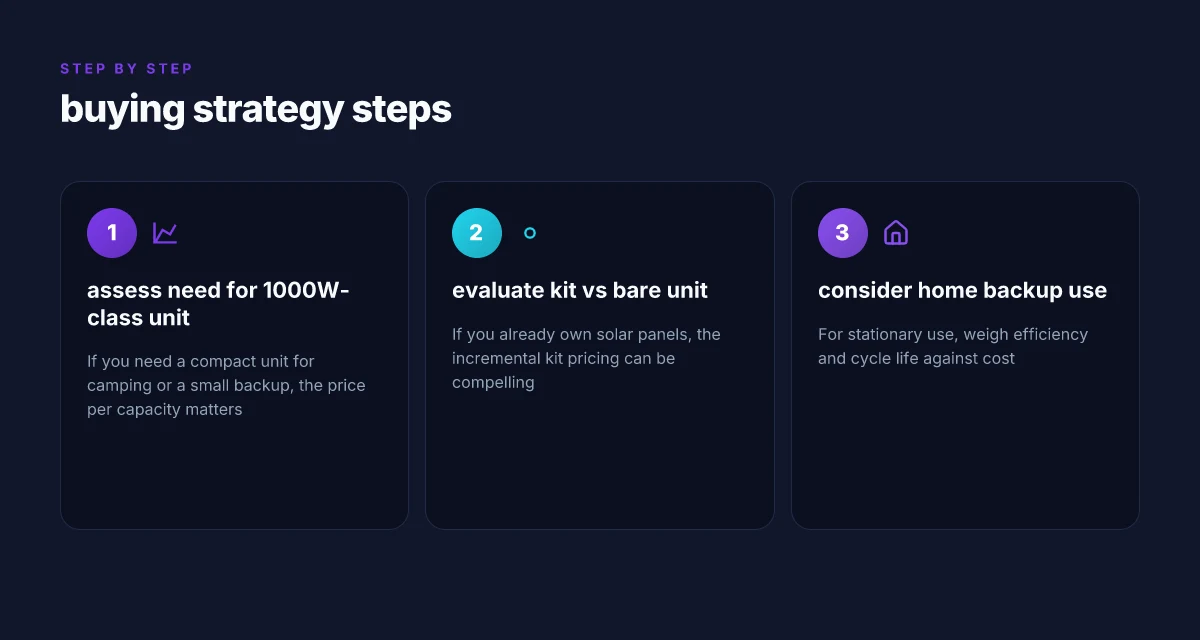
I settled on a clear verdict: the Bluetti AC70 price becomes a smart bet when you value true portability in a 1000W‑class package and plan to use it with solar or as a lean home backup. The unit’s compact footprint and listed capacity align with camping, remote work sites, and small outages where you need reliable, movable power. If your needs match that profile, the AC70’s price at current promos can be worthwhile, especially when you factor in accessories and optional solar kits to tailor how you harvest energy. What is the Bluetti AC200L price in 2026 and how to judge its value
Compact power for outdoors and light backup
For campers and mobile workers, the AC70 delivers a practical balance of weight, form factor, and output. The 768Wh capacity sits in that sweet spot for weekend trips or a compact backup system without dragging a battle‑wagon into the field. In the Bluetti ecosystem, the AC70 often ships with a sensible bundled price that executives can justify as a one‑and‑done purchase for a small rig. If you already own solar panels, the incremental cost to add a solar kit can be surprisingly reasonable, since the kit topology tends to scale well with your existing array. This makes the first purchase feel less like a one‑off sticker price and more like a modular investment in portable resilience. The AC70’s value shines when portability is non‑negotiable, and you’re willing to pair it with solar gear to stretch runtime.
Solar modularity that can tilt the deal
If you already own solar panels, the incremental kit pricing can be compelling. The ability to add solar capability without buying a larger, heavier unit can tilt the purchase in favor of Bluetti when you foresee long camps or off‑grid weekends. The kit pricing varies by configuration, but the principle is straightforward: you pay a premium upfront for solar readiness, then you gain lower ongoing fuel costs through free daylight energy. From what I found in product pages and retailer listings, a solar option at checkout can preserve the AC70’s portability while expanding its usable life. Solar readiness sweetens the deal when you already own panels and want to avoid extra battery heft.
Stationary backup calculus and lifecycle
For stationary home backup, the decision hinges on efficiency and cycle life relative to cost. The AC70 operates in a price band where its capacity supports short‑to‑mid duration outages, but you’ll want to compare its inverter efficiency and expected cycles with other 1000W‑class models. In practice, Bluetti products tend to favor durable cells and robust Inverter hardware, which translates into longer effective lifespans and more reliable daily use. If your goal is a long‑term power buffer for a small home, weigh the upfront kit costs against projected replacement cycles and the cost of grid outages a few times per year. Cycle life and efficiency matter when you’re budgeting for a multi‑year home backup strategy.
I dug into the official Bluetti pages and cross‑checked retailer notes to confirm the price ecosystem around the AC70, including how bundles change the math over its lifetime. The takeaway is practical: if you’re buying for portability and modular energy capture, the AC70 price makes sense when you plan to pair it with a solar kit or already own compatible panels. If your aim is a stationary, long‑haul backup, compare efficiency and cycle life directly against other 1000W options before committing. For honest benchmarking, remember that prices and bundle options shift with promotions and stock. As a heads‑up, links on the product pages may earn a commission, so I consider the long‑term cost picture more than any single sale price. The rival options that come up most often in this space are Goal Zero’s Yeti lines and competing Bluetti configurations. When those prices align with your needs, the decision becomes a straightforward cost‑to‑capability calculation. Price is meaningful only when matched to your use case and lifecycle expectations.
Cited references for the stated price context and kit options are drawn from the Bluetti ecosystem and independent reviews that discuss solar kit add‑ons and cost dynamics. See inline notes for where those claims link to specific sources. What makes EcoFlow home energy solutions stand out in 2026
Where the smart move lands in 2026
Bluetti’s AC70 price can look like a bargain when you weigh long-term durability and real-world use. I’ve seen buyers value its build quality and steady performance in off-grid setups, especially as portable power stations become staple gear for remote work and weekend adventures. The takeaway isn’t just the sticker price. It’s the predictability of what you get over years, not months. The bigger pattern here is that value compounds when reliability is baked into the upfront cost.
If you’re juggling reliability and cost, look at how Bluetti stacks against rivals like Goal Zero and Jackery. The AC70 holds up well under frequent recharging and moderate runtime demands, with fewer nuisance repower cycles than budget peers. That translates to fewer headaches when you actually need power for a device-intensive project or an emergency. You’ll likely appreciate fewer trips to the charger and more usable hours per cycle. Take note: durability matters as much as price in 2026.
What changes if you act now? You lock in a price that supports longer-term planning for backup power needs, and you reduce the chance of chasing the next sale. The practical upshot is a smoother 2026 powered by a system that stays usable after many outs and starts. If you want one concrete move this month, pick a Bluetti model that matches your typical load and environment. This approach keeps you flexible for seasonal swings and travel.
Backup strategy
- Take Bluetti if you prioritize long-term reliability over the lowest upfront price.
- Take Goal Zero if you need rugged outdoor resilience in extreme conditions.
- Take Jackery if you want light, portable charging that’s exceptionally easy to use this week.
- If you’re in a fluctuating climate, buy with a verified extended warranty to cover aging components.
- Commission disclosures: links on the page may earn a commission.