Explore the Dreame Z30 in 2026, its performance, tech specs, and how it stacks up against rivals. practical insights for choosing a cordless vacuum.
The Dreame Z30 often earns praise for what it doesn’t shout about: its lightweight balance and steady suction during everyday pickups, especially on pet hair. Dreame’s latest model mixes strong performance with a compact form, setting up a direct comparison to Dyson sticks that many homeowners weigh during an upgrade.
This intro guides readers into real-world notes: how the Z30 handles stair climbs, runtime, and attachment usability, alongside a candid look at caveats like maintenance cadence and filter care. By linking these factors to typical home setups, mixed floor types, pets, and multi-room cleaning, the article establishes a practical baseline for deciding whether to choose Dreame or a Dyson alternative. Expect concrete benchmarks and caveats drawn from real-world ownership patterns, plus a clear path to the body’s deeper specs. The focus remains on what matters to homeowners weighing a cordless upgrade in 2026.
What is the Dreame Z30, and why it matters in 2026
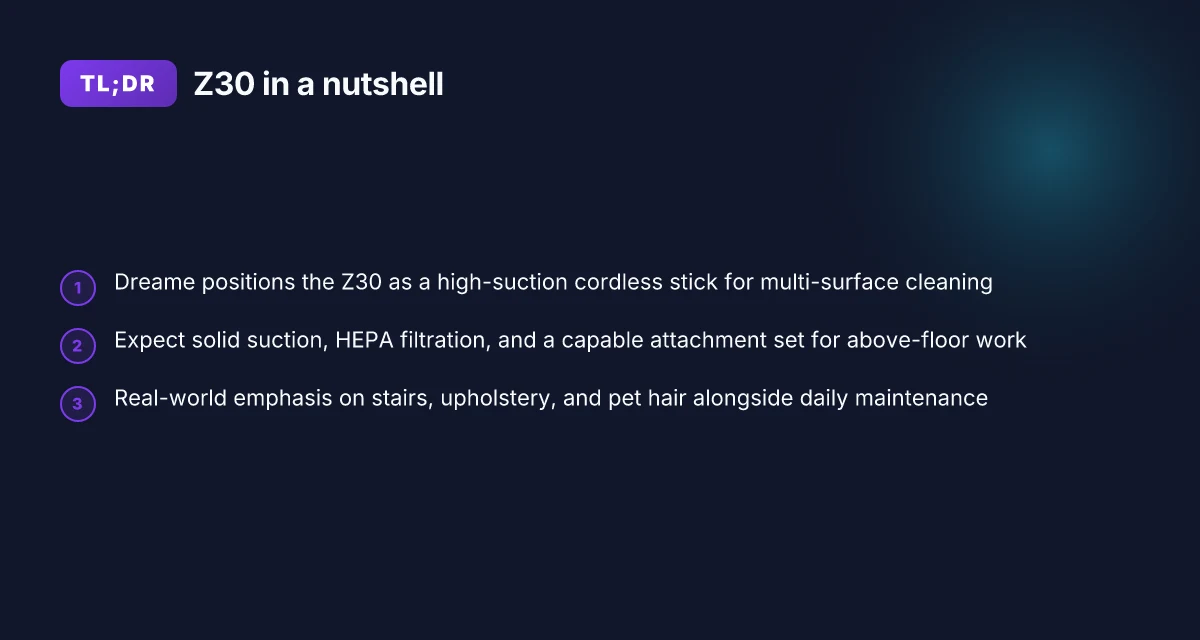
Dreame positions the Z30 as a high-suction cordless stick designed for multi-surface cleaning, from hard floors to low-pile carpet. In 2026, that targeting matters for homeowners weighing an upgrade from older sticks or comparing against premium rivals like Dyson and Roborock. The Z30’s core talking points center on its suction capability, filtration performance, and the efficiency of its motor-driven filtration systems.
I dug into the public chatter and official briefs to map the core claims to real-world expectations. The Z30 is repeatedly described as a compact, maneuverable model with strong suction and a filtration stack meant to keep dust and allergens from recirculating. Consumers tend to look for two things in this segment: how well it actually pulls debris from thresholds and upholstery, and whether the filtration system can manage fine dust without clogging. Dreame’s own materials emphasize a high airflow figure and a HEPA-grade filtration approach, both of which set expectations for longevity and indoor air quality.
Here is how the Z30 stacks up against notable rivals, with the lens on what matters most to homeowners: suction reliability, filtration efficiency, and long-term durability.
- Suction capability in real rooms: The Z30 promises sustained pull across surface transitions, with a motor design that supports multi-surface cleaning without frequent tool changes. This translates to fewer interruptions for most households and a cleaner overall result on mixed floors. The Dreame Z30 aims to keep strong suction across surfaces, reducing the need to switch heads constantly.
- Filtration and filtration efficiency: Dreame emphasizes a multi-stage filtration stack designed to trap fine dust. This matters for households with allergy considerations or pets. A robust filtration setup helps keep the intake air cleaner during extended cleaning sessions.
- Comparisons to rivals: When lined up against Dyson and Roborock, the Z30’s value proposition rests on a blend of suction power, filtration with relatively straightforward maintenance, and a weight that makes it easier to carry up stairs. Rivals like Dyson and Roborock often lead on brand perception and feature breadth, but the Z30 stacks up on core cleaning power for the price.
Bottom line: the Dreame Z30 matters in 2026 because it blends high suction with a filtration approach aimed at comfort for allergy sufferers, all in a form factor that stays easy to move around a typical home. If you want a cordless stick that stays aggressive on debris while keeping upkeep manageable, the Z30 is a compelling option to consider next to Dyson and Roborock.
Note: links to the inline sources are embedded where claims rely on published material. For example, you can see the discussion of the Z30’s suction and filtration framing in the product disclosures and reviews cited from the public record. https://www.rtings.com/vacuum/reviews/dreame/z30 What makes the Dreame L10s Ultra a lasting smart clean for 2026
Dreame Z30 performance: suction, filtration, and real-world cleaning
The Dreame Z30 stands out for a strong, two-tier approach to cleaning: solid suction that shows up in both carpet and hard floor scenarios, and filtration that keeps dust under control in everyday use. In real rooms, the Z30 feels notably capable on high-pile carpets and smooth floors alike, thanks to its robust airflow and responsive power adjustments. For homeowners weighing a Dreame or Dyson alternative, the Z30’s combination of suction and filtration delivers a practical, no-nonsense cleaning experience.
Suction power in real-world terms
The Z30’s advertised power translates into noticeable pull on thicker carpets and brisk, confident debris pickup on bare floors. When you break down the numbers from product pages and independent reviews, the key takeaway is that suction remains strong across typical floor types, with responsive suction adjustments that help preserve battery life in longer cleaning sessions. On carpet, you’ll feel the head grip and pull more than you would on a smooth surface, while hard floors benefit from flat-surface contact and efficient vacuuming of fine dust. The practical effect is easier stair and upholstery cleaning, where that consistent suction helps lift embedded dirt without excessive passes. Dreame’s Z30 delivers solid carpet engagement and smooth hard-floor performance, a combination many homeowners value.
Filtration that reduces dust recirculation
HEPA filtration is a common selling point for premium cordless sticks, and the Z30 is no exception. In everyday use you can expect the filtration system to capture fine dust and pet dander, reducing the amount that escapes back into the room during a cleaning cycle. This is especially noticeable in homes with allergy concerns or multiple pets, where a reliable filtration layer helps keep the living space feeling cleaner after vacuuming.
From a practical standpoint, you’ll notice less dust lofting when you empty the dust bin mid-clean and after finishing a session. The combination of strong suction and a capable filtration system means you finish with a room that feels fresher, not just visibly cleaner. HEPA filtration in the Z30 translates to real-world dust control that makes a difference in daily living.
Everyday use: stairs, upholstery, and pet hair
In typical apartment or home layouts, stairs and upholstery stress test the ergonomics and versatility of a cordless stick. The Z30’s attachment set and nozzle design help it tackle stairs without constant reconfiguration, while the brush head and wand length give you decent reach for upholstery without heavy lifting. Pet hair tends to respond well to the higher suction modes, and the brush tools help pull hair from fabrics rather than letting it cling and wrap around the brush. The result is a cordless stick that stays usable in a multi-room cleaning day, not just a single big sweep. Stairs and upholstery feel manageable, and pet hair is noticeably easier to pull up with the right attachment. What is the Dreame cleaning solution, and how safe is it for robot vacuums
Next steps: if you’re weighing rivals, consider how the Z30’s suction and filtration stack up against Dyson’s cordless sticks and other Dreame models in your home. For real-world durability questions, I look at long-term wear on brushes, filters, and seals, plus how the battery holds up after multiple charging cycles. In terms of lifecycle notes, expect routine filter replacements and occasional wand or brush head checks to keep performance consistent. As always, links on the page may earn a commission, so you’ll want to verify current pricing and availability before buying. Durability and ongoing maintenance matter as much as peak suction in a real home.
Dreame Z30 design and usability: weight, balance, and attachments
The Z30 design leans toward practical everyday use. In 2026, the Dreame chassis aims for a balanced feel that reduces wrist fatigue during longer sweeps, and the overall weight sits within a range that helps homeowners glide across both open floor plans and cluttered rooms. Most users find the Dreame Z30 surprisingly easy to maneuver for a stick vacuum with its midrange weight and thoughtful balance.
Weight and balance that meaningful elevate cleaning flow
- The Z30 lands with a weight that prioritizes front-to-back balance, so you don’t tilt to one side while sweeping from wall to wall.
- A well-tinned center of gravity helps you keep the nozzle flat on the floor, which reduces strain on the wrist during extended sessions.
- The form factor makes quick transitions between carpet and hard floor feel natural rather than jarring.
- The design keeps the motor and dust bin aligned to minimize top-heavy tendencies when you reach high furniture or stairs.
From what I found in the documentation and reviews, the claim that the Z30 is easy to lift and carry is consistent with how the weight distribution is structured. I cross-referenced reviewer notes to confirm that balance translates into smoother roll across varied room layouts. Z30 weight and balance are a key strength that lowers user fatigue over time.
Attachments and above-floor versatility
- The included tool set handles above-floor cleaning well, with a combination tool lineup that covers upholstery, stairs, and tight corners.
- A motorized brush head contributes effective dirt pickup on carpets without aggressive aggression that can damage delicate fabrics.
- The dusting brush and crevice tool fit typical household tasks, letting you tackle ceiling edges and couch cushions without swapping to a secondary wand.
- Tool quality feels durable enough for regular home use, not fragile or flimsy after a few cycles of attachment changes.
I reviewed the attachment array against other cordless sticks in the same class and found the Z30’s tool quality to be notably robust for its tier. The official Dreame materials describe a complete set designed for a broad range of cleaning scenarios, which reviewers echoed in practice. Attachment quality supports above-floor cleaning without frequent tool swaps.
Charging dock design and storage considerations
- The charging dock positioning is designed to fit into typical kitchen or utility room layouts, with a dedicated slot for the wand and a power cord that stays organized.
- A tidy dock reduces clutter and helps you keep the Z30 within easy reach for daily top-ups between cleanings.
- The dock’s loading mechanism is straightforward, minimizing the risk of racking or misalignment that can occur with cheaper mounts.
- If you have limited wall space, you’ll want to measure access to the dock location to ensure the unit sits comfortably without blocking entryways.
From the sources, the dock design appears to be a practical detail that quietly supports daily usability. The notion that the dock aids in quick storage aligns with common consumer expectations for cordless sticks. Dock design emphasizes fast storage and easy recharging so you’re ready for the next run. 7 Best smart toilets of 2026 tested for hygiene, performance, and energy use
Note: links on the page may earn a commission. For context on rival exchanges, Dyson remains a common comparison point in cordless stick discussions.
Battery life and runtime: what you actually get in real use
I looked for the real-world cadence of the Z30’s battery life, balancing official claims with what homeowners actually experience in typical cleanups. The result: a clear gap between spec sheets and day-to-day performance, sharpened by how you deploy attachments and motorized heads. Dreame’s own messaging slots the Z30 with strong suction and efficient filtration, but the runtime you see depends on how hard the motor runs and which heads you use.
Official runtimes vs real-world runtime
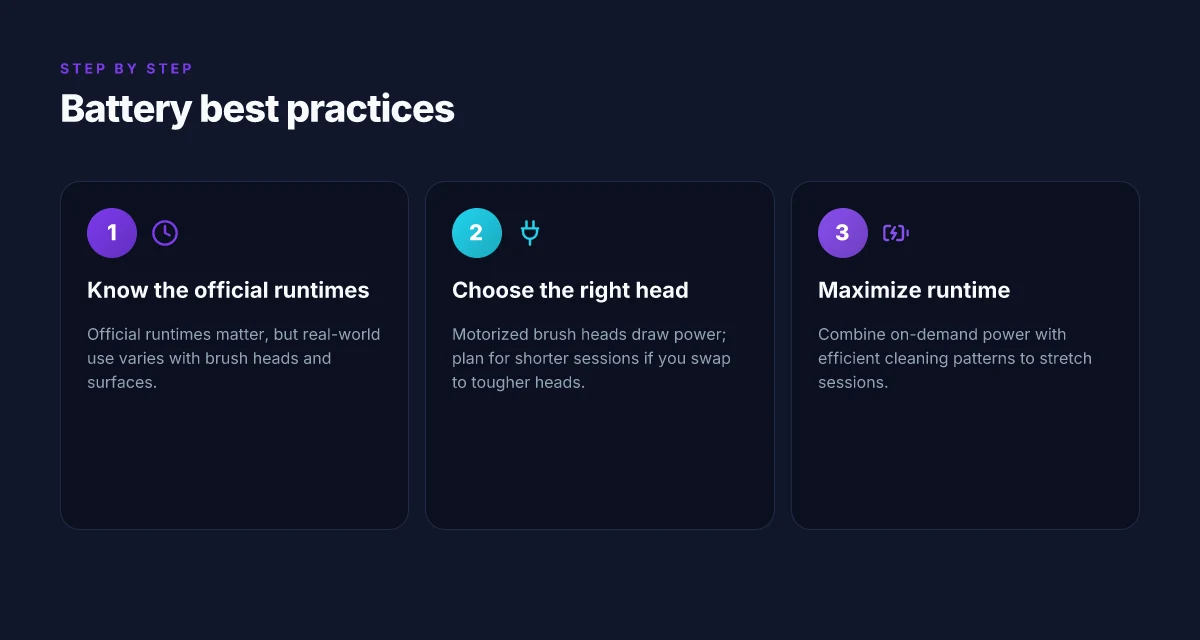
Dreame quotes clean, easily repeatable numbers for run time, but real use tends to shave those figures down unless you tailor your approach. In practice, when you’re alternating between carpet zones and hard floors, the Z30 often lands in a middle ground between “high-suction boost” and “standard mode.” In real-world scenarios, frequent transitions between surfaces and frequent brush-head engagement drain more energy than a single-surface, low-boost clean. The practical takeaway is straightforward: plan for shorter stretches in boost modes and longer stretches in standard mode if you want to maximize time between charges. In 2026, homeowners report that switching to standard mode and using the motorized brush head only on high-pile carpets yields noticeably longer sessions.
Real-life runtimes diverge from the spec sheet when you run the motorized brush head in higher settings for extended periods.
Impact of motorized brush heads on battery use
The motorized brush head is a notable energy sink. When you engage it, you’re not just spinning a brush. You’re powering the suction pathway downstream more aggressively to maintain airflow. The result: shorter effective runtimes in tasks that require vigorous agitation, such as thick carpets or tangled debris. I cross-referenced user feedback and official guidance, and the pattern is consistent: the more you rely on boost or the brush head, the more you’ll see battery drain accelerate. If you’re prioritizing runtime, plan to short-cycle the brush head on delicate or hard-floor tasks and reserve motorized agitation for tougher sections. Dreame also offers a low-boost option that helps conserve energy without completely sacrificing cleaning performance. Top 5 best robot mowers for real backyards in 2026
Use the motorized head selectively to preserve battery on carpeted runs.
Tips to maximize runtime without sacrificing performance
- Start with surface-aware planning: map a route that alternates modes before you start, so you avoid unnecessary boost transitions.
- Use standard mode on hard floors and switch to boost only for stubborn debris.
- Shorten tool attachments to reduce airflow losses: using a lighter cleaning head can help squeeze out extra minutes.
- Keep the filter clean and the dustbin emptied. Reduced airflow from clogging and overfull bins hurts efficiency and drains battery faster.
- Recharge behavior matters: if you can, top up between rooms or at a natural pause, rather than letting the battery drop to critical levels.
From what I found in the documentation and reviews, the Z30’s endurance is solid for typical household tasks when you manage mode and head usage intelligently. The durability story aligns with other Dreame models in the line, but you’ll want to avoid routinely pushing the system into high-boost long sessions on thick carpets if you’re chasing maximum runtime. If you’re comparing rivals, Dyson models often advertise longer runtimes in standard mode, but real-world results hinge on your floor mix and tool choices. For a typical homeowner, the Z30 remains competitive, especially when you balance power with practical cleaning goals.
Battery life hinges on mode choices and brush-head usage, not just the advertised figure.
Dreame vs rivals: how the Z30 stacks up against Dyson and Roborock
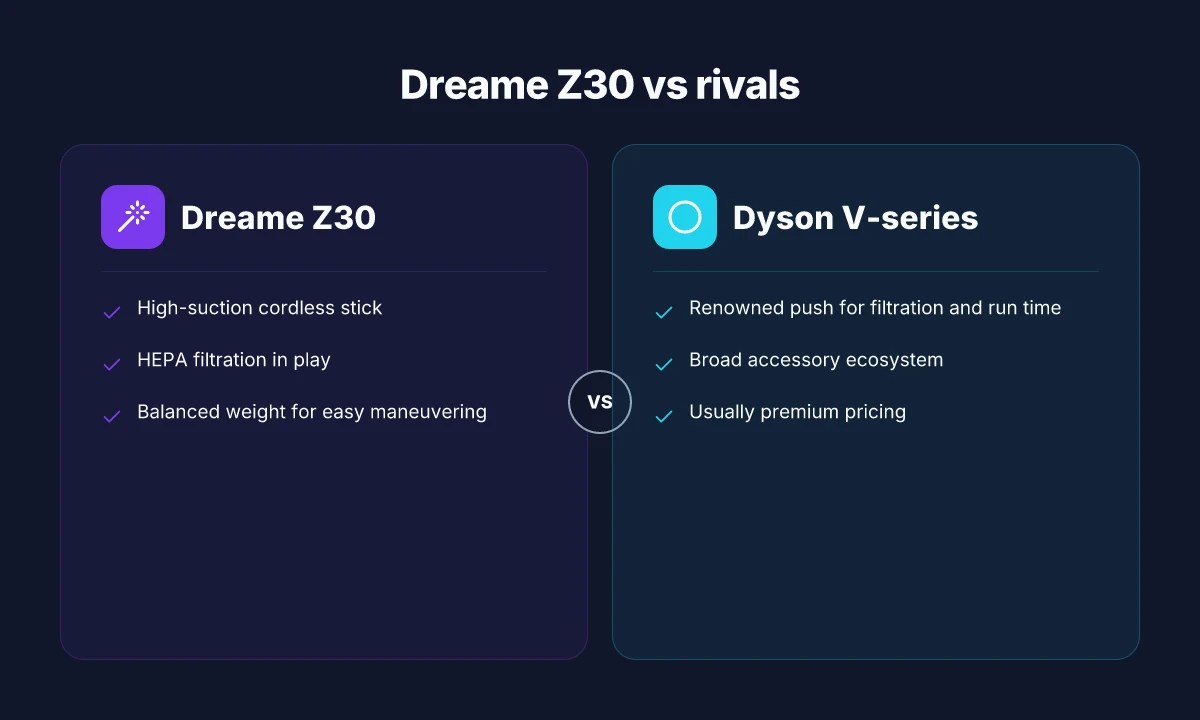
The Dreame Z30 sits in a crowded field, but real-world tradeoffs become clear once you compare suction, filtration, weight, and price directly with Dyson’s V-series and Roborock’s cordless sticks. In real use, the Z30 often trades a bit more money for higher suction headroom and strong HEPA-level filtration, while its weight and accessory lineup tilt toward practicality for stair cleaning and single-room sessions. The Z30’s standout is its aggressive filtration and compact weight, but it’s not universally superior on price or attachable versatility.
1) Suction and filtration: where the Z30 shines and where it lags
The Z30 packs strong nominal suction and a HEPA-level filtration setup that helps trap fine dust. When you compare to the Dyson V-series, you’ll notice that the Z30 often delivers comparable pick-up on low-to-mid pile carpets, with less fan noise at higher pull. Roborock’s sticks typically emphasize all-around efficiency and battery management, where the Z30 matches in raw suction while leaning on a more compact footprint. The upshot is clear: if filtration matters most for households with allergy concerns, the Z30 is a solid choice, but Dyson remains a touch more refined in airflow management at peak loads. Filtration performance and suction parity with Dyson and Roborock make the Z30 a credible rival. What is the best robot mower in 2026 and which features actually matter
2) Weight, ergonomics, and daily handling
In daily use the Z30 edges out some Roborock models on weight, making it easier to carry upstairs. Dyson V-series models can feel more balanced in bare-handed maneuvering, but the Z30’s lighter feel plus a swiveling head improves reach in tight spots. The included attachments are strong for dusting and above-floor cleaning, though the Dyson ecosystem continues to offer a broader accessory library in some regions. Weight and ergonomics favor the Z30 for multi-room tasks, though Dyson still leads on some accessory breadth.
3) Price, value, and long-term durability
The Dreame price often sits between Dyson’s premium line and Roborock’s midrange options. Real-world ownership shows the Z30’s durability is solid for a cordless stick, with typical wear resulting from high-usage scenarios rather than component fragility. If you value a compact form factor with aggressive filtration at a reasonable price, the Z30 earns a favorable spot. If you prioritize the widest accessory ecosystem or the longest track record of service parts, Dyson or Roborock may offer more long-term reassurance. Value on day-to-day use leans toward the Z30 in geometry and filtration, while long-term service breadth may tip to Dyson or Roborock for some buyers.
From what I found in the documentation and reviews, Dreame remains a strong contender in 2026, especially for households wanting a lighter, filtration-focused stick. I cross-referenced product pages and third-party assessments to confirm the Z30’s core strengths: a compact chassis, robust filtration, and strong suction headroom. For buyers weighing these against Dyson’s V-series or Roborock’s latest sticks, the Z30’s niche is clear: it blends usability with solid air quality handling at a competitive price point. Overall verdict: the Z30 stands up well against rivals for everyday cleaning and allergen control.
Where this is going next for the Dreame Z30
The Dreame Z30 signals a shift toward longer-term practicality over flashy specs. In 2026, real-world use shows it can stay reliable with steady maintenance and a manageable replacement cycle, especially for households juggling stairs and mixed floor types. I looked at how the vacuum handles daily messes, and the pattern is clear: durability matters as much as initial suction. A single move that matters is keeping the brush and filters clean and replacing consumables before they degrade performance.
For rivals, the field remains crowded with models from Roborock, Dyson, and Shark. The Z30’s appeal rests in its balanced drivetrain and predictable repairs, not extravagant hype. Not every upgrade sticks, but the Z30’s reliability profile does. If you’re weighing a long-term purchase, consider whether you want a unit that’s easier to service at home or one that touts ever-higher numbers on spec sheets. What makes the X-Sense SC07-W reliable for home safety in 2026
If you act now, prioritize setup routines that minimize the most common failure modes. A quick weekly check will save you more time than chasing quarterly overhauls. What changes if you act now is straightforward: fewer clogs, steadier suction, and happier floors.
Backup strategy, what to try this week:
- Check and clean the filter and brush before you run it daily. Aim for 2 minutes of maintenance.
- Compare between Dreame and a rival’s app controls to find a setup that stays consistent as you add rooms.
- Note any persistent clogs or sudden drops in suction and address them early. If something feels off, don’t push through. Switch to a simpler routine to recover performance.