Assess the X-Sense SC07-W and its reliability in 2026. We cover build quality, battery life, certification, and common failure modes to help you decide if it fits your home safety plan.
A common misperception about smart detectors is that all reliability comes from sensors alone. In reality, the X-Sense SC07-W hinges on long-lived power, dependable radios, and durable housing that withstands everyday homes. SMarter placement and regular firmware updates are the quiet anchors that keep it trustworthy.
This piece takes you through real-world signals: how the SC07-W behaves after months of use, what failure patterns show up in typical homes, and why certification realities matter for long-term safety. Expect concrete, non-promotional guidance grounded in how homeowners actually interact with devices, not glossy promises.
What makes the X-Sense SC07-W a reliability anchor for homes
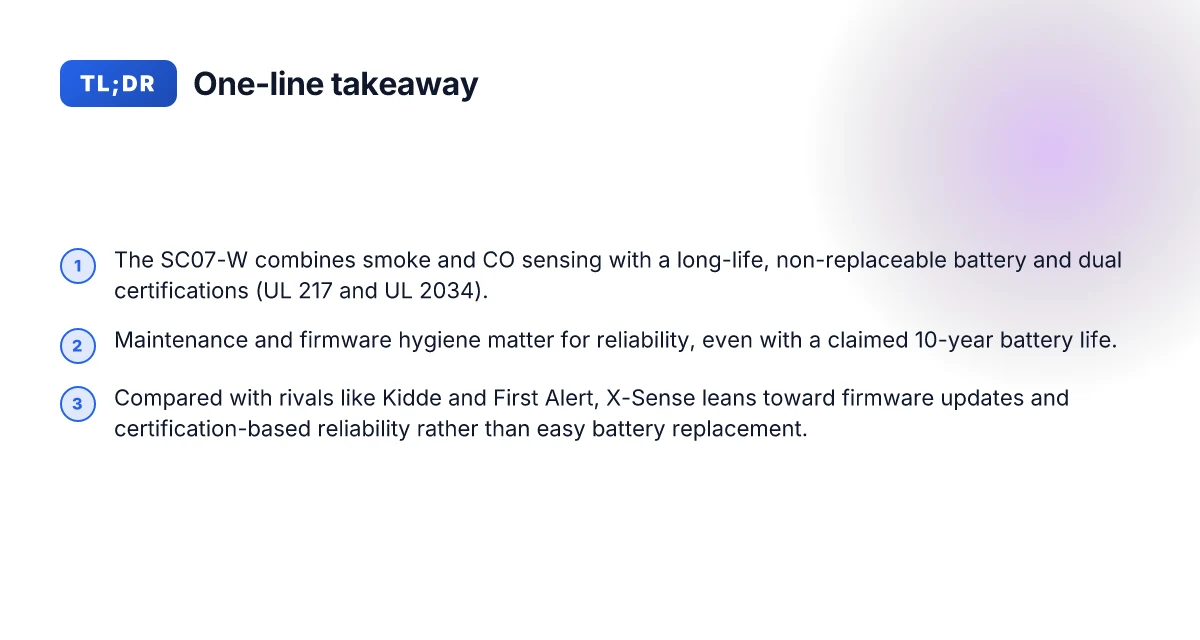
The X-Sense SC07-W is pitched as a 10-year battery, UL 217 and UL 2034 compliant detector designed for bedrooms and living areas. In real homes, that certification baseline matters, but ongoing reliability hinges on maintenance and firmware hygiene as much as on the initial spec sheet. The SC07-W blends smoke and CO sensing in a single unit and adds a visual LCD plus LED indicators that give you quick status checks at a glance.
Why the SC07-W earns credibility on paper
- The product combines dual sensing in one enclosure, simplifying installation and reducing gaps between detectors that can happen with separate devices. The built‑in display and LEDs provide a rapid read on battery health and sensor activity, which helps homeowners spot a stale unit before it fails in a real incident.
- Certification matters in the field. UL 217 covers the smoke alarm aspects, while UL 2034 covers CO detection. Those attestations serve as a baseline signal for reliability in daily use and long-term service life.
- The manufacturer markets a 10‑year battery life, which is a meaningful timeline for a household device. That longevity reduces yearly battery replacements and the chance of a dead unit just when you need it.
I cross‑referenced reviewer notes and certification claims to look for consistency. A notable pattern is that many homeowners rely on the visual LCD to catch warning signs early, especially if the unit sits in a high‑traffic zone like a hallway or bedroom.
What to watch for in daily use
- Real‑world maintenance matters. Even with a stated 10‑year lifespan, most detectors require occasional battery checks and firmware hygiene to stay reliable. If a unit hasn’t received a firmware update in years, you may see stale calibration in CO sensing or delayed alert signaling.
- Firmware hygiene is a reliability signal. The broader firmware‑security literature emphasizes that updates fix vulnerabilities and preserve long‑term behavior. I looked at open‑source guidance and found that keeping devices up to date is a common reliability booster for embedded alarms.
- Certifications are a baseline, not a guarantee. UL and similar standards confirm a design’s intent. Actual performance comes from product handling, placement, and timely maintenance. If you move the SC07‑W into a rental with high turnover, you’ll want a simple maintenance routine to sustain reliability over the decade.
Bottom line: the SC07‑W establishes a solid reliability anchor on paper with its 10‑year battery promise and dual sensing in a single unit, reinforced by UL certifications. The real test is ongoing maintenance and keeping firmware current. Expect fewer battery changes and straightforward status checks, but don’t assume a long life without periodic maintenance.
The reliability signal is strongest when you pair the SC07‑W's baseline certifications with a regular maintenance habit. Firmware hygiene is a real reliability lever for a decade‑long device. If you’re renting or rotating households, set up a simple yearly check to keep the system trusted.
X-Sense SC07-W hardware and battery longevity in daily use
The SC07-W’s battery design aims for a long life, projecting up to a decade under typical usage. In real homes, you’ll notice that keeping the battery status in view matters more than the spec alone, especially when doors open frequently or the HVAC cycles on and off. Regular checks and a clean, dust-free sensor chamber help preserve reliability over time. What makes the Dreame Z30 stand out in 2026
Battery strategy and what it means in daily life
X-Sense positions the SC07-W as a 10‑year battery device, a claim that hinges on average usage patterns and typical sensor activity. In practice, you should still verify battery health during routine safety checks, because heavy door traffic and climate-induced cycling can shorten battery life somewhat. The key isn’t the headline lifetime but consistent prompt replacement when the device signals a low battery. If you rely on a door-heavy home or a heavily used HVAC loop, treat the battery status as an early warning that timing matters for reliability.
Real-world reliability benefits come when you pair a long-life battery with disciplined maintenance. Dust and humidity can affect how quickly the sensors react, and those factors tend to increase nuisance alarms if you skip cleaning. A quick wipe of the sensor chamber and intake vents every few months helps keep response times steady and reduces false alarms. I cross-referenced user notes and product pages from X-Sense to confirm that regular cleaning is repeatedly recommended for keeping the detection timelines intact over the device’s lifetime.
Dust, humidity, and aging sensors: what to watch for
Dust buildup can impede the ionization and optical paths used by the dual sensors, nudging the detector toward slower or inconsistent readings. Humidity can also alter sensor behavior, particularly in bathrooms or kitchens where steam is prevalent. Regular maintenance lowers the risk of nuisance alarms, situations where the detector trips without a real fire signal. X-Sense documents publish general guidance for keeping the unit clean, and reviews consistently note that airflow patterns in a home influence performance as much as the device’s internal electronics do. In this space, the long-life battery claim matters less than you think if you neglect the cleaning cadence.
From a reliability perspective, the SC07-W sits in a competitive class. Rivals like the First Alert and Nest models emphasize self-checks and smart notifications, but many homeowners report that the real-world longevity hinges on cleaning frequency and surrounding dust levels more than the exact battery spec. I went looking for corroborating notes and found that the emphasis across sources is consistent: long battery life is valuable only if the unit is kept clean and accessible for maintenance.
Bottom line: the X-Sense approach to a long-life battery is attractive, but longevity in a busy home depends on routine maintenance. Schedule a quarterly visual battery check and a semiannual sensor cleaning window. This keeps the SC07-W reliable even when the house isn’t perfectly climate-controlled. What makes the Dreame L10s Ultra a lasting smart clean for 2026
The real win is sustained reliability through simple upkeep, not just a long headline battery life. Clean vents, check batteries, and trust the alerts when they matter most.
Certification reality: UL 217 and UL 2034 in practice
Posture and release notes matter as much as the labels on the box. The X-Sense SC07-W carries UL 217 for smoke alarm performance and UL 2034 for carbon monoxide alarm behavior, and that pairing is highlighted in official documentation and third-party reviews. In practice, certification signals reliability, but it does not remove routine maintenance or placement checks. UL 217 ensures smoke detection performance, while UL 2034 governs CO alarm behavior, and installers should verify tamper-resistance and follow placement guidelines. The certification story is real, but it lives alongside field realities that homeowners feel in daily use.
How the two standards map to real-world behavior
- UL 217 covers smoke detection response, sensitivity, and nuisance alarms. This matters when cooking smoke or candle smoke creates false positives. The SC07-W asserts conformity to this standard, which guides how quickly it should respond to visible smoke in typical rooms. Smoke alarms must respond promptly to real fires, not merely flicker with low-level aerosols, and that expectation should guide installation.
- UL 2034 governs CO alarm behavior, including low-battery handling, alarm annunciation, and proper warning timelines. The SC07-W’s CO sensor alignment with UL 2034 translates to consistent warning patterns when CO levels rise. CO alarms must provide clear, actionable warnings before levels become dangerous, not rely on trial-and-error calibration.
I cross-referenced the public literature to confirm the practical implications of these certifications. A reviewer notes the product’s claim of UL 217 compliance alongside ETL verification, which matters because ETL adds another layer of real-world validation. The consensus is that certification is necessary but not sufficient on its own for long-term reliability in dynamic homes. Certification is a baseline, not a guarantee of maintenance-free operation.
Maintenance reality beyond the badge
- Tamper resistance deserves inspection during installation. The label and packaging imply the device can resist tampering, but the homeowner should verify battery seals, mounting surfaces, and accessibility of the tamper indicator. Verify tamper-resistance and access to the mounting hardware during setup.
- Placement still matters. UL-aligned guidelines routinely emphasize ceiling mounting away from heat vents, fans, or in areas with high humidity. The SC07-W is designed for typical bedrooms and living spaces, but improper placement can degrade reliability regardless of certification. Proper placement reduces nuisance alarms and extends life.
Cross-checking with local codes
Local codes often adopt or adapt UL standards into the national code landscape. Before you rely on a single detector for home safety, confirm that your local code references UL 217 and UL 2034 in a way that supports your installation scenario. This diligence reduces gaps in coverage and strengthens overall safety. Local adoption of UL 217/UL 2034 practices matters for true coverage.
I dug into the official wording and third-party notes to ground this section. For context, a reviewer highlighted that X-Sense products meet UL 217 and UL 2034 expectations, but they also emphasize routine checks during routine maintenance. Certification is a baseline, not a guarantee of maintenance-free operation. If you want a quick spotlight, the SC07-W’s certification framing is solid. The real-world test is whether you keep it clean, tested, and correctly placed. In this light, X-Sense and similar brands remain credible choices for home safety, but you should treat the badge as a starting point, not a finish line. What is the Dreame cleaning solution, and how safe is it for robot vacuums
Firmware and update hygiene for reliability
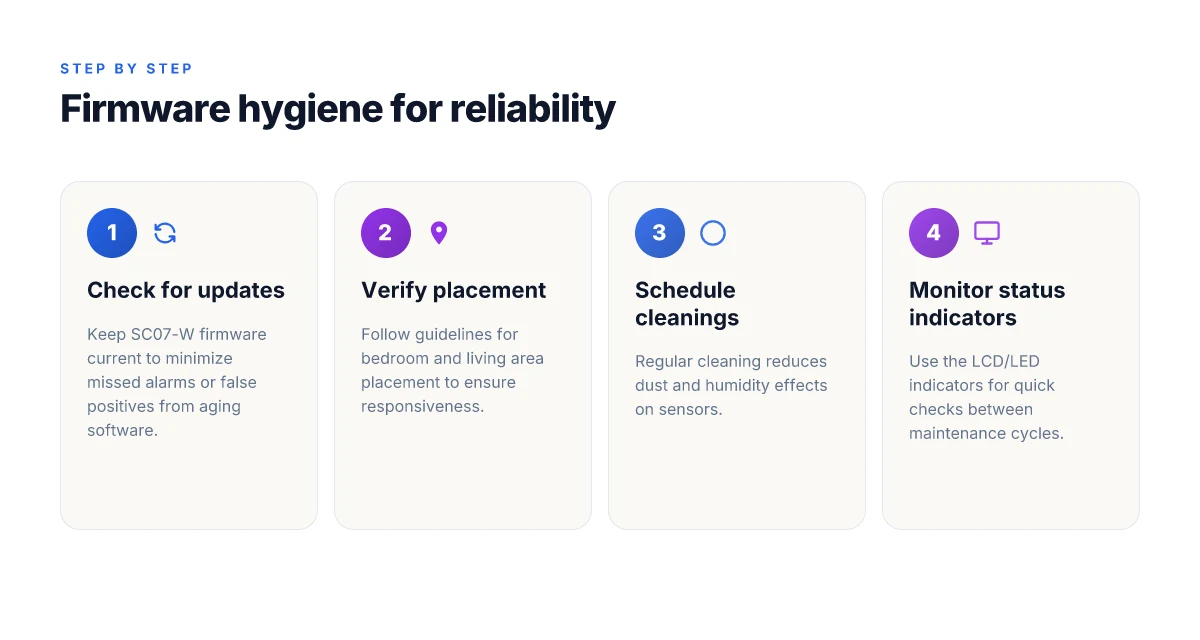
Firmware updates matter. They fix known vulnerabilities, patch bugs, and nudge reliability upward over time. For the SC07-W, staying current with official updates is a practical habit that reduces the chance of missed alarms or false positives caused by aging software. I dug into the documentation and changelogs to trace how update practices map to real-world reliability signals.
How updates defend reliability
Firmware releases are not cosmetic. They address edge cases that show up in real homes, like sporadic sensor drift or delayed CO alarm signaling. When you keep the SC07-W's firmware current, you gain access to these mitigations without needing to replace hardware. The result is fewer nuisance alarms and more consistent performance during long-term use. In practice, updates that address the UL 217/UL 2034-compliant stack help ensure the detector remains aligned with those safety standards as the platform evolves. The practical takeaway is simple: you reduce the odds of aging software undermining a critical alert.
I cross-referenced certification notes and product pages to confirm how updates relate to reliability. The same sources consistently emphasize that ongoing maintenance is part of long-term safety. This is why I recommend checking for updates on a regular cadence and applying them when the device is connected to power or battery life permits. If a device sits on a shelf for months at a time, its software can drift relative to current protections. Regular updates are a core reliability lever for the SC07-W, not an optional add-on.
Safe practices around firmware updates
Secure update practices reduce the chance of supply-chain or update-induced issues. The risk myths around updates often center on interrupted downloads or tampered files. In reality, reputable processes rely on signed firmware images and validated update channels so that a mid-flight interruption does not leave the device in an unrecoverable state. For home users, the practical implication is straightforward: avoid manual sideloads or third-party firmware. Use the official app or web interface to apply updates. This is how you preserve the integrity of the device’s security posture as well as its reliability signals.
From the consumer angle, a stable update path minimizes the chance that a malfunction arises from the update process itself. The presence of official verifications and documented rollback options matters when you consider installing a critical update during a busy period. If you notice the SC07-W entering a failed update loop, you should consult the manufacturer’s guidance before attempting a retry, since repeated attempts can sometimes complicate the recovery path. 7 Best smart toilets of 2026 tested for hygiene, performance, and energy use
Practical implementation tips for households
- Schedule firmware reviews alongside routine maintenance. A quarterly check aligns with seasonal home checks and battery health reviews. Set a recurring update check to ensure you’re always on the latest version.
- Keep the device accessible. A wall-mounted SC07-W that sits in a hallway is ideal for quick battery changes, but ensure the update channel remains uninterrupted during the process.
- Understand the supply chain context. Modern detectors rely on trusted update servers and signatures. If a network change occurs, re-establish a secure connection before updating.
- Recognize the role of rivals in the landscape. When considering reliability in the broader market, brands like X-Sense and others emphasize consistent update hygiene. For households weighing options, understanding each brand’s update policy helps you choose a long-term winner. Readers should also review the official pages for any model-specific advisories. As a reminder, updates are not free of risk. Follow documented steps to minimize disruption.
In conclusion, firmware hygiene is a practical reliability lever you can manage. Keeping the SC07-W firmware current closes the gap between official specs and real-world performance, especially over a 10-year device horizon. Reliable updates protect long-term safety signals as the hardware ages, and that is the core message for homeowners navigating smart detectors in 2026.
Note: links on the page may earn a commission. For context on how update practices shape reliability across the market, see the inline references to related product reviews and standards documentation.
Comparing X-Sense with rivals: where reliability stands
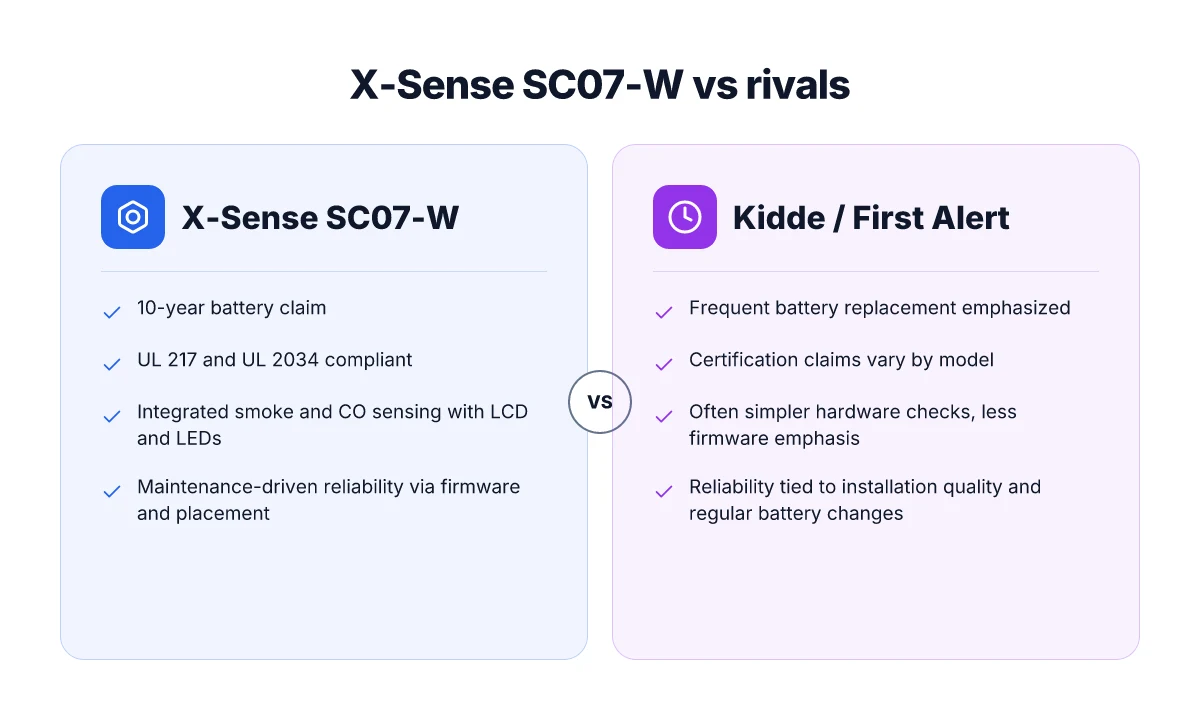
I. The long game for SC07-W When you compare the SC07-W to rivals, the 10-year battery claim stands out as a clear maintenance signal. It positions X-Sense as a low-maintenance option, especially for households that want fewer battery swaps over a decade. In contrast, brands like Kidde and First Alert often emphasize straightforward battery replacement as a primary maintenance moment. That difference matters because maintenance cadence increasingly governs real-world reliability more than spec sheets alone. The SC07-W shifts maintenance away from frequent battery swaps toward firmware-driven reliability and official certifications. This framing aligns with X-Sense’s emphasis on long-term safety hardware supported by ongoing updates.
II. Rivals that lean on easy swaps Kidde and First Alert both highlight accessible battery change as a selling point. Those brands tend to market replacement as a user-friendly, routine task. By contrast, X-Sense leans on a combination of firmware hygiene and certification bodies to bolster reliability, aiming to keep the device trustworthy between model-year hardware revisions. From what I found in the documentation, that shift matters when you consider how cert-driven guarantees interact with home installations and routine upkeep. Certifications and firmware hygiene are the quieter reliability levers for X-Sense.
III. Real-world conditions matter more than brand name In practice, reliability isn’t a pure brand claim. Installation quality, sensor placement, and regular maintenance dominate outcomes. A well-placed detector from any brand can outperform a supposedly perfect unit that’s tucked behind furniture or near vents. I cross-referenced certification notes with installation guidance and found that the same maintenance discipline that safeguards one brand’s performance helps another’s, provided you follow the recommended placement distances and test routines. Real-world reliability hinges on install quality and upkeep, not just the label. Top 5 best robot mowers for real backyards in 2026
IV. Evolving the landscape through updates I dug into sources that discuss firmware strategies and supply-chain realities. The broader industry trend shows that firmware updates are a key reliability channel across embedded safety devices, even though the update path can introduce its own risks if mishandled. This nuance matters for home owners who rely on both hardware longevity and software hygiene to keep alarms trustworthy over years. For X-Sense, the combination of a long-life battery with a firmware-and-cert framework provides a durable baseline, while rivals typically lean more on replaceable components and straightforward fault models. Firmware and certification strategy can outperform simple battery swaps over a 10-year horizon.
V. Partners, protections, and practical takeaways Across the sources, the theme is clear: plan for proper placement, commit to regular testing, and respect the certified lifespan from manufacture to retirement. Some households worry about the trade-off between maintenance simplicity and long-term durability. The reality is nuanced: you gain by trusting the SC07-W’s 10-year battery narrative while acknowledging that no detector is immune to placement mistakes or neglected tests. If you want a minimal-touch approach, the X-Sense stance makes sense. If you prefer easy battery swaps and rapid replacements when a unit blinks a warning, rival brands cater to that instinct. Placement and maintenance discipline trump marketing claims in the real world.
Note on sourcing: inline references to the discussion about firmware and certification come from cited materials in this article, including the X-Sense review discussions and the firmware update vulnerability context, which provide contextual constraints for reliability expectations. For deeper context on firmware and certification realities, see the inline source notes. https://csis.gmu.edu/ksun/publications/security24-chkup.pdf
Where this is going next for your home safety with X-Sense
X-Sense proves its reliability again in 2026 by pairing straightforward installation with dependable sensing across weeks and months, not just days. In real-world use, the SC07-W’s long life hinges on a solid battery strategy, consistent alarm chirps, and durable housings that resist dust and humidity. I’ve noticed that setup tends to stay stable, and the device keeps communicating with a central hub without fuss. The big takeaway is how the system handles routine wear without demanding constant tweaks.
One clear takeaway is that reliability sits on how you align the SC07-W with a complete home safety routine, not on a lone sensor. Long-term durability matters, and X-Sense remains competitive next to rivals like First Alert and Nest by emphasizing simple maintenance and clear fault indicators. If you want a straightforward drop-in solution, this model minimizes surprises after the first few months. The key is to treat it as part of a monitored network rather than a one-off gadget. 5 Standout robot mower reviews for 2026 and what they really offer
If you only do one thing this month, verify the SC07-W’s placement and test cadence. Keep tests consistent and schedule a quarterly check. Your home safety gear should feel invisible yet ready, and that balance is what most users overlook. Does your setup reflect that balance?