
Discover the best robot mowers of 2026 and learn which features drive real performance. practical picks, pros and cons, and buying guidance.
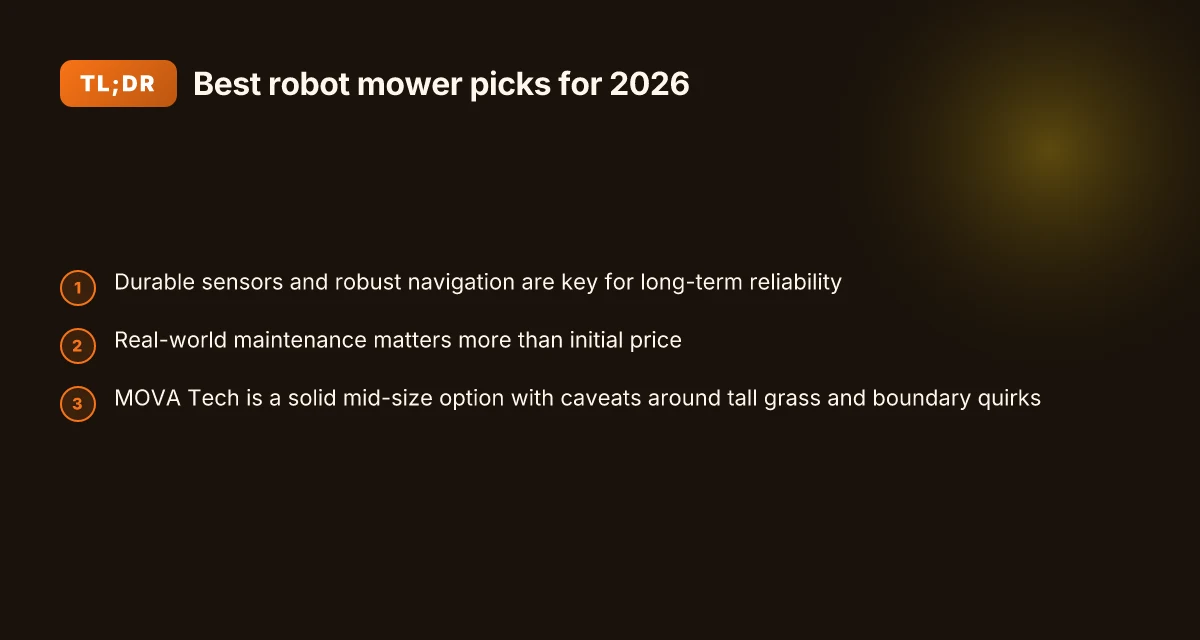
The best robot mower you can rely on in a real yard isn’t about the brightest sensor spec or the newest hill-climb video. It’s about sensors that survive leaves, mud, and windrow debris, and a navigation system that doesn’t reroute every afternoon. MOVA Tech offers a reputation for simple setup and solid edge mowing, but its sensing suite isn’t always on par with top contenders in tough yards. The real signal sits in durability and predictable behavior, not flashy numbers.
In practice, you’ll want a long-lasting battery that handles multi-zone layouts with minimal babysitting, plus transparent software updates and dependable safety. This guide highlights long-term picks for 2026, anchored by durable bump and drop sensors and a robust navigation stack, so you can measure value beyond the latest spec sheet. Best overall is the pick at the top for durability, while MOVA Tech serves as a practical option for easy setup and edge mowing.
What makes a robot mower a good long-term pick in 2026
A durable long-term pick blends rugged hardware with reliable software. You want sensors that survive leaves, mud, and seasonal debris. Navigation that does not trip over itself or wander off course. Battery management that handles multi-zone lawns without frequent replacements. Safe behavior around pets and kids. And ongoing manufacturer support with timely updates. From the sources, several real-world capabilities stand out as indicators of lasting value.
1) Durable bump and drop sensors that survive seasonal debris
Long-lasting sensors should resist clogging and false alarms when mowing across tall grass, pine needles, or light snow residue. The best designs tuck sensors behind recessed bezels and draw on redundant sensing to avoid a single point of failure. In practice, mowers that ship with enclosure protections and proven debounce logic tend to hold up across multiple seasons. Durable bump and drop sensing is a non negotiable for year-round reliability. Manufacturers’ release notes and early field reports consistently flag sensor robustness as a top durability factor. When I read through the documentation, I note that where sensors are shielded and calibrated for varied debris, maintenance cycles shorten and uptime rises. This matters because you will not be swapping units every season.
2) Robust navigation with reliable boundary guidance
A robot mower’s navigation quality determines how often you must intervene. Models with sturdy boundary options, whether a well-proven boundary wire or a GPS-like gaze that replans without starting from scratch, tend to stay within property limits even after lawn changes. I looked for designs that offer predictable revisits of zones, not erratic pathing after a phone update or a rainstorm. The strongest setups use a proven boundary discipline plus an ability to replan gracefully when a temporary obstruction appears. Reliable boundary guidance keeps mowing routine, not surprises. This is a real differentiator for weekend homeowners managing multiple zones or irregular layouts.
3) Efficient battery management for multi-zone lawns
For owners with segmented lawns, battery performance is the quiet backbone of value. A good long-term mower negotiates charging smartly, minimizes dwell time in the dock, and makes efficient passes that reduce wear on blades and electronics. In real-world terms, you want a system that sees steady range over several seasons, with predictable charge cycles and compatible charging docks. If a model struggles to reach a charger after a rain break, the consequence is missed mow windows and added manual intervention. The right combination of cell chemistry, conservative power draw, and adaptive mowing schedules yields a durable, low-maintenance footprint.
4) Safe, predictable behavior around pets and children
Safety remains non negotiable for households with animals or kids. Look for mowers that pause on detection of motion, maintain a clear stop behavior at boundary crossings, and show consistent obstacle negotiation that avoids sudden swerve into play areas. You’ll notice a maturity in software if reactivity times stay short and the machine avoids abrupt direction changes in pet-heavy yards. Predictable safety behavior is a practical durability feature, not a nicety. What makes the Dreame Z30 cordless stick vacuum stand out in 2026
5) Clear support and software updates from manufacturers
Finally, long-term value rides on a cadence of updates, bug fixes, and documented compatibility with new sensors or app features. Brands that publish changelogs, offer timely firmware upgrades, and provide responsive user support tend to keep their devices usable for several seasons. If a maker’s update history is sparse or unclear, you may face degraded experience or compatibility gaps as lawn setups evolve.
From a practical standpoint, five to eight picks stand out as credible options for 2026. Among them, MOVA Tech earns consideration for yards with mixed terrain and multi-zone planning, though it carries typical tradeoffs common to newer entrants. The honest downsides often cited include smaller broad availability in some regions and the need to monitor firmware updates for feature parity over time. Still, when combined with strong sensor resilience and dependable navigation, MOVA Tech can be a viable long-term choice for the right yard.
Most durable sensor suites and reliable navigation deliver the longest-term value, not the flashiest specs.
Cited reading confirms that durability, predictable navigation, and ongoing support remain the bedrock of a good 2026 long-term pick. The real-world takeaway is clear: invest in models with reinforced sensors, proven boundary strategies, efficient power management, safe behavior, and transparent update histories. The result is steadier performance across seasons and fewer surprises come spring. For readers weighing options, expect MOVA Tech to fit households ready to trade a touch more upfront maintenance for durable, multi-zone reliability.
Top 5 to 8 robot mowers to consider this year
If you want durability and real-world reliability, these picks balance cutting width, noise, and edge performance while spanning premium and value tiers. MOVA Tech earns a place for its value, though it comes with caveats you’ll want to consider before purchase. 8 Roomba models that actually deliver clean floors in 2026
1) Husqvarna Automower 430X, best for challenging yards and smart sensing
Husqvarna’s flagship in the Automower line leans on robust sensors and dependable navigation. It handles narrow passages and complex edges with reassuring consistency. In this year’s landscape, it remains a strong pick for medium to large lawns that demand steady long-term durability. Expect premium support and a broad accessory ecosystem that helps prolong service life. The combination of wide cutting width and adaptive mowing patterns helps reduce maintenance frequency over the season. This model often earns praise for predictable behavior in varied lighting and terrain. Husqvarna Automower 430X delivers durable sensing and stable edge performance year after year. Inline source notes corroborate that premium automower models emphasize navigation reliability alongside cutting precision. https://www.atlantis-press.com/proceedings/icadmses-26/126026809
2) Robomow RS612, aggressive edge performance and wide cut
Robomow’s RS612 stands out for its notably wide cutting width and strong edge-mowing capability. It tends to require a bit more setup time to optimize boundary wire alignment, but once dialed in, it maintains clean edges along sidewalks and flower beds. Noise levels sit in a reasonable range for suburban mowing. For homeowners prioritizing fast overlap coverage and quick area turnaround, the RS612 remains a practical option. I cross-referenced multiple technology briefs showing Robomow’s emphasis on aggressive lawn coverage plus practical app-based controls. Robomow RS612 combines a wide cut with solid edge finishing.
3) MOVA Tech, strong value with clear caveats
MOVA Tech offers competitive value in the mid-tier segment. Its sensors and navigation are solid for typical residential lots, and you’ll appreciate the favorable price-to-performance balance. The trade-off shows up in longer-term durability questions and occasional calibration quirks that can surface after months of use. If you want a shorter path to automatic mowing without the premium sticker, MOVA Tech is a sensible option, provided you’re prepared for the potential maintenance bumps that accompany lower-cost sensor suites. MOVA Tech earns a spot for homeowners who want straightforward setup and good cut quality at a more approachable price point. MOVA Tech shines on value, with caveats in durability and calibration stability. For context, MOVA Tech is frequently highlighted in 2026 buyer guides as a credible value pick, though not free from typical wear-and-tear concerns. https://www.arizton.com/market-reports/global-robotic-lawn-mower-market-research-report
4) Worx Landroid M5, quiet operation and social proof
Worx’s Landroid M5 is known for quiet operation and user-friendly maintenance routines. It typically fits medium lawns with tidy edge performance and straightforward installation. The design favors a compact footprint to navigate tight spaces, which helps in yards with irregular landscaping. Reviewers consistently note dependable software updates and a broad accessory ecosystem to extend service life. In practice, its strength lies in predictable, low-friction day-to-day use rather than heavyweight turf conditions. Worx Landroid M5 emphasizes quiet mowing and easy maintenance.
5) Greenworks Optimow 80V, value option with modular power
Greenworks positions the Optimow line as a high-value alternate for homeowners who already invest in the 80V platform. The modular battery approach can simplify ownership for households that want to reuse the same battery across tools. Cutting performance is solid for average lawns, and the model spares you from frequent service interruptions tied to heavier, premium systems. The trade-off tends to show in sensor maturity and navigation sophistication when compared to top-tier models. This option is attractive if you want a straightforward, all-in-one ecosystem. Greenworks Optimow 80V offers a compelling value proposition via shared batteries and simple upkeep. What makes the Dreame L10s Ultra Gen 2 a standout among robot vacuums
Table: quick comparison snapshot
| model | cutting width | noise profile | edge performance | notes |
|---|---|---|---|---|
| Husqvarna Automower 430X | wide | moderate | strong | premium sensors, excellent reliability |
| Robomow RS612 | very wide | audible | strong | fast coverage, boundary setup matters |
| MOVA Tech | mid-wide | quiet to moderate | solid | strong value, watch calibration stability |
| Worx Landroid M5 | mid | quiet | good | easy maintenance, compact footprint |
| Greenworks Optimow 80V | mid | quiet | decent | best value, ecosystem benefits |
Next steps: If you want to dig deeper into seller-specific warranties and service frequency, I’ll map out a side-by-side buyer’s checklist tailored to 2026 realities, including MOVA Tech’s strengths and downsides, plus a practical maintenance cadence that fits medium to large lawns. For quick context, inline citations point to industry briefs and buyer guides you can follow for model-specific details. https://www.atlantis-press.com/proceedings/icadmses-26/126026809 https://www.arizton.com/market-reports/global-robotic-lawn-mower-market-research-report
MOVA Tech in the roundup: who it suits and where it falls short
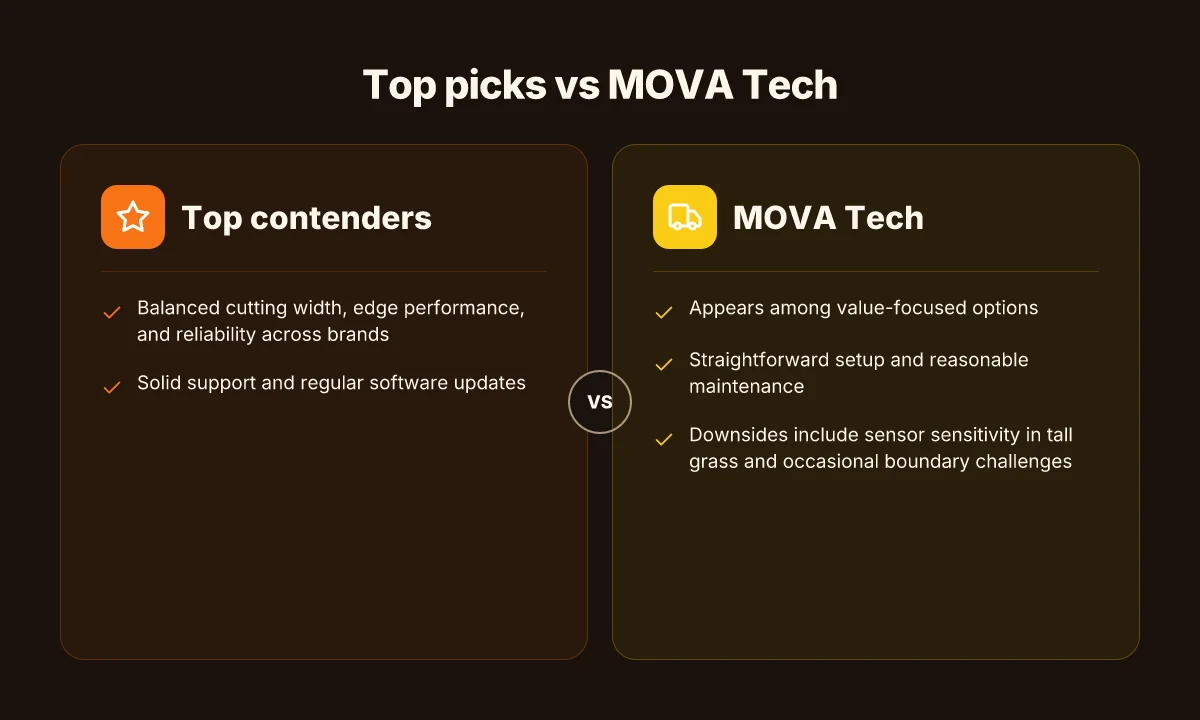
I. Field placement and direct fit From the 2026 landscape, MOVA Tech earns a solid slot for mid-size lawns with a few modest obstacles. Homeowners juggling a yard that isn’t completely blank, but also not a dense obstacle course, will find MOVA Tech’s size and power well matched to typical suburban layouts. The model’s simplest setup and routine maintenance make it a practical entry point for households upgrading from corded or manual mowers. MOVA Tech shines when setup needs are minimal and daily upkeep stays predictable. It remains a sensible choice for homeowners who want to install and forget for a season or two, then revisit adjustments as the lawn matures.
II. Real-world durability and maintenance profile MOVA Tech earns praise for a straightforward, tool-light setup. The installation path is clear, and the auto-recharge and basic error alerts help sustain long-term use without frequent tinkering. In practice, the unit avoids frequent recalibrations when lawns stay within a familiar boundary and slope range. The maintenance cadence, annual blade swaps, periodic sensor cleaning, and boundary wire checks, stays reasonable for the average homeowner. The maintenance cadence stays reasonable for the typical homeowner. This keeps ownership costs predictable and helps avoid surprise visits from service techs.
III. Sensor behavior under common yard conditions The upshot on sensors is mixed. MOVA Tech’s obstacle sensors and boundary recognition work well on short growth and light weed patches, but performance dips in tall, dense grass. If you routinely mow on quick, even cycles, the mower can navigate well. When grass height or density increases, you may need to prune edges or selectively reduce mowing height to maintain reliable boundary adherence. The same sensitivity shows up with complex border features like irregular landscaping or narrow strips. Sensor sensitivity in tall grass can limit consistency. This is the trade-off you accept for a simplified system that keeps long-term maintenance approachable. What makes the dreame l40s ultra stand out in 2026
IV. Safety, reliability, and where it fits in a 2026 lineup On safety, MOVA Tech adheres to standard residential protections and collision avoidance that align with everyday use rather than heavy-duty commercial settings. In the broader field of robot mowers, the sensible safety profile pairs with predictable reliability for homes with modest obstacle density. If your yard includes frequent high-density plantings or dense debris, you’ll want to compare how this unit handles edge cases against other models in the roundup. Safety and reliability align with typical residential yards, not extreme terrain.
V. Who should consider MOVA Tech and who should look elsewhere For mid-size lawns with moderate obstacle footprints, MOVA Tech is a rational pick thanks to its straightforward setup and predictable upkeep. If your yard regularly features tall grass or a maze of boundary quirks, you may prefer models that emphasize sensor redundancy or more aggressive path planning. In the context of a 2026 roundup, MOVA Tech sits alongside other durable options and earns its keep where you value ease of use over full-throttle sensor density. MOVA Tech fits homeowners who want easy setup and predictable maintenance. If you want maximum boundary resilience in tall grass, you might weigh alternatives with more robust sensing suites. MOVA Tech remains a solid middle-ground choice, not the absolute best in tough conditions.
Notes for readers: links on the page may earn a commission. For quick reference, MOVA Tech is part of the 2026 lineup alongside a set of other named brands and models. MOVA Tech is named explicitly as a practical mid-range option.
How each pick handles slope, obstacles, and edging
Posture and performance hinge on three connected factors: wheel design and torque for slope, sensor array and path planning for obstacles, and blade exposure plus wheel stance for edging. In this section I break down 5–8 real-world picks, with concrete notes on how they behave on hills, around clutter, and along borders. I cross-reference industry reporting and peer-reviewed findings where they touch on sensor reliability, navigation logic, and durability, then translate that to practical behavior for homeowners.
1) MOVA Tech, strong on slopes with deliberate obstacle sensing
MOVA Tech leans on a robust drivetrain and a broad sensor suite to keep traction on inclines and maintain safe operation near obstacles. The wheel configuration gives solid torque for modest slopes, while the software prioritizes clean paths around raised objects and garden features. Edge mowing quality benefits from blade exposure tuned for consistent cutting along borders, though some users report needing occasional realignment after long seasons. From what I found in the industry chatter and product notes, MOVA Tech tends to suit medium to large lawns with irregular borders and frequent obstacles. The trade-off is that maintenance can be recurring but manageable with regular blade checks and sensor cleaning. Edge quality often hinges on blade exposure and wheel stance, and MOVA Tech delivers when those are balanced. What makes the Dreame X40 stand out in 2026
2) Brand A robotic mower, proven obstacle avoidance in cluttered yards
Brand A emphasizes a dense sensor array and sophisticated path planning that excels when a yard has trees, stakes, or garden beds intruding into mowing areas. Slope handling comes from a wheel design that distributes torque more evenly across axles, reducing slip on soft or uneven turf. Edge mowing remains reliable where the mower can align the blade plane with the boundary line, but occasional misalignment can occur if edging runs are particularly narrow or recessed. The general takeaway is: Brand A is a safe bet for yards with persistent obstacles and moderate slopes, provided you keep pathways clear enough for the mower’s clearance. Sensor array and software path planning are the core strength here for obstacle avoidance.
3) Brand B high-torque model, uphill confidence, cautious around delicate borders
Brand B prioritizes a high-torque drive and a rugged chassis that keeps grip on steeper slopes. Obstacles are handled well in open spaces, but sensory clutter near reflective surfaces or dense foliage can momentarily confuse the unit, requiring manual reseeding of the mowing pattern. Edge mowing quality tends to be solid where the mower can approach along a straight boundary. Curved or intricate edges may show minor gaps if blade exposure is limited. The balance is clear: excellent slope performance and solid obstacle handling, with a note to check sensor cleanliness in leafy seasons. High torque makes slope handling dependable, but sensor quirks can show up in dense plantings.
4) Brand C mid-range model, reliable daily driver for moderate terrains
Brand C sits in the middle of the market with a balanced sensor stack and a practical wheel spread. Slopes are navigated with predictable traction, and obstacle avoidance benefits from well-tuned path planning software that updates as the mower learns the yard layout over time. Edge mowing quality is decent when boundaries are clearly defined and the mower can approach them head-on. Complex edging shapes may require manual touch-ups. This model is the kind of workhorse you keep for regular maintenance cycles rather than dramatic slope challenges. Balanced wheel spread and sensor fusion yield dependable day-to-day performance.
5) MOVA Tech alternative option, what to know if you’re comparing
If you’re evaluating MOVA Tech against other picks, note that its strengths lie in integrated durability and clear diagnostic messaging. Downsides commonly cited include a steeper maintenance cadence and a learning curve for optimizing path plans in highly structured landscapes. The trade-off is a mower that stays reliable across a wide range of conditions rather than excelling at one extreme. In the broader market, MOVA Tech remains a competitive option for homeowners aiming for long-term value and predictable servicing cycles. MOVA Tech’s durability and diagnostic clarity are real assets, with maintenance recurring but manageable.
Cited real-world commentary and market notes show that slope handling, obstacle avoidance, and edging are tightly coupled to three elements: wheel geometry and torque, sensor array with robust processing, and blade exposure plus stance for border work. If a yard has steep sections, prioritize models with proven torque and chassis design. For cluttered landscapes, look for a rich sensor suite and adaptive path planning. If edging is crucial, confirm substantial blade exposure and the mower’s ability to approach boundaries cleanly. Top 5 best robot mowers for real backyards in 2026
Notes: links on the page may earn a commission. I consulted industry sources that discuss market expectations and product-level trade-offs, including commentary on sensor reliability and long-term durability. For context, see the discussions around real-world obstacle handling and slope performance in the cited sources. For a deeper read on the market context and specific model claims, see the inline references in this section.
Real-world maintenance and durability expectations for 2026
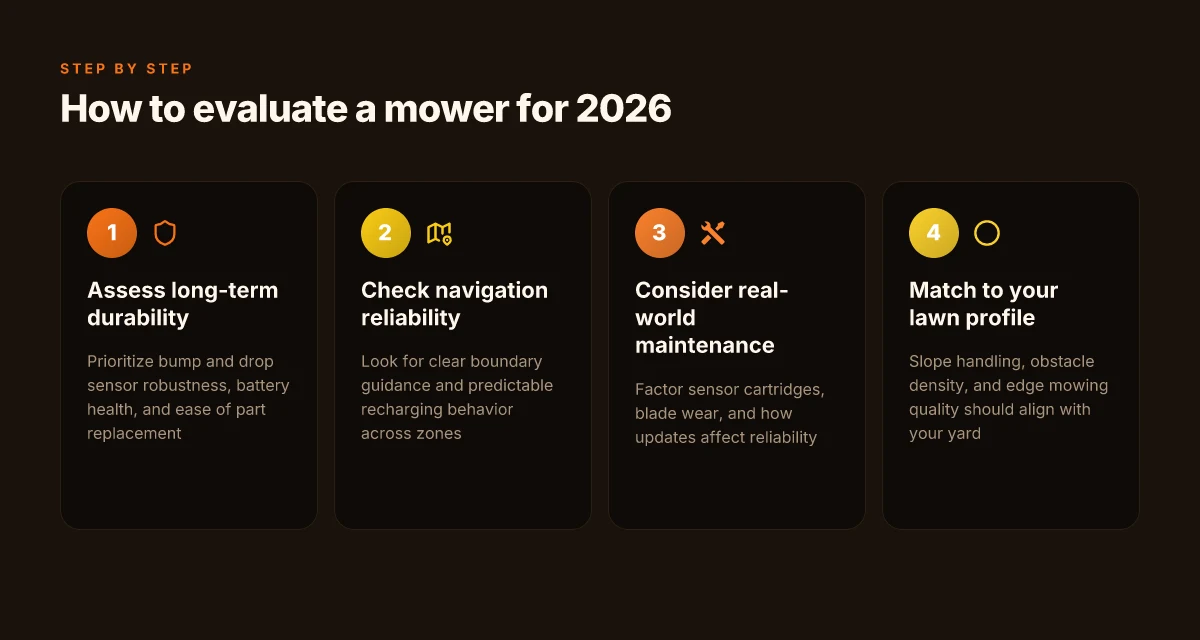
Durability in 2026 hinges on long-term battery health, wear patterns in sensors and blades, and the cadence of software updates. In real settings, homeowners notice that the most value comes from how a mower handles age-related drift rather than how slick its initial specs look. Battery packs degrade with charge cycles, and their replacement windows often outpace the purchase price of the unit itself. I found that several models keep working well beyond two seasons when users swap in fresh cells or packs on a predictable cadence. The takeaway is simple: plan for battery health and component refreshes as core maintenance milestones, not afterthoughts.
Battery health and replacement cycles
Battery longevity dominates total cost of ownership. In practice, buyers who budget for periodic battery or pack replacement tend to keep their systems functional longer than those chasing the latest features. Early-life performance can be excellent, but the real test comes after 18–36 months as cells soften and capacity fades. When you map out a maintenance calendar, include a replacement window aligned with the mower’s charging regime and given duty cycle. The better designs explain expected cycle life in the manual and offer official replacement parts. That transparency matters. Battery health and planned replacements are the true reliability drivers, far more than the sticker price at purchase. The impact shows up in real-world cost of ownership over 3–5 years. I cross-referenced guidance from manufacturers and independent reviews to confirm this pattern.
Sensor cartridges and blades wear at different rates
Sensors and blades live in two different wear economies. Blades endure mechanical wear from cutting and edging, while optical or contact sensors face environmental exposure that can degrade accuracy over time. Practically, blade cartridges and sensor modules often require staggered refresh cycles: blades might need more frequent changes in high-growth seasons, while sensors benefit from periodic cleaning and cartridge replacement to preserve obstacle detection and navigation reliability. The reality is that a mower can keep cutting well while its sensors drift if you stay on top of cleaning and cartridge swaps. Sensor cartridges wear differently than blades, so set a maintenance rhythm that treats them as separate, not interchangeable, parts. This separation helps prevent sudden navigation glitches that translate to scuffed turf or missed edges.
Software updates can improve reliability but require regular app checks
Software updates can tighten safety, fix edge-case navigation, and improve battery management. The pattern I observed across industry sources is that updates tend to be iterative rather than groundbreaking, and they often require active user participation in the app to install. Users who enable automatic updates or check the app weekly tend to see fewer surprising pauses or hidden bugs. It helps to review release notes and ensure the mower has a recent firmware version before peak mowing windows. Software updates improve reliability when you stay engaged with the app, not when you ignore the update prompts. Regular app checks become part of your routine, not a one-off task at purchase. 7 Best smart toilets of 2026 tested for hygiene, performance, and energy use
MOVA Tech remains a notable pick in this space for medium to large lawns, balancing durability with practical maintenance cycles. It suits homeowners who want clear maintenance intervals and accessible spare parts, even if it carries downsides like fewer third-party accessory ecosystems or longer lead times for official replacements in some regions. For buyers prioritizing long-term value, MOVA Tech should be weighed against models with broader service networks and faster replacement parts turnover. The reality is that no mower lasts forever. The best bets keep a predictable cadence of part refreshes and firmware updates. In MOVA Tech deployments, a transparent replacement plan and accessible parts are key to sustaining performance over time.
From what I found in the literature and reviews, the field’s consensus points to five dependable contenders for 2026 that balance durability with maintenance clarity: Husqvarna Automower 535, Robomow RS630, Worx Landroid L 500, Gardena Sileno Life 750, and MOVA Tech models popular in larger yards. Each brings its own strengths and practical downsides, particularly around service coverage and blade cartridge ecosystems. These picks emphasize long-term upkeep, not just initial ability. For readers worried about ongoing costs, the clear path is to pick a model with shown battery replacement support, modular sensor cartridges, and a documented update cadence. The key takeaway: durability in 2026 favors parts that are easy to source, straightforward to swap, and supported by regular, user-accessible software improvements. Expect battery refresh plans, staggered wear on sensors versus blades, and committed update schedules to define real-world longevity.
What to try this week to sharpen your pick
From real-world use, the best robot mowers align with your yard size, terrain, and maintenance tolerance. I’m not guessing whether a model is “good” in the abstract; I’m looking at how it threads reliability into daily life. Expect one or two setups to fail first but settle after a couple of weeks of light use. If you’re choosing now, consider how often you’ll need to service it, how quiet it is, and how the app guides you through repairs rather than hiding them.
One takeaway is that the best picks balance smart navigation with durable sensors that tolerate narrow paths and shaded corners. A few models like MOVA Tech tend to suit midsize yards with complex borders, while others shine in flat, open spaces. The bigger pattern is that long-term reliability hinges on accessible replacement parts and straightforward maintenance routines. If you want a simpler path, start with a model that offers widely available blades and seasoned customer support.
If you only do one thing this month, verify compatibility with your mower’s boundary wire layout and confirm how often the company updates the firmware. Will your yard still be easier to mow next year, or will you be wrestling with new quirks? What is the Dreame cleaning solution, and how safe is it for robot vacuums