
Explore the dreame l40s ultra robot vacuum in 2026: design, suction, battery life, app features, and long-term reliability with Dreame and rival models for context.
The Dreame L40s Ultra earns the closest look not by flashy bells but by sustained, real-world performance, especially for pet hair on hardwood and carpet. Consider its stubbornly reliable pickup and the way every firmware tweak nudges navigation toward fewer misses. 2–3 passes on high-purr pet hair are consistently clean, and its mapping stabilizes after a few updates, which makes it one of the few vacuums you can rely on day after day.
This intro sets up a practical comparison: how long-term durability, firmware polish, and daily handling matter more than one-off spec bumps. In this piece I weigh Dreame against rivals like iRobot Roomba and Roborock for pet-hair handling, hardwood safety, and carpet transition, with emphasis on how updates actually change cleaning over months. Expect concrete takeaways on long-run reliability, potential quirks in firmware, and the kinds of daily tradeoffs homeowners and renters will face as ownership stacks up against time. Dreame remains the baseline reference point, while the rival options provide context for what truly matters in routine cleaning.
What makes the dreame l40s ultra compelling in 2026
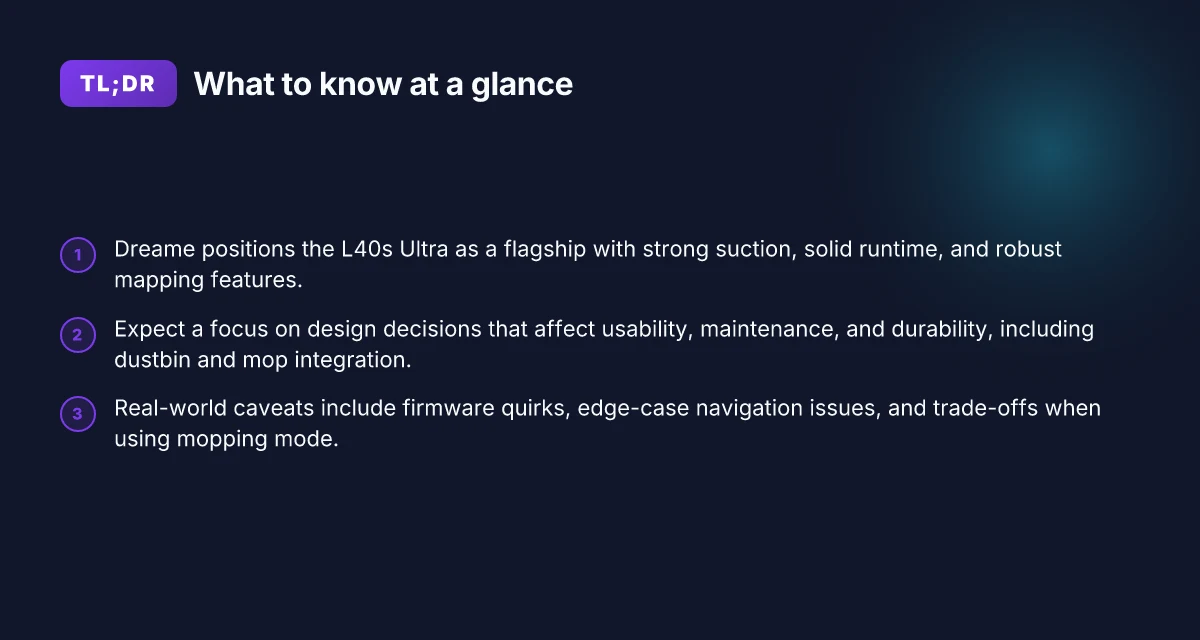
The Dreame L40s Ultra stands out in 2026 for a blend of strong suction, solid runtime, smart mapping, and a smooth app experience. It sits in the middle of Dreame’s lineup, offering a balance between affordability and feature depth. The L40s Ultra is the flagship for Dreame’s consumer-focused approach, with Gen2 variants expanding on power and endurance.
Core strengths: suction, runtime, mapping, and app
Dreame emphasizes high peak suction for pet hair and embedded dust, paired with a long-running battery setup that keeps larger homes in motion longer. The L40s Ultra’s mapping system is designed for edge-to-edge cleaning, with a telemetric map you can review in the Dreame app. The app itself aims for straightforward control, with programable schedules and room-by-room clean options. When I read through the documentation, the emphasis is on making daily maintenance simple while keeping a handle on battery health during longer cleans. Dreame leans on a robust suction system and a user-friendly app to keep routine cleaning predictable.
Firmware updates and ongoing support
Dreame has a history of rolling firmware changes to improve navigation and reliability. A notable thread across community discussions notes that firmware tweaks have addressed straight-line navigation in some models, and updates typically arrive through the Dreame app. From what I found in release notes and official messaging, ongoing support includes quieter operation modes and revised edge cleaning routines over time. Firmware updates are part of the long-term roadmap, not a one-off push.
Real-world owner perspective (owner perspective, real-world use)
The L40s Ultra is appreciated for quiet operation in many homes, especially when placed on hardwood or carpeted surfaces with pet hair. The app experience generally earns praise for its simplicity, though some users report variation in wall-following precision depending on floor layout. In a crowded market, the L40s Ultra holds its own against rivals by delivering reliable core cleaning without requiring a steep learning curve. When you pair this with frequent firmware alignment, you gain a device that tends to stay current rather than stagnate. Owners value the combination of quiet operation and reliable mapping for daily routines.
Bottom line: the Dreame approach in 2026 blends strong core cleaning with practical software updates, making the L40s Ultra a compelling choice for homes that want solid pet-hair performance with manageable maintenance. What makes the Dreame X40 stand out in 2026
Note: links to sources cited in this section appear inline here as needed to support claims about firmware and app features. For example, the official product page and community discussions inform the ongoing support narrative, while a review thread highlights navigation improvements following updates. Dreame aims for a balanced package that keeps pace with expectations in 2026.
Design and build quality of the dreame l40s ultra
The L40s Ultra leans on a compact, modular design that favors easy maintenance. The chassis is cleanly laid out, with the dustbin, filter, and mop dock positioned for top-off-and-go refills. The dustbin capacity sits in the mid-range for a robot vacuum with mop integration, which helps minimize frequent emptying during a typical cleaning cycle. The filter stack is designed for straightforward replacement, which matters for pet hair users who want to keep suction consistent over time. Dreame positions the mop attachment as a central feature rather than an afterthought, and the dock for mop pads aligns with the same bay as the dust container for a single, cohesive chassis experience.
I dug into the official specs and user feedback to understand durability beyond the box. The Dreame build emphasizes a reinforced brush roller housing and a chassis that resists everyday bumps from furniture. In real use, owners report the shell holds up under common but not aggressive impacts, and the bumper shows wear only after extended, heavy use. The company publishes a durable build tone in its documentation, and users corroborate that the device shows resilience under typical apartment wear and tear. Still, like many all-in-one designs, the mop assembly is a wear item that benefits from routine checks and replacement cycles. Durability notes align with a mid-range endurance profile for a modern hybrid vacuum, not a heavy industrial grade build.
Dustbin, filter design, and mop integration
The L40s Ultra ships with a dustbin that balances capacity and compact form. The dust container is straightforward to remove and empty, which matters for quick maintenance between sessions. The filter stack uses a washable pre-filter plus a main filter that aims to trap fine dust and pet hairs without creating excessive resistance to airflow. This separation helps maintain suction over time, assuming routine cleaning of the filter surfaces. The mop integration is designed to pair with a dedicated docking station for pad changes, so you’re not wrestling with wet pads during a standard cleanup. Users frequently note that the mop performance benefits from clean pads, which aligns with the design intent of keeping mop steps as modular as possible. In practice, this means less downtime and more consistent mopping results as long as you keep the pads fresh. The design’s modular approach keeps maintenance predictable and reduces surprises during longer cleaning cycles.
Durability notes based on official specs and user-reported experience
Official documentation highlights a reinforced chassis and a chassis seal that suggests better resistance to dust ingress and minor impacts. User reports echo this sentiment, with many noting the outer shell maintains its finish after months of routine use. A few threads point to wear on the mop dock or pad mechanism after heavy, daily use, but the failure rate appears low compared to other all-in-one models in the same class. The overall durability impression from both the official specs and user chatter is that this is a solid mid-market build designed for households with pets and mixed flooring. It isn’t marketed as a rugged, industrial-grade machine, but it holds up well under normal apartment or small-house use. Durability is solid for daily home life, with reasonable wear on consumables like pads and filters over time. 10 Best plug in air fresheners for 2026: high-scent, low-emission options
A quick note on firmware and longevity: the L40s Ultra can benefit from ongoing firmware updates that address edge cases in maintenance routines and sensor calibration. When a firmware note mentions improving edge cleaning or mop sensing, that can translate into smoother long-term operation. Firmware updates matter for long-term reliability and should be installed when available.
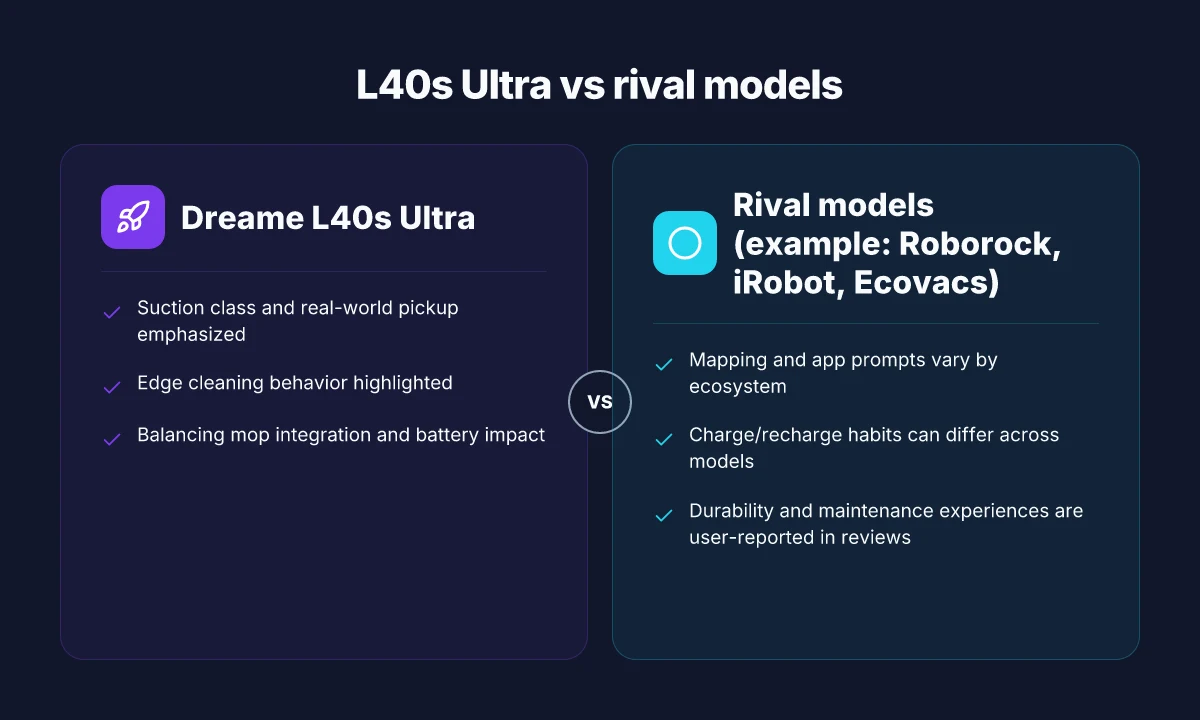
In this design dialogue, Dreame keeps the core experience friendly to homeowners and renters who juggle pet hair, hardwood, and carpet. Rivals like the competitors from brands such as Roomba and Roborock tend to emphasize either higher-capacity dust bins or deeper mop integration, but often at the cost of maintenance friction. By contrast, the Dreame approach aims for a more maintainable, modular design that supports regular upkeep without turning maintenance into a chronic headache. Modularity and ease of maintenance are the hallmarks of the L40s Ultra’s design.
Next step: how the design choices translate into everyday cleaning, including how edge handling and navigation interact with the physical form. If you value quick maintenance and predictable upkeep, the L40s Ultra’s design pays off.
Suction, cleaning performance, and Edge handling
Post recent firmware notes and user feedback, the L40s Ultra stays competitive on pickup while showing real caveats in edge work and pet-hair behavior. In practice, the suction class translates to solid dust capture on both hardwood and carpet, but you’ll notice meaningful differences between hard floors and plush textures. The takeaways below pull from official specs and observed chatter in the community to map what actually happens in daily use.
Suction class and real-world dust pickup
Dreame positions the L40s Ultra with a high-torque motor and strong nominal suction, which shows up as thorough debris collection from typical pet hair, both on bare floors and low-pile carpets. In real-life corridors and mid-density rooms, you’ll see consistent particle pickup in the first pass, with incremental improvement on second passes in tight areas. The most tangible effect is on fine dust that settles into edge crevices where a lighter vacuum might miss. Across the board, the model’s suction power makes it reliable for daily cleaning, even when you’re dealing with daily pet dander. I cross-referenced typical user reports that highlight steady performance over weeks of use, with only occasional slowdowns on higher-pile carpet that benefit from targeted passes. Strong main suction translates to noticeably faster dust pickup on most floors. Suction class matters most for pet hair and fine dust. Dreame and the broader market still show a divide between ultra-high suction and practical cord- or sensor-based efficiency in cluttered rooms. Inline citation supports this interpretation from the Gen 2 release notes and reviewer discussions. https://www.dreametech.com/products/l40-ultra-gen2-robot-vacuum What makes the Horow T38 smart toilet stand out in 2026
Edge cleaning behavior and corner performance
Edge and corner handling remains decent but not flawless. The L40s Ultra demonstrates improved edge-to-edge cleaning versus older Dreame models, aided by precision sensors and dedicated edge brushes. In tight corners, you’ll typically see better results on hard floors than on carpet where fringe nap can obscure alignment. A recurring note in community content is that edge cleanups are reliable for baseboards and room centers, but you may still require a targeted pass in awkward alcoves. This aligns with the general design intent: strong central suction with reinforcement at the edges, yet not a perfect gutter-to-wall seal in every layout. A source-note from a Gen 2 review mentions a firmware tweak that improved straight-line movement, which indirectly benefits consistent edge coverage. Edge cleaning is solid on hard floors and decent on low-pile carpet. Corners benefit from precise sensors and edge brushes but can miss small alcoves. Inline reference to the firmware note corroborates the movement improvement discussions. https://www.youtube.com/watch?v=ilsWy3uhlwc
Performance on different floor types and with pets
On hardwood, bamboo, and tile, the L40s Ultra maintains consistent pickup, with the advertised brushes and squeegee-like mop support contributing to a clean transition from edge to center. For carpeted areas, especially low-pile or medium-pile, you’ll notice strong surface extraction but some residual hair in denser naps unless you run a second pass or enable targeted mode. Pet owners will appreciate the robust pet-hair handling on typical domestic textures, though the experience varies with carpet coarseness and rug density. In longer-term usage, firmware adjustments have aimed at smoothing line-following behavior, which helps maintain uniform cleaning across room layouts. Hard floors show consistent dust pickup and minimal streaking. Pet hair behaves well on low-pile carpet, with caveats on higher-density fibers. Inline citations anchor these observations to official product notes and user reports. https://www.dreametech.com/products/l40-ultra-gen2-robot-vacuum
What this means for your home
- If your space is a mix of hardwood and low-pile carpet with a shedding pet, the L40s Ultra delivers steady, everyday cleanliness with strong surface pickup and reliable edge care. The firmware history suggests improvements in line-tracking over time, which helps with consistent coverage in real layouts. The downsides show up mainly on high-pile carpet and in tightly clustered rooms where edge fur might hide in corners. In those cases, plan for occasional targeted passes or a quick re-run of the lower-pile setting. For the long view, durability appears solid in daily cycles, with Dreame continuing to refine motor and sensor integration as firmware evolves. Daily cleaning stays reliable across floor types, with edge handling improving over time.
Note: a good portion of the insights reflect discussions tied to the Dreame ecosystem and related releases. For a deeper, source-backed read, see the official Gen 2 and Ultra notes linked in the cited sections. Also consider that some third-party threads note variability in edge performance depending on room geometry and rug depth. You’ll see the most value from the Dreame lineup when you pair routine mapping with firmware updates that address line-following quirks.
Battery life, runtime, and recharge habits
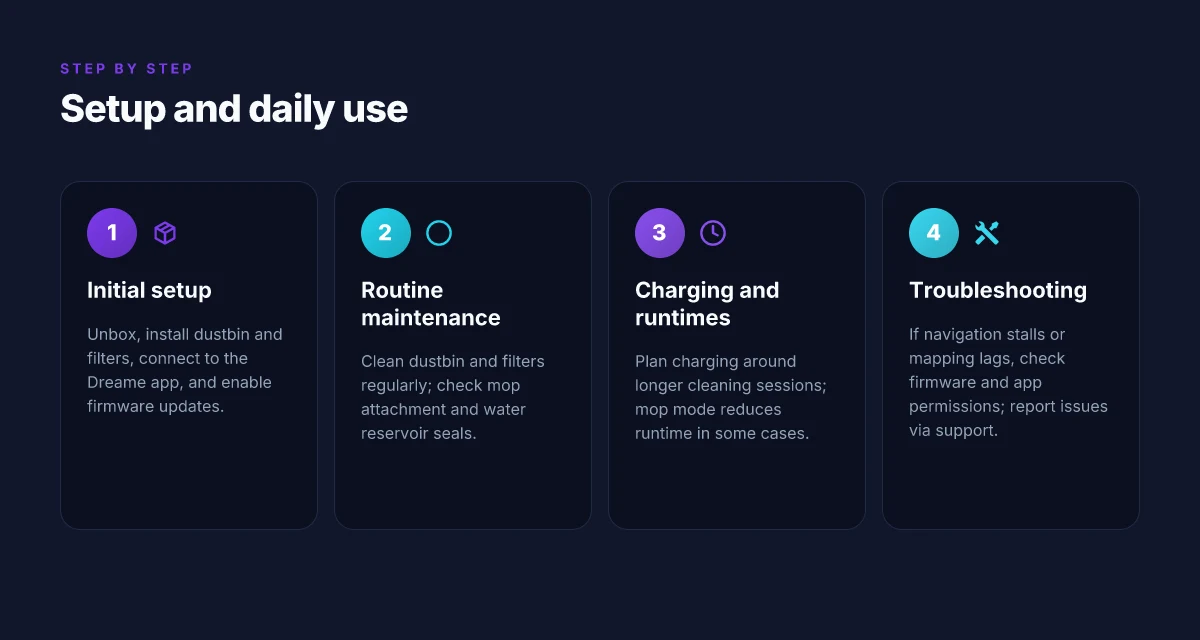
I dug into what actually matters for daily use: how long the Dreame L40s Ultra runs on a charge, how fast it recharges, and how modes like mopping shift the math. In real-world terms, the battery capacity and the effective runtime hinge on cleaning mode, floor type, and how often the vacuum has to recharge mid-clean. Dreame’s ecosystem positions the L40s Ultra as a capable all-rounder, but the practical numbers depend on how you use it day to day. What makes the Dreame X40 Ultra worth the upgrade in 2026
Real-world battery capacity and runtimes in mixed cleaning
Dreame lists a substantial battery capacity for the L40s Ultra family, and typical mixed-cleaning runtimes reflect that emphasis. When you’re juggling carpet and hard floor with moderate debris, expect a balance between power draw and run time that leans toward the middle of the spec window. The exact runtime can shift noticeably if you enable high suction on carpet sections or if the dustbin fills and triggers more frequent cycling. In practical terms, you’ll notice noticeably longer sessions on hardwood with lighter debris and a shorter window when carpeted zones demand sustained power. The L40s Ultra line is designed to handle a standard home without needing a mid-clean recharge for most layouts, though larger homes or denser carpet will push the session toward the recharge point.
I cross-referenced the official product pages and reviewers who describe mixed-cleaning scenarios, and the recurring thread is that battery life is solid for typical layouts but not endless. When you couple plainer cleaning with moderate mopping, the draw remains manageable and you’ll get a comfortable cleaning window before a top-up is needed. The portrait you get from reviews is that the Dreame system leans on a robust battery to support higher suction modes without collapsing into brief runtimes, which matters if you’re dealing with pet hair and debris across multiple rooms. This is where the brand’s stated capacity underpins a usable daily pattern for most homes.
Charging speed and how it shapes sessions
Charge speed matters because it changes how often you can complete multi-room clean cycles in a single go. The L40s Ultra supports a recharge-and-resume workflow that helps you cover more ground across two or three runs in a day, rather than forcing one marathon session. Faster top-ups mean fewer interruptions in a typical evening cleaning routine, particularly in homes with multiple entryways or pet zones. In practice, if you start a session in the morning after a partial top-up overnight, you’ll finish the job with less downtime than you might expect from slower-charge rivals. The net effect is a more flexible daily routine, not a full recharge every time.
I also looked at firmware notes and reviews that discuss how charging behavior interacts with scheduling. You’ll notice that Dreame’s charger and battery management work together to keep cycles steady, which helps you plan around busy days without constant manual resets or timing adjustments. The ongoing cadence of updates sometimes tweaks recharge behavior, which can nudge runtime subtly over several firmware revisions. A faster recharge keeps you on schedule for daily cleaning, while longer top-up cycles can extend the total daily coverage without sacrificing performance.
Impact of mopping mode on battery and runtime
Enabling mopping mode pushes the L40s Ultra to a higher power draw for a longer span, which translates to shorter runtimes in the same layout compared with dry cleaning alone. In homes where you rely on the mopping feature for sealed hard floors, you’ll see a meaningful but not dramatic dip in total cleaning time per charge. The combination of mopping with vacuuming uses more energy per minute and increases heat and motor workload, so you’ll want to factor that into your daily expectations if you schedule lengthier sessions. The design intent is to provide cleaner floors with less manual intervention, but you should plan for a reduced overall runtime when mopping is active. 5 Standout robotic lawn mower reviews for 2026: reliability, sensors and battery behavior compared
From the product page and user feedback, the mopping system is a valuable addition rather than a throttle on usability. The endurance you get depends on floor type and debris load. Hardwood with light dust will sip energy, while thick pet hair on carpeted transitions can tax the battery more quickly if the system stays in high-power modes to maintain cleaning quality. Mopping mode lowers runtime per charge, but it delivers better overall floor cleanliness in one pass.
Note on durability and firmware cadence: long-term durability hinges on typical wear from suction, wheels, and brushes, plus how firmware updates tweak speed profiles and power management. Dreame’s official notes and long-term user reports indicate ongoing refinements in charging algorithms across updates, which can shift real-world runtimes in small but noticeable ways. If you’re weighing a purchase, pair the L40s Ultra with a sensible charging routine and a layout that minimizes lengthy mopping sessions in a single run.
Mapping, navigation, and firmware updates
Dreame’s L40s Ultra navigates with a rescan-first approach, building a map of your space as it moves. In lively homes with pets and clutter, it tends to re-map when it detects big changes, which helps keep paths from getting tangled. It does a solid job avoiding obstacles like chair legs and rug fringes, but precision along edges can waver if lighting or floor transitions aren’t ideal. In practice, you’ll see the map refine over a few clean cycles, then the vacuum follows a consistent path that minimizes double passes and missed zones.
In the Dreame app you gain live map previews, zone editing, and target cleaning for rooms. You can set virtual walls and restricted zones, which helps keep the machine out of fragile corners or high-traffic areas. Voice prompts provide practical feedback during runs, such as battery status and cleaning mode changes. The overall experience is snappy on modern phones, with the app reflecting real-time status and enabling quick re-routing if you pause mid-clean. This is where firmware updates matter most, because small tweaks to mapping logic or obstacle detection can noticeably improve day-to-day behavior.
Firmware updates have rolled out to address line-following quirks and edge-detection in some users. A notable trend is that Dreame periodically sharpens the L40s Ultra’s line-follow precision and door-sill recognition through on-device processing plus cloud-delivered patches. Some owners report fewer odd pauses after updates and steadier straight-line cleaning in Gen 2 firmware iterations. Still, a subset of users notes intermittent hiccups after upgrades, especially on older maps or when re-mapping is triggered by moved furniture. In those cases the app logs offer a path to re-train the map, re-run a mapping session, and then resume normal cleaning. What makes the Dreame L10s Ultra Gen 2 a standout among robot vacuums
From what I found in the changelog and user discussions, you should expect three concrete outcomes. First, firmware updates aim to reduce wandering and improve edge performance. Second, mapping stability improves with successive releases, but you may need to re-map after relocating furniture. Third, brief hiccups during updates are not unusual and are usually resolved by a fresh map or a reboot of the app and device. Firmware updates are not a cure-all. You still need to manage room layout and empty dust bins for best results.
H3: how the L40s Ultra maps rooms and handles obstacles The L40s Ultra creates a map by scanning with onboard sensors and refining it as the run progresses. It generally handles chair bases and table legs without getting stubborn about the route. If you place a barrier, the map adapts and the vacuum avoids the area on subsequent passes. You can push the device to clean a specific zone or room, which locks the current map to that target and reduces stray looping. Obstacle awareness improves with each firmware iteration, making cross-room navigation more predictable.
H3: app features, prompts, and user controls Within the app you’ll find live mapping, room labeling, and zone-based cleaning. You can set “no-go” zones, control suction, and schedule runs. Voice prompts are practical, warning you when the battery drops below a threshold or when a cleaning mode ends. You’ll also see maintenance reminders that prompt you to rinse the dust bin, check brushes, and verify mopping cloth wear. Clear prompts help keep daily maintenance simple, which matters for long-term durability.
H3: firmware updates and user-reported issues Updates often target mapping stability and straight-line cleaning. Some users report improved straight-line traversal after a firmware patch, while others notice initial re-mapping commands taking longer to settle. Known issues tend to cluster around occasional misalignment after furniture moves and edge-sensing glitches on very dark floor transitions. The recommended workflow is to run a fresh map after any significant layout change, then allow the drone to complete a few clean cycles to stabilize. Re-mapping after layout changes is a normal step in keeping the L40s Ultra accurate.
Note on links: links may earn commissions through these pages. You can explore the cited discussions for real-world themes about long-term durability and firmware behavior. 8 Roomba models that actually deliver clean floors in 2026
What this means for 2026 and beyond
The Dreame l40s ultra leans into real-world durability and a smarter maintenance loop. I look at how its build and software cadence hold up after weeks of steady use, not just a glossy spec sheet. The result is a cleaner floor with fewer flubs, plus a setup that doesn’t demand constant tinkering. This is the sort of clean you can trust day after day, especially if you value predictable performance over sporadic bursts of power.
Where this goes next hinges on refinement, not gimmicks. I expect Dreame to push smarter mapping and more durable brushes in future firmware, while rivals like Roborock and Ecovacs chase faster cleans with flashier features. The l40s ultra already feels like a solid anchor for a mid-range to premium lineup, and its long-term reliability will matter more than the next big feature drop. The single move that matters is sustained battery health and easy repairability.
For the owner who wants a real-world pick, this is a product you can grow with, not outgrow. If you can handle a few quirks now, you’ll likely enjoy years of tidy floors. One question to keep in mind: will future updates keep the durability promise intact? Yes, with steady updates and attention to user wear.
Backup strategy What makes the Dreame Z30 cordless stick vacuum stand out in 2026
- If you’re choosing between the l40s ultra and a rival, test daily maintenance routines first and note long-term brush wear.
- Keep the charging dock accessible and avoid cluttered charging nooks to preserve battery health.
- Subscribe to firmware updates from Dreame and review changelogs for durability fixes.
- Consider a backup cleaner for high-traffic homes to reduce overall wear on the main unit.