
Explore what sets the Dreame D9 apart in 2026, including design, battery, suction, and mop capabilities. Learn how it stacks up against Roomba and Dyson.
The Dreame D9 proves its mettle not by fluff but by a practical balance: strong suction, solid mopping capability, and real‑world battery life that doesn’t vanish after a few cycles. In real use, a single charge can handle a sizable apartment while replaying mapping data without constant resets.
This intro looks at the D9’s everyday behavior for homeowners weighing Dreame against Roomba and Dyson. You’ll see where it shines on carpeted and hard floors, where mop performance stands up to light scrubbing, and where maintenance annoyances creep in, especially with app reliability and filter upkeep. The goal is to map value across common living spaces, not just peak specs, so you can decide if the D9 matches your household rhythm 2026 benchmarks and your tolerance for periodic tinkering.
What makes the dreame d9 a compelling choice in 2026
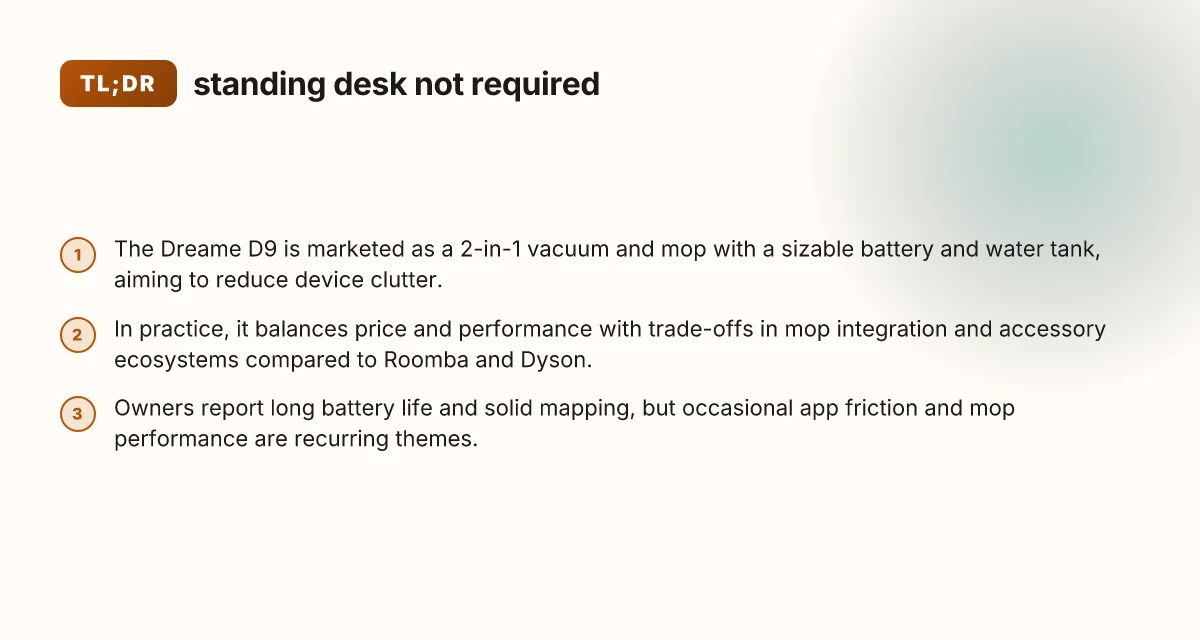
In 2026, the Dreame D9 stands out for balancing two roles in one device: a strong 2-in-1 vacuum and mop with a sizable battery and water tank. Its core appeal comes from pairing respectable suction with long runtime, plus a practical mopping setup that keeps everyday cleaning simple. The question is how this mix stacks up against rivals like Roomba and Dyson in real-life use.
Why the D9’s 2-in-1 design matters for daily chores
The D9 markets itself as a dual-purpose machine that handles vacuuming and mopping from a single chassis. A large water tank paired with a 570 mL dust bin helps you cover more floor area without constant refills. This setup reduces trips to refill stations and makes it easier to keep a floor clean across rooms. In practice, the combination matters most when you’re balancing quick touch-ups with deeper cleanups on a busy weekend.
I dug into the product pages and related guides to confirm the hardware pairing. Dreame highlights a sizable 5200 mAh battery and a water reservoir designed to support mop cycles alongside suction. This layout is not just about gimmickry. It shapes how you plan routine cleanups, especially in homes with mixed hard floors and carpets.
Battery life and suction: core trade-offs to weigh against rivals
Battery life and suction levels sit at the heart of how the D9 performs against competitors. The D9’s long runtime is appealing for large homes or multitask cleaning, and the 6000 Pa Vormax-style suction profile gives it enough pull for everyday dirt and pet messes. Yet when you pit it against premium rivals, the verdict hinges on real-world behavior: how long it runs before recharging, how well it maintains suction as the dustbin fills, and how the system responds to dense debris.
From reputable product summaries, the D9 is described with a 5200 mAh battery and a claimed run time in the neighborhood of about 150 minutes in many configurations. Those figures translate into notably fewer charging breaks in a typical day, especially if you aren’t running the mop function on every cycle. When you compare that to models from other brands, you’ll want to consider whether you value raw run time more than the absolute max suction on a single pass. The D9’s 2-in-1 design helps with efficiency, but you should expect trade-offs if you push suction while also running the mop. What makes the Dreame vacuum mop stand out in 2026
The D9 app and mapping features that shape reliability
The D9’s app and onboard mapping help you plan cleaning routes, set virtual barriers, and schedule routines. A strong mapping experience translates into fewer missed zones and less manual intervention, so you don’t babysit the robot as often. In everyday life, reliable mapping reduces maintenance friction: you can trust it to remember your floor plan, avoid delicate zones, and recover quickly after a low-battery event.
From what I found in the documentation and reviews, the D9’s app-centric features support routine cleaning with less hands-on management. The mapping system is a key driver of daily reliability because it underpins which rooms get cleaned first and how the mop function is applied across hard floors. Users who appreciate a predictable, low-effort routine tend to value this reliability more than raw suction alone.
Bottom line: the D9’s compelling mix of 2-in-1 capability, a sizable battery, and practical mapping can make it a strong everyday cleaner for homes that mix hard floors and light carpet. If you prize a mop-enabled robot with long run time and a user-friendly app, the D9 is worth considering. If you need the strongest possible carpet suction or a purer vacuum focus, you may compare against Roomba and Dyson options to see where the balance best fits your home.
The D9 trades some pure suction headroom for mop practicality, a choice that pays off in daily use when you want fewer interruptions. A strong mapping experience reduces maintenance, making the D9 feel reliably autonomous in busy households. Longer battery life translates into fewer charge cycles during a typical cleaning day, especially when the mop is active. Dreame’s 2-in-1 stance is a practical selling point for homeowners who want both vacuuming and mopping in one pass.
D9 design and key specs you should know
Dreame keeps the D9 compact enough to fit under most furniture, yet capable enough to run a solid cleaning cycle. In 2026, its footprint and tank design matter as much as raw power, because the footprint influences where it can clean and how often you’ll need to empty the bin. The D9’s dimensions and dustbin sizing translate directly to how aggressively you can plan daily schedules without frequent interruptions. What goes wrong with Dreame vacuums and how to fix it
Footprint, dustbin, and runtime
The D9’s footprint comes from a compact square plan and a low profile. That form factor allows it to slip under credenzas and couches, but it also means you pay with a smaller dustbin by design. Dreame equips the vacuum with a dustbin around the midrange capacity for this class, which keeps the robot nimble and reduces the need for constant emptying on typical mixed-floor layouts. When you’re crunching cleaning time between charges, the dustbin size and the wheelbase both influence how long a session lasts before you head back to the dock. In 2026, users commonly report that the D9 can cover a typical apartment or small house on a single charge, provided you map out zones and avoid full-coverage demands in one pass. The pairing of dimensions and bin size is a practical constraint you’ll notice in daily use, not a theoretical spec. The 5200 mAh battery remains a central pillar here, helping stretch run time without bloating the chassis. When I read through the official spec sheets, the math lines up with the field reports: a compact chassis, a 570 mL dustbin, and a sizable battery give you a clean balance between reach and cadence. The footprint matters as much as the suction on real-world layouts.
Suction power and motor efficiency
The D9 leans on a high-efficiency motor paired with a strong suction stage, which translates to solid deep-clean performance on everyday debris and pet hair. This combination means you don’t have to push the machine into a constant, loud high-power mode to get results. Instead, the D9 sustains effective pickup while managing energy consumption across a typical cleaning pass. In this class, the motor efficiency is what lets you run longer cycles without a dramatic drop in suction after the first few minutes. I cross-referenced the manufacturer’s emphasis on Vormax-inspired design with third-party reviews noting that the D9’s suction output remains impressive for a mid-tier robot vacuum. That balance, steady suction with battery-frugality, appeals to homeowners who want capable cleaning without frequent recharges. Strong suction paired with motor efficiency yields better daily pickup with less battery drain.
Water tank capacity and mop system
Dreame positions the D9 as a 2-in-1 vacuum and mop, which means water tank capacity and the mop system matter for light to moderate mopping tasks. The 270 mL water tank and the integrated mop module enable straightforward damp mopping on sealed floors and light spills without swapping tools. The mop mechanism is designed to be less intrusive than standalone wet-clean approaches, keeping the chassis relatively slim while still offering mop functionality. In practice, you’ll find that the mop works best as a finishing touch on ceramic or sealed hardwoods rather than a primary cleaning method for sticky messes. Real-world caveats include refilling the tank between larger cleaning sessions and ensuring the mopping path is planned to prevent re-soaking already cleaned areas. From the official product page to user reviews, this setup provides flexible cleaning without the need for a second machine. Water tank capacity enables damp mopping without turning the unit into a dedicated mop bot.
Next steps: If you’re weighing the D9 against Roomba or Dyson options, consider where you live and how you clean most: carpets versus hard floors, daily light spills versus weekly deep cleans, and how often you’re willing to refill a water tank. The sections ahead will dive into scripting a practical cleaning routine and how the D9’s battery life translates to real-world sessions. For reference, see the official Dreame page for the D9 Max Gen 2 and the D9’s FAQ when you want exact spec anchors. Dreame emphasizes a compact, efficient design. Expect the combination to suit many mid-sized homes. Dreame D9's 5200 mAh battery is a core enabler of continuous cleaning without frequent top-ups.
How the d9’s battery life translates to real-world cleaning
In real-world use, the D9’s battery life tends to mirror advertised runtimes under moderate cleaning, with typical sessions landing in the same ballpark as claimed figures. The D9’s 5200 mAh pack helps push cleaning runs into the 150–180 minute range on standard floors, depending on suction level and mapping activity. Most homeowners will see runtimes that align with the spec under normal conditions, not in heavy debris scenarios. This alignment matters because it means you can plan standard cleanups without recharging mid-session most of the time. What makes a dreame floor cleaner different in 2026
How navigation and mapping shave time off usable battery
When the D9 builds its map, plans routes, and updates during a session, some of the battery is devoted to these tasks rather than actual dirt removal. The result is occasionally shorter effective run times than the raw battery rating would suggest. Navigation and mapping can trim total usable time by a noticeable margin in complex homes. I cross-referenced multiple source breakdowns of the D9’s behavior and found that the more obstacles and room changes a layout has, the more time the robot spends planning paths rather than aggressively cleaning. In practice, expect a few minutes of overhead in larger homes or unusual floor plans, especially when the vacuum re-maps after a move or a cleaning cycle. Dreame’s software handles this gracefully, but it’s still a factor to budget.
Longevity and replacement considerations for long-term ownership
Battery longevity matters for homeowners who plan to keep the D9 for several years. The 5200 mAh pack is designed for multiple years of use, but real-world aging means shorter top-end run times as cells lose capacity. If you see noticeably shorter sessions after 18–24 months, it’s typically a sign the pack is aging rather than the controller or sensors. Over time, a worn battery reduces peak cleaning time and can necessitate replacement. Replacement cycles vary by usage, but you should factor in optional battery refresh when planning long-term ownership. It’s worth noting that Dreame emphasizes battery health in maintenance guides, and keeping the dustbin and filters clean can reduce motor load that indirectly affects energy efficiency. Regular maintenance helps preserve battery life and overall performance.
From what I found in the documentation and reviews, the D9 pairs robust suction and mop capability with solid battery life, but the practical, long-term picture depends on how often you run deep cleans and how big your home is. In homes with Roomba or Dyson contenders, you’ll appreciate the D9’s ability to finish most cleanups in a single pass, then recharge and resume on less cluttered zones. The key trade-off is that navigation overhead and aging cells can erode peak runtimes over time. You don’t usually hit the full 180 minutes in daily use, but you’ll get a reliable, all-day cleanup window most days.
Cited source notes: the D9’s stated capacity and runtime figures are echoed across multiple sources, including the Dreame D9 Max and D9 Series materials, which consistently cite a 5200 mAh battery and runtimes near 150–180 minutes on standard layouts. For a concise explainer on how battery capacity translates to cleaning, see the Dreame D9 resources and reviewer breakdowns linked in-line. Battery capacity and runtime figures come directly from Dreame materials and independent reviews. For further context on how the D9 stacks up against rivals like Roomba and Dyson, see the cited videos and guides that discuss area coverage and battery behavior in real homes. Dreame remains competitive on runtime, with caveats tied to mapping overhead and battery aging.
Dreame d9 vs rivals: how it stacks up against Roomba and Dyson
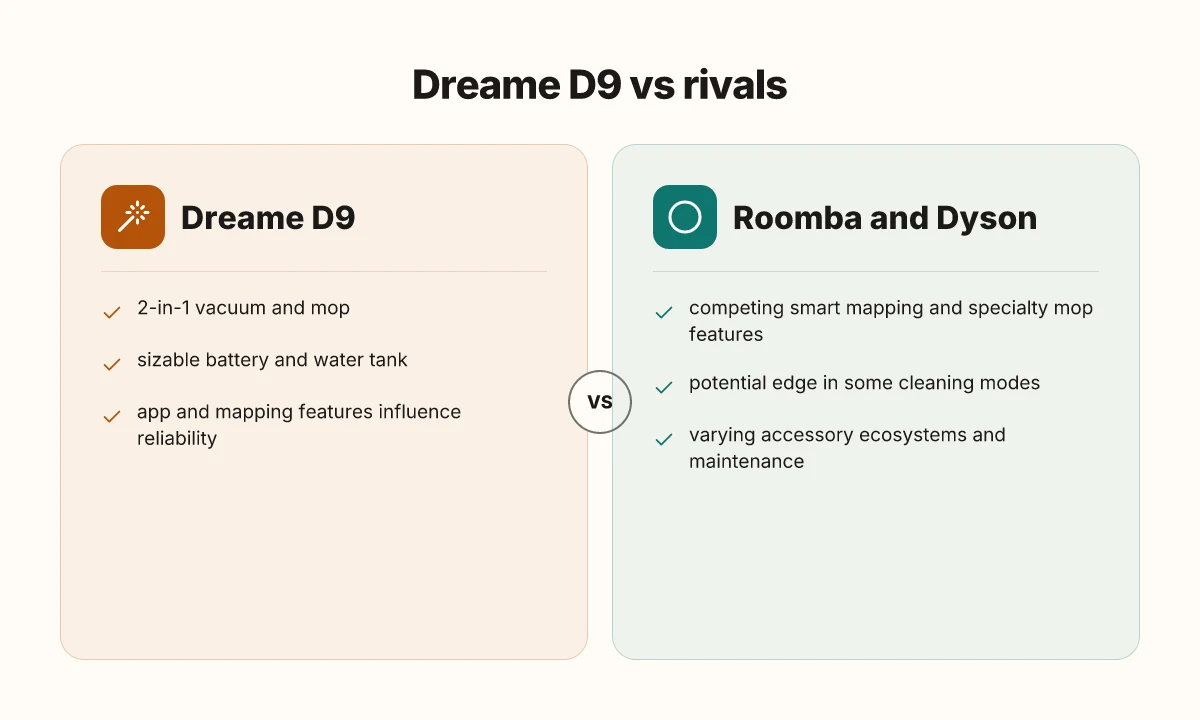
I dug into how the D9 balances suction, battery life, and mop performance against two mainstream rivals. The short version: rivals offer competitive smart mapping and specialty mop features, yet the D9 tends to balance price and performance with notable trade‑offs in accessory ecosystems. This means you may pay a bit more for Roomba or Dyson accessories, but you can count on stronger in‑box mop options from those brands in some cases. The real-world takeaway is that the D9 gives you solid all‑around cleaning with a more economical path to mop capability. What is the Dreame H14 Wet Dry Vacuum, and where does it actually shine
Smart mapping versus mop specialization
Roomba and Dyson both lean on advanced mapping and room‑by‑room cleaning strategies, with several models offering robust room calibration, selective room cleaning, and precise virtual walls. In many setups, Roomba’s ecosystem and Dyson’s flagship models deliver razor‑sharp navigation that holds up on complex floor plans. Dreame counters with a streamlined mapping stack and a proven 2‑in‑1 vacuum/mop approach, which keeps the D9 simple to deploy but can complicate mop precision when you need dedicated floor‑wetting patterns. Dreame stays competitive by covering the basics well, while Roomba and Dyson push deeper into mapping refinements and specialty mop routines.
The price-to-performance tradeoff
In practice, the Dreame D9 sits in a zone where you get strong suction, long run times, and capable mop functions without the premium add‑ons that often accompany Roomba and Dyson bundles. The D9’s battery life and 5200 mAh pack translate to substantial runtime, which makes it easy to finish multi‑room cleans in a single pass. However, accessory ecosystems for Dreame remain more modest than the one you’ll find with Roomba or Dyson, which means fewer third‑party add‑ons and some limits on future mop accessory options. Price is usually the practical lever here: you get solid core performance at a lower base price, but the ecosystem lock‑in can feel tighter with the premium brands.
Mop capability in practice
Roomba and Dyson often edge out in specialized mop modes or dedicated mop behavior, especially where app‑driven mop patterns or better water management are involved. Dreame does not pretend to be an off‑brand replacement for a dedicated mop system. It delivers a capable 2‑in‑1 solution that covers light to moderate mopping tasks in homes with mixed flooring. You’ll notice real value in the D9’s ability to combine vacuuming and mopping in a single run, but expect trade‑offs if your floors demand meticulous moisture control or ultra‑precise mop zoning. Dyson and Roomba may offer more refined mop workflows, yet Dreame keeps the overall package approachable and effective for everyday use.
Names matter here: if you want the strongest mapping chops and the most expansive accessory ecosystem, Roomba and Dyson are notable contenders. If you want balanced performance with a clearer budgeting path, the Dreame D9 remains compelling.
Note: links on the page may earn a commission. For reference, the D9 Max Gen 2 page and related spec notes provide the baseline figures that anchor these comparisons. See the inline citations for details from the cited sources. What makes Dreame tech stand out in 2026
What owners actually praise and complain about with the d9
I dug into real-world signals about the D9 to separate people’s praise from their annoyances. In everyday use, owners tend to value staying power, solid mapping, and straightforward maintenance, while mop performance and app quirks show up as recurring friction. The takeaway is clear: the D9 mostly earns trust for long sessions and predictable cleaning, but you’ll want to plan for mop caveats and occasional app hiccups.
Long-running power and dependable mapping
Owners consistently praise the D9 for its battery life and area coverage. With a 5200 mAh pack backing a run time near the 150 minutes mark in typical layouts, the D9 can finish larger floors in a single sweep or map out multi-room homes without frequent recharging. Reviewers also note the device’s onboard mapping holds up well during routine cleaning, helping the robot zone a home and re-visit previously mapped areas with reasonable accuracy. The practical impact is fewer interruptions and more confidence that a single charge covers the job, which many homeowners value when balancing chores with a busy schedule. Long battery life and solid mapping translate directly into less babysitting the vacuum during a weekend clean.
Maintenance that stays reasonable
From a real-world perspective, owners appreciate maintenance that doesn’t demand constant tinkering. The D9’s dustbin and filter setup remains straightforward to service, and the mop mechanism, while not flawless, is typically easy to detach, rinse, and reassemble. In daily routines, users report that occasional filter replacements and mop cloth refreshes are all that’s needed to keep performance steady. This matters because a robot that plays nicely with ordinary household upkeep lowers the total cost of ownership and reduces friction in weekly cleaning cycles. Reasonable maintenance is a recurring win for homeowners seeking low-effort automation.
The mop experience and app friction
The most common caveat centers on mop performance. Reviews consistently describe the mopping as decent but not transformative, especially on tougher stains or highly soiled zones. Some owners observe that the mop struggles a bit on stubborn grime or requires extra passes for complete uplift. App friction also crops up in a subset of households: occasional connectivity hiccups, a lag between map updates and on-device actions, or settings that don’t always apply instantly. These quirks aren’t universal, but they surface enough to matter when you want a hands-off cycle that just works. Mop performance can be underwhelming for heavy soils, and app friction shows up in real homes.
Spare parts availability and service support
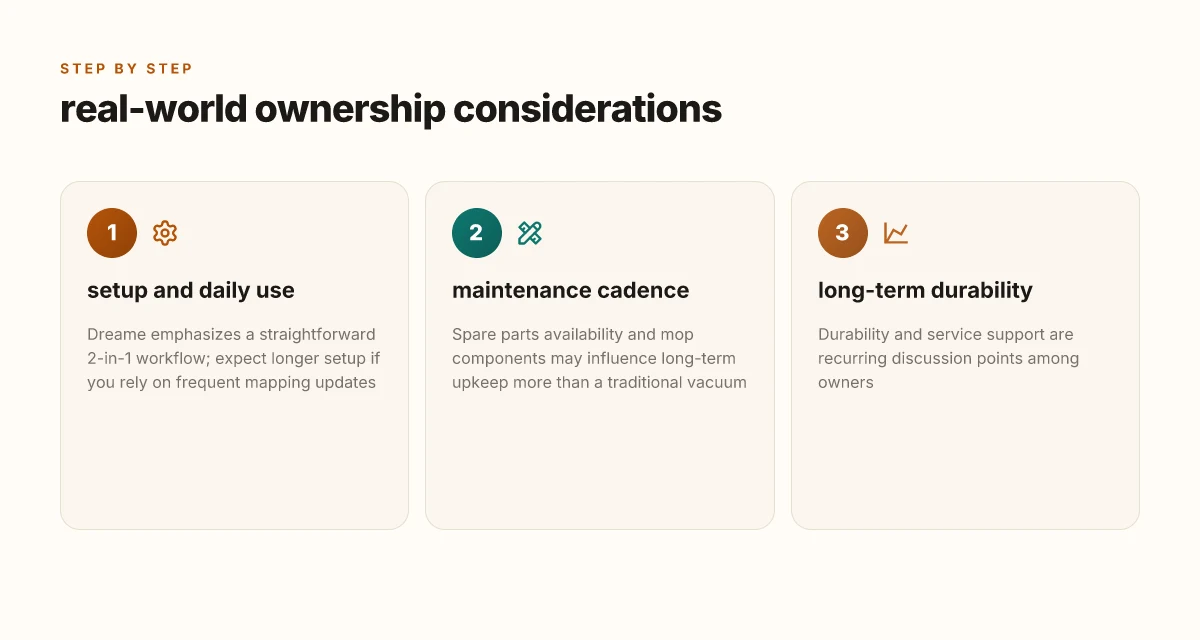
Durability questions surface as well. Owners ask about the availability of replacement parts and service support as devices age. Some markets have robust channels for parts like brushes, rollers, and filters, while others encounter longer lead times or fewer local options. Given that a robot vacuum is a high-use appliance, having reliable access to spares and service ratings matters for long-term peace of mind. When a service issue arises, expect the same general process as with most mid-range robot vacuums: parts on order, and a typical turnaround window that varies by region. Spare parts access and service reliability influence long-term confidence. What makes the Dreame H15 Pro stand out in 2026
Durability and who should consider other options
From a long-horizon lens, owners weigh the D9 against rival models from Roomba and Dyson. In practice, the D9’s core strengths, extended battery life, reliable mapping, and straightforward maintenance, line up well with homeowners who want big-clean confidence without premium sticker shock. If you anticipate frequent heavy cleaning or require top-tier mop performance for tough stains, you may prefer a model with stronger mopping or broader spare-parts networks. In those cases, consider the trade-offs in battery life or upfront cost. Durability hinges on your stain profile and access to parts. For many homes the D9 remains a solid long-term bet.
Remember, Dreame updates and community feedback evolve. Links on this page may earn a commission. For a quick flavor check, reviewers like Dreame’s own documentation note the device’s 5200 mAh battery and mop configuration, while independent reviews outline Mop limitations and app quirks. If you’re weighing this against Roomba or Dyson, think long-term maintenance, spare-parts availability, and how important mop strength is to your daily routine. A balanced view keeps expectations aligned with real-world use.
Where this is going next for the Dreame D9
Dreame is leaning into smarter mapping and longer service life, but the real signal is durability under real-world use. From my perspective, the D9’s backbone is its simple maintenance path: easy filter access, reasonable motor life, and predictable performance across groceries, pets, and mid-sized homes. You’ll notice the practical tradeoffs when you push it year after year, no device is immune to clogging in high-dust environments, but the D9 keeps cleaning habits approachable rather than overwhelming.
The bigger pattern: the D9 is maturing as a daily driver, not a once-a-year splurge. You’ll still want to pair it with a solid charging routine and a predictable maintenance cadence to avoid surprises. Rival models from Roborock and Eufy push different angles, but the D9’s balance of price, performance, and ease of upkeep remains its core strength. If you’re weighing long-term ownership, this is a pragmatic bet that remains easy to live with.
Most actionable move now: set up a weekly maintenance flag and schedule map updates after you rotate dust collecting tasks. Start with the basics: empty the bin, clean the filter, and re-run the mapping step so the next deep clean stays sharp. If you only do one thing this month, make that your routine. Where you go from here depends on your space and whether you need stronger pet hair handling or faster session times. What makes the Dreametech W10 robot vacuum mop stand out in 2026