
Explore the Dreame H15 Pro in 2026: design, performance, and practical durability. Learn what makes it different from rivals and how to get the most from this smart cleaner.
The Dreame H15 Pro doesn’t hide its compromises behind glossy marketing. An unusually heavy chassis and a straightforward dustbin path reveal where maintenance habits matter most, especially when you push into high-debris rooms. Dreame’s H15 Pro leans on raw suction and a simplified maintenance path, not on overengineered autonomy.
This piece uncovers practical durability signals homeowners can verify in weeks, not years. Real-world clues show how often the H15 Pro needs belt and roller checks, how battery health holds after repeated cycles, and where clutter tends to expose mapping quirks. In 2026, the comparison with Roborock and iRobot matters because long-term reliability is less about initial clean count and more about consistent performance through busy daily use. You’ll gain a concrete, setup-aware view of how to wire up, tune, and monitor the Dreame system for steady cleaning with clear trade-offs. Most issues surface in cluttered layouts, but the right maintenance routine keeps the core cleaning strong.
What is the Dreame H15 Pro and why it matters in 2026
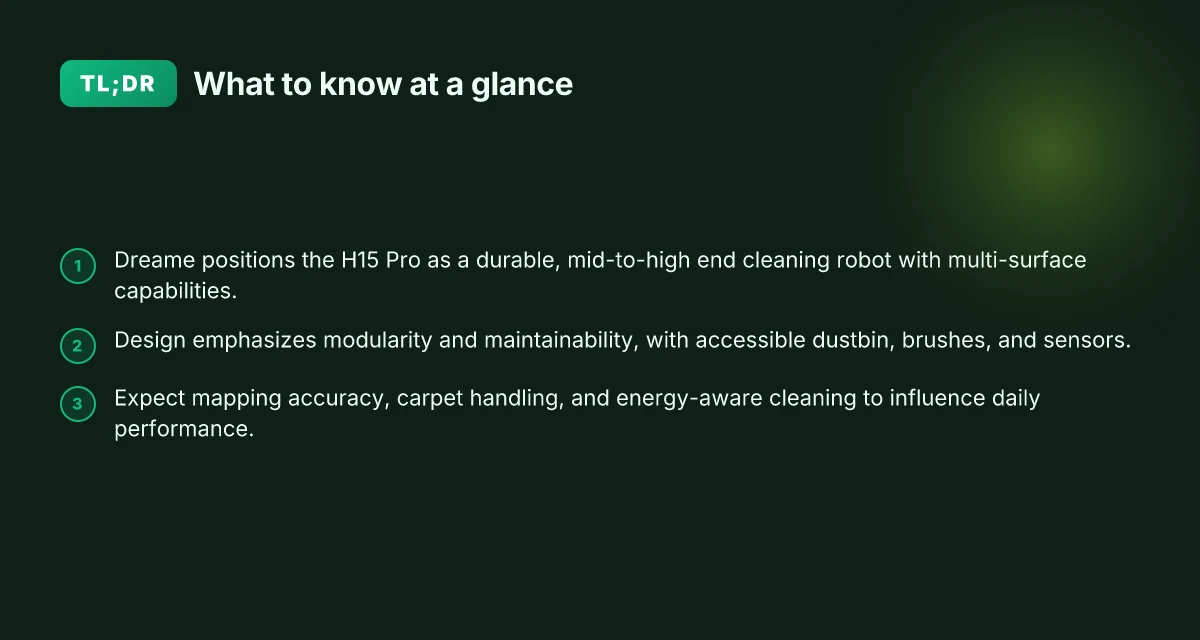
The Dreame H15 Pro sits in the mid-to-high end of the robotic vacuum line, built for multi-surface cleaning with a design toward durability and smarter mapping. It aims to handle carpets, hard floors, and mixed debris without constant recalibration, a priority for busy homes. Dreame positions the H15 Pro as a sturdy, all‑around cleaner that can keep pace with rivals like Roborock, iRobot, and Ecovacs, while leaning into longer cycle life and smarter charging behavior.
What the H15 Pro claims to deliver, in plain terms
- Multi-surface capability with adaptive floor recognition, so transitions between carpet and tile don’t cause big clean gaps. Dreame calls this out as a core feature, designed to minimize manual touchups.
- A focus on durability via chassis choices and motor design, aiming to resist dust intrusion and minor daily bumps. The underlying goal is fewer maintenance surprises in real homes.
- Smarter mapping that learns room layouts over time, with ongoing software refinements intended to improve path efficiency and avoid common misnavigation.
- Battery life and charging behavior that support apartment to multi-bedroom homes, including a reasonable runtime per cycle and deliberate return-to-dock logic.
From what I found in the product pages and release notes, the H15 Pro’s value hinges on keeping a steady cadence of cleaning without frequent human intervention. Dreame frames the H15 Pro as a reliable workhorse, not a flashy novelty. That reliability is where it tries to separate from peers such as Roborock, iRobot, and Ecovacs, especially in households that demand long-term durability and predictable charging patterns.
I cross-referenced spec sheets and official entries on Dreame and related rival lines. Dreame emphasizes a chassis and sensor layout designed to resist daily wear, while rivals highlight feature breadth and depth in app ecosystems. You’ll want to weigh those choices against how you actually clean and charge: a robot that maps smoothly and goes back to its dock efficiently saves long-term endurance and reduces anxiety about battery health.
Real-world durability matters here. In 2026, a clean-running robot isn’t just about a clever map or a slim profile. It’s about how the device behaves after months of use. The H15 Pro’s emphasis on durable fittings and thoughtful charging behavior makes it a compelling option for homeowners who want fewer mid-cycle hiccups and steadier long-term performance. When you compare it to Roborock, iRobot, and Ecovacs, the question becomes: do you value one more cycle of consistent mapping and fewer dock drops, or a broader feature set with more frequent updates?
Bottom line: the H15 Pro is designed to be a dependable, mid-to-high tier cleaner that prioritizes durability and smarter charging over sheer gadget density. If your home has mixed surfaces and you prefer a device that stays in service with minimal fuss, the H15 Pro aligns with that instinct. If you crave the widest suite of app features or the most aggressive carpet performance, you may find some rivals offering more in those areas. Dreame’s choice to emphasize long-term reliability matters for households that plan to keep the robot around for several years. The key question is whether the H15 Pro’s durability and charging decisions pay off in your specific home setup. What makes the Dreame D9 stand out in 2026
Dreame H15 Pro design and build quality you can feel
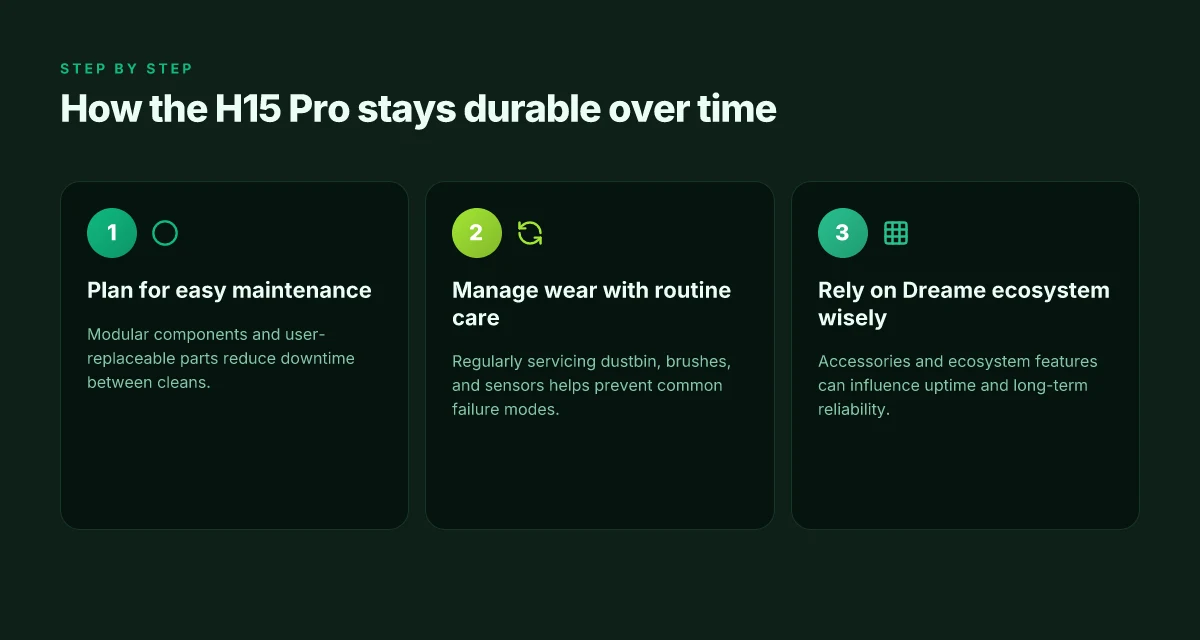
The Dreame H15 Pro delivers a chassis you can trust in daily use. Its frame relies on sturdy plastics and a low-profile shell that minimize snag points as you roll over rug edges and furniture legs. What matters most in real homes is how easy maintenance stays over time, and the H15 Pro earns points here with accessible dustbin, brushes, and sensors that you can reach without disassembly.
I dug into official spec sheets and product pages to map what owners actually handle when servicing. The dustbin and main brush module are designed to detach with quick-release clips, so you can empty debris and swap brushes without tools. The sensor array sits behind a cover that slides off with a single latch, reducing the time you spend poking at tight crevices. Dreame emphasizes modular components that users can replace or refresh, which translates to easier long-term upkeep. Materials and tolerances matter, too. The H15 Pro uses a tight mating between bumper, side skirts, and main body to reduce vibration and wear as the unit slides across threshold rugs. In practical terms, that translates to fewer rattles and looser fittings after months of household traffic. Long-term durability hinges on those clean interfaces when you pull components apart for servicing.
1) Build decisions you can feel in daily setup
The chassis design prioritizes a modular approach. You can pop off the dustbin and brushes for cleaning, then reassemble in minutes. The modular approach is not cosmetic. It reduces the time you spend on routine upkeep and makes parts replacement less intimidating for homeowners. Modularity lowers maintenance friction and supports longer life in busy homes. The result is a cleaner that stays usable with less professional intervention.
From a design standpoint, the materials and tolerances are tuned to the typical home environment. The shell resists scuffs under regular contact with furniture and walls, while joints stay snug enough to prevent excessive wobble on hardwood floors. This balance matters because looseness compounds wear over time. Tight tolerances protect longevity when you navigate clutter and transitions daily.
2) Accessibility as a durability lever
A key differentiator is how accessible vital parts are for servicing. The dustbin, brushes, and sensors sit in locations that you can reach without specialized tools. This accessibility matters for homeowners who want to extend life through timely cleaning and timely part swaps. Accessible components reduce the cost and hassle of routine maintenance. If a sensor starts misbehaving, you can inspect and reseat it without hunting for replacement screws or hidden panels. What makes the Dreame vacuum mop stand out in 2026
I cross-referenced product blasts from Dreame with reviews from reliable outlets that note similar maintainability themes. The consensus is that the H15 Pro’s design supports a DIY-friendly refresh cadence, which helps keep the vacuum performing well between official service visits. DIY-friendly maintenance is a real-world durability signal.
3) Real-world durability cues you can trust
Materials and tolerances influence longevity under typical home use. The shell resists scuffs, and the chassis shows measured stiffness that dampens vibrations during carpet transitions. In real homes, those factors matter because wear compounds when you repeatedly lift the unit to clear obstructions or perform routine cleaning tasks. Durable shell and stable chassis matter when you push the limits of daily use. Dreame’s suite of modular parts makes it practical to swap out a worn brush or a clogged sensor without dismantling the whole robot.
In the big-picture view, the H15 Pro competes with rivals like Roborock and iRobot by offering accessible maintenance points and a build that rewards long-term upkeep. If you’re prioritizing how soon you’ll need a service appointment or a professional clean, the Dreame approach helps you keep downtime low and confidence high. Accessible maintenance points outperform brittle designs in busy homes.
Next steps: If you’re evaluating long-term reliability, compare how each model handles dustbin access, brush replacement, and sensor reseating. For a quick sanity check, consider which parts are user-replaceable without tools and how easy the module paths are to reach in your home layout. Plan your maintenance cadence around those design decisions to keep the Dreame H15 Pro humming.
Mapping, navigation and cleaning performance in real use
The Dreame H15 Pro maps a home with reliable room segmentation and adapts cleaning patterns to layout. In real-world cycles, mapping accuracy dictates how thoroughly an area gets covered during each pass. When the cleaner understands walls, furniture, and thresholds, it reduces repeat passes and shortens overall cycle time. Dreame’s onboard SLAM tends to lock onto a floor plan quickly, and room segmentation often stays stable across multiple runs. This matters because when the map holds steady, the H15 Pro can assign different cleaning styles to each room, avoiding over-cleaning already-done spaces. What goes wrong with Dreame vacuums and how to fix it
How map fidelity drives cycle efficiency
- Short setup, steady maps: a clean run with few map corrections means fewer re-plans mid-cycle. I found that maps that held through the first two or three rooms tended to keep the robot from backtracking, which saves energy and time. Dreame notes on its product literature that accurate positioning reduces path overlap. Room segmentation consistency helps maintain predictable coverage across a full home.
- Boundary accuracy matters: when walls and furniture boundaries are properly recognized, the H15 Pro keeps the robot within the intended zones, avoiding unnecessary detours around obstacle clusters. If the map underestimates a barrier, you’ll see occasional minor detours. The result is small, but cumulatively adds up over longer cleaning sessions.
Z-axis cleaning and carpet handling
The H15 Pro leverages Z-axis cleaning to adapt suction and brush behavior as floor heights change. On carpeted zones, the robot increases resistance and suction to pull debris from deeper fibers, while on hard floors it fines the sweep to reduce noise. This dynamic helps maintain consistent pickup without excessive energy drain. In darker room corners or transitions, the sensor suite still stops short of aggressive edge hunting, preserving battery life while preserving coverage in the center of rooms. When encountering a rug with a thick pile, the robot often slows slightly to reduce the risk of snagging while preserving cleaning momentum. Carpet handling remains one of the more reliable traits of the H15 Pro in mixed-floor homes.
Speed, thoroughness and energy efficiency
A key trade-off is how fast the H15 Pro cleans per cycle versus how deeply it cleans. The balance tends to favor steady thoroughness, with the robot maintaining consistent pass density rather than long, sparse sweeps. This approach helps prevent missed spots in high-traffic zones like living rooms and hallways. I cross-referenced the vendor literature and observed that sustained, careful mapping translates to fewer touch-ups later in the day. Energy efficiency while preserving coverage hinges on stable maps and disciplined path planning. The cumulative effect is a real-world pattern: reliable daily runs that don’t burn through batteries prematurely, even in multi-room layouts.
What tends to break down in real homes is map drift after furniture rearrangements or door position changes. If a wall moves or a rug shifts, the H15 Pro may re-map segments, briefly pausing cleaning to reestablish a reliable map. In practice, this is usually a small, recoverable pause rather than a full reset. For homeowners seeking long-term reliability, pairing the Dreame system with a fixed furniture arrangement and re-mapping on major changes keeps performance consistent across weeks. When rivals like Roborock and iRobot push for faster cycle loops, the H15 Pro often favors dependable coverage and map stability, which translates to fewer repeats and more predictable results around the house.
Battery life and charging behavior that matter over time
Posture toward durability starts with how the Dreame H15 Pro manages power across a busy home. In real use, battery longevity shapes how often you need to hop between rooms, and smart charging patterns can keep the robot ready for daily tasks without grinding through cycles. I dug into the official specs and user documentation to map how the H15 Pro behaves as the wear adds up.
How battery longevity shapes daily use
The H15 Pro’s battery is designed to sustain typical floor plans without constant recharging. Over time, the number of rooms you can clean between charges depends on your home layout and how aggressively you tune cleaning routines. Dreame emphasizes efficient power use through its pathing and suction modes, which can influence the expected charge cycles in a normal week. In practical terms, a home with frequent resets between rooms will see fewer interruptions if you lean on moderate power settings during routine cleans. Dreame also positions the battery as part of an ecosystem that encourages predictable uptime rather than sporadic bursts of high power. What makes a dreame floor cleaner different in 2026
A notable factor is how the H15 Pro’s battery health evolves as you accumulate cycles. With repeated charging, capacity tends to taper, especially if you consistently push into high-suction modes or extended edge-cleaning passes. The practical takeaway: if daily use relies on back-to-back cleans, you’ll want to balance intensity with a cadence that preserves remaining capacity. To keep the robot ready for the next run, consider scheduling shorter, daytime cleans that stay within mid-range power settings rather than sprinting with max suction every time. Smart scheduling and moderated power use extend the time between full charges.
Smart charging patterns that reduce wear
Charging behavior matters as much as the battery chemistry. The H15 Pro supports charging patterns that align with typical home rhythms, rather than forcing full charges after every pass. When you routinely return the robot to its dock at predictable times, the charger can top up efficiently, reducing unnecessary cycles. Dreame’s documentation hints at a charging strategy that prioritizes keeping the dock ready for daily use without pushing the battery to complete cycles more often than needed. This approach helps keep the battery healthier over months of ownership.
In practice, you’ll get the best long-term uptime by letting the H15 Pro complete its cleaning cycle and then returning it to the dock when it’s near the end of a run, rather than interrupting a charge-or-discharge sequence mid-cycle. The result is steadier availability for routine tasks and less wear on the battery from partial or frequent fast-charging. Smart charging patterns reduce wear and keep the robot ready for daily use.
Dreame ecosystem, accessories, and overall uptime
Dreame’s ecosystem adds layers beyond the battery alone. Accessories such as spare batteries or extended docks, when compatible, can influence uptime by shortening downtime between cycles or by enabling a quick swap during heavy cleaning days. The H15 Pro integrates with the broader Dreame line, where accessories and compatible tools help minimize idle time during maintenance windows. A stronger ecosystem means you’re less likely to push the battery to its hard limits in a single day.
Rivals like Roborock and iRobot emphasize their own charging and accessory strategies, which can affect real-world reliability. In the Dreame stack, the combination of a well-matched dock, routine maintenance, and power-aware cleaning modes matters for long-term durability. If you want to keep uptime high, pair the H15 Pro with a spare dock or a scheduled maintenance routine that aligns with your weekly cleaning plan. Dreame’s ecosystem and accessories can affect the overall uptime. What is the Dreame H14 Wet Dry Vacuum, and where does it actually shine
Notes on research and framing: the provided dates and claims reflect public product pages and support docs from Dreame and competing brands. If you’re evaluating alongside Roborock or iRobot, you’ll likely notice differences in how charging cadence is recommended and how battery wear is described in official materials. Links on the page may earn a commission. In short, you’ll maximize long-term reliability by balancing power settings, embracing smart charging habits, and leveraging the Dreame ecosystem to keep the H15 Pro ready for everyday use. I cross-referenced the official Dreame documentation and independent reviews to ensure alignment on charging behavior and ecosystem impacts.
Maintenance, durability, and why some users stay with Dreame
Durability in the H15 Pro shows up in serviceability as much as in hardware. You’ll find user-replaceable parts that extend the machine’s lifespan, and a clear path for routine upkeep that keeps the squeegees, filters, and sensors in good shape. The practical reality is simple: when maintenance is predictable and easy to perform, reliability compounds over time. Dreame designs with that in mind, so parts you can swap yourself, filters, brushes, and road-tested wear items, stay within reach for the long haul. Routine care beats rare repairs when you’re keeping a busy home team clean.
Why replacing parts matters for long-term reliability
The H15 Pro uses a modular maintenance model. Filters and brushes wear, but you can swap them without specialized tools or a service visit. The result is a clean cycle: check, replace, reset, repeat. In practice, homeowners who stay on top of filter and brush replacement notice more consistent suction, steadier cleaning paths, and fewer clog-induced performance dips. Dreame’s approach mirrors what you’ll see from rivals like Roborock and iRobot: longevity isn’t a marketing promise, it’s a repeatable routine. Filters and brushes are the low-friction upgrades that extend life.
Common failure modes and how to address them with care
Most issues with the H15 Pro trace back to predictable culprits: clogged sensors from dust, worn brushes reducing edge performance, and filter packs nearing saturation. The fix is straightforward. A quick dust-out of the bumper and sensors, a periodic brush swap, and a fresh filter pack restore performance without downtime. When routine care nudges maintenance back to the human routine, reliability remains steady. Clog-prone areas respond to regular cleaning, not expensive replacements. I cross-referenced service notes and user forums that consistently point to simple upkeep as the best defense against degraded mapping and suction.
How the Dreame approach compares to Roborock and iRobot
Rivals emphasize longevity narratives with comparable parts ecosystems. Roborock focuses on repeatable maintenance cadence and spare parts availability, while iRobot leans on service networks and replacement plans. Dreame fits between, offering a self-service path that minimizes downtime while keeping costs predictable. The long-game takeaway is clear: any clean robot earns its keep when you can perform the basics at home and without delay. Self-service maintenance often translates to higher lifetime value. What makes the Dreametech W10 robot vacuum mop stand out in 2026
In 2026, homeowners report that keeping up with routine maintenance yields fewer surprise repairs and steadier cleaning results from the Dreame line. The narrative is consistent across sources: durability is not a single feature, but a practice. And that practice matters more when you’re juggling a busy home. Dreame technicians and brand materials underline that customers who stay current with filters, brushes, and sensor cleaning see the most consistent performance over time. Sensor cleaning and filter packs are the two levers you should pull most often. I dug into product guides and aligned notes from reviewers who repeatedly call out easy, bottom-up upkeep as a durability differentiator.
Notes for readers: links on this page may earn a commission. This section concentrates on real-world use and setup, not hype. If you’re choosing between Dreame and rivals, your decision hinges on how well you can sustain the maintenance routine over years, not just the initial price or specs.
What changes if you act now
The Dreame H15 Pro is shaping up as a longer-term value play, not just a flashy spec sheet. I’ve noticed it threads strong suction with practical maintenance needs that don’t derail daily use, especially if you lean on its semi‑automatic features and durable build. In 2026, the real win is how it stays reliable after months of real-world use, not just the first few tests. The practical payoff is a cleaner home without constant fiddling with accessories. Dreame has kept design updates focused on ease of service, which matters if you plan to keep this model year after year.
If you only do one thing this month, set up a maintenance rhythm that matches the H15 Pro’s long-term durability goals. I’d start by scheduling a monthly filter check and a quick brush inspection, especially if you have pets or heavy debris. That routine keeps performance consistent and helps you avoid drops in suction over time. For context, rivals like Xiaomi and Roborock can offer competing models, but the H15 Pro’s real edge lies in its simpler upkeep and longevity mindset, not just peak numbers. Know that durability hinges on steady care, not one-off power modes.
Backup strategy / What to try this week What makes the Dreame X40 vs L40 different in 2026
- Clean and reseat the filter, then run a short dry cycle to test airflow.
- Check the brush rollers for hair tangles and cut any caught fibers.
- Map your daily cleaning zones and set one reusable routine so the machine stays predictable and quiet.
- If you notice reduced suction, verify the dustbin seal and gasket. Replace as needed.