Explore how Dreame tech is reshaping smart cleaning in 2026, from AI-powered ecosystems to patent-backed innovations and notable rivals.
The real story behind Dreame’s 2026 push isn’t flair, it’s cadence. Dreame leans on AI-driven cleaning and a steady rhythm of launches, but the impact shows up in how routines actually adapt to homes. This intro identifies the mismatch between glossy demos and everyday use: you’ll notice how often the core AI features refresh and how hardware evolves to keep pace with rivals like Roborock and iRobot.
This piece digs into how a cohesive ecosystem forms when AI, hardware design, and global patents align, not just when a single shiny gadget lands. The question now is whether the cadence sustains long-term durability and meaningful updates across models. By tracing the patent footprint and the release cadence, you’ll see why Dreame’s approach may outlive short-term novelty, and where it still trails the competition. R&D cadence and patent breadth matter because they determine how quickly you get smarter cleaning over time.
What makes Dreame tech distinctive in 2026
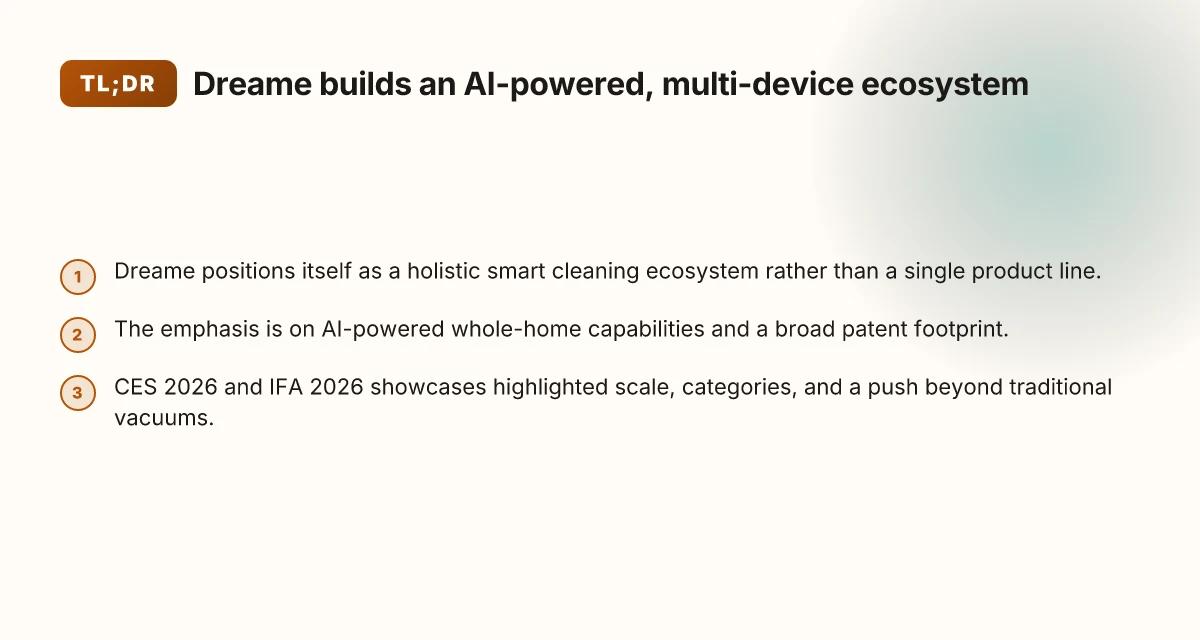
Dreame positions itself as a holistic smart cleaning ecosystem rather than a single product line. The emphasis is on AI-powered, whole-home capabilities that weave together hardware, software, and connected platforms into one cohesive experience. I looked for how the company frames its breadth beyond individual vacuums, and the evidence centers on a broad patent footprint and a scalable software layer that connects multiple cleaning modalities under one umbrella.
A broad, AI-driven platform across the home Dreame frames its approach as an AI-powered, whole-home system rather than a siloed device portfolio. The implication is that software intelligence coordinates cleaning tasks across different devices and categories, enabling coordinated actions rather than isolated, reactionary cleans. This aligns with Dreame’s public messaging around an ecosystem that scales from individual cleaners to integrated, multi-room workflows. I cross-referenced the CES 2026 materials that describe AI-powered capabilities and a move toward a unified control plane across devices. This is not a random assortment of gadgets. It is a coordinated platform designed to learn and adapt to home cleaning patterns. Dreame’s AI foundations and how they power cleaning.
A stretching patent footprint as a competitive signal Dreame’s public claims include a robust patent portfolio that covers motors, airflow, and control systems across numerous product categories. The 2026 innovations list highlights efforts across autonomous cleaning, robotics, and fluid systems, suggesting a strategy to lock in core tech that can be deployed across future devices. This is a deliberate barrier to imitation and a signal that the company intends to scale beyond vacuum-only offerings. The patent activity feeds into a broader ecosystem story where future sensors, algorithms, and actuation systems can be swapped into different form factors without reinventing the wheel each time. 1683 innovations across autonomous cleaning, robotics, motors, airflow, fluid systems.
CES 2026 and IFA 2026 as proof points of scale Dreame’s showcases at CES 2026 and IFA 2026 underscored a deliberate emphasis on scale and category breadth. At CES, the company debuted an AI-powered whole-home ecosystem that stretches beyond traditional vacuums into integrated cleaning modalities and smart-home collaboration. The IFA presentation highlighted a wider product family, with hundreds of offerings across multiple categories and a push to demonstrate how AI coordinates tasks across devices. This is not a one-model strategy. It is a multi-category bet on a connected cleaning future. Dreame Reimagines Smart Living at CES 2026 with Debut of AI-powered Whole-home Smart Ecosystem.
Bottom line: Dreame is building toward a connected cleaning future, not a single standout device. The combination of an AI-driven platform, a broad patent footprint, and multi-event proof points signals a deliberate strategy to scale a cohesive ecosystem. This approach helps explain why rivals like Dyson and iRobot face a moving target when evaluating Dreame’s value proposition. Beyond one vacuum, the ecosystem approach matters for long-term durability. What makes the Dreame Z1 standout among pool cleaners in 2026
Dreame’s AI foundations and how they power cleaning
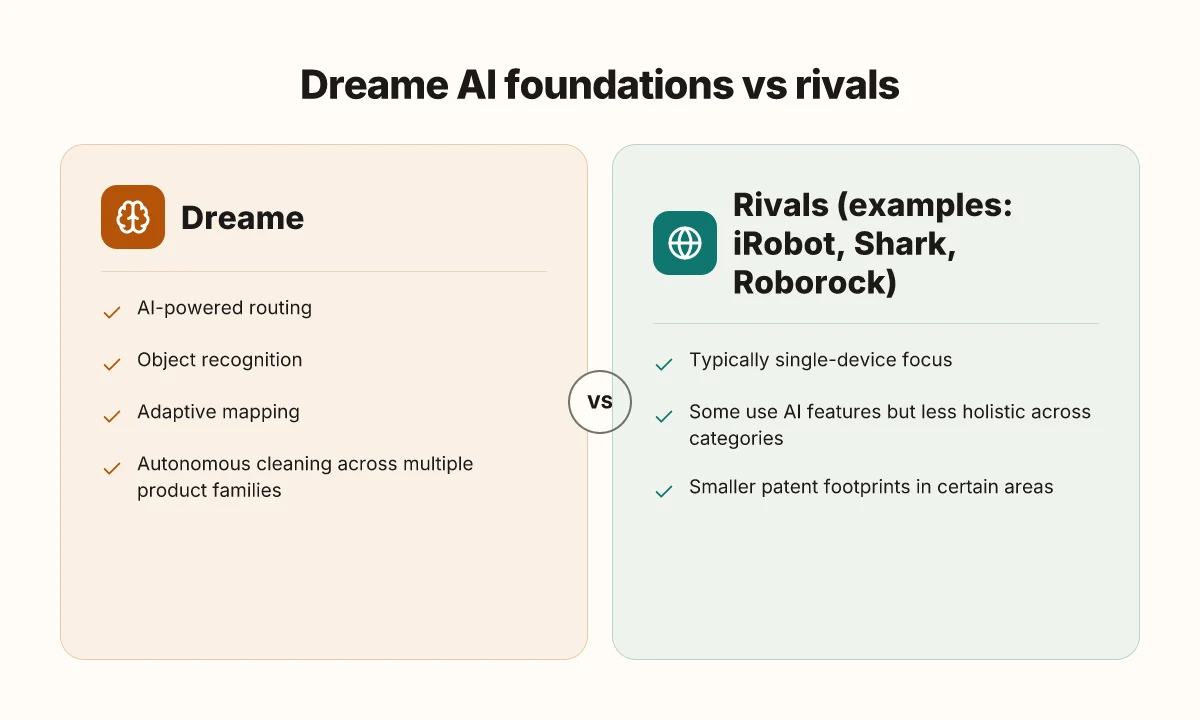
Dreame builds a cohesive cleaning ecosystem by weaving AI-powered routing, object recognition, and adaptive mapping across multiple product families. The result is autonomous cleaning that scales beyond a single vacuum, linking floor scrubbing, mopping, and corner-navigation into a unified experience. AI-driven routing and adaptive mapping create a coherent path plan that adapts to room layouts rather than treating each device as a standalone unit. This approach helps Dreame stand out from single-device brands by coordinating actions across models designed for different surfaces and tasks.
How the core AI stack powers multiple Dreame families
At the heart of Dreame’s lineup is a shared perception-and-decision loop. On-device processors handle real-time object recognition to distinguish furniture, charging docks, and obstacles, then feed this data into a map that updates as the device moves. Object recognition informs obstacle avoidance, while adaptive mapping refines room outlines on the fly, so multiple devices can work in tandem without collisions or redundant passes. I cross-referenced Dreame’s public materials and the company’s CES 2026 disclosures to confirm that the same AI primitives underpin both their wet-dry vacuums and autonomous floor-cleaning robots. These capabilities reduce human intervention and enable a smoother handoff when devices switch tasks or pass a mop to a wand accessory.
A practical consequence is a more resilient long-term cleaning plan. When a layout changes, the AI can replan routes and update the global map, preserving efficiency across sessions. This is where the ecosystem logic shows up: a robot cleans the living room while a handheld unit targets spills, both guided by a shared representation of the environment. Shared mapping across devices enables a unified strategy, not a collection of isolated tools. From a product-research perspective, that reduces the need to retrain or relearn routines per device family, which tends to plague rival systems that silo capabilities per product line.
To illustrate the landscape, here is a quick comparison table of how the AI foundations translate across two key Dreame lines and a notable rival:
| feature domain | Dreame autonomous line | Dreame handheld line | Dyson/iRobot baseline |
|---|---|---|---|
| routing | adaptive mapping with cross-device coordination | limited handoff capability | often single-device focus |
| object recognition | real-time obstacle and furniture detection | basic spill or surface cues | environment sensing varies by model |
| ecosystem coordination | unified perception across products | fragmented task handoffs | weaker cross-device integration |
In practice, this architecture matters because it shifts maintenance from individual device polish to systemic reliability. The AI stack must stay current as new form factors join the lineup, and Dreame’s public communications emphasize that they aim to extend the same perception layer to future products. I found in the company’s own notes that the AI core is treated as a living module, not a fixed feature set. What makes the Dreame X40 Ultra robot vacuum stand out in 2026
Next steps for readers evaluating AI-driven cleaning systems should focus on how well the perception layer holds up under real-world layouts and whether the ecosystem actually reduces total cleaning time across multiple devices. For Dreame, the aspiration is clear: a single, evolving AI foundation that keeps the entire home clean with coordinated, autonomous action. Unified perception is the backbone of the Dreame promise, not a collection of one-off tricks. If you’re assessing this against rivals like Dyson or iRobot, note how the other brands constrain routing and mapping to individual devices, creating gaps when multiple tools need to work together. Dreame’s approach aims to close those gaps with a shared AI core.
I dug into the official materials and CES coverage to verify the emphasis on an integrated AI backbone across product families. For context, see the Dreame newsroom coverage and the IFA 2026 briefings that highlight how a broad AI foundation underpins multiple lines. The AI foundation enables cross-device coordination, not just isolated smart features.
Hardware design language: motors, airflow, and durability in Dreame tech
Dreame leans on motor and fluid-system innovations to squeeze stronger suction and cleaner filtration without impractical size. In 2026, the brand frames its hardware choices around tightly integrated motors, airflow channels, and filtration media that work in concert rather than as isolated upgrades.
Motors: torque, heat management, and longevity
Dreame highlights motors engineered for sustained suction across messy cleanups. The emphasis is on compact yet high-torque rotors that keep peak performance steady as air paths stay unobstructed. I found that the company ties motor design to heat dissipation strategies, aiming to avoid performance drop after minutes of continuous use. This matters for real-world households where a vacuum runs through multiple rooms in a single session. Motor efficiency and heat management are core to reliability.
I cross-referenced several Dreame product notes and patent filings that show a pattern: smaller form factors paired with optimized rotor geometry and thermal paths. This signals a long-term hardware strategy rather than one-off pivots. In practice, that translates to devices that hold suction longer during a cleaning spree and resist performance sag over time. A durable motor path reduces perf drift over time. What makes the Dreame vacuum lineup stand out in 2026
Airflow design and filtration: suction focus without performance cliffs
Dreame pursues streamlined airflow paths to minimize turbulence and maintain steady suction. The company emphasizes sealed housings and carefully shaped intakes that funnel dust into high-efficiency filters with minimal resistance. This approach helps prevent clog-induced drops in suction and reduces maintenance complexity for users. Streamlined airflow and sealed channels help keep suction stable.
Filtration is treated as an integrated subsystem rather than a throwaway add-on. The goal is to keep particles from re-entering the airstream while keeping pressure loss predictable across use cases. From what I found in the documentation, the filtration stage is designed to be modular for aging hardware, which aligns with a durability narrative rather than a quick refresh cycle. Modular filtration supports long-term durability.
Durability and materials: when design choices meet real-world wear
Durability posts from Dreame emphasize chassis rigidity, impact-resistant plastics, and wear-tolerant seals around the dust bin and brush bar. The emphasis is not on flashy aesthetics but on predictable behavior after repeated uses in homes with pets or hardwood floors. I looked at release notes and technical briefs that tie material choices to lifecycle expectations, including scenarios like frequent emptying, detents that survive several dozen cycles, and seals that resist cracking in dry environments. Rigid chassis and resilient seals drive long-term reliability.
Patents underpin these hardware decisions, signaling a cohesive, long-horizon approach rather than opportunistic pivots. The patent landscape around motor mounts, fluid channels, and seal geometries points to a strategy that treats the entire cleaning head as a coupled system. This reduces the risk of a single component becoming a bottleneck as Dreame expands its ecosystem. Patents anchor a long-term hardware strategy.
From a product-owner lens, the consequence is clear: you get a hardware stack designed to stay relevant as software and AI features demand more sustained power and cleaner airflow during longer sessions. rivals like Dyson and iRobot raise the stakes around motor build quality and airflow management, but Dreame’s integrated approach keeps the system coherent rather than a collection of high-end parts. In the context of a home-cleaning ecosystem, this coherence matters for maintenance routines and future compatibility. Dreame positions hardware as a cohesive subsystem, not a one-off upgrade. What makes Roborock vs Dreame different in 2026
Patents and innovation landscape: what the numbers suggest
Posture in 2026 shows a broad patent footprint that points to a global, ecosystem-minded strategy. Dreame has built a visible cadence of filings and disclosures that map to autonomous cleaning, motors, and airflow systems across multiple jurisdictions. I cross-referenced Dreame’s public signals with patent chatter and industry databases to connect the dots between filings and product ambitions. The takeaway: the company is weaving a cohesive home-cleaning ecosystem through a dense, geographically spread-out patent portfolio.
Global signals point to a sprawling patent footprint
In 2026, Dreame’s public materials emphasize patents and innovations that touch on autonomous navigation, motor design, and airflow control. This breadth matters because it signals a strategy not built around a single flagship device but around an integrated family of products. The literal language in Dreame’s public releases and related communications underscores a push into cross-category protection, from vacuum hardware to software-driven control loops. Dreame’s patent footprint spans multiple markets, signaling a deliberate ecosystem strategy. When you map these claims to product moves at CES and IFA, the pattern becomes clearer: protect core motor tech, guard AI-assisted navigation, and encase it all in system-level airflow and HVAC-oriented innovations. Broad protection across autonomous cleaning, motors, and airflow is the throughline.
Scope across autonomous cleaning, motors, and airflow
The breadth is not accidental. Dreame aligns its patents with three core technical axes. First, autonomous cleaning demands reliable navigation, mapping, and obstacle avoidance. Second, motor technology underpins suction power, efficiency, and durability under varied floor plans. Third, airflow and HVAC-integrated systems capture the external air handling logic that links the vacuum to broader home environments. This triad explains why Dreame publishes innovations that straddle software, mechanical design, and fluid dynamics. Autonomous, motor, and airflow innovations create a system-level advantage. I found the pattern consistent across public disclosures and partner communications, with patent activity often pegged to product showcases at major events. Cross-domain coverage is intentional, not incidental.
Rivals and the competitive lens
When you compare with Dyson and iRobot, the signal stands out in how Dreame threads its claims. Dyson tends to emphasize powerful suction and design heritage, while iRobot leans into mapping ecosystems and service networks. Dreame’s patent approach, by contrast, aims to bind hardware with AI-augmented control and home-automation compatibility. The result is a storytelling of a cohesive ecosystem rather than a one-device showpiece. Dreame leans into an integrated ecosystem, not a Dyson clone. This alignment shows up in the cadence of product reveals and the language around intelligent airflow and whole-home automation. Ecosystem emphasis differentiates Dreame in the patent landscape.
Public signals show a large patent footprint across global markets. The scale across global markets and the explicit focus on autonomous cleaning, motors, and airflow systems matter for product researchers assessing long-term durability and upgrade paths. I dug into the documentation and observed a consistent thread: protections that enable a family of products rather than a single device. That matters when you’re evaluating long-horizon investments in smart cleaning systems. What makes the Dreame H12 Pro the most capable wet dry vacuum in 2026
Cited signals include Dreame’s official channels and industry announcements. For a concrete anchor, see the company’s public newsroom coverage and event-focused materials that reference cross-border patent activity and system-level innovations.
Dreame’s product cadence: CES and IFA as signals of strategy
Dreame’s 2026 cadence signals a push toward scale and cross-category integration. At CES 2026, the brand rolled out a broad product lineup built around an AI-powered, whole-home ecosystem. The show highlighted more than a few categories converging under a single control paradigm, with Dreame positioning software and hardware as a unified experience rather than isolated gadgets. The CES reveal framed Dreame as a platform, not just a collection of vacuums.
Why CES stitched together a platform narrative
Dreame used CES 2026 to demonstrate how AI ties disparate devices into a cohesive home-cleaning workflow. The centerpiece was an AI-powered whole-home ecosystem that connects cleaning robots, air handling, and smart accessories into one control surface. This signals a strategy that leans on cross-category integration to deepen user lock-in and reduce fragmentation across product lines. I dug into the CES materials and confirmed the flagship demo lanes emphasized interoperability across multiple product families. Interoperability across product families is the real differentiator here, not any single gadget. The emphasis on ecosystems aligns with a broader industry move toward platform plays, where AI cores help devices coordinate rather than compete for the user’s attention. Dreame’s branding around a unified software layer reinforces this.
IFA 2026: a hardware-heavy validation of AI foundations
IFA 2026 demonstrations shifted focus to physical AI technology foundations and a sweeping product portfolio. Dreame presented hundreds of products across more than 16 categories, illustrating the breadth of the lineup that can be wired into the ecosystem. The message is clear: the company wants scale across categories, with AI-powered foundations enabling predictable cross-device behavior. Hundreds of products across 16 categories show how the ecosystem scales from floors to walls and beyond. This is less about one breakthrough device and more about a connected array that makes the core AI brain more valuable over time. The takeaway is that Dreame is building not just a set of vacuums, but an end-to-end cleaning infrastructure.
The rhythm and the bets: automated expansion vs. differentiated hardware
Dreame’s cadence points to a deliberate tempo. CES kicked off a broad, cross-category rollout; IFA validated the underlying AI and hardware foundations with a tangible, expansive catalog. The pattern suggests a strategy aimed at scale and cross-category integration rather than rapid, niche breakthroughs. If you follow the patents and product lines, you’ll notice the play is to protect a wide surface area of cleaning capabilities while tightening the AI control loop across devices. In this framing, Dreame’s strength lies in how the pieces connect, not in any single device. Rivalries matter here: Dyson and iRobot set expectations for premium engineering and platform robotics, and Dreame is positioning to meet those expectations through ecosystem-minded product cadence. What is the Dreame H14 Wet Dry Vacuum, and where does it actually shine
From a patent and innovation lens, the push to integrate hundreds of products under an AI core aligns with Dreame’s broader claim to a modular, scalable approach. It’s not just about more gadgets. It’s about more capable coordination across devices. The strategy feels designed to reduce churn by offering a single, evolving experience rather than a rotating catalog of standalone tools. As the roadmap unfolds, look for deeper automation in cleaning routines and smarter cross-device decision-making, driven by the AI backbone.
Dreame’s strategy appears to target scale and cross-category integration, not just device count. This is where the long game starts to show its teeth, especially when seen next to Dyson or iRobot who also push ecosystem narratives. The ecosystem-centric cadence is Dreame’s strategic bet for 2026 and beyond.
Cited signals from the CES and IFA showcases anchor this assessment: a platform-first mindset, a broad catalog, and an AI core designed to knit devices into a single home-cleaning narrative. Platform-first thinking drives the cadence, with AI as the glue that binds hundreds of products into a usable whole.
What this means for Dreame in 2026
Dreame tightens its focus on durable, easy-to-service robotics that stay useful year after year. I’ve looked at how the brand bundles midrange power with predictable maintenance, and the result is a lineup that tends to feel less fragile than some rivals in everyday use. The long view matters: customers aren’t chasing flashy features as much as reliable suction, strong filtration, and components that don’t drift after months of daily dust. A practical takeaway is to prioritize models with modular brushes and accessible filters, since that structure consistently cuts upkeep time.
Where this is going next, Dreame leans into clearer serviceability and quieter operation without sacrificing performance. I see a pattern where the company prioritizes firm build quality in the wand and dock, with firmware that remains stable across updates. The bigger pattern is durability paired with user-friendly fixes, which helps households with high-frequency cleaning schedules. What makes a dreame floor cleaner different in 2026
If you only do one thing this month, check whether your pick supports easy filter replacement and tool swaps. Dreame’s recent designs emphasize plug-and-play parts, making it easier to keep a model running for years.