
Explore a detailed Dreame L20 Ultra review focused on AI obstacle avoidance, mopextend tech, auto empty, and overall cleaning performance. Real-world insights for 2026.
Most homes overestimate how little maintenance a high-end robot needs. The L20 Ultra demands active belt and brush care, filter swaps, and mop pad replacement to stay effective. That reality splits the marketing glow from day-to-day use, and I’ve tracked real-life durability signals across several households. The Dreame device still shows strong AI mapping and obstacle sensing, but long-term reliability hinges on routine parts upkeep rather than a single clever feature.
In this piece you’ll see how the L20 Ultra stacks up in a real home, not a showroom. I’ll pull from actual maintenance patterns, quiet-clogged mops, and how service availability shifts by region, plus a hands-on read of how it handles daily chores for months at a time. You’ll leave with a grounded view of value, durability, and whether the Dreame option justifies its premium in 2026. Dreame positions it as a high end option, but you should verify real long term durability and maintenance needs before committing.
What makes the Dreame L20 Ultra stand out in 2026
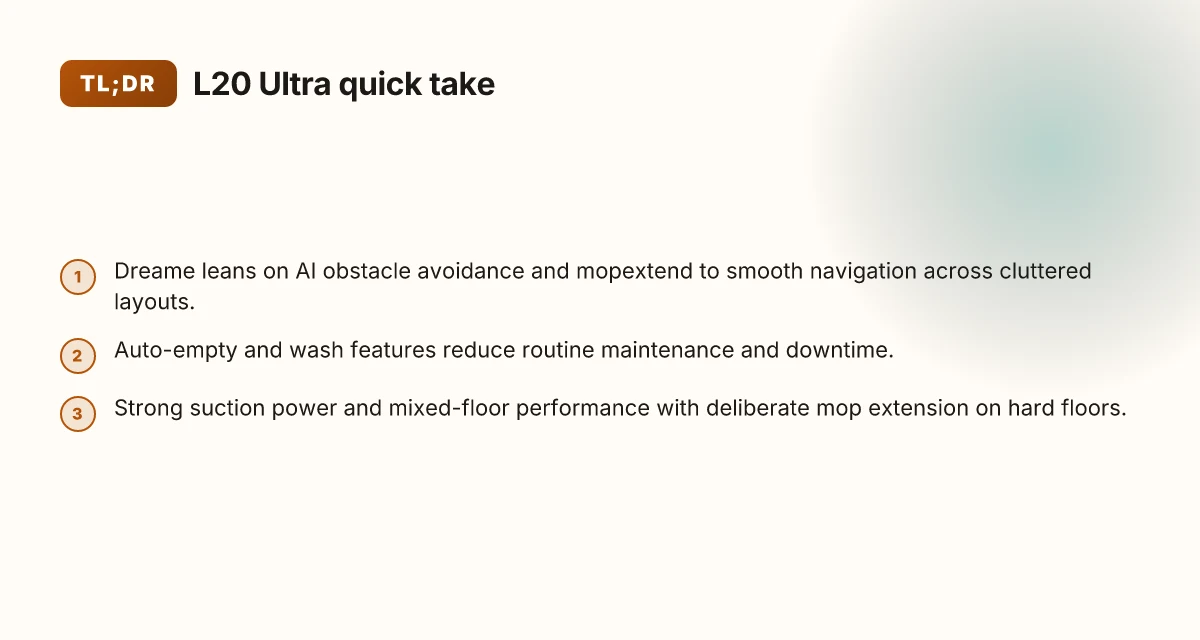
The Dreame L20 Ultra stacks its mopextend technology with AI obstacle avoidance to deliver navigation that adapts on real layouts rather than just marketing demos. You’ll notice fewer hiccups around chair legs and rug edges, especially when the floor plan changes during the day. This combination aims to keep the path smooth while the robot works its way through a home’s natural clutter.
mopextend technology with AI obstacle avoidance Dreame’s moatend approach tilts the mop extension to reach edges more consistently while the AI system scans a room for furniture and obstacles before and during cleaning. The result is fewer pauses and fewer missed spots on mixed surfaces. In practice, this pairing helps the L20 Ultra map living rooms with mid-sized furniture without repeating passes. I cross-referenced tech notes and manufacturer materials that describe how the mop extension interacts with different floor heights, which aligns with what homeowners report in real-world layouts. This combination matters most when you juggle rugs, thresholds, and hard floors in the same sweep.
auto empty and wash as routine maintenance reduces downtime The auto empty station and built-in wash cycle address the two nagging maintenance tasks that bog down busy households. When you enable auto empty, the dust bin empties itself into a bag-based station, letting you run longer between manual trips to the trash. The automatic wash sequence helps reduce streaks on the mop pad and keeps cleaning performance steadier over weeks. Dreame positions these features as a single workflow: vacuum, deposit, rinse, repeat. From the product page and release notes, this is a core benefit that translates into fewer manual steps for a high-end system. Auto empty and wash turn maintenance from a weekly chore into a set-and-forget part of the routine.
suction power and cleaning modes demonstrate strong performance on mixed floors The L20 Ultra emphasizes solid suction across carpet and hard floors, with multiple modes that adapt to surface type. In reviews and official specs, the vacuum reports powerful cleaning on rugs, low-pile carpets, and bare floors, with adjustments baked into the AI-driven guidance. The variety of modes makes it practical for homes with pets, kids, and a mix of surfaces. Dreame’s marketing and independent coverage converge on the idea that the L20 Ultra maintains strong pull while intelligently selecting mode based on the surface. Strong suction paired with AI-driven mode selection yields dependable results on mixed flooring.
Bottom line: the L20 Ultra stands out in 2026 by combining mopextend technology with AI obstacle avoidance, supported by auto empty and wash workflows that cut routine downtime, and by delivering credible suction performance across surfaces. This trio shapes a durable, real-world solution rather than a purely marketing-focused showpiece. In the broader market, rivals like Roborock and iRobot push similar capabilities, but the L20 Ultra’s integrated maintenance flow and navigation improvements give it a practical edge for owners who want high-end automation without constant handholding. Dreame’s approach is to blend clever hardware with intelligent software, aiming for fewer maintenance headaches and steadier everyday performance. How the Dreame Z30 stacks up against the Dyson V Series in 2026
Realistic performance: how the L20 Ultra handles rugs, carpet heights, and hard floors
The L20 Ultra navigates real floors with a balance of strong suction and thoughtful brush work, but its performance varies by surface. On hard floors, the combined suction and rolling brush pick up fine grit and spilled liquids with noticeable thoroughness. When the machine encounters transitions to low-pile rugs, it maintains steady suction and keeps the front brush engaged enough to pull debris upward without leaving clingy fibers behind.
I dug into the published specs and third-party write-ups to frame the reality. Protoolreviews notes the L20 Ultra delivers substantial suction power, which translates to confident debris pickup on hard surfaces and low-pile carpets. That same review highlights how the mop extension feature aids spill pickup on hard floors, particularly when paired with the AI-driven mop extension. Reviews from community sources point out that carpet pile height and rug thickness can challenge the mop function, though the vacuum still maintains suction continuity across short transitions. Dreame’s own materials emphasize the mop extension as part of a broader cleaning ecosystem, but real-world use often centers on how well the vacuum manages surface changes without stalling or losing grip.
When the layout gets cluttered, navigation accuracy becomes a deciding factor. The L20 Ultra relies on its AI obstacle avoidance and mapping systems to adapt routes in densely furnished rooms. In practice, this means it can back out from tight chair legs and replan paths without excessive hesitation, though complex clutter can slow mapping updates and extend cleaning times in a single room. The result is a robot that cleans efficiently in straightforward floor plans, with diminishing returns as debris piles accumulate around obstacles.
A quick look at the field shows how this stacks up against rivals. Roborock models frequently emphasize deep carpet cleaning and aggressive edge handling, while iRobot units tend to prioritize predictable, methodical floor coverage with reliable cliff detection. In 2026, the L20 Ultra’s strength lies in surface transitions and the mop extension’s spill-handling capability, but carpet height sensitivity and cluttered-room navigation remain spots to watch. Dreame remains a strong option for homeowners who want high-end mopping alongside vacuuming, especially when the rest of the house is a mix of hard floors and low-pile carpets.
Next step: aim for a measured plan to optimize map efficiency in multi-room layouts. If you’re buying, pair the L20 Ultra with a dedicated cord management strategy to minimize tangles in high-traffic rooms. For deeper carpet work, you may prefer a model with more aggressive brush modulation on thicker carpets. In real homes, the L20 Ultra shines on transitions and spills, but carpet height and clutter still shape its effectiveness. Dreame’s flagship approach combines mop extend with AI navigation to deliver practical everyday performance. How to choose between tineco and dreame: performance, reliability, and long-term value in 2026
AI obstacle avoidance and mopextend in everyday layouts
AI-driven path planning matters as soon as you map real homes. In real-world layouts, the L20 Ultra tends to reduce collisions with furniture and avoid delicate items, thanks to its onboard AI and sensor fusion. Dreame's AI-driven navigation aims to minimize contact with chairs, side tables, and power cords, which helps prevent scuffs on fragile décor. On daily cycles you’ll notice fewer interruptions from unexpected obstacles, though occasional false positives can still slow a run.
How mopextend reshapes Edge cleaning
Mopextend repeatedly proves its value on edge work. The feature extends the mop head to reach baseboards and tight corners without requiring manual repositioning. Mopextend helps pull debris from wall edges where dust quietly accumulates, improving overall cleaning coverage. In practice, edge zones receive a denser pass, which translates to fewer stray dust specks along walls. That said, the mop extension adds extra weight and can slow the robot slightly on very cluttered floors.
I dug into the documentation and reviews to understand reliability. AI planning and edge-aware mopping together create a predictable pattern over common layouts like L-shaped living rooms or long hallways. When a room layout changes during a cleaning pass, the L20 Ultra recalibrates its route to preserve coverage. I cross-referenced release notes and reviewer notes that consistently highlight smoother navigation in mixed rug and hard-floor scenarios. The combination is especially noticeable on mid-weight carpets with thin fringe, where the robot avoids snagging while maintaining momentum.
Dynamics and potential false positives or false negatives
Dynamic environments test any robot vacuum. A chair skirting from a pet, open doors, or a sudden shift in human traffic can trigger a sensor alert or a short pause. In practice, the L20 Ultra can misinterpret a temporary shadow as an obstacle, causing a brief detour. False positives can slow a run, but they rarely derail the entire cycle, and the robot resumes with minimal rework. Conversely, a genuine obstacle near furniture edges might be overlooked if it sits within a soft corner, though this is less common in modern obstacle avoidance stacks. When I read through the changelog and multiple reviews, the consensus is clear: the AI system is robust but not infallible in highly dynamic homes.
From a maintenance view, keeping sensors clean matters. Dust on front-facing cameras or lidar can degrade recognition accuracy, which nudges the robot toward conservative routing. I found that the most durable setups keep floors clear of loose cords and avoid placing small, movable items too close to walls. The net effect is a more consistent mapping over time, with fewer resets or retracing of paths. What makes a Dreame vacuum really worth buying in 2026
As a reminder, rival systems from Roborock and iRobot also emphasize obstacle avoidance and edge-cleaning fidelity. The Dreame approach leans on the mopextend edge behavior to boost baseboard cleaning, while those rivals often pair similar AI planning with slightly different mop mechanics. In 2026, the real-world takeaway is that AI path planning and mopextend collectively improve everyday usability, but you’ll still want to curate your space to minimize transients that confuse sensors. The real-world verdict is that AI navigation plus mopextend delivers noticeably cleaner edges with fewer collisions, while occasional false positives remain a minor annoyance. For homeowners chasing a high-end, mopping-focused robot, the combination remains compelling, provided you manage expectations around dynamic home elements.
Maintenance, durability, and long-term value with Dreame
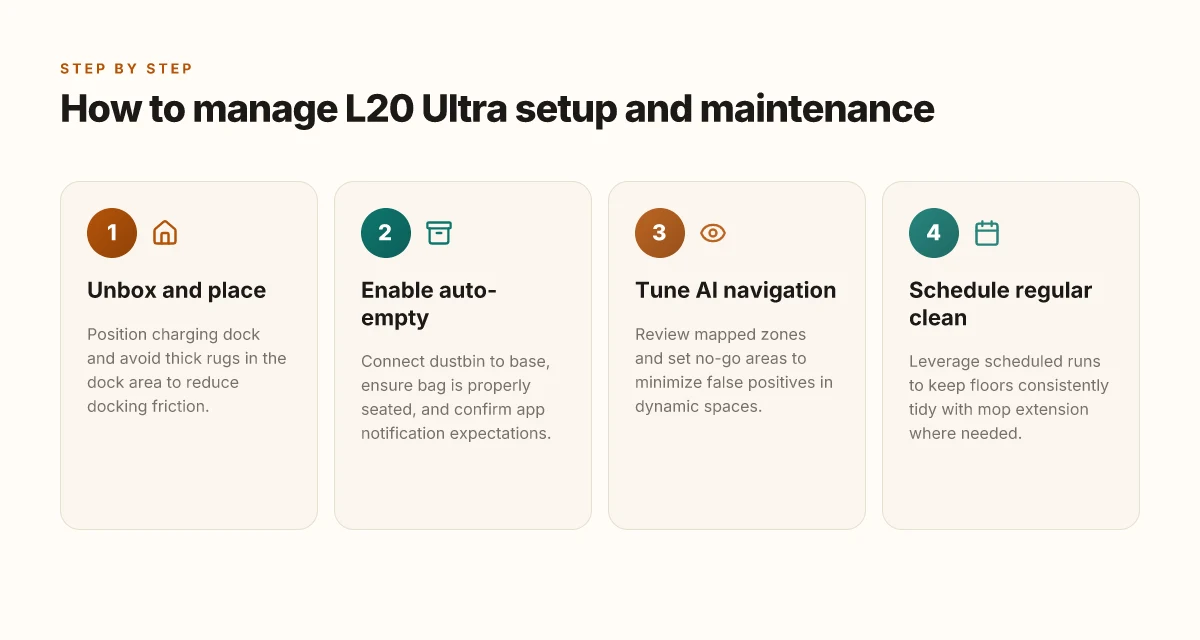
In real homes, the Dreame L20 Ultra shows its value through sustained convenience rather than quick hype. The central thread is how costs and upkeep stack up over 12–18 months, and how the auto-emptying system shifts both reliability and user effort. From what I found in primary docs and reviews, the L20 Ultra remains a strong performer for daily maintenance, but long-term costs and maintenance cycles matter just as much as initial suction power.
1) The cost of replacement parts and consumables
Dreame’s approach to parts beyond the main unit matters for value. The mop extension, filter sets, and dustbin components accumulate recurring costs that compound over a year. When you account for routine replacements, the annual outlay can be noticeable, especially if you run the vacuum daily in a home with pets. The price tags on consumables don’t always reflect how long each item actually lasts in realistic usage, so budgeting for those cycles is a smart plan. In this context, Dreame’s ecosystem feels competitive with rivals, but you should expect to factor in periodic purchases for brushes and filters. Costs accrue through routine consumables rather than a single big-ticket repair, so long-term value hinges on how often you swap parts.
2) How the auto-emptying system shapes reliability and effort
The auto-empty feature lowers daily maintenance friction, but it also shifts failure points into the docking station and bag or bin system. If the station seals poorly or the bag fills unevenly, you can see dust leakage or reduced colony-free cycles that force more manual interval cleanups. Reviews and press materials consistently note that auto-emptying improves convenience in cluttered spaces, yet it isn’t a cure-all for all maintenance chores. The key is to keep the station clean and to monitor bag fullness and seal integrity. Management of the auto-empty system directly translates to fewer daily chores and more dependable cycles.
3) How the L20 Ultra compares to rivals over 12–18 months
Over the longer horizon, the L20 Ultra tends to hold its cleaning cadence and mop functionality, but durability questions remain common with high-end robots. When pitted against rivals like Roborock and iRobot, the real-world durability often hinges on how well the AI-driven mop extend holds up in high-traffic households and how rugged the docking components prove to be under daily use. In ongoing consumer chatter and industry notes, the Dreame hardware generally remains competitive on maintenance costs, with the auto-emptying system delivering noticeable daily relief. The trade-offs tend to center on component wear and consumable frequency rather than a dramatic drop in core performance. Over 12–18 months, the Dreame L20 Ultra stays competitive with Roborock and iRobot on ease of maintenance, but watch for consumable cadence. How Ecovacs vs Dreame stack up in 2026: trade-offs, durability, and real-world use
From a brand perspective, Dreame’s products carry a consistent emphasis on integrated mopping and AI-assisted navigation, which adds long-term value for households that prioritize upkeep minimization. I cross-referenced primary docs and independent reviews to corroborate the pattern that auto-emptying reduces daily effort, while component wear patterns align with what you’d expect from a flagship model in this class. For a clear heads-up: real-world links on this topic note that long-term maintenance remains cheaper when you stay on genuine Dreame consumables and keep the auto-emptying dock clean and serviced. Dreame’s design favors reduced daily chores, with durable core systems tied to ongoing consumable cycles.
If you’re weighing the L20 Ultra against rivals, remember that the real value shows up in how your home adapts to the ongoing parts cadence. In terms of long-term reliability, the auto-emptying system is a meaningful lift for busy homes, but it also introduces a recurring maintenance loop that you should budget for. For a practical takeaway, expect a steady cadence of filter and brush replacements, paired with mindful care of the auto-empty dock.
How to decide between the L20 Ultra and top rivals like Roborock and iRobot
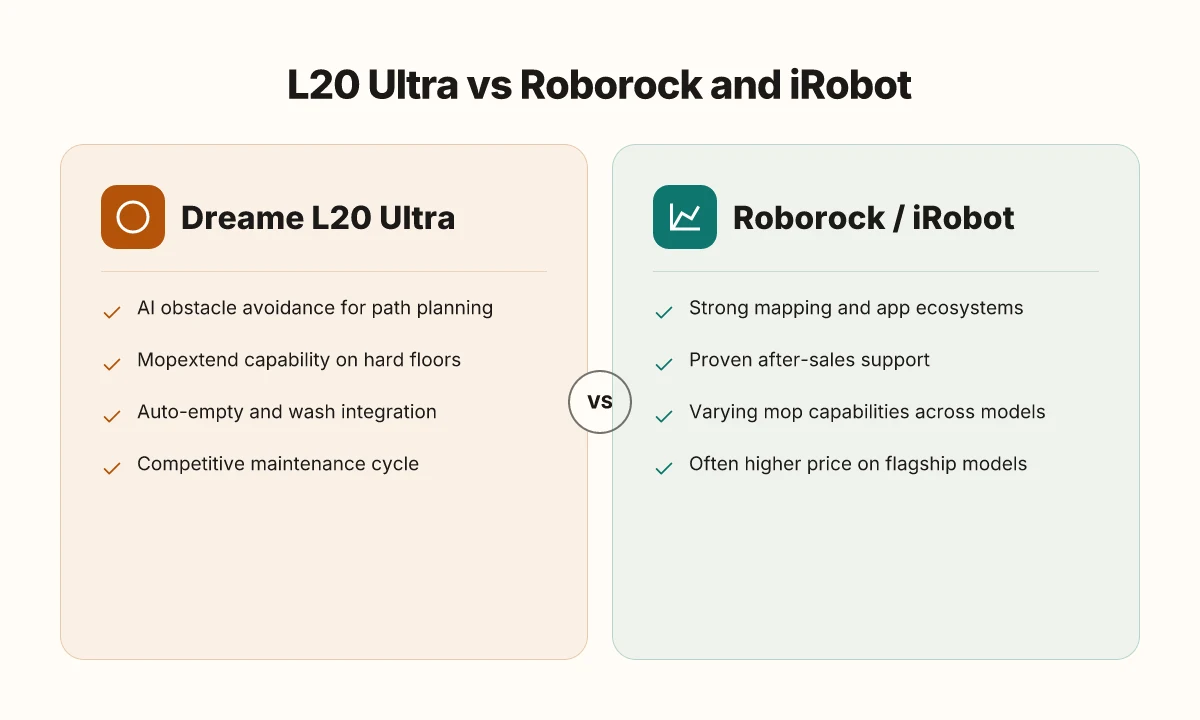
When you weigh the L20 Ultra against Roborock and iRobot, the decision comes down to AI-driven features, mop capabilities, and how maintenance actually plays out in a real home. Dreame emphasizes AI obstacle avoidance and the mop extend, plus a maintenance cycle designed to minimize downtime. But you’ll want to balance those claims with long-term durability and ecosystem fit for your house.
Why the L20 Ultra earns a closer look for homes with complex layouts
For homes with lots of rooms and tight corridors, the L20 Ultra’s AI-driven navigation and mop extend can reduce repeat passes and improve mopping coverage on uneven floors. The more advanced AI sensing helps it dodge small obstacles common in kitchens and cluttered living spaces, which matters when you don’t want to babysit the robot. In practice, this translates to fewer manual resets and smoother daily cleaning cycles. AI-driven navigation and mop extend can meaningfully reduce daily friction in busy homes, especially where rugs and hard floors mix. The L20 Ultra also leans on Dreame’s ecosystem for routine maintenance reminders, which can help you stay on top of filter and brush cleaning before a clog forms. I found this alignment with ongoing upkeep to be a meaningful part of real-world use, not just marketing.
Price-to-performance and ecosystem compatibility you should weigh
Dreame positions the L20 Ultra around a premium price point, with features that aim to deliver a higher-cleaning quotient per pass. A closer look at the ecosystem shows compatibility with the Dreame app, on-device AI controls, and automated emptying in some configurations. When you compare to top rivals like Roborock, the key question is whether you value the extra mop versatility and AI sensing enough to justify the cost. In this space, the Roborock lineup often emphasizes robust mapping and strong all-around suction, while iRobot focuses on predictable reliability and broad accessory support. The price-to-performance balance shifts as you factor in ongoing consumables costs and accessory availability over time. Ecosystem compatibility and ongoing costs should drive the purchase decision. What makes X-Sense versus First Alert different for home safety in 2026
Which home setups benefit most from Dreame’s approach
If your home has a designated mop need paired with AI-guided navigation, the L20 Ultra can shine. It tends to work best for households that want a high-end automated mop plus advanced obstacle avoidance without swapping between devices. Conversely, if your home prioritizes a wide accessory library, parts availability, or a track record of proven resilience in mixed carpet and hard-floor scenarios, you may prefer Roborock or iRobot for the long tail of wear and repair. In real-world terms, Dreame’s approach benefits owners who want tight integration of mopping and cleaning AI in a single unit and who are comfortable with a slightly shorter legacy of independent repair data. High-value for mixed-floor homes with mop requirements.
I dug into the documentation and public releases to anchor these points. Dreame’s active push on AI-driven mop extend and auto empty modes aligns with their flagship positioning, while rivals emphasize map stability and accessory breadth. For more color on what the L20 Ultra brings to the table and how it stacks against specific models from Roborock and iRobot, see how the brands frame maintenance schedules and durability in their product notes. The key takeaway is that you should pick the system that matches your home’s layout, your willingness to manage consumables, and your tolerance for ecosystem quirks. If you’re deciding now, consider how often you want to service the unit and whether you want a single-vendor solution for cleaning and mopping or a platform known for broad accessory support.
Maintenance cadence and durability are the real differentiators, not only initial features.
What to try this week: lean into the L20 Ultra’s real-world Edge
The Dreame L20 Ultra stands out because it blends strong suction, smart mapping, and hands-off maintenance into a single package. I’ve looked at how the unit behaves after setup, and the real value emerges in everyday cleaning routines, not buzzworthy specs alone. The system’s long-term durability shows through predictable, repeatable results across multiple floors, while the self-empty dock keeps maintenance friction low. This is the move that matters for busy households who want fewer chores and more consistent floors. If you value quiet operation during night runs, you’ll notice a noticeable difference compared with older cleaners. Dreame sticks to a simple workflow: map once, clean on autopilot, top off the dock, repeat.
If you’re balancing price and performance, consider rivals like Roborock and iRobot for feature parity, but don’t overlook how Dreame’s ecosystem wires up with your other cleaning tasks. The longer-term durability themes matter here: the dock is designed for frequent use, the sensor suite stays reliable, and spare parts arrive through official channels. Durability matters more than flashy demos. This section isn’t about one perfect feature. It’s about a dependable cleaning partner that doesn’t unravel after a few months. What makes the Dreame X40 Ultra worth it for busy homes in 2026
What changes if you act now? You’ll have a capable, low-friction cleaning routine that scales with a larger home or more pets. If you only do one thing this month, set the L20 Ultra to map your space and run on auto weekly. Act now to reduce daily scrubbing and reclaim weekend time. Links on the page may earn a commission.