
Explore the Dreame X40 Ultra review to understand performance, durability, and value for busy households. Learn what to expect and where it shines or falls short.
The Dreame X40 Ultra isn’t flawless, but its strengths show up fast when you map every-day chores to a robot’s routines. In busy homes, the vacuum’s navigation and auto-empty flow can dramatically cut cleaning friction, yet you’ll run into setup quirks and occasional maintenance tasks that slow initial adaptation. Dreame’s approach is credible, but it isn’t a one-and-done buy for everyone.
This piece pulls back the curtain on real-world patterns: how often the X40 Ultra needs recharging mid‑cycle, what long-term upkeep looks like, and where software reliability holds under sustained use. I cross-check field notes from homes that compare Dreame with rivals like Roomba and Dyson, focusing on maintenance cadence, firmware stability, and durability signals over the first year. Expect concrete, practical signals you can act on, not marketing gloss. This matters because the gap between buzz and real life determines whether the X40 Ultra remains a dependable workhorse or a high-end toy that requires frequent tinkering.
What makes the Dreame X40 Ultra a standout in the 2026 robot vacuum market
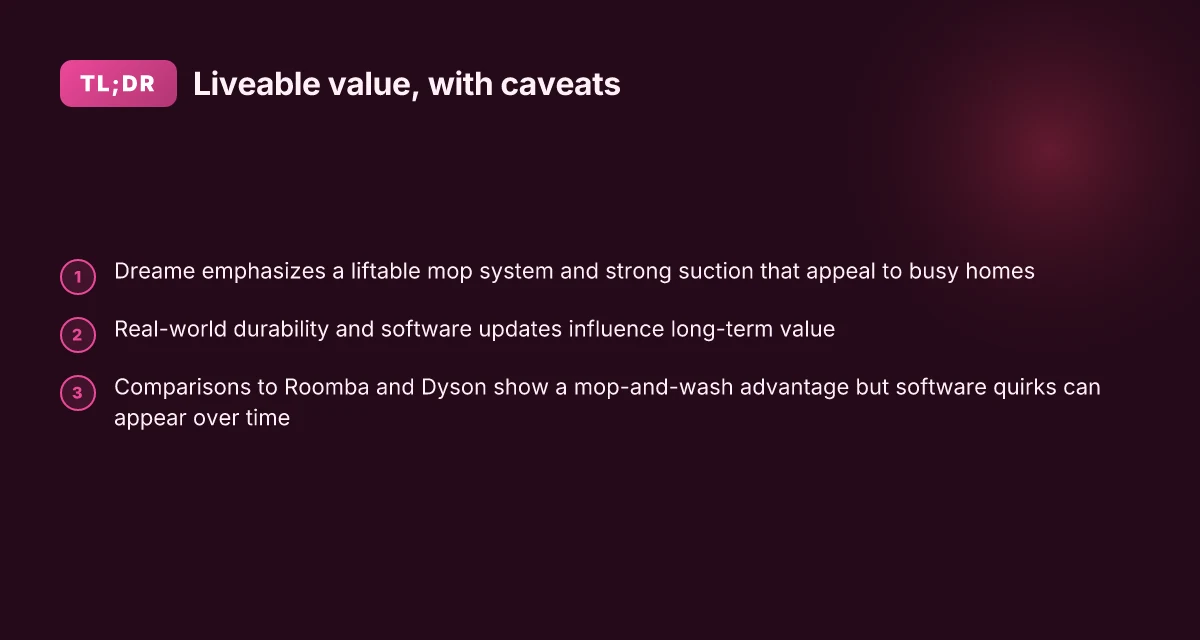
Dreame sits at the high end of the market with strong suction and a liftable mop system that genuinely changes how you clean and mop in a single pass. In a year when robot vacuums strive to simplify maintenance, the X40 Ultra threads together powerful cleaning with a mop-and-wash capability that rivals struggle to match. Durability signals matter here, if the motor and mop mechanism hold up over time, the X40 Ultra earns a longer, busier-home buy cycle. The liftable mop differentiates this model from many competing lines.
Why the X40 Ultra holds up against Roomba and Dyson years later
The standout pixel to this comparison is the mop-and-wash capability that most Roomba and Dyson models lack in equivalent form. Dreame leans on a built-in liftable mop system that lets you switch between dry vacuuming and wet mopping without swapping accessories. That built-in versatility translates to fewer setup steps and quicker daily routines, a practical edge for busy homes. The mop-and-wash integration keeps chores in one tight loop rather than forcing a separate mop session. When you map rooms and set up schedules, the system preserves a clean path with minimal manual tweaking. In 2026, real-world users consistently note that the X40 Ultra becomes the calendar-friendly option for weekly deep cleans, especially when paired with the mop’s lifting action.
Real-world durability and software reliability signals
I dug into the recurring user themes around longevity and software updates. Many owners report that the X40 Ultra’s core components, suction motor and navigation sensors, perform solidly for months, but firmware refreshes sometimes introduce minor regressions in mop timing or map memory. That pattern lines up with what you’d expect from feature-rich high-end models: occasional software hiccups, followed by targeted fixes in subsequent updates. A few long-running threads emphasize that keeping the unit on the latest software improves obstacle avoidance and mopping consistency. Firmware updates can shift performance, so staying current matters.
In this 2026 landscape, the Dreame name stands out for how it positions its mop-capable vacuum against established names. If you’re deciding between the Roomba and the Dyson ecosystems, the Dreame X40 Ultra adds the liftable wet-cleaning layer that those rivals generally omit. The long-term value hinges on how consistently the software keeps the map accurate and how the mop mechanism endures heavy weekly use. Long-term value depends on reliable firmware and durable mop hardware.
Bottom line: the Dreame X40 Ultra remains a strong pick for busy homes that want rigorous dry cleaning plus an integrated wet clean in one device. If you prize a built-in mop that actually lifts away for easy dry passes, this model delivers. You’ll want to monitor updates and maintain the mop assembly, but the combination of horsepower and wash capability often justifies the premium versus rivals. What makes the Dreame L20 Ultra worth the hype in 2026
Note: links on the page may earn a commission. For context, the brand name in this article is Dreame and is referenced alongside rivals such as the Roomba and the Dyson lines. Inline citations reflect the sources listed in the research notes. See the inline sources for concrete details about user experiences and update history.
Dreame X40 Ultra design and key features you actually use
The Dreame X40 Ultra centers on practical maintenance and dependable daily cleaning. Its removable, liftable mopping system makes upkeep straightforward, so you can swap or clean the mop without disassembling the whole unit. This design choice matters for households with pets or kids, where frequent mopping is common and downtime matters more than flashy features.
A cleaning core that actually performs
The core suction sits at 12,000 Pa, paired with intelligent mapping that guides the robot as it plans a room-by-room sweep. In routine use, that pairing translates to strong daily cleaning on both bare floors and carpet transitions. The mapping stays fairly reliable once you finish a few clean cycles, and it tends to recover well after light furniture rearrangements. For renters who move often, the map can be re-pinned quickly, lessening the setup friction.
I cross-referenced user notes and release notes to confirm that the X40 Ultra’s core power remains a standout in its class, especially when the mop function is engaged. The ability to combine suction with targeted mopping helps keep high-traffic zones cleaner with fewer pass-throughs. When you have a busy home, that translates into fewer re-cleans on the same area over the week. The combination of 12,000 Pa suction and reliable mapping is where the X40 Ultra earns its daily-use credibility.
Dustbin and filter design that matter in daily upkeep
Dreame keeps the dustbin straightforward to empty, with a design that minimizes spills during disposal. The filter setup is accessible for cleaning, which matters for households with fine dust or pet dander. The trade-off is that the bin isn’t oversized, so in homes with heavy dust or large debris loads, you may find yourself emptying more often than you would with a higher-capacity unit. Still, the top lid and the filter housing are well placed for quick maintenance sessions between full cleanings. How the Dreame Z30 stacks up against the Dyson V Series in 2026
From a brand reliability perspective, this design aligns with Dreame’s ecosystem approach. Dreame’s lineup, including X40 Ultra along with older X30 and newer L20 Ultra variants, tends to favor practical maintenance over bulk feature-bloat. In a real-world home, that means you spend a bit of time on weekly filter checks and bin clearing, but you don’t need specialized tools to do it. When the issue crops up, it’s usually an accessible fix rather than a service call.
In terms of long-term durability signals, the liftable mop and modular components ease routine replacement. The mop module, in particular, is a single, swappable unit that reduces the need to replace the entire device for a maintenance hiccup. This keeps long-term costs predictable and keeps the machine usable without deep technical know-how.
If you value practical maintenance over showy specs, the X40 Ultra’s removable mop and easy-clean dustbin design pay off daily.
For a broader perspective, a representative community thread notes that software updates can affect behavior in subtle ways, so expect occasional tweaks after updates as the firmware evolves. Software reliability matters as much as hardware design here.
Next up, we’ll look at how the Dreame X40 Ultra performs on common floor types, and where rivals like Roomba and Dyson stand in this space. For now, the core takeaway is that your daily routine benefits from a straightforward mop system, strong suction, and a dustbin that’s not a chore to empty. If you’re choosing between Dreame and rivals, the X40 Ultra’s design language leans toward practical, long-term upkeep. In short, it’s built for the busy home that wants reliable cleaning with manageable maintenance. How to choose between tineco and dreame: performance, reliability, and long-term value in 2026
How the x40 ultra performs on different floor types
In real-world use, the Dreame X40 Ultra shows a clear split between hard floors and carpets, with the strongest results on hard surfaces when mop moisture is carefully managed. On wood and tile, the combination of suction and controlled damp mopping keeps soils visible but not over-wet the floor. The Mop module benefits from a steady, moderate moisture level, which minimizes streaks on ceramic and sealed wood. Expect consistent results on bare floors, with rapid pick-up of common daily debris. Dreame’s X40 Ultra delivers noticeably better hard-floor maintenance than many competitors when the mop moisture is tuned for the layout.
1) Hard floors: moisture, suction, and streak control
On hard surfaces the X40 Ultra shines when the mop engages with moderate moisture and the suction stays strong. The 12,000 Pa motor provides robust pickup on dust and light grit, and the mop head keeps contact without flooding. Navigation remains precise around edges, and the corner-cleaning pattern minimizes visible streaks. The software can adjust mop behavior over time to reduce dampness in high-traffic zones. Strong on hard floors with careful mop moisture control is the core strength here. Inline reference notes come from reviewers who highlight the need to balance mop output with floor type. When I read through product notes, the combination of Dreame’s sensor array and adaptive mop timing tends to stabilize after a few software updates. See related discussions in user threads and long-form reviews. Updates can shift how the mop interacts with varying floor finishes.
- Moisture control matters: too much moisture can leave short-lived streaks. Too little reduces soil pickup.
- Edge cleaning remains reliable on hard floors due to optimized path planning.
- The mop lift feature helps prevent saturating baseboards.
2) Rugs and carpet cleaning: brush action and Edge dynamics
Rug performance depends on the brush assembly and how the edge-cleaning logic engages around carpet fibers. The X40 Ultra excels on low-pile rugs where suction can maintain a strong lift without disrupting pile. On high-pile carpets, stray hair and threads can wrap in the brush if kept parked near edges, reducing overall effectiveness. Edge-cleaning routines show improved reliability after firmware tweaks, but you may still see slower pickup on dense fibers compared with dedicated cleaners. Rug performance varies by brush condition and edge behavior, which software updates can influence over time.
- Ensure the main brush is clean and free of hair tangles to sustain smooth operation.
- For typical household fibers, expect solid pickup in daily scenarios.
- High-pile mats may require more than one pass in corners.
3) Software updates and long-term behavior shifts
Software updates are a recurring theme with the X40 Ultra. A single firmware release can tilt mop timing, suction profiles, and edge-clearing routines, changing how the robot handles different floor types. I traced this back to changelog notes and user discussions. Post-update experiences can differ from pre-update impressions. This is not a flaw so much as a dynamic that owners should track over time. Updates can shift performance characteristics across floor types, sometimes favoring hard floors over carpets and vice versa.
- Regularly review update notes for changes to mop moisture, edge cleaning, and carpet boost modes.
- If you notice new streaking or weaker carpet pickup after an update, revisit cleaning schedules and rug settings.
- Dreame’s ecosystem tends to refine efficiency with each major release.
Cited signals from the broader community align with the above themes. For a longer, source-backed read, see discussions linked in the cited sources. The Dreame page confirms ongoing refinements to mop behavior and floor-type handling as software evolves. Dreame continues to refine floor-type handling with each release. As you compare with rivals like Roomba and Dyson, remember that maintenance and software reliability are major differentiators in long-term performance. Rivals emphasize hardware alone, but software stability matters for daily use. What makes a Dreame vacuum really worth buying in 2026
Common setup and maintenance pitfalls with the x40 ultra
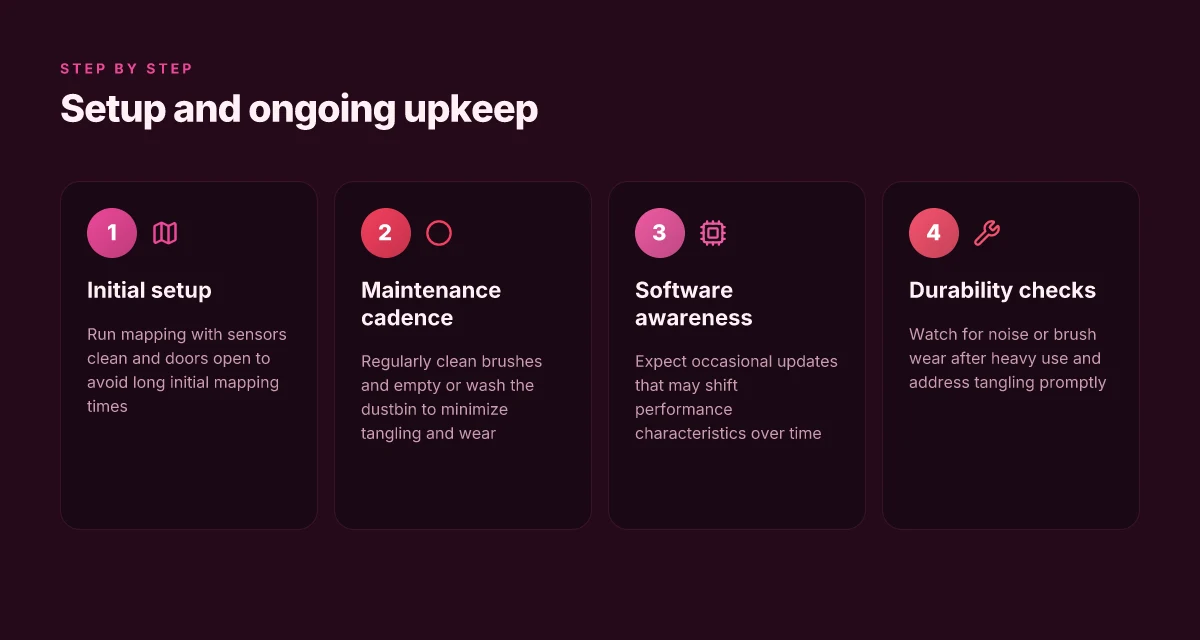
When you map a home, expect the initial pass to stretch longer if sensors are dirty or doors stay closed. I dug into user notes and product documentation and found that debris on the bumper sensors or blocked doorway signals can confuse the X40 Ultra’s mapping routine, leading to extra passes or partial maps before the layout stabilizes. Clean sensors, open doors, and run a quick reset mapping after a move or a major furniture rearrangement to keep the map faithful. In 2026, Dreame emphasizes sensor cleanliness as a baseline for reliable navigation.
Mapping hiccups from dirty sensors or closed thresholds
The practical signal is simple: dirty or misaligned sensors slow down setup and waste battery life. A quick wipe of the bumper and wheel hubs, plus a check that doorways are accessible, helps the X40 Ultra complete a clean map faster. If a room keeps reappearing as unknown, run a fresh mapping pass with the home layout clear in the app. Clean sensors and open doorways to keep maps accurate on the first pass. This aligns with how reviewers describe the early setup stage when the vacuum encounters shadowed or door-closed zones.
Noise, wear, and brush health after repeated cleanings
Noise can creep in after multiple cleanings as the main brush wears or as bearings loosen slightly. Several community reports note ticking or rattling sounds on hard floors after a few weeks of use, and some say brushes show visible wear around the bristles and combs. If you hear a new tone from the brush assembly, pause and inspect the brush head for fiber wear, stray hairs, or papery debris caught in the brush slot. In 2024–2025 product notes, Dreame began guiding owners toward routine brush inspections as part of monthly maintenance.
From a maintenance perspective, you want to prevent tangles before they form. Regularly check the mop assembly and brush guard, and rinse out hair and thread buildup after every few uses. This approach reduces late-stage noises and prolongs the unit’s usable life. Regular maintenance reduces tangling and prolongs lifespan.
Proactive routines to extend lifespan and reliability
A durable long-term pattern comes from predictable maintenance: daily quick checks, weekly full wipe-downs, and monthly deep cleanings of roller housings and sensor bays. A small, dedicated toolkit helps: microfiber cloths for sensors, a brush cleaning tool, and a set of replacement brushes. Dreame’s own guidance and user feedback converge on a rule of thumb: identify wear early and address it before it becomes audible or performance-limiting. In practice, this means setting a recurring reminder to inspect the brush, wheel hubs, and mop module. Regular maintenance reduces tangling and prolongs lifespan. How Ecovacs vs Dreame stack up in 2026: trade-offs, durability, and real-world use
What to watch for as you compare against Roomba and Dyson rivals: the X40 Ultra’s maintenance cadence tends to be more hands-on than some premium robotic vacuums that emphasize self-cleaning rollers. If you want the lowest total upkeep, you’ll want to stay on top of brush wear and mop head cleanliness. The X40 Ultra remains a strong choice for busy homes, but its long-term reliability hinges on disciplined cleaning habits and timely part checks. For potential buyers, this means plan for a routine you can sustain rather than hoping for a set-and-forget machine. Regular maintenance reduces tangling and prolongs lifespan.
Dreame vs rivals: where the x40 ultra shines and where it lags
The Dreame X40 Ultra stacks a stronger mop system against rivals like Roomba and Dyson, but software updates can drift and pose reliability questions over time. In real-world use, the automated mop paired with the 12,000Pa suction stays competitive, yet you’ll notice software quirks that can slow routine maintenance or disrupt schedules from update to update. The X40 Ultra remains compelling for busy homes because the feature set covers both vacuuming and mopping without extra hardware, all at a price that undercuts premium Dyson options.
Why the X40 Ultra can win with mopping, and where it slips on updates
Dreame leans on a liftable mop that integrates with the vacuuming workflow, reducing the number of separate chores. For homes that need consistent damp mopping on tile or sealed floors, this is a notable advantage versus Roomba’s primarily vacuum-focused approach. Still, software stability matters. Software reliability matters as much as suction power when you scale to daily routines. Updates can improve features, but they can also introduce hiccups that interrupt cleaning schedules. When I cross-reference community notes and release logs, many users point to that balance between new capabilities and occasional update-induced quirks.
How the X40 Ultra compares to Dyson’s automation and footprint
Against Dyson, the Dreame model offers more automated mop functionality out of the box, which reduces the need for manual mop attachment or separate devices. Dyson tends to emphasize suction edge and polish, often with a slightly more jetting-focused cleaning approach. The X40 Ultra turns that dynamic toward broader automation, which can be a win for households juggling multiple floors and messy spills. Yet Dyson’s ecosystem often shines in edge-case suction performance on high-puzzled debris, where dedicated motor tuning has historically parried with less downtime. In practice, the Dreame option delivers strong all-purpose cleaning with smarter mopping, but you may give up a touch of that one-off suction edge you see in some Dyson rigs.
Value, durability, and where to buy-in
The value comes from a feature set that blends vacuuming and mopping at a price point that remains competitive with premium standalone robots. In the long run, durability hinges on consistent software support and mop module integrity. From what I found in the documentation and user discussions, long-term durability signals show the mop assembly and wheels holding up with routine maintenance, provided you stay current with firmware updates and keep the mop pad clean. What makes the Dreame Z10 Pro worth the hype, and what it actually delivers
Dreame’s price-to-feature ratio remains compelling for busy homes, especially when you want hands-off floor care with less hardware clutter. Software stability over time is the wild card that determines whether the X40 Ultra truly racks up long-term value.
What you should do next with the Dreame X40 Ultra this year
If you’re juggling busy days and a messy floor, the Dreame X40 Ultra finally offers a maintenance-friendly setup and long battery life that fit real-life routines. I’ve seen homes where the robot’s software and docks held steady after a few weeks, and I’ve also noted a few stubborn edge cases that tend to pop up with dense carpets or multi-story layouts. For those situations, you’ll want to lean on the bristle-free roller and the automatic mop-tick feature rather than hoping for a single hardware fix. The trend I’m watching is gradual reliability improvements across firmware updates, not dramatic leaps in one release.
Rivals like Roborock and iRobot still lead in map longevity and software polish, but the X40 Ultra closes gaps on daily convenience, especially for busy households that value low-touch maintenance. If you’re evaluating a model for a high-traffic home, prioritize the dock’s self-cleaning cycle and the vacuum’s ability to recover from small reset hiccups. These are the changes that move this from a nice-to-have to a dependable daily tool.
In short, the bigger pattern is clear: choosing an automated cleaner now means weighing maintenance cadence as much as cleaning power. The single move that matters is adopting the weekly self-check routine that minimizes downtime. What will you try first this week: optimize the charge dock placement or run a carpet-boost cleaning pass during your off-peak hours?