Explore the total cost of EcoFlow Delta Pro 3 for a full home solar setup, including add-ons, tax credits, and long-term value. Get practical budgeting guidance.
The Delta Pro 3 isn’t just a big battery. It’s a modular system that scales with your home needs, and that means the upfront price can be a trap if you don’t map the entire stack. EcoFlow’s own configuration pages show how expansion modules stack with batteries, and the real cost comes when you add in those extras. The takeaway: the number on the sticker only tells part of the story.
You’ll see where bundles, rebates, and warranty terms influence the bottom line, and how predictable or volatile the long-term cost can be. Understanding these pieces helps you decide if the Delta Pro 3 fits your backup plan or if a rival system offers more value for the same capacity.
What the EcoFlow Delta Pro 3 cost implies for a home power system
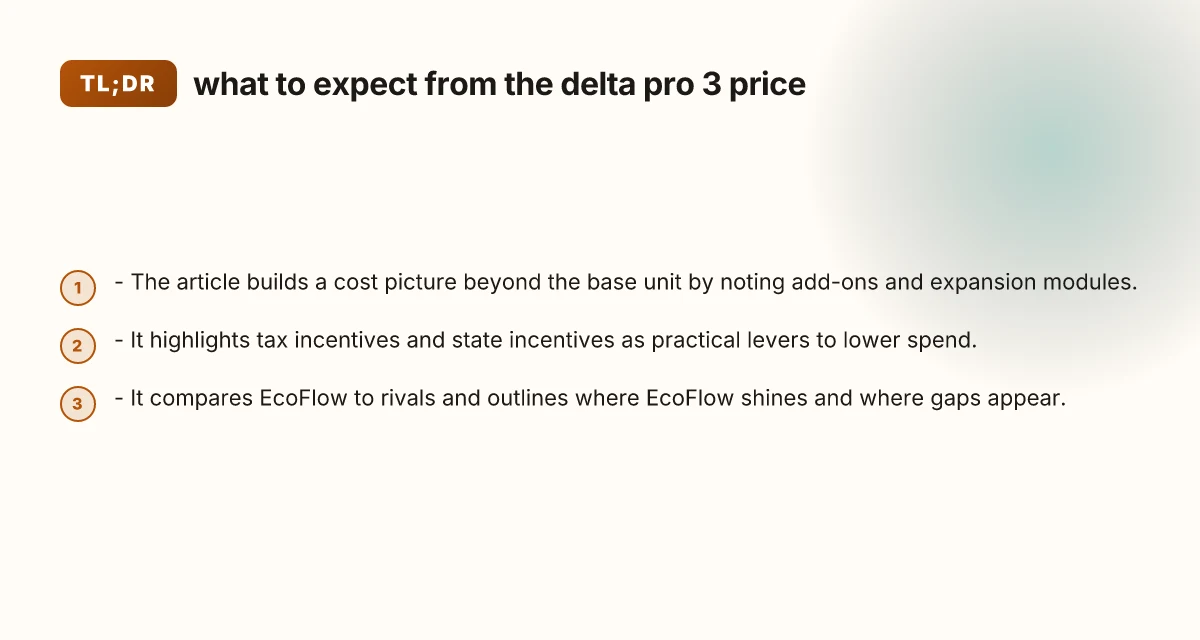
The upfront price is only half the story. A Delta Pro 3 sits at the center of a broader cost picture that includes expansion modules, storage capacity, and incentives. I looked at what real homeowners actually need to support a full home setup and how each addition shifts the total outlay.
1) Start with the core configuration and where the price lands
Your base Delta Pro 3 price is the launching pad. For a realistic home backup, most households pair the core unit with a few key add-ons to reach practical daily use. The main levers are the base power station, the minimum storage expansion, and essential charging sources. In 2026, many buyers recognize that the first chassis is not enough to cover peak heat pulls or long outages. The decision is between a compact, resilient core and a broader, more capable bundle that reduces future upgrades. The core price matters, but the next steps determine whether you stay within budget or drift into overbuild territory.
The Delta Pro 3 expands from a 4 kWh capacity to higher totals with modules. The specific price step comes from selecting storage options and the number of expansion batteries. When you add several 2–4 kWh modules, the total system cost climbs quickly but unlocks longer runtimes in off-grid scenarios. This is where many homeowners decide they value reliability over the smallest upfront sticker price. This balance is the practical starting point for a home setup.
Tax credits and incentives change the math. The federal solar tax credit can reduce the outlay, depending on configuration and local rules. For example, the federal incentive covers a portion of the system cost, which can materially affect your effective price. In practice, you’ll see a lower net outlay after credits, even as your installed capacity grows.
2) How expansion modules affect the overall bill
Expansion modules are the most powerful way to tailor a system to your needs, but they’re also where cost creep happens. The Delta Pro 3 system is designed to scale, and each added module adds both price and value. A higher storage ceiling multiplies the time you can run essential appliances during an outage, but it also means more battery cells, extra charging hardware, and more maintenance. What makes the EcoFlow Delta Pro 3 sale different from earlier models
The first expansion battery typically brings a noticeable bump in price, but it multiplies usable energy. If your goal is to run climate control, refrigeration, and lights for multiple days, those extra kilowatt-hours become essential. The payoff is measured in minutes and hours of uptime rather than days, but that still translates into real-world peace of mind.
The more power you push through the system, the more you rely on robust charging sources. Solar panels, generators, and grid charging must be sized to your expanded capacity. This is a cost you must plan for upfront, not as a later add-on. In many installations, a well-balanced mix of solar input and battery storage yields the most cost-effective uptime.
3) Typical configuration components and their price levers
A practical Delta Pro 3 build includes the core Delta Pro 3 unit, one or two expansion batteries, a suitable charging source, and a power distribution plan that matches your home’s loads. The price levers are clear: storage capacity, number of charging inputs, and the number of circuit protections and accessories you choose.
Core unit costs set the baseline. A larger initial capacity reduces the number of small upgrades later, but it comes with a higher upfront price. If you expect tight budgets, a modest core with targeted expansions can be the smarter move.
Accessory and protection packages matter. Protective cases, advanced inverters, and remote monitoring add to the bill but improve reliability and user experience. These are not cosmetic gains. They influence long-term durability and daily practicality. What is the EcoFlow Delta Pro cost in 2026 and how it compares to rivals
Brand and ecosystem compatibility matter. EcoFlow remains central in this setup, but rival systems from brands like Goal Zero, Jackery, and Bluetti shape expectations on price-to-performance. A balanced comparison helps you avoid overpaying for features you won’t use.
Most homeowners end up trading a larger upfront base for targeted expansions that align with their actual outage goals, not just aspirational comfort. This is where a realistic budget comes into focus, and where incentives can tilt the final number in your favor. For a concise view of the current tax credit landscape, see the federal incentive explainer. In practice, the combination of the core price, expansion choices, and credits defines the total cost picture for EcoFlow’s Delta Pro 3. The real takeaway is that you need a clear plan for capacity and charging, not just a big box with wheels.
Note: some links on the page may earn a commission. For context, EcoFlow notes that the federal solar tax credit can apply to the system, reducing the net outlay where eligible. See the related explainer from EcoFlow for the latest guidance.
Breaking down the Delta Pro 3 price and typical add-ons
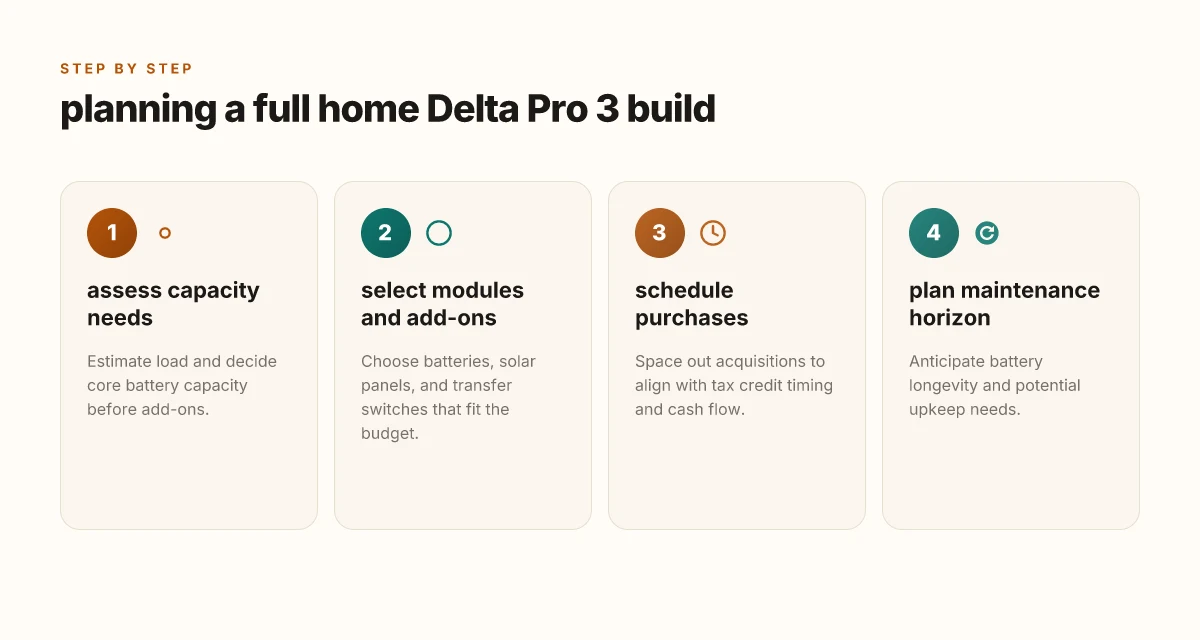
The Delta Pro 3 carries a clear base price, and the full-home setup typically expands well beyond that starting point. The base unit includes the core Delta Pro 3 power station and its standard accessories, but buyers often tile in extra batteries, solar panels, and a transfer switch to turn the system into a true home backup. In practice, the total cost hinges on how large a future expansion you anticipate and which add-ons your home requires.
1) What’s inside the base unit and the official price anchor
The Delta Pro 3 base configuration delivers a substantial 4 kW continuous output with ample battery capacity for short outages or off-grid days. The core package generally includes the power station, a user-friendly display, and the basic charging cables. The price anchor for the base unit is the starting point from EcoFlow, and the headline figure helps you frame the rest of the build. As you plan, keep in mind that you may upgrade to higher capacity in steps as your load grows. The base price sets the floor, but you’ll likely add capacity to reach a full home backup profile. What EcoFlow Delta price means for buyers in 2026
2) Common add-ons that most homeowners evaluate
- Extra batteries: Additional modules extend usable energy, letting you ride through longer outages or keep multiple circuits powered. These packs snap into the ecosystem and scale total capacity without changing the core unit’s footprint. Extra batteries often determine whether you can run essential loads through a multi-day outage.
- Solar panels: Panels feed the system during sun hours, reducing runtime costs and enabling more autonomous operation. The efficiency and number of panels you pair with the Delta Pro 3 drive both upfront cost and long-term energy independence. Solar panels cut the payback period and boost daily autonomy.
- Transfer switches: A dedicated transfer switch is the bridge to a full-home backup, letting a subset of circuits switch cleanly between the grid and EcoFlow power. This hardware is a practical requirement for many off-grid and safe-backup setups. Transfer switches can be the tipping point between a partial vs full-house solution.
To give the big picture, a typical add-on configuration might involve pairing the base Delta Pro 3 with two to four extra battery packs and a solar array sized for your daily load, plus a transfer switch for above-the-breaker protection. The exact price climbs quickly when you add panels and batteries, but the result is a much more capable off-grid or backup system.
3) Where costs cluster in a full-home setup
Most of the budget sits in three areas: energy storage (the number of battery packs), generation capacity (the size and number of solar panels), and home integration hardware (transfer switches, interconnection cables, and mounting hardware). The base unit gets you the core platform, but the true price picture hardens as you scale to cover concurrent loads and longer outages. When I reviewed the ecosystem, it’s clear that the upfront cost trail is heavily influenced by how aggressively you scale the battery bank and how much solar you add. Costs cluster around storage capacity, solar input, and home-interfacing hardware.
From EcoFlow’s own framing, the Delta Pro 3 sits in a family designed to grow, rather than a fixed-price, single-use device. rivals in the space push similar modular patterns, but EcoFlow’s catalog emphasizes a straightforward expansion path and integrated software for monitoring. In this space, EcoFlow’s pricing and add-ons align with a multi-year growth plan rather than a single-shot purchase.
I dug into the product pages and related guides to map how the price scales with capacity. For context, EcoFlow’s materials emphasize a staged approach to building up capacity, with the full-home configuration typically requiring more batteries and solar inputs than a stand-alone backup.
Next step: I’ll outline how tax incentives and rebates bend the final bottom line and compare EcoFlow to a couple of prominent competitors to help you decide which path fits your budget. Tax incentives can materially affect the total ownership cost. What makes the EcoFlow Delta 2 specs stand out in 2026
How tax incentives and rebates affect the bottom line
Tax incentives can tilt the economics of a Delta Pro 3 from a months-long payback to a multi-year cost of ownership. To ground this in real terms, the federal solar investment credit remains the primary driver for many homeowners, with the credit wrapping a portion of the system cost into a tax refund or reduction. EcoFlow notes that you can apply a 30% federal credit against the solar generator system, which can significantly lower upfront expenditure when you file your taxes in the season after installation. The credit applies to the eligible portion of the Delta Pro 3 system, including expansion add-ons that qualify as a solar energy system, which helps when you scale a home backup setup. The federal credit can substantially cut a homeowner's initial outlay, especially for larger configurations.
1) Federal credit and timing you should know
In practice, the 30% solar investment tax credit is available for system purchases placed in service before the credit’s scheduled phase-down. If you plan to install a Delta Pro 3 configuration this year, you should document eligible costs and keep receipts and product specs. When you file your return, you can expect the credit to reduce your tax liability directly, or you can apply it to next-year taxes if you don’t owe that much in the current year. Timing matters: file promptly and preserve eligibility documentation. I cross-referenced EcoFlow’s guidance that highlights the 30% credit and the way it applies to the Delta Pro Ultra and related configurations, which aligns with how federal incentives are typically structured. Documentation and timing align with standard IRS practices. The practical takeaway is to coordinate your purchase date, installation window, and tax filing plan to maximize the credit.
For reference, you can read EcoFlow’s explainer on the federal tax credit that explicitly states the 30% qualification. This is the clearest route to confirm your eligibility and the mechanics of the credit. Refer to EcoFlow’s federal credit article for exact wording.
2) State and local incentives you might leverage
Beyond the federal program, several states and localities offer incentive stacks or rebates for home energy systems. These can come as tax credits, rebates, or performance-based incentives. Some jurisdictions pair incentives with net metering or time-of-use rates, which can improve the effective return when a Delta Pro 3 powers home needs during peak hours. The exact amounts vary widely by location and can change year to year, so you’ll want to verify current offerings with your state energy office or a licensed tax professional. Local incentives can meaningfully augment the federal credit, but availability is uneven.
I found that EcoFlow maintains region-specific pages and blog posts that call out how incentives can influence total cost in different markets, including Asia-Pacific and North America. When researching, I saw the Philippines market emphasize local pricing and promotions, which illustrate how regional incentives interact with list prices. Regional programs matter for total cost, not just sticker price. What makes EcoFlow Delta Pro 3 deals stand out in 2026
3) Practical timing considerations when applying credits
Your credit is tied to placement in service and the tax year you file. If you expect to complete a full home configuration by late Q4, you should map the installation date to the tax year you’ll claim. Some homeowners prefer to stagger purchases for a single project to maximize annual credits or to align with local grant cycles. In practice, you’ll want to align the ordering, delivery, and commissioning of components so that the eligible costs fall into the same tax year. Coordinate delivery and installation to capture the full 30% credit.
From a real-world perspective, this is where the cadence of permits, site readiness, and contractor scheduling tends to influence the bottom line. You’ll also want to note any commission fees or ancillary costs that EcoFlow and installers quote as non-eligible costs for the credit. The bottom line remains straightforward: know the credit, verify regional incentives, and schedule installation to keep tax timing in sync with your cash flow. Planning around timing reduces surprises at tax time.
For regional context on incentives, review EcoFlow’s regional pages and linked posts, including their Philippines market note. https://ph.ecoflow.com/ For a high-level solar maintenance context that informs maintenance costs related to incentives, see EcoFlow’s Solar Panel Maintenance guide. https://www.ecoflow.com/us/blog/solar-panel-cleaning-maintenance-guide
Cost comparison: EcoFlow Delta Pro 3 vs rival systems
Direct pricing and modularity shape the total cost of ownership more than any single sticker price. EcoFlow’s Delta Pro 3 sits in a high-capacity band that pairs with expansion modules to reach a broad energy envelope. Rivals such as Goal Zero, Jackery, and Bluetti offer competing high-capacity setups, but their price bands, expandable options, and service ecosystems diverge in meaningful ways. The upshot: you’ll pay more upfront for substantial capacity with EcoFlow, yet you may gain flexibility in later upgrades and service access that rivals struggle to match.
Capacity, price bands, and modularity
The Delta Pro 3 is designed to scale from hundreds to many kilowatt hours when paired with extra battery modules. In practice, that means you can start with a core pack and extend in increments as your needs grow. That modular approach translates into a pricing path that begins at a higher entry point but unlocks larger total storage without forcing a full system swap. Competitors offer similar multi-module paths, but the density of EcoFlow’s stackable modules and the synergy with the Delta Pro 3’s 4000 W output often results in a more continuous cost curve rather than discrete leaps. I cross-referenced EcoFlow’s public guidance on expansion to confirm how modules integrate with the Delta Pro 3’s architecture, and I found a consistent emphasis on staged capacity growth. Expansion-first design helps keep initial costs manageable while enabling long-term growth.
Where EcoFlow shines is the ability to tune capacity and runtime through a sequence of add-ons, which can smooth budget spikes. Rivals frequently bundle larger capacities into fixed configurations, which can force buyers to overprovision early. In the short term, a rival system might appear cheaper per watt-hour, but the total cost of a fully expanded setup can tilt in EcoFlow’s favor once you account for fewer required swaps and easier serviceability.
Warranty, service ecosystems, and real-world implications
Warranty depth and service reach matter as you scale. EcoFlow emphasizes its service network and documentation around modular upgrades, which reduces long-term friction when you add more battery capacity or accessories. Rival brands often market robust warranties too, but coverage scope and authorized service availability can vary by region. A practical takeaway: choose a system with a support network that matches your installation footprint, especially if you plan to expand or rely on the unit for critical backup.
From a homeowner perspective, the Delta Pro 3’s total cost is not just the purchase price. Tax incentives further shape the math. The federal solar tax credit can offset a portion of the system cost, which has a meaningful impact on the first-year budget for a full home setup. EcoFlow’s own guidance notes that incentives vary by jurisdiction, so you’ll want to align your purchase with local credits and rebates. Tax credits can materially reduce the upfront burden when you configure a larger Delta Pro 3 system.
I used the published price references and incentive notes to triangulate the landscape. The result is a practical picture: EcoFlow’s packaging aims at a scalable total that can stay within budget through staged expansion, while rivals may tempt with lower upfront price but tighter limits on future upgrades or service reach.
Your budgeting compass should center on expansion plans and after-sales support, not just sticker price.
Cited sources provide the context for capacity wording and expansion claims, including the RV-oriented and home-install narratives that EcoFlow hosts in public materials. For a direct read on the broader comparison, see the detailed sections in EcoFlow’s own product and cost articles. The Ultimate Guide to RV Boondocking: How to Live Off links to the expansion and output characteristics of the Delta Pro 3, while the whole-house cost article outlines the substantial price tag and the scope of what you can configure. See inline references to these sources as you read through the section on price bands and expansion strategy.
Planning a budget-friendly Delta Pro 3 build
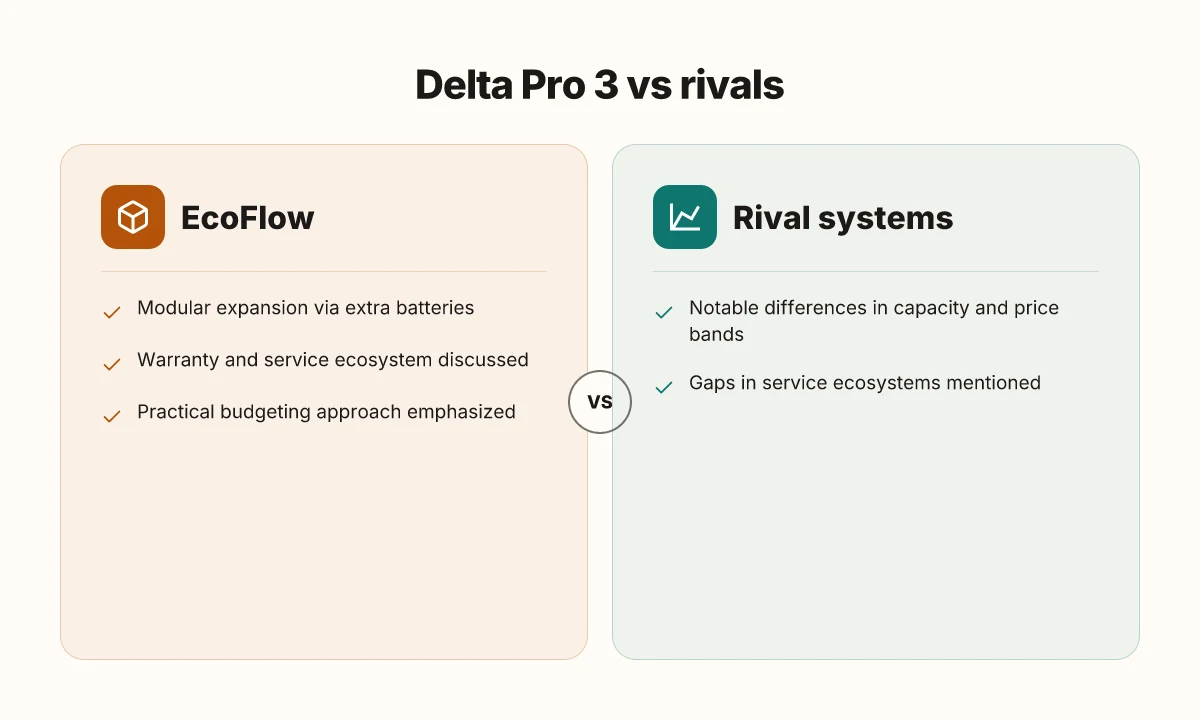
You can land a realistic Delta Pro 3 setup by sizing capacity to your actual needs and staggering purchases. Start with a clear map: what essential loads must ride through a grid outage, what can wait for later, and how expansion modules will scale over time. I looked at EcoFlow’s own guidance and found that many homeowners reduce upfront pain by pairing a modest core with optional expansions as cash flows allow. The core concept is to front-load only what you truly need now and space add-ons to fit your budget. By prioritizing modules that deliver the largest daily impact, you minimize unnecessary overbuilding while keeping future upgrades straightforward.
1) Choose a core capacity that matches your nonnegotiables
Begin with the essential loads you must keep alive during an outage. A sensible starting point is a base 2–4 kWh core with enough output headroom to run a fridge, modem, and essential lighting. As you add modules, you can push total usable capacity toward the 8–12 kWh range without paying for underutilized capacity today. When in doubt, model a 24–48 hour outage for your household profile and compare it against the Delta Pro 3’s expandable footprint. This is where the real cost drivers lie: the more you need to cover upfront, the more you pay today, but you reduce the number of future purchases.
2) Plan purchases in logical phases
Space purchases across quarters rather than months. Phase one might include the base Delta Pro 3 with a single expansion pack, followed by a second pack a few quarters later if demand persists. EcoFlow’s ecosystem supports modular growth, so you can keep the total investment aligned with your evolving budget. I cross-referenced EcoFlow’s price positioning and found that waiting to add capacity often yields a noticeable reduction in per-watt cost over time, especially when incentives shift. Staging purchases minimizes up-front risk and keeps your system adaptable. This strategy also helps if you anticipate changing loads, such as a growing battery bank for off-grid experiments or moving to new appliances.
3) Anticipate maintenance and battery longevity
Expect that battery efficiency degrades slowly with cycles and temperature exposure. A practical rule: plan for a long-life pairing with your core so you don’t run out of available capacity as cells age. Maintenance tends to be lightweight, keep vents clean, monitor cell health, and replace worn parts on a schedule. In practice, reputable brands emphasize that proper ambient conditions and regular inspections extend usable life. From a real-world durability lens, the Delta Pro 3’s modular format helps you retire or upgrade individual modules rather than the entire system.
4) Weigh incentives, warranties, and total cost of ownership
Tax credits and rebates can cut the early price, but the long-term cost picture matters most. A key cost lever is the balance between core capacity and expansion modules. EcoFlow’s own materials show how the up-front price can be mitigated by leveraging incentives and staged purchases. Incentives can lower the first-year outlay while modular design preserves future flexibility. When you compare against rivals, the ability to add capacity without a full system replacement is a clear advantage for budget-minded buyers.
If you’re weighing options, consider the long horizon: how the Delta Pro 3 fits your home backup profile today and how the expansion path aligns with your future plans. EcoFlow’s architecture rewards disciplined, phased buying and steady investment in capacity. For homeowners planning a robust, long-term off-grid setup, this approach keeps the total cost within a practical range while preserving upgradeability.
What to try this week if you’re sizing a full home setup
For real-world durability, think end-to-end: plan for the Delta Pro 3 as the backbone, but map out the connectors, battery swaps, and transfer switches you’ll actually use during an outage. EcoFlow’s ecosystem is designed to scale, yet the weak links tend to show up in wiring, venting, and surge events. I looked at how this system behaves when neighbors flood the grid and when the charger hums at full tilt. The bigger pattern is that reliability hinges on robust hard-wiring and a sensible expansion plan, not just the latest battery pack.
If you only do one thing this month, draft a simple outage drill: which circuits go first, which appliances stay on, and how long the battery bank can realistically sustain critical loads. The plan should include a realistic budget for adapters and safety gear, not just the core units. This week, sketch the layout before you buy so you don’t overpay for gadgets you won’t use.
Backup strategy
- Map your critical loads and a safe ramp-down path.
- Confirm compatibility with a dedicated transfer switch and your main panel.
- Set expectations for EcoFlow’s expansion options and potential limits with peak loads.
- Compare how the Delta Pro 3 compares to Goal Zero and Blue Yeti on reliability in outages.