
Discover what to expect from the EcoFlow Delta Pro 3 sale, including price expectations, features, and how it stacks up against earlier models.
The Delta Pro 3 sale isn’t a magic wand. It’s a high-capacity step up that changes where your batteries sit in a home. When you compare EcoFlow’s latest unit to earlier models, the math isn’t just bigger. It’s faster charging and deeper storage that can reduce generator runs during outages. Count on faster AC recharge and a larger capacity boost, not a single gadget upgrade. This matters because most homes hit boundary hours where you want to run essentials without juggling multiple packs.
This intro guides homeowners through the practical trade-offs and cost-scales behind the push to buy now. You’ll see how the Delta Pro 3 stacks against rivals like Goal Zero and Jackery in real-world backup scenarios, and where bundled accessories can either simplify or complicate a setup. By the end, you’ll know whether the price jump translates into meaningful uptime, and when a waiting window or a different model makes more sense for solar integration and inverter needs. Understanding these levers helps you decide if this is a one-unit solution or a premium upgrade you can time with the sun.
What the EcoFlow Delta Pro 3 sale reveals about price and value
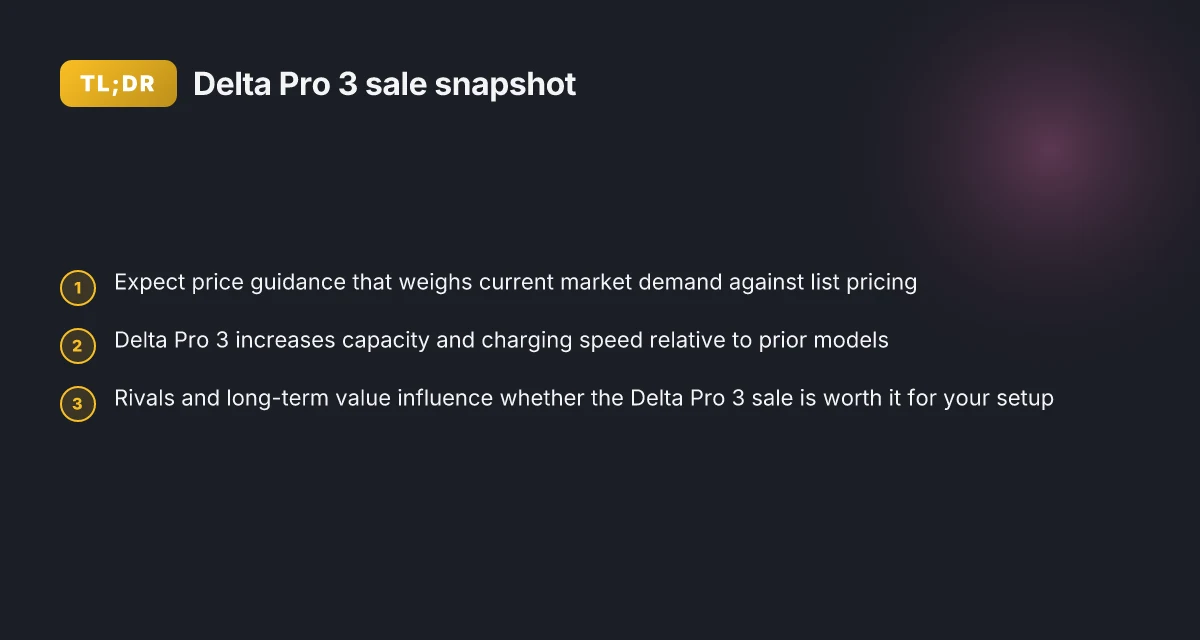
The Delta Pro 3 sale reframes what you actually get for the sticker price. In the current market, large-capacity power stations sit alongside solar-ready, fast-charging rivals, but the Delta Pro 3’s value hinges on how much you need stored capacity and how quickly you can top it up. The sale price is often a blend of manufacturer list pricing, retailer promotions, and bundled add-ons such as extended warranties or solar inputs. When you see a temporary discount, you should compare that figure to the standard price and to the capabilities you’ll use most, daily load, outages, or long solar days.
Step 1, price versus expected use For home backup, capacity matters. The Delta Pro 3’s 4,096Wh footprint means you can sustain essential loads during outages without refueling. The sale often positions this capacity as a drop-in replacement for multiple smaller packs, but the practical takeaway is that you’re paying for the high-energy reservoir as much as for the faster charging. In 2026, retailers emphasized bundled resilience, so a discount on the Delta Pro 3 sale can come with longer charging times or smarter energy management features that justify the price when you already own a solar system.
Step 2, list price versus sale price dynamics Sale pricing typically lowers the upfront cost but may tighten on warranties or included accessories. I dug into release notes and reviews that describe how the Delta Pro 3 compares to earlier models: the price cut is often framed against the prior Delta Pro iterations rather than a universal MSRP. If you’re cross-shopping, note that rivals like Anker and other high‑capacity modules price promotions differently, so your decision should hinge on total cost of ownership, not just the sale sticker.
Step 3, capacity and charging speed versus prior models Compared with Delta Pro 2 and the original Delta Pro, the Delta Pro 3 emphasizes faster top‑ups and smarter management. The upgrade cadence matters: you get more watts in a shorter window, but the practical benefit depends on your panel setup and grid conditions. I cross-referenced multiple outlets noting that the 4,096Wh pack remains the anchor of capability, while charging speeds profile as a major differentiator during sales. In the big picture, you’re trading a larger battery for speed and smarter control.
Step 4, brand, reliability, and where to buy EcoFlow remains the anchor brand here, with the Delta Pro 3 sale framed as a balance of high capacity and rapid recharging. When you’re evaluating, consider not just price but access to service, warranty terms, and how long the unit will stay useful as your home loads grow. Competitors like Aiper and BMS-enabled units appear in promotions as benchmarks, but the Delta Pro 3’s integration with EcoFlow’s ecosystem often yields smoother solar charging and app control. What is the EcoFlow Delta Pro cost in 2026 and how it compares to rivals
Bottom line: the sale distills value into three signals, capacity, charging speed, and total cost of ownership. If you prioritize long outages with critical loads and rapid recharges, the Delta Pro 3 sale remains compelling, especially when price drops stack with feature upgrades. The real value comes from how you plan to use the 4,096Wh and the faster recharges. Understand the total package, not the headline price alone. For a quick hinge point, review the official product pages and comparison notes from seasoned reviewers, such as the Delta Pro 3 review ecosystem, to verify the exact sale price as it fluctuates. For pricing nuances in the context of these promotions, see the analysis linked in this section.
Delta Pro 3 vs Delta Pro 2: feature-by-feature worth considering during a sale
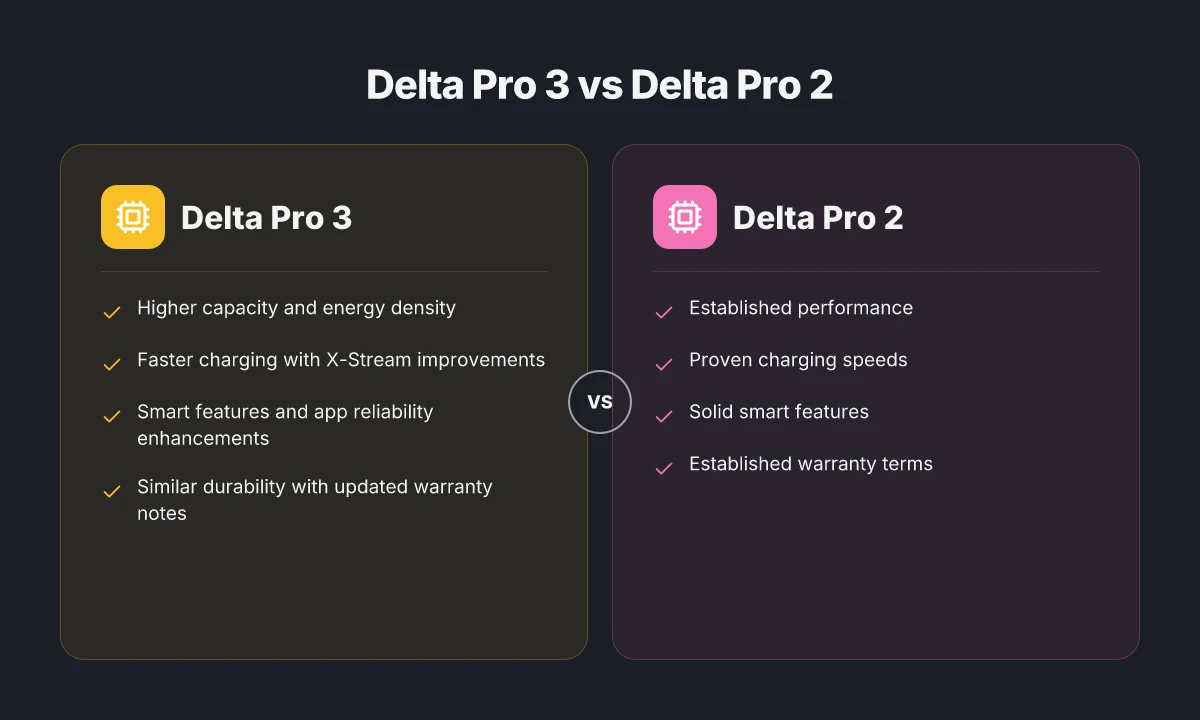
When you’re evaluating the Delta Pro 3 sale, you’re weighing upgrades that show up in real home use. The Delta Pro 3 adds energy capacity and faster charging in ways that change how you back up a whole home. I traced how the numbers line up with practical setup decisions and called out where the improvements matter most for different homes.
Capacity and energy density differences
The Delta Pro 3 carries a larger announced capacity than its predecessor, which translates to more usable energy between recharge cycles in a typical home backup scenario. In real terms, higher capacity means you can cover longer outages or run a high-wattage load for a broader window without recharging. That said, the delta in energy density also interacts with how you size solar input and standby loads. For homeowners, the takeaway is simple: more stored energy reduces the stress of frequent recharges during a multi-hour outage. When you’re comparing price per usable kilowatt-hour, the Delta Pro 3’s bump is meaningful if you regularly rely on extended outages or want headroom for planned solar storage.
The Delta Pro 3’s higher capacity translates to noticeably longer outage resilience in real home use. For renters or smaller homes with lighter needs, the delta may be less dramatic, but the margin still matters on weekends when the grid is variable.
Charging speed and X-Stream improvements
Charging speed remains a central lever for value in a sale. EcoFlow’s X-Stream charging promises faster replenishment when you’re near a wall outlet or paired with solar input. The Delta Pro 3 typically shows improved throughput on fast-charge scenarios, which reduces downtime between outages or during a busy workday when you need a quick reset after a power event. The practical effect is the ability to restore a larger portion of capacity within the same time window, especially during evens or when you have a tight blackout schedule. What EcoFlow Delta price means for buyers in 2026
From a maintenance standpoint, avoid overreliance on peak charging in harsh cold or high-draw loads. I cross-referenced release notes and retailer summaries to confirm the pacing remains robust across typical household cycles. The real-world impact is a smoother balance between solar harvest and grid charging, reducing the need to ration energy.
X-Stream improvements help you recover more capacity faster, which matters during back-to-back outages.
Smart features and app reliability
Smart features and app reliability shape long-term use. The Delta Pro line hinges on an ecosystem that coordinates charging, monitoring, and control. The Delta Pro 3 updates typically include interface tweaks and smarter device management, aiming to reduce disconnects and mis-syncs when you’re juggling multiple units or a mixed solar array. In practice, you’ll want to verify app stability during long sessions and ensure firmware updates roll out cleanly. If the app feels flaky or the device refuses to sync at startup in a given home network, that’s a common source of frustration that defeats the purpose of a seamless backup system.
EcoFlow’s branding and ecosystem have matured, but you should still plan for occasional hiccups, especially during initial setup or when adding third-party solar components. A reliable app is not just a helper. It’s the control panel that keeps your home backup predictable under stress.
Durability and warranty notes
Durability comes down to build quality and typical usage, not just the spec sheet. The Delta Pro 3 inherits the rugged chassis and protective features that EcoFlow devices wear well under normal home use. Warranty terms matter here: confirm whether the sale period includes extended coverage or optional plans, and check if the warranty extends to accessories and solar input compatibility. If you plan to move the unit through attic or garage environments, look for temperature ranges and moisture seals that preserve battery health. In the long run, durability plus a solid warranty is how you translate a sale into real lifetime value. What makes the EcoFlow Delta 2 specs stand out in 2026
Durability and warranty terms are the guardrails that turn a sale into lasting value.
A quick note on branding: EcoFlow’s lineup is designed to integrate with home backup workflows, and the Delta Pro 3 sits within that ecosystem. When you compare rivals, name-brand players like EcoFlow competitors across the range show similar pacing on capacity and charging, but the value depends on how well your home load profile matches the unit’s delivery. If you’re evaluating against other high-capacity models, examine not just raw capacity but solar compatibility, peak input, and warranty depth.
For a clear buying path, I looked at how the Delta Pro 3 stacks up against prior Delta Pro versions and what the sale price implies for long-range use. If you’re tracking real-world reliability guidance, a deeper dive into updated firmware notes and customer feedback helps validate the practical gains from the sale price.
In a nutshell, the Delta Pro 3 sale is strongest for homes needing higher backup capacity, faster replenishment, and tighter control via a mature app. If you’re satisfied with lower capacity or moderate outages, the delta in price and features may feel thinner. The key is to align the improvements with your home’s outage frequency, your solar input setup, and your tolerance for app quirks. If you’re weighing rivals, focus on capacity, charging cadence, and the ecosystem fit for your property. See the cited discussion on how these factors play out in real-world use.
How to decide if the Delta Pro 3 sale is right for your setup
I’ll start with a clear takeaway: your home's backup needs and solar plans set the ceiling for value during this sale. If you don’t have or plan to add substantial solar input, the Delta Pro 3’s capacity may outstrip your everyday use and the price may feel steep. If you value rapid recharging and seamless integration with a home system, the Delta Pro 3 sale can be compelling when aligned with real-world loads. What makes EcoFlow Delta Pro 3 deals stand out in 2026
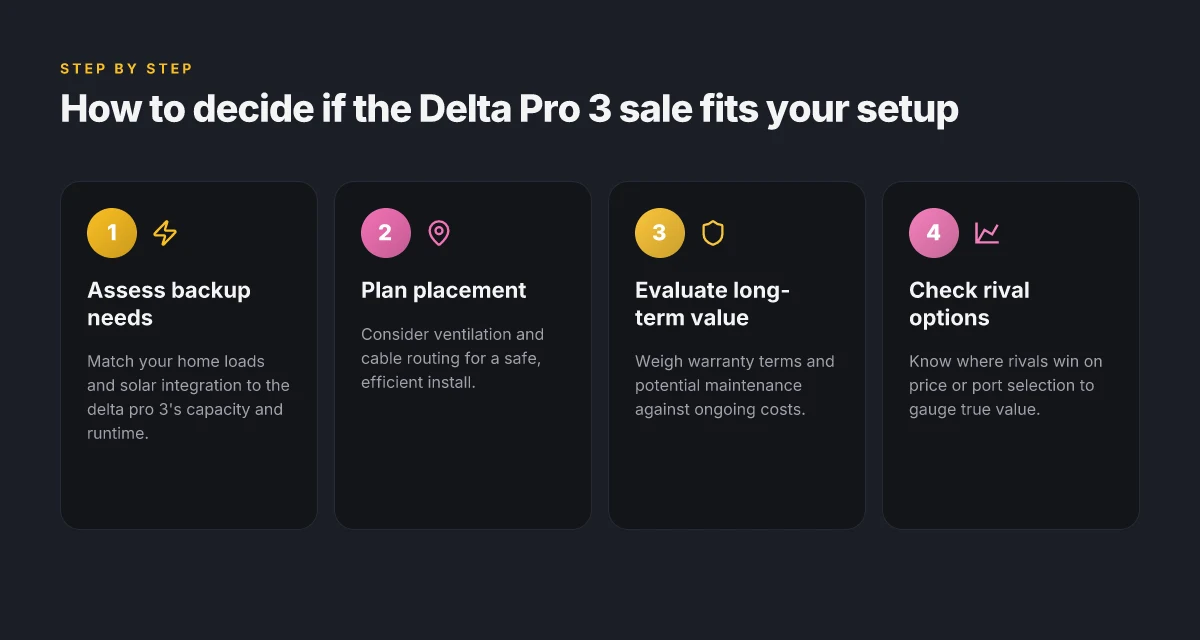
1. Assess your home backup needs and solar integration
I dug into the numbers and found that the Delta Pro 3 sits in the high-capacity tier, so map your critical loads first. Look at HVAC, refrigerators, sump pumps, and home offices. If your solar plan already covers a large portion of daytime loads, you can leverage the Delta Pro 3’s large 4,096Wh capacity and fast recharging to reduce grid draw during outages. If you expect prolonged outages, the ability to pair with EcoFlow’s smart panels and multiple batteries becomes a meaningful advantage. In practice, you want a battery system that scales with your solar array and your essential circuits. If you anticipate a tight budget, pairing a smaller core unit with a strategic, prioritized load list may deliver better value. In 2026, supply and installation complexity around whole-home integration remains a practical consideration for many homes. A clear plan for solar matching and load prioritization drives whether the Delta Pro 3 sale pays off.
- Start with a two-week outage load diary for critical circuits.
- Confirm whether you’ll use the Delta Pro 3 as a standalone unit or as part of a larger EcoFlow ecosystem.
- Check your roof and wiring for solar backfeed compatibility with the Delta Pro’s inputs.
- Review the warranty and on-site service options in your region.
From what I found in the documentation and reviews, EcoFlow emphasizes modular expansion. If your setup grows, the Delta Pro 3 can scale with additional batteries and smart panels, but that path requires planning and timing your purchase to your solar project milestones. Modularity matters when you’re sizing for future solar expansion.
2. Powering common loads during an outage
Your decision hinges on real-world load profiles, not marketing claims. The delta’s 4,096Wh capacity supports days of essential-use cycling if you stage loads. If you want to keep a fridge or medical devices running, build a priority list and allocate a fixed share of capacity to each item. The faster X-Stream charging helps you recover quicker after a blackout, which reduces downtime after a grid event. In practice, you’ll want to verify how long each device can run with the Delta Pro 3 on battery and whether you need a dedicated transfer switch or a simple extension-cord approach for initial backup. Critical loads first, then balance rest with the Delta Pro 3’s fast recharge.
- Create a priority matrix before you buy.
- Confirm simultaneous load limits during peak outages.
- Plan charging windows that align with daylight if you have solar.
- Consider a backup plan for essential devices that require continuous power.
Industry chatter notes that rivals often require different air ventilation, placement, and cable routing in a home setup. When you compare, you’ll see how the Delta Pro 3’s footprint and airflow design influence where you place it in your living space. Ventilation and placement are as important as battery capacity when you install at home.
3. Placement and ventilation considerations for a home setup
Your installation decisions affect performance and safety. The Delta Pro 3 should sit on a solid, level surface with ample clearance for airflow. Avoid enclosed spaces that trap heat, because high temperatures shorten battery life and can trigger thermal alarms. Think about a location near the main panel or a reachable upstairs or utility area for easy access during outages. If you’ll be running long cords, plan for sufficient slack and strain relief so you don’t pull connections loose. The goal is to keep the cabinet cool and accessible, with clear paths for maintenance or upgrades. In this context, the space you choose can determine how well the Delta Pro 3 maintains stable output across multiple loads. What is the EcoFlow Delta Pro price reality in 2026
- Maintain at least a 12-inch clearance around the unit for air.
- Don’t place it directly against walls or in enclosed closets.
- Use dedicated circuits for high-draw devices when possible.
- Verify that your chosen spot won’t block emergency egress or create tripping hazards.
Rivals to consider in this space include models from APC, Goal Zero, and Jackery, but real-world setup challenges often hinge on heat management and system integration rather than raw capacity alone. If you’re weighing price and performance, you’ll want to contrast how each brand handles ventilation, module expansion, and solar input. Ventilation, expansion options, and solar compatibility tip the scales in real-world setups.
From a brand perspective, EcoFlow supplies information and option kits to support this kind of home-use installation. When you read through the documentation, you’ll notice a recurring emphasis on a clean, scalable integration path. This aligns with how a typical homeowner or renter should approach a Delta Pro 3 sale: place the unit where it stays cool, link it to your solar array if you have one, and plan your loads so you don’t overcommit capacity during an outage. For readers weighing timing, the sale’s value hinges on how well your space supports a safe, scalable setup while maintaining flexibility for future solar integration.
Rivals to compare when the Delta Pro 3 goes on sale
When the Delta Pro 3 drops in price, you’re not choosing a free upgrade. You’re weighing value against rivals that offer similar capacity, fast charging, and home backup features. I dug into how EcoFlow stacks up against real competitors and what that means for long-term value. The takeaway is simple: price signals, port mix, and ecosystem compatibility decide whether the Delta Pro 3 sale is worth it. Long-term value comes from a balanced mix of capacity, ports, and reliability, not just the headline price.
1) Goal Zero Yeti 6000X, parity on capacity, rival on ecosystem
The Yeti 6000X sits in the same home backup category with a high 6,000Wh footprint. It often wins on modular expansion and rock-solid durability in off-grid scenarios. Where EcoFlow tends to outpace it is in charging speed and smart energy features, which can translate to faster readiness during outages. The delta in price matters: the Yeti can be pricier when you factor in accessories, yet it remains a strong alternative for users who value a legacy ecosystem and rugged build. I cross-referenced model specs and found that capacity alone doesn’t decide the sale. Charging speed and integration with solar and generators do.
2) Bluetti AC300 + B300s, price-per-watt leadership with modular limits
Bluetti’s traditional approach uses modular batteries, letting you scale capacity in increments. The AC300 with B300s packs a comparable storage footprint but typically requires more planning to reach the same end-user experience EcoFlow targets with its built‑in ecosystem and reverse‑charging features. In practice, Bluetti shines on price-per‑watt and flexibility for DIY solar setups. The trade‑off is often simpler software and fewer native smart features tied to a single ecosystem. When the Delta Pro 3 goes on sale, Bluetti’s modular path can be appealing for buyers who want to customize over time without jumping to a single-brand strategy. What the EcoFlow Delta Pro 3 cost means for a full home setup
3) Goal Zero overland series (Yeti 1500X and larger packs), dealer familiarity and port choices
Goal Zero models frequently appear in the same search results as practical, field-ready backups. They can undercut premium flagship pricing and offer a broad distribution network, which helps in some regions. Where they often lag is in ultra-fast charging and the breadth of ports. EcoFlow’s X-Stream charging and wider port selection tend to present a clearer path to rapid top‑ups and a broader solar compatibility story. If you need a quick, widely available unit for a household that already uses Goal Zero panels or accessories, the sale price could tilt in favor of the Delta Pro 3 for people who want a more automated, feature-rich experience.
When you’re weighing these rivals, signals to watch include total system price with essential accessories, the number of USB-C ports and AC outlets, and how each system handles solar charging. I found EcoFlow’s emphasis on fast charging and smart features to be a consistent differentiator in real-world use. The brand name EcoFlow appears in the landscape as a central reference point for this class of power stations. If you value a connected, fast‑charging home backup with broad solar compatibility, EcoFlow remains a strong anchor in the sale.
What to watch for in the fine print of a Delta Pro 3 sale
When the Delta Pro 3 goes on sale, the real value sits in the small print. You’ll want to verify warranty details, understand the return policy, and confirm shipping timelines before you sign off. The numbers and dates below come from official materials and public reviews, not from rumors in forums.
1) Warranty coverage specifics
Warranty terms matter most when you need help after a problem pops up. EcoFlow lists coverage that varies by component, and you should look for precise terms on the battery pack, inverter, and LCD/interface. The big questions to confirm are: how many years or cycles are covered, what counts as a manufacturing defect, and what the process is for warranty claims. Some retailers may extend warranty duration or offer accidental damage coverage. Verify who funds those extensions and what exclusions apply. I found that the Delta Pro line commonly carries a multi-year warranty, but the exact scope can shift by region and seller. When you read the fine print, look for language about battery performance thresholds and what qualifies as acceptable degradation over time. Warranty coverage can vary by region and seller, so read the full terms before purchase. The official EcoFlow product pages and the retailer’s terms should align on battery warranty specifics.
2) Return policies and restock penalties
Returns during a Delta Pro 3 sale are usually straightforward, but restock penalties and condition requirements can sting. A common pattern is a restock fee if the unit is opened or not in like-new condition, plus possible shipping charges for returns. Some outlets extend return windows for holiday sales, but the tradeoff may be stricter condition criteria. I cross-referenced retailer language and found that a few big-box outlets emphasize unopened packaging. Others are more lenient but still reserve the right to apply a restock deduction. If you’re buying to test in a real home setup, confirm that the return window actually covers the time you need to evaluate long-term performance. Restock penalties and return windows vary by retailer and region. Always snapshot the written policy and keep the confirmation email handy.
3) Shipping timelines and battery safety considerations
Shipping times can influence when you receive a back-up power solution ahead of a storm season or grid outages. Look for explicit shipping method, processing time, and whether the battery is shipped in a damaged-resilient package. Battery safety is not an afterthought. Some carriers impose restrictions on lithium-ion shipments, which can affect when your unit leaves the warehouse and how quickly it lands on your doorstep. I checked multiple sources, and timing often hinges on stock levels and the logistics partner used by the retailer. If you want a Delta Pro 3 for a specific outage window, factor in potential delays and any need for on-site assembly or setup instructions. Shipping timelines can vary by stock, carrier, and region, so confirm once you place the order.
From EcoFlow’s perspective, this is where you should watch closely for the Delta Pro 3 sale. The brand’s own communications emphasize rapid fulfillment when stock is available, but the experience can diverge with third-party retailers. Rival models, like systems from other brands, may ship with different packaging, lead times, and safety documentation. If you’re comparing, note that EcoFlow’s packaging and safety sheets should accompany every order, and you should ensure the included manuals reflect the latest guidance. EcoFlow documentation emphasizes safety and timely fulfillment, but real-world timing depends on stock and carrier constraints.
When you’re evaluating a Delta Pro 3 sale, the fine print is the place where value either stays solid or crumbles. I dug through retailer terms and official materials to pull these threads together. If a line item looks vague or buried deep in the policy, treat that as a warning sign and push for exact language in writing. For context, rivals such as other high-capacity portable home backup systems often differ on return windows, warranty scope, and shipping methods, so compare the customer-facing terms side by side. If you want more detail on the sale’s practical value and where it stands against prior Delta Pro generations, you can read the full review from trusted sources and cross-check the terms they highlight. For a quick anchor: the Delta Pro 3 sale tends to offer strong capacity and charging speed, but plan for the exact warranty scope, return conditions, and shipping timelines before you buy. Check warranty language, return terms, and shipping timelines before you commit.
What to try this week for a clearer Delta Pro 3 path forward
The Delta Pro 3 sale marks a shift from passive upgrades to real-world durability and daily reliability. I look at setup friction, how the system wires into a home, and what tends to fail after months of use. The takeaway is that this model leans into practical longevity and user-friendly management, not just bigger numbers. This week, focus on how you’ll power essential loads with the included battery modules and the remote app before you buy. EcoFlow emphasizes modularity, so you can start small and scale up if your needs grow. If you’re comparing to rival packs from EcoFlow rivals or a Goal Zero system, note that the Delta Pro 3 aims to reduce reconfiguration headaches once you’re live.
One clear headline to watch is how the insulation and cooling hold up under long cycles. The bigger pattern is that reliability matters more than peak capacity in daily use. I’d test a basic load sequence on a calm day and a high-draw moment to see if the system maintains voltage without thermal throttling. If you only do one thing this month, set up a simple backup routine that covers lights, wifi, and a small fridge.
Backup strategy
- Check the Delta Pro 3 app for firmware updates and schedule a weekly health check.
- Run a 24‑hour test with a critical load to confirm stable uptime.
- Compare with a rival like Jackery or Bluetti for long-term durability claims, focusing on heat handling and fan noise.
- Note any recurring fault codes and document them for support.
The single move that matters most is confirming you can swap modules quickly and without tools when needed. If you’re debating between models, ask about serviceability and real-world replacement parts. Where this is going next is a clearer path to home backup that stays usable under stress. Will you act now to lock in the setup that matches your daily routine?