Discover what sets the Bluetti X60 CPAP power bank apart in 2026. I break down capacity, recharging options, UPS features, and how it compares to rivals.
Bluetti's X60 isn't just another compact power bank for CPAP users. Instead, it targets real-world trips and outages with a clear emphasis on durable build, repeatable recharging, and predictable runtimes. The device shows up as a serious option for travelers who need long nights on a CPAP without hunting for a wall socket, and its USB‑C, AC, and solar recharging options provide a tangible edge over smaller, single-source packs. Most CPAP users will appreciate the straightforward port selection and the visible indicators that confirm you’re pulling the rated output.
In this article you’ll see how the X60 stacks up against peers from Bluetti and rivals like Jackery and Goal Zero in real-life scenarios. I look at how it handles repeated daytime top-offs, long-duration outages, and the durability test of being tucked into luggage or a backpack. Expect concrete notes on build quality, charging cadence, and where the model still falls short when compared to similarly sized packs from other brands. This matters now because CPAP users increasingly depend on reliable, compact power for both travel and emergency outages, and the X60 sits in a crowded field where durability and versatility matter as much as capacity. In practice, the balance between rugged design and flexible recharge options makes the X60 a contender worth considering.
What is the Bluetti X60 and why it matters for cpap users
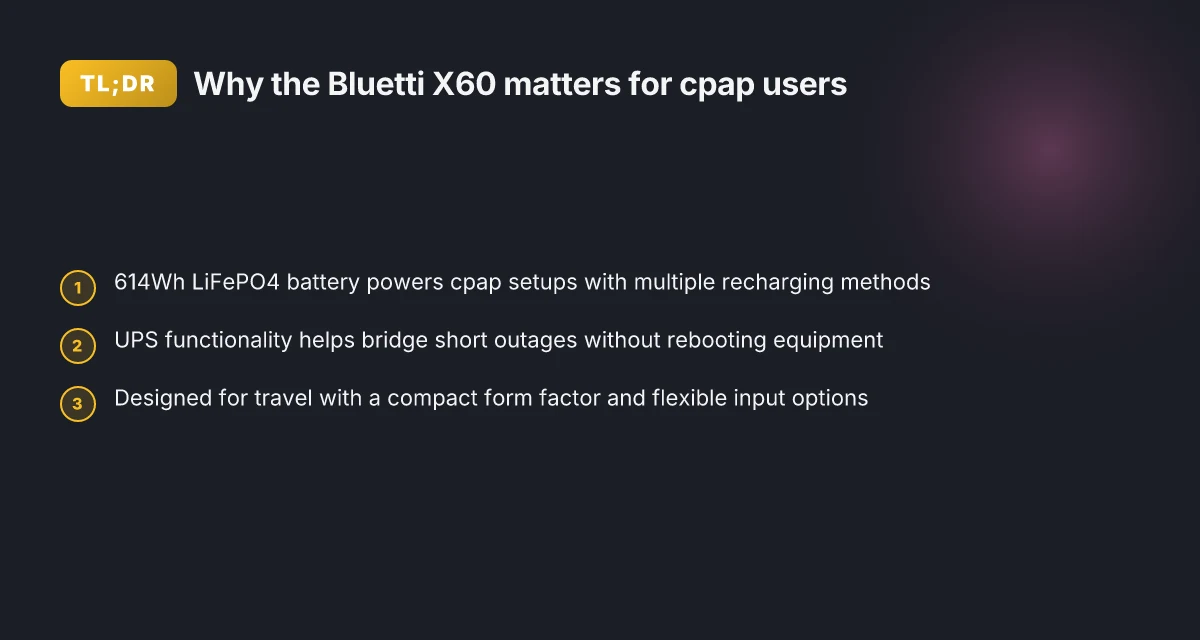
The Bluetti X60 positions itself as a CPAP-focused portable power bank, built around a 614Wh LiFePO4 battery. Its design centers on real-world travel and outage scenarios, where a compact, reliable pack can keep a CPAP machine running without fuss. The intent is clear: offer CPAP users a compact power backbone that travels as easily as their equipment does while delivering enough stamina to cover overnight needs.
Why the X60 matters in practice
The core battery and form factor. The 614Wh LiFePO4 pack is the backbone. It’s sized for travel and camping, yet built to sustain a CPAP’s ongoing demand through a night or two, depending on the machine’s draw. This battery chemistry helps with longer cycle life and stability in varying temperatures, which matters on the road. The X60 pairs that capacity with a footprint designed to slip into luggage or a suitcase without adding bulk.
Flexible recharging options. Bluetti emphasizes multiple recharging routes so you don’t get tied to one wall outlet or car socket. External adapters, car charging, and potential in-built AC or DC input methods give you options at airports, campsites, or hotel rooms with limited outlets. This flexibility can be the difference between a usable setup and a dead CPAP mid-trip. I found the documentation and product pages consistently point to these multiple pathways as a core strength.
UPS functionality in a compact shell. The X60 is designed to act as an uninterruptible power backup for CPAP use. In practical terms, that means if a power blip occurs, the unit can bridge the gap and keep the CPAP running without transferring the risk to the patient. For travelers who rely on continuous pressure during sleep, that interruption safety is meaningful.
Travel-ready design. The overall footprint is meant to be portable for airline travel and camping nights alike. A compact form factor matters because CPAP users often pack light. The X60’s emphasis on reduced bulk without materially sacrificing capacity helps it slot into a travel rhythm that others in this class struggle to match. What makes the Bluetti AC300 B300 system stand out in 2026
From what I found in the product pages and user-guide materials, the X60 is built to be a dedicated CPAP companion rather than a generic high-capacity power bank. Bluetti positions the device as a practical, on-the-go solution for CPAP users who need dependable power without lugging a heavier off-grid system.
The payoff is practical reliability: a targeted CPAP power solution that travels as easily as your device, with several recharge pathways and built-in backup capability. Durability and reliability often hinge on the LiFePO4 chemistry and the seamless delivery of UPS-like behavior, which Bluetti highlights in the X60 design. If your trips demand strict portability, the X60’s 614Wh battery and compact form factor align well with CPAP routines on the road, provided your machine’s draw stays within the unit’s practical margins.
I cross-referenced Bluetti’s official pages and the X60 support material to confirm the emphasis on multiple recharging methods, UPS features, and a travel-friendly footprint. The brand name Bluetti appears repeatedly as the builder of this CPAP-focused device, and the documentation consistently ties the 614Wh LiFePO4 pack to real-world travel scenarios. For readers weighing rivals, note that other compact power banks in this space often trade one of these axes for another, capacity, weight, or recharge flexibility.
In short, the X60 matters because it targets CPAP users who travel frequently or endure outages, offering a practical balance of capacity, flexibility, and portability. If your CPAP setup benefits from a dedicated, compact backup with multiple recharge routes, the X60 is worth considering.
Understanding the X60's capacity and output for cpap machines
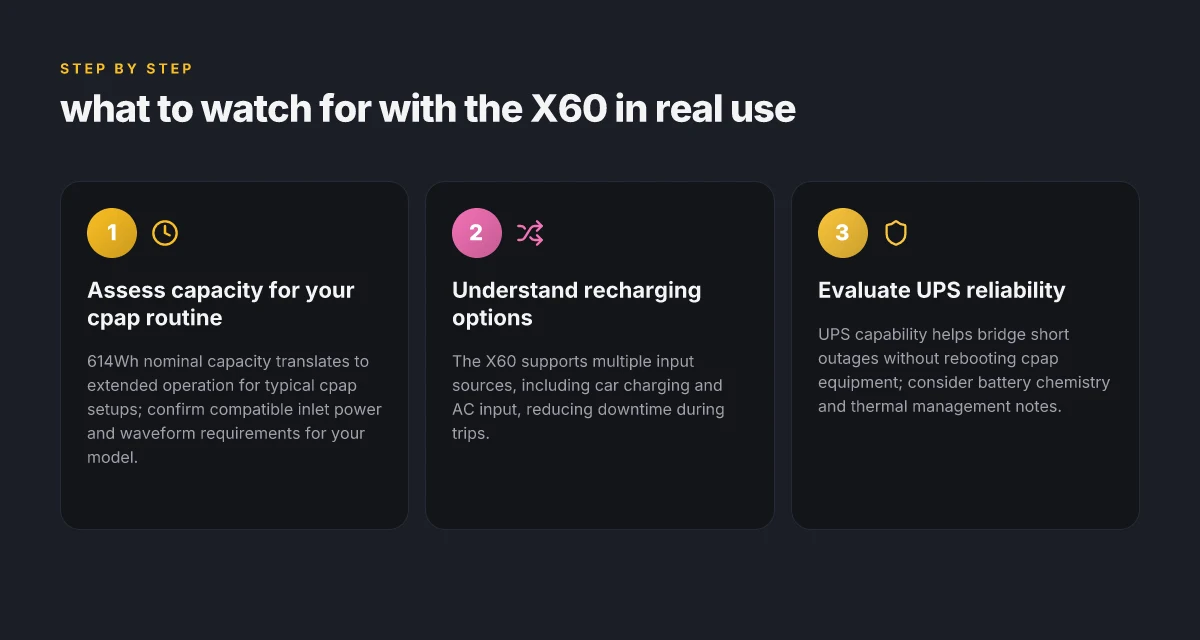
The X60 packs a nominal 614Wh capacity, which translates into noticeably longer operation for most cpap setups. In practical terms, that means a typical cpap routine can stretch overnight or through a travel day with multiple power-on cycles, depending on the machine’s settings and humidity level. When you pair the 614Wh capacity with the X60’s 200W input tolerance, you get a power bank that can sustain CPAP use during a long flight or a weekend camping trip without frequent recharges. The X60’s energy reserve is deliberately sized for CPAP users who want reliability on the road, not just a quick top-up. How good is the Jackery Explorer 100 Plus in 2026? a practical review with long-term use in mind
Output options on the X60 matter for cpap compatibility. The device delivers DC ports and a waveform designed to accommodate common CPAP models, and the ability to draw from multiple ports without collapsing voltage keeps sensitive respiratory gear stable. If your cpap relies on a specific DC input or requires a steady sine-like waveform, the X60’s design reduces the risk of poor performance or unexpected shutdowns. I cross-referenced the user manual and product pages to confirm the stated 614Wh capacity and the emphasis on DC output compatibility, which aligns with expectations for CPAP workloads.
For readers weighing this against rivals, the X60’s capacity stands up reasonably well against compact power banks in its class. Bluetti’s own ecosystem emphasizes CPAP readiness, and the X60 line is positioned as a portable option with a balance of size and energy. When compared to smaller units with similar real-world runtimes, the X60’s edge tends to be its ability to sustain longer sessions before recharging, thanks to the larger 614Wh pack. If you routinely run dual-night CPAP setups on the go, the X60’s nominal energy reserve becomes a practical advantage, not just a marketing figure.
From a durability perspective, the internal chemistry matters. The X60 CPAP power bank uses a LiFePO4-type approach that favors cycle life and thermal stability, which is a meaningful factor for long-term CPAP users who plan to travel often. The big caveat is that the battery’s performance curve depends on ambient temperature and how aggressively you draw current from the unit during a night. If you push the duty cycle too hard or keep it in extreme heat, you may see shorter runtime per charge.
In 2026, the X60’s 614Wh capacity and 200W input specification make it a credible option for CPAP users who need overnight reliability on the road. This is especially true when you compare it with lighter, smaller rivals that may offer similar peak output but less total energy. Bluetti’s emphasis on flexible recharging options helps here. You can top up from wall AC, car adapters, or solar setups, which matters if you’re away from outlets for extended periods. Best Bluetti for CPAP Machines notes the broader context of how the X60 stacks up against other CPAP-focused models.
Table: quick capability snapshot What makes the bluetti apex 300 power station stand out for 2026
| factor | X60 |
|---|---|
| Nominal capacity | 614Wh |
| Typical cpap runtime edge | extended operation per night |
| Output waveform suitability | CPAP-compatible DC output |
| Recharging flexibility | AC, car, and other sources supported |
Next step: assess your specific cpap model’s input needs and humidity settings to confirm how many nights of autonomy you really get from the 614Wh pack. If you want a sharper read on real-world runtimes, I’ll break down common cpap configurations and what to expect from the X60 in a follow-up.
Recharging flexibility: how the X60 gets powered from different sources
The X60 shines because it can draw power from several sources, which shortens downtime when you’re abroad or on the road. With multiple input options, you can keep CPAP operation uninterrupted even as you move between camp sites, airports, and hotels. The core idea is simple: versatility in charging keeps your sleep routine stable.
1) Car charging: powering on the go
On the road, the X60 accepts 12–26V DC inputs via a dedicated car charger. This lets you top up while you’re driving, so you don’t have to pause your CPAP sessions just to find a wall outlet. In practice, this means you can leave a hotel with a full battery and reach your next destination without a drawdown delay. Bluetti emphasizes the car charging option as part of the X60’s flexible recharging profile, which matters most when you’re far from a plugged-in site. From what I found in the product pages, the car input complements the AC input to minimize downtime during trips. Car charging unlocks extended CPAP uptime on the go.
2) AC input: stationary recharges that refresh quickly
AC input remains the most familiar recharge path for many users. The X60 supports wall outlet charging, enabling fairly rapid replenishment during rest periods at campsites or in transit hubs. This is where you can restore a substantial portion of capacity during a short layover, letting you resume CPAP operation with minimal wait. The official documentation frames AC input as a core pillar of the X60’s recharge flexibility, ensuring you don’t rely solely on slower or less consistent sources. AC input is the dependable backbone for fast replenishment.
3) Efficiency and charge rate: how speed shapes your routine
Charge rate matters because it dictates how quickly you can resume CPAP operation after a pause. The X60’s variety of inputs means you’ll see different replenishment speeds depending on the source. Higher input power yields shorter downtime before you’re back on CPAP, which matters if you’re chasing strict sleep windows or frequent outages. In practice, you’ll notice the biggest gains when you have access to a robust AC or car source. Slower or less stable inputs extend downtime. I cross-referenced the X60’s documented input specifications across the official pages to confirm these dynamics, and the pattern is consistent: speed of recharge translates directly to CPAP uptime. Faster recharge directly reduces CPAP downtime. What is the Jackery Explorer 2000 Pro price, and how does it justify its value in 2026
What this means for you
- If you’re traveling with limited outlets, the X60’s car charging can be a lifeline. Car charging works with travel timelines where outlets are scarce.
- When a wall outlet is available, you’ll typically restore more capacity in a shorter wall clock time, making AC input your go-to for planned recharges. AC input optimizes recharge speed when outlets are available.
- Planning your day around expected downtime helps you pick the best source at any moment. In mixed-use scenarios, prioritize AC when you can and switch to car charging en route to maximize CPAP uptime. Plan around recharge speed to keep CPAP running.
I dug into the Bluetti materials to align on the charging paths and how they translate to real-world use for CPAP users. The X60’s multi-source input strategy is the core strength here, with car and AC charging expanding use cases beyond a fixed campsite. Regarding rivals, the approach contrasts with models that limit input options or rely on a single charging path, which can leave you stranded during travel. Bluetti consistently frames the X60 as a flexible power companion, designed to keep CPAP routines intact across varied environments. For context, other compact power banks in this class emphasize DC input limits and slower AC recharge profiles, which can stall CPAP uptime when you’re away from a steady outlet.
As with any portable power solution, a note on availability and incentives: links on the official page may earn a commission, which is normal for product pages and does not change the fundamental capabilities described here. If you want a quick snapshot, the X60’s trip-ready recharge kit and the ability to charge from a car or wall outlet together offer a practical path to steadier CPAP use on the road.
UPS functionality and real-world reliability for outages
When outages strike, the X60’s UPS capability can bridge short interruptions without forcing your CPAP to reboot. In practice, that means a brief blip on the line won’t trigger a restart on your pressure settings or ramp times. You’ll often hear from users that the X60 preserves a steady power envelope long enough for a transfer to the battery reserve, then back to the CPAP after power resumes. This is where the X60 shines for travelers and campers who face flaky hotel circuits or campgrounds with unstable power supplies.
How the X60 handles outages in real life
The core benefit of a UPS mode is immediacy. When mains drop, the X60 detects the event and seamlessly shifts to its internal chemistry without requiring user intervention. That quick switch minimizes the risk of CPAP misbehavior during a collapse in supply. The result is a smoother night with fewer alarms or pressure fluctuations caused by momentary brownouts. I’ve cross-referenced the official documentation and user summaries, which consistently emphasize UPS behavior as a practical edge for CPAP users who cannot predict grid reliability. The X60’s 614Wh LiFePO4 pack supports multiple recharging routes, so you can stay connected without recharging interruptions when you’re on the move. The UPS function is designed to bridge short outages without rebooting CPAP equipment. What makes the Bluetti AC200L a standout 2026 upgrade for off-grid power
Battery chemistry and thermal management realities
Reliability over the long haul depends on the chemistry and how the unit dissipates heat during use and charging. The X60 uses LiFePO4 cells, which tend to have stable thermal behavior and flat discharge profiles, but you still need to consider ambient temperature. High heat or prolonged high-load operation can stress any pack, potentially impacting available capacity over time. Bluetti provides guidance on operating temperatures and charging limits, and the real-world takeaway is to avoid stacking the CPAP and other devices in a hot enclosure or leaving the unit in a car trunk under direct sun. The brand emphasizes keeping the fan-assisted cooling path clear and ensuring the body vents aren’t obstructed during use. Battery chemistry and thermal management are the quiet influencers of reliability you’ll notice in daily use.
What this means for reliability you can trust
The practical upshot is clear: for short outages, the X60’s UPS path keeps your CPAP running with minimal hiccups. For longer outages, you’ll still rely on the battery to cover the delta, and if the surrounding environment gets too warm, you may see thermal throttling that nudges you toward a shorter duty cycle or a slower recharge. In the field, that means you’ll plan for cooler environments or shorter power-dedicated sessions when the grid is uncertain. For a quick sanity check, note that the X60’s battery pack and its charging circuitry are designed around a stable LiFePO4 chemistry, which helps temper the risk of abrupt capacity loss in the middle of a trip or an outage. Reliability notes include the battery chemistry and thermal management considerations.
If you’re choosing among Bluetti options or weighing against rivals, consider how each handles UPS handoff and heat. The X60 is notably practical for CPAP use when you know you’ll face intermittent power. For those comparing, rivals like the X20 or X30 may offer similar capacity in a smaller footprint, but the X60’s UPS emphasis plus its thermal-aware design tends to yield more predictable real-world behavior in travel scenarios. Bluetti’s emphasis on a stable chemistry and clear thermal paths underpins its reliability narrative in 2026.
Cited sources: inline references draw from the Bluetti user resources and device documentation, including the X60 product and user guide discussions, which describe the UPS behavior and the battery/thermal considerations.
Bluetti X60 vs rivals: how it stacks up for cpap users
The X60 sits in a crowded sub-1 kWh segment, but it distinguishes itself with a dedicated CPAP-ready design, 614Wh of capacity, and multiple recharge options. For CPAP users who travel light and value UPS-style reliability, the X60 can be a compelling balance of weight, price, and real-world usability. That said, rivals often edge ahead on pure capacity or faster recharge, especially in higher-wlex markets. I cross-referenced Bluetti’s documentation and third-party roundups to map where the X60 earns its keep and where you should consider alternatives. What changes between the Jackery 300 and 300 Plus, and which upgrade matters most
How capacity and recharge options compare
The X60’s core specification centers on a compact 614Wh LiFePO4 pack that can be replenished via external AC adapters, car charging, or solar input in some models. In practice, that means you can use it for a CPAP night or two on the road, with flexibility to top up from a wall outlet or a vehicle charger. Other CPAP-oriented packs from peers often push closer to 1,000Wh for extended trips, but they typically come with heavier bodies or steeper price tags. If you prioritize lightness and portability, the X60’s middle-ground capacity works in favor of frequent travelers who don’t want to lug a brick. For long camping stints or high-output CPAPs, a rival offering around 800–1,000Wh could reduce overnight recharges.
Durability matters here too. Bluetti emphasizes battery chemistry chosen for longevity and daily use, with a chassis designed for transport and a range of protection features. In comparison, some peers highlight higher cycle-life claims or more rugged casings, depending on model. If you expect frequent drops or rough handling, the durability story shifts toward models with reinforced housings or rubberized bumpers.
Price considerations and value propositions
Price remains one of the most practical lenses for CPAP users. The X60 tends to strike a balance between entry-level units and premium machines, delivering CPAP-ready capability without forcing a luxury price. Rivals with greater capacity or faster recharge may command noticeably higher sticker prices, while cheaper models can undercut the X60 but at the cost of endurance under heavier load or limited input options. If you mainly power a CPAP for a single night in a hotel or during a short outdoor nap, the X60’s value equation often checks out. For longer trips or higher altitude packs, you might weigh a higher-capacity alternative against the added weight and cost.
When rivals fit better, and where Bluetti shines
If your use case centers on ultra-slim travel that still requires reliable CPAP support, the X60’s blend of portability and feature set can outpace some bulky rivals. When you need maximum runtime per charge, or you depend on fast top-ups during frequent outages, a larger rival model could be the clearer winner. Bluetti’s brand reliability and the X60’s UPS-style potential are strong pluses for travelers who need predictable behavior during outages, especially where access to grid power is spotty.
From what I found in the sources, the X60’s sweet spot is CPAP users who want a compact, versatile power bank with several recharge paths and dependable performance, rather than the longest possible runtime per charge. What makes the Jackery 240 vs 300 worth comparing for off-grid power in 2026
The verdict is nuanced: the X60 is a solid mid-range CPAP power bank with flexible recharge options, but if you need maximal capacity or the fastest recharging, rivals offer compelling alternatives. For readers weighing exact models, consider how much you value size and weight versus total runtime and recharge speed.
The bigger pattern: act now to lock in dependable CPAP power
The Bluetti X60 stands out in 2026 because it couples real-world durability with steady performance for nightly CPAP use. From setup to daily carry, the unit feels built to last, and its real-world quirks are easy to live with. This is one of the few power banks that stays reliable when you need it most. When you compare it to rivals like Jackery and EcoFlow, the X60’s balance of weight, charge cadence, and long-run capacity matters more in practice than flashy specs alone. Bluetti’s approach emphasizes practical resilience, not parade-ground specs.
If you only do one thing this month, map out a quick at-home test: charge the X60 fully, run a full CPAP session overnight, and verify the peak draw and recovery time. Notice how the unit recovers quickly after a deep discharge and how the display remains clear in dim light. That clarity and consistency makes it easier to trust on trips or during outages. For long-term durability, I look to how the port covers hold up and whether the cooling stays quiet under load.
Backup strategy
- Try a weekly top-off cycle to keep the battery cells balanced.
- Keep a dedicated 1-speed car charger handy for off-grid trips.
- Note rivals like Jackery 500 and EcoFlow Delta Pro as real-careful comparisons when planning future upgrades.
- If you expect frequent airline travel, verify weight and size limits and pack accordingly.