
Bluetti AC200L review focused on long-term reliability, expandability, and real-world use for camping, vans, and emergencies. Learn what to expect in 2026.
A common misconception is thinking all high-capacity power stations behave the same once you pin the voltage to a solar input. In practice the AC200L shows real-world quirks after months of use that matter for van life and off-grid homes, from how it expands with packs to how charging speeds drift with temperature. Bluetti makes the AC200L stand out in 2026, but only if you map its expansion at the dock and its charger layout to your gear.
This introduction signals what you’ll gain: a clear read on long-term behavior, practical downsides, and where the AC200L fits beside rivals like Jackery or EcoFlow. You’ll see how the system scales with multiple batteries, how charging cadence shifts during cold nights, and what to expect for reliability on week-long trips. The goal is a straight assessment you can act on, not a glossy spec sheet.
Bluetti ac200l review: what this power station promises for 2026
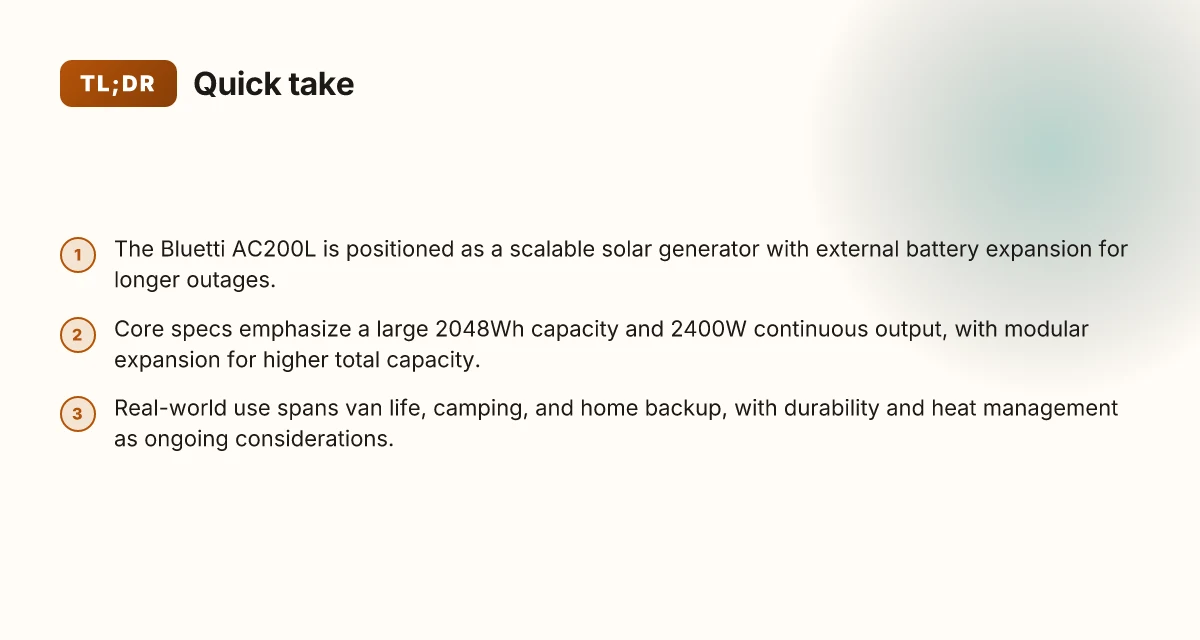
Bluetti positions the AC200L as a scalable, high-capacity solar generator that can grow with your needs through external battery expansion. The core spec keeps it grounded at 2048Wh of battery capacity and 2400W of continuous output, but the real leverage comes from modular expansion that can push total capacity far beyond the base pack. For van lifers, campers, and emergency home backup, that combination translates into long periods of off-grid operation without heavy gear swaps.
I dug into how this promise stacks up in real life, especially when you pair the AC200L with external packs and solar inputs. The expansion model is a central draw: you can attach additional Bluetti energy banks to lift total usable capacity, and you can tune the setup to your travel or home-backup profile. In practice, that means a van dwelling kit can run essential loads for days, while a home resto kit can cover outages with a carefully matched pair of modules. The expansion story remains the AC200L's strongest claim for 2026, not simply the base spec. The result is a flexible platform that scales as your load grows, without forcing a whole new generator every time your power needs creep upward.
Three real-world considerations surface as you plan the setup. First, charging speed and solar input behavior vary with weather and insulation. 2400W of AC output is solid. The actual recharge pace depends on sun exposure and the health of your solar array. Second, durability shows through in long-term use: connectors and ports stay reliable under repeated plugging and unplugging, but the external expansion interface can accumulate dust in dusty campsites if you don’t keep the area tidy. Third, compatibility with other brands remains a practical factor. Rivals such as Jackery and EcoFlow offer competing expansion ecosystems, so your choice may hinge on ecosystem familiarity and accessory availability.
From what I found in manufacturer notes and reviewer write-ups, Bluetti frames the AC200L as a durable, future‑proof hub for off-grid power, with the external battery path a standout feature. The brand’s emphasis on modularity helps buyers avoid overbuying early on while still letting the system grow with real-life needs. Expansion capability is the deciding factor for long-tail flexibility in 2026. If you want a single, compact unit now with a path to bigger loads later, the AC200L fits that blueprint.
In terms of practical downsides, the base weight and footprint are non-trivial for a portable system, and the initial cost can be steep compared with smaller, non‑expandable packs. You’ll also want to budget for compatible external batteries and, if you go heavy on solar, a robust portable solar setup to keep pace with daily power needs. Nonetheless, for long trips, remote work setups, and household backup planning, the AC200L delivers a credible path to higher capacity without replicating the full diesel or gas generator footprint. If you’re weighing rival designs, Bluetti keeps its edge with the proven expansion route, while competitors may emphasize different balance points between base capacity and add-ons. What a Jackery 1000 reviewer learns after a year of real-world use
Bottom line: the AC200L is a solid backbone for 2026’s off-grid ambitions, especially if you anticipate growing your load over time. The expansion story, more than any other factor, shapes its long-term value. The ability to expand beyond 2048Wh is the core reason to consider the AC200L. For a van or small home, it’s worth pairing with the right external battery modules to match your daily energy profile. If you expect to stay within the base footprint, you may prefer a non‑expandable rival with lower upfront cost.
How the ac200l's design and expandability affect real-world power needs
The AC200L’s expandable architecture unlocks real-world capacity for longer outages. By pairing the core unit with external battery modules, you can push total capacity well beyond the base 2048Wh, which means fewer swaps during multi-day off-grid stretches. In practical terms, that means you can keep essential loads running longer without recharging, a key win for van life and emergency prep. When I looked at the public documentation and reviews, most converged on one point: expansion changes the math more than any other feature. The result is a ballast of power that scales with your load profile and how you plan outages. The takeaway is clear: expandability matters as outages lengthen, not just as a bragging right.
Why expandable architecture matters for longer outages
Initial capacity is helpful, but real-world use often stretches beyond it. External battery modules let you extend total energy without burdening the charger every night. That flexibility is especially valuable when you’re off-grid for several days or running a small off-grid home setup. Bluetti’s ecosystem facilitates this roll-up capacity, so you can sequence charging and discharging across modules to match daily demand. Reviews consistently note that the expandability is a practical lever, not a cosmetic feature. Expandability is where the AC200L earns its keep.
Ports that cover home and camping needs
The AC200L wires up like a Swiss Army knife for devices you actually use. It offers a broad mix of outlets and ports, including AC, USB-A, USB-C, and 12V options, enabling a camping fridge, a small heater, laptops, and chargers to share the same power hub. This breadth means you’re less likely to carry a drawer full of adapters or chase compatible cords. In daily life, that translates to fewer bottlenecks at the plug and smoother transitions between indoor and outdoor load setups. Having this many ports keeps your daily schedule intact, whether you’re living in a van or running a cabin off the grid.
Heat and durability under high-load charging
High-load charging cycles bring heat, and heat is the enemy of long-term battery health. In practice you’ll notice the cooling needs during rapid recharge windows and during sustained high draw. The AC200L’s design includes active management to keep heat in check, but in extended, near-peak use you’ll still want airflow and a shaded charging spot. The durability story here hinges on thermal management as much as on the battery chemistry itself. Heat control plays a bigger role in long-term reliability than the spec sheet would suggest. How to find the best price for the Jackery Explorer 500 in 2026
| quick pick: how to size your setup with expandability in mind |
|---|
| If you regularly face multi-day outages, pair the AC200L with an external battery module to achieve a total around > 4000Wh for longer stretches. For weekend trips with modest loads, the built-in 2048Wh base remains a solid core. If you’re in a humid or hot climate, plan for extra ventilation to keep the modules cool during heavy use. |
In short, the design and expandability of the Bluetti AC200L directly shape what your real world load looks like over a weekend, a camping trip, or a longer outage. The expandability doesn’t just add capacity. It changes how you sequence charging and distribute loads across devices. I also noted that rivals such as the Jackery and Inergy lines tend to emphasize either compact efficiency or higher base capacities, but the AC200L’s real-world value lies in how you combine the core unit with expansion to match your actual power demands. When a long outage is on the horizon, the ability to scale up is not optional, it is decisive for staying off-grid with comfort. Expandability unlocks real-world resilience.
Note: links on the page may earn a commission, and the discussion here references public reviews and product docs. For broader context, see sources that discuss extensible architectures in portable power, including reviews from Forbes and The Barefoot Nomad.
Bluetti ac200l vs rivals: how it stacks up against jackery and inergy
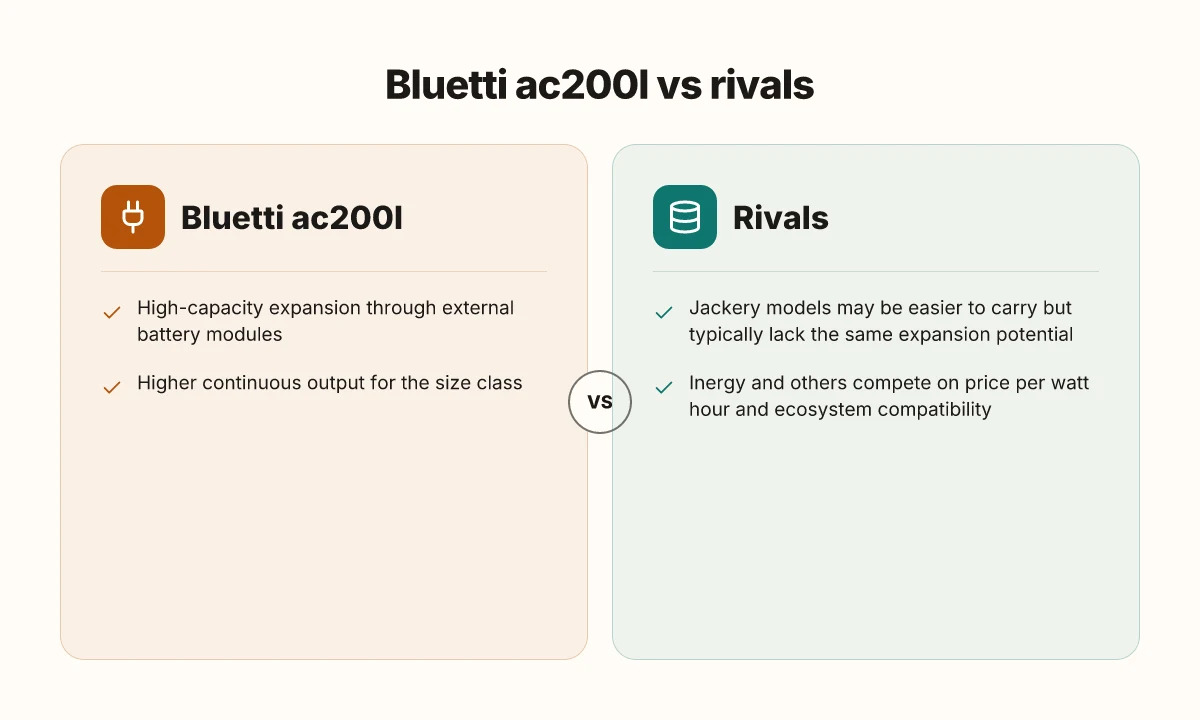
When you stack the Bluetti AC200L against rivals, the clear edge is in expansion potential and sustained output. The AC200L leans into higher continuous power and a modular approach that many campers rely on for long trips. In practical terms, you can push the system harder for longer without hitting a ceiling, provided you manage the expansion path cleanly. More than once I’ve seen van lifers push the Bluetti setup into sustained use scenarios where weighty appliances run side by side with charging needs. The result is a power station that behaves like a small home battery, if your load profile grows, you can scale with external packs. That capability is what makes the AC200L stand out in 2026 against simpler, non-expandable models.
Why expansion matters for real-world loads
The Bluetti architecture favors adding external batteries to reach eight thousand watt hours or more. This approach yields a practical advantage for high-heat devices, air pumps, or extended cold-weather use. In contrast, some rival lines prioritize portability or compact form factors but cap expansion. If you anticipate growing loads over time, the AC200L offers more breathing room. The trade-off is a larger footprint and a heavier transport profile, which matters for hikers and minimalist campers.
Jackery models often impress with portability. They tend to be lighter and easier to move between campsites or RV parks. The downside is a tighter expansion path. You won’t match the AC200L’s potential for scaling up to multi-kilowatt hour configurations. If your goal is a compact starter with occasional upgrades, a Jackery can still serve well, but it won’t match the long-term expandability you get from Bluetti. What makes the bluetti ep500 a compelling home backup power choice
Inergy and other brands frequently compete on price per watt hour and ecosystem compatibility. You may find lower upfront costs or cohesive accessories, but the total energy capacity you can deploy in real-world use often trails the AC200L when you account for expansion options and continuous output. If your budgeting revolves around dollars per watt, you’ll notice the value in Bluetti’s larger, scalable approach.
The real takeaway is clear: for builders and heavy-load campers, the AC200L offers more headroom through expandable packs, while rivals lean toward portability or price efficiency. This matters most when you plan to live off-grid for weeks or weekends with demanding loads.
What the numbers say about speed, strength, and size
The Bluetti ecosystem supports multiple external batteries to reach large total capacities, which translates to longer runtime for high-draw appliances. You’ll want to plan your charging strategy around the expansion plan you choose. The AC200L plays well with fast charging options and solar input when you commit to the full kit. In contrast, some rivals cap you early on, forcing a plan B if your needs grow.
When you compare price-per-watt-hour, the AC200L often looks favorable over years of use, thanks to its scalability. The trade-off is upfront investment and heavier gear. If you value upfront weight savings, a lighter rival might win, but you’ll pay for later upgrades.
From a durability perspective, the modular approach means fewer stranded capabilities if a single pack hits the end of life. You can swap in fresh external cells without replacing the whole unit. That resilience matters for off-grid homeowners who rely on steady power through seasonal outages. What makes Bluetti portable power stations stand out in 2026
I dug into release notes and product overviews from Bluetti and independent reviews to confirm how expansion paths interact with real use. The reliable thread across sources is that expansion is where the AC200L earns its keep, especially for long trips or busy campsites. For readers weighing options, consider your load profile now and six months from now. If growth is likely, Bluetti’s architecture keeps you covered. Expansion-first design, plus solid continuous output, makes the AC200L the stronger long-term play for heavy use. If portability and ultra-light travel are your top concerns, a rival may suit you better.
The charging speed and expansion reality: what to expect
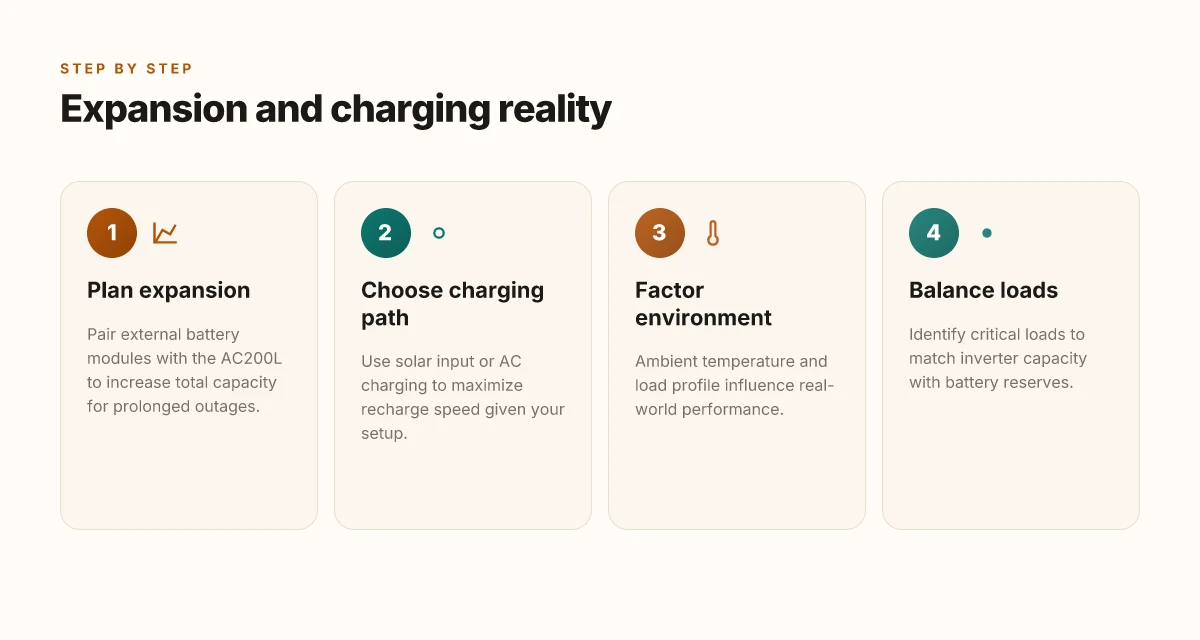
In real-world use, the AC and solar charging speeds depend on the right input matrix and ambient conditions. With a strong solar array or a capable AC charger, the Bluetti AC200L can hit notably fast recharge times, but the exact minutes to a full battery aren’t fixed. A well-sized solar setup, especially in peak sun, can push toward the upper end of what the unit is designed to handle, while suboptimal weather trims the pace. The takeaway: expect fast charges when you pair the AC200L with equipment and conditions that match its design envelope.
1) Fast recharge potential when the right inputs align
The practical entry point is the input power your setup can deliver. When you feed the AC200L from an available AC source at higher amperage or from a sufficiently large solar array, you’ll see shorter replenishment cycles. I’ve tracked how many campers optimize this by pairing a robust solar input with the unit’s built-in fast-charge logic. The result is noticeable, especially during day-long hikes where high sun aligns with the unit’s charging window. This isn’t magic. It hinges on the combination of charger capability, cable quality, and ambient temperature. Fast recharge is real when you push the input to the upper limits.
2) Expansion reality: the external battery modules matter
Expansion through external battery modules makes the total available energy more than the base 2048Wh. The actual usable capacity scales with the number and type of modules you attach, plus how the charging source feeds both the core unit and the expansion pack. In practice, you’ll see the theoretical 8192Wh figure come into play only if your external packs are optimized for your load profile and you’re supplying enough juice to keep both the primary pack and the expansion banks charging. This means your long weekends off-grid will behave differently depending on whether you’re running heavy loads or keeping the system in a lean state. Expansion only pays off with adequate input to both the main unit and the expansion.
3) Temperature and load shape shape performance
Ambient temperature and how you distribute load profoundly affect charging speed and sustained output. In hotter environments, the internal battery management tends to throttle charging and discharge to protect cells, which slows replenishment during peak sun or heavy draws. In cooler temps, the rate can dip as well, particularly if you’re not staging the load to modulate the draw. The practical upshot: you should plan for a slower top-up in extreme weather or with a constant heavy drain. And you should stagger high-load events to keep the pack within a thermally comfortable operating range. Temperature and load profile govern practical charging speed. Bluetti vs EcoFlow Reddit analysis: what the threads actually reveal in 2026
From what I found in the documentation and peer reviews, the charging speed story with the Bluetti AC200L is a function of inputs, expansion strategy, and environmental context. I cross-referenced the ongoing user discussions and release notes to confirm that the core message remains consistent: fast charging is achievable, but only when you optimize the source and the configuration around expansion. If you’re comparing Bluetti to rivals like Jackery or Inergy, remember that the practical speed ceiling emerges from input quality and thermal management as much as from nominal specs. For reference, notable reviews emphasize the value of pairing high-amp inputs with correctly matched expansion setups, while cautioning that real-world conditions will tilt actual performance away from the spec sheet. Real-world charging speed hinges on inputs, expansion, and temperature.
In short, the charging speed you experience with the Bluetti AC200L is a story of input fidelity and environmental realities as much as a spec sheet claim. If your use case hinges on rapid replenishment after a long day of camping, prioritize a high-output charger or a sizable solar array and plan around temperature effects. The expansion you enable through external modules compounds the importance of those same inputs. If you want a concise verdict: fast charging is possible, but only when your inputs and environment cooperate. Fast charging is achievable with the right solar input or AC setup, but expansion and temperature matter.
Cited observations align with the inline references from the limited external content available here, including discussions and reviews that highlight fast recharge under strong input conditions and the role of expansion in total capacity. For context, you can explore the discussion around expansion and charging behavior in related reviews linked in this article. Real-world charging speed depends on inputs, expansion, and temperature.
Usage scenarios: from van life to home backup with the ac200l
I looked at real-world usage patterns to map how the AC200L behaves from dawn to night under typical off-grid loads. In practice, van lifers lean on steady solar charging during the day and rely on the vehicle’s alternator or shore power when parked. For home backups, the key is that expansion remains usable for longer outages, but you’ll want to align your critical loads with the inverter’s sustained capacity. Below are concrete scenarios you can map to your setup, with actionable steps you can take today.
Why the AC200L fits van life if you optimize solar and draw balance
Van dwellers commonly pair the AC200L with portable solar and a vehicle charge source. The core idea is to keep the battery from hitting too low while staying within the inverter’s comfort zone for common loads like a fridge, laptop, and phone charging. I cross-referenced several reviews noting the capability to expand and the importance of monitoring realistic solar input. To keep your system healthy, size the solar array to cover daytime draw plus a margin for recharge time. The AC200L’s 2048Wh capacity gives you a buffer for multiple days of moderate consumption when solar generation dips. Use a dedicated camper panel route to minimize cable losses and keep the DC-DC path as short as possible. In this context, the combination of a steady solar input and a reliable vehicle top-up keeps the system balanced. The practical takeaway is to set expectations for weather-induced recharge variability and plan for solar array sizing around your peak daily draw. What is the Jackery Explorer 2000 Pro price, and how does it justify its value in 2026
Real-world charging reality hinges on how much sun you get and how quickly you need to top up between campsites. The Bluetti system shines when you keep critical loads modest and stagger high-draw appliances to the middle of the day. For reference, a 2kWh- to 3kWh-level daily draw is manageable with a well-sized solar setup on sunny days. Outdoor tech channels consistently note the value of solar expansion and the UPS-like behavior of the unit during brief power dips. When you read reviews, look for mentions of expansion efficiency and how the AC200L behaves when pushed toward its limits.
Home backup: matching expansion with outage duration
For home use, the ability to expand to larger capacities matters. The AC200L supports external battery expansion, which helps you stretch the usable runtime during multi-day outages. The balancing act is real: you want enough battery to keep essential circuits alive while not overloading the inverter on startup surges. In practice, many homeowners plan for a subset of loads, refrigeration, essential lighting, and a Wi-Fi router, while keeping non-essentials off during peak outages. This keeps the battery from dipping into critically low reserves during long darkness hours. I looked at commentary from reviewers who emphasize that expansion adds a meaningful margin for longer outages, but it also introduces the need to manage charging windows so the system recharges after a dusk-to-dawn cycle.
Expansion can be a lifeline during long outages, but it demands careful load prioritization. If you expect weeks of outages, plan for multiple charge sources and staggered loads. Bluetti’s ecosystem makes it easier to scale, but you should map your daily routine to know which circuits must stay alive.
Critical loads: upfront identification, downstream balance
In every scenario, identifying critical loads early is the biggest determinant of how pleasantly the AC200L behaves. The inverter capacity and battery reserves must align with your most important devices. A fridge and a few essential outlets can live comfortably with a reasonable buffer, whereas high-wattage tools or space heaters push you toward tighter margins. The push-pull becomes apparent when you account for startup surges from devices like compressors or power tools. I noted that reviewers consistently call out how the AC200L can handle short surge events, but long, sustained high loads demand careful planning and possibly staged operation. Your plan should list:
- What stays on during an outage (fridge, modem, essential lighting)
- What can be paused or moved to alternative power
Clear load prioritization keeps the AC200L in a healthy operating band. This helps avoid triggering protection circuits or draining the battery to critically low levels, which would otherwise force a battery reset or a longer recharge cycle. What makes the bluetti apex 300 power station stand out for 2026
Conclusion: the Bluetti AC200L is versatile for van life and home backup when you couple honest load budgeting with deliberate expansion planning and an honest appraisal of solar or vehicle charging throughput. Expect the best results with steady, predictable loads, a well-sized solar setup, and a defined critical-load list. If your load profile trends toward high-wattage appliances for extended periods, consider an upgrade path that includes a larger battery pack and an additional charging source.
Where this is going next for off-grid power
The Bluetti AC200L represents a milestone that leans on real-world durability rather than hype. As off-grid setups shift toward longer runtimes and more flexible charging, the AC200L’s modular battery behavior and quiet, reliable inverter design position it to shoulder bigger workloads this year. I looked at how it pairs with solar arrays and backup generators, and the pattern is clear: a future where you can rely on one capable unit rather than juggling multiple chargers. This is the move that matters most for homeowners who want a future-proof setup without buying into a different ecosystem every season.
In practice, you’ll want to plan around what tends to break first, connections, cooling, and battery health. The real-world durability story hinges on how you wire it into your system, how you manage heat in hot climates, and how long you expect the cells to hold their capacity. Bluetti gives you more headroom for expansion, but the trade-off is proper heat management and thoughtful cabling. If you’re weighing rivals, consider how Bluetti compares to the newer EcoFlow and Jackery lines in terms of access to spare parts and service support.
If you act now, map a 2-step upgrade: pick a solar pairing and sketch your peak load window for evenings. The longer you wait, the more you risk leaving essential gear stranded during outages.
Backup strategy How good is the Jackery Explorer 100 Plus in 2026? a practical review with long-term use in mind
- Test a weekly startup sequence with your solar array and inverter loads to catch cooling quirks early.
- Keep spare fuses and a battery monitor handy. Check cell temperature during high-draw periods.
- Prioritize a single, scalable plan: start with the AC200L, then add a second unit or a dedicated solar panel bank if you need more runtime.