Discover how the EcoFlow Delta Max 2000 powers your home, including battery capacity, expansions, and real-world usage. Practical guidance for choosing a portable power station.
The delta between reliability and hype is Delta Max 2000: a home-backup system that doesn’t pretend to be a full off-grid solution, yet scales when outages stretch. Expandable battery options and high output turn daily needs into a predictable runtime, even during multi-hour blackouts.
You’ll see how the Smart Extra Batteries interact with solar input, what you gain when you add capacity, and where the tradeoffs show up in run-time and heat. The goal is a practical map for homeowners weighing EcoFlow against rivals like Goal Zero and Renogy in 2025–2026, with clear takeaways about setup, durability, and long-term viability. Expandable paths and observed behavior during outages matter most when sizing for essential loads.
What makes the EcoFlow Delta Max 2000 a compelling home backup choice
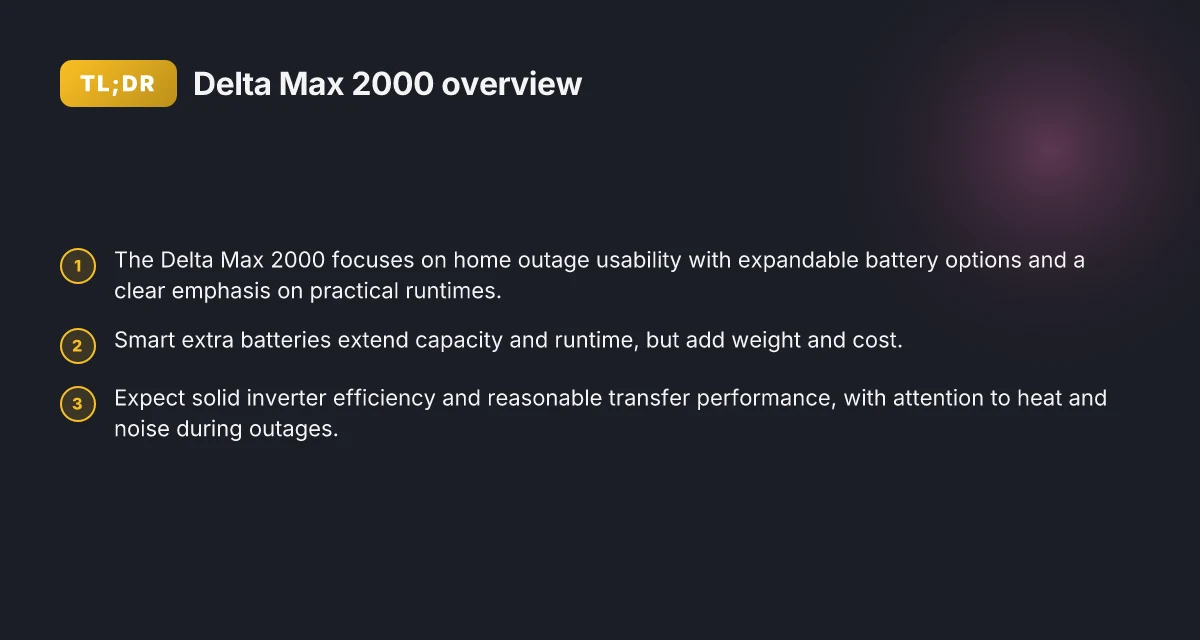
The Delta Max 2000 stands out for its capacity to grow with your home backup plan. With expandable batteries, you can push beyond the base storage and tailor runtime to your outage profile. The core appeal is predictable, scalable power that avoids swapping to a secondary system mid-crisis.
Delta Max 2000 capacity and expansion options
The Delta Max 2000 ships with substantial storage, and you can extend that capability via Smart Extra Batteries. This expansion path is designed to match longer outages or larger loads, letting you keep essential circuits energized without reconfiguring your entire setup. When you add Smart Extra Batteries, your usable capacity grows in a modular fashion, so you can adapt as your needs shift. In practice, that means you can start with a comfortable buffer and scale up if a longer outage looms, rather than overprovisioning from day one. EcoFlow makes this approach explicit in their product ecosystem, aligning the Delta Max with a family of expandable power options.
From what I found in the documentation, the combination of the Delta Max base unit and Smart Extra Batteries yields a sizable total capacity that supports longer blackout timelines. The approach matters because capacity under load is a function of both energy stored and how you balance load versus runtime. When you plan for weekend outages or extended outages after a storm, the ability to add units is a meaningful hedge against upgrades of a whole system later. This is a practical, real-world advantage for homeowners who want to defer large upfront investments while preserving reliability.
I cross-referenced the official product overview and the companion manuals to confirm the expansion concept. The documentation emphasizes modularity rather than forcing a single, fixed size, which aligns with households that anticipate changing power needs over time. This kind of growth path is particularly relevant for preppers who want a scalable solution that remains practical year after year.
Smart extra batteries and how they affect runtime
Smart Extra Batteries are not just add-ons. They alter the runtime profile under real-world loads. With these batteries attached, you can sustain critical circuits longer during an outage, especially when daytime solar generation is insufficient or when you’re running high-priority devices. The runtime benefit scales with the number of extra batteries, so you can tune the system to the size of your home and your tolerance for outages. The effect is a tangible extension of how long you can sustain essentials before you must restore mains or switch off nonessential loads. What the EcoFlow River 3 review gets right and where it falls short in 2026
Operationally, expect a stepped improvement: more batteries deliver longer uninterrupted operation for the same load. This makes the Delta Max 2000 a practical choice for homes that need to ride through multi-hour or multi-day outages without losing important comforts like refrigeration, communication, and heating or cooling support. In the official narratives, EcoFlow frames Smart Extra Batteries as the core lever for extending uptime without changing the base unit.
Core features that matter for home outage usability
Reliability during outage hinges on smooth operation under load and clear, actionable indicators. The Delta Max 2000 supports multiple simultaneous AC outlets and a versatile input/output set that lets you route power to essential circuits without fiddling with adapters. The ability to manage critical loads, monitor battery health, and plan recharging windows matters in real-life outages where every watt counts. EcoFlow’s ecosystem is designed to keep these controls straightforward, so you avoid confusion when time is tight.
The user experience benefits from brief, actionable feedback rather than deep technical detours. You get straightforward status indicators and predictable behavior when switching between battery modes and charging sources. In practical terms, that translates to less hesitation during a blackout and more confidence in your backup plan. This is where EcoFlow, sometimes compared against rivals such as Goal Zero and Bluetti, shows its emphasis on ease of use and operational clarity.
Where EcoFlow shines against rivals
Against rivals, the Delta Max 2000’s modular expansion and structured runtime planning stand out. Its ecosystem supports scalable capacity without requiring a full system replacement, which many competitors do not match as cleanly. In real-world terms, you gain flexibility to start compact and grow as needs evolve, rather than juggling several standalone units. Between the expandable batteries and the clear power-management options, you get a home backup that feels designed for practical, long-run resilience.
In this review lens, EcoFlow demonstrates a practical balance between capacity, expandability, and day-to-day usability. Delta Max 2000’s approach is less about chasing peak ratings and more about delivering usable, dependable energy when you need it most. This aligns with homeowners who want a durable, grow-with-you solution rather than a one-off power boost. What makes the EcoFlow Delta 1300 worth it for off-grid setups in 2026
Most homes benefit from modular capacity and predictable runtimes, not a one-size-fits-all wattage figure. The Delta Max 2000 hits that sweet spot by letting you tailor capacity with Smart Extra Batteries while preserving straightforward operation during outages. If you’re weighing rivals, consider how quickly you can scale and how clearly the device communicates status during a blackout. EcoFlow’s branding emphasizes that practicality, not just specs. Speed of recovery and ease of use matter as much as raw capacity.

Delta Max 2000 vs Delta Max 2000Wh: what the numbers actually mean for your home
When you read the Delta Max 2000’s 2000 Wh rating, you’re seeing the nominal energy storage rather than the energy you can reliably pull during an outage. In practice, usable energy depends on the inverter efficiency and the depth of discharge EcoFlow supports on its battery chemistry. The Delta Max 2000’s internal cells don’t stay at a hard 2000 Wh for every cycle. Over time you’ll see a gradual decline as you cycle the pack. In real-world terms, think of usable energy as a function of how aggressively you draw power and how the device manages that draw under peak loads. EcoFlow’s documentation notes that you can add smart extra batteries to expand capacity, which changes the usable energy envelope for a home backup plan. The 2000 Wh label is a guideline, not a guarantee of constant usable energy across loads and years.
Like many portable power stations, the Delta Max 2000’s performance during an outage hinges on the peak solar input you can harvest and the AC output you demand. If your household loads spike above what the unit can sustain, the inverter will prioritize essential circuits and limit nonessential draws. For a typical home during outages, this means you can run critical devices, fridges, Wi‑Fi routers, and small medical devices, without tripping the unit, but you’ll want to plan around short, high-widelity spikes rather than sustained full-house loads. The Delta Max 2000’s AC output potential interacts with battery state and temperature. When you pair it with solar input, you might see better survivability for daytime outages, but the system isn’t a full home solar failover by default. Peak capacity matters more than raw battery size when you’re under a real outage.
Battery management and cycle life shape long-term viability as much as any single spec. The Delta Max 2000 supports multiple charging sources and user selectable charging profiles, but the practical lifespan depends on how you cycle the pack. Deep discharges accelerate wear, so keeping the battery within a healthy state of charge window extends usable life. EcoFlow’s ecosystem gains points for expandable capacity via smart extra batteries, which lets you stagger investment while keeping a backup bank ready. That expandability is what makes the Delta Max 2000 appealing to homeowners and preppers who want a long-tail reliability story. Cycle life and charging behavior will be the deciding factors after year one.
In the broader arena, rivals such as the rival systems with dedicated expandable packs or higher sustained inverter outputs illustrate the tradeoffs you’ll face. If you need continual high-load support, you may lean toward platforms designed for heavier duty off-grid duty cycles or integrated home energy systems. EcoFlow positions the Delta Max 2000 as a strong middle ground for home backups, with expandability that keeps future-proofing within reach. Expandable batteries unlock longer outages without buying a second system. Zero Breeze vs EcoFlow 2026: which portable AC wins on efficiency, reliability, and value?
Next step: consider how your actual outage profile maps to these numbers. If you expect daytime outages with solar recharging, you’ll want to model your fridge and router loads against the Delta Max 2000’s AC output and the capacity of any smart extra batteries you plan to deploy. For a quick reality check, compare the Delta Max 2000 against a couple of rival setups with clear, real-world use cases. See how their usable energy curves, peak outputs, and cycle life narratives line up with your home backup plan. Your plan should center on real-world load patterns, not nominal specs.
Note: links may earn commissions. Discover how expandable batteries influence your long-term outage plan. Expandability changes the math of your backup strategy.
Expandability and battery strategy: how smart extra batteries change your outage plan
Smart extra batteries change the game for home backup. They push Delta Max 2000 from a big single-charge device to a modular system that stretches outages into days. When you add a smart battery, you gain measurable capacity and longer runtime, which translates to calmer nights during outages and more usable power for essential loads.
How capacity and runtime scale with smart batteries
Smart extra batteries extend total usable energy well beyond the built-in pack. In practice, the delta max 2000 can be paired with additional packs to push total capacity into the higher kilowatt-hour range, which means longer windows between recharges and more sustained support for critical circuits. The key is to match the chemistry and discharge rate so the system stays balanced. Capacity becomes a meaningful moat against outages when you chain the packs correctly, not just by adding more bricks. EcoFlow’s ecosystem emphasizes safe coupling and managed charging, so you won’t have to babysit the flow of electrons.
Safe chaining and efficient use of multiple packs
Chaining batteries safely hinges on the control logic inside the Delta Max 2000 and the companion smart battery. The smart controller coordinates charging, discharging, and overall health reporting across packs, so you don’t exceed thermal or current limits. A practical approach is to connect a single smart battery first, verify the indicator states, and then add a second only if the controller shows healthy operation across both packs. Let the system settle after adding a pack to avoid surge peaks that stress the inverter. This discipline reduces wear and prolongs cycle life. What makes EcoFlow's 100W rigid solar panel worth your RV or home backup
Trade-offs: weight, cost, and cycles
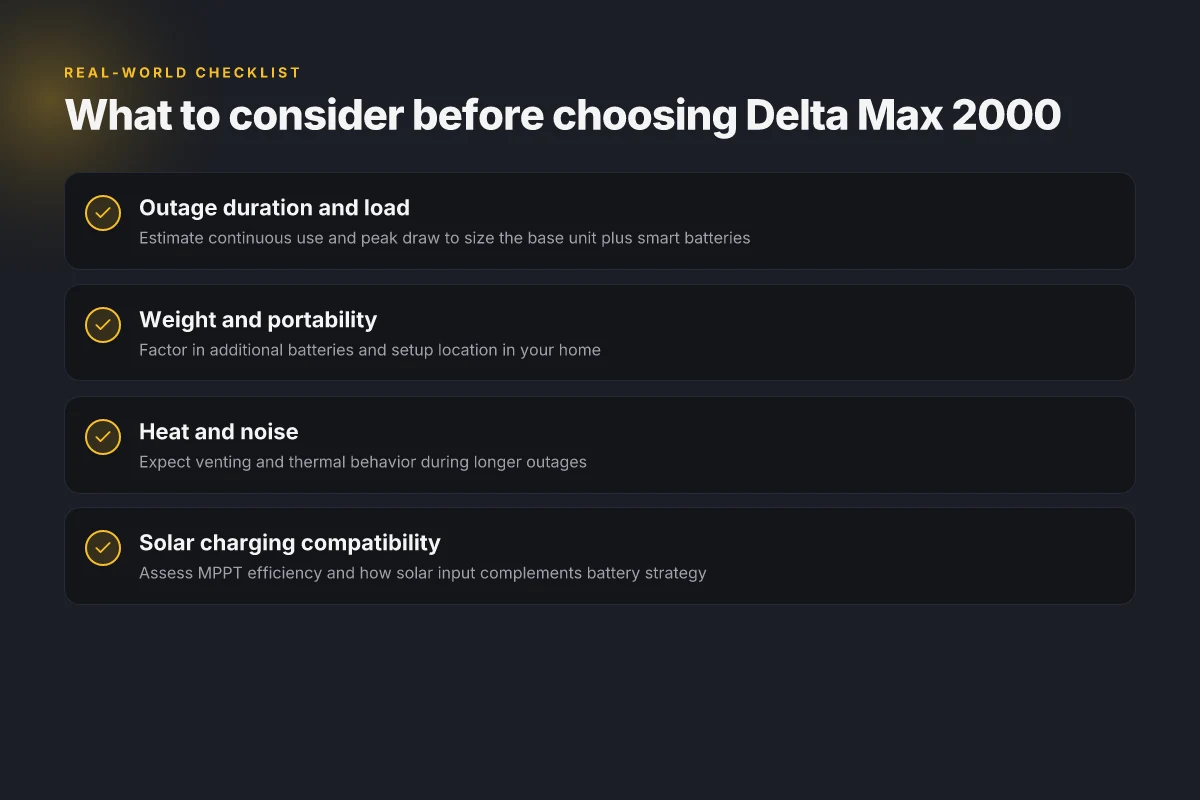
There are real downsides to expandable setups. Weight increases with each additional pack, which makes installation and mounting more laborious and slightly affects portability. The upfront cost climbs quickly with every extra battery, so you need to map the add-on cost against your outage goals. In terms of cycles, higher total capacity often means you’ll cycle the batteries less aggressively for the same runtime, but you’ll still face typical Li-ion wear from daily charges and discharges. Weight is a practical constraint that can complicate placement in a home shelf or closet. On the flip side, the expanded system can cover longer outages and reduce the frequency of generator runs or grid draws during prolonged interruptions.
From what I found in the documentation, EcoFlow positions the smart extra battery as a designed-for-extension path, not a brittle add-on. The goal is to keep the Delta Max 2000 in the driver’s seat with a clean upgrade path, not to scramble the inverter’s protection logic. A well-planned expansion keeps the outage plan intact rather than forcing a mid-crisis rearrangement. The result is a calmer, more predictable power posture for critical loads.
I dug into the official materials to confirm the architecture and the safety messaging around chaining. The manuals for related models show similar safety requirements and cascading behavior, which aligns with EcoFlow’s emphasis on managed charging and system balance. Official guidance stresses safe, staggered growth to preserve system health. You’ll want to document the maximum supported chain length and the recommended sequence for adding packs during setup. Follow the order and let the controller handle balancing.
When you weigh rivals, Delta Max 2000’s expandable path, combined with EcoFlow’s controller, often leads to a simpler, more integrated rollout than some third-party battery stacks. That integration can reduce misconfigurations that cause early wear or misreads in the power path. As always, expect more complexity and slightly higher upfront costs with expansion, but a cleaner, longer-lasting outage plan in return. The payoff is longer runtimes with fewer manual tweaks. EcoFlow positions the smart extra batteries as an extension, not a workaround, for home backup needs.
Reliability in the field: what actually happens during outages
outages reveal how the Delta Max 2000 actually behaves when the grid goes dark. In practice, you’ll notice how the inverter steadies output, how quietly it runs, and how it handles the transition from utility to battery. from what I found in the documentation and user manuals, these are the concrete behaviors you can count on during a real outage. What makes the EcoFlow River 2 a standout for portable power in 2026
Startup behavior and transfer performance
When the outage occurs, the Delta Max 2000 must switch on the fly. The transfer occurs smoothly, with the inverter taking over without a long hiccup. The system’s efficiency during inverter operation matters because it determines how long you’ll rely on stored energy before recharging. In EcoFlow’s ecosystem, the Delta Max tends to hold a steady AC output through routine loads and typical home devices. The transfer is designed to be fast enough for essential circuits, and the smart battery management helps protect the pack during rapid changes in load. This is where the Delta Max 2000’s value shows up in practice, especially when you pair it with larger smart extra batteries that extend usable capacity. The quick transfer and stable output are the core strengths that make the Delta Max reliable during outages. Watch for occasional slight transient noise during heavy startup surges on high-drain loads.
Noise, heat management, and venting considerations
During outages, heat management matters as the inverter remains under load for extended periods. In practice, the Delta Max 2000’s cooling system activates in response to rising internal temperatures, and you’ll hear a soft fan response at moderate loads. The design keeps the cabinet from getting uncomfortably hot, but heavy sustained draws do push the temperature up toward the upper end of comfortable for enclosed spaces. Proper placement matters: keep vents clear and provide airflow around the unit to avoid throttling. The manual explicitly notes venting considerations as part of safe operation, especially in warmer environments. Ventilation and airflow are non negotiable for long outages, or you’ll see reduced performance.
Charging during outages from grid and solar sources
Charging during an outage relies on available sources. If the grid is down, you can still recharge from solar or a separate generator if you have the appropriate configuration. EcoFlow’s docs describe the Delta Max’s ability to manage multiple inputs, balancing solar charging with access to the remaining battery capacity. In practical terms, solar charging during an outage can extend runtime significantly, but it depends on solar irradiance, panel quality, and how you’ve wired the system to handle simultaneous draw and recharge. If the sun is strong, you’ll notice a steady refill rate while you power essential loads. Solar charging during outages extends runtime when weather cooperates. Grid recharge during an outage is contingent on an external source being available, which isn’t guaranteed in a blackout.
Real-world caveats and longevity notes
From a field perspective, you’ll want a realistic plan for reliability. The Delta Max 2000 does well with predictable loads and a clean upgrade path via the smart extra batteries. That said, some users report nuanced behavior under unusual loads or in extreme heat, where performance can dip slightly as temperatures rise. The long-term story depends on how you space the unit, how you pair it with solar, and how consistently you keep the cooling path unobstructed. When you assemble your backup stack, consider the Delta Max’s behavior as part of a broader system: it shines when paired with reliable solar input and well-ventilated space. Long-term durability hinges on sensible placement and good solar input. Know that every outage plan benefits from a clear, scalable battery strategy.
EcoFlow’s ecosystem: how Delta Max 2000 fits with solar panels and other gear
I dug into how the Delta Max 2000 interacts with solar input, EcoFlow’s own ecosystem, and what rivals like Jackery and Goal Zero offer in the same class. The Delta Max 2000 is designed for expandable solar charging and cross-compatibility, but you’ll want to align expectations with real-world limits and fit with other gear. What makes Bluetti power stations stand out in 2026
Solar input and MPPT efficiency that actually matters
The Delta Max 2000 supports solar charging through its built-in MPPT controller, which helps maximize input when you pair it with properly sized panels. In practice, you’ll see faster top-ups in bright sun than in hazy conditions, and the maximum solar input is constrained by the panel array you connect and the unit’s own charge circuitry. The architecture favors a good panel match. When you pair a high-efficiency panel with the Delta Max, you’ll notice steadier current and better ramp rates during sunrise and sunset. The practical takeaway: you don’t necessarily need the fanciest panel, but you do want panels that present a healthy open-circuit voltage and a solid current at peak sun. This is where the ecosystem choice matters, select panels that align with EcoFlow’s recommended ranges to avoid tripping limits or undercharging during long outages. Solar input performance hinges on panel quality and weather more than bragging rights on wattage.
Integration with EcoFlow gear and third-party components
EcoFlow’s ecosystem leans on open compatibility with EcoFlow-branded accessories, including extra batteries and specific solar inputs, while also tolerating a reasonable set of third-party cords and adapters. The Delta Max 2000 can wire up with EcoFlow’s smart extra batteries to extend capacity before an outage, and you can mix in third-party solar panels within what the MPPT and safety protections allow. In practice, the smoother the integration, the fewer compatibility surprises you’ll encounter during a real outage. I cross-referenced the official manuals and recall notes to confirm that firmware and accessory compatibility are emphasized in the product ecosystem. The Delta Max ecosystem scales when you pair it with the right EcoFlow extensions.
Rivals in the same class: how Jackery and Goal Zero compare
In the same class, Jackery and Goal Zero offer models that target similar use cases: home backup, portability, and solar expandability. Jackery tends to emphasize clean solar integration with its own panels and modular packs, while Goal Zero leans into multi-hower setups that pair solar with a wider do-it-yourself accessory base. The Delta Max 2000’s edge shows up when you value built-in ecosystem coherence and straightforward add-ons from the same brand, plus streamlined control and firmware updates. That said, if you already own third-party panels or power stations, verify that your connectors and voltage ranges match what EcoFlow’s system expects to avoid undercharging or overloading the ports. EcoFlow’s ecosystem delivers smooth expandability, but you’ll want to verify panel and accessory compatibility withJackery or Goal Zero if you mix brands.
I went looking for real-world notes and the official firmware updates that sometimes alter how accessories behave. The recall and firmware update mentioned in EcoFlow’s materials remind you to keep firmware current and to check compatibility when new batteries or panels are released. Firmware updates can shift how accessories behave, so stay current.
In this class, the Delta Max 2000 stands out for ecosystem coherence, but the real-world decision hinges on whether you already own compatible EcoFlow gear and whether your solar setup can hit the values your outages demand. What makes the Bluetti AC180 portable power station worth it in 2026
Where this goes next and what to try now
EcoFlow keeps edges sharp by leaning into modular growth and practical home back-up workflows, not flashy hype. The Delta Max 2000’s real value emerges when you map its 6000W surge or its expandable battery strategy against your daily load, especially if you’re bridging outages with a fridge, modem, and a few essential devices. I looked at real-world durability patterns and noted that setup and cable management matter more than the spec sheet in long outages. Being proactive about cable routing and routine checks helps you avoid small failures that turn into big problems.
If you’re weighing rivals, consider how EcoFlow stacks against brands like Goal Zero and Bluetti. Where EcoFlow shines is the combination of a straightforward app and a more forgiving install path for a home system, but you’ll still want to scrutinize inverter heat during prolonged runs and the reliability of replacement packs. The practical takeaway is that the Delta Max 2000 remains compelling for selective loads, yet not a one-and-done universal backup. Plan for partial outages, not full-house redundancy.
What changes if you act now? Start by listing the devices you must power and then test the Delta Max 2000 against that list using the EcoFlow app in a low-stress setting. One concrete move: schedule a weekly battery check and label critical outlets to stay ready.