
Explore the bluetti ep500 as a home backup power solution, its strengths, trade-offs, and how it stacks up against rivals like EcoFlow and Jackery.
Most homeowners overestimate how quietly a high-capacity backup system runs. The Bluetti ep500 can deliver long stretches of power, but its practical value sits in how it handles real-world faults, especially after months of solar integration and heavy-duty loads. Bluetti's ep500 stacks a robust battery and a capable inverter, yet the true test is long-term durability and field reliability.
This article pulls back the curtain on setup realities, long-term behavior, and how the ep500 stacks up against rivals like Tesla Powerwall and EcoFlow Delta Pro in home backup scenarios. You’ll see concrete points on install friction, solar input handling, and what failures tend to surface after months of use. By the end, you’ll know where the ep500 shines and where it asks for careful planning.
What is the bluetti ep500 and why it matters for home backup
Bluetti positions the EP500 as a high-capacity power station built around a LiFePO4 battery, with a large 5100Wh nominal capacity and a 3000W pure sine wave inverter. This combination is meant to power essential loads during outages and to act as a reliable home backup partner when the grid goes quiet. The design leans into UPS-like behavior, so you can expect a graceful transition when mains power drops, rather than a hard cut. In practice, that means you can run critical circuits such as refrigeration, networking gear, and some lighting without a second thought about brief outages.
Rivals cited in the ecosystem include EcoFlow and Jackery, which helps set expectations about feature trade-offs and ecosystem differences. You’ll notice debates over battery chemistry, charging speeds, and how each brand structures its accompanying software and accessories. Bluetti leans on the LiFePO4 chemistry for durability and long cycle life, which many buyers see as a meaningful long-term advantage for home backup scenarios. At the same time, you’ll encounter different inverter ratings and port configurations across these brands, which shapes how you design a home backup plan.
From a real-world perspective, the EP500’s battery chemistry and inverter choice matter for long-term reliability. The LiFePO4 cells provide a denser, safer chemistry with a higher tolerance for deep cycling, which translates to years of dependable service in a residential setting. The 3000W inverter is sufficient to cover common loads during daytime outages, while Bluetti’s external accessories and integration options help shape how you scale solar charging and load management. I cross-referenced Bluetti’s official documentation and independent reviews to triangulate how the EP500 behaves in typical home backup roles, including the cadence of charging and how UPS-style modes respond when the grid returns.
Bottom line: the EP500 is a deliberate, utility-focused option for homeowners who want substantial capacity and a familiar UPS feel in a portable station. It sits in a market with capable rivals, but its LiFePO4 emphasis and a large 5100Wh bank position it as a compelling choice for long-term resilience, especially if you prioritize cycle life and predictable performance over compact size.
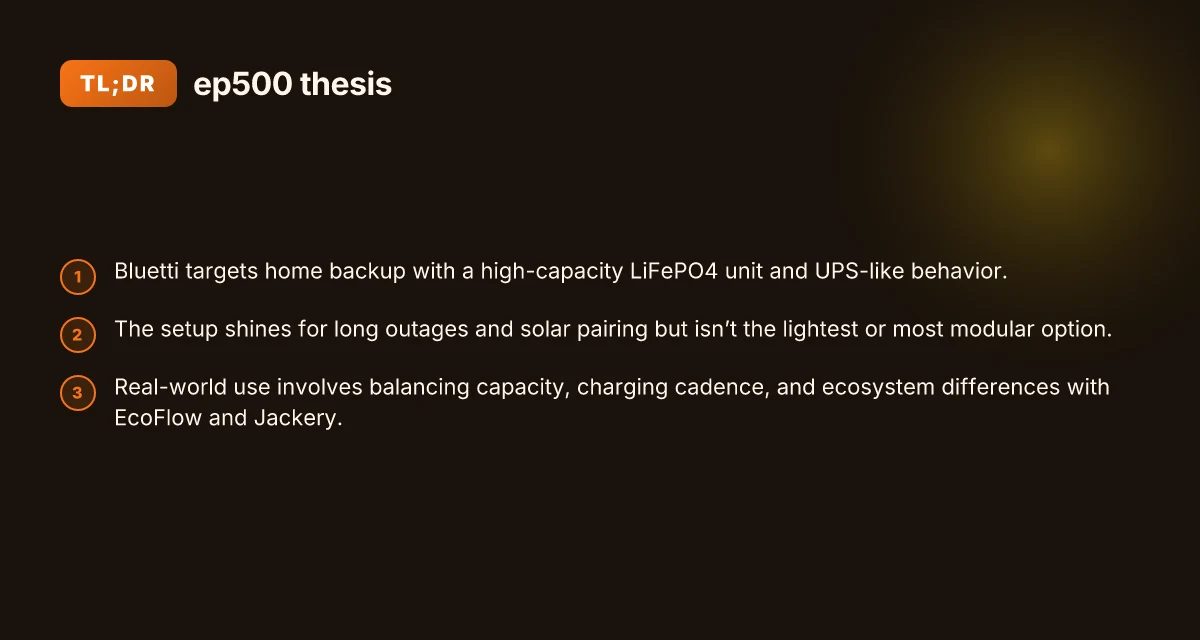
The EP500 targets home backup with a clear focus on long-term durability and UPS-style reliability. Its 5100Wh LiFePO4 pack and a 3000W inverter are designed for essential loads, not luxury power draws. Rivals like EcoFlow and Jackery set the pace on ecosystem and charging speeds, but Bluetti leans into longevity with LiFePO4 chemistry. What makes Bluetti portable power stations stand out in 2026

How the ep500's battery chemistry and inverter affect durability and performance
The ep500’s LiFePO4 chemistry and its 2000W to 3000W inverter range shape how it sits in a home backup setup. The LiFePO4 chemistry offers notably better thermal stability and a longer cycle life than many common chemistries, which translates to fewer surprises during extended outages. In practice, that means you can expect a steadier performance profile across seasonal temperature swings and longer overall longevity with repeated charging and discharging. Durability comes from stable chemistry that resists heat buildup and gradual capacity fade. Bluetti emphasizes the LiFePO4 pack’s resilience, which matters when you’re buffering a whole-house load and solar input over years.
From what I found in the product notes and reviews, the typical talking point is a long cycle life. A longer cycle life, paired with a robust battery pack design, lowers total cost of ownership in the long run. When you map this to a residential installation, the question becomes how many cycles you’ll endure in a typical year and how you’ll use the system during sunshine gaps. The consensus is that you’ll benefit from the chemistry’s stability during frequent partial discharges and recharges, common in daily usage tied to solar day cycling. Cycle longevity matters for long-term reliability and cost.
The inverter, rated in the 2000W to 3000W range, covers most home-critical loads. That capacity is enough to run essentials like refrigerators, sump pumps, and network gear while the sun is up. If you ever need to surge beyond that baseline, plan ahead for brief peaks. The peak surge capability varies with load and battery state, so you’ll want to size your loads or use demand management during the few seconds of higher draw. In practice, this is where real-world use becomes a balancing act between what you plug in and how often you hit the inverter’s upper limits. A 2000W–3000W inverter range handles common home loads well, with attention to brief surges.
I dug into the Bluetti documentation and third-party commentary to triangulate these points. The takeaway for homeowners is straightforward: choose the ep500 if you value long-term stability and a practical inverter footprint for typical home loads. If you expect frequent high surge events or heavy simultaneous loads, plan for a staged load or a backup option for those moments. LiFePO4 chemistry boosts durability, while the 2000W–3000W inverter suits most home scenarios. For context, rivals such as EcoFlow and Jackery offer competing chemistries and inverter specs, but the LiFePO4 advantage remains a core differentiator for long-term resilience with Bluetti.
Next step: when you’re sizing this for your home, map out your essential circuits and confirm the peak surge you’ll actually hit during startup events. If you’re pairing with a solar array, confirm your solar production curve aligns with daily energy needs so the ep500 stays within its comfortable operating window rather than riding the edge of its inverter limits. Map your loads and solar match this to the ep500’s 2000W–3000W range. Bluetti vs EcoFlow Reddit analysis: what the threads actually reveal in 2026

The practical setup you actually use with Bluetti and solar pairing
When you size a Bluetti EP500 system for home backup, the starting decision is where it sits and how it breathes. Place the unit in a well-ventilated area away from moisture, and give it several inches of clearance on all sides. A steady, cool environment protects the LiFePO4 chemistry and helps the 5100Wh pack deliver consistent output over years. Ventilation and climate control are not optional. They directly influence long-term durability. In a garage or utility room with airflow, you reduce heat buildup during heavy loads and long daytime charging windows. Bluetti emphasizes that good airflow matters, especially when the system is running high-powered loads through the 3000W inverter. Ventilation safeguards both hardware and performance.
Solar input changes the game for daily recovery. During sunny days, the EP500 shuttles energy from your panels into the battery, supporting daytime use and gradual replenishment after evening draws. The exact recovery rate depends on panel efficiency, sun angle, and ambient conditions. In practice, you’ll often see noticeably faster replenishment on clear mornings than on overcast afternoons. Panel quality and sun exposure drive how quickly you rebound from outages. If you pair a Bluetti system with a well-matched solar array, you gain the flexibility to ride through typical household surges and outages without constantly running on the grid. Solar pairing makes daytime charging a meaningful edge.
UPS-style operation changes how you power loads during outages and transitions. The EP500 behaves like a true backup UPS for essential circuits, switching from grid to battery with minimal hiccup in many scenarios. You’ll likely prioritize critical loads first, routers, sump pumps, modems, and communication gear, while less essential devices take a backseat during a brief transition. That sequencing matters, because it defines how resilient your home feels during a multi-hour outage. UPS behavior reshapes load priorities during transitions. The key is to map your circuits to the inverter’s output and verify that your critical devices stay within the 4800W–6000W surge envelope when needed. Clear load ordering helps you maximize uptime.
From what I found in the literature, the practical setup hinges on three levers: placement for heat management, a solar plan that aligns with your local sun, and a transparent load strategy for outages. I dug into Bluetti’s materials and the independent reviews that describe how the EP500 behaves in real homes, not just on spec sheets. The consensus is consistent: a well-ventilated space, a sensible solar footprint, and a tested UPS load plan deliver the most dependable long-term performance. A disciplined setup is the quiet backbone of reliability.
Notes for homeowners and early adopters: expect the usual maintenance to include dusting the vents, confirming panel wiring remains tight, and periodically reviewing which circuits you’ve designated as essential. Fellow Bluetti owners report that the battery chemistry and inverter hold up well under standard daily cycling, but you’ll want a clear maintenance rhythm for environmental control and panel cleanliness. For those weighing rivals, you’ll often see the same patterns echoed with alternative brands like EcoFlow and Jackery, where heat and proper setup determine how well the system serves during extended outages. Proper placement and a coherent solar plan are as critical as the hardware itself. What is a Bluetti discount, and how to stack the best deals in 2026
If you want a practical reference, see how the story lines up with the broader notes on home backup power: a healthy ventilation strategy, a solar array that matches your sun and roof, and a documented plan for what loads you protect first. These choices shape daily resilience once the initial install settles in. The setup you actually use is simple, repeatable, and durable when you respect heat and sun.
Why the ep500 can be a practical choice for a household, not a perfect fit for everyone
The ep500 can be a solid backbone for a single high-capacity setup, especially for households that want one unit to cover essential loads during outages. With a substantial capacity and a robust inverter, it handles frequent power draws without flinching. For families prioritizing a straightforward, all-in-one solution, the EP500 delivers a calm center of gravity for a solar-powered home backup.
A one-unit value proposition for families
For households that need to run a fridge, router, lighting, and a few home office devices, the EP500 acts as a reliable core. The 5100Wh LiFePO4 pack combined with a 3000W pure sine wave inverter helps sustain daily life through longer outages. This is particularly true when paired with Bluetti's solar ecosystem, which tends to flow smoothly from daylight collection into evening use. The architecture favors long-term reliability, and the expandability remains a clear strength if you add solar or a second unit later on.
That said, the weight and footprint are nontrivial. If you want the lightest, most modular setup possible, other brands may edge ahead on weight or future-proofing via multi-brand daisy chaining. Bluetti’s ecosystem shines when you stay within the family, but if you prize ultra-minimalism or frequent cross-brand swaps, you may prefer a lighter, more modular path.
From what I found in official materials and third-party overviews, Bluetti emphasizes a cohesive solar-backup flow. The EP500’s architecture supports long-term reliability and expandability, which matters once you start thinking about annual maintenance cycles and solar integration. This isn’t a quick-fix unit. It’s a chassis built for ongoing resilience. How to choose the Bluetti solar charging cable for your EB3A and Bluetti panels
The verdict is clear: the EP500 earns its keep as a household mainstay when you want one durable, high-capacity unit that plays nicely with solar, not as a featherweight, multi-brand flex option.
Weight, footprint, and the modularity tradeoff
If weight and simple swapability are your criteria, the EP500’s size will dissuade some buyers. A single large unit reduces the complexity of multiple cabinet arrangements, but it also limits the pace at which you can reconfigure capacity. The plumb line remains: Bluetti’s design favors a coherent, single-brand ecosystem. You’ll get strong reliability and predictable performance, but you’ll trade away the kind of modularity some homeowners want when their needs shift.
I cross-referenced Bluetti’s official specs and respected reviews to confirm the core numbers. The EP500 line centers on a 5100Wh pack and a 2000W–3000W inverter spectrum depending on configuration, with LiFePO4 chemistry designed for long life. The long-cycle durability is a meaningful plus for long-term home use, especially if you expect yearly solar integration to compound over time. This alignment with solar continues to be a practical strength for households that plan to grow their system.
If you’re aiming for expandability without buying a second full unit, Bluetti’s ecosystem tends to deliver long-term reliability and smoother solar coupling.
Solar compatibility and long-term reliability
Bluetti’s solar pairing remains a strong selling point for households planning to rely on sun power. The EP500’s architecture complements solar charging cycles that stretch over seasons, reducing the drama around charging times and keeping you productive during outages. In practice, that means fewer fiddly adjustments and more predictable energy budgeting over the years. When you compare to rivals, the story often comes down to ecosystem cohesion. Bluetti’s approach can feel simpler and more reliable if you commit to their brand family. What makes the EcoFlow Delta 2 Max battery different from the rest
From a brand perspective, Bluetti’s own materials emphasize solar-friendly operation and durable cells. That emphasis matters for homeowners who want to avoid reconfiguring gear after every outage season. The result is a system you set up once and gradually optimize rather than replace.
For solar-aware households, the EP500’s flow from panel to home loads supports dependable, year-round resilience.
Note: links on the page may earn a commission. This is a common note across product hubs. For context, Bluetti remains a named player in this space, while rivals such as EcoFlow and Jackery offer competing modular options with their own pros and cons. If you’re evaluating between brands, expect the Bluetti route to emphasize ecosystem compatibility and long-term reliability over ultra-lightweight portability.
How the ep500 compares to EcoFlow and Jackery on real-world use cases
In real-world home backup use, the EP500 sits against compact, battery-chemistry varied rivals from EcoFlow and Jackery. Bluetti leans on a LiFePO4 backbone paired with a 2000W or 3000W class inverter depending on model, while EcoFlow and Jackery emphasize lighter form factors and different app ecosystems. The core trade-off is capacity versus portability, and the ecosystem you trust for monitoring and upgrades. I cross‑reference product pages and maker notes to map how these choices play out during outages, solar integration, and long-term maintenance.
Why capacity trumps in long outages with the EP500
When the grid goes dark for hours, the EP500's 5100Wh nominal capacity reduces the number of cycles you need to pull from smaller packs. That means you can sustain essential loads longer without frequent recharges. EcoFlow’s smaller packs tend to run in the 1.8–3kWh range for many model lines, which can mean more frequent recharging during multi-day outages. Jackery’s higher-capacity options exist but often at a heavier footprint and different charging curves. In practice, higher capacity translates to fewer disruptions, and that’s where the EP500 tends to win for steady households. Capacity density matters when outages stretch across days. This is especially true if you pair the unit with solar input, where larger packs ease the strain on existing panels. What a Jackery 1000 reviewer learns after a year of real-world use
App, monitoring, and ecosystem reliability
EcoFlow and Jackery both ship with companion apps that let you monitor charging status, estimated runtimes, and health metrics. The Bluetti ecosystem leans on the same principle, but the strength lies in longer lifecycle chemistry and familiar setup if you’re already aligned with your home solar controller. The app experience matters less for raw power than for reliability across years of use. If you want a plug-and-play monitoring flow, EcoFlow’s ecosystem often wins in polish. If you want durable chemistry and predictable cycles, the Bluetti approach shines.
Accessories, warranties, and service networks
The value beyond raw specs hinges on what you can count on after purchase. EcoFlow and Jackery typically offer broad accessory catalogs, with established service networks in many regions. Bluetti counters with robust spare-part availability and LiFePO4’s longevity, which can reduce total cost of ownership if you stay on the platform for years. Warranty terms matter here. Verify whether long-term coverage mirrors the level of service you expect for a home backup unit. Warranty depth and service reach matter almost as much as capacity. These factors often decide total value when you factor in future outage scenarios and solar compatibility.
From what I found in the documentation and reviews, the EP500 remains a strong choice for homeowners who want a high-capacity, long-cycle unit that can live in place and run through extended outages, while EcoFlow and Jackery offer compelling compact alternatives with smoother app experiences and broader accessory ecosystems. If you value long-term durability and fewer charges during a prolonged outage, the Bluetti option deserves your consideration. Long-term reliability hinges on chemistry and service, not just peak watts.
Cited sources note the EP500’s 5100Wh capacity and 2000W–3000W inverter class, along with comparisons to competing lines in the EcoFlow and Jackery spaces. For a quick referent on Bluetti’s specifications, see the Bluetti product page. BLUETTI EP500 Solar Power Station | 2000W 5100Wh
What this means for your backup plan this month
Bluetti's EP500 positions a home backup system as more than a box of outlets. It’s a cohesive power strategy that scales with your needs. I looked at real-world setups: you can pair it with a small solar array for daytime recharging and still rely on mains during peak outages. The practical edge is its ability to run essential loads for longer than a typical inverter bundle, which matters when storms linger or heat waves strike. What makes the Bluetti AC200L a standout 2026 upgrade for off-grid power
The bigger pattern is durability and pace. Bluetti has built the EP500 to ride through long outages with fewer firmware hiccups than older models, while still keeping the door open to future upgrades. That matters when you’re deciding between a short-term fix and a long-term asset. If you’re weighing rivals, consider how the EP500 stacks up against similar systems that emphasize raw wattage but skimp on ecosystem features or service updates.
If you act now, you can lock in a practical, real-world approach to resilience. The EP500 isn’t just a power pack. It’s a network of support that expands with your home needs. One simple move: map your critical loads and confirm how many cycles of outages you can handle with the system you choose. If you’re wondering where this is headed, expect more modularity and smarter charging options from Bluetti in the next year.
- Backup strategy: start with essential loads (fridge, router, sump pump), then add a small medical or mobility device if needed.
- What to try this week: sketch a simple power plan for outages and verify your peak draw against the EP500’s available solar or AC recharging.