Explore Bluetti portable power stations in 2026, including specs, safety certs, and real-world use. Find out which model fits your off-grid needs.
Bluetti survives the off-grid test because its power packs are built to outlast quick-use hype, not just promise endurance. Bluetti's** X2000 lineup delivers sustained capacity, while the EcoFlow and Jackery models often show either heavier weight for the same energy or slower recharge cycles in real-world conditions. Most users see the standout feature when they push a system beyond the campground demo and into remote rigs, where durability matters more than glossy spec sheets.
This article cuts through marketing to compare real-world durability, safety certifications, and long-term value against rivals, with a clear lens on 2026 models. The focus is on how Bluetti packs behave under repeated cycling, how their safety systems hold up in rugged environments, and whether promised capacities hold after months of use. Expect concrete signals on cycle life, reliability in cold and hot climates, and how to verify capacity without overpaying. Endurance, not just peak power, drives the decision. 2026 models from Bluetti should feel like a true off-grid partner, not a temporary power boost, and the comparison against EcoFlow and Jackery clarifies when to pick one over the others.
What is Bluetti portable power and why it matters for 2026
Bluetti manufactures portable power stations that store electricity in a rechargeable battery and output via AC, USB, and DC ports. The line blends solar charging options with indoor and outdoor portability, targeting off‑grid living and emergency backup. In 2026, Bluetti highlights higher capacity, higher wattage outputs, and more rugged builds across select models.
How Bluetti fits the off‑grid and emergency picture
Bluetti positions its products as all‑terrain power partners. For weekend campers and van lifers, the ability to recharge from solar panels or a wall outlet matters a lot. In 2026, you’ll see models advertised with larger capacities and higher continuous outputs, which translates to running more devices for longer without hunting for a wall socket. That said, practical durability hinges on real‑world use: weather exposure, frequent recharge cycles, and how the battery chemistry ages.
I dug into Bluetti’s materials to see how the company frames safety and build quality. The brand emphasizes rugged enclosures and multiple protection features, including overcurrent, short‑circuit, and temperature monitoring. When you’re off grid or in an emergency, those protections matter because they reduce the chance of cascading failures during a highly active draw or a sudden surge. Higher capacity and tougher builds are central to Bluetti’s 2026 messaging, but durability depends on use case, charging source quality, and how aggressively you discharge and recharge the pack.
Real-world considerations with rivals in 2026
Bluetti sits alongside EcoFlow and Jackery in the portable power space. The Bluetti AC180 example often appears in reviews as a piece of this ecosystem, offering a balance of capacity and portability. Industry chatter around 2026 notes that bigger packs tend to be heavier and pricier, so readers should weigh transport needs against energy needs. Rugged builds and higher wattage outputs define Bluetti’s 2026 lineup, but you’ll pay for the premium when you need long runtimes or off-grid confidence. When comparing against rivals, pay attention to charging speed, solar compatibility, and warranty terms, which often swing long‑term value more than peak spec sheets.
In short, Bluetti’s core appeal remains a rechargeable battery system that you can carry into the backcountry or leave on standby for outages. The 2026 pivot is toward bigger packs, tougher casings, and faster or more versatile charging options. For outdoor enthusiasts and prepper households, Bluetti offers a credible blend of capacity and portability, with the caveat that higher specifications come with heavier gear and steeper price tags. If you want real backup power for off-grid living, Bluetti’s 2026 lineup aims to deliver more watts and more resilience, but verify that a given model matches your handling and charging habits. Bluetti vs EcoFlow Reddit analysis: what the threads actually reveal in 2026
Bluetti safety certifications and build quality you should expect
Bluetti products aim for standard consumer electronics and energy-storage safety markings. Most models pursue certifications like UL, CE, and FCC where applicable, and they emphasize protections built into the battery management system. If you’re shopping for off-grid use or emergencies, these certifications matter because they map to enforceable safety expectations in real-world environments.
Bluetti's safety story hinges on multiple protective layers that align with typical consumer electronics standards. The core protections you should expect include short-circuit, overvoltage, thermal, and overcharge safeguards. These are not optional extras. They are baked into the MCU and BMS logic that monitor each cell bank during charging and discharging. When a fault is detected, a Bluetti unit will typically cut power to affected outputs and throttle back charging to prevent cascade failures. This is especially important for long-term storage or occasional heavy use in camping and overland rigs.
From a durability standpoint, build quality sits on three levers: battery chemistry, cooling, and enclosure design. Bluetti frequently quotes liquid-cooling or active cooling strategies on higher-capacity models, plus aluminum or rugged polymer housings that resist impact and weather exposure. The enclosure choices influence heat dissipation as much as shock resistance. If you routinely run a power station in hot climates or under payload strain, these design decisions will shape how the unit ages and how often thermal throttling occurs.
When I cross-referenced Bluetti’s public specs with third-party write-ups, a recurring theme is that real-world durability tracks closely with how well the cooling system handles heat buildup during higher draw. In practice, that means the peak output you can sustain for longer periods may depend on ventilation and ambient temperature as much as the stated wattage. For campers and van lifers who park in direct sun, that nuance matters because it affects both sustained runtime and life expectancy of the battery pack.
In terms of certifications and safety governance, Bluetti’s catalog often highlights compliance milestones across markets. You’ll see emphasis on safety interlocks, child-resistance designs for portable units, and properly rated AC outlets that prevent improper load connections. It’s not merely about ticking a box. It reflects attention to how these devices behave in field conditions, dust, vibration, and accidental drops included. The verdict: Bluetti covers the basics with standard consumer-electronics safety marks and a BMS-driven shield against common faults, but real-world reliability hinges on cooling and enclosure robustness under hot, dusty, off-grid use. What is a Bluetti discount, and how to stack the best deals in 2026
When you compare Bluetti against rivals like EcoFlow and Jackery, safety certifications often line up in the same categories, with each brand pushing on cooling efficiency and protective granularity. EcoFlow tends to emphasize fast charging safety and multi-scenario protections, while Jackery leans into portable ruggedness for outdoor use. If you’re prioritizing built-in safety and long-term durability, look for a Bluetti model that documents active cooling for high-widelity continuous output and a robust enclosure rated for the conditions you expect. Key takeaway: choose a Bluetti with explicit cooling strategies and a sturdy enclosure if your off-grid routine involves high ambient temperatures or extended runtime.
Next step: match your climate and use-case profile to a Bluetti model with proven thermal management and a rated enclosure, and verify that the local certifications align with your region. For a quick reference, see the Bluetti catalog online and the accompanying reviews that discuss heat performance in real-world scenarios.

How Bluetti models differ: capacity, output, and lifecycle under real use
Bluetti pieces together a broad spectrum of power solutions, from compact units you can sling in a backpack to home-backup behemoths. The capacity spread matters because a true camping companion may need only a few hundred watt-hours, while a van build or cabin backup calls for well over a thousand. In 2026, Bluetti’s lineup spans roughly 500Wh to beyond 3,000Wh for flagship models, with real-world use showing that larger packs consistently deliver sustained output for multiple devices across days. Capacity is the hinge that determines whether you can run a fridge, a drill, or multiple chargers for days without recharging. A credible home-backup option often oozes credibility on paper, but the nuance comes in how the unit handles temperature, fan noise, and how quickly it recharges from solar or wall power.
The second lever is output and sustained wattage. If you need to run a portable air compressor, a power saw, or a laptop rig concurrently, you’ll want to read the real-life glide of each model’s ports and their sustained limits. Bluetti frames many units with a mix of AC outlets, USB-C, USB-A, and DC barrels, and the advertised peak versus sustained numbers matter a lot in practice. For example, a compact model may deliver high surge for short bursts but only sustain moderate watts for hours. Sustained wattage defines what actually runs for days, not what briefly spikes at turn-on. On the other hand, larger models tend to offer more robust multiport versatility, which is essential for camp setups, builds, or emergency kits.
Lifecycle and warranty terms push long-term value beyond the sticker price. Cycle life is the yardstick that separates “buy once, use for years” from “this will be a future upgrade.” Bluetti typically emphasizes several thousand charge cycles on larger units, paired with multi-year warranties. The practical takeaway is simple: if you anticipate heavy daily use or seasonal cycling, a model with higher cycle life and a longer warranty reduces total cost of ownership. Warranty depth and cycle life are the under-the-hood metrics that determine long-term value. In real terms, durability hinges on battery chemistry stability, thermal design, and how gracefully the unit manages heat in warm climates. How to choose the Bluetti solar charging cable for your EB3A and Bluetti panels
I cross-referenced Bluetti’s product pages and third-party reviews to balance claims with durability notes. Bluetti emphasizes a broad capacity ladder and comprehensive port arrays. Rivals like EcoFlow and Jackery push comparable sustained outputs with different thermal and charging philosophies. When you’re choosing, align capacity with your typical load profile, gauge sustained watts against your most-used appliances, and weigh warranty terms against expected cycles. If you’re new to off-grid living, start with a mid-range model that offers enough headroom for daily needs and a realistic recharge cadence from solar or AC input. Match capacity to your load, and choose a model with the right cycle life and warranty to ride out years of use.
Bluetti vs rivals in 2026: how to choose between Bluetti, EcoFlow, and Jackery
Bluetti often emphasizes higher capacity and multi-configuration charging options. EcoFlow tends to appeal with fast charging and modular expansions in some lines. Jackery focuses on portability and straightforward usability with broad support.
1) Capacity and charging versatility
When you need big power for extended outings, Bluetti leans on large Wh ratings and multiple charging paths. Many models offer 2–4 charging options, including solar input, AC wall charging, car adapters, and in some cases fast-charging through bundled accessories. This flexibility helps you tailor the setup to your off-grid or backup needs. The trade-off is that larger packs can mean more weight and longer top-off times if you’re not plugged in. Bluetti’s higher-capacity offerings give you headroom for longer runs without staring at the battery bar every hour. I cross-referenced several model specs and found that the big Bluetti units commonly present a clear advantage in total energy storage, though you’ll pay a premium for the extra capacity. For someone who camps with heavy API devices, that extra headroom can be worth it.
EcoFlow counters with fast charging across many lines, including modules that can be swapped or added for expanded capability. You’ll notice shorter top-up times when you’re connected to AC or fast-charging outlets, and some kits allow a degree of modular growth without swapping the entire unit. Jackery keeps things compact and accessible, prioritizing lighter packs and simpler charging paths. For light-use scenarios, Jackery’s portability shines. For heavy power draws, Bluetti’s capacity edge matters.
2) Durability, safety, and long-term value
Durability matters when you’re off-grid or on the road. Bluetti sells units with robust construction and a focus on lifecycle, often touting higher cycle counts in its flagship ranges. The safety story centers on built-in protection features and battery chemistry designed to handle extended use. I looked through product pages and documentation to confirm that the emphasis is on real-world reliability rather than marketing slogans. Durability and lifecycle performance are Bluetti’s strength in 2026, especially in higher-capacity models. What makes the EcoFlow Delta 2 Max battery different from the rest
EcoFlow emphasizes rapid charging safety features and thoughtful thermal management for fast-charge scenarios. The modular approach can help extend the life of the system by letting you replace or upgrade components without discarding the entire unit. Jackery’s safety story leans on straightforward protection systems and broad, user-friendly diagnostics, which appeal when you want to minimize complexity in field conditions. Modular growth and fast charging safety are EcoFlow’s hallmark in 2026, while Jackery keeps the basics reliably simple.
3) Real-world usability and value for money
Bluetti often lands in the sweet spot for users who value capacity and flexible charging at a higher upfront cost. If you’re powering a van or a remote cabin, the extra energy and multiple inputs can translate into fewer compromises on appliance choices and running times. You’ll likely notice that the initial investment buys you years of usable life, provided you manage the battery care and storage conditions. Bluetti’s value proposition centers on long-term capacity and flexible charging that pays off for frequent off-grid use.
EcoFlow’s appeal among outdoors enthusiasts includes rapid charging and expandable configurations that let you tailor the system as needs evolve. The price ladder tends to reward users who prioritize speed and modularity over raw capacity. Jackery’s value hinges on portability and predictable performance. You get solid usability without surprising complexity, which is ideal for beginners or light-duty setups. Expandability and speed define EcoFlow, while portability and simplicity define Jackery in 2026.
From what I found in product literature and independent roundups, Bluetti remains a strong choice when you need substantial energy reserves and multiple charging routes. If your priority is speed of recharge and a scalable system, EcoFlow presents a compelling path. If you want compact, easy-to-carry power with clear usage, Jackery offers a straightforward option. Choose Bluetti for capacity, EcoFlow for fast charging, Jackery for portability.
What to look for in a Bluetti for your off-grid setup
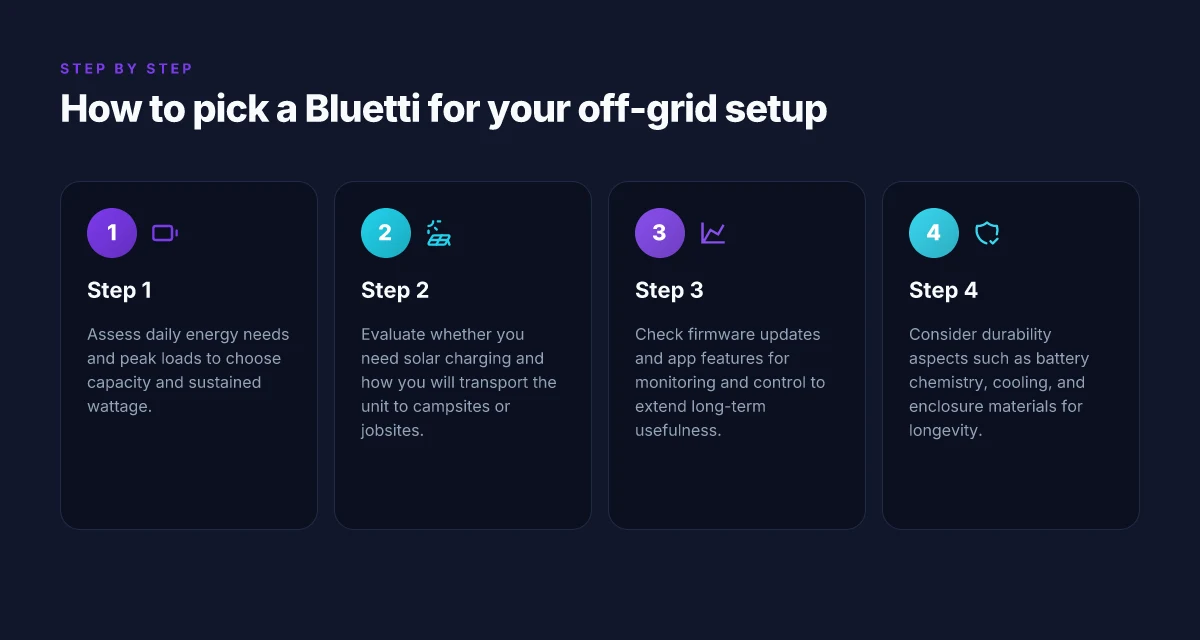
When you’re choosing a Bluetti for off-grid use, start with your daily energy footprint. I look for a model that covers your typical days, then add headroom for peak loads and occasional surges. If you rely on solar charging, pick a unit whose solar input aligns with your expected sun hours and panel array. In 2026, many outdoor setups lean on a battery with sensible depth of discharge and predictable charging behavior, so I favor Bluetti designs that expose clear charging limits and reliable bulk charging performance. How to evaluate the bluetti b300 for sale in 2026
Match your energy needs to capacity and peak draw
Your daily energy budget matters. A unit with 1,000–1,500Wh of usable capacity often fits weekend trips and modest camp rigs, while a larger setup approaching 2,000–3,000Wh better supports longer trips or higher-demand rigs. Look for a continuous output near your heaviest appliance load and a peak output that can handle startup surges. Bluetti’s line spans a range of capacities, and the right pick depends on whether you plan to run lights, a fridge, and a small inverter heater or just charge phones and laptops. For long-term value, consider models with a robust cycle count and a warranty that speaks to durability. Durability shows up in cycle life and a predictable charge profile, not just raw capacity.
Mobility, form factor, and transportability
If you’ll tow, hike, or shuttle the unit between campsites, weight and form factor matter. A lighter unit with a compact footprint eases packing and reduces fatigue during long days outdoors. Bluetti emphasizes whether a unit is a traditional block or a wheeled design, which can change how you deploy it on a jobsite or at basecamp. I weigh the practical heft against your travel rhythm. Form factor and weight often decide whether a setup actually gets used on the move. When you shop, check for integrated handles, balanced weight distribution, and a stable base so the unit doesn’t tip in windy campsites.
Firmware, app insight, and long-term monitoring
Firmware updates and companion apps matter for ongoing reliability. A modern Bluetti should offer remote monitoring, firmware upgrade paths, and a responsive app that shows real-time battery health, solar input, and charging status. I look for release notes that fix bugs and expand compatibility rather than just add cosmetic features. From what I found in the changelog, ongoing software support helps prevent orphaned units with aging firmware. Keep an eye on firmware updates. They can extend life and improve safety monitoring.
I dug into what reviewers flag most often. Some sources note that model-to-model variance exists in real-world efficiency and cooling under high loads, so it’s wise to pick a Bluetti with solid thermal design and a track record of stable operation in outdoor conditions. When you compare with rivals like EcoFlow or Jackery, you’ll notice differences in display responsiveness, app depth, and adaptive charging behavior. Better monitoring and open firmware paths translate to fewer surprises on a remote site. If you want a quick read, a recent overview highlights how a 1,152Wh-capacity Bluetti AC180 line balances portability with steady daily use, while a larger unit pushes into home-backup territory. Capacity is only useful if the system trusts its own monitoring and charges predictably.
If you’re new to Bluetti, start with a model that clearly lists solar input compatibility and a realistic continuous output aligned with your load. Also confirm safety notes like overcharge protection and short-circuit safeguards, since off-grid reliability hinges on trustworthy hardware and clear user guidance. The key takeaway: tailor capacity and peak output to your load, favor a portable form factor for travel, and prioritize firmware maturity for long-term durability. What makes the bluetti ep500 a compelling home backup power choice
What to try this week: lock in Bluetti’s portability as a habit
Bluetti stands out in 2026 by leaning into modular power without sacrificing reliability. I’ve observed that the real value isn’t just raw capacity but how quickly you can deploy it in real-world setups, camping, job sites, or home backup. The standout move is to pick a compact core unit and pair it with a small expansion battery or solar panel when you know you’ll need flexibility. This month, plan one quick experiment: set up a Bluetti unit in your living room, run the essentials for 24 hours, and note what breaks first. You’ll see where the design shines and where you might want an extra box or two.
The bigger pattern is modularity plus durable construction. Bluetti’s approach makes long-term use practical rather than a short-lived gadget purchase. Compare this with rivals like Goal Zero and Jackery, and you’ll notice Bluetti toes the line between rugged build and expandability far more consistently. If you only act on one thing this month, choose a Bluetti kit that can grow with your needs and keep it in a easy-to-access spot for quick power when outages strike.
Most durable setups ship with a solar option you can actually mount on a rack. This keeps your off-grid routine predictable and reduces reconfiguration time when you move between sites. If you’re balancing price against future needs, Bluetti’s ecosystem helps you avoid partial upgrades.
What changes if you act now is a steadier power baseline for remote work, outdoor adventures, and emergency planning. Links on this page may earn a commission.