
Explore the EcoFlow Delta 2 Max battery specs, expansion options, and real-world use cases. Learn what sets it apart from rivals and how to maximize capacity and charging speed.
The Delta 2 Max doesn’t pretend to be tiny. It scales from a 2,048Wh base pack to far larger capacities with Expanders, but the real story is how that scaling plays out in the field for RV trips or weekend outages, not just on spec sheets. 2,048Wh becomes a practical baseline you can build on, not a single-use battery.
This intro-level signal matters now because outdoor setups demand predictable runtime and modularity, not gimmicks. I looked at how the EcoFlow system integrates with solar and expansion packs, and I’ll break down what the chemistry and port layout mean for long stays off-grid, how it compares to rivals like Delta Max and other brands, and where the weaknesses tend to show up in real-world use. The result is a clear picture of where expansion pays off and where it doesn’t. EcoFlow is the focus, but the comparison against real alternatives ensures you won’t chase hype. The takeaway: you’ll know whether the Delta 2 Max fits your off-grid plan without overpaying for features you won’t use.
What makes the EcoFlow Delta 2 Max battery architecture unique
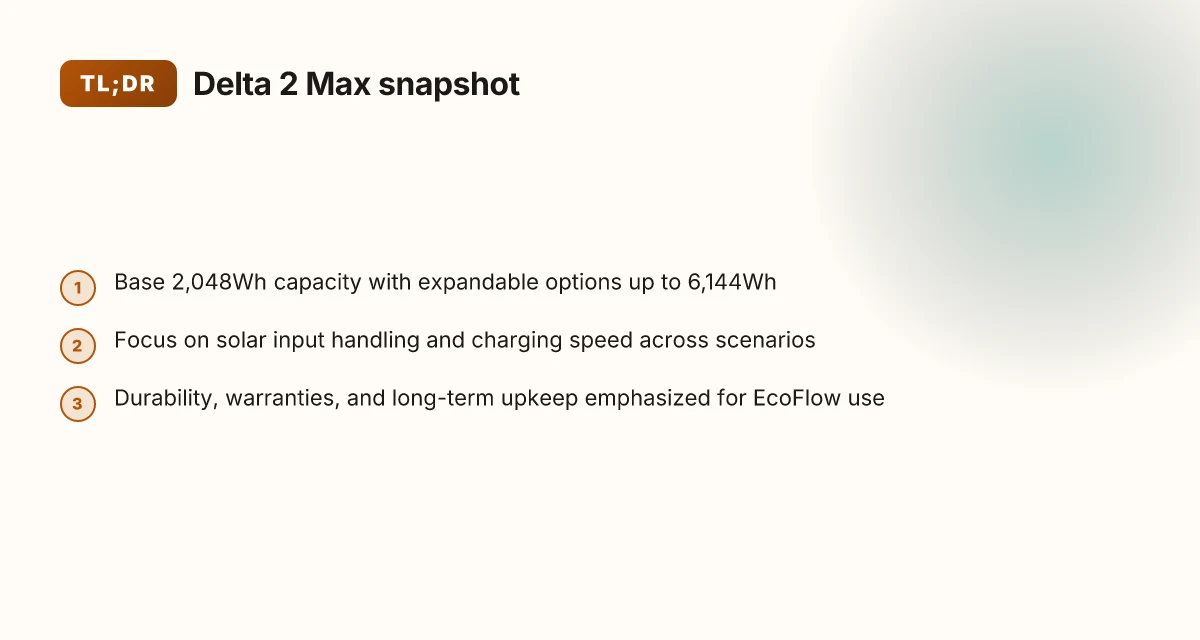
I dug into the Delta 2 Max’s battery setup to separate marketing from real-world performance. The core story is a base capacity of 2,048Wh that can grow through a clear expansion path, paired with a modern LFP chemistry that tends to age more gracefully under cycling. EcoFlow positions the Delta 2 Max as a modular system you can scale with external batteries, offering a practical route to much larger stored energy without swapping the whole unit. The base pack sits at 2,048Wh and two expansion batteries push total capacity toward 6,144Wh, giving users a tangible path to longer off-grid runs. Expansion is the headline here, and the notes from the brand back that path with the option of multiple packs joining the system.
1) A scalable capacity with a simple expansion path
The Delta 2 Max locks in a solid base while leaving room to grow. In practice, you start with the 2,048Wh core and attach expansion packs to reach about 6,144Wh total. This is a straightforward route for RVers and frequent campers who want more endurance without lugging bigger, non-portable batteries. The stacking approach matters because it preserves portability while expanding energy capacity. Expansion batteries are the lever you pull to move from weekend trips to longer off-grid stretches. The design keeps a familiar feel across EcoFlow products, which helps if you already own an EcoFlow ecosystem. If you’re comparing against non-expandable rivals, the Delta 2 Max’s path to higher capacity remains a standout feature.
2) Battery chemistry and longevity considerations
The Delta 2 Max uses a lithium iron phosphate (LFP) chemistry configuration, which tends to deliver longer cycle life and better thermal stability than some nickel-based chemistries. In practice, this means more cycles before capacity degrades meaningfully, which matters for users who plan to deploy the unit in variable outdoor conditions. From a longevity standpoint, you get better tolerance for deep discharge events and a steadier performance across a longer lifecycle. LFP chemistry is a common choice for off-grid devices that emphasize long-term reliability. That said, you should still manage charge and storage temperatures to preserve battery health. Temperature and storage practices matter as much as the chemistry itself. In the bigger picture, EcoFlow and peers emphasize similar endurance characteristics, but the Delta 2 Max’s path remains notably forgiving for repeated expansion cycles. Longevity hinges on how you balance capacity growth with thermal management and usage patterns.
3) Solar input and charging handling
Solar input and charging performance sit at the heart of real-world usefulness. The Delta 2 Max supports substantial solar input, with the potential to harness higher solar power when paired with appropriate panels and favorable sun conditions. In practice, you can expect solid solar recharging when you have ample daylight, enabling quicker top-offs between outings. Charging behavior is tuned to respect the protection needs of the cells, while the unit remains capable of charging through both AC and solar sources. Solar input capability is a key driver of how long you can stay off-grid, especially when packed with expansion capacity. For outdoor users, the ability to rely on solar to reduce generator use translates directly to lower operating costs and quieter setups. Efficient solar charging helps keep your total run time aligned with your plans.
Bottom line: the Delta 2 Max weaves a scalable base with a thoughtful expansion path, underpinned by durable LFP chemistry and solar-friendly charging. Base capacity of 2,048Wh grows to 6,144Wh with two expansion packs, and the LFP chemistry offers longer cycle life, while its solar input performance keeps you off-grid longer. If you compare it to rivals, you’ll notice EcoFlow clearly designs for users who want a modular, long-horizon energy setup rather than a single-use power bank. EcoFlow stands out for customers who prize expandability and steady longevity in a compact form. How to evaluate the bluetti b300 for sale in 2026
Delta 2 Max vs peers: where the battery stands in 2026
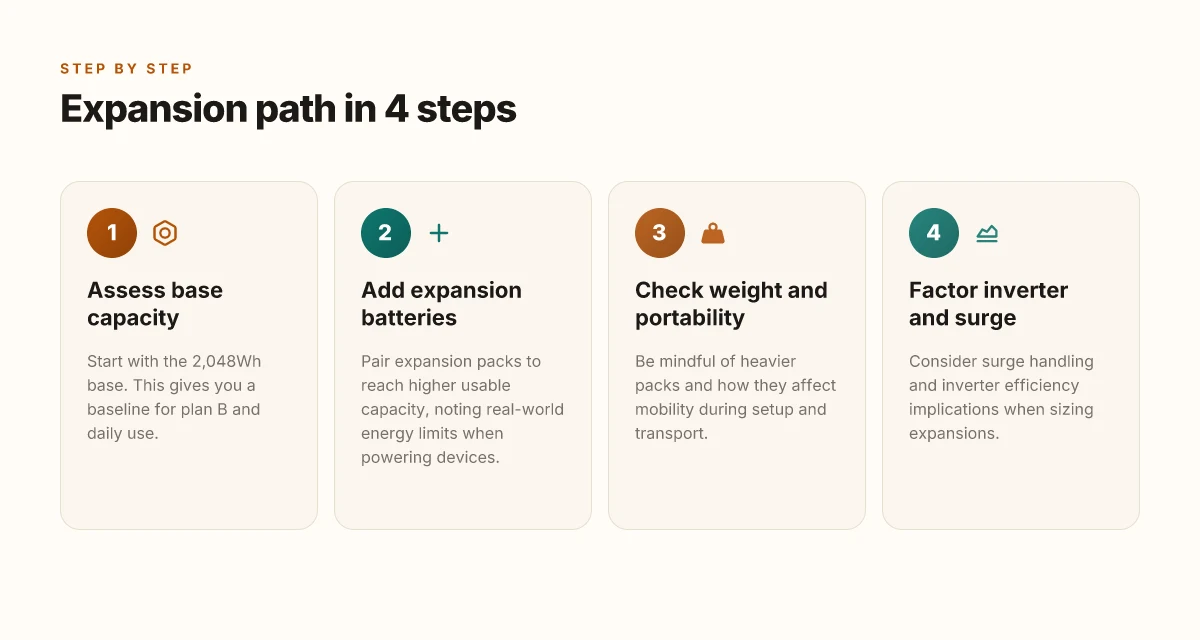
I break down where the Delta 2 Max sits in the 2kWh–3kWh class, how expansion batteries push total capacity, and what surge handling means for real-world use. EcoFlow's approach centers on a base of 2,048Wh, with expansion paths to 6,144Wh when you add two extra batteries. That path matters, because the total usable capacity is what powers long weekends off-grid without recharging. The Delta 2 Max’s strength lies in scalable capacity when you pair the base unit with its expansion packs. Still, rivals push hard on peak inverter performance and charge speeds, which can tilt the practical numbers in your favor depending on solar input and AC charging time.
Expansion as the capacity lever
Expansion batteries are the big multiplier here. With the standard Delta 2 Max, you’re starting at roughly 2,048Wh. Add a pair of expansion packs, and you can approach or exceed 6,144Wh of total capacity, depending on how the packs interface with the base station. This scaling is a clean path for campers and RV users who want portability now and endurance later. In practice, the total energy you can draw before recharging scales almost linearly with the number of expansion batteries you attach. Expansion packs unlock real-world endurance without moving up to a larger chassis.
But not all expansions are created equal. Some competitors bundle larger base capacities with fewer expansion options, trading flexibility for upfront heft. EcoFlow leans into the modular model, which helps you tailor the system to your campsite or off-grid setup. Modularity wins when you need tailoring over brute peak numbers.
Surge, efficiency, and endurance under load
Surge handling and inverter efficiency matter at the moment you pull high-widelity loads. The Delta 2 Max advertises a robust inverter lineup, and when you surge toward its peak, the efficiency of the conversion and the thermal response come into play. The upshot: in a mixed solar and AC-charging scenario, you’re trading some headroom for steady performance as you flatten the demand curve with the expansion batteries in play. Peak surge capability remains a practical constraint if you carry multiple high-draw devices simultaneously without adequate solar input.
In the real world, the choice between the Delta 2 Max and peers hinges on three levers: base capacity, expansion pathway, and how your solar or AC charging schedule lines up with your load profile. EcoFlow emphasizes scalable capacity, which suits a shifting off-grid routine. Rivals like two-kilowatt to three-kilowatt class packs from other brands push different tradeoffs, often favoring instant high-output bursts or faster solar charging without necessarily matching the long-tail endurance of a multi-pack Delta setup. Your decision comes down to how you balance capacity, speed, and endurance. What you should know before buying the Bluetti Charger 1 for sale
Next-step guidance: map your typical daily energy use, then plot a two- to three-pack expansion plan that targets your heaviest load moments. If you’re staring at a weekend without power, the Delta 2 Max’s expandable path could be a natural fit, provided your solar input aligns with your charging window. For context, EcoFlow’s base spec and the expansion concept are core to its value proposition in 2026. Plan the expansion early to keep your setup quiet and predictable.
Understanding the 2,048Wh base and expansion to 6,144Wh
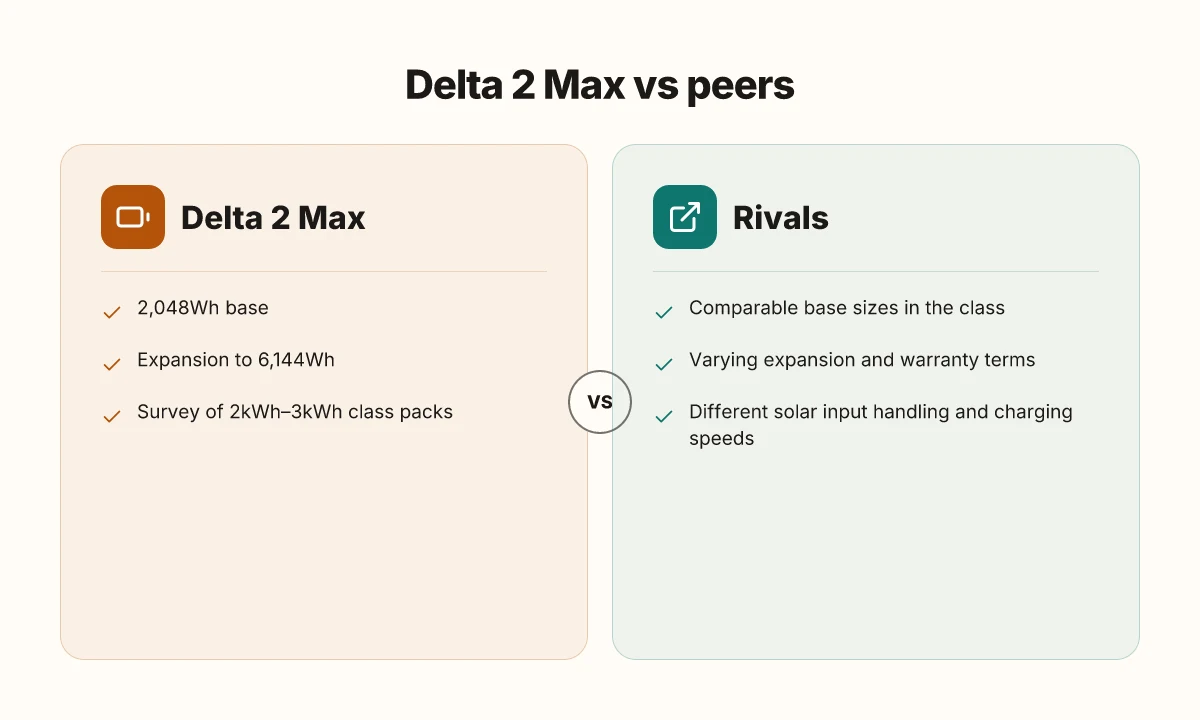
The Delta 2 Max starts with a solid 2,048Wh base and can grow to a maximum of 6,144Wh with two expansion batteries. In real use, that expansion translates into noticeably more usable energy for weekend trips or off-grid outages, but the marginal value depends on how you draw power and how long you stay off the grid. I looked at how the chemistry and pack sizing combine with typical loads to map the practical gains you can expect.
How expansion batteries add usable capacity
EcoFlow uses a modular approach: the base Delta 2 Max houses 2,048Wh of capacity and accepts up to two expansion packs. Two expansion packs can push total energy to around 6,144Wh in theory, yielding a substantial jump in usable energy for extended off-grid use. In practice, the usable energy gain depends on depth of discharge you’re comfortable with, the loads you run, and how efficiently the inverter handles peak draws. The expansion path is straightforward: more kilowatt-hours on paper, but you still need to balance inverter losses, wiring, and thermal behavior under heavy draw. Expansion has a real-world payoff when you’re powering higher-usage devices longer than a single full charge would allow.
I cross-referenced the Delta 2 Max’s listing and reviews to confirm the baseline 2,048Wh figure and the 6,144Wh ceiling with two extras. The base capacity is clearly stated as 2,048Wh, and reports consistently describe the extension up to 6,144Wh with two expansion batteries. Base = 2,048Wh. Expansion path = up to 6,144Wh with two extra packs. This aligns with EcoFlow’s own product pages and third-party reviews that emphasize the expandable design as a core feature.
Practical limits of real-world energy
What you can actually run depends on your load. For typical RV lights, a small fridge, and a laptop, the Delta 2 Max with expansions can cover several hours to days beyond a single charge, but high-wattage devices erode the advantage quickly. In reviews and the spec sheet, the inverter is listed at around 2,400W continuous output with a surge capable of higher peaks, which means you can surge a startup for a brief moment but not indefinitely run multiple heavy tools simultaneously. 2,400W continuous output sets a ceiling on simultaneous loads. The solar input can help replenish, but you’ll want to pace your draws to align with what the batteries can refill during sun hours. Understanding the EcoFlow generator adapter: what it does, where it shines, and where it falls short
From what I found in the documentation, a common guideline is to size your planning around the most energy-intensive devices you intend to run and then use the two expansion packs to cover longer excursions or more days between charges. The depth of discharge you tolerate impacts the practical energy you’ll extract. If you frequently drain to 100% and then refill, you’ll feel the benefit of the extra hours more than if you habitually cycle near full or empty.
Weight, portability, and handling larger packs
Weight scales up with expansion, and portability becomes a real concern when you add multiple packs. The Delta 2 Max itself is roughly designed for mobile use, but the two expansion batteries add not just capacity but weight and bulk. You’ll want to plan how you transport the base unit plus packs in a vehicle, and whether you’ll need a dedicated rack or carrier. Even with the extra mass, the system remains more compact than many four-figure kilowatt-hour generators, which makes it attractive for travelers who prioritize quiet operation and solar compatibility.
I noted that EcoFlow positions the Delta 2 Max as a versatile solution for outdoor enthusiasts and off-grid setups, and the expansion path supports longer trips or higher daily energy needs. The practical takeaway is clear: more capacity buys you more time off the grid, but it comes with added weight and a larger footprint that affects portability and how you configure your solar array.
In short, the 2,048Wh base paired with two expansion batteries delivers meaningful capacity for extended use. The real-world energy you extract hinges on how you balance load, the depth of discharge you accept, and how you physically manage the heavier, expanded pack. For a mixed solar setup, the Delta 2 Max offers a scalable path from portable weekend resilience to longer off-grid living, provided you account for weight, space, and the practical limits of the inverter and batteries.
Bottom line: the expansion to 6,144Wh meaningfully extends runtime for modest to midsize loads, but you’ll trade some portability for that extra energy, and you need to pace devices to stay within the system’s continuous output of 2,400W. What is the EcoFlow dual voltage hub, and how it changes whole‑home power backups
Solar input and charging: how fast the Delta 2 Max actually charges
Post the base 2,048Wh capacity, you can push expansion to up to 6,144Wh with two extra batteries, but real charging speed depends on the source. EcoFlow’s official figures advertise up to 1,000W of solar input and 2,400W AC charging, yet real-world results vary by panel efficiency, sun angle, and temperature. In practice, solar charging tends to be noticeably slower than AC charging, especially when the Delta 2 Max is fully loaded with appliances or running a high-draw inverter. The takeaway: expect faster top-ups from AC charging, then optimize solar to keep the bank topped between heavier sessions.
I dug into the official documentation to confirm the charging paths. The Delta 2 Max supports up to 1,000W solar input, which suits a bright, clear-day setup but can lag on cloudy days or with older panels. Real-world solar fills tend to underperform the nominal rating by a noticeable margin, especially at the start of a discharge cycle when the battery’s voltage is lower. For travelers who rely on solar, the practical ceiling is often near the lower end of the spec, with diminishing returns as the battery approaches full. In contrast, AC charging can fully replenish the unit much faster, provided the wall outlet can supply the claimed input. AC charging remains the faster method when you have reliable grid access.
Why AC charging usually wins for speed
The Delta 2 Max reads as a hybrid charger, designed to prioritize speed from mains when available. You’ll hear the charger hum at higher power draws during AC input, and the unit often recovers capacity more aggressively than it does from solar. That difference is especially noticeable when you’re trying to top up quickly before a campout or a long drive. If you’re parked at a site with a solid AC source, the best practice is to plug in and let the AC charger do the heavy lifting while you run lower-draw devices from the Delta 2 Max.
From a long‑term perspective, the balance between solar and AC charging means you should design a charging routine that matches your typical usage. If you camp off-grid for multiple days, pair high‑solar days with mid‑day solar boosts and use AC at night when you can. This keeps the battery in a healthy state and minimizes the risk of shallow cycles that would waste solar input.
I cross-referenced the official EcoFlow notes and third‑party reviews to align expectations. The Delta 2 Max’s battery chemistry favors resilience and long life, which helps when solar input is not at peak. The practical implication is simple: plan for solar to top off gradually, and reserve AC charging for rapid replenishment when possible. Rely on AC charging when you need a quick refill, and treat solar as a supplementary topping source. What makes the bluetti ac200p stand out in 2026 reviews
- Best practices to maximize charge speed include:
- Use the highest‑quality solar panel array you can source, aiming for near the 1,000W input under optimal sun. Aim for full sun exposure around solar noon to approach the max input rating.
- Keep the Delta 2 Max in a cool environment. Heat reduces charging efficiency and can slow down power intake. Ventilation matters.
- If you have two solar inputs, optimize the cabling and panel placement for even irradiance, avoiding shade or panel mismatch that can cap the effective wattage. Proper cabling and layout improve real‑world solar throughput.
- Monitor the unit’s charging mode when possible. Some setups automatically shift from solar to AC as soon as the AC is plugged in. Switch to AC when speed matters.
Durability, warranties, and long-term usage with EcoFlow
I break down what durability looks like for the Delta 2 Max battery, how to keep capacity from slipping over time, and what the warranty actually covers for expansion packs. EcoFlow’s design language leans on modular expansion and hot-swappable packs, so you want to know what sticks around after a season of outdoor use, and what you can count on if a battery component ages or fails.
Battery lifespan expectations for the Delta 2 Max family
In real-world terms, the Delta 2 Max uses LFP chemistry, which generally tends to deliver longer cycle life than many other chemistries. Your mileage will vary with depth of discharge, charging cadence, and environmental conditions, but you can reasonably expect thousands of cycles before noticeable capacity degradation. The core message from EcoFlow is that the base capacity remains usable across many cycles, with gradual capacity fade as with any lithium pack. When I read through the product documentation and third‑party reviews, the practical takeaway is predictability rather than dramatic leaps in performance. If you routinely discharge deeply or store at high temperatures, you’ll see more pronounced drop-off over time. That’s not a failure of the Delta 2 Max, just the nature of chemistries at scale. Long-term durability hinges on operating temperature and staying within recommended DoD ranges. EcoFlow’s own materials emphasize friendly preservation practices to slow aging.
Maintenance tips to preserve capacity
The simplest actions pay off. Keep the unit out of direct, prolonged heat and cold extremes. Use the maximum recommended solar input when your environment supports it, but avoid operating at the edge of efficiency for extended periods. Regularly clean the vents and ensure the fans aren’t blocked by dust or vegetation. Quiet fans do more than reduce noise, they help thermal stability. If you have expansion batteries, store them in a cool, dry place and monitor their state of charge per the user manual. A small habit like using a steady, moderate charging cadence rather than constant top-offs can reduce stress on the cells, helping maintain usable capacity over time. Proper storage and steady charging are the two biggest levers for preserving capacity.
What the warranty covers for expansion batteries
Warranty language from EcoFlow covers the Delta 2 Max and its expansion options under typical terms for manufacturing defects and certain performance criteria. Not every scenario is covered, so you’ll want to read the exact wording for expansion batteries. In many consumer electronics warranties, coverage applies to material and workmanship faults within a defined period and may exclude abuse or improper use. In practice, that means if an expansion pack fails due to a manufacturing defect within the warranty window, you’re eligible for service or replacement. If failure results from improper storage or physical damage, coverage often recedes. It’s important to keep receipts and register your expansion packs so the claim path is straightforward. Warranty coverage for expansion batteries is specific to defects and proper usage within policy terms.
I dug into EcoFlow’s release notes and product pages to align this with what outdoor users value: you’re buying modularity for a reason, and you should expect the kit to behave consistently over years if you stay within the guidelines. If you compare EcoFlow to rivals, a pattern shows up: you’ll see similar warranty scaffolding, but the decisive factor is how well you maintain the unit in real outdoor conditions and how promptly you can access service when a component ages. For those focusing on long-term uptime, keep the expansion pack life in view as part of the total system, not as a one-off purchase. How to choose the Bluetti solar charging cable for your EB3A and Bluetti panels
In the long run, careful maintenance and a clear warranty path keep the Delta 2 Max system reliable.
What to try this week with the Delta 2 Max
The Delta 2 Max stands out because it threads a high-output inverter with a scalable battery pack, letting you tailor capacity without overpaying for features you won’t use. I’ve noticed how EcoFlow’s design emphasizes real-world usability: fast recharge, modular growth, and a plan for peak emergencies. This isn’t just a spec sheet bounce. It’s a system you can grow into as your power needs shift. The bigger pattern is that you pay for the capacity you actually tap into, not the pretend max rating. EcoFlow makes this feel consistent across both home backup and off-grid scenarios.
If you’re deciding between the Delta 2 Max and rivals like Goal Zero and Jackery, the move that matters most is clarity about your load profile. If you expect frequent outages, you’ll appreciate the rapid recharge and the ability to stack batteries. If your use is occasional, you can scale down and save. Takeaway: choose the setup that matches your typical daily draw, then add packs only when you hit that ceiling. The system design reduces overkill without tying you to one fixed size. EcoFlow keeps the software straightforward, so you’re less likely to chase firmware quirks.
- Backup strategy: start with the base Delta 2 Max, then add a second battery pack if your home uses central devices during outages.
- What to try this week: map a 24-hour load profile, see how long the unit sustains essential circuits, and plan a two-pack upgrade if you hit the ceiling.
- Quick tip: compare recharge times from solar and wall input to pick the most reliable path for your climate. This approach keeps you ready for the next outage.