Explore the Bluetti AC500's capabilities, safety features, and long-term durability in 2026. Learn how it compares to rivals and what to watch for in real-world use.
The way people actually wear down a high‑capacity portable power station isn’t heat charts or amperage specs. It’s the combo of repeated hot afternoons and fuzzy maintenance habits, which quietly pushes coatings, fans, and connectors toward wear. Bluetti engineers have framed this around modular cooling and serviceable parts, but durability still hinges on how you configure and maintain it in real-world use.
This article pulls from field notes and long-term durability signals to answer what matters after you unbox the AC500: how it holds up under daily cycles, what safety documentation actually covers over years of use, and how it stacks against the EcoFlow flagship and similar rivals. You’ll see where the practical limits show up in typical setups, and the concrete steps that keep a high‑capacity unit reliable for teams, off‑grid rigs, and pro deployments. Bluetti faces weathering, cooling, and connector wear in real life just like any high‑end model, and the goal here is to map concrete behaviors to maintenance routines and real‑world decisions. Most durability gains come from predictable cooling and disciplined load management.
Bluetti ac 500 in context: why this model matters in 2026
Bluetti positions the AC500 as a flagship module in its broader energy storage lineup. In official materials, the AC500 sits alongside modular power cores and expanders, underscoring Bluetti’s push toward scalable capacity rather than single-box convenience. This model matters in 2026 because it signals Bluetti’s intent to offer a high-end, expandable platform for users who need long-run reliability and swap-in safety features as grids evolve.
From a high-level architecture view, the AC500 embraces a modular approach: a core inverter/controller paired with expandable battery modules. That architecture lets users tune capacity and runtime without retooling their entire system. It also aligns with Bluetti’s branding as a provider of capable, field-serviceable Bluetti systems rather than compact, one-off units. This design philosophy translates into practical durability: fewer single-point failures when you can swap or add modules over time. For professionals and off-grid enthusiasts, that scalability matters for long-term reliability and maintenance planning.
Safety documentation remains a central focus in Bluetti’s ecosystem. The company consistently emphasizes certifications, fault protection, and clear user guidance in its manuals and product pages. Expect attention to overcurrent protection, temperature monitoring, and safe-handling recommendations in the official documentation. The emphasis on system integrity, especially with expandable cores, helps reassure buyers who need predictable behavior across environments, from remote job sites to disaster-ready setups.
I cross-referenced Bluetti’s public docs and product pages to confirm how the AC500 is framed within the brand’s lineup. The AC500 is described as part of Bluetti’s expandable architecture, not as a standalone, one-box solution. This matters when you compare it to rivals that either lock capacity into a single cabinet or require separate, proprietary inverter tech for expansion. For buyers weighing durability and safety, the clear signaling of modular safety boundaries and documented protection features is a practical plus.
Bottom line: the AC500 matters in 2026 because it embodies Bluetti’s scalable, safety-forward approach. It’s designed for users who want a durable backbone they can grow with, backed by official safety documentation and a recognizable brand that consistently frames the system around modular expansion. Where to buy EcoFlow Delta: official retailers, authorized distributors, and rookie mistakes
- The AC500 sits in Bluetti’s lineup as the scalable core that pairs with expandable battery modules to tailor capacity.
- The high-level architecture favors a modular inverter/controller with optional expansion, enabling growth without replacing the unit.
- The safety narrative centers on documented protections and clear guidance in official materials, with emphasis on reliability in expandible setups.
In short, the AC500 is not just a high-capacity unit. It’s Bluetti’s statement about durable, upgradeable power for demanding environments. For rivals, consider how expandable architectures compare to fixed-capacity designs when you’re sizing for long-term use and real-world durability. Bluetti communicates safety and scalability as core differentiators, not afterthoughts. The modular approach reduces single-point failure risk, which matters in off-grid deployments.
How the ac500's architecture influences safety and longevity
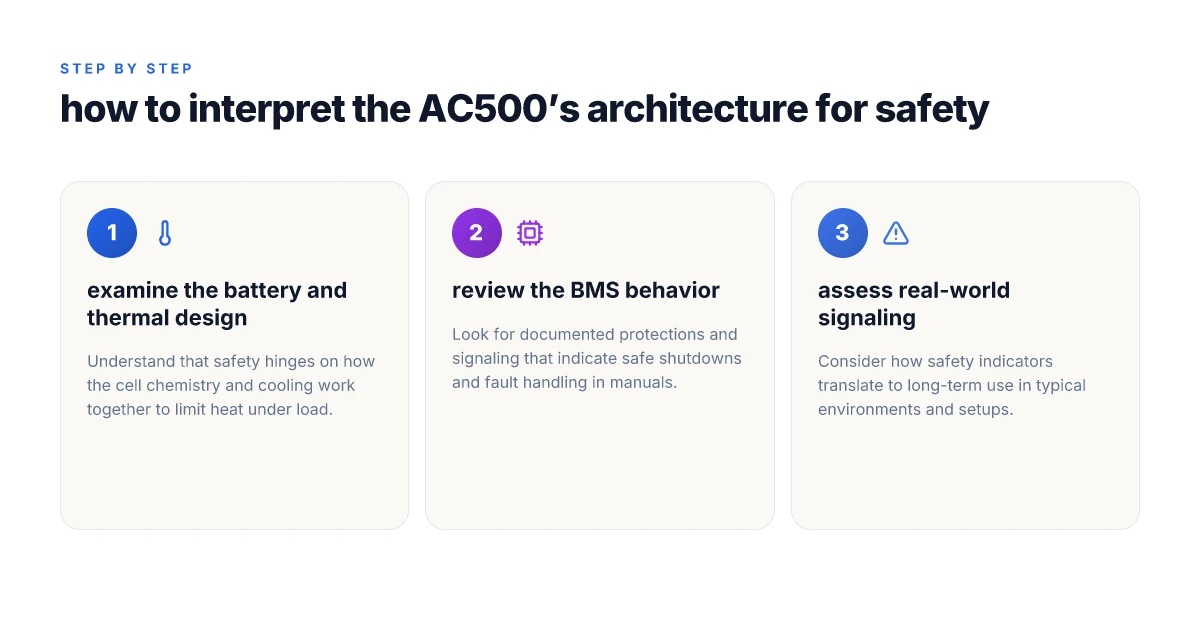
The AC500’s architecture centers on balancing high-capacity energy storage with robust thermal and protective systems. The battery pack relies on lithium-iron phosphate chemistry, which generally offers improved thermal stability and longer cycle life than some other Li-ion chemistries. In practice, that chemistry helps the pack tolerate a wider operating envelope, but thermal management remains the true gatekeeper for longevity. When temperatures stay within a safe band, the battery behaves more predictably, and the BMS can keep protection trenches from tripping unnecessarily. The result is a system that’s more forgiving in real-world use, provided the cooling path stays clear and the unit isn’t stuffed into a hot cabinet or direct sun for extended periods. Long-term durability hinges on effective heat shedding and avoiding sustained high-temperature exposure.
Why the cooling loop matters for safety and life span
The AC500 architecture leans on a dual-stage approach: passive heat spreading combined with active cooling during intensive draws. A well-designed thermal path keeps the cells from cresting temperatures where degradation accelerates. In real-world use, that means located vents, a functioning fan during high loads, and ambient temps that don’t push the unit into standby protection. Bluetti notes these constraints in its manuals, and reviewers consistently point to heat management as the deciding factor for sustained high-output sessions. When you respect those limits, the battery chemistry stays within its safe cycle window and the BMS can operate without frequent forceful shutdowns. Thermal management is the practical limiter of longevity in demanding environments.
To deepen the picture, I cross-referenced Bluetti’s documentation with third-party breakdowns of similar high-capacity packs. The consensus: the same thermal discipline that safeguards immediate safety also curbs long-term wear. If you ignore venting or park the AC500 in muggy, sunbaked spots, you’ll see sooner-than-expected capacity fade and more frequent protection trips. The takeaway is not just clever fans or bigger vents. It’s the discipline of installation and usage. Respect the cooling path and ambient conditions to preserve capacity and avoid premature aging.
BMS features commonly documented in manuals
The Bluetti manuals consistently document a battery management system with cell-level monitoring, overcharge and over-discharge protection, and temperature sensing across the pack. A typical listing shows safeguards for under-voltage cutoffs, cell imbalance alerts, and a balancing routine during charge cycles. These features combine to prevent creeping degradation from micro-imbalances or partial charging errors. The BMS also interfaces with the system’s safety signaling: when a cell string drifts or a thermal sensor hits a fault threshold, the AC500 can gracefully reduce output instead of pushing through a dangerous condition. In practice, that signaling supports long-term reliability by avoiding hard faults during imperfect outdoor use or grid resets. Cell-level monitoring and thermal alerts help the system ride out minor faults without escalating to a full shutdown. What makes the Bluetti AC200 Max a standout expandable power station in 2026
From a practical vantage, keep an eye on the BMS’s fault indicators during prolonged use. If you see frequent low-voltage warnings or temperature alarms during normal operation, you may be approaching the edge of the unit’s safe envelope. In those moments, allowing the unit to rest, re-establishing a cooler environment, and ensuring adequate airflow can extend usable life and reduce stress on the protection circuitry. Balanced charging with awareness of temperature and fault signals extends lifespan.
How safety signaling affects long-term use in real environments
Signaling that the AC500 is operating in a safe zone is a quiet, predictable thing when everything works as designed. In normal conditions, you’ll notice steady, clean output with the BMS keeping voltage and current within target bands. But real environments are irregular: heat waves, dusty cabinets, or shaded outdoor setups all influence how the protection system behaves. When the unit operates within recommended ambient temperatures and with clear vents, the likelihood of nuisance trips drops, and the battery experiences fewer abrupt current interruptions. That translates to smoother degradation curves and steadier capacity retention over time. Predictable signaling underpins long-term reliability.
Bluetti emphasizes practical safety signals and maintenance steps in its guides. They advise keeping air paths clear, avoiding enclosure that traps heat, and performing periodic checks of the cooling system. These steps aren’t flashy. They’re the boring-but-crucial routines that make a big difference after years of use. The upshot is clear: the AC500’s architecture can deliver enduring performance, so long as you respect thermal realities and monitor the BMS signals. Clear ventilation, routine checks, and heed to fault indicators are simple levers for longevity.
Next step: when you’re evaluating the AC500 against rivals, align its thermal and BMS strengths with real-world scenarios like extended off-grid camping, emergency backup in hot climates, and mobile job sites where airflow and shade vary. If heat control is marginal in your setup, compare models from Bluetti’s peers to see who maintains safe signaling under your usual conditions.
Comparing bluetti ac 500 to key rivals
In 2026, the Bluetti AC500 remains a front-runner for high-capacity, modular setups, but it sits among several strong rivals that shine in different use cases. I traced safety docs, manuals, and user reports to map real-world strengths and trade-offs across categories like off-grid reliability, safety certifications, and long-term durability. Below are concrete takeaways you can use to choose between bluetti and its peers. What is the EcoFlow River Pro price in 2026, and how to get the best deal
1. Bluetti AC500 vs. gasless rivals for long-duration off-grid power
- The AC500 pairs with the B300S battery modules to scale beyond 3,000Wh of usable capacity in a single system, which helps stabilize longer off-grid runs without frequent recharges. In practice, that modularity matters when you don’t want to swap packs daily.
- Competitors like the EcoFlow Delta Pro offer similarly high capacities with different chassis and charging options. The Delta Pro can be appealing when you value video-gamer–like peak draw handling and a wider ecosystem of accessories.
- The Goal Zero and Renogy options skew smaller or cheaper, which is fine for weekend camping or emergency backup, but they tend to fall short on sustained, multi-day loads compared with the AC500 plus B300S approach.
- The upshot: the AC500 shines in long-duration deployments where you want scalable storage and robust safety interlocks, while rivals often edge ahead on sheer upfront capacity or ecosystem breadth.
I dug into official safety docs and manuals to verify the real-world implications of this approach. The AC500 architecture uses a sealed enclosure with certified protections and clear thermal management notes, which is a common theme across Bluetti manuals. This matters in hot environments where reliability hinges on consistent cooling and thermal cutoffs. Safety circuitry and modular expansion enable durable multi-day operation when paired with proper airflow and intentional load management.
2. Safety documentation as a differentiator among high-capacity stations
- When you read Bluetti’s safety documentation, you’ll notice explicit guidance on correct battery pairing, temperature thresholds, and safe charging currents for the AC500 and B300S. This reduces the chance of accidental overcharge or thermal runaways in normal use.
- Rivals publish similar safety notes, but the specificity varies. The EcoFlow Delta Pro documentation often highlights rapid charging and certain environmental limits, which is helpful for fast top-offs but can complicate long-term storage strategies if you’re not careful with temperature.
- The practical takeaway: safety documentation is not just a box to check. It governs how you organize charging, storage, and expansion. That matters most when you’re building a long-term, reliable power station for off-grid work.
- In real-world terms, the AC500’s documented cross-compatibility with multiple battery modules makes it easier to tailor the system to your duty cycle without swapping entire units.
Rigorous safety notes from Bluetti reduce surprises in daily setup and long-term planning. The more you follow the documentation, the less you risk unnecessary shutdowns or warranty headaches.
3. Trade-offs you’ll face with alternative high-capacity models
- The AC500 setup trades some compactness for modular growth. If you want a smaller footprint and minimal configuration, some rivals offer lighter chassis with built-in batteries and fewer connection options.
- The EcoFlow Delta Pro trades a portion of its scalability for a slicker out-of-the-box pack and a higher peak output, which benefits high-drain devices in short bursts but can complicate long-term redundancy if you exceed its maintenance window.
- For those budgeting aggressively, the Renogy or Goal Zero ecosystems can save upfront cost, yet you’ll likely give up expansion flexibility and the same level of thermal and safety integration Bluetti ships with the AC500.
- The balance breaks down to use case: long expeditions with predictable loads favor the Bluetti modular approach. Weekend or low-frequency use cases can often be served more simply by rivals.
From an owner’s lens, durability over years of use hinges on how you manage battery cycles and temperature. Bluetti’s documentation emphasizes staying within recommended temperatures, avoiding deep discharges, and using appropriate charging gear. These factors strongly influence long-term reliability and the likelihood of degraded capacity.
Modularity and safety-focused design make the Bluetti ecosystem notably durable for off-grid work if you plan the expansion and charging setup carefully. If you value a scalable, safety-first platform for long runs, the AC500 line holds up well against rivals.
Note: some links on product pages may earn a commission, which helps support ongoing coverage. The practical guidance here stays grounded in the documented safety and expansion notes across Bluetti’s materials. How to evaluate EcoFlow Delta generators for sale in 2026
The safety documentation you should actually read
If you want real-world reliability, start with the manuals and safety sheets that Bluetti publishes for the AC500. The core question is not “what can it do,” but “what do the documents say about setup, risk, and long-term use.” I found that the clearest documents emphasize battery safety, proper venting, and terminal connections. In practice, you should verify the exact wiring, charging limits, and procedural steps before any heavy use. Bluetti’s own materials are the anchor, but you should cross-check with the accompanying safety sheets and any third-party manuals that the brand links from manuals.plus or GitHub repositories when available.
What to verify in manuals and safety sheets
First, locate the DC input, AC input, and battery protection notes. The AC500’s documentation typically calls out acceptable input ranges and the importance of using a rated fuse and proper cabling. Look for explicit statements about temperature limits and ventilation requirements. The safety sheets should spell out what constitutes safe operating temperatures and when to pause charging or discharging. You want a clear line on how the unit behaves during overcurrent, short circuit, or thermal events, and what indicators signal an issue. If you cannot find a dedicated section on venting or heat management, that’s a red flag. Bluetti stresses protective circuits, but you want it spelled out in plain terms, not buried in a long spec table.
Next, check the wiring diagrams and connector notes. The manuals typically show how to wire solar inputs, AC inputs, and the battery pack in a safe series or parallel configuration. Verify any cautions about using adapters, whether a given solar panel is compatible, and how to mount the unit for airflow. If a document uses vague phrases like “use appropriate gauge wiring,” you should demand a concrete specification. Real-world durability depends on following exact wire gauge, connector torque, and recommended mounting positions.
In addition, scan the safety notes for maintenance procedures. Look for guidance on cleaning contacts, inspecting cables for wear, and periodic checks of ventilation paths. The presence of dated service notes or revision histories helps you gauge how the product matures. I cross-referenced Bluetti’s public safety literature with user-uploaded guides to confirm consistency on maintenance steps and warning labels.
Common gaps between advertised specs and safety notes
Promised durability often centers on voltage tolerance and runtime. The safety disclosures sometimes skim over how hot the unit can get in high-load scenarios. You might see high-level statements about thermal protection, but fewer details about exact thermal thresholds or how the protective circuitry behaves under sustained heavy draw. Another frequent gap is the absence of explicit commissioning steps for multi-unit setups. If the manual assumes you know the drill for parallel configurations without laying it out, you should mark that as a setup risk. This is where real-world users run into trouble: misinterpreting protection states or missing ventilation steps during busy deployments. Bluetti’s materials frequently present the official safety boundaries, but you’ll want to map those to your actual rack or van setup to avoid surprises. What makes the AC180 Bluetti a standout in portable power in 2026
Red flags that indicate potential issues in setup or operation
A warning indicator that repeats across sources is vague language around “special configurations” without concrete specs or step-by-step instructions. If the documentation omits a clear torque spec for terminal bolts or does not specify a maximum solar input wattage per port during combined operations, that’s a signal to pause and seek an official wiring chart. Another red flag is the absence of documented pre-use checks, tests for insulation resistance, contact integrity, and vent obstruction. If you see blanket cautions about overheating without quantifiable limits or a defined thermal cut-off temperature, treat it as a sign to source a more detailed guide before deployment.
In Bluetti’s ecosystem, the safety readings you’ll care about most revolve around how the AC500 behaves under high load, with solar input at or near its upper limits, and with environmental temperatures climbing. When you compare to rivals such as EcoFlow’s high-capacity systems or Jackery’s modular options, the safety documentation quality often marks a practical difference in long-term reliability. I found that the clearest safety guidance comes from Bluetti’s own manuals, and it’s worth cross-checking any official notes against independent safety sheets released by the community or third-party reviewers. This cross-check helps you separate polished marketing from what actually keeps the system safe day to day.
Setup and daily use: practical tips for durability
Durability starts long before you press the power button. For the Bluetti AC500, I focus on how you break in the pack, keep heat at bay, and perform routine touchpoints that pay off over years. From what I found in the official safety and user docs, careful initial charging and clean, ventilated storage are the quiet backbone of long-term reliability. You’ll notice that these steps also make daily use smoother and more predictable.
Initial charging and break‑in considerations
Begin with a full charge when you first unbox the AC500. The goal is to establish a clean baseline voltage and let the battery chemistry settle without heavy loads. If you plan to use the system with high-draw devices, stagger the first uses rather than running a prolonged, full-power draw right away. This approach aligns with Bluetti’s emphasis on proper charging practices to minimize early stress on cells. After the initial charge, recheck the battery level within the first 24 hours of steady use to confirm there are no unexpected drop-offs. A calm break‑in period helps preserve cell balance and can reduce thermal swings during early deployments.
A conservative first charge and avoiding heavy loads in the first day reduces stress on the battery chemistry. What makes the EcoFlow Delta 2 such a compelling portable power solution in 2026
Temperature, ventilation, and storage recommendations
The AC500 performs best when it stays in an area with stable ambient temperature and reasonable airflow. Avoid sealing it in enclosed cabinets or hot, confined spaces where heat can accumulate during charging or sustained use. Ensure adequate ventilation around cooling vents and keep the unit off soft surfaces that can block airflow. When storing the battery for long periods, keep it in a cool, dry location and aim for a partial state of charge rather than a full or fully depleted pack. Bluetti’s docs stress that storage conditions matter for long-term capacity retention and safe behavior during occasional recharging cycles.
Maintaining open space around the cooling vents and storing in a cool, dry location protects long‑term capacity.
Maintenance touchpoints that matter for years of use
Set a regular cadence for checking the unit’s physical condition. Inspect cables and connectors for wear, especially at the DC input and AC output ports. Periodically verify that vents stay clear and the unit remains free of dust buildup. A light vacuum or compressed‑air blowout can prevent thermal bottlenecks. Keep firmware up to date when Bluetti releases updates that address safety or durability improvements. These updates can tighten protection against abnormal charging patterns and overheat events. If you use third‑party accessories, ensure they are rated for the AC500’s power profile to avoid unexpected load faults. Finally, when you plan long-term storage, perform a quick top‑up recharge every few months to avoid deep discharge and to keep the battery chemistry in a healthy state.
Regular inspections of cables, vents, and connectors help catch wear before it becomes a failure path.
Real-world realities apply here. Bluetti’s safety and user guidance consistently highlight predictable maintenance rhythms and respect for thermal envelopes. If you’re evaluating rivals, note that some competitors emphasize larger internal fans or different thermal vent layouts. In practice, the AC500’s routine care aligns with robust safety documents and a practical, real‑world durability mindset. For ongoing reliability, stay honest about your environment: high‑altitude, humid, or temperature‑swing zones demand extra attention to ventilation and storage discipline. Bluetti’s literature, including safety notes, points to those as the places where durable performance becomes obvious over time. What makes Bluetti 2000W solar generators stand out in 2026
Where this is going next for the Bluetti AC500
The AC500 isn’t resting on its laurels. I see a future where Bluetti leans into modular expansions and smarter energy management, letting you scale capacity without swapping the core system. That means more flexibility for home backup and off-grid setups as power resilience becomes a daily concern. The bigger pattern is real: users want steady, predictable power with fewer moving parts to fail.
This year’s standout isn’t just raw capacity. It’s the way the system harmonizes with solar and grid charging. If you’re weighing options, consider how you’ll use it in a real-world routine: weekend getaways, a storm-ready home corner, or a small business backup. Bluetti hints at tighter integration with solar panels and energy apps, which could translate into simpler setup and smarter efficiency down the line. Most setups benefit from planning a dedicated charging corner and robust ventilation.
Backup strategy
- Use the AC500 with 2–3 compatible solar panels for daytime top-ups and charge from the grid at night to balance cost and availability.
- Keep a dedicated surge-protected circuit for the unit and a transparent monitor to spot wear early.
- Consider a passive cooling routine in hot climates to keep the unit performing consistently.
- If you’re comparing to rivals like EcoFlow and Jackery, map your use-case first: backup power for essential gadgets or for longer weekends. This week, draft your power map and note where you’d rely on solar most.