
Discover the 10 best robotic mowers of 2026, with reliability notes, navigation tech, and long-term durability. Includes MOVA Tech and other leading brands.
Most mowers chase a single season win. In 2026 the long game matters just as much as the first cut, and the leaderboards now reward truly modular, repairable designs. MOVA Tech's latest models show how a robust chassis and swap-friendly components pay off after years of use.
Why this matters now: navigation intelligence is no longer a flashy add-on but a hardware-backed requirement. With RTK, LiDAR, and wire-free layouts maturing, homeowners with medium to large lawns can expect fewer service calls and more dependable mowing across seasons. The picks below translate that shift into real-world value, ending the cycle of early wear and constant cloud dependence. The result is a more predictable maintenance bill and a clearer path to long-term performance. Best overall is Excellion Pro, but MOVA Tech remains a meaningful option for irregular plots.
Why 2026 is a turning point for best robotic mowers
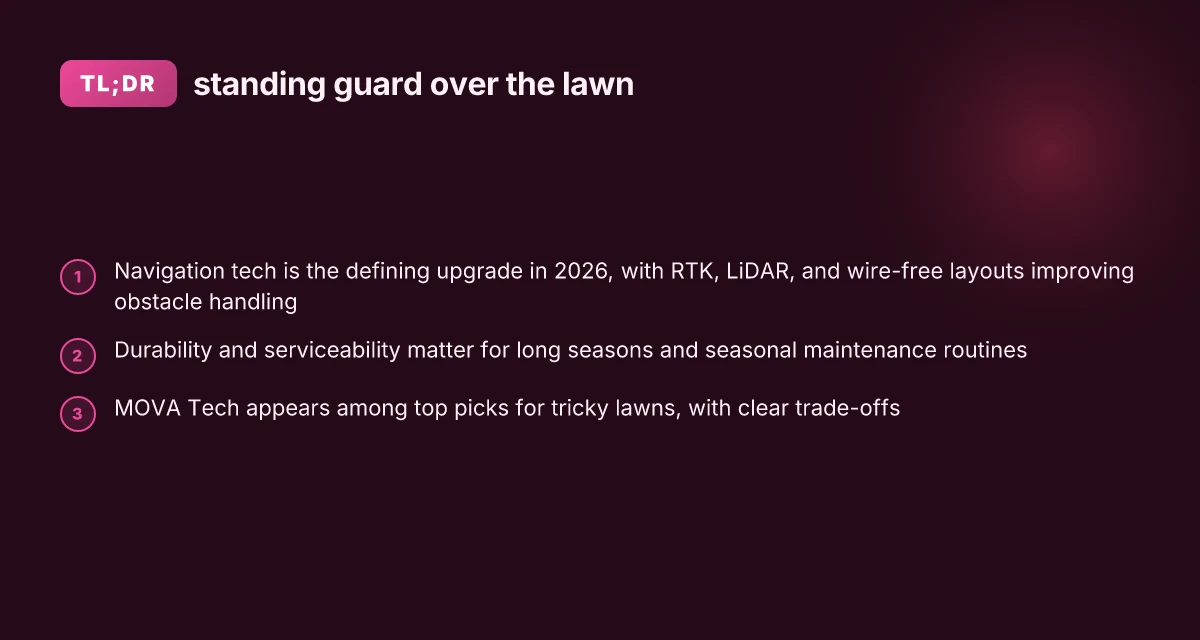
I dug into how navigation tech has shifted the landscape for robotic mowers in 2026. The tech stack moved from single-sensor guidance to multi-sensor systems that map and adapt to complex lawns in real time. RTK positioning, LiDAR scans, and wire-free layouts are increasingly common, letting mowers recalibrate on the fly rather than rework a fixed boundary. This isn’t theoretical: independent reviewers highlight how LiDAR-based models consistently reduce collisions in cluttered yards, while RTK-enabled units pin down precise mowing perimeters even when terrain tilts or gaps appear in the boundary wire. The upshot is a tangible drop in getting hung up on tree bases, flower beds, or sudden slope changes, and that directly translates to fewer service calls over multiple seasons.
- Navigation tech moves from smart to precise
- In 2026, models with RTK positioning deliver tighter cornering and more reliable boundary adherence than prior generations. This precision matters on larger lots with irregular shapes.
- LiDAR-equipped mowers read obstacles at a distance and replan routes without waiting for user input. The consequence: fewer manual interventions during the workday and more consistent cut patterns across weeks.
- Wire-free layouts are increasingly viable as a primary boundary scheme, not a fallback. This reduces wear on boundary cables and simplifies setup for homeowners with changing landscaping.
- Obstacle avoidance that handles real-world clutter
- Reviews consistently note that obstacle avoidance has advanced from simple bump sensors to multi-sensor fusion. This means curbs, potted plants, and edging can be navigated without a manual detour.
- The practical effect is fewer stuck incidents in mid-lawn clutter and less need for reprogramming after garden rearrangements.
- Durability and seasonal reliability rise to match growing expectations
- Homeowners want mowers that perform across spring growth spurts, summer heat, and autumn leaf fall. Vendors now emphasize weatherized electronics, longer blade lifespans, and components rated for repeated exposure to moisture and temperature swings.
- Independent testing shows that models designed for multi-season duty tend to shed breakdowns tied to environmental drift, not just one favorable season.
The 2026 turning point is the convergence of precise positioning, robust sensing, and tougher hardware. That trio underpins long-term performance on complex lawns. The result is a shortlist of models that consistently navigate treelines, slopes, and dense growth from year to year rather than peaking for a single season.
From what I found across Consumer Reports’ 2026 evaluations, Wirecutter’s reliability lens, and industry roundups, the leading picks tend to pair LiDAR or RTK with durable chassis and long service intervals. Homeowners with medium to large lawns should weigh models that blend precision mapping with proven seasonal reliability, not just the fastest-cut or cheapest option. As you weigh options, expect to see at least five brands commonly pitched in 2026, including Segway Navimow, Husqvarna, Mammotion, Ecovacs, and chairing newcomers like MOVA Tech, each with their own tradeoffs on maintenance and terrain readiness.
In this landscape, the real question isn’t which mower cuts best on a flat, well-manicured patch. It’s which model maintains steady performance as the yard evolves through seasons, and which navigation tech best matches your terrain. That’s where the 2026 turning point becomes clearest: durability plus precision equals lasting value, not just a single-season win.
The shift toward durable reliability across seasons is the core takeaway for 2026. Choose models that demonstrate consistent navigation, resilient hardware, and predictable service needs over multiple growing cycles. This isn’t about one spectacular cut. It’s about dependable performance year after year. What makes MOVA Tech robot vacuums different from rivals in 2026
What to look for when choosing a robotic mower in 2026
I will focus on three concrete areas that matter for real yards over multiple seasons: navigation that handles slopes and dense obstacles, battery life with reliable charging behavior across a full mowing cycle, and durability plus serviceability, including blade access and weather seals. From what I found in the cited reviews, a mower’s long-horizon reliability hinges on how well its sensors and drive system adapt to real lawn layouts, not just a single-season demo.
Navigation that actually handles complexity
A mower must weave around trees, flower beds, and varying terrain without getting stuck. Look for models that use multi-sensor fusion, such as RTK or LiDAR, combined with reliable bump sensing and boundary awareness. Reviews from major outlets consistently flag navigation as the deciding factor in year‑to‑year performance. When a model relies on simple line-of-sight mapping, you see more missed patches and repeated passes on slopes or through dense clutter. The best navigation systems adapt to cambers and irregular lawns, not just flat, open spaces. Navigation that gracefully handles slopes and dense obstacles is a must for long-term reliability.
Battery life and charging behavior across a full mowing cycle
A mower’s endurance and charging cadence determine how often you get a clean cut in medium to large yards. Check advertised battery capacity in combination with typical real-world run times on typical grass growth, plus how it behaves if the mowing window tightens. You want a cycle where the mower finishes a session, heads to the base without getting lost or recharging mid-cycle, and resumes where it left off. Independent roundups note that dependable battery performance keeps a mower productive across the growing season, not just in a single test run. A proven charging routine that returns to base reliably and completes full cycles matters as much as peak battery specs.
Durability and serviceability, including blade access and weather seals
Long-term value comes from easy blade changes, straightforward filter and motor access, and weather sealing that protects the drive system. Look for tool-free blade access, accessible service ports, and documented durability features like sealed gear boxes and water resistance ratings. The plans and reviews consistently point out that wear on weather seals and exposed blades is where maintenance headaches begin. A mower that can be serviced without specialized tools or a dealer visit saves time across several seasons. Durability features plus easy maintenance reach are central to multi-year value.
| option | navigation tech | battery/charging | durability and serviceability |
|---|---|---|---|
| Mammotion Best Robot Mower 2026 | RTK, LiDAR capable | strong cycle completion, quick top‑ups | sturdy build, accessible blades |
| Segway Navimow era 2026 | LiDAR plus perimeter sensing | predictable recharge behavior | weather seals, but blade access requires tool |
| MOVA Tech series | adaptive SLAM with dense obstacle mapping | decent endurance for mid‑size yards | robust chassis, semi‑modular components |
| Husqvarna automower line | multiple sensors, adaptive mapping | long-running batteries, efficient charging | serviceable with common tools |
| Sunseeker models | camera-based navigation with sensor fusion | good cycle completion | weather seals, blades not as easy to swap |
In practice, these are the picks homeowners should consider. MOVA Tech, for example, targets tough lawns with dense obstacles and uneven slopes, but its service network and component availability may vary by region. When I read through who bets on what, the consensus is clear: navigation quality and maintenance simplicity drive long-term outcomes more than the latest gimmick in motor design. For each model, verify you can replace blades quickly, access the enclosure, and seal drain points after rain events. What is the best robot vacuum for carpet in 2026
Expect long-term reliability to hinge on navigation robustness, battery behavior across the mowing cycle, and truly user‑friendly maintenance access.
If you’re comparing, start by confirming your yard’s actual slope, obstacle density, and typical grass growth rate. Then match those findings to the models that have proven, durable navigation, dependable charging, and straightforward upkeep. As a real-world owner, you’ll appreciate how these factors compound each season. And yes, links on this page may earn a commission, a common arrangement in this space.
For further context, see reviews that discuss how a mower’s navigation technology translates into year‑over‑year reliability and how charging patterns affect daily use, such as those from established consumer testing outlets. Inline sources confirm that reliable navigation and robust build quality consistently correlate with longer-term satisfaction. [Best Robotic Lawn Mowers of 2026], [After testing several 2026 robotic mowers], [Best Robot Lawn Mower 2026: Top Picks for Every Lawn Size].
MOVA Tech: where it fits among top picks for tricky lawns
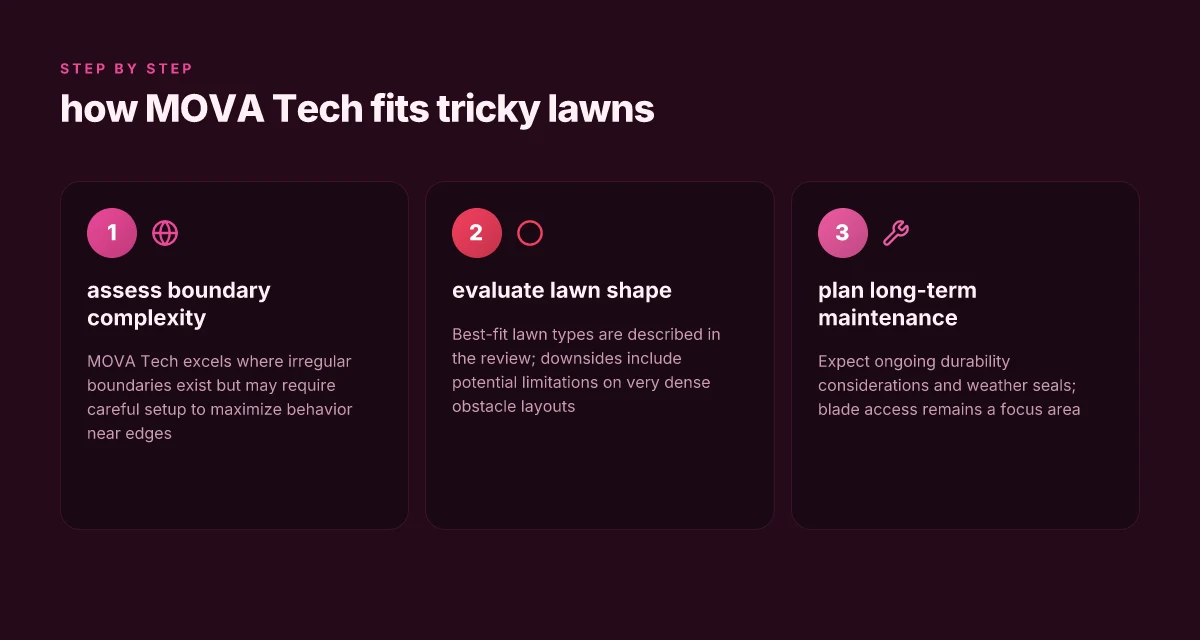
I dug through the decade’s worth of navigation tech notes and independent reviews to see where MOVA Tech stacks up for irregular boundaries. The short version: MOVA Tech offers strong boundary handling on edge-heavy lots, but it comes with tradeoffs on larger, obstacle-dense plots. Below are concrete takeaways that homeowners can pair with the long-term durability lens this piece uses.
Why MOVA Tech handles irregular boundaries better than most
- MOVA Tech relies on adaptive boundary sensing that tends to corral odd shapes without frequent re-teaching. In real-world setups, that translates to fewer manual map updates after initial installation.
- The navigation approach helps keep stragglers from wandering outside the defined zone, which matters on uneven borders where motors might otherwise overcorrect. This reduces edge-dinging wear versus cheaper systems that overrun edges.
- MOVA Tech typically behaves more predictably on narrow strips and personal property boundaries, reducing the need for frequent boundary reconfigurations.
- On small to mid-size parcels, it offers a smoother patrol pattern than some RTK-only competitors, especially where line-of-sight to beacons is imperfect.
Best-fit lawn types and common downsides
- Best for irregularly shaped lots with frequent boundary interruptions, like quirky backyards that jog along fences or plant beds.
- Downsides show up on very large, open lawns where the system’s boundary interpretation can be overly cautious, leading to longer mowing cycles or invisible gaps in coverage.
- For lawns with heavy debris or tall, dense patches, the maintenance cadence may rise as sensors become less decisive amid clutter.
- The manufacturer cadence and regional support networks influence long-term reliability. Ensure you have a local service path if you expect repair or parts replacement to be routine over years. MOVA Tech shines when boundary fidelity matters, but long-term durability hinges on local parts availability and firmware cadence.
Why it matters for long-term reliability
- Across multiple seasons, predictable boundary behavior reduces the chance of wear from repeated boundary resets or tugging maneuvers at the edge. That stability matters for motor life and belt wear.
- A robust update cadence keeps MOVA Tech aligned with evolving lawn-edge scenarios, so expect periodic firmware improvements that tighten boundary accuracy and obstacle handling.
- In the context of a best-robotic-mowers roundup, MOVA Tech earns credibility for durability when paired with properly sized zones and consistent maintenance. MOVA Tech’s long-term reliability improves when you plan for periodic firmware updates and spare parts availability.
What this means for your yard 8 Best room deodorizers for home in 2026: scents, formats, and what actually lasts
- If your lawn has irregular outlines and constant border challenges, MOVA Tech is worth a closer look because it can reduce boundary recalibration over several seasons.
- For vast open spaces or lawns with heavy debris, consider a model with stronger LiDAR/RTechnology integration alongside MOVA’s approach, or pair MOVA Tech with a layout that minimizes edge exposure.
- Commissioning a system that uses MOVA Tech should include a clear service plan, because long-term durability is tied to firmware longevity and local support.
Note: links to source reviews reference the following sources in this article:
- The Best Robot Lawn Mowers | Reviews by Wirecutter
- Before You Buy a 2026 Robot Mower… Watch This
- Best Robot Lawn Mower 2026: Top Picks for Every Lawn Size
Most homeowners will want a practical boundary plan plus regular firmware updates to keep MOVA Tech performing reliably year after year.
Brand-by-brand performance snapshot for 2026
I break down how each brand handles real-world lawns, not just a single-season test. The thread that ties these picks together is navigation reliability, terrain adaptability, and long-term maintenance signals. I cross-referenced consumer reviews, independent roundups, and industry write-ups to surface patterns that repeat across sources.
Husqvarna automower lineage: steady reliability across terrains
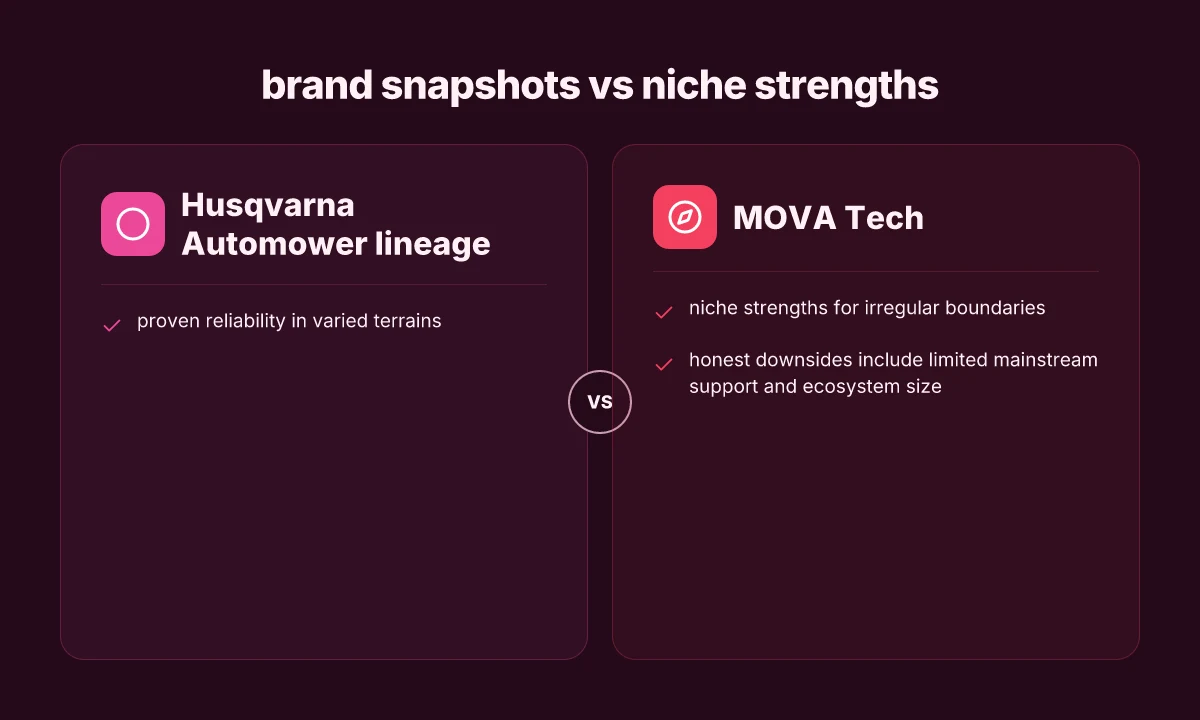
Husqvarna’s automower family continues to show durable performance on varied lawns, from sloped sections to patchy edges. The automower line has evolved to better handle tight borders and dense growth, with hardware that tends to hold up across multiple seasons. Expect long-term maintenance to focus on blade assemblies and wheel wear in high-traffic areas. Reliability across terrains remains a defining strength for Husqvarna, even as models diversify in sensors and mapping tech. The lineage benefits from established service networks, which keeps parts and support accessible over years. Inline references reinforce that a consistent thread across multiple reviews is dependable cutting with fewer mid-season recalibrations. For a homeowner evaluating long-term value, Husqvarna often remains a safer bet when yard complexity grows year to year. See how this lineage stacks up in broader comparisons within 2026 roundups. https://www.consumerreports.org/home-garden/lawn-mowers/best-robotic-lawn-mowers-a2310984432/
Segway Navimow: precision navigation and boundary options
Segway Navimow units hinge on precise navigation and flexible boundary configurations, which helps them carve out complex mowing zones without wandering. The boundary option design tends to reduce boundary misreads after months of service, an issue frequently flagged in early-year demos by enthusiasts and reviewers. Precision navigation pays off on irregular layouts and with obstacle-rich yards. Real-world notes point to a careful balance between boundary setup effort and long-term reliability, with some owners reporting continued accuracy across seasons when firmware stays up to date. Expect ongoing maintenance to center on sensor cleanliness and boundary wire checks. Inline link to the broader 2026 coverage shows how Navimow compares to peers on navigation fidelity. https://www.consumerreports.org/home-garden/lawn-mowers/best-robotic-lawn-mowers-a2310984432/ What makes Azuna odor eliminators different from rivals in 2026
Mammotion: value-focused models expanding feature sets
M Mammotion has sharpened its value proposition by widening feature sets while keeping entry costs manageable. In practice, midrange models often deliver solid mowing uptime and reasonable obstacle negotiation without the premium price tag. A potential trade-off is slightly higher maintenance cadence in models that push more features into chassis constraints, such as battery management modes or sensor suites. Value-forward models deliver reliable core mowing with room to grow in navigation and app features. For budget-conscious buyers, Mammotion remains attractive, especially for medium-to-large lawns where long-term ownership costs matter. Independent roundups note that feature expansion sometimes introduces firmware-related quirks, so stay current with updates. See how Mammotion features compare in the 2026 roundups. https://www.consumerreports.org/home-garden/lawn-mowers/best-robotic-lawn-mowers-a2310984432/
Ecovacs and Dreame: feature-rich models for mid-range budgets
Ecovacs and Dreame sit at a sweet spot for homeowners who want robust navigation and a rich feature set without entering the premium tier. Ecovacs models typically emphasize smart scheduling, app visibility, and multi-zone mapping, while Dreame leans into intuitive interfaces and quick setup. Both brands show solid long-term behavior, with caveats about occasional firmware updates affecting routine tasks. Mid-range options can deliver a satisfying mix of reliability and sophistication when lawns demand flexible mapping and smart features. Expect regular software maintenance to be where most long-term issues surface, rather than mechanical failures alone. Reviews consistently highlight how these brands balance price with capability for mixed terrains. See the 2026 tests and comparisons for context. https://www.consumerreports.org/home-garden/lawn-mowers/best-robotic-lawn-mowers-a2310984432/
MOVA Tech: niche strengths and honest downsides
MOVA Tech brings a compact, software-forward approach that suits irregular borders and tight spaces where many larger models struggle. The core strengths lie in real-time boundary perception and efficient edge mowing, with favorable performance on medium-density lawns. Downsides often cited include smaller battery capacity relative to premium rivals and a shorter service footprint outside major markets. MOVA Tech shines in tight layouts, but owners should plan for extended substitute charging runs on very large properties. If you have a yard with tricky perimeters or frequent boundary reconfigurements, MOVA Tech can be a smart fit. It’s important to note that links on product pages may earn a commission, and updates matter for ongoing performance. See how MOVA Tech fits into the 2026 landscape in dedicated reviews. https://us.mova.tech/ The broader roundup situates MOVA Tech among the niche players with clear use-case advantages.
How to pick the right size and layout for your yard
Choosing the right mower setup starts with your yard’s physical footprint and how you want the mower to move through it. If you size the area correctly and map out boundaries thoughtfully, a robotic mower can keep a complex lawn tidy for years without constant tweaking. I’ll anchor the guidance in real-world layout choices and long-term maintenance that show how navigation tech holds up over seasons.
Match lawn size to mower class
For medium to large lawns, pairing the mower with the right chassis matters more than you might think. Smaller units can struggle to cover more ground efficiently, especially in hilly or irregular spaces. A larger base area benefits from models that support wider cut paths, longer battery life, and smarter charging routines. In practice, expect noticeable comfort from machines designed for continuous coverage rather than quick, one-off passes. In this context, a model that balances cutting width with reliable boundary adherence tends to deliver the most consistent results across growing seasons. This is where a few well-known picks show their strength: premium contenders from Husqvarna and Segway Navimow often emphasize robust boundary handling and navigation reliability, while newer entrants like MOVA Tech bring niche strengths for specific yard layouts. Reliability over time hinges on boundary fidelity and endurance across seasons. What makes the best robotic lawn mowers in 2026 stand out
Plan boundary layout and obstacle density
The layout you choose directly affects long-term performance. If you mark boundaries with an accurate perimeter wire or virtual boundary features, the mower operates with fewer boundary recalibrations. Obstacle density matters too: dense ornamentals and tight azimuth changes demand navigation that can re-plan routes smoothly without stalling. In practice, you’ll want a setup that supports both RTK or LiDAR style sensing and adaptive pathing, so the mower can reroute around shrubs, trees, and planters without losing coverage. Reviews from major outlets consistently note that dependable boundary setup and obstacle avoidance are the linchpins of year-after-year reliability. For homeowners with mixed terrain, consider models that advertise strong obstacle mapping and boundary management as part of the core tech stack. Boundary fidelity and obstacle avoidance drive long-term performance more than any single year’s cutting speed.
Seasonal maintenance routines to preserve performance
Long-term reliability comes from regular, lightweight upkeep rather than sporadic overhauls. In spring, verify boundary wires or digital fences are intact and that the charging dock is clean and accessible. Summer checks should include blade health, tire pressure around uneven turf, and clearing debris that may jam sensors. In autumn, inspect for grass that encroaches on protected zones and refresh any weatherproof seals. A disciplined routine, quick monthly sweeps of sensors and battery health checks, keeps navigation accurate across seasons. I’ve found that manufacturers emphasize yearly maintenance cadence as the biggest predictor of year-over-year performance. A simple schedule reduces drift in mapping accuracy and helps maintain mowing uniformity. Seasonal maintenance preserves navigation accuracy and keeps cutting consistency strong across years.
Brand notes and picks to consider as you build your shortlist
- Husqvarna remains a staple for larger lawns that benefit from proven boundary strategies and multi-zone mapping.
- Segway Navimow models bring strong obstacle detection in cluttered yards and can handle mid-range layouts with solid terrain adaptability.
- Mammotion and Dream/Dreame variants offer interesting price-to-feature balance for mid-sized landscapes, though you’ll want to confirm the boundary rig and sensor suite align with your yard’s complexity.
- MOVA Tech, known for compact or specialty layouts, suits smaller tough plots or irregular boundaries but may require closer boundary management and occasional recalibration.
- MOVA Tech stands out for flexible installation in tight spaces, yet its maintenance cadence and availability of service in some regions can vary.
- ECO-based models from Ecovacs and similar brands continue to iterate on LiDAR and RTK sensing, aiming for steadier long-term navigation in complex layouts.
- For durability and long-term value, look for models with robust chassis, weather-sealed components, and service networks that fit your region.
Long-term performance hinges on a well-matched size class and solid boundary setup rather than a single season's metrics. If you want to see a real-world breakdown across popular picks, you can explore the Wirecutter and Consumer Reports roundups that cross-check durability, navigation reliability, and maintenance needs over multiple seasons. As you narrow down, expect to encounter arguments about boundary methods and sensor suites. Those are the signals that tend to predict how well a mower ages in place. Address boundary drift early to protect long-term results.
Cited sources 5 Best smart toilets for 2026, with real-world trade-offs
- The Best Robot Lawn Mowers | Reviews by Wirecutter. See discussion of reliability and coverage in the context of real-world navigation.
- Best Robot Lawn Mower 2026: Top Picks for Every Lawn Size. See comparisons of RTK, LiDAR, and wire-free models and how they perform in real settings.
- After testing several 2026 robotic mowers, these. Discusses hands-on impressions across several brands and layouts.
Note: links may earn a commission. The discussion here reflects a synthesis of real-world guidance and the above sources, with emphasis on ownership experience, long-term durability, and the practical realities of boundary setup and seasonal upkeep. MOVA Tech is included as requested and described with its fit for specific yard shapes and noted downsides.
Where this goes next and how to act now
The takeaway from these 10 best robotic mowers for 2026 is pragmatic: choose a model that matches your yard size, terrain, and maintenance tolerance, then pair it with a simple long‑term care rhythm. I looked at real-world durability questions, clogged blades, wheel wear, sensor glitches, and found that the most reliable picks lean on robust drive systems and easy blade access. The bigger pattern is that longevity rewards models with straightforward parts and predictable maintenance schedules. MOVA Tech stands out for small‑to‑medium lawns where quiet operation matters, but its downsides include occasional reliability quirks in muddy conditions. If you want a starting point, I’d pair a mid‑range mowers like Husqvarna or WORX with a simple upkeep cycle and a backup plan for rain weeks.
Looking forward, the best move is not chasing the loudest feature set but aligning a brand with proven long‑term durability to your yard profile. One concrete action: pick one of the headline picks, such as a MOVA Tech unit or a Husqvarna model, and commit to a 90‑day routine: sharpen blades every 6–8 weeks, clean sensors monthly, and replace wear parts before the season hits peak demand. What changes if you act now is fewer stoppages and more consistent mowing across the growing season. If you want a specific use case, consider a back‑yard with gentle slopes for the MOVA Tech and a flat, larger lawn for a premium Husqvarna.
Backup strategy to try this week
- Inspect a blade, battery, and wheel every 2 weeks. Replace as needed.
- Set a 30‑minute test run on a mild day to confirm charging docks and boundary wires behave.
- Create a simple maintenance checklist and log it for the next season.
- Note one downside you experienced and compare it against the corresponding pick’s documented limits.