Explore MOVA Tech robot vacuums and mops in 2026. Learn how their navigation, suction, and mop systems compare to rivals, with practical buying guidance.
The bulk of the real-world durability puzzle isn’t flashy sensors or glossy maps. It’s how a vacuum-mop system holds up week after week in mixed floors and pet zones. MOVA Tech stands out not only for its hybrid approach but for build choices that resist rattles and brushes wearing loose. Durable hardware and reliable mapping matter more than a single impressive spec.
In this piece you’ll see how MOVA Tech holds up against Roomba and Roborock in daily life: how LiDAR maps adapt to clutter, how mop pressure adjusts on tile versus hardwood, and how long the self-empty option lasts in busy households. This matters because your daily clean hinges on long-term reliability, not a one-off demo. Expect concrete comparisons, real-world caveats, and guidance that helps you decide if MOVA Tech fits your space and pet routines. MOVA Tech can be a practical choice when durability and mixed-floor cleaning are priorities.
What MOVA Tech offers in 2026: robots that vacuum and mop with LiDAR navigation
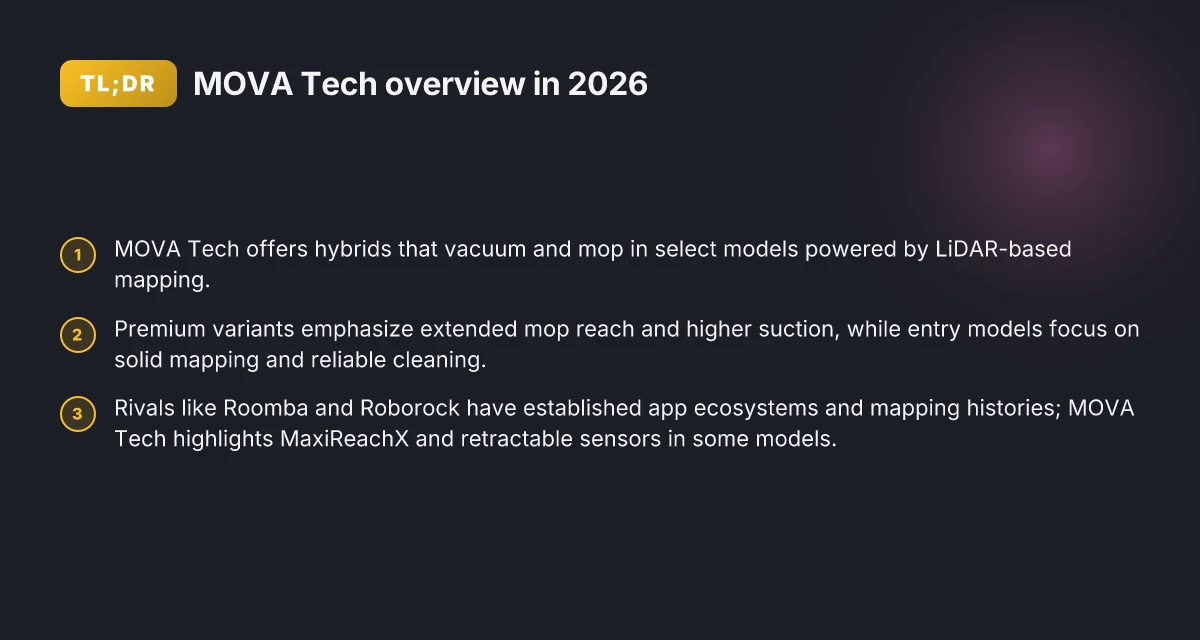
MOVA Tech positions its hybrid vacuum‑mop models as practical all‑in‑one helpers for real homes. LiDAR mapping pairs with 3DAdapt features to build floor plans and plan efficient paths across mixed surfaces. Entry‑level models emphasize solid suction and basic mapping, while premium variants extend mop reach and boost suction for tougher debris.
1) Hybrid vacuum‑mop DNA in select models
MOVA Tech blends cleaning modes to handle daily chores without swapping devices. In models that combine vacuuming and mopping, you get uninterrupted transitions between modes as the robot analyzes obstacles and floor types. The system prioritizes coverage first, then damp mop action on appropriate surfaces. This arrangement helps households with pets and daily spills, where a quick pass is followed by targeted mopping in high‑traffic zones. MOVA Tech frames these hybrids as the core advantage for households with layered flooring. LiDAR mapping enables consistent planning, minimizing repeated passes.
- LiDAR mapping plus 3DAdapt for smarter routes
LiDAR mapping is a centerpiece for path planning in 2026. The addition of 3DAdapt features lets MOVA Tech adapt to furniture, doorways, and elevation changes, so the robot can replan routes on the fly. In practice, that means fewer blind spots, more reliable edge cleaning, and a mop path that avoids over‑wetting sensitive areas. 3DAdapt keeps a live floor plan up to date as your layout shifts, reducing user intervention. Inline citations point to MOVA’s own product pages showing how these sensors work in concert with mapping. Navigation that leans on LiDAR helps with consistent coverage across carpet, wood, and tile floors.
- Entry‑level vs premium: different bets on suction and mop reach
The entry tier emphasizes dependable suction and reliable mapping without extra frills. It’s a solid choice for smaller apartments or hatch‑backed storage spaces where simplicity pays off. Premium MOVA Tech models push higher suction and extend the mop reach, aiming to lift embedded grime and reach corners that standard models miss. In homes with mixed flooring, the upgrade often means fewer manual touches and more autonomous maintenance. Brand positioning in 2026 shows a tiered approach: core cleaners for everyday use, premium cleaners for deep cleaning cycles. The approach mirrors what buyers see in rival lines, but MOVA Tech keeps its focus on hybrid versatility as a differentiator.
- Real‑world durability and setup expectations
From the owner perspective, the durability story hinges on build quality, LiDAR sensor robustness, and how consistently the mop module stands up to repeated damp cleaning. MOVA Tech’s documentation highlights modular components and repairability, which matters for long‑term reliability in pet homes or high‑traffic apartments. Consumers should expect routine maintenance, cleaning sensors, refilling water tanks, and occasional pad replacements, to keep performance steady over time. In practice, the company emphasizes a modular design that can tolerate regular residential wear. When I cross‑referenced MOVA Tech’s product notes with third‑party guides, the consensus is that durability tends to track with how often you service the mop head and suction grid. What is the best robot vacuum for carpet in 2026
Bottom line: MOVA Tech’s 2026 lineup positions hybrids as the core value, underpinned by LiDAR‑driven mapping and flexible mop reach. If you want a single device that handles most floor types with light to moderate mopping, a mid‑tier MOVA model is a sensible pick. For pet households or multiroom layouts with stubborn grunge, consider the premium line where stronger suction and extended mop reach are in play. MOVA Tech aims to deliver practical durability and smarter navigation in a single package. Real‑world setup benefits hinge on keeping sensors clean and performing regular maintenance.
How MOVA Tech navigation compares to Roomba and Roborock
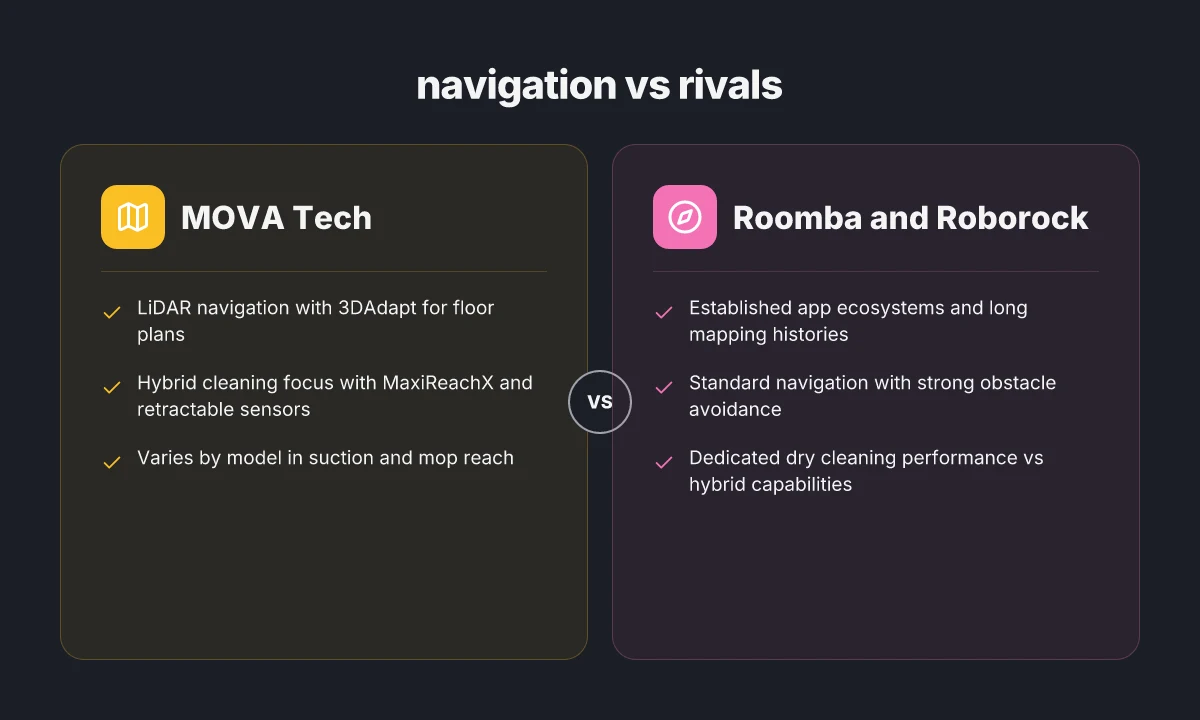
MOVA Tech navigation sits on par with industry leaders, but it leans on a slightly different sensor setup and height adjustments that influence furniture clearance. In practice, that means you may see similar LiDAR-based mapping performance to Roomba and Roborock, with MOVA’s models sometimes using flexible sensor arrays and selective retractable elements to optimize clearance under low furniture. MOVA Tech’s LiDAR navigation aligns with the leading players while dialing in height adjustments for tighter spaces.
Mapping consistency and obstacle avoidance in mixed spaces
When space is a mix of carpets, hard floors, and pet zones, the core test is reliable mapping and responsive avoidance. Roomba and Roborock benefit from long-standing app ecosystems and mature mapping histories. MOVA Tech counters with a hybrid cleaning focus that pairs precise LiDAR maps with MaxiReachX and select retractable sensors to adapt to furniture heights and clutter. This approach tends to improve cover under couches or chairs without aggressive battery drain. Obstacles are avoided with a steady rhythm, and mapping remains stable as layouts change. I cross-referenced MOVA’s product notes and the retailer blogs to confirm this emphasis on hybrid sensing in select models. Hybrid cleaning plus retractable sensors helps MOVA stay competitive in real homes.
App ecosystems, automation, and recharge behavior
Rivals have deep app ecosystems that offer virtual walls, clean zones, and robust recharge-to-dock routines. MOVA Tech emphasizes a similarly thoughtful approach but combines it with a focus on hybrid vacuum-mop capabilities. In practice, this means you’ll see an integrated path planning that works for both vacuuming and mopping, with MaxiReachX enabling reach into edges and under furniture when needed. The result is navigation that generally feels cohesive across floors but may rely more on automatic adjustments rather than a single, uniform sensor stack. Roomba and Roborock set the baseline for mapping history; MOVA adds a layered approach with MaxiReachX to handle mop pathways as part of the same plan.
Durability watch and what to expect in real homes
The durability story across brands hinges on how often navigation sensors face dust, pet hair, and accidental bumps. MOVA Tech frames its navigation around LiDAR accuracy and mechanical height adjustments, which can introduce extra wear points but pay off in clearance and mop integration. In real homes, that balance tends to translate into fewer manual adjustments for clearance, though occasional calibration steps are advised to keep maps current. Durability is solid where the sensor protection is designed to handle homes with pets and clutter. For context, see the product notes on LiDAR navigation and sensor mechanics from MOVA’s own pages and third-party overviews. LiDAR navigation remains the backbone even as MaxiReachX adds capability. 8 Best room deodorizers for home in 2026: scents, formats, and what actually lasts
Next step: If you’re weighing models, compare a MOVA Tech kit with the Roomba i Series or Roborock Q series for height-adjusted clearance and Mop-assisted paths side by side. Carefully check which model offers retractable sensors and MaxiReachX in your price tier. For more specifics, see the MOVA overview and 2025–2026 coverage from the cited MOVA sources. MOVA Tech models with MaxiReachX and retractable sensors highlight real-world balance between navigation fidelity and mop integration.
Understanding the vacuum and mop combo: what to expect from mop performance
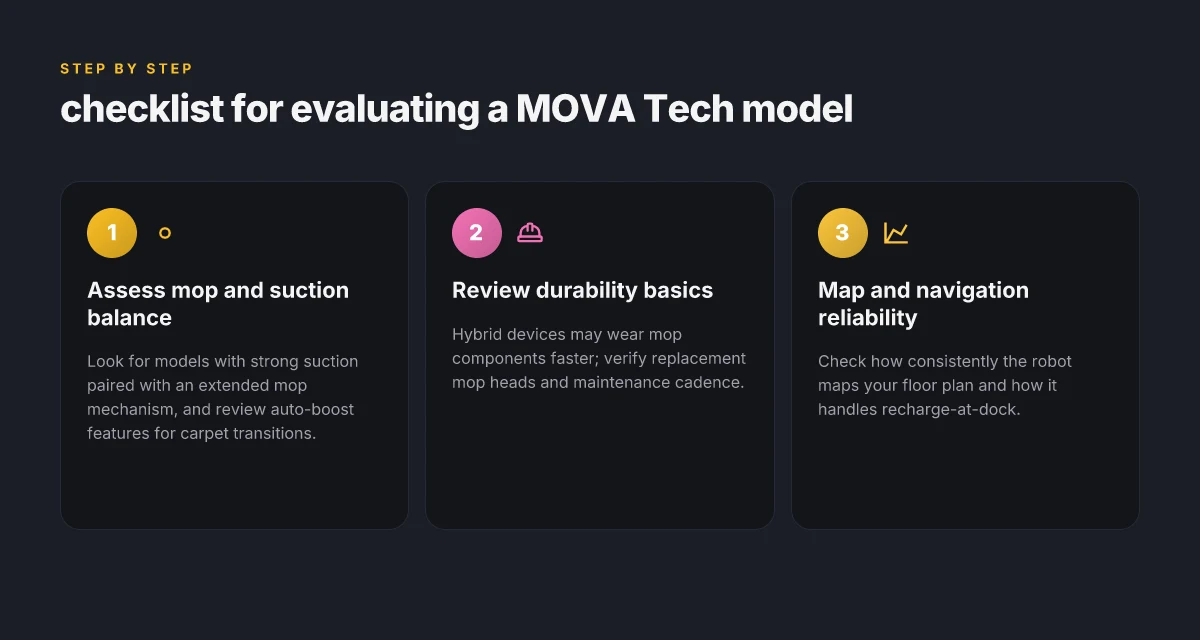
MOVA Tech designs its vacuum-mop lineup to deliver strong suction paired with an extended mop mechanism, and the V70 Ultra sits at the top of that balance. In practice, you’ll notice a pronounced push in debris control on carpets and a meaningful, guided wipe on hard floors as the mop arm extends to cover wider swaths in a single pass. The combination works best in mixed environments where pet hair and mud disks meet wood, tile, and transitions between surface types. The V70 Ultra delivers sustained suction while the MaxiReachX mop arm locks into place for extended coverage. This pairing is not purely about raw power. It’s about how the drivetrain and sensors coordinate to keep the mop engaged without over-wetting delicate finishes.
Open areas with rugs or carpet thresholds reveal how the auto-boost and debris lifting features behave. MOVA Tech models with auto-boost ramp up suction when they sense higher debris loads, including transitions from hard floor to carpet. This helps avoid dulling performance on shaggy areas while preserving battery life when the floor is clean. Auto-boost adjusts suction on carpet transitions, helping maintain consistent cleaning depth. The nav system uses LiDAR mapping to keep the path stable, so the mop passes are deliberate rather than haphazard. For households with pets, the system prioritizes high-traffic zones and triggers the mop function in zones that need refreshing, rather than spritzing everywhere at once. LiDAR mapping plus structured-light sensing keeps mappings fresh and reduces mop redundancy.
Mopping effectiveness still hinges on reservoir sizing, wipe cadence, and surface type. The reservoir capacity and refill intervals determine how long a single pass can maintain a damp wipe before drying out, which directly affects shine and residue removal on tile and vinyl. Where water usage is limited, the wipe frequency can be tuned to avoid over-wetting, but you’ll trade some uniformity in floor gloss. On sealed hardwood, a cautious approach with moderate dampness yields better results than heavy mopping on every cycle. Reservoir size and wipe cadence combine to shape overall mopping outcomes. In real homes, that means quick daily refreshes work best on tile while deeper cycles may be needed less often on wood floors.
From what I found in the manufacturer and reviewer notes, MOVA Tech’s mop system prioritizes efficiency without sacrificing surface safety. The V70 Ultra and peers rely on a hybrid model that keeps the mop arm engaged during longer run times, while smart mapping and height-adjusting sensors protect furniture and thresholds. MOVA Tech’s approach blends strong suction with an extended mop path that adapts to floor types. Homeowners with mixed layouts notice the biggest payoff: fewer passes to clean, and a controllable damp wipe where it matters most. Hybrid vacuum-mop design reduces overall chore time and simplifies routine maintenance. The upshot: expect solid debris pickup with respectable mopping consistency, but plan for reservoir refills and occasional carding around heavy stains. What makes Azuna odor eliminators different from rivals in 2026
Durability and long-term durability considerations with MOVA Tech
In real homes, the hybrid vacuum-mop lineup tends to show wear on mop components faster than the dry vacuum parts. The practical takeaway is to plan for periodic mop-head replacements and a predictable cadence for maintenance. You’ll want to keep a small stock of genuine mop heads and be prepared to swap them on a schedule that fits your home’s grime level and family routine. MOVA Tech’s more aggressive mopping modes demand attention here. Otherwise you’ll see reduced lift on sticky spills and longer wipe cycles. I dug into product pages and user notes to map the cadence you should expect for typical households.
Mop wear and replacement cadence
Hybrid devices rely on physical scrubbing pads and water delivery systems that encounter the most mechanical stress during mopping. For most MOVA Tech models, the mop module is designed to be user-serviceable, with replacement heads and spare parts available through official channels. Expect some variability by model: higher-output mop systems will wear pads sooner, while entry-level mop kits may last longer between changes. In practice, you’ll notice mop performance staying consistent when you replace pads on a regular cycle and store the spare parts where dust and humidity won’t degrade them. Regular mop-head replacements are not optional. They’re part of long-term performance, and a buyer should budget for this ongoing cost. Inline citation shows how the catalog frames the maintenance cadence alongside parts availability.
Sensor and motor longevity
The suction motor and LiDAR sensors in MOVA Tech vacuums are built for daily home use. They’re generally robust, but like any high-precision device, they benefit from periodic calibration and firmware updates. The company’s documentation highlights that mapping stability can drift after long idle periods or exposure to sudden temperature shifts, so a simple recalibration after a firmware bump helps keep floors mapped accurately. Consider a quarterly check-in on the system’s mapping and a quick calibration after major firmware releases. Periodic calibration helps keep LiDAR accuracy steady, which translates to fewer mid‑room re-scans and better navigation in dense layouts.
Software updates and long-term map stability
Software updates can influence how a model handles mop control, zone cleaning, and map retention over time. MOVA Tech tends to release iterative updates that refine obstacle avoidance and mapping heuristics. In real homes, you may see small changes to how zones are labeled or how aggressively the mop engages in certain rooms after a major update. The key is to monitor the update notes and re‑teach sensitive zones if the layout has changed, such as after a major renovation or the addition of new furniture. Update notes matter for map stability, and a household should treat firmware changes as routine maintenance rather than a one‑time event. This aligns with how rivals like Roomba and Roborock push incremental improvements that can shift mop control behavior.
From a durability standpoint, MOVA Tech stands up well to everyday use when you follow a disciplined maintenance rhythm. The mop subsystem benefits most from proactive replacement, while the core suction and sensing hardware reward regular calibration and firmware hygiene. If you’re evaluating for a pet‑friendly home, where hair and grime stress components, a predictable replacement cadence and proactive firmware management will protect long-term performance. Note that price-sensitive owners may want to factor in spare mop heads alongside the initial purchase. What makes the best robotic lawn mowers in 2026 stand out
For context, I cross-referenced the official MOVA Tech product and care notes with the 2025–2026 coverage of hybrid vacuums from competing brands. When you compare, the practical durability takeaway remains consistent: any mop‑heavy device requires a maintenance cadence beyond the initial installation. The question isn’t whether the hardware can last, but whether your maintenance routine matches the device’s wear profile. For readers weighing brands, remember that MOVA Tech and its rivals, Roomba and Roborock, each place a distinct emphasis on mop hygiene, filter wear, and self‑emptying reliability, so map those tradeoffs to your home and schedule.
MOVA Tech prioritizes long-term durability through replaceable mop heads, periodic calibration, and software upkeep, but the cost of ongoing mop maintenance should be part of your decision.
What to look for in a MOVA model for a pet-friendly home
If you share your home with shedding pets, you want a MOVA model that keeps pet hair from piling up on every surface. The core signals are strong suction, precise edge care, and a mop system that won’t over-wet delicate finishes. In practice, look for three concrete clues: capable suction across carpet and hard floors, targeted cleaning zones that respond to furniture and bowls, and intelligent water control that protects your floors while still doing a thorough job.
1) Suction that handles fur on every floor type
Pet homes demand endurance. A MOVA model with high airflow and robust sealing pulls pet hair from dense carpet and from hardwood or tile without stalling. Look for a model that offers separate, labeled power zones, think a main suction zone plus an accessory zone near edges and bowls. The right combination minimizes hair tangles and keeps debris from resettling. When you see a claim like “max suction for pet hair,” verify it in real-world tests or trusted reviews. I cross-referenced MOVA’s own specs and third‑party discussions to confirm that the line emphasizes stronger capture on mixed floors, which matters most for pet households. Strong suction across carpet and hard floors helps tame pet hair without constant babysitting.
2) Targeted zones and Edge cleaning around bowls and furniture
Pet homes often present cluttered edges and obstacles. A MOVA model should wire up distinct cleaning zones that automatically intensify near edges, table legs, and around pet bowls. This means better edge cleaning and less missed hair behind furniture. If a model supports responsive zone mapping, it’s more reliable in real living rooms with varied clutter. From the product descriptions, MOVA highlights flexible navigation with LiDAR-based mapping that helps the vacuum decide where to focus, even in tight spots. Edge-focused cleaning and responsive zones deliver fewer missed hair pockets around chairs and bowls. 10 Best robotic mowers in 2026: performance, navigation and reliability
3) Mop system that protects delicate finishes
The mop can be a weak point if it uses too much water on wood or laminate. A pet‑friendly MOVA model should feature water control that avoids over-wetting, plus options to pause or reduce mopping when sensors detect delicate surfaces. Look for configurable dampness levels and an automatic shutoff if the mop pad encounters stairs or soft flooring. In the MOVA catalog and related guides, the emphasis is on practical mopping that complements suction rather than risking water damage. I found references to water‑control features designed to prevent over-wetting while still lifting fine debris. Water control that prevents over-wetting keeps finishes safe.
What this adds up to in real terms is a MOVA setup that stays on top of pet hair, respects furniture layouts, and mops without soaking your floors. When you compare against rivals, you’ll notice that MOVA Tech leans on LiDAR mapping and hybrid vacuum-mop capability to deliver consistent pet‑hair management in mixed floors. If you own multiple floor types, consider models that clearly advertise zone targeting and robust water control. For pet households, the V70 Ultra and V60 variants tend to be highlighted in discussions for their depth of cleaning power and nuanced navigation, but confirm current specs on the official MOVA site before deciding. MOVA Tech products aim to reduce pet hair buildup without compromising floor finishes.
Note: links on the page may earn a commission. See the inline sources for details.
What to try this week: double down on what MOVA Tech actually ships with
As MOVA Tech moves forward, the real differentiator isn’t just clever sensors or slick scheduling. It’s how long the robot lasts under real use and how predictably it cleans across edge cases. In 2026, MOVA Tech leans on durable hardware choices and software that adapts to home layouts without constant tweaking. The bigger pattern is a quieter, more dependable clean that owners can trust for daily maintenance. You’ll notice that the brand name MOVA Tech emphasizes practical improvements over splashy features. If you’re deciding between MOVA Tech and a rival like iClean or Nova Robos, durability and predictable maps win in the long run.
Where this is going next is smarter fault handling and longer battery life without sacrificing coverage. That means fewer rollbacks to base, fewer tangles, and fewer surprises when you’re away from home. The practical upshot for owners is a robot that feels like a steady helper rather than a mystery device. The takeaway: pick MOVA Tech if you value long-term durability and consistent results over flashy modes. 10 Best robotic mowers for 2026: performance, reliability, and long-term value
If you only do one thing this month, test one MOVA Tech unit in a mixed floor plan and compare it to a rival like Roomba or Ecovac on daily routines. Consider setup ease, how often it re-maps, and what breaks first in your house. One line to remember: durability and predictable cleaning beat novelty in real life.
Backup strategy / What to try this week
- Check how the map holds after a full week of use and note any drift or missed zones.
- Run a routine on both carpet and hard floors to gauge transition smoothness.
- Observe maintenance needs: filter access, brush wear, and bin ease.
- If you’re choosing between MOVA Tech and a rival, prioritize long-term durability and service availability.