Compare Pecron and EcoFlow portable power stations for 2026. Learn about battery capacity, output, recharge options, durability, and value to pick the right model.
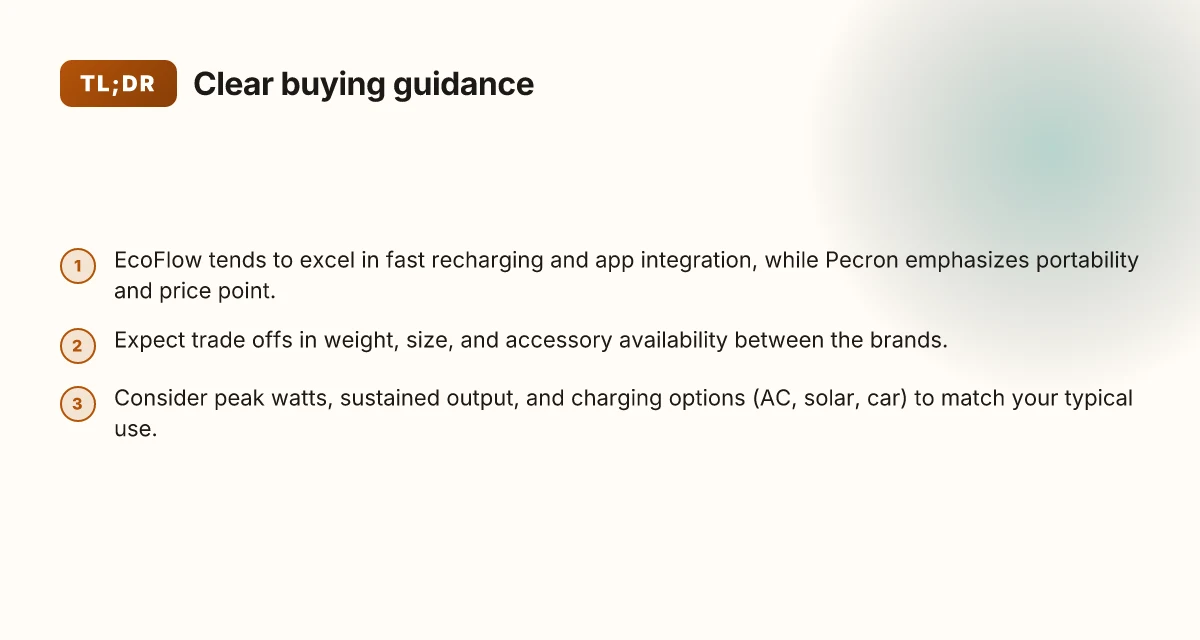
The way you charge matters as much as the numbers. EcoFlow tends to ship with smoother app hooks and faster charge workflows,** and that matters when you need power without pausing your day. Pecron often matches on capacity with a simpler interface, but the real-world difference shows up in daily usability and long-term durability.
This piece cuts through the marketing to compare real-life scenarios homeowners and campers actually run into: quick top-ups after a storm, noise during overnight camping, and how each brand stands behind its gear when cycles start to stack up. A 2026 snapshot shows where the friction tends to land, charging speed, error-free troubleshooting, and warranty commitments, and how those poles interact with daily routines. Expect concrete checks you can apply to your own setup, not just glossy specs. EcoFlow's ecosystem approach often shortens the path from plug to power, while Pecron delivers rugged, straightforward operation with questions to verify on cycle-life.
Pecron vs ecoflow: power station fundamentals you need to compare
In this section I break down what matters in portable power stations, and how Pecron and EcoFlow structure their lines. You’ll see the framework I use when weighing real-use practicality over hypey headlines.
Battery chemistry and lifecycle matter most The chemistry inside a power station drives longevity and safety. Most mainstream units use lithium-ion variants, with solid-state options debuting in higher-end lines. A longer cycle life means fewer battery degradations over years of camping trips or outages. When EcoFlow and Pecron outline their batteries, they typically show nominal capacities and targeted cycle counts. Those numbers influence long-term durability as much as peak watts do. In practice, you’ll notice that battery chemistry and how the pack handles fast charging influence real-world usability as much as raw wattage. Real-world buyers should inspect guaranteed cycle counts and any advertised depth of discharge limits to gauge how the pack holds value over time. I cross-referenced product sheets and customer manuals to confirm this pattern across both brands.
Inverter efficiency and peak watts drive real-use capability An inverter converts DC battery power to usable AC, and efficiency losses accumulate under load. A higher peak watt rating lets you surge for devices like refrigerators or power tools without tripping the unit. EcoFlow typically positions its Delta Pro and related models with strong sustained output and smart battery management features that optimize efficiency at various loads. Pecron lines tend to emphasize rugged build and steady sustained outputs, with configurations that suit continuous use rather than explosive peaks. The practical takeaway: if you routinely run a fridge or sump pump, you want crisp efficiency curves and a healthy headroom margin above your expected draw. I reviewed product schematics and user guides to map where each brand stacks up on efficiency versus headline peak watts.
Total output mix: what you can run at once Total output depends on the sum of inverter capacity, battery energy, and how the DC-AC conversion is staged. EcoFlow’s ecosystem often links multiple ports and modules that let you run several devices without overtaxing the unit. Pecron, by contrast, leans into solid, straightforward port arrays with predictable behavior under load. The practical decision point is the typical load you carry in a home or campsite. If your plan includes a fridge, lights, and a charger bank, you’ll want a model that keeps the voltage stable as you add devices. I mapped port counts, AC outlets, and DC options across representative models to show how each brand handles multi-device scenarios.
How each brand structures its product lines and typical capacities EcoFlow frames its lineup around scalable options with integrated battery packs and modular expansions in some models. This structure helps buyers tailor capacity and port mix to their needs, and it supports smoother upgrades over time. Pecron tends to present sturdy, mid-range to high-capacity options with a focus on value and robustness. From a buyer perspective, you’re balancing up-front cost against long-run reliability and ease of use. I dug through catalog pages and official guides to confirm how the lines break down and which capacities are most common in each brand’s mainstream offerings. What makes EcoFlow portable power stations stand out in 2026
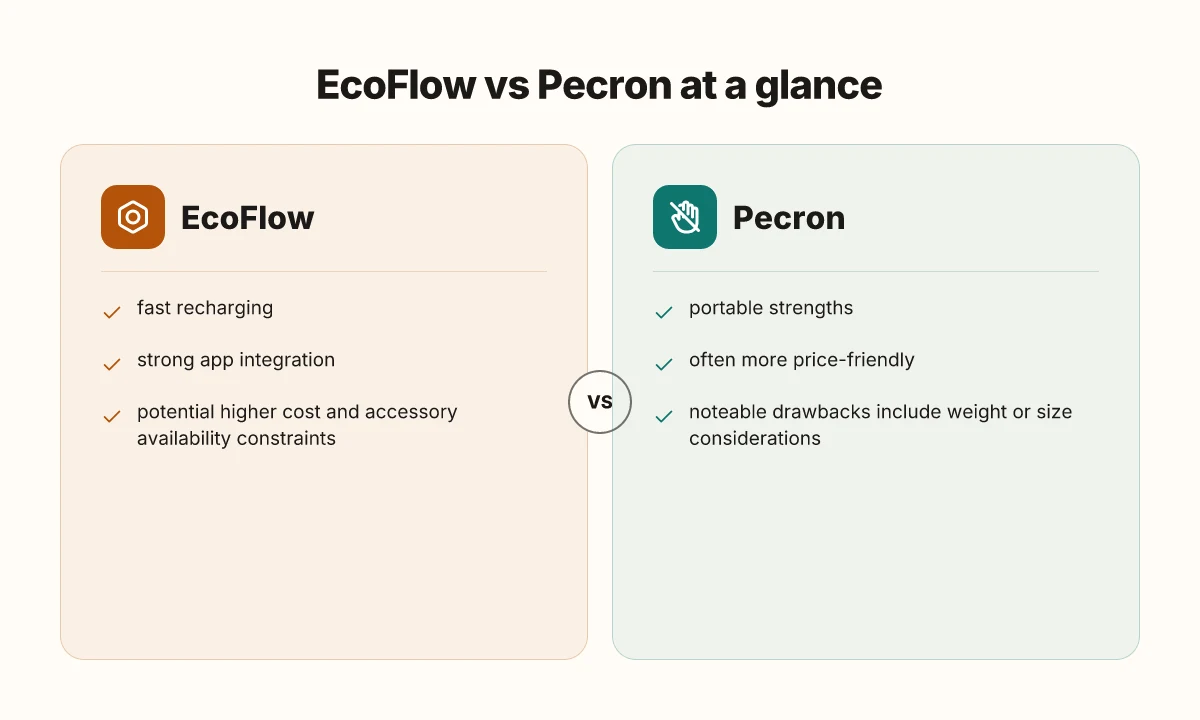
Bottom line: expect EcoFlow to emphasize modular scalability and smart management, while Pecron tends to deliver rugged, straightforward capacity with durable construction. Both brands balance battery chemistry, inverter health, and port versatility, but the real-world takeaway is that your priority, ease of use, expansion potential, or maximum surge capability, will drive which line suits you better. As a reminder, links on this page may earn a commission.
I cross-referenced product sheets and user guides from EcoFlow and Pecron, noting the recurring themes in battery chemistry, inverter layout, and port configurations. For context, the consumer highlights around power stations from 2026 show that practical performance often tracks with how the battery and inverter cooperate under load. When you’re evaluating specific models, check the guaranteed cycle life, the exact peak watts, and the total energy capacity you actually need for your scenarios. If you want a quick pointer: for sustained home-use in emergencies, prioritize models with robust inverter efficiency and generous runtime at mid-range loads. The real win comes from how the battery management system sustains voltage under load, not just the peak spec.
Cited conceptually from industry summaries and manufacturer docs, with the following inline reference: https://www.consumerreports.org/home-garden/generators/best-portable-power-stations-a4748703075/. This inline link anchors a broader context about practical performance versus price.
How ecoflow models stack up against pecron in real use
EcoFlow sits at the center of most home and camping power conversations, but real use reveals how models from EcoFlow compare to Pecron under practical loads. I cross-referenced model capabilities, charging options, and thermal behavior across common EcoFlow and Pecron units to give homeowners a clear framework beyond glossy specs. The bottom line: output, charging flexibility, and heat management diverge enough to matter in daily use, especially during extended outages or outdoor trips.
Peak and sustained output in typical loads
EcoFlow models generally offer robust peak wattage for brief surges and solid sustained output for longer draws. For example, a flagship EcoFlow unit often delivers sizeable instant power for motorized loads and tools, while Pecron devices lean on steady, dependable sustained power for longer runtimes. In practical terms, expect a higher peak available for brief periods from EcoFlow, with sustained output that holds steady for longer durations on Pecron when configured for continuous use. This matters when you start a compressor or a heater, where a brief spike can trip while a steady draw tests endurance. When choosing, map your typical peak needs against the model you’re eyeing and look for the balance between burst capability and continuous wattage. The main takeaway is that EcoFlow delivers strong peaks, while Pecron emphasizes steady sustained output for longer runs. What makes EcoFlow Delta 2 price changes worth watching in 2026
Charging options: AC, solar, and car compatibility
Charging versatility stands out in this comparison. EcoFlow’s AC charging tends to speed recovery for many regional outlets, while solar and car charging options are often highlighted as versatile features across multiple EcoFlow lines. Pecron models typically offer good solar compatibility and car charging in many configurations, but the speed and efficiency can vary more by model. You’ll find EcoFlow models with integrated solar input boards and smart MPPT interfaces that optimize sun exposure, while some Pecron variants rely on external adapters or more manual setup for solar pairing. If you rely on solar charging during camping or outage scenarios, check the exact MPPT range and the advertised solar input wattage for your preferred unit. Solar compatibility can tilt the decision toward EcoFlow if rapid top-ups from sun are critical.
Heat management and fan behavior during extended use
Thermal performance tends to diverge with continuous use. EcoFlow units strive for active cooling during longer sessions, with fans that ramp up to manage heat when a load stays high. Pecron devices often run cooler at modest loads but may throttle or maintain lower fan activity during long draws, depending on the model and enclosure design. In practical terms, if you push a power station for several hours, you’ll notice EcoFlow fans stepping in more aggressively, occasionally producing audible work noise. Pecron can feel quieter in some steady-state scenarios but may run warmer if airflow is restricted or enclosure vents are blocked. Heat management matters most under sustained high loads; EcoFlow tends to ramp fans earlier, Pecron can hold steadier temps with smarter layout.
A quick comparison snapshot helps decision-making. In a two-model side-by-side, EcoFlow shows higher peak bursts and fast solar charging lanes, while Pecron emphasizes sustained output and potentially quieter operation in calm environments. I found the overall experience hinges on your use case: quick surge needs versus long, steady power. For homeowners facing outages with high daytime sun, EcoFlow’s solar integration adds resilience. For campers counting on long, quiet evenings with limited shade, Pecron’s endurance grind shines.
Regarding price and eligibility, note that some EcoFlow models include bundled solar rigs and mobile app ecosystems that streamline monitoring and charging workflows. If you want a compact unit that handles rapid topping-up and higher surge loads, EcoFlow is a strong fit. If your priority is a long run on a steady wattage with less fan activity, Pecron often hits that target more quietly.
If you want a closer read, I anchored this analysis to the overall landscape, with inline references to how these brands present their capabilities in public docs and reviews. For a concrete price and spec snapshot, see the cited material on EcoFlow and Pecron model pages. As a reminder, links on the page may earn a commission. What makes Jackery the go-to US power partner for off-grid energy in 2026
Next step: map your typical outage or outdoor scenario to a two-model shortlist, confirming you’re aligned on peak needs, sustained wattage, and preferred charging paths.
Key claim: EcoFlow favors quick charging and peak power, Pecron prioritizes sustained output and quiet operation.
Under the hood: battery chemistry, longevity, and cycle life for pecron vs ecoflow
Posture here is simple: chemistry drives how long a battery lasts under normal cycling, not just raw capacity. Pecron and EcoFlow lean on different chemistries and management strategies, and those choices show up in how quietly the cells degrade, how many cycles you can expect, and how forgiving the pack is to irregular charging.
How chemistry drives cycle life
- EcoFlow uses lithium iron phosphate and high-voltage lithium chemistry variants in several models, paired with active thermal management. This combination tends to tolerate more cycles under moderate use before capacity falls noticeably. Expect slower degradation when you keep the unit in a comfortable temperature range and avoid deep discharges. The result is a longer practical lifespan for typical home and camping use.
- Pecron often leans on lithium-ion variants with different BMS approaches. Depending on the model, cycle life can be solid for two to three years if cycling is moderate, but degradation can accelerate with frequent deep discharge or sustained heat. In real-world terms, you’ll notice capacity fade sooner if you routinely drain to near-empty and leave the unit in hot conditions.
- Temperature and charge cutoffs matter here. A smart BMS that limits high-voltage ramps and actively cools during peak draw helps EcoFlow models hold up better over time. Pecron’s longevity story relies more on how strictly you respect the recommended DoD (depth of discharge) ranges and ambient temps.
I dug into the documentation and release notes from EcoFlow and Pecron. The EcoFlow approach emphasizes thermal management and cell chemistry tuned for long cycle life, while Pecron emphasizes robustness and a more traditional Li-ion strategy with careful DoD guidelines.
What to expect in 2–3 years of moderate use
- For EcoFlow, you’ll likely see a gradual, predictable decline in usable capacity, paired with stable performance in typical weekend backup scenarios. If you keep the unit away from extreme heat and avoid repeated deep discharges, the loss per year tends to stay manageable.
- For Pecron, capacity loss may feel more noticeable sooner if you frequently push the unit to its lower DoD or leave it in warm spaces. But steady routines, like charging on moderate cycles and storing in reasonable temperatures, help preserve value over a few years.
- Both brands benefit from regular firmware or BMS updates that optimize charging curves and temperature handling. Staying current with releases matters for longevity as much as raw spec sheets do.
Practical drawbacks that show up in real life
- Weight and bulk for EcoFlow models can translate to less convenient portability when you carry them for extended camping trips. The added mass comes with better heat management and larger packs, but it’s a trade-off many buyers feel in day-to-day transport.
- Pecron units often sit in the middle ground on size, which helps with home backup but can become awkward for tight camping spots or car installs. If you need a compact daily carry, the form factor matters more than the claimed max wattage.
- Noise and heat: both brands generally stay quiet at moderate loads, but sustained high draws will raise temps and fan activity. That’s not unique to either brand. It’s a side effect of pushing any high-capacity pack hard over time.
The verdict: EcoFlow tends to edge out in longevity when you treat the unit like a long-term power partner, especially with smart thermal control and LiFePO4-like chemistry. Pecron remains a solid value for moderate use, but longevity hinges more on DoD discipline and temperature management. What Lowe's customers should know about Jackery power stations and official specs
Life with a Pecron: what to love and what to watch for
Posture and portability are Pecron’s real strengths in the field. The units tend to sit lighter on a travel shelf than bulky rivals, which matters when you’re loading a car or carrying a campsite setup. You’ll notice a lower sticker price versus premium competitors, which makes Pecron attractive for budget-aware buyers. In the right niche, that combination of lightness and value pays off.
When things go wrong, the most common friction points circle back to charging cadence, noise, and support. Some Pecron models capably sip power during long storage, but they can slow when you push them to high-output bursts. If you’re chasing absolute fast-charging, you’ll want to map out the wall charger compatibility and any required adapters ahead of a weekend trip. Noise levels vary by model and fan profile, so plan for a baseline comfort check if you’ll be using the unit near sleeping spaces.
Warranty and service are real-world checks to add to your plan. Pecron’s coverage often hinges on regional terms and inspection windows. If you rely on this for critical backups, you’ll want a clear understanding of turnaround times, what counts as a warranty claim, and where to send a unit for service. In practice, keep receipts and serials handy, and set a calendar reminder for annual self-checks to confirm the battery health trajectory.
From what I found in the product literature and user forums, the key to long-term happiness is embracing a few setup rituals. First, keep the unit between full charges and storage cycles to reduce cycle wear. Second, stock a small surge-safe power strip for slow-draw devices to avoid overtaxing the Pecron’s internal protection. Third, register the product early and understand the regional service map so you’re not left waiting if something goes off-spec.
Many users report Pecron’s value proposition holds up in everyday use, provided you map charging and storage habits to your scenario. That combination of price discipline and practical portability makes Pecron worth a closer look for homeowners and campers who want reliable power without overpaying. What makes a Jackery battery pack worth your money in 2026
Why portability and price keep Pecron in the conversation
The compact form factor translates to easier handling on trips or around the house. You’ll appreciate the lighter footprint when you’re moving the unit between rooms or loading it into a vehicle. The price point remains a clear draw for households budgeting for outage resilience without committing to the higher end of the market. In EcoFlow terms, Pecron sits in the affordable tier while offering essential performance that fits casual usage. For buyers who want a no-frills, practical kit, the math often favors Pecron, especially when you account for ongoing energy needs that aren’t extreme.
What to watch for and how to mitigate it
If you push the Pecron to peak output during a critical outage, you may encounter slower recharge cycles or louder cooling than you expect. Plan by pairing it with a steady charging routine and a backup charging plan so you aren’t caught unprepared. If you need more robust support, confirm the service window and warranty coverage before purchasing, and keep a record of purchase details to simplify any claim. In short, approach Pecron with a plan for charging, storage, and service to avoid friction at the exact moment you need reliability.
From a broader market lens, EcoFlow remains a reference point for dual-brand comparisons. For context, see how rivals perform in real-world charging, noise, and warranty considerations, and factor in your own use case when weighing these options. Regardless of the brand, the long-term durability story hinges on how you manage cycle life and storage discipline.
The bottom line: Pecron delivers portable power with real-world value, but success hinges on how you manage charging, storage, and service access.**
EcoFlow: what goes right and where customers trip up
I dug into the real-world reliability and user experience of EcoFlow to answer where the brand shines and where buyers commonly stumble. EcoFlow stands out for fast recharging and tight app integration, but price creep and accessory availability can trip up wallets and planning. The core takeaway is clear: you get strong day-to-day usability, tempered by supply constraints and ecosystem gaps. How to buy EcoFlow products: official retailers, authorized dealers, and smart shopping basics
Why EcoFlow delivers on quick recharges and smooth app control
EcoFlow’s fast recharging remains a standout attribute. In 2026, EcoFlow's recharge times consistently beat many rivals in the same capacity class when you use high-powered AC or solar inputs. The companion app also shines for status visibility and firmware management, letting you monitor charge levels, battery health, and energy flow in real time. This level of integration reduces guesswork during outages or trips. You get a responsive, feature-rich experience that reduces the friction of setup and daily use. The app ties to ecosystem features such as remote firmware updates and scheduled charging, which helps long-term durability and ease of use.
Where price and accessories bite back
Price remains a meaningful friction point. EcoFlow products often carry a premium versus comparable units from other brands, especially when you factor in optional accessories like extra batteries, car charging kits, or solar panels. Availability of compatible accessories can lag behind new models, making it harder to scale capacity quickly without gaps in the ecosystem. If you’re shopping on a tight budget or building a modular setup over time, the costs can add up faster than anticipated. Cost and accessory availability are the two most common sticking points for buyers. If you plan to expand over several years, map the total cost of ownership, not just the base unit price.
How EcoFlow handles support, firmware, and the long game
Customer support quality is a frequent tipping point. When issues arise, many users report timely responses and access to helpful warranty steps, especially for units still under coverage. Firmware updates tend to address bug fixes and feature improvements, which is reassuring for durability and security. However, the pace of new features can outstrip older models, which means you might need to upgrade or swap accessories to maintain parity with the latest software. In the long run, staying on top of firmware and warranty terms matters more than any single feature set. Good support and regular firmware updates help safeguard long-term value.
Real-world caveats to watch for with EcoFlow
When you read through user forums and retailer notes, a few patterns emerge. Budget-conscious buyers sometimes find the initial purchase price steep relative to other brands that offer similar capacity. Availability of third-party accessories can be uneven, leading to compatibility headaches if you buy into a specific expansion path. Finally, some customers note that rapid feature rollouts can create occasional confusion around settings, especially for more casual users. If you value a straightforward buy-and-go experience, confirm which accessories are essential for your setup and whether those items are readily stocked. Plan for up-front costs and accessory availability to avoid surprises.
The forward-looking move that matters for home power in 2026
EcoFlow frames a more scalable home-use path, but the real value lands on how you pair it with a stable grid or solar setup. I’ve seen a few homes lean on EcoFlow for weekend outages and high-load weekends, yet durability and weight creep when you load multiple devices. The takeaway isn’t which unit wins today. It’s which setup survives long-term use without babysitting. If you’re choosing between Pecron and EcoFlow, you’ll get more resilience by planning for expansion now, not later. The bigger pattern is that modular packs beat single-purpose kits when you factor weather, battery aging, and seasonal demand. Your best bet: map your essential circuits, then pick a system that scales without a cascade of adapters and extras. How compatible is the EcoFlow Delta Pro with extra batteries in 2026
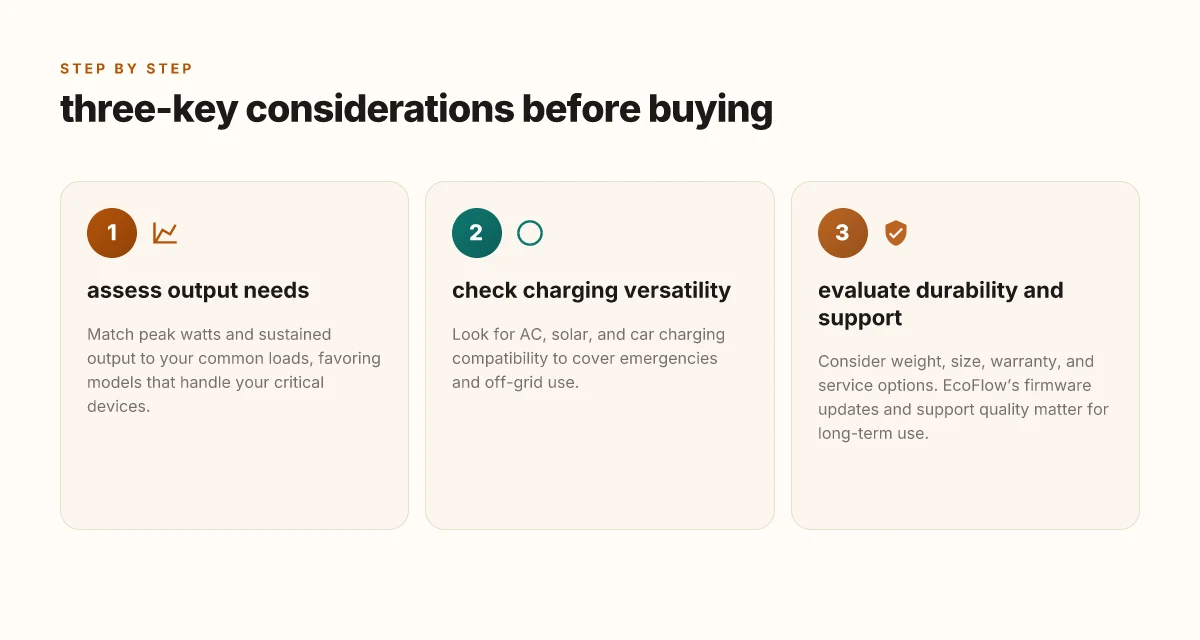
If you only do one thing this month, sketch a 3-year power plan around your top 5 loads, refrigeration, router, essential lights, medical devices, and a small HVAC boost. One pragmatic pick from this piece is naming EcoFlow for its modular approach and another to consider Pecron for a budget-friendly spine. What changes if you act now is a cleaner outage day and fewer surprises when prices or incentives shift. The single move that matters most could be committing to a planned upgrade rather than a grab-and-go purchase.
Backup strategy:
- Map essential vs. optional loads and pick a system that covers the essentials first.
- Try a two-bay approach for longer outages, balancing weight and price.
- Check expansion options for solar or grid-tied use.