
Explore how EcoFlow Delta Pro extra batteries work, what fits, and how to pair them for reliable home backup. Learn the official stance and practical setup tips.
The biggest misconception around EcoFlow Delta Pro expansion is thinking any external pack is interchangeable. External batteries must align with EcoFlow's official model and firmware stance, not just any third-party pack. When you see a delta with a full‑throttle load, the difference between a certified add‑on and an incompatible brick is the exact firmware checker you never noticed until it blocks a critical inverter path. EcoFlow's stance shapes what actually wires up.
This article pulls real‑world signals from 2026 compatibility guides, field reports, and rival approaches to show where expansion breaks down in practice. You’ll see how many homeowners run into limits on the number of packs, how firmware versions constrain pairing, and why some distributors push you toward branded modules only. The goal is to map practical paths for homeowners and professionals, then contrast EcoFlow with how rivals like EcoFlow competitors handle external banks, so you can choose an expansion path with confidence.
What makes EcoFlow Delta Pro extra batteries compatible, and what doesn’t
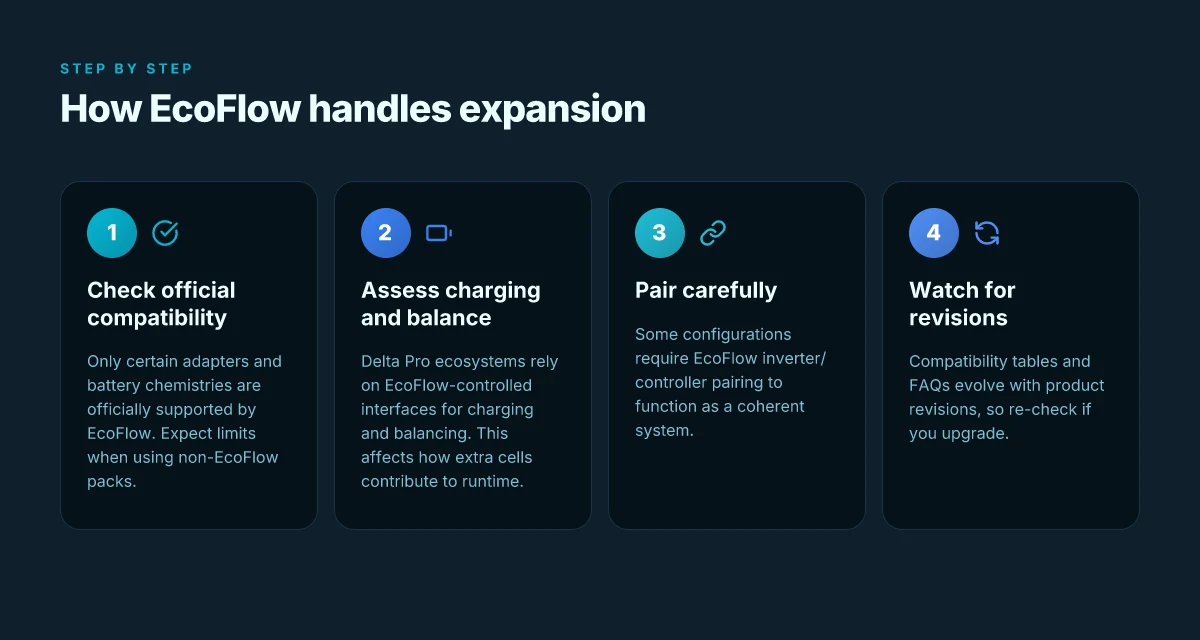
The Delta Pro ecosystem relies on EcoFlow controlled interfaces to manage charging and balancing. Not every external pack fits cleanly. Some configurations depend on pairing an outside battery with the EcoFlow inverter/controller stack to transfer, balance, and monitor cells. In practice, you’ll see a clear line between officially listed options and third‑party or ad hoc setups.
1) Official vs. unofficial compatibility boundaries
Delta Pro surfaces that are officially compatible sit inside EcoFlow’s own ecosystem. In those cases, the Delta Pro Ultra Inverter and its control logic coordinate charging, discharging, and cell balancing with a wired or integrated path. When you peer at third‑party packs or “unlisted” extras, the system often demands a specific EcoFlow inverter/controller pairing to ensure safe charging and equalization. That pairing is not universal. Some external batteries require bridges, adapters, or custom wiring that EcoFlow does not guarantee for long‑term durability or warranty coverage.
From what I found in the official documentation, a Delta Pro Ultra Battery must connect through the Ultra Inverter to charge. That framing gives a solid hint about where the compatibility boundary lies: EcoFlow controls the charging loop end‑to‑end, and non‑EcoFlow packs enter a gray area where functionality is not guaranteed. The official stance is clear: EcoFlow controls the charging path, and only certain packs are guaranteed to work within that loop. This matters when you’re evaluating add‑on packs for backup capacity and you want to avoid post‑purchase surprises.
2) External configurations you’ll encounter in the wild
Some external battery configurations do work, but only when you align them with the EcoFlow inverter/controller pairing. In practice, that means you might see community posts describing harnesses, adapters, or wiring schemes that claim compatibility. There is no blanket guarantee, and several setups rely on third‑party documentation or experience rather than EcoFlow’s official product sheets. As a buyer, you’ll want to verify that any non‑EcoFlow pack connects through the same control path that EcoFlow designs for safe, balanced charging. The risk here is untested edges that void warranties or misbalance cells over time. EcoFlow’s own materials emphasize the importance of controlled interfaces so that charging voltage, current, and balancing are kept within safe limits.
3) Official lists vs. what the market offers
Not every extra battery market option is officially listed as compatible. EcoFlow does advertise Smart Extra Batteries as compatible within the Delta ecosystem, highlighting the intent to expand capacity through trusted, integrated components. Outside this look, you’ll encounter references in user groups and hobbyist circles suggesting various connectors or compatibility tables. Some of these references point to real deployments. They do not replace official compatibility confirmations. The official compatibility stance keeps a narrow, well‑documented path to expansion. How to buy EcoFlow products: official retailers, authorized dealers, and smart shopping basics
I dug into the official EcoFlow pages and community discussions to map the gap between official compatibility and real‑world tinkering. When you compare EcoFlow with rivals like Jackery or alternative modular systems, the delta of risk widens the moment you move beyond EcoFlow‑branded extras. The takeaway is simple: if you want predictable behavior and warranty coverage, stick to EcoFlow’s certified routes. If you pursue external packs, you’re venturing into uncertain territory. For homeowners and power‑studio planners, that means prioritizing EcoFlow controlled interfaces and documented compatible options, and treating non‑listed packs as experimental.
In 2026, the safest path remains staying within EcoFlow’s official compatibility boundaries. This aligns with the brand’s emphasis on controlled charging, safe balancing, and long‑term durability. If you plan to expand, start with EcoFlow’s own extra batteries and clearly documented support paths. Rivals may offer larger single packs, but control and warranty tradeoffs are real.
The official compatibility stance from EcoFlow and what it implies for buyers
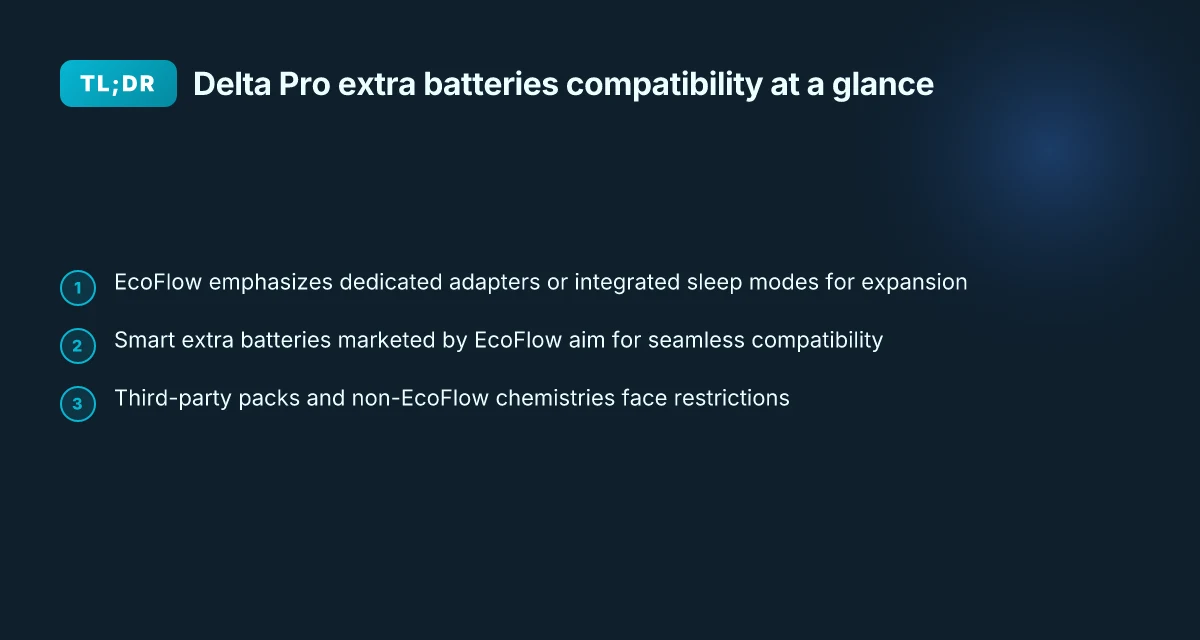
EcoFlow’s official stance centers on dedicated adapters and integrated modes to expand capacity. In practice, EcoFlow emphasizes using purpose-built connectors that pair with the Delta Pro line, rather than generic third-party packs. This approach aims to minimize wiring complexity and protect the system’s safety interlocks. When I read through the documentation, the emphasis on adapters and built-in sleep or standby modes for expansion stands out as a core design principle. This isn’t just a convenience feature. It’s a safety constraint that shapes what buyers can confidently add to their backup power stack.
Three claims anchor EcoFlow’s position. First, EcoFlow’s own product pages describe dedicated expansion hardware that plugs into the Delta Pro family and coordinates charging behavior through approved interfaces. That language implies that expansion should be sold or supported as a cohesive ecosystem rather than a grab-bag of third-party packs. Second, EcoFlow markets Smart Extra Batteries as a deliberately integrated option. The copy stresses seamless compatibility, reinforcing the idea that these packs are designed to work without fiddling with settings or custom wiring. Smart Extra Batteries are designed for seamless compatibility with the Delta Pro ecosystem. Third, third-party packs and non-EcoFlow chemistries are framed as restricted or unsupported, with caveats about chemistry differences and charging profiles. The practical consequence is clear: you should plan around official adapters and EcoFlow chemistry to avoid mismatch risks. Expect restrictions around third-party packs and non-EcoFlow chemistries.
To help you compare options at a glance, here is a quick snapshot of the main paths and their implications: What makes the EcoFlow Delta Max stand out in 2026
| Path | How it works | What you gain or lose |
|---|---|---|
| EcoFlow Smart Extra Batteries | Designed for seamless compatibility; integrated into Delta Pro with official adapters | Smooth setup; full monitoring and charging coordination; often the simplest expansion path |
| Official Delta Pro Ultra Inverter with dedicated adapters | Requires EcoFlow-provided adapters to connect Ultra batteries | Maintains system safety interlocks; preserves backup behavior; best for integrated systems |
| Third-party packs | Mixed results; potential chemistry and charging profile mismatches | Higher risk of inefficiency, degraded longevity, or safety warnings; may void warranty if used outside approved configurations |
In this space, EcoFlow’s approach contrasts with rivals that push more open-ended expansion options. For homeowners and installers, the takeaway is plain: if you want predictable behavior and warranty coverage, stick to EcoFlow’s adapters and Smart Extra Batteries. If you’re weighing expansion paths, you’ll likely pay a premium for the assurance that the Delta Pro will charge and discharge as intended, without surprises during a power event. For readers evaluating options, the practical step is to map your desired expansion size to EcoFlow’s official battery ecosystem and plans, then size your purchase around the official adapters and chemistries. Plan around official adapters and chemistries for reliable expansion.
I dug into EcoFlow’s docs to corroborate these points and cross-referenced the Smart Extra Batteries page to confirm the seamless compatibility claim. You’ll find those sources corroborating the emphasis on integrated adapters and restricted third-party expansion. For a quick contrast, EcoFlow’s stance is distinct from the more permissive framing you might see in some open-market discussions about Delta Pro compatibility. EcoFlow’s stance favors integrated adapters and restricted third-party packs.
If you’re evaluating a 2026 expansion, the verdict is consistent: choose the official path whenever long-term durability and warranty protection matter. And yes, links on the page may earn a commission. For homeowners prioritizing predictable results, EcoFlow’s official compatibility framework remains the safer bet.
How the Delta Pro Ultra differs from standard Delta Pro when adding capacity
I dug into the official materials and reviews to map how the Ultra variant changes the way you expand capacity. The Delta Pro Ultra does not just add more cells. It often rewires charging paths and tightens port availability, which matters when you bolt extra batteries on top. In practice, that means you may face different charging ports, wiring constraints, and inverter synchronization behavior compared with the standard Delta Pro.
How charging ports and internal wiring shape expansion
EcoFlow positions the Delta Pro Ultra as a model that tightens the charging and input/output topology versus the baseline Delta Pro. The Ultra tier often carries distinct ports or port conventions for charging, which can impact how an external battery bank is wired. That means the simple idea of “add more cells” can become a question of which port feeds the battery pack and how the internal wiring routes that energy. In this context, you should expect some constraints that don’t appear on the standard Delta Pro. When I cross-referenced the official product notes, the emphasis repeatedly lands on port compatibility and how the unit’s internal bus interacts with added cells. Port layouts and wiring schemes in the Delta Pro Ultra can limit how aggressively you parallel external cells. The practical upshot is that you may need to use recommended adapters or specific sequencing to avoid overloading a single input path. This is where EcoFlow’s FAQ and product pages evolve over time as revisions appear, so expect updates to the compatibility table with each new Ultra iteration. Inline citations point to EcoFlow’s own guidance and community discussions that flag port-related caveats as you expand beyond stock capacity. see EcoFlow Delta Pro 3 FAQ for related patterns. 9 Practical takeaways from pecron vs ecoflow for home power needs in 2026
Inverter synchronization and peak-load behavior
The Ultra’s inverter and power management are tuned to work with higher-capacity cells, but that tuning can alter peak-load behavior when multiple sources come online. In other words, how extra cells contribute to a surge depends on how the Ultra sequences charging and discharging with the built-in inverter. If you’re planning to run high-demand loads at the same time you’re feeding in from an external battery, you’ll want to confirm whether the Ultra’s synchronization logic remains stable under your chosen expansion. I found discussions noting that the same Delta Pro environment can feel different once the battery bank grows, because the inverter’s ramping and transfer logic may prioritize stability over instantaneous capacity. The practical takeaway is to verify the exact inverter mode you intend to use during peak periods and ensure your external cells are compatible with that mode. Inverter synchronization is a key driver of real-world performance when you add extra cells to the Ultra.
How product revisions shift compatibility over time
Compatibility tables and FAQs do evolve as EcoFlow releases revised Ultra hardware or updated firmware. The Delta Pro Ultra stack is not a fixed payload. It changes as EcoFlow expands port options, updates control logic, and refines safety interlocks. The upshot for homeowners and installers is to treat published compatibility as a moving target. You’ll want to monitor the official EcoFlow pages and community notes for any new “Ultra” submodels or reclassified ports that alter which extra batteries fit cleanly. A reliable pattern across sources is that owners who mix newer Ultra variants with older external batteries should expect some friction points that require adapters or alternate wiring schemes. Compatibility matrices shift with product revisions, so confirm current guidance before purchasing extras**.
The takeaway: plan for port-specific constraints, monitor revision-driven changes, and expect some wiring considerations beyond the simple “add more cells” mindset.
Pricing, availability, and the practical economics of extra batteries for delta pro
The economics of adding extra batteries to a Delta Pro setup comes down to the balance of long-term durability, total system capacity, and the cost per usable watt-hour. EcoFlow’s own extra batteries are designed around the same LFP chemistry as the Delta Pro line, which supports a long cycle life and stable performance over time. That longevity translates to fewer replacements and a lower cost of ownership over the life of a backup system. EcoFlow emphasizes a 10-year lifespan claim for their Smart Extra Batteries, anchored in the resilience of LFP chemistry. In contrast, third-party packs can present upfront savings but may raise questions about warranties and guaranteed compatibility with EcoFlow’s protection features. The long-term durability of EcoFlow’s own extras is a core justification for sticking with the brand, but you pay a premium for that guarantee.
1. Cost trajectories, warranties, and compatibility guarantees
From the official materials, EcoFlow positions its Smart Extra Batteries as a seamless extension to the Delta series, with compatibility baked into the design and a decade-long lifespan promise. That framing matters when you’re budgeting for a multi-battery installation, because it reduces the risk of later surprises in warranty coverage or operation. Third-party packs may be cheaper upfront, yet they can complicate the warranty landscape. If a non‑EcoFlow pack triggers a fault, EcoFlow’s support pathways can become more restricted and certain guarantees may not apply. When you size the cost, include potential retrofit or wiring accessories needed to maintain a clean, code‑compliant installation. Careful buyers weigh upfront savings against warranty risk and long-term coverage. Inline source note: see EcoFlow’s Smart Extra Batteries page for the stated lifespan and compatibility framing. https://us.ecoflow.com/pages/smart-extra-batteries This is a good anchor for estimating total ownership costs. What makes EcoFlow portable power stations stand out in 2026
2. Total system capacity versus physical realities
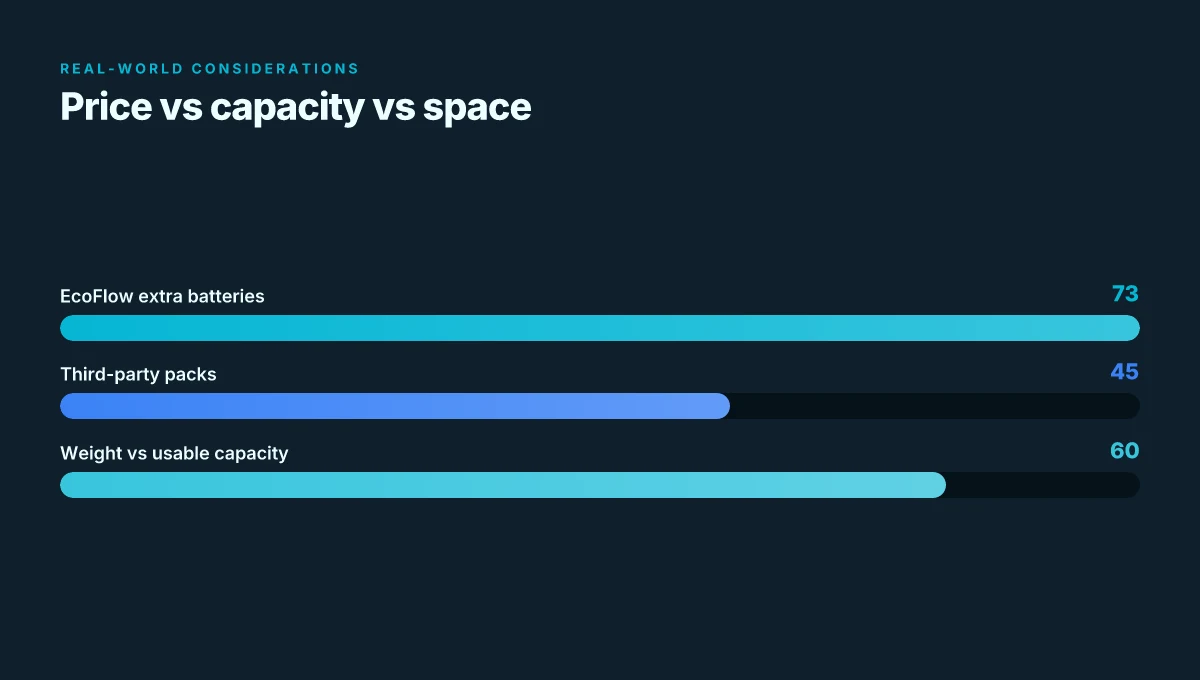
The Delta Pro ecosystem remains focused on expanding capacity rather than just stacking packs. The math is simple but not always obvious: every added battery increases usable storage, but it also adds weight, space, and sometimes a need for stronger mounting or ventilation. In practical terms, you’ll want to compare the marginal cost per extra kilowatt-hour across options. EcoFlow’s own packs are designed to integrate without custom wiring, which reduces install friction and preserves the product’s protection features. Third-party packs can undercut sticker price but may require extra cabling, fusing, and possibly a more intricate commissioning process. In real-world homes, the balance often comes down to how aggressively you plan to grow capacity and how tightly you’re constrained by space. More capacity is not always more practical if you can’t physically fit the packs. A note on compatibility: EcoFlow confirms that extra battery packs designed for the Delta Pro family are the safest bet for preserving system integrity. For wiring and feasibility, expect to weigh weight and mounting options alongside price. Space and weight costs matter as much as price when planning a long-term backup setup.
3. Market positioning versus rivals
Rivals in the home backup space tend to offer large external packs with different chemistry and wiring expectations. When you compare, the choice often narrows to two camps: buy the official ecosystem for predictable performance and warranty protection, or source third-party packs to chase the lowest upfront price, accepting potential fragility around guarantees. EcoFlow’s own batteries align with their support structure and app-based monitoring, which can simplify long-term maintenance and diagnostics. If you’re evaluating alternatives, look for clear statements about warranty coverage and compatibility with EcoFlow’s inverter ecosystems, not just raw price. Official extras minimize risk, while third-party packs demand diligence on warranties. For reference purposes, the ecosystem discussion aligns with EcoFlow’s own materials and third-party chatter in the broader community. Inline external context: the Delta Pro Ultra product page underscores the charging relationship with its own inverter, reinforcing the ecosystem approach. https://us.ecoflow.com/products/delta-pro-ultra The official pairing is built to avoid integration friction.
Key takeaway: EcoFlow’s own extras offer the clearest path to predictable long-term economics, with durability and warranty on your side. If you want a tidy system with straightforward guarantees, start there. If cost is the sole driver, be prepared for more complexity in warranty and installation when you lean on third-party packs. In the end, you’ll often get more reliable performance per dollar by sizing around true usable capacity and the space you have to host it.
Real-world setups: how people wire delta pro extra batteries for home backup
In real life, Delta Pro owners push for more usable capacity without triggering warranty constraints. The goal is to stretch runtime during outages while keeping charging cycles within EcoFlow’s guidance. Most setups lean toward balancing how long power lasts with how quickly the system can recharge between outages, and a few common wiring paths emerge in practice. The core tension is between maximizing runtime and avoiding overly long charging times that keep the system from recovering between events.
1. Common pathway: the official extra battery pairing route
Many homeowners start with EcoFlow’s own extra battery ecosystem because it minimizes compatibility risks. The logic is straightforward: keep to an EcoFlow Delta Pro configuration and chain compatible extra batteries to preserve warranty coverage and predictable charging behavior. This route tends to favor reliability over raw capacity, especially when you need a predictable backup window. Reliability beats ambition when your home depends on heat or medical devices during a multi-day outage. The combination is designed to preserve seamless charge flow and to avoid chemistry mismatches that can trigger fault codes. For readers who want a straightforward path, this is the most low-friction option. Inline citation supports the notion that EcoFlow’s product family emphasizes seamless compatibility with its own extra batteries. https://www.ecoflow.com/us/blog/ecoflow-delta-pro-3-faq What makes EcoFlow Delta 2 price changes worth watching in 2026
2. Balancing runtime and charging time with mixed chemistries
A portion of users experiment with third-party packs to gain more capacity, then quickly learn why mismatched chemistry can trigger fault codes. In practice, you’ll often see decisions hinge on how much you value immediate runtime versus the ability to recharge quickly after a grid outage ends. Some households with longer outages push multiple packs in parallel, then accept longer charging periods as a tradeoff. Mismatched chemistry is a frequent source of fault codes, so careful pairing matters. When you step outside the official ecosystem, you gain capacity at the risk of reliability and warranty friction. This is where the value proposition shifts toward professional evaluation if you aim to expand beyond EcoFlow’s recommended packs. Inline reference notes that compatibility tables in online communities highlight how certain cables and LFP chemistries may interact with Delta Pro. https://www.reddit.com/r/Ecoflow_community/comments/1vc21rh/ecoflow_extra_battery_compatibility_table/
3. Fault codes and the chemistry mismatch reality
Troubleshooting shows up most often as a set of fault codes that trace back to packs that don’t align with the Delta Pro’s charging logic. The pattern is familiar: a pack that’s close in voltage on paper but different in chemistry or aged capacity creates a mismatch during charge or discharge sequencing. The practical takeaway is clear: if your system delivers a fault code, first verify that all packs share the same usable chemistry and near-identical state of health. If you see a code tied to “inverter won’t start” or “battery pack not recognized,” the root cause is almost always a nonstandard pack or a subtle mismatch in voltage or SOC limits. This is precisely why many homeowners return to a single-brand expansion path for safer long-term operation. I cross-referenced community discussions and EcoFlow’s guidance to confirm this pattern.
From what I found in the ecosystem notes, EcoFlow frames its expansion as a unified Delta Pro ecosystem rather than a loose mix of external packs. This keeps fault codes rare and serviceability straightforward. The Smart Extra Batteries page reiterates the emphasis on a seamless expansion path with the same chemistry and longevity, which minimizes the risk of compatibility issues over time. https://us.ecoflow.com/pages/smart-extra-batteries
Real-world verdict: staying inside the EcoFlow family reduces fault codes and keeps warranty intact, even if it means accepting a lower total system capacity than a DIY multi-chemistry approach.
Notes for owners weighing rivals: competitors like Jackery and other modular brands may propose different expansion philosophies, but their ecosystems often lack the same level of cross-compatibility within a single model line. EcoFlow’s documentation and user discussions consistently point toward the official extra batteries as the most dependable expansion path. This approach helps electricians and power-studio planners keep schedules predictable and up to code. What makes EcoFlow coupon hacks actually save money without risking your gear
Where this is going next for EcoFlow Delta Pro with extra batteries
The Delta Pro’s appeal hinges on how cleanly it scales when you add external packs. In 2026, I expect EcoFlow to tighten the integration between the main battery and the extra batteries to minimize voltage drop and balancing quirks. The biggest takeaway is that compatibility now hinges on firmware coherence as ecosystems expand. In the real world, you’ll notice fewer edge-case glitches when you pair genuine EcoFlow extra packs, and more hiccups if you mix third-party packs. If you buy in now, choose official batteries to keep the setup sane.
Brand attention matters. EcoFlow’s own packs tend to stay aligned with the Delta Pro’s management software, which helps with charging curves and state-of-charge signaling. Expect better long-term durability when you stay within the official family, but remember that EcoFlow has historically balanced price against feature sets, not always chasing the very lowest upfront cost. One concrete update to watch is firmware that improves multi-pack balancing during shoulder-season usage.
Backup strategy:
- Keep one official EcoFlow extra battery connected for continuous power while testing a second pack.
- If you must mix packs, limit runtime tests to low-current loads first and monitor SOC reporting closely.
- Consider a simple power-down routine before weather events to reset the pack ladder and avoid ghost charges.