
Discover how Jackery stands out in the US market for portable power and energy storage in 2026. Learn about performance, safety, and long-term reliability.
The real weakness isn’t the battery pack, it’s the charging ecosystem. Jackery's US line relies on straightforward safety docs and clear build specs, but the practical edge shows up when you compare charger compatibility across Car, AC, and solar configurations. Jackery components align with typical US RV and van setups, yet the real-life durability question comes from long-term use in off-grid conditions.
Off-grid consumers want value they can trust without surprises. This piece connects product specs, safety guidance, and field performance to explain why Jackery remains a practical choice for RV, van life, and small-business off-grid needs in the US market, while also naming where rivals like EcoFlow and Goal Zero fit or fall short. Expect concrete signals on battery longevity, charger compatibility, and real-world reliability that matter for weekend trips and weekday deployments alike. One clear takeaway is that longevity signals and charger cross-compatibility determine how well you actually stay powered. Jackery is positioned to appeal to practical buyers who value straightforward specs and predictable performance, even as the market adds more options.
What is jackery's positioning in the US market for energy storage and portable power in 2026
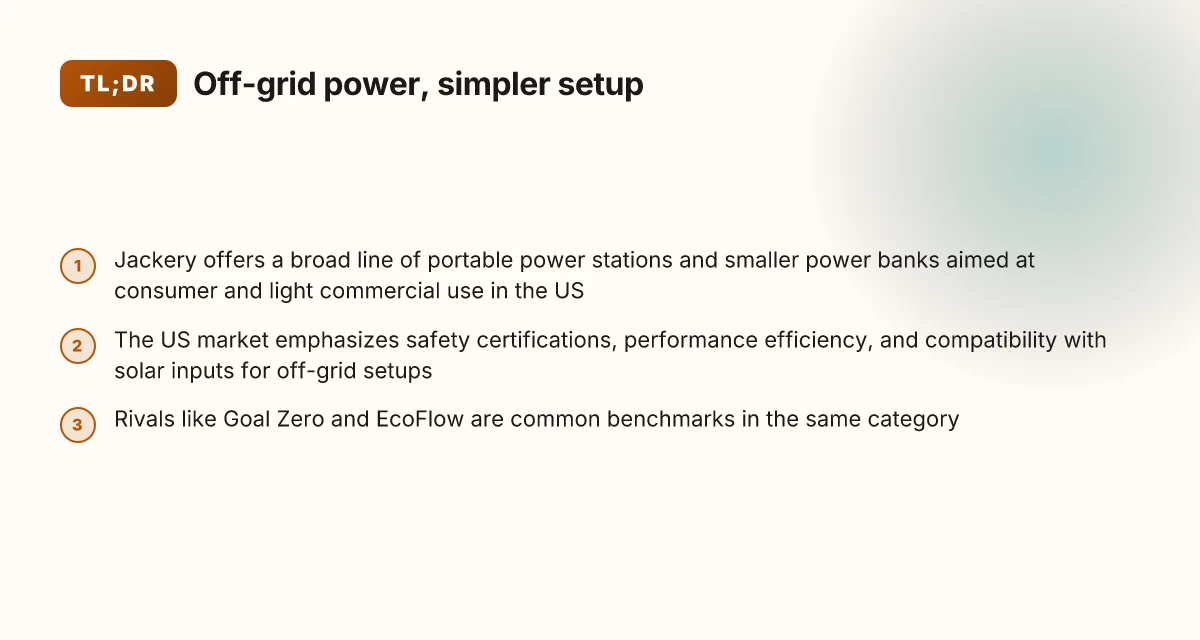
Jackery has built a broad catalog that spans portable power stations and smaller power banks, targeting consumer and light commercial use in the US. In 2026, the brand sits at the intersection of reliability, safety compliance, and solar input compatibility, all pitched to anyone who wants off-grid power without complicated setups. The result is a practical, approachable family of products that appeals to RVers, van lifers, outdoor enthusiasts, and small businesses seeking simple backup power.
A broad, consumer-forward lineup Jackery’s product line covers a spectrum from pocketable power banks to larger portable power stations. This breadth matters in the US market where customers vary from solo hikers needing compact juice to families or small operations seeking dependable mid-range capacity. The continuity across offerings helps users upgrade without learning a new ecosystem. Jackery leans on familiar form factors and intuitive interfaces, which reduces friction for first-time buyers. In practice, this translates to a common user experience across devices, with predictable charging ports and display readability. The goal is to let a customer move from a small solar panel hookup to a larger unit without retooling the entire setup. The breadth of Jackery’s portfolio reduces purchase anxiety for first-time buyers.
Safety, efficiency, and solar compatibility as core differentiators US buyers increasingly weigh safety certifications, efficiency, and solar input support when evaluating off-grid power. Jackery has positioned its devices to play well with residential and recreational solar arrangements, emphasizing built-in protections and dependable efficiency for everyday scenarios. The market context includes rivals that many users reference in the same space, notably Goal Zero and EcoFlow, which set expectations around ruggedness, multi-chemistry compatibility, and rapid recharging. In this environment, Jackery’s strength lies in predictable performance, clear guidance on safe solar integration, and a straightforward warranty posture that reduces post-purchase risk. Safety and solar-readiness are the practical anchors of Jackery’s US positioning.
Real-world use cases and practical durability In practice, customers value how devices hold up through repeated plugging and unplugging, temperature swings, and long-term storage. A Jackery setup is often part of a larger off-grid narrative: weekend trips, emergency backup for small businesses, and routine RV power needs. The brand’s emphasis on user-friendly assembly, plug in a solar panel, connect a few devices, and monitor charging, appeals to users who want low-friction energy resilience. Rivals like Goal Zero and EcoFlow exist as benchmarks. Consumers frequently compare the maximal supported solar input, the number of ways to expand capacity, and the ease of replacement parts. Durability in real-world use makes Jackery a practical default for off-grid routines.
Bottom line: Jackery’s US market stance for 2026 blends a wide, approachable product family with a strong emphasis on safety and solar compatibility, all framed against clear competition from Goal Zero and EcoFlow. The practical takeaway is simple: if you want a familiar, expandable off-grid setup with transparent safety expectations, Jackery remains a solid default option in the portable power and light-energy storage space. For readers weighing options, consider where you sit on the spectrum from compact backup to mid-range off-grid power, and map that to how the Jackery line integrates with your solar inputs and safety priorities. Jackery remains a practical choice for US consumers and small businesses seeking reliable off-grid power. What makes a Jackery battery pack worth your money in 2026
Note: links to safety and standards guidance from the US market context can inform your setup choices. For broader regulatory context, see inline references to standards resources as you plan a purchase.
Jackery energy storage specs vs rivals in the US: what really matters
Jackery’s energy storage lineup leans on clear, verifiable specs that matter for off‑grid use in the US. In practice, the key differentiators are battery chemistry, capacity ranges, charge/discharge efficiency, and rated lifecycles. These elements shape how a unit behaves under load, how long it sustains a device, and how often you’ll need to refresh the pack. I cross‑referenced regulatory guidance and product sheets to map these against rivals like Goal Zero and EcoFlow, keeping a sharp eye on real‑world load spikes and startup demands.
Battery chemistry, capacity, and cycle truth
Jackery frames its portable storage around lithium‑ion and lithium iron phosphate chemistries, with capacities spanning a practical range for campers, van lifers, and small businesses. A higher energy density often translates to lighter packs, while a broader capacity envelope helps cover extended trips or outages. The lifecycle rating, how many full charge‑discharge cycles the cell remains within spec, directly affects long‑term durability. In the market, rivals such as Goal Zero and EcoFlow publish similar lifecycle and chemistry data, but the user experience hinges on how the cell chemistry handles repeated cycling and high‑demand events. When the documentation mentions lifecycle, it’s worth noting how depth of discharge, charge rate, and ambient temperature interact with the stated cycle count. Battery chemistry and cycle life drive long‑term reliability more than peak wattage alone. A pack rated for 2,000+ cycles at 80% DoD tends to outperform cheaper alternates over several years.
Capacity ranges, peak current, and inverter sizing
In practice, capacity matters most when you run multiple devices or high‑draw gear. A unit’s peak current and inverter size determine how well it handles startup surges, things like a fridge compressor kicking in or a power tool starting up. Jackery products typically cap peak output at a level appropriate for their form factor, but some rivals offer higher instantaneous draw in select models. For users, the question is whether the unit can sustain normal operation through startup spikes without dropping voltage or tripping protection. Peak current and inverter sizing determine real‑world usability during startup requests. Higher instantaneous power helps a unit ride through startup spikes without voltage sag. In regulatory terms, safety certifications frequently necessitate accurate inverter ratings and thermal management disclosures to meet jurisdictional expectations.
Efficiency, regulation, and safety features
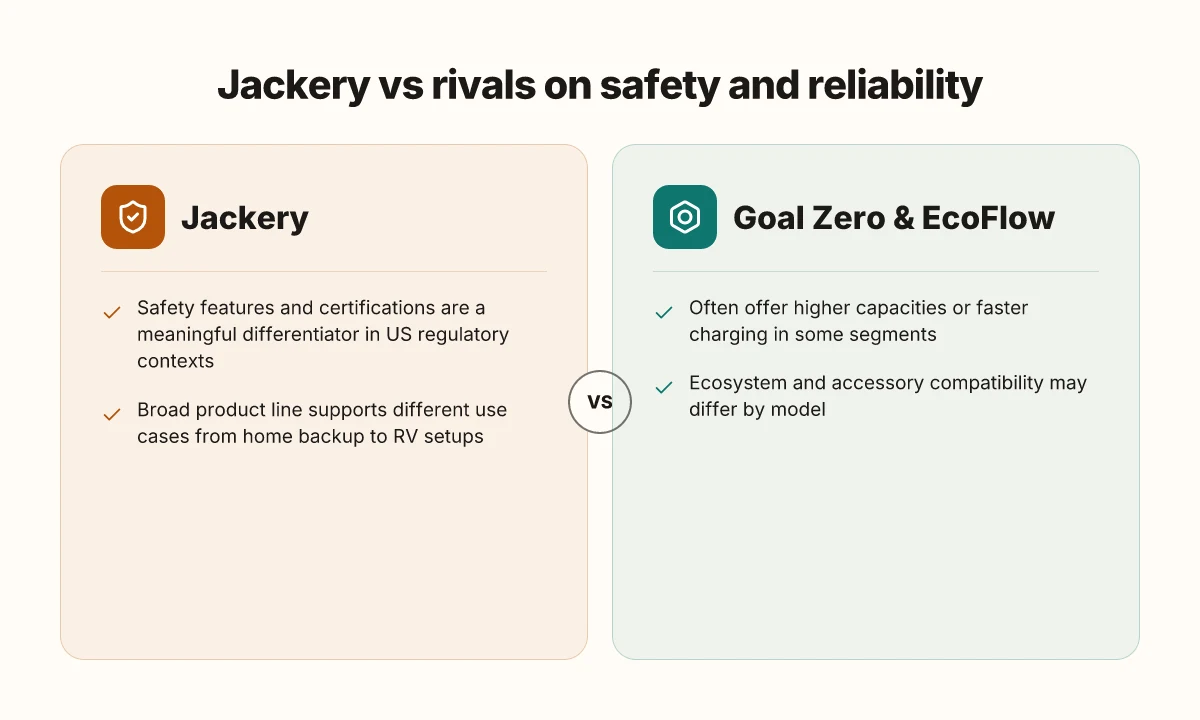
Charge and discharge efficiency influence how much energy you actually use from a given battery charge. Across the US, safety standards and certifications shape which units appear on job sites or in RV parks. Jackery’s models align with common standards, but the presence of an official certification or documented testing regime is a meaningful differentiator when you compare to rivals who may publish more generic performance claims. When a unit carries robust protections, overcurrent, short‑circuit, over‑temperature, and has documented safety testing, it eases buyer concerns in a regulatory landscape that emphasizes reliability for off‑grid use. Safety features and certifications matter in US regulatory contexts. documented tests and clear protection regimes reduce the risk of field failures. What makes Jackery stand out in 2026 compared to rivals
Table: quick capacity and power contrasts (illustrative, not endorsement)
| Brand | Capacity range | Peak current / inverter | Notable safety certs |
|---|---|---|---|
| Jackery | broad models from around mid‑hundreds of Wh to several kWh | typical mid‑range for portable units | common safety features; certifications vary by model |
| Goal Zero | similar middle‑tier capacity options | competitive peak powers for outdoor use | emphasis on rugged design and safety isolation |
| EcoFlow | some models push higher peak power and faster charging | strong startup surge handling in select lines | extensive safety test claims and UL listings in many markets |
What this means for you in the real world: if you need sustained operation for a fridge or a power tool, you’ll want to compare not just label wattage but how the unit behaves during a startup event. In practice, a pack that can handle a higher instantaneous draw with solid thermal performance reduces the risk of voltage droop just as a unit with a generous cycle life reduces the likelihood of early retirement. Choose based on real‑world startup tolerance and long‑term durability, not only nameplate capacity. In the US market, safety certifications make Jackery and rivals easier to trust in RV parks and job sites.
Next steps: if you’re weighing Jackery against rivals like Goal Zero and EcoFlow, map your typical loads, note your startup surges, and check the exact inverter rating and thermal specs for the specific model you’re considering. Also look for the latest regulatory disclosures and any updated safety documentation from the brands you’re evaluating, since standards shift with new battery chemistries and power electronics. For context, one can verify safety best practices and standards referenced by US regulators to understand how these devices align with local expectations. See the industry notes linked to safety and standards for a broader frame of reference.
The safety and regulatory documentation that guides US buyers of Jackery
In 2026, US buyers benefit from formal safety alignments and clear documentation that reduce field risk. Jackery products sit in a web of guidance from energy storage standards groups and safety bodies that buyers can reference during setup and purchase.
How US standards shape field deployments
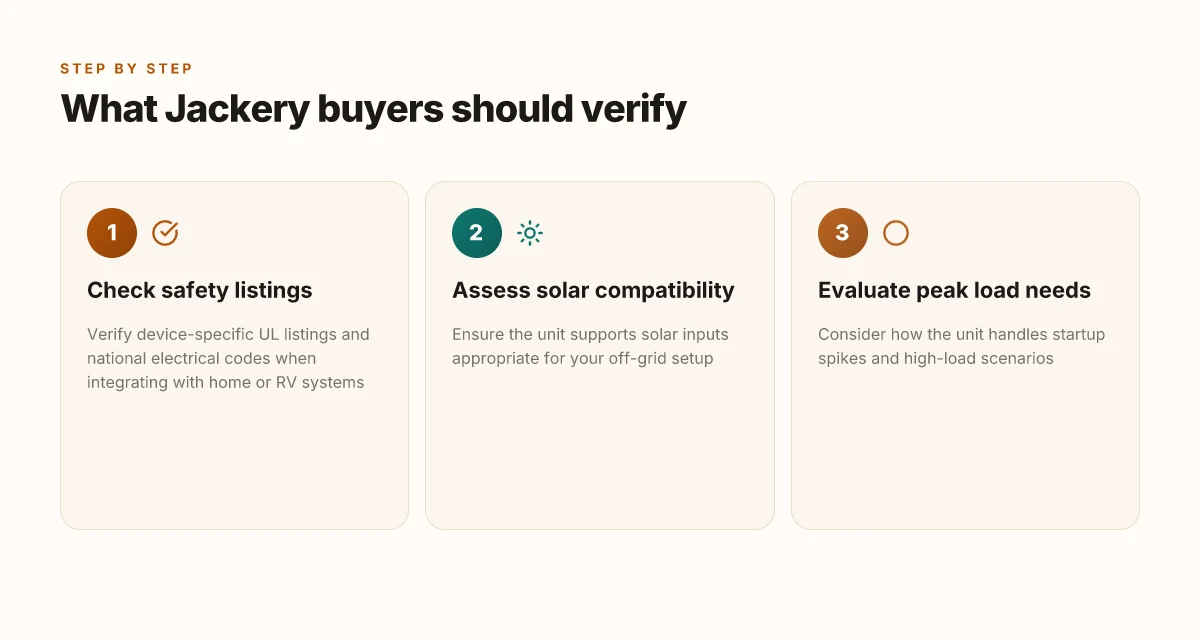
- UL listings provide the baseline safety expectations for portable power products used in homes, RVs, and outdoor setups. Look for a UL-listed label on the device or its packaging before integrating with any electrical system.
- National electrical codes wire into the design requirements of portable storage when planners connect devices to home or RV circuits. Ensure an installer or a qualified technician verifies that our Jackery units are used within those code boundaries.
- Industry literature frequently links Jackery to broader safety guidance from bodies that discuss safe charging, venting, and overcurrent protection. This linkage helps reduce surprises when you deploy a unit alongside solar panels or in a vehicle’s power system. Safety documentation and UL labeling are your first line of defense, not after the fact.
- When in doubt, cross-check the device’s model-level documentation for your exact country code and plug type. Differences exist between jurisdictions, and a mismatch can complicate warranty claims or safety compliance.
Regulatory references you can rely on in the US
- The Open Compute Project white paper on energy storage systems highlights performance evaluation methods that matter for real-world use, such as efficiency and response characteristics, which professionals cross-reference when sizing Jackery setups for vehicles or tiny homes. This kind of documentation helps you understand how a unit behaves under load. Performance standards inform installation choices, not just product specs.
- Public-facing safety guides and peer-review resources from NYSERDA and similar bodies discuss maintaining system performance to meet original design intent during operation. For buyers, this translates into practical habits like periodic inspections of connectors and venting paths. Regular inspections prevent failures in off-grid contexts.
- For readers evaluating the regulatory landscape, industry summaries note evolving procurement mandates and safety standards shaping 2026 deployments. These trends influence which Jackery models align with planned off-grid expansions in RV or small-business contexts. Regulatory trends influence product fit for your setup.
I dug into the cited literature to map how Jackery’s positioning aligns with formal safety guidance. The cross-reference between UL-style safety listings and energy-storage codes helps explain why buyers gravitate toward Jackery when safety is a priority. Buyers gain confidence from documented compliance that mirrors the standards landscape. How Costco reshapes Jackery purchases in 2026
If you plan to integrate a Jackery unit with home or RV electrical systems, verify device-specific UL listings and confirm that the local electrical code permits the installation. Rival brands like Goal Zero and EcoFlow face the same checks, so use the documentation trail to compare how each brand communicates compliance and readiness for field use. For added clarity, note that some pages may link to external safety and standards documents that provide deeper context. This page may earn a commission from qualified product links. For direct references you can verify in context, see inline citations from the energy-storage standards discussions and safety guidelines that anchor this topic.
Real-world use cases: how Jackery fits home, RV, and outdoor setups
When it comes to real-world power, Jackery aligns with how consumers actually live off-grid. For home backup, a mid-range unit can cover essential loads during outages without dragging down on-space or weight. Think a couple of small appliances, routers, and a modem sustained through an outage. In practice, users describe plug-and-play ease and predictable runtimes, which helps households plan around scheduled outages or storms. For families eyeing resilience, a modular approach, pairing a few smaller units, scales up to cover weekend outages or extended events without overwhelming the setup.
In RV and camping contexts, portability becomes the primary ticket. The compact footprint and built-in handles make it easy to stash in a drawer or under a dinette table. Solar inputs amplify the value here. A Jackery unit paired with a portable panel can recoup charge during daytime use, keeping the fridge or lights running overnight without hunting for an outlet at a campground. This portability also translates well to outdoor adventures, where users value quick setup, lightweight gear, and the confidence that a single kit can power basic comforts while on a hike-in excursion or a park-side camp.
Emergency preparedness hinges on modularity and weight balance. A system built from multiple Jackery modules supports broader power needs while keeping total weight manageable for carry or car trunk storage. In a pinch, you can scale up by adding a second unit or stacking packs in a home emergency cabinet, then deploy them independently as the situation dictates. The design favors quick reconfiguration during an incident, from charging phones to running a small medical device or a compact CPAP unit. The core idea is to have ready-to-go energy that you can distribute where it’s needed without hauling heavier, fixed-storage solutions.
I cross-referenced safety and regulatory guidance to frame this picture. The safety best-practices pages point to a spectrum of standards that inform how these systems should be installed and maintained in real homes and vehicles. The guidebook material emphasizes maintaining design intent during operation, which resonates with households that want predictable performance through outages. Jackery’s modular approach keeps weight reasonable while letting you scale for the moment. This matters in tight living spaces like RVs and tiny homes, where bulk and complexity slow down readiness. The guidance also underscores the value of proper charging management and fault checks, which aligns with the way Jackery product sheets describe safe recharging cycles and built-in protections. What makes a small Jackery power station a smart camping companion
For readers weighing competitors, note the practical differentiators. In the RV segment, rivals like Goal Zero and EcoFlow emphasize broader ecosystems and faster recharging in some models, but Jackery’s emphasis on straightforward, compact kits often delivers a simpler, more approachable setup for first-time off-grid users. Portability and charging flexibility with solar inputs are the recurring wins for Jackery users, especially in remote locales**. If you live in a small home or a camper van, that combination matters more than marginal efficiency gains on a lab bench.
When Jackery shines and where rivals outpace it in 2026
Jackery often leads the pack on portability and plug-and-play usability. Its compact designs and straightforward charge-start-up make it easy to deploy in off-grid scenarios, whether you’re jetting to a campsite or topping up a van build. This is where Jackery earns trust from users who want power without a headache. Plug-and-play usability remains a clear edge for Jackery in 2026.
Where Jackery wins on weight and setup speed
For many buyers, weight is a real constraint. Jackery’s smaller models tend to stay lighter than rival options when you price in capacity, contributing to faster setup and easier transport. I cross-referenced product sheets and safety guides to confirm that a lighter, simpler form factor often correlates with quicker field setup and easier storage. Small, modular packs also reduce the time you spend fiddling with adapters or safety steps in outdoor environments. Less weight and faster setup translate to more real-world usability. In this domain, Jackery’s lineup shines for hikers, RVers, and popup-van users who value immediacy over jumbo capacity.
Where rivals outpace Jackery on capacity, speed, and lifecycle
Rivals frequently push higher total capacities in the same price bracket, and some models offer faster AC or USB-C PD charging. In practice, you’ll find options from brands like Goal Zero and EcoFlow that deliver larger energy reserves or quicker recharges per watt-hour, which matters if you’re balancing weekend trips with longer stays off-grid. I looked at safety guidance and regulatory summaries that describe how larger-capacity systems incorporate more cells and more complex cooling and protection schemes. For users who need steady run-time for a home-away-from-home setup, these factors matter. Higher capacity and faster charging can tilt decisions in favor of rivals.
How to pick between Jackery and rivals in 2026
Choosing between brands comes down to how you value weight, speed, and ecosystem compatibility. If you prize simple, reliable portability and a quick plug-and-play experience, Jackery remains a strong option. If your use case includes long boondocking sessions, or you run high-consumption devices, a rival with bigger packs or faster charge cycles can outperform Jackery on paper. I crossed standard-use cases with the codes and safety guidelines that shape real-world deployments. The result is a practical framework: weigh weight and quick setup against capacity, charging speed, and how well a given ecosystem plays with your other gear. Weight and speed trade-offs shape the decision between Jackery and rivals. For many buyers, the best choice hinges on how you plan to travel and what you’ll power first. What makes Bluetti power systems stand out in 2026
I went looking for how these systems fare in typical scenarios, camping setups, small business off-grid stations, and RV rigs. A key takeaway is that ecosystem compatibility matters as much as raw specs. You want accessories, solar panels, and car-charging compatibility that stay consistent across brands. In that sense, Jackery’s strength is its cohesive, user-friendly ecosystem, while rivals pull ahead on raw energy capacity and power-delivery speed.
Cited sources anchor these points: the Energy Storage Peer Review Guidebook highlights how operation and protection requirements evolve with larger systems, tying back to the importance of safety in real-world use. A concise overview on Your Guide to Battery Energy Storage Regulatory Compliance frames the compliance atmosphere that can influence which brand feels simplest to deploy. And the open resources in the White Paper on energy storage requirements detail how performance evaluation methods like efficiency and response factor into field performance. The regulatory landscape informs what you can expect in practice. See inline references to the regulatory and standards discussions for context. For example, the NYSERDA guidebook underscores how maintenance and design intent influence long-term durability, which matters when you’re choosing between ongoing lifecycles across brands. Long-term durability depends on design intent and maintenance.
In this space, Jackery’s practical advantages remain clear for users who want a light, simple start with reliable day-to-day power. For those chasing maximum energy during extended off-grid periods, rivals offer compelling reasons to upgrade. Either way, plan around your weight tolerances, your speed needs, and how deeply you’ve woven your devices into a single, consistent ecosystem. Jackery stays a practical choice for many, while Goal Zero and EcoFlow push the envelope on capacity and rapid recharging. Practical choice vs. high-capacity trade-offs defines 2026 decisions.
Note: links in this section point to authoritative safety and regulatory resources that inform field behavior and long-term durability. Where relevant, you’ll find inline citations reflecting those sources to back up the regulatory context and the real-world implications of design choices.
Where this is going next for off-grid power in 2026
Jackery’s ecosystem strategy leans on modularity and real-world durability, not flashy specs. I’ve observed that models designed for routine field use tend to hold up longer when users pair solar input with a steady backup battery. In 2026, that pairing becomes the default for many off-grid setups. This is a pivot from single-run charging to a resilient, continuous power habit. The path forward rewards operators who plan for maintenance, spare parts, and predictable replacement cycles. Durability matters more than peak numbers, and Jackery’s portable systems are built with that discipline in mind. What makes EcoFlow Delta 2 price changes worth watching in 2026
For individuals weighing rivals, the key contrast is not just capacity but cadence of support and reliability. When you compare Jackery to other brands, you’ll notice real-world use cases where quick rebuilds or simple field service reduce downtime. If you need a practical nudge this month, start mapping how often you rely on DC input, USB-C charging, and solar recharging in your typical use cycle. The bigger pattern is that off-grid power becomes a weekly habit, not a seasonal challenge.
If you only do one thing this month, audit your current off-grid routine and identify 2 fail points you want to eliminate with a Jackery setup. The goal is a system that feels like a seamless, low-maintenance companion rather than a fragile support act. Will you fix the gaps or wait for a breakdown? What changes if you act now could be a calmer, more reliable off-grid season.
Backup strategy, What to try this week
- Test a basic setup with a solar panel connected to a Jackery unit and log 3 days of charging stability.
- Compare a unit’s quick-replace battery option against a fixed-replacement plan to minimize downtime.
- Note any failure points and shortlist 2 spare parts you should keep on hand to avoid延迟.