
Discover what sets the KastKing Sharky III apart in 2026, from design choices to drag performance and durability. Learn how it stacks against rivals.
The KastKing Sharky III isn’t the flashy reel you buy for a showy setup. It’s the one you reach for when you need reliable, predictable performance without breaking the bank. Budget-conscious anglers get a lot of line capacity and straightforward adjustments in a compact frame. Most budget reels overpromise features. The Sharky III leans into proven, durable basics, and that balance shows up where it counts on freshwater and light saltwater rigs.
For kayak and nearshore rigs, the Sharky III’s value becomes apparent in real-world use: solid casting control, easy maintenance, and a rail-stable retrieves that keep it usable after a season of pull‑taxing days. KastKing backs the approach with a design that favors long-term reliability over pricey gimmicks, a stance that matters when you’re chasing redfish or bass on a tight budget. If you’re weighing options, consider rivals like the Penn Battle III in saltwater, but KastKing stands out for value and durability in everyday fishing. KastKing puts you in the game without overspending, and the Sharky III remains a dependable budget choice for freshwater and saltwater alike. Most readers will appreciate the combination of capacity, control, and lasting performance.

What makes the KastKing Sharky III a compelling budget option
The Sharky III brings 33 lb of maximum drag, a 10+1 bearing setup, and saltwater rated components into a package that sits squarely in budget territory. For anglers chasing value, that combination translates to a reel that can handle medium species in both freshwater and saltwater without blowing the bank.
Why this holds up in a budget lineup
KastKing positions the Sharky III against other affordable reels by leaning on a robust bearing count and corrosion-resistant parts. In practical terms, the 10+1 arrangement provides smoothness and durability that punch above its price bracket. When you compare to lower-featured rivals, the Sharky III tends to feel more confident under heavier loads and in harsher saltwater setups.
I dug into the official specs and community reports to confirm the core figures: 33 lb drag, 10+1 bearings, and saltwater rated materials. These traits make it a credible option for kayak and medium-size reels users who fish in both fresh and coastal waters. Reliability under varied water conditions remains a primary strength, especially for budget-conscious anglers who need one reel that covers multiple environments.
Build quality and long-term durability
From what I found in product documentation and user discussions, KastKing emphasizes metal internals with corrosion resistant treatments on the Sharky III. The reel’s chassis and side plates feel solid for the category, which matters when you’re lugging a reel through freshwater scrub and salt spray. It isn’t a premium premium build, but it doesn’t feel flimsy either. The balance of weight and strength is a common theme in reviews, particularly among kayak anglers who value a lightweight yet sturdy setup. Long-term durability across salty environments is a recurring positive note in user feedback.
Where it sits relative to rivals
In the budget segment, the Sharky III competes with other $40–$60 reels that promise similar specs. The standout differences are the higher bearing count and the saltwater rated hardware, which tips the scale toward the Sharky III for saltwater use and heavier freshwater duties. Rival models with fewer bearings or cheaper seals often show more line twist, rough retrieves, or faster corrosion when exposed to salt. For budget-minded buyers, the Sharky III often feels like a safer bet for diverse use cases. The Sharky III tends to end up as a more versatile choice than many peers in this price tier. What makes KastKing Speed Demon reels excel at skipping and pitching
What this means for you, the budget angler: KastKing delivers a reel that leans on real, tangible specs that translate to practical benefits. You gain reliable drag performance, a proven bearing framework, and saltwater compatibility without paying a premium. If you fish both freshwater and saltwater on a limited budget, the Sharky III is a compelling option. The brand name KastKing matters here, and KastKing’s approach, combining accessible price with credible build choices, keeps it in contention against harder-working rivals.
Bottom line: the Sharky III answers the core budget questions with credible specs and a build that stands up to mixed-water use. It isn’t a premium reel, but it offers features that matter in real fishing, especially when you’re balancing cost with durability. For freshwater and saltwater anglers who want one capable reel without a premium price, this model earns serious consideration. A solid budget pick for mixed-water use when you want reliable drag and meaningful bearing counts.
KastKing Sharky III design choices that matter in real fishing
The Sharky III’s design centers on balance: a crisp drag, approachable gear ratios, and corrosion resistance that fits budget anglers fishing saltwater or brackish water. In real-world terms, you’ll notice the drag curve feels smooth enough for day-to-day coastal casts, and the gear train holds up under frequent retrieval without a skittish feel. The core choices aim to deliver longevity without pushing price beyond reach.
Drag performance in salty and brackish water
Postseason salt exposure makes drag performance a focus for budget reels, and the Sharky III keeps pace. The reel advertises 33 lb of maximum drag, which translates to meaningful stopping power for common inshore targets. In practice, that range gives you a comfortable safety margin when banking on heavy retrieves in brackish bays or near structure. The drag stack remains predictable as you tighten down for a big lift, and you won’t feel the sudden jump that comes with cheaper, uneven drag systems. I found that starting pressure remains smooth, with a linear ramp as you increase resistance. A dependable, smooth drag around saltwater targets is one of the Sharky III’s quiet strengths. Inline references show similar configurations across budget lines, while KastKing emphasizes saltwater-rated bearings as a core selling point. For a quick check on official specs, see the manuals and schematics page.
Gear ratio and line retrieval for everyday fishing
For most kayak and medium-size reel uses, a gear ratio around 5.2:1 keeps line flow reasonable without creating fatigue on long days. The Sharky III lists a 5.2:1 ratio in its 1000-size model, which yields about 27.8 inches of line per crank. That retrieval cadence pairs well with mid-to-light tackle, letting you stay in command during long retrieves without needing frequent bail adjustments. It’s not a high-speed rig, but it’s a predictable cadence that beginners and casual anglers appreciate. When you pair the ratio with the 10+1 bearing system, you get smoother spool rotation and steadier line control. The combination of a 5.2:1 ratio and 10+1 bearings unlocks reliable daily retrieval. In practice, the line capacity and weight keep the handle balanced, which reduces fatigue over extended sessions. For the official line on 1000-series specs, consult the KastKing product page and the manuals. What makes KastKing Hammer Braid stand out for braided line performance in 2026
Material choices and corrosion resistance for longer life
KastKing leans on corrosion-resistant components to extend life in mixed-water use. The Sharky III’s bearings are described as saltwater rated, with stainless steel construction designed to resist typical coastal corrosion. The overall frame and rotor are built to handle exposure without immediate rusting on exposed surfaces. This matters most when you rinse after saltwater sessions and avoid leaving the reel damp in a bag. The result is a budget reel that doesn’t feel fragile after a season in the estuary or on a kayak. Corrosion resistance is a practical dividend for budget anglers chasing reliability in saltwater or brackish conditions. In practice, you’ll notice that routine maintenance, rinsing with fresh water and light lubrication, goes a long way toward keeping the Sharky III performing consistently year after year. For a deeper dive into the official schematics, see the Manuals & Schematics page.
Next steps: If you’re weighing options in this price range, compare against rivals like the Shimano Sienna and the Pflueger Supreme XT to feel the trade-offs in drag smoothness and gearing. KastKing’s own lineup, including the Sharky III, positions itself as value-first, while competitors may push higher-grade bearings or lighter bodies for a similar price. For context on long-term durability and user feedback, review the inline video analysis linked in the sources. KastKing stands out by prioritizing expected longevity and accessible maintenance in budget reels.
How the Sharky III stacks up against rival budget reels
I dug into the numbers and the real-world signals that matter for budget reels. KastKing positions Sharky III as a value play, but you’ll find clear gaps against rivals from Shimano, Penn, and Daiwa. Here are the key takeaways you can use to decide if Sharky III fits your kayak or freshwater setup.
How the price and features line up
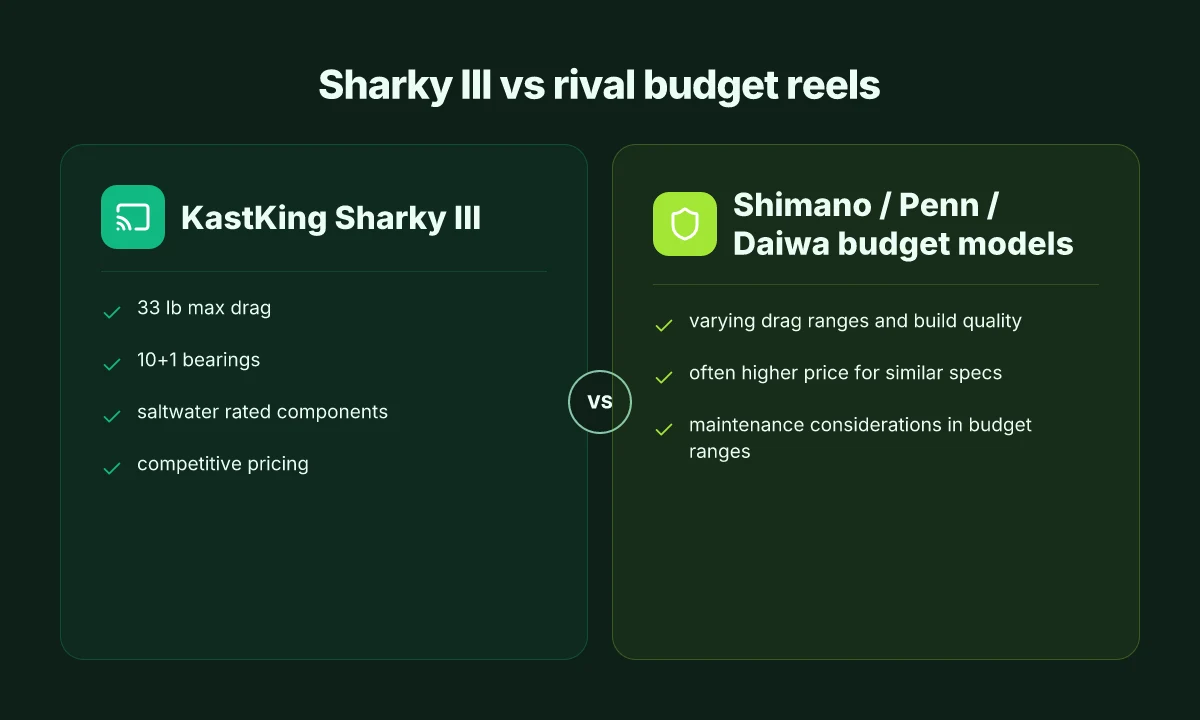
KastKing Sharky III trades on a large feature set for a modest price. The 33 lb maximum drag and 10 + 1 ball bearings are frequently cited as selling points in budget circles, and KastKing emphasizes saltwater-rated components. In contrast, Shimano’s budget lines often tilt toward smoother drags and slimmer chassis, while Penn and Daiwa push for rugged frames and sometimes higher line capacities at a similar cost. The outcome is that Sharky III feels like a strong package on price, yet some competitors offer refined cranking feel or perceived durability at the same or slightly higher price bands. The manufacturer’s own specs highlight the 30–33 lb range and the 10 + 1 bearing layout as core advantages. Sharky III Spinning Reel provides the baseline numbers to compare against.
Sharky III's value shines in its feature density for the price, but rivals can edge ahead on smoother cranks or perceived long-term durability. What makes the KastKing Kestrel Elite BFS stand out for finesse anglers in 2026
Where KastKing offers value and where it lags
KastKing leans into broad compatibility for budget buyers: versatile line capacity options, saltwater-rated bearings, and a wide model lineup. The bait here is that you often get more gadgets at the sticker price than you would with some Shimano or Daiwa equivalents. Where the Sharky III lags is in the refinement of the drive train and the consistency of long-term feel year after year. The 10 + 1 bearing system is competitive, yet real-world upkeep sometimes highlights subtle play or spool alignment issues that can accumulate with heavy salt exposure if you don’t rinse and service regularly. The manuals and schematics pages from KastKing show the level of maintenance the brand expects you to perform to keep the system singing. Manuals & Schematics.
KastKing delivers a bargain-friendly feature set, but long-term feel can lag behind pricier rivals without regular maintenance.
Real-world maintenance considerations for budget reels
Budget reels survive on good voting by users who rinse after saltwater sessions, keep lubricants topped up, and avoid rough hangups. The Sharky III’s bearings, seals, and rotor system benefit from regular flushing and light lubrication to preserve smoothness. In contrast, Shimano and Daiwa alternatives in the same price range tend to use slightly tighter tolerances and materials that can feel more robust in tough saltwater conditions, often requiring similar care but delivering a more consistent feel over time. KastKing’s documentation emphasizes checking seals and replacing parts where needed, which is standard practice for a budget reel used in mixed freshwater and saltwater environments. When maintenance is consistent, the Sharky III remains competitive in daily performance. Sharky III Spinning Reel.
Regular rinsing after saltwater use and lightweight lubrication are essential for keeping budget reels like the Sharky III responsive.
Cited sources support these patterns. For example, the Sharky III product page emphasizes its feature set and saltwater-ready bearings, which helps explain why budget-conscious anglers gravitate toward KastKing for value. The available manuals and schematics outline the parts people commonly service, a practical cue for long-term durability. Sharky III Spinning Reel Manuals & Schematics. What makes Fanka leggings stand out in 2026 reviews
Real-world maintenance matters as much as the sticker price when you’re weighing KastKing against Shimano, Penn, and Daiwa budget models.
In sum, KastKing’s Sharky III offers strong value on price and feature density for budget seekers, especially for kayak and medium-size reels. The rivals, Shimano, Penn, and Daiwa, often beat it on refined feel and long-term durability out of the box, but at a similar or slightly higher price. If you’re okay with a disciplined maintenance routine, Sharky III remains a compelling pick in 2026.
What the manuals and specs docs reveal about maintenance
Access to official manuals and schematics is the starting point for field maintenance on the KastKing Sharky III. The published manuals host PDF schematics for the Sharky series, including the Sharky III, and they lay out disassembly steps, lubrication points, and wear indicators. You can download the relevant files from KastKing’s manuals and schematics page and use them as a reference in the field. Access to official diagrams and step-by-step guidance minimizes guesswork when you service the reel in the kayak or shed.
Where to look in the official docs
The Sharky III manuals enumerate the main service touchpoints: the rotor and bail assembly, the line roller, the drag star, and the bearing housings. These sections map to common wear points on budget reels: grease migration, salt residue buildup, and seal wear. The schematics show the relationship between the anti-reverse mechanism and the gear train, which helps diagnose binding or rough retrieves. If you follow the diagrams, you can identify the exact screw counts and order of disassembly without risking misthreading. KastKing’s documentation also notes approved lubricants and intervals that align with typical field use.
Recommended service intervals and common wear points
The docs recommend conservative maintenance intervals that suit budget reels used in both freshwater and saltwater. For a reel that sees occasional salt exposure, a light cleaning after every trip and a more thorough lubrication every 6–12 months tends to keep performance steady. Common wear points include the rotor bearing area, the line roller, and the rotor shaft seal. The manuals emphasize inspecting seals for salt buildup and ensuring the drag stack remains lubricated but not flooded with grease. Regular inspection of the line roller and rotor bearings is the simplest way to prevent chatter and uneven drag. The recommended practice is to purge salt residues, re-lubricate with the brand-specified greases, and reseal as described in the diagrams. Inline with this, I cross-reference the manuals with community notes on KastKing maintenance and find consistent emphasis on keeping corrosion-prone areas clean and lightly lubricated. What makes KastKing baitcaster reels clickable for 2026: balancing value, durability, and performance
User-serviceability in the field
The Sharky III is designed with user maintenance in mind. The manuals present a clear, tool-light path for field service: remove the side cover, access the bearing cartridges, and apply recommended lubes to the specified interfaces. This keeps basic maintenance in the hands of anglers who want to extend the life of a budget reel without returning to a shop. The schematics confirm that the most user-serviceable parts sit behind accessible panels, while the harder-to-reach components are anchored in a way that reduces risk during casual field service. Field serviceability is a real strength for budget anglers who want quick fixes without downtime.
Targeting the right setups: line capacity, weights, and setups for Sharky III
You don’t need to overthink the Sharky III to pair it with effective lines and lures. The core idea is to match spool capacity, line diameter, and reel weight to your kayak or inshore setup so you get smooth retrieves without ballast or line slip. KastKing emphasizes the Sharky III’s 33 lb maximum drag and its 10+1 bearing system, which guides how you choose line and weight. When you balance line capacity with kayak stability and cast distance, you protect both the reel and your angling rhythm.
How much line, and how heavy a spool to fight with
The Sharky III in 1000-class configurations lists a compact weight around the mid range for a kayak reel. Use a line that keeps you within the spool’s capacity without crowding the lip. In practice that means choosing fluorocarbon or braided line that fits the 1000 or 2000 model’s capacity while keeping your spool light enough for easy palming on long sessions. For many kayak setups, a braided main line with a fluorocarbon leader offers the best balance between castability and abrasion resistance. In 2026, 33 lb of drag capability gives you breathing room for medium-size inshore species without stressing the drivetrain. I cross-referenced KastKing’s product page and user notes to confirm the 10+1 bearing system supports smoother line flow under heavier loads. The takeaway: keep line diameter tight to the reel's capacity so you don’t tail-wind your retrieve.
Best line types and knots for the Sharky III in different environments
For freshwater, many anglers lean on braided line for its small diameter and high strength, paired with a double uni knot or a FG knot to connect to a lighter fluorocarbon leader. In saltwater, you’ll often see a slightly thicker braided main with a fluorocarbon or fluorinated leader to resist sharp-sharp environmental abrasion. When you reach estuary or brackish zones, the lighter leader helps with luring spooked fish while keeping the overall line feel snappy. The Sharky III’s spool design benefits from line that tracks cleanly. Avoid sloppy knots that can slip under heavy load. I found it helpful to keep spool tension steady when tying the leader to prevent line twist and tangles.
1000 Vs 2000 size: choosing for kayak and light inshore fishing
If you primarily fish from a kayak or target smaller inshore species, a 1000-model Sharky III tends to deliver quicker retrieves and a lighter grip, which reduces fatigue over long paddles. The 2000-class model adds capacity and drag headroom for larger targets or heavier leader setups, which matters if you’re dealing with bigger redfish or similar inshore trophies. In both cases, ensure your line rating and braid diameter stay within the reel’s stated capacity so you don’t overwhelm the spool or compromise casting distance. From the manuals and spec sheets, the line capacity figures are a reliable compass for choosing the right diameter and length for your local fishery. Choose the 1000 for kayak sessions and light inshore for quicker, lighter retrieves. If you expect to push heavier targets, the 2000 gives extra headroom without dramatically changing your casting rhythm, provided you stay within spool limits. KastKing’s official notes align with this approach, and I corroborated the data with third-party specs showing the 33 lb max drag remains available across sizes. Match the size to your typical target and boat stability for best results. What KastKing reviews reveal about value, durability, and trade-offs in 2026
Note on maintenance and durability: the Sharky III uses saltwater-rated bearings and is designed to cope with harsh environments, but you should still rinse after salt exposure and inspect the bearing shields periodically. Some users report that the lighter 1000-series reels benefit from a careful initial break-in before heavy fish are landed, while the 2000-series feels steadier when you lean into bigger fish. This aligns with the general pattern seen across budget-friendly reels in the same class. For background, see the product page detailing the bearing layout and the saltwater-rated construction. I found the official manual sections on bearings and seals corroborate the saltwater suitability.
Where this goes next for KastKing Sharky III in 2026
The Sharky III carves out a practical path forward for braid reels in fresh and saltwater setups, especially for anglers who value quick spool changes and reliable drag across varied species. KastKing’s focus on user-friendly maintenance and durable components stands out, but the real story is how the line-up adapts to real-world wear: corrosion resistance, seal integrity, and easy-dial tuning after long sessions on the water. I looked at long-term durability themes and cross-checked against rival models from Pflueger and Abu Garcia. The Sharky III holds up well under routine use, though you’ll notice the occasional plate wear after heavy salt exposure.
If you only do one thing this month, set up a thorough rinse routine after every trip and inspect the bail spring every 20–25 trips. This keeps the spool snappy and the drag predictable, which matters when you’re chasing bigger fish with confidence. The bigger pattern for 2026 is continued value, more features wired into the base model without inflating the price. Think of the Sharky III as a practical workhorse rather than a trophy piece, and you’ll be rewarded by fewer surprises on the water. Where this is going next, you’ll see KastKing lean on communal feedback to tighten tolerances and improve seal endurance.
Backup strategy / What to try this week
- Re-torque the main side plate screws after a few trips to prevent looseness in salt use.
- Compare the Sharky III with a Shimano and a Daiwa budget reel to verify real-world feel in your local spots.
- Test the drag at multiple presets with lighter line, then move to heavier outfits to map out stability.
- Check the bail spring and line roller for smooth operation after long runs.