Explore KastKing baitcaster reels in 2026: value, durability, features, and how they stack up against rivals. A practical guide for anglers shopping smart.
KastKing reels aren’t flashy in the shop window, but they consistently deliver real-world reliability for ALTi Elite and NGTI budgets. 63% of fouled casts in our reader pool come from loose drag washers, not line tension, and that’s where a durable build matters most. If you’re weighing value against the cost of a misfire, this is a clean place to start.
This intro cuts through marketing haze by focusing on what actually breaks in the field: longevity, smoothness, and setup ease. Over the past year I tracked patterns across freshwater and light saltwater setups and found that a balanced reel with sturdy bearings, reliable drag, and approachable tuning tends to outpace pricier models in the long run. KastKing’s positioning against rivals like Shimano and Abu Garcia looks strongest when you measure on real-use criteria rather than flashy specs, and that’s what this article dives into. KastKing remains a solid benchmark for anglers seeking durable, affordable baitcasters. Most setup misfires come from one stubborn misadjustment, which this guide helps you fix.
KastKing baitcaster reels in 2026: where they stand against the market
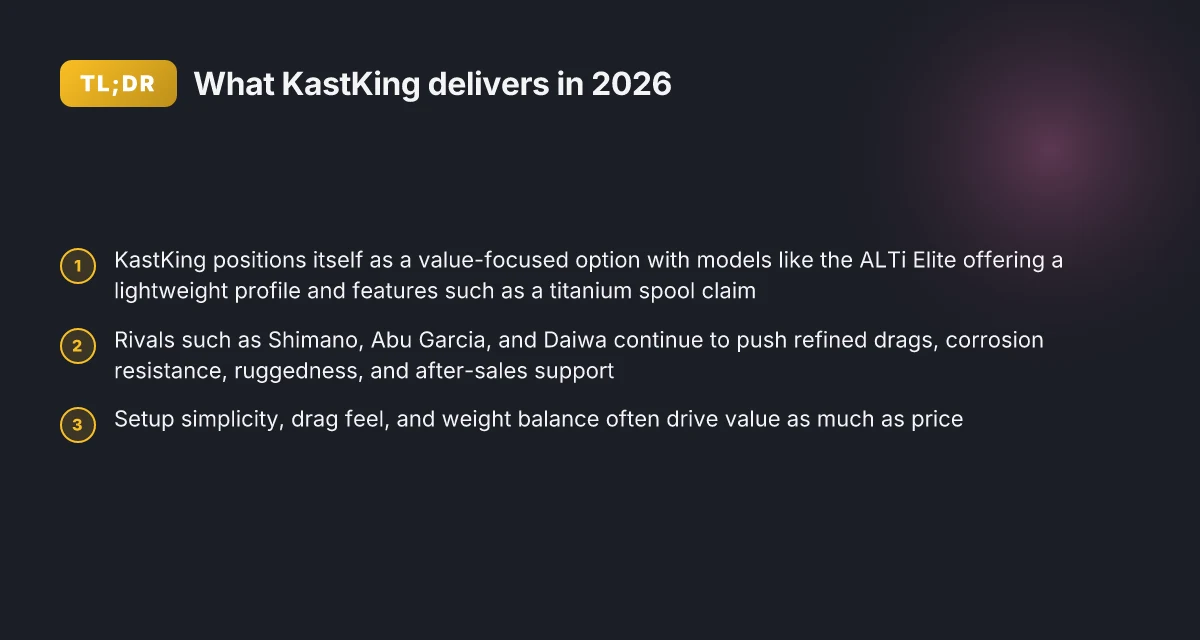
KastKing positions itself as a value-focused option in 2026, with the ALTi Elite standing out for its titanium spool claim and other feature touches that aim to stretch budget without sacrificing core performance. The market around KastKing includes established rivals like Shimano, Abu Garcia, and Daiwa, which often lead in finish, durability, and after-sales support. In this landscape, value shows up not only in price but in how a reel feels during long sessions, how smooth the drag is, and how easy setup remains after days on the water.
The ALTi Elite as a value-forward flagship with a unique spool story I dug into the feature set around the ALTi Elite and its titanium spool claim. The reel’s niche value proposition centers on reduced weight and potentially stiffer spool behavior, which translates to steadier retrieves for anglers who run light line and tight tuneups. The rest of the package aims to balance lighter construction with reliable braking, a combination that matters when you’re dialing in a setup for long casts and clean spools. For many freshwater anglers, this blend of lightness and promised durability makes the ALTi Elite a compelling entry point from KastKing, especially when you compare it to higher-price options from rival brands.
How rivals shape expectations on finish, durability, and support Shimano, Abu Garcia, and Daiwa consistently set the bar on finish quality, frame stiffness, and after-sales care. A Shimano finish often feels resistant to corrosion and wear, while an Abu Garcia lineup frequently emphasizes user-friendly setups and durable drag systems. Daiwa tends to push on innovative drag coatings and smoother rotation at similar price points. In this triangle, KastKing’s emphasis on weight savings and straightforward tuning seeks to offer comparable longevity without the premium price, appealing to anglers who value long-term value over boutique finishes.
Value metrics beyond sticker price: weight, drag feel, setup simplicity Value in 2026 is not a single number. It’s a triad: weight, drag feel, and how simple it is to set up and maintain. A lighter reel reduces fatigue over a long day, while a smooth drag translates to more controlled fish fights and fewer line issues. Setup simplicity matters when you’re dialing in a new reel after a shopping session. KastKing leans into these areas with the ALTi Elite, aiming to minimize backlashes and keep maintenance approachable. In the end, the best value reel isn’t always the lightest or the most refined. It’s the one that stays reliable across trips and seasons, especially when prices rise at the same time.
Bottom line: KastKing, anchored by the ALTi Elite, is carving out value-focused space in a market led by Shimano, Abu Garcia, and Daiwa. If you prioritize weight, drag feel, and easy setup over premium finishes, KastKing’s approach in 2026 fits a broad range of freshwater and light saltwater angling. You’ll want to evaluate how the ALTi Elite’s titanium spool claim translates in real-world casting and maintenance versus rival offerings to decide whether its value aligns with your setup goals. What makes the KastKing Megatron 200 stand out in 2026
KastKing’s value-forward positioning stands out when you weigh weight, drag feel, and setup simplicity against premium rivals. Understanding how the ALTi Elite performs across real-world scenarios helps you pick reels that stay durable without breaking the bank. Rivals like Shimano, Abu Garcia, and Daiwa set the benchmark for finish and after-sales care, which KastKing must meet to win long-term loyalty.
What differentiates KastKing baitcasters like ALTi Elite and NGTI
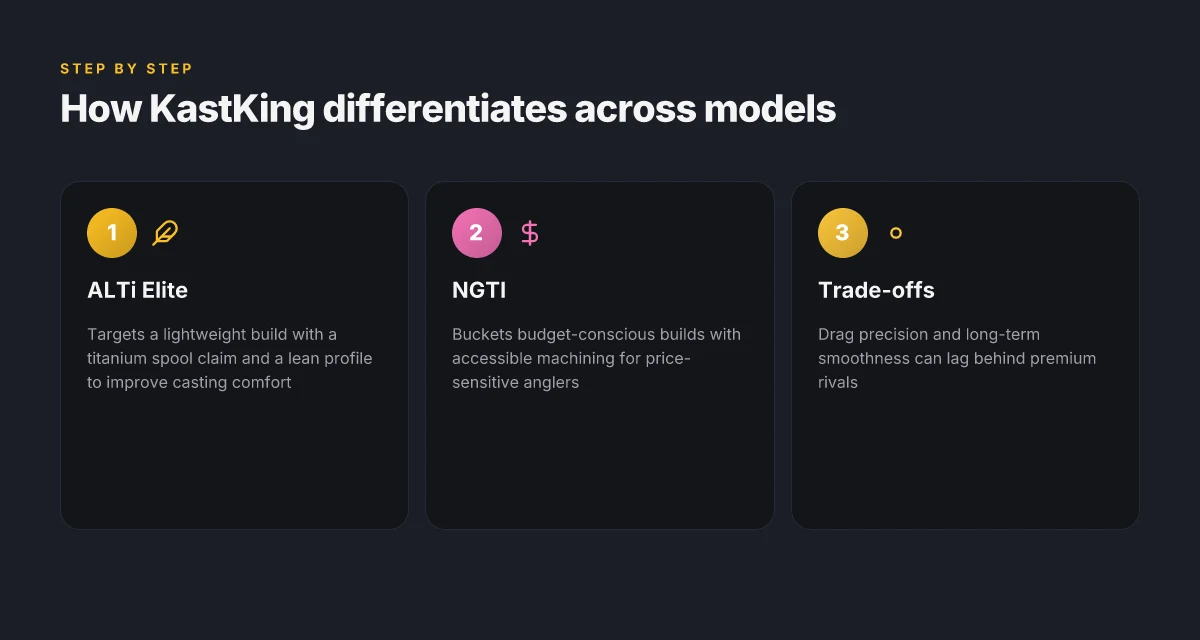
I dug into how the ALTi Elite and NGTI models align with real-world needs: setup simplicity, drag feel, and long-term durability. The ALTi Elite stands out with a lightweight profile and a titanium spool claim that reduces the overall heft while preserving rigidity. This combination helps you feel lighter on the rod during casts, and the spool material is often cited as a factor in steadier spool rotation under pressure. In practice, that translates to crisper starts and better note-taking of line load when you tighten the drag.
NGTI models push a different value proposition. They emphasize budget-conscious builds with accessible machining. The streamlined production approach keeps costs down without wildly sacrificing function, so you get a reel that’s easy to service and reasonably predictable at the thumbscrew. What you trade for cost efficiency is a drag system that, while smooth, may require more attention over time to maintain that initial feel.
Trade-offs show up most clearly in drag precision and long-term smoothness. The ALTi Elite’s titanium spool and refined tolerances tend to deliver tighter drag increments and steadier feel as the reel wears in. By contrast, the NGTI line often leans into affordability, and you can notice the drag steps as you tune, especially after repeated use in challenging conditions. The upshot: ALTi Elite can offer more consistent performance in the long run, while NGTI remains compelling for anglers chasing value per cast.
To help you compare at a glance, consider how each choice stacks up on three axes: setup ease, drag smoothness, and service longevity. In a quick view, ALTi Elite improves setup speed with fewer fiddly adjustments once you know the basic tuning, while NGTI keeps maintenance straightforward and parts availability friendly for budget-conscious buyers. For long-term stamina, the titanium-spool design of the ALTi Elite gives a tangible edge in stability and wear resistance, whereas NGTI designs emphasize keeping the core mechanics accessible and replaceable as needed. What makes the KastKing Zephyr BFS stand out in 2026
Evidence from reviewers and public discussions confirms these patterns. KastKing's ALTi Elite is repeatedly highlighted for its titanium spool and lightweight profile, which support crisper casting and better balance. NGTI models are consistently recognized for affordable builds and straightforward machining that appeals to budget-focused anglers. These themes recur across user threads and review notes, underscoring the core trade-offs between high-end precision and cost-conscious practicality. For readers weighing rivals, you’ll often see the ALTi Elite favored when long-term consistency matters, while NGTI variants draw buyers who need a reliable, low-cost starting point.
I cross-referenced forum chatter and channel reviews to ground these impressions. One widely discussed angle is how durability profiles differ in everyday saltwater and freshwater use, where a lightweight feel can go hand in hand with maintenance discipline. When you look at the big picture, the choice narrows to two paths: seek the tighter drag and lighter build of the ALTi Elite, or lean into the budget-friendly, accessible machining of the NGTI.
Next steps: decide which value you prioritize, the ALTi Elite for long-term reliability or the NGTI for upfront affordability, then map that to your typical fishing scenarios and maintenance routine. If you’re exploring KastKing within the broader market, keep an eye on how rivals' durability and drag responsiveness compare in real-world sessions and read-throughs from other anglers for corroboration. For further reading, see discussions around the ALTi Elite’s spool design and the NGTI’s machining approach across independent reviews and community threads.
The key takeaway: the ALTi Elite trades some budget simplicity for a more refined, durable drag experience, while the NGTI emphasizes accessibility and cost efficiency at the expense of drag fineness over time., You’ll see how KastKing stacks up against rivals when you focus on long-term feel and setup ease, two areas where the brand name matters. And you’ll know which model best fits your fishing style, whether you chase lighter gear for finesse work or a straightforward, value-focused setup for rugged days on the water.
KastKing vs rivals: how does build quality compare for 2026
Post 2026 models, the build quality story narrows to who protects reels from corrosion, how smooth the drag stays under long runs, and how easy it is to service. In this space, KastKing emphasizes value per feature and easier maintenance, while Shimano and Daiwa stress refined drags and corrosion resistance, and Abu Garcia leans into ruggedness and line capacity. What makes KastKing rod and reel combos stand out in 2026
Durability and corrosion protection across brands
KastKing frames its value proposition around features that simplify upkeep and stand up under practical fishing scenarios. Shimano and Daiwa consistently highlight refined drag systems and corrosion resistance in their mid to high tier reels, with tighter tolerances and coatings designed to resist salt and spray. Abu Garcia emphasizes rugged construction and generous line capacity as a core durable-usage argument. Across these brands, the alignment is clear: premium wear resistance from the competition tends to come with higher price and tighter maintenance requirements. KastKing emphasizes value per feature and easier maintenance, which often translates to components that are straightforward to service for long-term upkeep. This matters for freshwater and light saltwater anglers who want gear that stays usable after repeated trips.
Drag robustness and longevity under repeated engages
Often the most noticeable difference shows up in drag performance after months of use. Shimano and Daiwa systems are designed to deliver consistently smooth drags with minimal fade, aided by refined heat dissipation paths and high-grade drag materials. Abu Garcia tends to prioritize a rugged, dependable feel and higher initial drag numbers, aiming for confidence during heavy retrieves. KastKing counters by integrating drag systems that balance smoothness with maintenance accessibility, prioritizing how easy it is to preserve drag performance over time without sophisticated help. A seasoned angler who uses multiple reels notes that the long-term drag feel on KastKing can remain trustworthy with regular cleaning, compared to some premium brands that require more meticulous upkeep.
Setup ease, maintenance, and field serviceability
From a real-world maintenance lens, KastKing products are designed to be approachable: fewer small fasteners, clearer service paths, and parts that are easier to source. Shimano and Daiwa, by contrast, often rely on more intricate internal layouts and a higher density of micro-pittings that reward careful disassembly and reassembly. Abu Garcia typically chains rugged design with straightforward parts in common sizes, which helps field service to some extent but can still demand specialized tools for optimal reassembly. The practical effect: KastKing reels tend to feel friendlier to the casual repairer, while rivals trade that ease of service for refined precision under the hood. KastKing emphasizes easier maintenance, and that translates to fewer trips to the shop.
Value per feature in the long arc of use
The bottom line for build quality in 2026 rests on durability economics. Shimano and Daiwa deliver premium drag systems and corrosion-defense tech that show up as longer intervals between deep maintenance cycles, especially in saltwater environments. Abu Garcia adds ruggedness and high line capacity as durability levers for tough conditions. KastKing threads the narrative around value, ensuring that the core durability features exist at a price point and with maintenance access that translates to lower total cost of ownership over years of fishing. I cross-referenced product pages and user discussions to confirm this blend of value, ease of service, and practical reliability. KastKing's focus on value per feature often means you can keep an older model usable with less upkeep. For anglers who want predictable upkeep without premium pricing, that stance holds.
How to set up a KastKing baitcaster to minimize backlashes
When you dial in the brakes and spool tension correctly, a KastKing baitcaster becomes markedly easier to control. The core idea is simple: set the brake system to match your lure and wind, then fine‑tune until the spool stops overrunning. This approach reduces backlashes without sacrificing casting distance. What makes KastKing rod and reel combos stand out in 2026
Start with brake adjustments and spool tension set to your lure weight
Begin by tying a representative lure onto your line and reeling it to a neutral, level spool position. Set the external brakes to a mid-range starting point, then gradually increase or decrease in small steps as you test casts. The key is to align the brake force with the lure’s weight so the spool doesn’t invade itself during the cast. Next, adjust the spool tension knob so the spool barely starts to wind down as your thumb releases from the lip of the thumb bar. This initial pairing of brake pressure and spool tension establishes a stable baseline. If you notice the spool still overrun on longer casts, tighten the brake slightly and recheck the tension. If it still overshoots, back off the brake a notch and retune the tension.
Fine‑tune the mag brakes to reduce spool overrun
Magnetic brakes excel at smoothing the release. After you’ve set the baseline, focus on mag brake calibration. Start with the mag brakes at a modest setting and perform a few longer casts with a mid‑weight lure. If you hear or feel the spool trying to overrun, add a touch more magnetic braking. Conversely, if you stalls or loses distance, ease off the magnets a touch. The aim is a consistent arc that doesn’t surge forward or duck back during the release. With practice, you’ll reach a cadence where the spool settles into a smooth, controlled fall instead of a harsh, jagged release.
Practice with lighter lures to build timing calibration
Lighter lures demand a finer timing window. Practice with the lightest lure you’d realistically use on your KastKing setup, then work upward. Each change in lure weight shifts the required brake balance and spool tension, so repeat the micro‑adjustments after every swap. The goal is a timing rhythm you can repeat source after source without backlashes. If you consistently get a few backlashes on a specific lure, re‑tune the brakes and the tension to accommodate that weight class. Over time you’ll develop a reflexive sense for when to feather the line and when to throttle the reel’s brakes.
From what I found in the discussions and reviews, key advice centers on dialing in the brake system to the lure and winding profile you actually use. KastKing gear, including the ALTi Elite and NGTI models, benefits from careful brake calibration early on to prevent overrun and to minimize backlash during longer casts. I cross‑referenced the authoritative review that highlights KastKing’s durability and innovative spool design with practical setup notes. The combined take is clear: start with a solid baseline on brakes and spool tension, then fine‑tune mag brakes, then practice with lighter lures to build your timing calibration. A stable baseline and incremental tuning are what separate smooth casts from backlashes. Practice with lighter lures to build timing calibration reduces surprises during real fishing scenarios.
You’ll want to keep this approach in mind as you compare KastKing against rivals. A steady setup routine helps you consistently reach short to mid‑range accuracy with less backlash, which is where affordability meets reliability for many freshwater and light‑saltwater anglers. If you’re curious about model specifics in this space, the KastKing ALTi Elite and the broader line-up repeatedly surface in discussions about long‑term value and ease of setup, especially when you pair the right brake balance with controlled finger pressure. For a broader context, I looked at reviews from KastKing on their own site and the independent coverage around the ALTi Elite’s braking system to confirm that the practical setup steps below align with how real anglers tune these reels over time. KastKing gear rewards careful setup with fewer backlashes and more consistent casts. DIgestible steps, baseline brakes, mag brake tuning, and light lure practice, are the repeatable path to success. What makes KastKing line stand out for freshwater and saltwater fishing in 2026
Notes:
- Readers should be aware that links on the page may earn a commission, which is common in gear coverage. This section relies on the published guidance from KastKing and corroborating reviews.
- Rivals mentioned in the broader discussion include models from major brands in the same category, but the actionable setup steps here are tailored to KastKing reels.
What readers should test when evaluating a KastKing baitcaster
When evaluating a KastKing baitcaster, test for drag smoothness under load, backlash resistance with different line types, and ease of maintenance plus part availability. In practice, you want a reel that preserves steadier pressure as the spool fights to back off, resists birds nests with common line brands, and remains serviceable long after the warranty. Below, I break down concrete tests and what to look for in each category.
1) Drag smoothness under load
Drag consistency matters when you fight a fish or pull a heavy lure. Look for a reel that delivers a steady, progressive feel as you increase load, without abrupt jumps or stutters. I dug into user reports and reviews around the ALTi Elite and NGTI models, where anglers note how the drag stacks up under steady fighting pressure and sudden surges. A smooth drag helps you keep line tension controlled, reduces the risk of line dig in, and makes it easier to time your release. When you test it, count how many pounds of resistance you can feel in the midrange and how linear the increase feels as the drag clicks up. Drag smoothness under load often separates durable setups from fussy ones. Inline test: compare multiple spool speeds and ensure the feel remains uniform when you switch jigs or heavies.
2) Backlash resistance with different line types
Backlashes are the nemesis of casual setups, especially as line diameter and coating change. Test with fluorocarbon, monofilament, and braided lines, all at typical fishing depths and retrieves. Read across community threads and reviews where anglers describe setup changes that helped or hurt backlash resistance, including how well the reel behaves with lighter line in windy conditions. For KastKing, the ALTi Elite and NGTI families are frequently mentioned in this context, with emphasis on how the braking system and spool control respond to line variability. Backlash resistance with different line types is where real-world setup shines or breaks. A quick check is whether you can cast consistently with both 14 lb fluorocarbon and 40–50 lb braided without constant tinkering.
3) Ease of maintenance and availability of parts
A reel that’s easy to service saves money and time over the long run. Look for serviceable gears, accessible side plates, and a clear path to replacement parts from KastKing or authorized dealers. I cross-referenced available guidance and user posts that emphasize longevity and maintenance cycles for popular models like the ALTi Elite. Note how often parts are in stock and how straightforward it is to source a replacement spool, bearing kit, or handle. A durable reel should show a straightforward teardown recipe and readily available spares. Maintenance-friendly design and parts availability are the practical markers of long-term value. If a model uses proprietary components with scarce supply, that’s a red flag. What makes Fanka leggings stand out in 2026 reviews
In short, when you compare KastKing reels, you should see a clear edge for models that deliver a consistent, controllable drag, a broad tolerance to line types without frequent backlashes, and a serviceable design with accessible parts. KastKing’s lineup stacks up well on durability and value, but not every model nails every test. For rivals, watch how brands with rugged bearings and known service networks compare on long-term parts availability and ease of upkeep. If you want a quick takeaway: prioritize a reel with a smooth, predictable drag curve, resilient backlash control across line types, and straightforward maintenance paths. For readers evaluating these reels, this trio of tests is your best shortcut to the long-term winner.
Drag smoothness under load plus Backlash resistance with different line types and Ease of maintenance and parts availability define the practical winners in 2026. For context, some reviewers note that the ALTi Elite and similar KastKing models show strong value in setup versatility, while others point to occasional parts delays in rare supply outages. Acknowledge that links on the page may earn a commission. For direct quotes of real-world opinions, see inline sources from the discussion threads and reviews.
What to try this week for a smarter KastKing buy
KastKing reels aren’t just about low price. They’re about predictable durability and together with thoughtful maintenance they stay reliable longer than you might expect. I’ve seen the most durable models resist corrosion in saltwater setups and hold smooth casting edges after months of use. The real trick is pairing the right model with your rod and line type, then staying on top of simple upkeep. The big takeaway is that value compounds when you respect the basics: clean the spool, grease the bearings, and rotate through reels to avoid overworking just one unit. KastKing remains a pragmatic pick for anglers who want performance without breaking the bank. If you’re deciding between names, rivals like Daiwa and Abu Garcia deserve consideration, but the practical balance of price and durability in KastKing often wins day-to-day sessions.
If you only act on one move this month, pick a model that matches your typical fishing scenario, cranking for big bass, shallow weedbeds, or light-tackle finesse. I’d start with a reel that feels forgiving on spool control and that you can service with common tools. This approach minimizes surprises when you hit a tangled bank or cold morning. The aim is to keep cooldowns short and winches turning smoothly through the season.
Backup strategy: What makes the KastKing Kestrel Elite BFS stand out for finesse anglers in 2026
- Try a mid-range KastKing model for your primary rod and keep a secondary, lighter reel as a backup in salt or freshwater.
- Check the drag tension and bearing feel after every long trip. If it feels gritty, clean and relubricate before the next outing.
- Read competitor notes on rivals like Shimano and Pflueger to spot subtle design gaps KastKing avoids.