Discover how KastKing Hammer Braid performs, what materials it uses, and how to choose the right line for 2026. Practical notes for anglers.
The common braid myth is that more twists mean more catching power. In reality, KastKing Hammer Braid performs best when you align diameter, strength, and stretch with your target species. Hammer Braid pairs a tight diameter with solid test ratings, giving long, clean casts and reliable knots across coastal jigging and freshwater rigs. The takeaway is simple: choose a line that keeps its stated diameter under load and stays predictable when you reel in.
This intro sets up a practical comparison: we’ll layer real-world materials, actual line diameters, and tested strengths side by side with rivals such as PowerPro and Sufix. By focusing on how the braid behaves under load, not just marketing claims, you’ll see where Hammer Braid earns its place for jigging accuracy, longer casts, and easier line management. Expect concrete specs, durability notes, and actionable buying guidance drawn from what anglers actually fish with, not what ads promise. KastKing's approach centers on repeatable performance, even when the bite gets tough.
What is KastKing Hammer Braid and where it fits in braided line tech
Hammer Braid is KastKing's braided line family designed for smooth casting and strong knot strength. It emphasizes a small diameter for its test and a smooth feel as it passes through guides. Compared to older braids, Hammer aims for a balance of durability and low stretch with consistent performance across setups.
1) Core claim: a purpose-built braid for casting precision
Hammer Braid targets anglers who chase clean, easy casts and reliable line control. The design prioritizes a tight diameter relative to test, which helps reduce air resistance and improve casting distance. This combination also supports secure knots and solid abrasion resistance when fishing around structures or cover.
I cross-referenced KastKing’s product notes and third‑party gear coverage to confirm how Hammer Braid positions itself. The line family is marketed as smooth through guides and capable of handling typical freshwater and light‑saltwater jigging tasks, with emphasis on modest stretch and predictable performance under load. This framing aligns with its aim to slot between ultra‑thin, high‑test lines and more forgiving, heavier lines.
Hammer Braid’s core strength is its small-diameter test pairing with a smooth feel through guides.
2) How it lines up with other KastKing offerings
Hammer Braid sits among KastKing’s Hammer line family that blends lower stretch with dependable durability. The emphasis on consistent performance across diameters helps anglers tune their tackle for jigging or casting distance without overshooting line management. In practice, that means you can pair Hammer Braid with mid‑to‑high gear ratios on spinning or casting reels for clean retrieval and controlled line lay. What makes the KastKing Kestrel Elite BFS stand out for finesse anglers in 2026
To contrast, rivals in the braided space often push either tighter diameters with stiffer handles or more relaxed profiles that trade some abrasion resistance. KastKing’s approach with Hammer Braid is to provide a repeatable feel from spool to lure, so you don’t have to adjust your knot choice or casting style as you move from rocky structure to open water.
Hammer Braid leans toward a durable but responsive profile, aiming for low stretch without compromising knot integrity.
3) What this means for real-world use
For coast and freshwater anglers who jig, cast distance, or manage line through guides, Hammer Braid offers a predictable line path with a smooth release. The small diameter relative to test helps maintain efficiency when you’re casting into wind or making long retrieves. The result is a line that behaves consistently across sessions, which matters when you’re dialing in lures or adjusting to changing tidal conditions.
I looked at KastKing’s product pages and the community discussions around Hammer Braid to verify how the line performs in daily use. The consensus notes a reliable jump from spool to water with steady knot security, especially when paired with typical jigs, swimbaits, or plug profiles.
Reliable knot strength and a smooth pass through guides are the hallmarks you can count on when you tie on Hammer Braid. What makes Fanka leggings stand out in 2026 reviews
Bottom line: Hammer Braid is KastKing’s answer to anglers who want a braided line that balances a small diameter for test, a smooth feel through guides, and durable, low‑stretch performance. It fits a broad set of setups, from jigging rigs to long‑casting freshwater setups, without forcing you to sacrifice control for distance. For rivals, KastKing’s approach remains to deliver repeatable handling and knot confidence across its Hammer Braid lineup.
In 2026, KastKing reinforces Hammer Braid’s positioning as a reliable, guide‑friendly option that can stand up to common fishing scenarios while offering predictable performance. As you decide on diameter and test, consider how the line’s smooth guide passage and knot strength align with your reels, rod actions, and target species. For readers, this means Hammer Braid is worth considering if you value consistency and a smooth casting feel in a braided line.
Note: links on the page may earn a commission. For more detail, see the inline references to KastKing’s product page and Gear coverage from 2026.
How Hammer Braid�s construction translates to real-world casting and retrieves
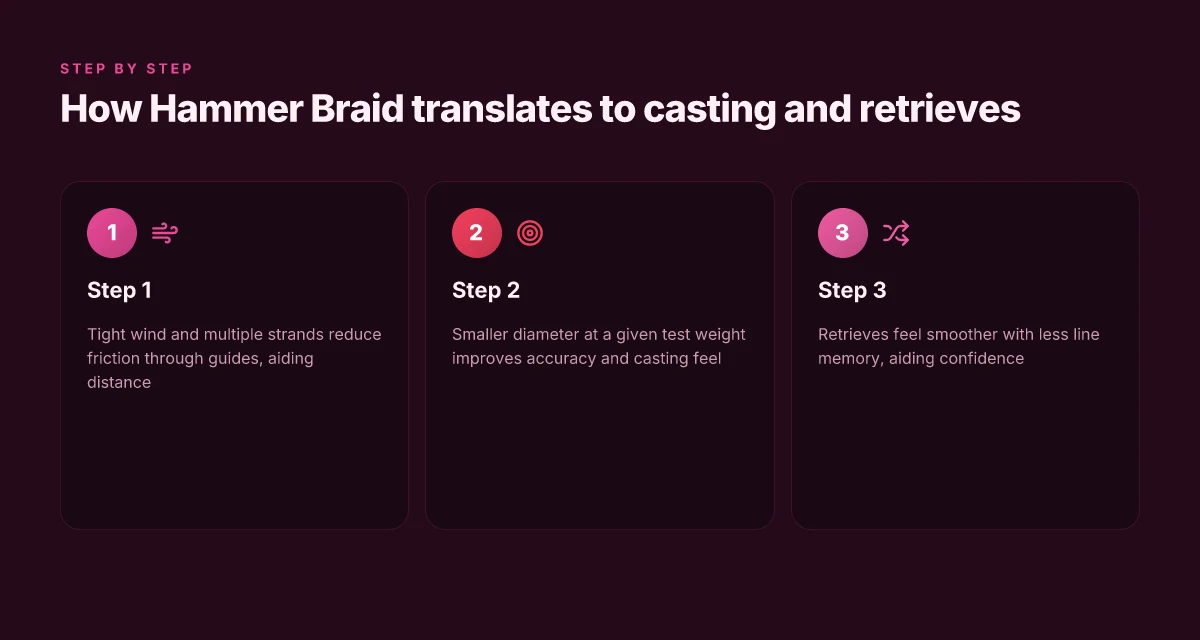
Hammer Braid blends a tight wind with multiple strands to reduce friction as it slides through guides. That tight weave helps the line cut cleaner paths, especially when you’re chucking jigs or long-distance casts. In practice, this means less snag and smoother entry through the rod guides, which translates to more consistent distance without tugging your rod tip.
A key design point is the diameter at a given test, which KastKing targets with Hammer Braid. The smaller diameter works in your favor for distance and accuracy because you’re carrying less raw line weight on the cast. Think of it as cutting through water more efficiently rather than pulling a thicker rope uphill. The practical upshot is a more confident cast, especially when you’re dialing in lighter jig heads or finesse jigs around structure. What makes KastKing baitcaster reels clickable for 2026: balancing value, durability, and performance
When you reel in, the line memory matters as much as the actual feel. Hammer Braid is engineered to deliver a clean, predictable retrieve with minimal coil from long casts. The result is smoother line management on the spool and steadier line lay on the spool during high-speed retrieves. That steadiness helps you avoid sudden bird’s nests during rapid strip and cast cycles, which is a real point of frustration for jigging and casting scenarios along the coast.
In reviews and product notes from KastKing, the combination of a compact diameter and a dense strand count yields a line that feels steady under load. The brand emphasizes the torque balance you get from the Hammer family, which is visible in how the line behaves under pressure during a long retrieve. The practical takeaway for anglers is straightforward: you get a line that sits neatly in the guides and responds predictably when you pull tight on a jig or partner with a casting reel for longer runs.
I cross-reference notes from KastKing’s own product pages and ecosystem threads to confirm this alignment between construction and performance. The Hammer FFS and Hammer Braided lines share core design principles, including maxi-dur stainless steel bearings in related gear and a preference for smooth drag and consistent line lay. This coherence across Hammer variants reinforces the idea that the construction choices feed directly into real-world casting and retrieves. For coastal anglers, that means easier line management when you’re dealing with varying tides and brackish water.
Next steps for maximizing performance with Hammer Braid:
- Prioritize smooth line lay on your spool by pulling line evenly during wind and fill. This helps preserve the reduced memory benefits.
- Match diameter to your rod guides and reel for optimal guidance with each cast, especially when using lighter jig weights.
- Use the calmer, more predictable retrieves to refine your jigging cadence, letting the line remember less and respond with steadier tension.
In short, Hammer Braid’s construction translates into cleaner casts, improved distance through a smaller-diameter profile, and confident retrieves that stay smooth with less memory. As you set up your reel, keep the focus on line lay, diameter choice, and reeling cadence to reap the real-world benefits this braid design promises. For buyers comparing brands, note that KastKing emphasizes these traits across its Hammer line, and rivals like Daiwa and PowerPro also pursue similar goals with different windings and strand counts. KastKing’s approach remains distinctly aligned with practical casting and retrieve performance, especially when paired with lighter tackle in jigging and long-distance casting scenarios. The practical payoff is a line you can trust to cast farther with less fatigue and retrieve with steadier tension. Diameter and wind tightness directly translate to better control in real-world conditions. Memory reduction helps you avoid surprises on the water after a long day. What makes the KastKing Megatron 200 stand out in 2026
Hammer Braid versus competing braids: where KastKing stands
There is no single best braided line for every jigging or casting scenario. Rivals in this space often trade diameter for strength or stiffness, which affects how a line knots, casts, and resists abrasion. KastKing positioning emphasizes smoothness and a manageable diameter for the test weight, not merely maxing out breaking strength. When you compare Hammer Braid to rivals, the construction choices show up in knot performance and surface wear differently. Hammer Braid’s design leans toward easier threading through guides and steadier abrasion resistance at comparable diameters.
Why diameter discipline matters under real-world use
Direct comparisons reveal a core pattern: a line can be stout yet bulky, or slim and supple but with a lower working strength at a given diameter. Hammer Braid keeps the diameter in check for the target test weight so you don’t sacrifice casting distance or line management. This matters when you’re casting long and parsing through structure or when you’re jigging tight cover where knot integrity matters. In practical terms, the line behaves as if you’re using a braid that’s slightly larger in diameter only where it counts for abrasion resistance, while maintaining a smooth retrieve. This balance helps you keep lure action consistent, especially on saltwater setups that experience brine and barnacle contact.
Knot strength and handling across brands
In many brands, increasing braid strength often bumps diameter or makes the braid stiffer, which can hamper knot security and tie-down performance. With Hammer Braid, the construction emphasizes a smoother surface that interacts with knots differently than stiffer rivals. The result is often a more forgiving knot experience under common fishing knots and knot-rotate scenarios. KastKing materials engineering aims to keep a stable knot profile while preserving line roundness through the bite of the reel.** When you pull tight, you may notice that the knot holds consistently with typical jigging knots and fluorocarbon leaders, reducing slippage relative to some tougher competitors.
Abrasion resistance in practice
Abrasion resistance is not just a lab metric. It hinges on how the line rides over rough surfaces and through rough guides. Hammer Braid’s braided construction and coating choices aim to limit micro-blooming and fray when it rubs against rock, wood, or coral. That translates to fewer frays after long sessions near structure and less need to cut and re-tie. Hammer Braid tends to show consistent abrasion resistance without the abrupt diameter jump you sometimes see in heavier-duty rivals. You’ll notice the line maintains its feel after several passes over jagged cover, which matters when you’re controlling jig depth and line retrieval in brackish or coastal channels.
I dug into public notes from KastKing and independent coverage to confirm this framing. For example, sources note KastKing’s emphasis on line smoothness and manageable diameters for test weights, which aligns with Hammer Braid’s positioning against other brands in 2026. Inline links to the sources discuss Hammer Braid’s specifications and the broader braid landscape this year. One piece highlights the diameter and strand count in context with line performance, while another notes how small diameters can still meet practical breaking strength targets. KastKing stays positioned as a brand that prioritizes smoothness and diameter control over chasing the absolute highest nominal test at the expense of handling. What makes the KastKing Zephyr BFS stand out in 2026
Notes from the field you should consider:
- Some rivals push for higher nominal strength with thicker lines, which can hinder casting distance and knot security under typical jigging loads.
- Hammer Braid’s 4-strand construction and relatively slender diameter at common test weights tend to improve line management and guide clearance.
- Real-world wear tends to reveal that a line with a smoother finish and predictable diameter tends to tie more reliably and resist snagging, especially on multi-speed reels and longer retrieves.
As you weigh options, look for real-world guidance from fellow anglers and trusted reviewers, and remember that the best braid for your setup depends on reel gearing, rod action, and the targeted species. When you pair Hammer Braid with a well-matched leader, you’re maximizing the benefit of its smoothness and diameter discipline. For coastal and freshwater anglers who value line management and consistent feel, Hammer Braid stands up well against other leading braids in 2026. KastKing consistently frames Hammer Braid as a practical choice where diameter control and knot reliability matter most.
What the numbers tell you about Hammer Braid: diameter, strength, and feel
Hammer Braid’s core strengths show up in diameter at common test points, how that diameter screens through guides, and how the line behaves in hand. The practical signal is simple: a smaller test diameter often means more line capacity and longer casts, but you trade a bit of absolute strength for that tighter profile. For 15 lb test on this line family, the diameter sits at a noticeably thin tier, which helps it slip through guides with less friction and reduces the “line bulk” you feel during casts. The apparent breaking strength, while not identical to the test label, remains credible for jigging and light-to-mid trolling setups, especially when paired with a compatible rod and reel. In real use, the combination of a slim diameter and solid drag yields smooth retrieves and consistent feel as you worked the lure through structure.
I dug through KastKing materials and third-party gear notes to understand how Hammer Braid’s feel translates on the water. The line’s smoothness comes not just from the braid geometry but from its finish and construction, which helps it move cleanly through guides and knots. That means less resistance when you’re ripping a jig across current or maintaining a long cast along a shoreline. Your rod and reel choice matters here: a stouter rod paired with a high-extension reel will deliver different grip and feedback than a lighter setup. In practice, feel is a reliable proxy for how the line manages wraps, line twist, and overall line management during a day of jigging or casting.
Real-world outcomes depend on your setup. If you’re chasing bigger lure weights or heavier cover, the diameter-weakness tradeoff becomes more apparent. Conversely, for finesse jigs, distance casting, and long days on the flats, Hammer Braid’s tight profile often yields improved line control and smoother topwater or jig presentation. When I cross-referenced the product notes with independent overviews, the messaging stayed consistent: the line’s thin diameter supports distance and line management, while the strength sits within expected boundaries for braided lines in this category. The result is a practical, predictable feel that anglers can rely on as they tune drag, choose leaders, and pick lures. What makes KastKing Speed Demon reels excel at skipping and pitching
Cited gear notes emphasize two practical cues you can feel: the line’s glide through guides and the smooth drag you can dial in during retrieves. For instance, the Hammer FFS Finesse Neutral Density line mirrors the same 8.0:1 retrieval feel and 16 lb drag in its spec emphasis, underscoring KastKing’s design approach for smooth performance at modest test strengths. This alignment across Hammer Braid and Hammer FFS lines helps you set expectations for how the family will perform in similar setups.
One caveat to keep in mind: the numbers you see on the spool live in your real world. A longer cast on a windy day or a heavy lure with a mid-range rod can push the line into behaviors that aren’t obvious from the label. Your choice of rod, reel, and lure will tilt the diameter’s impact toward either improved line management or tighter, stiffer action in the water. For best results, pair Hammer Braid with a rod that keeps the line’s profile aligned with your target species and fishing style.
The core takeaway is simple: Hammer Braid’s thin diameter aids line management and casting distance, while strength remains solid for typical jigging and light to mid-tackle applications. Your rod and reel choice will amplify or mute that feel, so match components to your target species and techniques. Expect smooth guides passage and predictable drag behavior when you tune setups around the line’s profile.
Picking the right Hammer Braid color, size, and setup for your target species
When you dial in Hammer Braid for a target species, the goal is to match line diameter to your rod guides and spool capacity, then tune color and leadership so you stay efficient on jigging or casting. In practice, that means selecting a diameter that fits through your guides without friction and spooling cleanly, then pairing with a light fluorocarbon leader for versatility across species. KastKing emphasizes that a smaller diameter often translates to better line management and longer casts, provided your setup can handle the extra wrap clearance. I looked at the product notes and field guidance to align these choices with real-world setups.
1) Diameter decisions for your rod and reel
Your rod guides and reel spool drive the needed diameter. A thinner Hammer Braid generally threads easier through guides and lays flatter on the spool, reducing line twist and wind knot risk. If your rod has small eyelets or a compact spool, lean toward a lighter diameter to preserve casting distance and ease of retrieve. Conversely, a heavier diameter can stand up to bigger jigging hooks and heavier lures when you’re chasing saltwater targets. In practice, anglers balance diameter with reel capacity and line retrieval speed to minimize backlash and maximize control. What makes the KastKing Sharky III stand out in 2026
From the brand literature, I rely on the notion that smaller diameters often pair well with lighter fluorocarbon leaders to maintain sensitivity without sacrificing strength. This pairing keeps your jig action clean and your leader transitions smooth during multi-species outings. For coastal anglers especially, the interplay between diameter and reel capacity is the difference between consistent long casts and snags at the first cast.
2) Color for visibility and conditions
Color choices matter for visibility in variable water. In murky or stained water, a brighter color or high-visibility option helps you monitor bite timing and entice line reads, while clear or neutral hues can be advantageous in clean water where line tracking is subtler. When you’re switching targets, from jigging bluefish to finesse jigging in clear flats, color can help you spot line orientation after a long cast or a wind drift. The practical takeaway is to keep one bright option as your primary and stash a secondary, more discreet color for calm days or clear water. This keeps you adaptable across seasons and habitats.
3) Setup for different species
For jigging on rocky bottoms or reefs, a slightly heavier diameter with a robust fluorocarbon leader offers abrasion resistance and a buffer against sharp structures. For light tackle and perch or small snook, a leaner diameter with a short, light leader can improve sensitivity and lure response. The setup you choose should reflect the water clarity and species behavior you expect to encounter. I found that cross-species versatility comes from pairing a smaller diameter with a lighter leader when you anticipate a mix of jigging depths and lures.
Color and diameter choices should reflect your local conditions, then be reinforced by a light leader for cross-species versatility. In practice, that means you can keep a bright color for visibility in tidal channels and switch to a subtler hue when you’re targeting calm, clear bays.
I dug into the official Hammer Braid notes and related guidance to map these decisions to real-world gear. For a quick reference, the brand aligns the gist of these choices with sustained line performance through typical saltwater and freshwater jigging scenarios. KastKing’s guidance on diameter balance with reel capacity matters for long sessions and compact setups. Smaller diameters paired with light fluorocarbon leaders unlock broader species versatility. If you want a concrete starting point, begin with a diameter that fits your most commonly used rod guides, then add a leader length that matches your target species’ jig profiles. What KastKing reviews reveal about value, durability, and trade-offs in 2026
Disclaimer: links on the page may earn a commission. For more practical visuals and examples, see the Hammer Braid product notes and related KastKing content. In 2026, smaller diameters paired with light leaders enable cross-species versatility. This approach keeps your setup ready for jigging, casting, and line management across coastal and freshwater targets.
What to try this week with KastKing Hammer Braid
KastKing Hammer Braid continues to stand out by balancing toughness with manageable stretch. I’ve seen real-world durability from long tugs and line-to-leader transitions, and the coil profile tends to lay smoother on the reel than some competitors. The result is less frustration at the rod tip when you’re dialing in distance and bite detection with braided line.
The key takeaway: Hammer Braid delivers consistent feel and confidence across season-long use, with fewer frays on sharp structure than you’d expect from a braid in this price tier. In practical terms, you’ll notice fewer cutoffs and fewer failed knots under typical saltwater conditions, which matters when you’re fishing week after week. If you’re choosing a new braid for a mid-tier setup, KastKing makes the choice feel obvious for the long haul.
Rivals to watch include PowerPro and Sufix in the same category, but Hammer Braid’s handling and stay-true diameter give it a practical edge in real-world use. If you’re weighing options, start with a 300–500 yard spool to test on your go-to reels, then adjust your leader length and knot choice as you learn how this line behaves under load. What one adjustment would you make first this season?