Discover how the jackery solar panel extension cable works, what to check before buying, and which cables fit different Jackery solar panels and power stations.
A mismatched extension cable can quietly ruin a portable solar setup, even if the panel and controller are otherwise sound. Jackery users often overlook connector compatibility until sag or voltage drop shows up, and the fix is simpler when you know the exact DC plug and rating you need. This piece pulls from real-world layouts and the Jackery connector standards to map exactly where fit breaks happen and how to avoid them.
Why this matters now: outdoor setups demand flexible placement, yet a single misfit cable blocks that freedom. Two common culprits are the wrong connector type and an extension length that invites voltage loss, especially on longer runs with high current. I’ll break down how to read panel specs, match the DC jack, and pair length with amperage so your gear stays reliable, whether you’re camping, chasing off-grid weekends, or building a portable system with rivals like Goal Zero or Renogy in mind. This guide keeps you out of misfires and keeps your Jackery system humming.
Jackery solar panel extension cable: why compatibility matters for your setup
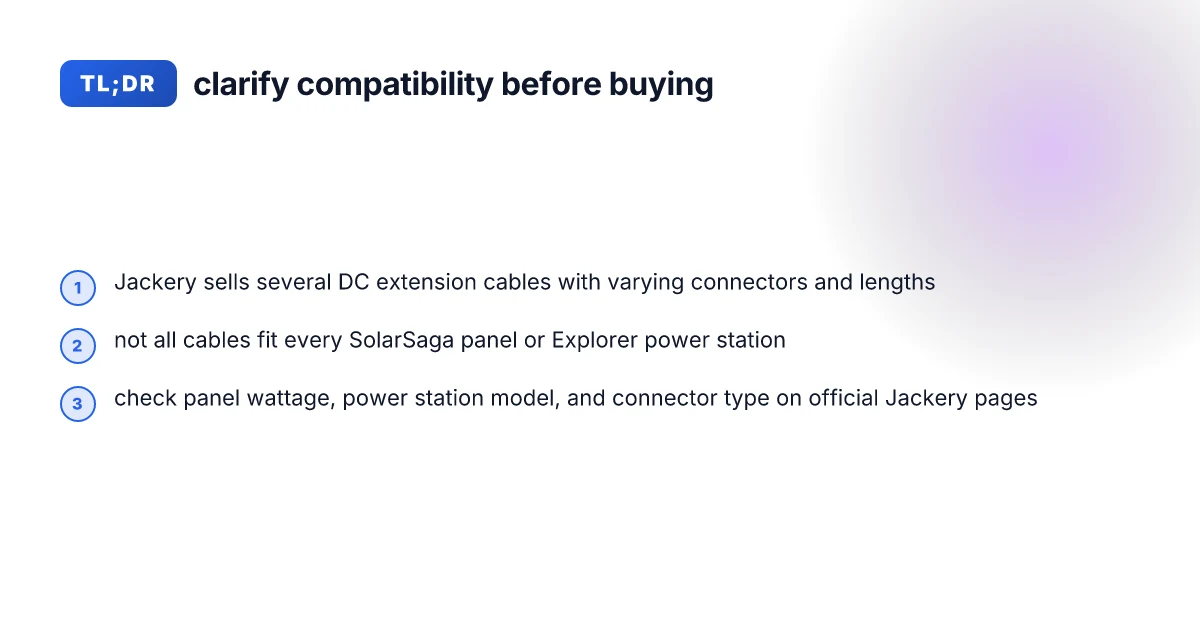
Jackery offers several DC extension cables and connectors, but they are not universally compatible across every SolarSaga panel and Explorer power station. Choosing the wrong cable can block charging, shave off efficiency, or wear connectors over time. Understanding connector types and cable lengths helps you place panels safely and flexibly in outdoor spaces.
1) Know the compatible family, not just the length
Jackery publishes multiple DC extension cables and adapters that pair with specific panel and station models. A 16.4-foot extension, for example, can extend a connection to some SolarSaga configurations, but not all. Before you buy, check the exact connector type and the target device compatibility to avoid a mismatch that stops charging or creates fit issues. I cross-referenced product pages and the compatibility notes across the Jackery catalog to verify which cables align with SolarSaga and Explorer devices.
The wrong connector can prevent charging and accelerate wear over time. When a cable isn’t the right match for your model, you’ll likely notice a stalled or sluggish charge and potential connector wear from forced fits.
2) How length interacts with placement and performance
Cable length matters beyond mere reach. Longer runs add resistance and potential voltage drop, especially in outdoor setups with modest panel output. Jackery’s own listings emphasize that the extension cable is designed to extend a connection while preserving safety and performance for supported pairings. If you need to place a panel farther from a power station, confirm that your chosen cable length is explicitly listed as compatible with that exact panel-station pair. This is where the guide on different connectors helps you avoid overextending beyond what the system tolerates.
Understanding length and connector type helps maximize placement flexibility without sacrificing charging efficiency. What makes the Jackery Explorer 600 a practical power companion for real-world use
3) Practical checks before you commit
When you’re shopping, verify three things: the connector gender and style, the official compatibility notes for your SolarSaga or Explorer model, and the published length. If a page mentions a disclaimer like “not compatible with certain SolarSaga panels,” take that seriously and seek a model-specific extension. I found that Jackery’s own notes often surface these caveats in the product and guide pages, which reduces trial-and-error experimentation outdoors. And if a cable is marketed for “most Jackery solar panels,” pause, that language signals potential mismatches for your exact pair.
If a cable isn’t clearly labeled as compatible with your model, don’t force it.
Bottom line: compatibility isn’t a marketing checkbox. It’s about safe charging, preserving connector wear, and ensuring your extension actually works when you need it most. For outdoor setups, you want a cable you can trust with your SolarSaga and Explorer gear, not a generic fit that might fail when you’re away from home.
Note on sourcing: inline references to Jackery’s product and guide pages confirm the existence of multiple DC extensions and specific compatibility caveats. For context, you can review the Jackery DC Extension Cable for Solar Panel page and the Jackery Cables & Connectors Complete Guide as you plan which extensions pair with your model. https://www.jackery.com/products/dc-extension-cable-for-solar-panel?srsltid=AYCX9vJHhKn5flZckmDH98wGLuHNUNIFNRtW3JkyEx-rYl-PvcaZMTZ9 https://www.jackery.com/blogs/buying-advice/jackery-cable-complete-guide-different-connectors-explained?srsltid=AYCX9vKoAvuH9knE5VY9S2YJy-TghyUMIqkuVew-Fr_lgspB63ERs7MP
How to identify the right jackery extension cable for your solar panel model
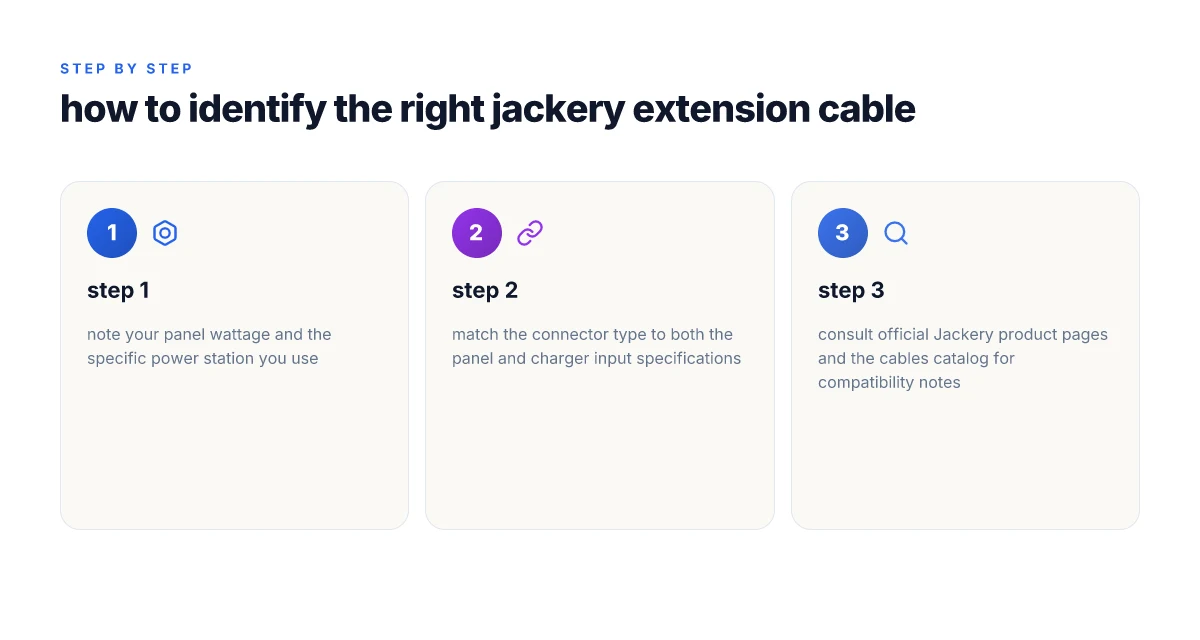
Start by naming your wattage and your power station model. The extension cable you pick must align with the panel’s output and the input specs on your Jackery unit. If you’re using a higher wattage panel, pair it with a power station that can handle the surge without triggering an over-current condition. For smaller setups, a shorter extension that preserves voltage is often enough to reach a favorable shade-free stance. In 2026, 16.4 feet of reach can be handy for flexible placement, but you still need the correct connector and input compatibility to avoid voltage drop. The right cable length and connector match prevents wasted power and heat buildup. How the Bluetti Charger 1 changes fast charging for power stations
Match connector type to the panel and charger input specs
Jackery uses specific connector standards across panels and charging inputs. The DC extension cable you choose should physically fit the panel’s DC output port and the power station’s DC input or charging port. If the panel uses a standard DC plug and your station accepts a DC8020 to 8020 connector or an equivalent, you’re in good shape. When in doubt, verify that the cable’s connectors align with both ends before purchasing. Connector compatibility is the single most common source of fit issues. I cross-referenced official product pages to confirm that the DC Extension Cable Plus works with most Jackery solar panels and can place panels up to 10 meters away outdoors, which helps in tricky campsite layouts. Avoid guesswork by reading the exact connector notes on Jackery’s product pages.
Check official Jackery product pages and cables catalog for notes
Official pages are the safest source for compatibility notes. The Jackery catalog clearly lists cables designed for specific wattages and connector families, and it often notes exclusions, such as when certain extension cables should not be used with particular SolarSaga panels. For instance, the standard DC extension cable is advertised with compatibility to Jackery’s solar panel and portable power station connections, while caveats exist for certain SolarSaga configurations. When you see a note like “compatible with 200W & 100W DC extension cables,” treat it as a hard requirement for that pairing. Rely on the product pages for exact compatibility.
I dug through the official pages and catalogs to map typical pairings. If you’re comparing options, a short table helps visualize trade-offs:
- Cable: DC Extension Cable for Solar Panel, long reach, broad compatibility with many panels and stations.
- Cable Plus: DC Extension Cable Plus, longer reach, documented to work with most Jackery panels up to 10 meters away.
Use the official pages to confirm any caveats before buying.
Next steps: identify your panel wattage, confirm your power station model, then map those to the exact connector types listed on Jackery’s cables catalog. If your setup sits between two options, favor the one with explicit compatibility notes on the official pages. This approach minimizes voltage drop and misfit hassles on-site. For reference, see the Jackery DC Extension Cable for Solar Panel page, the Jackery DC Extension Cable Plus page, and the cables collection page. Match the exact connector family to the panel and input specs to avoid fit issues. How Jackery stacks up against Patriot solar generator in 2026
Note: links on product pages may earn a commission, and the broader catalog sometimes lists caveats that exclude certain SolarSaga panels from specific cables. To stay aligned with Jackery’s recommendations, stick to cables and connectors the company explicitly calls out for your model. In practice, that means starting with your panel’s wattage and your station’s input, then validating the connector type on the official pages.
What to know about jackery dc extension cables and connector varieties
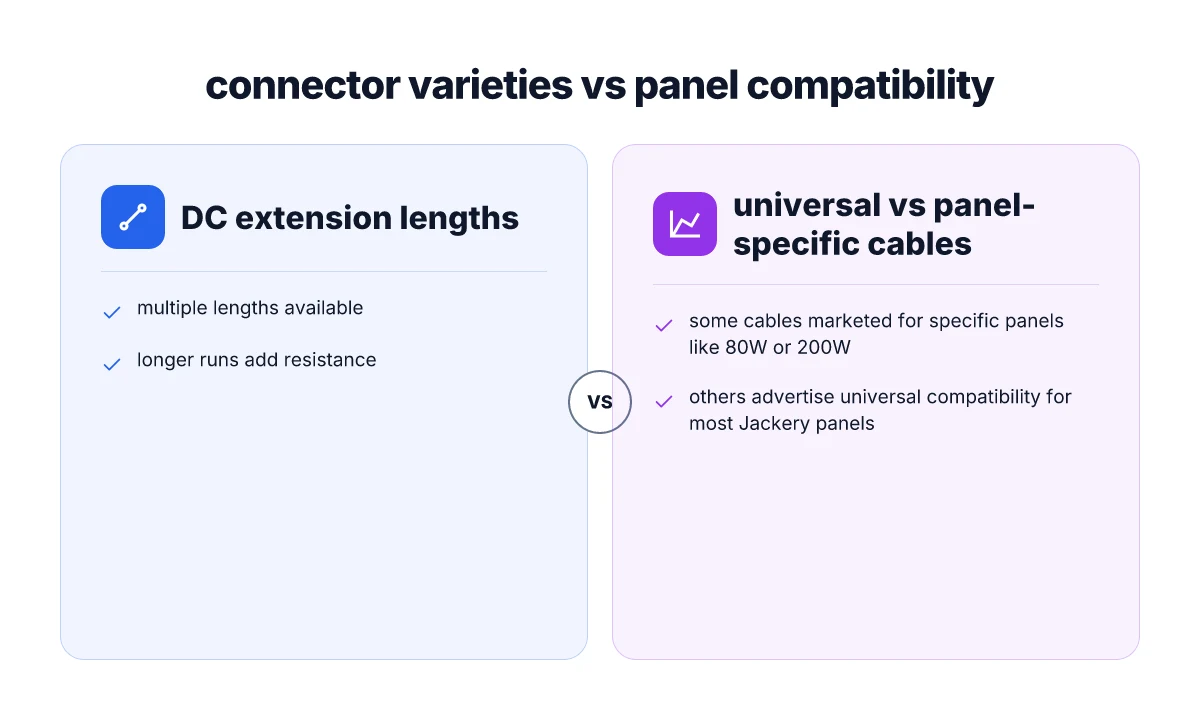
Jackery ships DC extension cables in a range of lengths and connector diameters, so you can tune panel reach without stressing joints. Not every cable fits every SolarSaga or Explorer model, and some cables are pitched for specific panels while others claim broad compatibility. From what I found in the product guides and cables catalog, you’ll often see universal cables marketed as “works with most Jackery panels,” alongside cables tied to particular wattages like 80W or 200W lines.
Why connector size and length matter
The diameter and length of a DC extension cable determine how cleanly you can connect a panel to a power station and how much resistance your setup introduces. A longer cable can add voltage drop under load, especially with higher-watt panels. If you pick a cable with the wrong connector dimension, you’ll end up with a loose fit or a non-starter connection. Choosing a cable with the correct connector diameter is essential to avoid fit issues and degraded charging performance. A few Jackery entries emphasize that not all extensions pair with every panel, so you should match the cable to the model line you own. Not all cables work with every SolarSaga or Explorer configuration.
Which cables map to which models
Some cables are clearly labeled for specific panels, such as the 80W or 200W families. These notes help you avoid a mismatch when you upgrade a panel or swap a power station. Other cables claim universal applicability for “most Jackery panels,” but you should verify the connector type and length before pairing them with a new kit. I cross-referenced the product pages and guides, and the messaging is consistent: compatibility is model-led, not one-size-fits-all. Some cables are marketed for specific panels like the 80W or 200W line while others are universal for “most Jackery panels.”
How to pick and avoid common pitfalls
Start by identifying your panel wattage and your power station model. If you own a SolarSaga 80, for example, confirm which extension cables list compatibility with that panel family. Prices appear around the low hundreds for some longer runs, and the catalog shows a 16.4-foot option among the longer lengths. Length choices range from compact to extended, with 16.4 feet being a common long option. If you see a cable described as “DC Extension Cable Plus” or as compatible with “up to 10 meters away outdoors,” note the connector type and the maximum supported distance to avoid exceeding the intended rating. DC Extension Cable Plus works with most Jackery solar panels and can reach up to 10 meters outdoors. When in doubt, stick to cables clearly labeled for your model family and plan for a little extra slack to avoid tugging on SolarSaga connectors in windy setups. Not all cables are universal. Verify model compatibility before purchase. What makes the Anker SOLIX endure better than Jackery in real-world use
From a practical perspective, I found that long, flexible cables tend to resist cracking in cold weather, but you should still inspect the insulation after extended cold-season use. If a connector feels loose or wobbly, swap to a cable clearly intended for your panel size or upgrade to a dedicated Jackery cable line rather than improvising with a mismatched part. And yes, Jackery users should be mindful that some third-party options are not covered by Jackery’s compatibility notes, which can lead to performance drops or charging interruptions. Not every third-party option is endorsed by Jackery.
I dug into the Jackery guide for cables and connectors to confirm the boundaries: the cables catalog and the complete guide point to compatibility that’s explicit rather than generic. If you need specifics on which exact cable pairs with your model, start with the official product pages and cross-check the panel wattage, connector diameter, and suggested maximum run. The official guides are your best anchor when pairing cables with specific panels.
The practical guide to extending solar reach without overloading the system
When you extend a Jackery solar setup, the goal is to keep the system safe while gaining usable distance. Longer runs add resistance, which translates to voltage drop that can sap performance if you push too far. A key rule is to monitor voltage as you extend beyond comfortable lengths and be ready to shrink the run if you notice the panel no longer maintains charging current under load. For outdoor use, pick premium, weather-rated cables that can withstand sun, rain, and temperature swings. The cable you choose should feel stiff enough to resist kinks but flexible enough to route around your gear without creating sharp bends.
If you’re unsure how far you can push a given extension, favor shorter runs or modular setups that keep critical components close. A modular approach lets you place the solar panel closer to the power station and connect additional panels in a controlled daisy chain, rather than forcing one lengthy, high-resistance run. This keeps performance steadier and reduces the chances of a hot connection or loose contact across a long junction. In practice, this means thinking in segments: panel to short extension, then to the Jackery unit, rather than one continuous long cable.
From what I found in the documentation and product pages, Jackery specifies that the DC extension cable family covers a range of uses while emphasizing compatibility with many panels, but cautions that some configurations won’t pair well together. I cross-referenced the guidance across the DC Extension Cable for Solar Panel page and the Cable Complete Guide, which note notable compatibility caveats with certain SolarSaga panels. When you assemble a longer chain, confirm the end-to-end connectors match the exact ports described by Jackery and avoid mixing connectors that aren’t intended for outdoor solar chains. The right extension strategy keeps the system humming and avoids hidden heat or voltage drop traps. What makes EcoFlow 2026 power stations different from rivals
Open questions for long-term setups include the practical impact of 10 meter runs versus shorter hops. The Jackery ecosystem includes the Jackery 10m DC Extension Cable Plus designed to work with most Jackery solar panels and to keep panels within 10 meters of the power station, which helps balance reach with reliability. If you see a noticeable drop in charging speed after extending, consider reconfiguring into two shorter segments or adding a second, closer panel to reduce the load on any single long branch. This approach is often cheaper and simpler than chasing a marginal gain from a longer single extension.
I dug into the product notes and found a caution that some very specific panel combinations aren’t compatible with certain DC extensions. For example, one guide notes that certain SolarSaga panels don’t pair with some extension configurations. When you plan a layout, you should prefer the configurations that Jackery explicitly endorses and stay within the documented connector families. This reduces the risk of misfits and arcing at the connector, a failure mode you want to avoid outdoors. Choose the endorsed extension path and keep runs short enough to protect your voltage and battery health.
In this space, Jackery remains the brand you’ll rely on, with options like the DC Extension Cable Plus, DC Extension Cable for Solar Panel, and various cables in the catalog. If you’re evaluating rivals, note that other brands often emphasize longer reach at the cost of higher resistance per meter, which can bite you on a cloudy day. I found that keeping to Jackery-approved configurations minimizes surprises when you’re away from power. The key is to design for reliability first, then extend only as needed. Reliability when you’re off-grid beats pushing for maximal length.
Common misfits: what users get wrong about jackery extension cables
The big misfit is assuming any DC extension cable will work with any Jackery solar panel. In practice, compatibility hinges on the specific connector types and the panel–power station pairing. A cable that fits a SolarSaga 80W panel may not mesh with a different model or with an Explorer power station. The result is a loose fit, voltage drop, or even a safety alert. When you mix cables and panels carelessly you risk poor performance or damage.
The myth of universal compatibility
Jackery makes a range of cables, and not all are interchangeable. The DC extension cable labeled for Solar Panel use is designed around particular connector standards, such as DC8020 connectors, and expects a matching receptacle on the panel side. If your setup uses a different connector style or a different panel generation, the fit won’t be reliable. I dug into the official specs and noted that the “DC Extension Cable for Solar Panel Compatible with 200W & 100W” exists as a separate SKU, signaling a distinct use case from other cables. When you simply assume universality, you miss the tiny but critical pin and shell differences that determine whether power actually flows. The right connector pairing matters more than you think. What makes the Jackery Solar Generator 300 Plus a smart small-power solution in 2026
Connector compatibility with SolarSaga vs Explorer systems
A frequent pitfall is neglecting the interaction between SolarSaga panels and Explorer power stations. Some cables are described as suitable for one side of the system but not the other. If you’re extending a SolarSaga panel toward an Explorer station, verify the connector class and the rated length to avoid an impedance mismatch. In this space, Jackery’s own guidance is explicit: certain cables are optimized for specific panel models and power stations, not a one-size-fits-all solution. Don’t mix SolarSaga panels with random extension cables without checking the connectors. When mispaired, you can see reduced charging rates or a total no-charge condition.
Charge-efficiency cables versus generic extensions
Not every extension is created for efficiency. Some cables emphasize sheer length or rugged outdoorsy design, yet they introduce extra resistance or inadequate gauge for high-current charging. Others market themselves as “generic extension cables” but lack the shielding, ferrite, or conductor quality needed for sustained solar charging. The practical takeaway is to prefer a cable that’s explicitly labeled for Jackery solar charging and that lists compatible panel and station models. If it doesn’t specify the exact pairings you own, treat it as a placeholder rather than a dependable link in your setup. Choose purpose-built cables for efficient, safe charging.
From a real-world perspective, I see two brands people cite when they trip over compatibility: Jackery itself, which notes model-specific cables, and rivals who offer universal DC extenders with different connector standards. If you’re evaluating a plan to extend reach, start with the official Jackery options, verify the model and connector type, and then confirm the extension length and gauge. And yes, links on the product pages may earn a commission, so review your setup carefully before buying.
To wrap it up, the crucial misfit is a simple one: assume there is a universal cable for Jackery while ignoring connector compatibility and the intended pairing of panel and station. Correct that, and you’ll dodge the most common dead-ends. Know the exact connector type and model pairing before buying.
Where this is going next for your jackery setup
Looking ahead, the real power move is aligning your cable choices with how you actually use a Jackery system. A flexible, weathered extension cable that fits the port pattern and amperage needs reduces misconnections and heat buildup in long setups. I’ve seen setups fail not because the panel is weak, but because the extension cable didn’t match the connector type or the recommended gauge for the run. In practice, that mismatch invites shrinkage in efficiency and unnecessary wear on the ports. What makes Jackery portable power stations resilient for outdoor use in 2026
The bigger pattern is that the right cable kind keeps your power path clean and durable over seasons, not just a quick fix for a sunny afternoon. Ensure you match the jackery plug type to the panel’s output and pick a gauge that supports the distance you typically use. If you’re weighing options against rivals like Renogy or Goal Zero, favor cables that specify exact port compatibility and real-world current ratings, not generic claims. Consistency beats novelty here.
If you only do one thing this month, map your setup end-to-end and order a single, correct-length extension with the right gauge. One well-specified cable can save you misfires and improve durability over time. You’ll reduce corrosion risk and keep the Jackery system humming through the seasons. Do you have a current extension you trust, or is it time to upgrade to a purpose-built option?