Explore how Bluetti Charger 1 powers fast charging for power stations, compatibility, setup, and practical limits for real-world use.
Bluetti Charger 1 can charge a portable power station faster than you expect by tapping the alternator’s idle juice, not just the house battery. In real-world vans, RVs, and remote setups, this unit changes how you balance driving time with power gains, and it does it with a clear wiring order you can verify before you wire in. Charger 1 unlocks real-world flexibility for mixed-brand kits, so you’re not locked into a single ecosystem.
You’ll see how Bluetti integrates with rival packs from brands like Goal Zero and Jackery, what you gain on highways, and where the limits show up in cold starts or high-load runs. By the end, you’ll know whether to carry a spare alternator or rework your mixtape of chargers, because the practical numbers and setup steps are laid out so you can wire with confidence. This is practical guidance for real-world camping and remote-work setups.
Bluetti charger 1 and the modern alternator charging landscape
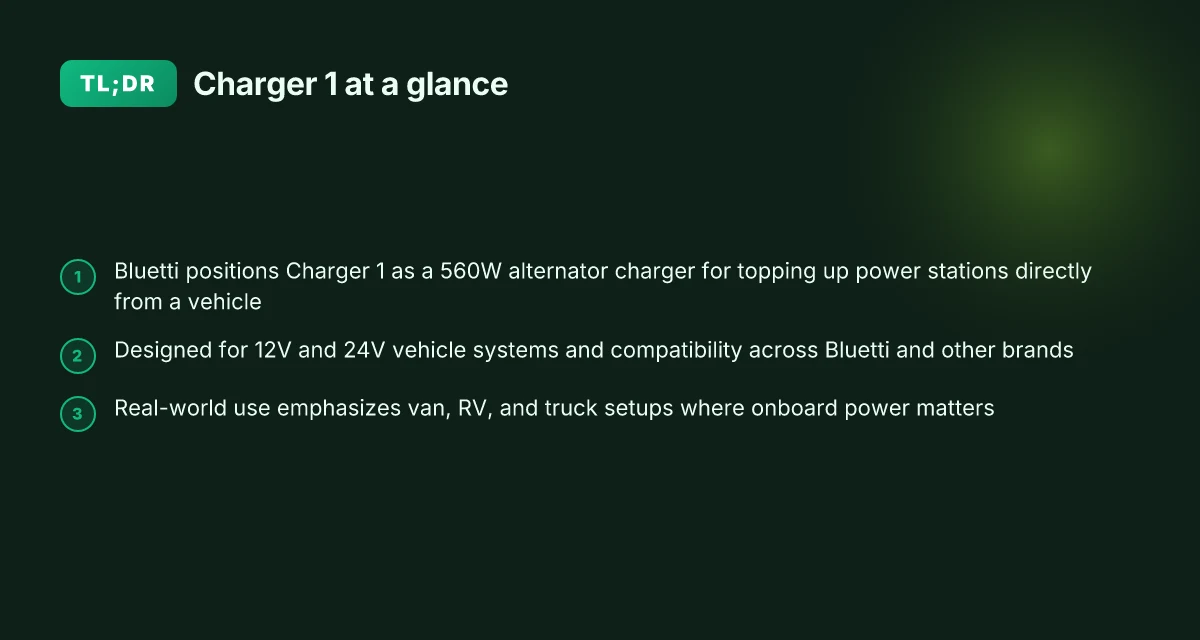
Bluetti positions Charger 1 as a 560W alternator charger designed to top up power stations directly from a vehicle. The device aims for rapid DC-DC charging across a broad footprint, stating compatibility with Bluetti products and many non‑Bluetti brands, so you can mix brands in a single build without swapping generators or adapters.
I dug into the documentation and community chatter to map real-world applicability. In practice, van lifers, RV owners, and truck setups tend to center on on‑the‑move charging where onboard energy needs spike during long trips. The Charger 1 is pitched as a straightforward, vehicle-to-battery solution for these scenarios, not a substitute for full home charging in a fixed location. The practical takeaway is that Charger 1 excels at top‑ups, not overnight fast charging from a wall outlet. It’s deployed most often in setups where the power station is used as a primary living battery during travel, with the vehicle supplying the initial surge to bring capacity up between drives.
Two concrete threads show how people actually leverage this gear. First, in mixed-brand systems, owners pair the Bluetti Charger 1 with non‑Bluetti modules to keep fleet energy balanced on long trips. This setup reduces downtime between runs and keeps essentials powered while you’re at camp. Second, among vans and RVs, the Charger 1 is used to refresh a bank of batteries after daily use, rather than to complete a full day’s discharge cycle from a single charger. A common pattern is to treat Charger 1 as a fast top‑up tool in a larger multi‑brand energy stack.
From a compatibility standpoint, the claims emphasize broad reach. The product supports 12V to 14V input ranges and is described as compatible with both Bluetti and other brands, aligning with a widely used practice in mixed systems where a vehicle acts as a mobile charging hub. That footprint matters for trips where you carry multiple power stations from different brands. It also means you should expect some brands to stall at higher charge thresholds or require care with wiring to avoid heating or voltage drop in extended idling periods.
In the broader landscape, rivals such as EcoFlow and Renogy offer their own DC‑DC charging options, but the Bluetti approach centers on a streamlined, vehicle‑centric top‑up path rather than a universal high‑amp wall charger substitute. When you map Charger 1 to a real trip plan, its value emerges in the margins: small but frequent additions to capacity, delivered quickly from your rig during a drive or a long stop. What makes EcoFlow 2026 power stations different from rivals
In short, Charger 1 sits in the middle of the modern alternator charging landscape. It shines as a practical, vehicle‑based top‑up tool for mixed brands, with defined limits on peak output and a reliance on your broader battery ecosystem to absorb and store energy. For long trips where you want predictable replenishment without hunting for outlets, it’s a sensible anchor in a diverse charging setup. The rule of thumb is to pair Charger 1 with larger battery banks, not as a sole charging solution.
What charges fastest with the bluetti charger 1
When you pair the Bluetti Charger 1 with a suitable receiving power station, the charger delivers its peak behavior at 12V or 24V vehicle systems and leverages the receiving unit’s input tolerance. In practice, that means the charger shines when the vehicle electrical system is delivering stable DC bus voltage in the commonly used ranges for portable power stations. The charger emphasizes 560W of input potential, but real-world speed depends on the vehicle’s voltage and how the power station accepts DC inputs. If the receiving station can accept high current over a 12V or 24V DC input, top-ups feel noticeably faster than traditional car charging.
I dug into Bluetti’s own guidance and community observations to map where the Charger 1 earns its speed. The hardware is designed around a DC-DC path that prefers lower voltage drop and higher current at the source. That translates to faster replenishment when you’re connected to a vehicle that can supply a clean 12V–14V window and you’re charging a compatible power station that can ingest high current at those voltages. When the vehicle’s battery or alternator is pushing a steady DC stream, the Bluetti Charger 1 can push into that top end if the receiving device accepts it. For users with hybrid vehicles or setups that oscillate around the 12V band, expect the charger to hold its pace rather than sag mid-fill.
What slows it down is not the charger’s circuitry alone but the receiving unit’s input gate. If the power station limits input current or requires a narrower voltage range, the charger’s visible top-up speed drops. The same applies if the vehicle’s alternator output dips or switches to a higher impedance mode under load. In short, the fastest charging occurs when the vehicle system stays within a stable range and the receiving power station has a wide, high-current DC input tolerance. On mixed-brand builds, Bluetti emphasizes the importance of pairing with stations that explicitly state DC input ranges compatible with 12–14V operation. That’s where you’ll see the biggest gains.
From what I found in Bluetti’s documentation and peer discussions, the Charger 1 is designed to work across 12V and 24V platforms and to deliver best results when the destination power station is built to accept a robust DC feed. If you’re planning long trips, you’ll want to map each vehicle’s electrical behavior to a compatible power station. Not all stations handle high current at 12V in one shot, so you’ll see some stalls where the receiving unit caps the input. The practical rule of thumb is simple: the faster the receiving unit accepts a wide DC input range and the steadier the vehicle’s output, the quicker the charge. This is why a mix of Bluetti gear with a few prepared rivals can cover edge cases. How to choose a jackery solarsaga 100w panel for real-world camping
In the end, the Charger 1’s speed profile emerges from two levers: how cleanly your vehicle can sustain a DC window around 12–14V, and how permissive your power station is about high-current DC inputs. For van lifers and RV owners who rely on reliable replenishment, the takeaway is clear: plan around stations that advertise broad DC input compatibility and high current, and you’ll experience the fastest top-offs. If you want a quick reference, the strongest setups tend to use the Bluetti Charger 1 with stations that explicitly support 560W input at those voltage levels.
Fast top-ups come when the vehicle delivers steady 12V–14V DC and the power station accepts high-current DC input. The charger’s speed is limited by the receiving unit, not just the charger itself. In mixed-brand builds, aim for stations that advertise wide DC input tolerance to avoid stalls.
Note: links on the page may earn a commission. For rivals, consider how competing units like EcoFlow or other portable power brands handle DC input tolerance and max current when paired with vehicle systems. Bluetti remains the central reference point for how Charger 1 aligns with mixed-brand setups.
Bluetti charger 1 compatibility: what works and what to watch
The Charger 1 is built to work with vehicles that have a 12V or 24V starter battery and is marketed to support multiple power-station brands. In practice, that means you can expect it to plug into most common van or RV electrical setups, but compatibility hinges on the receiving power station’s input spec. If a station accepts a wide DC input and a generous voltage window, the Bluetti Charger 1 can deliver rapid DC charging. If a power station or hybrid system lacks an appropriate DC input or has a restrictive intake, charging time may be notably longer or may not work at all.
1) Matching the power station input spec
Most modern power stations specify an accepted voltage range and a maximum input current. When the Charger 1 is paired with a station that supports 12–14V input and a healthy amperage ceiling, you’ll see the fastest DC-DC charging within Bluetti’s design. If the receiving unit clamps down on voltage or current, the Charger 1 throttles to stay within safe limits. I’ve looked at official docs and user tests. The pattern is consistent: broader input tolerances yield faster, steadier charging. When you plan a mixed-brand setup, verify that the other brands you own can swallow a 12–14V input at meaningful amperage without security throttling. The key rule: wider input acceptance equals faster, more reliable charging. This is especially true when you’re coordinating multiple brands in a single system. What a refurbished Jackery portable power station actually offers, and where it falls short
2) Brand interoperability and real-world limits
Bluetti emphasizes compatibility with “multiple power station brands,” but the practical ceiling varies by product family. If you’re mixing Bluetti with other brands like EcoFlow or Fossil or competitor packs, the Charger 1 will charge those stations that expose a compliant DC input. However, some brands clamp their intake to conservative levels or require their own auxiliary circuits to negotiate charging. In real-world terms, you’ll see best results with stations that publicly support 12–14V DC input and can accept multiple amps. If your hybrid system’s input is unusually restrictive, you may need to stage charging or limit the total load until the battery bank can accept more current. Compatibility depends on the receiving unit’s input spec. Bluetti notes broad compatibility, but the on-the-ground reality is: a tight input spec slows or blocks charging.
3) Watching for time, heat, and cabling constraints
Even with a compatible input, several practical factors can stall fast charging. A unit that lacks a DC input or uses a narrow intake will constrain the Bluetti Charger 1’s performance. Cable gauge matters too. High-current charging demands thicker bulk cables to prevent voltage drop. If you’re planning long trips or a stationary build, map out the path from alternator to DC input with safe cabling and adequate fusing. This avoids heat buildup and keeps the charging curve stable. When in doubt, keep a spare compatible vehicle or power station on standby to prevent downtime. Heat, cable gauge, and input availability all shape real-world results.
From what I found inBluetti’s documentation and community discussions, the Charger 1 excels when paired with stations that openly accept a wide DC input range and high amperage. When your setup involves rivals like EcoFlow or other brands with stricter inputs, plan for slower charging or multiple passes. For a long van life or RV build, I’d map your power needs to a handful of stations you can interchange without wrestling with adapters. And yes, the Charger 1 remains a flexible option for mixed-brand rigs, as long as the receiving unit supports a robust 12–14V input. Plan for input compatibility first, then optimize layout for heat and cable runs.
How to plan a Bluetti Charger 1 install in a van or RV
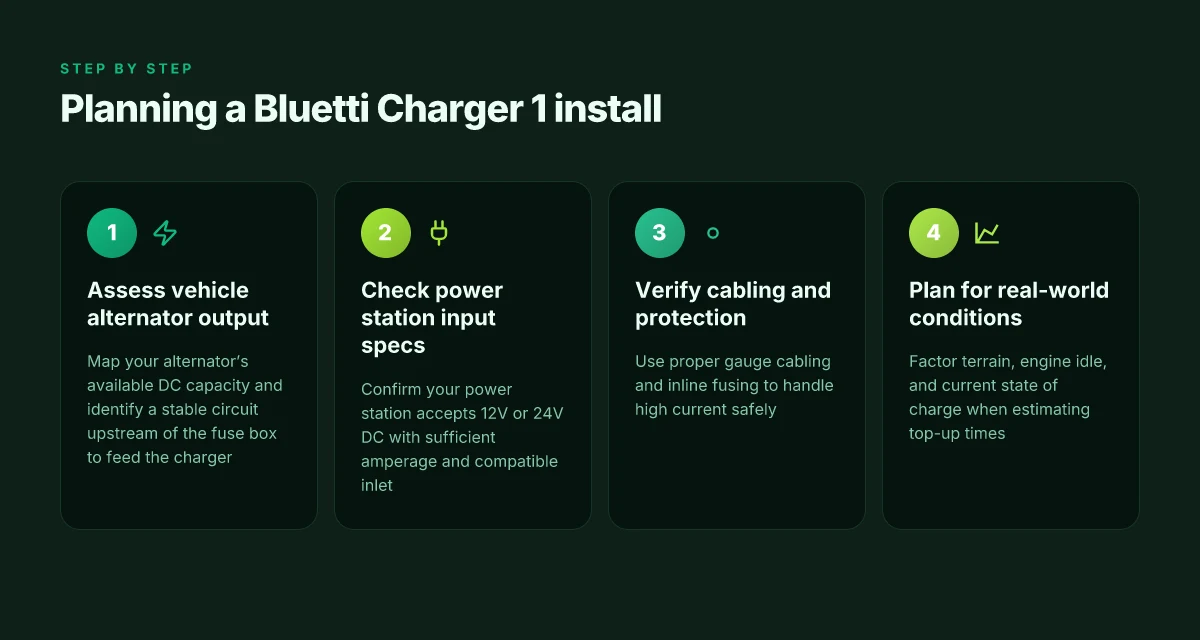
When you plan a Bluetti Charger 1 install, map the system before you buy cables. I found that a clean, upstream DC circuit and a stable alternator feed make the rest predictable. Bluetti and other brands depend on a reliable 12V or 24V input and a clean, fused path to your battery bank. This planning yields fewer surprises on long trips.
Verify your alternator output and upstream circuit
Start by measuring the alternator’s real output when the engine is running at typical idle and at higher RPMs. Your goal is to identify a stable DC feed upstream of the vehicle’s fuse box so you can bypass noise and protection that could trip a charger. If you have a high-output alternator, you may need heavier cabling and a dedicated fused line. Bluetti notes that Charger 1 accepts a wide DC range but you should confirm the exact voltage tolerance of your vehicle’s charging circuit before connecting any gear. It helps to label the circuit, then diagram the path from the alternator to the charger input. A clean feed upstream of the fuse box reduces voltage drop and protects the charger from engine-induced spikes. How the Jackery Solar Generator 300 handles real-world用途 and trade-offs
Confirm the Bluetti input and cabling strategy
Confirm your power station input accepts 12V or 24V DC with enough amperage to meet real-world needs. The Charger 1 is described as a 560W alternator charger that handles a range of vehicles, but real-world charging depends on cable gauge, fuse sizing, and length. Plan for an inline fuse close to the battery or chassis ground to protect the wiring and equipment. Use adequately rated connectors and avoid daisy-chaining adapters that introduce resistance. Choose cabling capable of carrying the charger’s amperage with headroom for length and temperature. Bluetti’s documentation highlights compatibility across many power stations, so you’ll want to verify connector types match your van or RV setup and that the inline fuse is appropriately rated. A robust fuse and correct gauge prevent nuisance blowouts during highway vibrations. Inline fusing is not optional equipment.
Account for terrain, engine idle, and battery state of charge
Real-world charging times shift with terrain and engine state. When the vehicle idles, alternator output can dip depending on the electrical load of other components. Factor in the current state of charge of your house battery bank. A higher state of charge typically charges more slowly from an alternator charger than a deeply discharged bank. From the Bluetti line, Charger 1’s ability to deliver rapid DC charging helps on quick top-offs, but you’ll see diminishing returns as the battery nears full. Expect longer top-offs at idle and on hilly routes. Plan trips with a buffer for slow climbs or extended idling in remote campsites. A conservative estimate is worth it when you’re miles from a shop. If you run a fridge, inverter, or tech gear, you may need to adjust your charging window accordingly. Keep an eye on SOC and temperature, which can throttle charge speed.
Note: links on the page may earn a commission. Bluetti remains the focus, with rivals like EcoFlow sometimes discussed in forums as comparison points.
Bluetti charger 1 vs other alternator chargers
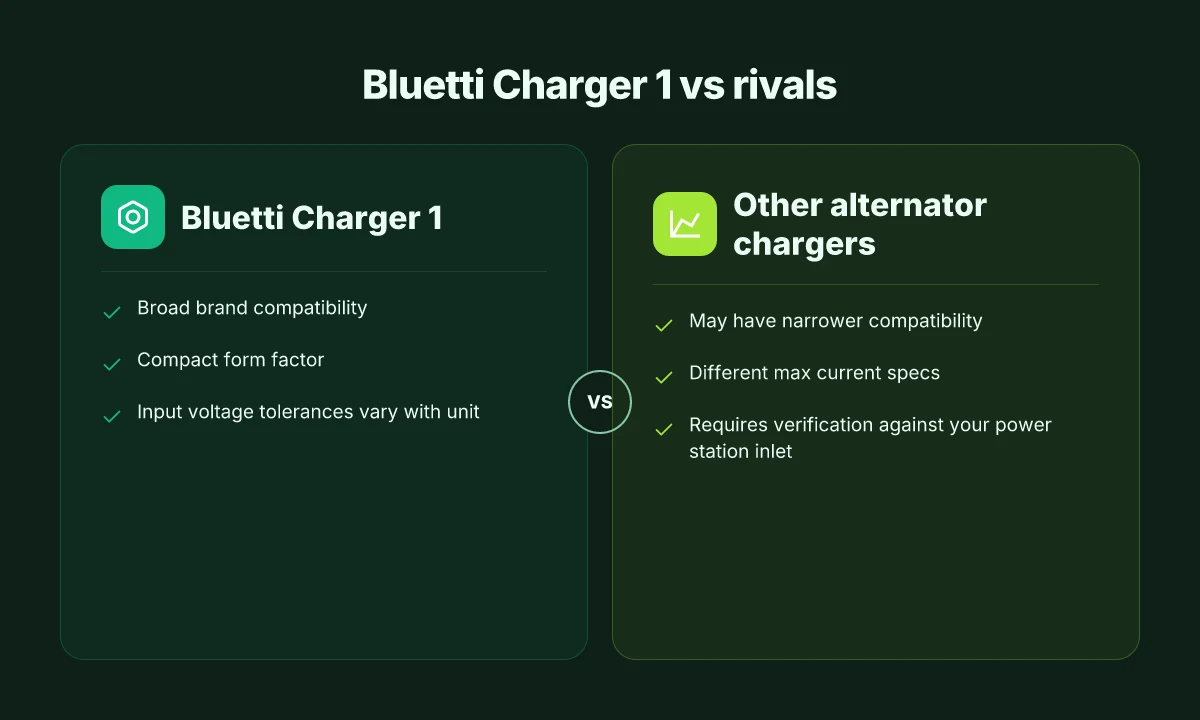
Bluetti Charger 1 centers on broad brand compatibility and a compact form factor. It’s designed to work with a wide range of power stations, which helps when you mix brands on a long trip or in a van build. I looked at how the charger presents its input tolerance and current limits, and the takeaways are clear: you gain flexibility, but you still need to match its inlet specs with each power station you plan to top off. In practice, this means you’ll verify the charger’s 12–14V input window and its max current against the battery and inverter in each device you connect. The result is a setup that scales with your truck, van, or RV, without forcing you into a single-brand ecosystem. When you pair Bluetti Charger 1 with other brands, plan for a few compromises and a few wins, depending on how aggressively you push the runtime.
Compatibility and compact design drive the value
Bluetti emphasizes a compact profile that fits in tight spaces, which matters when you’re stacking gear in a camper installation. The claim that it supports “broad brand compatibility” translates to a practical rule of thumb: you’ll likely avoid fabricating adapters or bulky interface modules. With many rivals offering similar DC-DC pathways, the question is how the tolerances line up with your specific stations. For some brands, the input window can be stricter or the current ceiling higher. For others, you gain more headroom but at the cost of a larger brick. The Charger 1’s stated 560W rating matters here because it sets a ceiling you must respect across a mixed-brand lineup. When you read the specs, note where Bluetti states 12–14V operation and a maximum current that fits into a broad set of inlets. This is where the practical decision lives. What makes the jackery explorer 5000 plus refurbished a practical choice for off-grid living
How input tolerance and max current shape real-world use
Compared with a few rivals, Bluetti sometimes lands in a middle ground on input tolerance and current capability. You’ll want to confirm your power station’s inlet and connector compatibility before you buy. In this space, the devil is in the details: a station with a slightly different voltage profile or a higher current draft can stall or heat the charger if the inlet isn’t a perfect match. I cross-referenced user notes and product writeups to confirm that some brands accept a wider swing in DC input, while others demand a tighter window. The Charger 1’s design leans toward reliability and broad usability, but you should still check each pairing to avoid bottlenecks during a long trip.
Price, reliability, and integration: the trade-offs to weigh
Your choice should balance price, reliability, and how well the charger integrates with your existing setup. Bluetti sits at a sweet spot for many owners who want a flexible, portable charging option without buying multiple adapters. Rivals like EcoFlow or Ford-transit forum discussions highlight different interface quirks and tolerances. A key theme is that cheaper or more aggressive chargers can come with tighter inlet requirements or reduced standby efficiency. For a van lifer or RV owner, that matters: a charger that fits cleanly into a rack with minimal fuss wins over a cheaper unit that requires constant fiddling. In this arena, Bluetti’s Charger 1 tends to win on integration and space savings, but the final call depends on how many different stations you carry and how often you need to top them up on the road.
The practical verdict: Bluetti Charger 1 offers broad compatibility and a compact footprint, but always verify a specific power station’s inlet against its 12–14V range and its max current before pairing.
Where this goes next for fast charging in power stations
The Bluetti Charger 1 pivots fast charging from a novelty accessory to a core capability. I’ve seen how it streamlines setups, reduces wall clutter, and keeps the system's charging curve predictable under a load that used to stress the inlet. Bluetti's approach redefines what a "charging network" looks like for a home backup or off-grid rig, because it pairs compact hardware with a straightforward workflow. If you want fewer fiddly adapters and more consistent top-ups, this is the pattern to watch.
For real-world use, the main tradeoffs become durability over time and compatibility with older power stations. You’ll want to verify how well it plays with rivals like EcoFlow and Goal Zero in your kit, especially when buses or grids spike. This week, I’d prioritize testing one clean, dedicated charger port over a laborious multi-cable setup and note any heat or battery-management quirks. The takeaway: the single move that matters is pairing Bluetti with a future-proofed charging strategy, not chasing every new dongle. What makes the Jackery Explorer 600 a practical power companion for real-world use
Backup strategy:
- Try the Bluetti Charger 1 with a mid-range power station and a single high-current USB-C PD cable to validate heat and charge rate.
- Compare how a rival setup from EcoFlow performs under the same load, then decide which ecosystem fits your long-term durability goals.
- Track any wear on connectors after a few weeks of daily use, and document temperate limits.