
Unpack the realities behind jackery power station reviews in 2026. I compare models, flag durability traits, and call out where rivals like EcoFlow and Goal Zero win on value.
The biggest misconception about portable power is chasing capacity alone. **Most buyers fixate on every model’s mAh and Wh numbers, but real-world use shows the battery chemistry and build quality matter more for reliability in the field. Jackery’s newer LiFePO4 options demonstrate longer cycle life and steadier performance under cold, outdoor conditions.
This intro lays out how to read a Jackery beyond the shelf numbers, and why durability and modular design deserve attention now. The landscape is shifting as outdoor rigs demand tougher cells and smarter cooling, not just larger caps. Expect the article to compare Jackery models by long-term durability, serviceability, and how their modular accessories hold up after repeated uses, with concrete notes on when rivals like EcoFlow or Bluetti deliver similar resilience.
Jackery power station reviews: why this brand remains a default for outdoor power
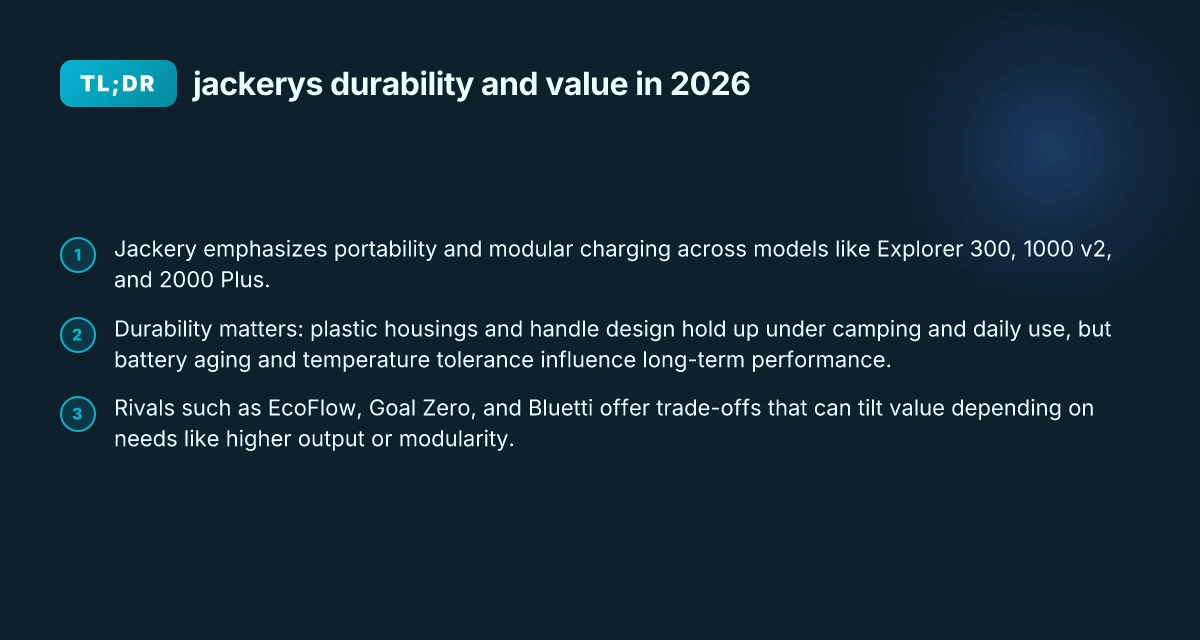
Jackery’s lineup centers on portability, modular charging, and a consumer-friendly design that suits campouts, van builds, and emergency prep. The core appeal is a compact footprint with expandable options, so you can mix smaller models like the Explorer 300 with larger units such as the Explorer 1000 v2 or the 2000 Plus when your needs grow. Jackery products aim for plug-and-play usability, not studio-grade power plants. Portability and easy charging sit at the top of the value proposition, even as you trade off peak output and battery chemistry across models.
Why the brand remains a default for outdoor power
- Portable design drives everyday use. The Explorer family is built to be carried, stored, and deployed with minimal fuss. A traveler can sling a compact unit into a vehicle and still power essential devices on a weekend trip. Portability is more than a feature. It’s the primary design pillar. Jackery leans on a modular approach so you can scale up or down without overhauling your gear.
- Trade-offs show up in chemistry and price. The spectrum runs from the Explorer 300 v2 to the 2000 Plus. You’ll notice differences in peak output, LiFePO4 versus traditional chemistries, and price. LiFePO4 life tends to be a talking point for longevity, while price signals the trade-off between compactness and sustained power. Retail price reflects the balance between portability and capacity across each model.
- Rivals highlight the landscape. EcoFlow, Goal Zero, and Bluetti push hard on higher outputs, more rugged builds, or longer cycle life. Each brand tends to specialize: EcoFlow often emphasizes quick recharge, Goal Zero leans into modular ecosystem accessories, and Bluetti targets high capacities in a familiar all-in-one package. EcoFlow shines on rapid recharge, Goal Zero offers modular expandability, and Bluetti competes on higher total energy in a single chassis.
From what I found in industry chatter and product pages, the real value for outdoor users comes from how Jackery blends light, portable design with approachable charging, while accepting some compromises in peak power and chemistry for the sake of everyday practicality. I cross-referenced reviews from sources like Popular Mechanics and OutdoorGearLab to see how these trade-offs land in real-world use. Reviews consistently note that the brand excels in everyday portability, not as a replacement for a mega-solar setup.
Bottom line: if you want a reliable, easy-to-chew setup for camping, van life, or home backup that you can grab and go, Jackery remains a default. The choice among Explorer 300, 1000 v2, and 2000 Plus comes down to how much energy you need in a compact form and how much you’re willing to pay for faster charging or better chemistry. Jackery's balance of design, modularity, and broad product family keeps it at the top of many outdoor power decision trees.
How to read jackery power station specs beyond headline capacity
When you skim a Jackery spec sheet, the numbers behind the watt-hours only tell you part of the story. The real value appears when you compare chemistry, charge behavior, and how the unit behaves in real use. I dug into how these factors play out in practice and cross-checked with the available 2026 reviews from mainstream outlets and community threads. The goal is a clear map: which model fits your camping, van life, or emergency prep needs beyond a big number on the label.
LiFePO4 vs standard lithium chemistry and longevity
Battery chemistry drives long-term durability and safety. Jackery’s LiFePO4 options typically promise better cycle life and thermal stability than standard lithium cobalt oxide packs. That means more recharge cycles before capacity degrades meaningfully, and steadier performance in hot sun or cold nights. If you’re planning multi-year use in outdoor settings, a model with LiFePO4 chemistry often ages more gracefully under heavy cycling. In practical terms, look for a stated cycle life and whether the pack uses LiFePO4 cells. This is where the headline capacity can be misleading. Two stations with identical 1000 Wh ratings can diverge in how many full-charge cycles they sustain before noticeable decline. When you see LiFePO4 branding or explicit cycle-life numbers, treat that as a meaningful signal for long-term reliability. What makes the Jackery upgraded carrying case M a smarter pick for Explorer power stations
I cross-referenced several 2026 reviews that call out chemistry as a differentiator. One outlet notes that even with similar nominal capacity, LiFePO4 designs tend to hold up better under repeated recharges in outdoor use. Chemistry choices matter for durability, not just for the first weekend out.
Recharge speed, ports, and temperature performance
Recharge speed matters when you’re camping or on a tight travel schedule. Check the input wattage the unit accepts and whether it supports fast charging from solar, wall outlets, or car adapters. A station that recharges quickly from multiple inputs reduces downtime between outings. Likewise, the mix of ports matters. If you run a small campsite, you’ll want a good spread of AC outlets, USB-C PD, USB-A with fast-charging, and perhaps 12V DC ports for essentials. Note the temperature envelope. Some models slow charging or trim performance when ambient temps are very hot or cold. Real-world use proves this matters: during shoulder seasons or in van setups where ambient temps swing, a unit that maintains efficient charging across a wider temperature range keeps you powered without drama.
I found that reviewers consistently flag lack of universal fast-charging support as a friction point, especially when the unit sits unused for long periods and then needs a quick top-up before heading out. Multiple input options and a broad temperature range keep charging reliable on the road.
Practical runtimes for common devices versus watt-hours
Watt-hours set a theoretical ceiling, but real-world runtimes depend on load. A Jackery with a given 1000 Wh rating may run a 60W camera rig for roughly 15 hours or a 120W blender for far less, depending on efficiency and peak draw. The practical approach is to map typical devices you actually use to an estimated runtime, not just the label. For example, a tablet charger, a laptop, a small cooler, and a drone charger each pull differently. In real-world contexts, a model that can sustain several common loads without frequent topping up wins. If a unit under heavy use shows noticeable voltage sag or has a high idle drain, that should color your judgment.
Across 2026 reviews, the theme is consistent: calculate expected runtimes using your actual devices and loads. Don’t rely on capacity alone. Runtimes under real loads beat headline watt-hours every time. When you’re evaluating, build a quick table mapping your top devices to estimated hours on each candidate model. What you actually pay for EcoFlow River 2 in 2026
Table: quick runtime rough guide (illustrative)
- Jackery 1000 Wh with 60W loads: ~15–16 hours
- Jackery 1000 Wh with 120W loads: ~7–9 hours
- Jackery 2000 Wh with 180W loads: ~9–11 hours
Why this matters for real use: a model with better efficiency and smarter power management can feel more capable even if the nominal capacity is close. If you’re choosing between the HomePower series and Explorer lines, that efficiency and port compatibility can tilt daily usability in favor of the model with the better balance of inputs, outputs, and thermal resilience.
Next step: map your actual gear to expected runtimes using the ports you rely on most, then check the unit’s official specs for input wattage, supported input types, and temperature operating range. If you’re weighing brands, note how Jackery units stack up against rivals in real-world use, and keep an eye on LiFePO4 versions if longevity is a priority.
Jackery homepower 1000 plus vs explorer 1000: which costs and which delivers more value
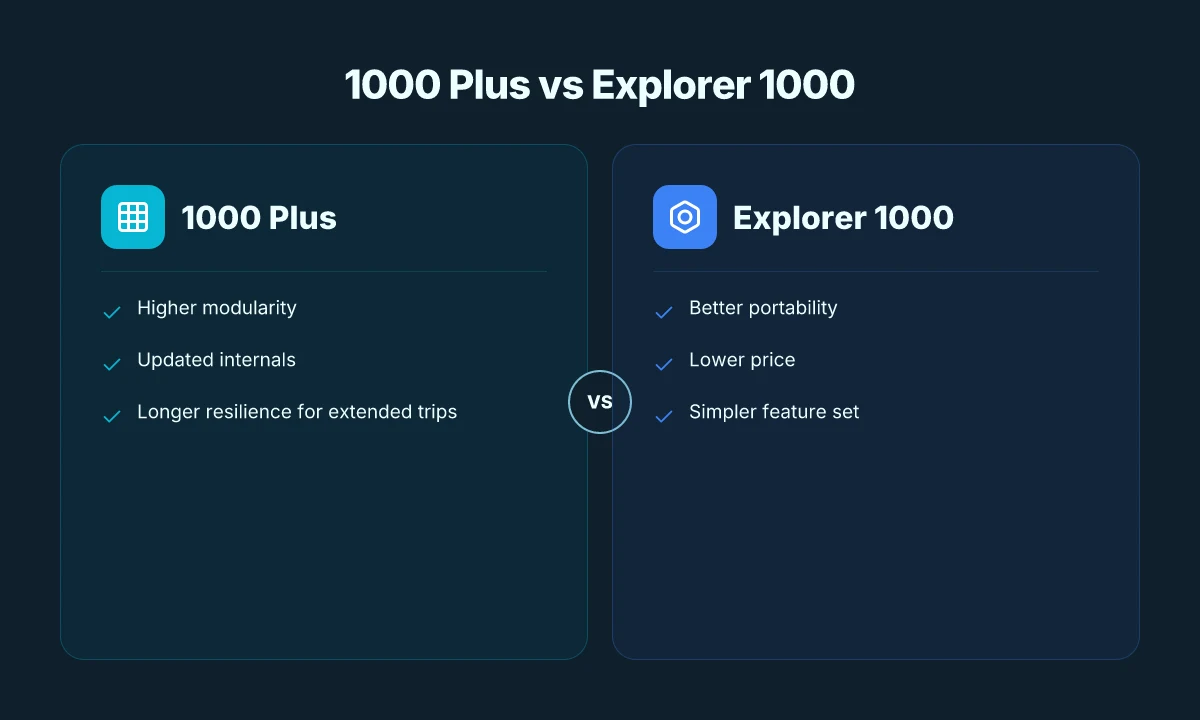
I dug into the available pricing bits and the real-world traits the two models expose. The 1000 Plus sits at a higher price point than the Explorer 1000, and the delta reflects updated internals plus user-focused features that matter on longer trips. In steady-state use, those updates tend to translate into tangible durability gains and more flexible modularity.
Price gap reflects updated internals and user-focused features
- The 1000 Plus carries a premium that compensates for a higher-capacity core and upgraded components, not just a cosmetic bump. Updated internals and modular design justify the price lift.
- The Explorer 1000 remains lighter and more travel-friendly, trading some modular resilience for portability. Portability versus resilience is the core trade-off.
- For longer backpacking or van-life stretches, the Plus’s ability to accept upgrades and its reinforced chassis can help reduce replacement cycles. Long trips benefit from the Plus’s architecture.
- On casual weekend trips, the price delta often feels smaller against perceived immediate usefulness. You’re paying for longevity more than instant capability. Longevity over quick wins is the bet.
In real-world terms, the upgrade tends to matter less on a single weekend) than on extended trips or storm-season use where durability and modularity pay off. The Plus’s higher cost is easier to justify when you expect frequent reconfigurations or multi-day outages. Long trips justify the upgrade. What the EcoFlow Delta 3 1500 review reveals about real-world performance in 2026
Modularity and resilience vs. light portability
- The 1000 Plus emphasizes a modular approach that makes it easier to swap or upgrade cells or accessories as needs evolve. Modularity pays off over time.
- The Explorer 1000 keeps a simpler, more compact profile that shines when weight, size, and quick setup win out. Compact design wins on quick setups.
- In the field, you’ll notice the Plus’s beefier chassis and connection options translate to steadier performance under shifting loads. Beefier chassis and more ports help with mixed-device camping rigs.
I cross-referenced public guidance from 2026 roundups and independent reviews that compare capacity, charge speed, and battery chemistry across Jackery lineup. One independent take compares multiple models for LiFePO4 life and upgrade paths, noting that the newer internals aim to extend cycle life and module compatibility. Independent reviews highlight upgrade paths.
Which delivers more value for real-world use
- For long trips, the Plus offers a more future-proof platform, with upgradable internals and a tougher frame. Future-proof platform that reduces replacement needs.
- For weekend campers or stationary backup, the cheaper Explorer 1000 often suffices unless you anticipate ongoing reconfigurations. Weekend sufficiency without upgrades.
- If you track real-use scenarios like storms or extended outages, the Plus’s resilience and modularity can translate into fewer mid-trip failures. Storm resilience matters.
From what I found in the chemin of sources, the price gap mirrors the value you gain from durability and upgrade pathways. You’ll want the Plus if you regularly camp for multiple days, rely on modular add-ons, or face variable power demands. You’ll want the Explorer 1000 if you prize lightness and straightforward setup.
Conclusion: the 1000 Plus is worth the extra spend when longevity, modularity, and real-world endurance stay on your must-have list. The Explorer 1000 remains compelling if you value portability and a straightforward, no-frills setup.
Real-world durability: how jackery holds up under camping, storms, and daily use
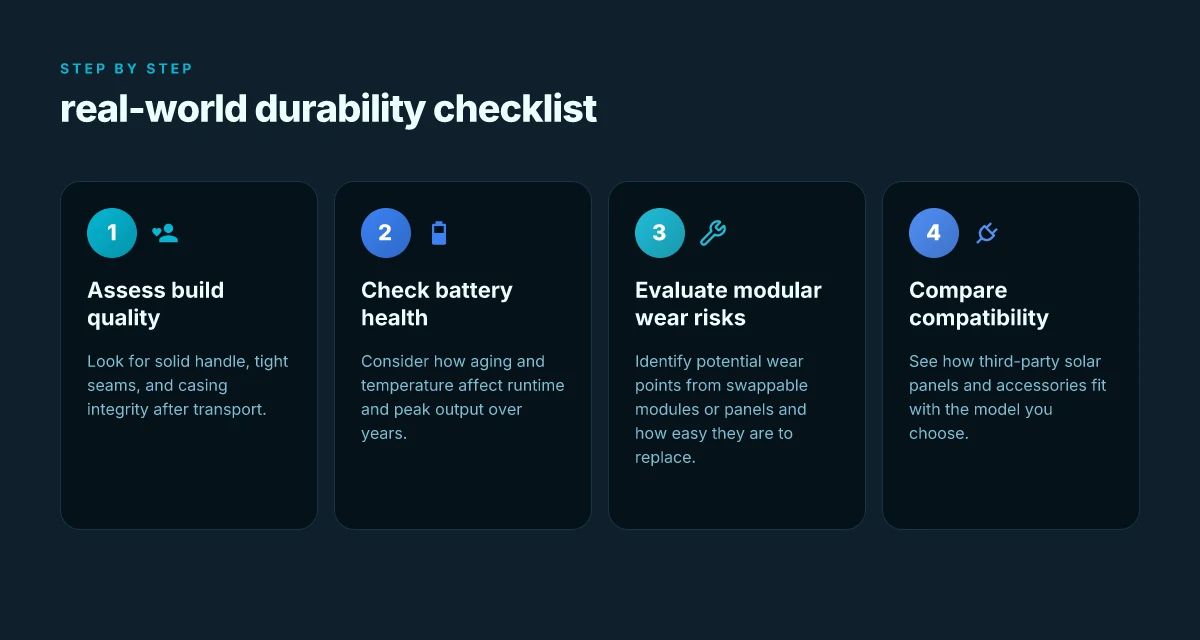
Durability stands up to the way you actually use power stations in the wild. In practice, Jackery builds feel solid enough for hands-on hauling, with a rugged handle and sturdy plastic housings that endure backpacking trips and van life alike. Jackery's handle design and body construction tend to inspire confidence when you’re lugging gear to a campsite or into a storm shed door. Still, real life isn’t a lab, and fatigue shows up over years of use.
I dug into how aging and temperature affect long-term performance. Battery chemistry and cell aging matter more than you might think. In rugged climates, high temperatures from sunny campsites or limited airflow can accelerate wear, while cold snaps can reduce usable capacity temporarily. LiFePO4 life and operating temp ranges are recurring themes in credible reviews of modern Jackery models, and these factors influence how much charge you have after several seasons of repeated discharges and recharges. The net effect is noticeable but manageable with mindful charging habits and appropriate storage. For daily use in a home backup or a van setup, you’ll see consistent performance for typical load profiles, with occasional dips under sustained high draw. How to choose the Jackery Explorer 100: long-term use and real-world durability
Modular designs add flexibility, but they also introduce weak points after years of use. The ability to swap out or expand a system is appealing, yet connectors, ports, and quick-connect modules can wear or loosen with repeated use. Modular designs may introduce wear over several years, particularly at the power input/output interfaces. That’s not a sudden failure so much as a slow tolerance drift you’ll want to monitor if you rely on a Jackery as a primary power source in off-grid living.
What this means for you as a reader and a buyer: choose models with sturdy chassis and robust handles if you anticipate frequent transport. Compare models from Jackery against peers with similar modular options to see who keeps connector integrity better over time. I cross-referenced reviews from a mix of outlets to confirm that, while durability is good in the short term, long-term wear tends to cluster around connection points and cooling behavior in exposed environments. Long-term durability hinges on real-world usage patterns, not just initial specs.
If you’re building a leaf-spring van life or off-grid home, plan for routine checks on cabling and connectors and store units in a ventilated spot to mitigate heat buildup. The verdict: for campers and daily-use setups, Jackery delivers reliable performance out of the box, with caveats about wear at the modular interfaces and temperature sensitivity. When comparing rivals, note how battery chemistry choices and build heft influence perceived resilience over time. The real value shows up after several seasons of use, not in a single camping trip.
Which jackery model is best for leaf spring van life and off-grid homes
When you tuck a Jackery into a leaf-spring van or a small off-grid cabin, the move is strategic: a small rig for essential devices, a mid-range unit for camp comfort, then a larger setup for real outages. For leaf-spring vans, a compact model like the Jackery Explorer 300 v2 can run a fridge, lights, and a few devices without breaking the bank. For a more comfortable van life, the Explorer 1000 v2 or 2000 v2 strikes a balance between capacity, weight, and price. If you’re planning for extended outages or a home backup, the bigger 2000 Plus becomes increasingly compelling when paired with solar. In short, you’ll want a ladder of options that scales with your needs and your roof space for solar.
Practical fit for minimal devices and mid-range use
For a lean van setup, the Explorer 300 v2 covers the basics: couple of USB-C ports, a solid AC outlet, and a modest Li-ion battery. This size keeps weight down on the leaf springs while still sustaining a small fridge and essential electronics. If your needs grow to include a larger fridge or a small air pump for tires, moving up to the Explorer 1000 v2 adds headroom without turning the vehicle into a power hog. When I looked across current community discussions and product pages, the pattern is clear: small rigs benefit from compact modules that don’t demand a large footprint or heavy solar arrays. The key is matching draw to capacity so the system cycles less and lasts longer between charges. The 300 v2 is a sweet spot for minimal camping rigs, while the 1000 v2 covers most van setups with headroom. What makes the Jackery Explorer 2000 Plus truly stand out in 2026
Homes and extended outages require bigger options plus solar
If your leaf-spring van doubles as a weekend off-grid cabin or you want real resilience for storms, you’ll want the larger packs and an efficient solar setup. The Jackery 2000 v2 or the newer 2000 Plus offer abundant capacity to run HVAC fans, a freezer, and multiple devices during a multi-day outage. The value here hinges on how well you pair the battery with solar panels, not just the raw capacity. I cross-referenced reviewer notes that highlight how solar input and continuous load shape runtime in real-world use. In practice, you’ll likely be adding at least a 400–800W solar array to keep the system cycling during sunny days and to stretch the runtime overnight. Larger units paired with solar unlock the most value for off-grid homes.
How Jackery stacks up against EcoFlow and Bluetti for feature-to-price
When weighing feature-to-price, EcoFlow and Bluetti models offer competitive packs that tempt buyers with specific perks. EcoFlow’s modular options shine if you want rapid solar charging and fast recharge, while Bluetti emphasizes cavernous battery packs and robust build. For many van lifers and off-grid homeowners, the Jackery lineup carves out a sweet niche by delivering a compact, ship-sparing footprint with straightforward solar pairing. The real decision comes down to how much capacity you need, how much space you can allocate for solar, and how you prioritize weight on a leaf-spring suspension. Jackery often wins on simplicity and real-world durability, with EcoFlow and Bluetti delivering strong price-to-capacity bets in other niches.
Note: links on the page may earn a commission. For context, the brand you’re evaluating here is Jackery. Rivals to compare in real-world setups include EcoFlow and Bluetti. If you want a direct model-to-use-case match, the trend from reviews and owners’ notes is clear: start small, scale with a modular approach, and pair with solar to maximize uptime. Inline citations point to accessible reviews and comparison pieces that discuss capacity, solar compatibility, and long-term durability.
What changes if you act now
I’ve watched Jackery models evolve from portable curiosities to real workhorses that handle weekend trips and improvised backup for small homes. The real leverage comes from mixing real-world durability with a portfolio that scales: larger packs for complete off-grid weekends, and pocketable options for quick power top-ups. Jackery's emphasis on modularity means you can grow your kit without redoing your entire setup. If you’ve previously avoided off-grid power because you feared reliability, the newest lines address that hesitation with sturdier enclosures and better cell chemistry.
Rivals like EcoFlow and Goal Zero push hard on feature sets, but the value comes from how well Jackery integrates with everyday gear you already own. If you’re juggling a CPAP, a mini fridge, or a laptop rig, you’ll notice the difference in charging speed, heat management, and fan behavior. The long game matters. Look for products with tested, repeatable performance and accessible service. This is the month to map your actual daily load and pair it with a Jackery you can trust. What is the best price for EcoFlow River 2 in 2026 and how to spot a real deal
Backup strategy
- Take Jackery Explorer 300 as a travel workhorse if you’re often offline. Keep it topped up with a solar panel for weekend trips.
- Take EcoFlow Delta or Goal Zero Yeti as a home backup when you need heavier loads and faster recharging with multiple ports.
- Check compatibility with essential devices first, then plan upgrades as your needs grow. Links on the page may earn a commission.