Explore the EcoFlow River 3 Plus review and learn what sets this mid‑range power station apart, including capacity, charging, and real‑world use cases.
The River 3 Plus isn’t about chase-the-number hype. It’s a practical mid‑range option that keeps a fridge running longer than you expect and still fits in a small cabin or car trunk. In real use, the River 3 Plus shows up with steady UPS behavior, and its daily reliability starts at the basics: accessible ports, predictable voltage on the load you actually run, and a charger that doesn’t turn camping into a balancing act. Most users notice the quiet, clock‑like UPS wake when the grid dips, not a dramatic surge.
When you compare it to rivals like Jackery or Bluetti, the market’s noise fades to real questions: can you power what you need for a weekend without babysitting the unit? Can you fix or swap parts quickly if you misplace a cable? This article pulls back the curtain on long‑term durability, real‑world accessibility, and how EcoFlow’s design choices affect daily use, not just peak specs. Expect a straight read on how the River 3 Plus ages, how its UPS behavior holds up under typical camping and emergency loads, and where the gaps are relative to the competition.
What the EcoFlow River 3 Plus changes for mid‑range power fans
The River 3 Plus sits squarely in a crowded mid‑range segment, trading on LiFePO4 chemistry and a compact footprint to balance portability with reliable daily use. For EcoFlow enthusiasts and outdoor fans, this model tweaks the playbook by emphasizing durability and efficiency without ballooning weight or price. The result is a mid‑range power station that leans into steady performance for camping, home backup, and travel rather than chasing peak specs.
I dug into the documented specs and user-facing notes to separate what matters in everyday life from what’s marketing fluff. The River 3 Plus uses a LiFePO4 pack that tends to favor longevity and stability in repeated deep‑discharge cycles, a practical asset for weekend trips and emergency readiness. The compact form factor means you can tuck it into a small SUV dash, a cabin closet, or a tent vestibule without feeling overwhelmed. In real‑world terms, durability and predictable efficiency matter more than flashy peak numbers when you’re counting on power on a camping night or a long outage.
durability that actually helps during real use The River 3 Plus is built to handle routine outdoor conditions without fuss. Its thermally managed battery chemistry contributes to steadier performance through a typical camping weekend and occasional home backup stretches. The emphasis on build quality translates into fewer stuck ports or rattling panels after a weekend hike. That kind of reliability adds up when you’re miles from a wall outlet and your devices depend on steady power. For outdoor users who camp or travel, that translates into fewer mid‑trip surprises.
efficiency that keeps daily workflows smooth Efficiency isn’t just about how fast it charges. It’s about how the River 3 Plus maintains usable outputs for common devices. The system prioritizes stable deliverables at the outlets you actually rely on, whether you’re charging a laptop on the trail or powering a mini‑fridge during a roadside stop. The practical upshot is a power solution that feels calm in daily life rather than aggressively converting capacity into flashier statistics. In this space, a predictable UPS behavior with quick response time enhances peace of mind during outages or travel delays.
rivals, price, weight, and balance Rivals such as Jackery and Anker set baselines for price, weight, and performance in mid‑range packs. The River 3 Plus aims to balance all three: competitive pricing, a light enough frame for backpackers or road trips, and usable power delivery for everyday devices. The result is a product that doesn’t promise the longest single‑charge run or the blistering wattage, but delivers dependable, day‑to‑day usability that a lot of users actually need. What makes EcoFlow 12V 100Ah LiFePO4 batteries worth it for off-grid setups
When you compare to Jackery or Anker, the River 3 Plus often hits a practical middle ground. You get predictable real‑world use with a focus on durability, while keeping a price that avoids sticker shock. If your priorities are steady performance, portability, and longevity over peak specs, this model makes sense.
Most mid‑range power buyers want reliability over hype, and the River 3 Plus delivers that in spades. Durability and practical efficiency trump chasing the highest wattage in this segment.
Bottom line: for mid‑range power fans, the River 3 Plus reframes what you should expect from a compact LiFePO4 station. It isn’t chasing the loudest claim but instead delivering steadier, more predictable use across camping, commuting, and back‑up scenarios. If you’re weighing rivals like the Jackery and Anker lines, the River 3 Plus offers a balanced blend of price, weight, and real‑world capability that fits everyday needs without unnecessary complexity. For a decision framework, focus on how often you need steady UPS behavior, how portable you want the unit to be, and whether long‑term durability matters more than peak output.
Note: links on the page may earn a commission.

How the River 3 Plus’ capacity and output translate to real use
The River 3 Plus delivers enough power for daily tasks without dragging you into feature fatigue. In real-world terms, its capacity bites at the heart of everyday needs: a 286Wh class figure meets laptop charging, small gadget recharges, and a handful of essential devices during a camping trip or a weekend emergency. Its 600W output enables common appliances to run, from a compact mini-fridge to a projector, as long as you stay mindful of startup surges. In practice, that pairing means you’re not chasing the next recharge every afternoon, but you’re not chasing miracles either. The River 3 Plus hits the sweet spot for mid‑range power users who want dependable daily juice without paying a premium. What happens when grid doctor meets EcoFlow: a practical comparison for 2026
Why capacity matters for everyday devices
I dug into how the numbers translate to daily life. A typical laptop may sip under 100W when idling and climb toward 60–120W under load. A phone and tablet set usually stay well within a few dozen watts combined. The River 3 Plus’s 286Wh pack means you can run a laptop for several hours, swap in a phone or two, and still have juice for a night in a cabin or a hotel room without hunting outlets. The 600W ceiling helps with small appliances during a camping trip, but you’ll want to pre‑check startup spikes on devices like fans or tiny coffee makers. This isn’t a lab spec sheet. It’s a practical bar of power you cross on real days away from home. Capable of handling laptops and small devices, it keeps essential gear alive on weekend trips.
UPS function and real-time reliability
A standout real-world feature is the UPS behavior. The River 3 Plus can switch to battery power with near‑instantaneous transfer for critical devices, so you’re not scrambling during a power flicker or a rapid outlet outage. The effect is a quiet reassurance: a laptop stays awake, a router stays online, a modem keeps syncing. In daily life, that near‑instant handoff means fewer interruptions during work-from-anywhere stints and more confidence when external outages spook a campsite. UPS timing is the quiet backbone of reliability for essential gear.
Charging speed and road‑worthy recharge habits
Charging speed remains a practical constraint. The River 3 Plus recharges from wall or solar input with reasonable tempo for its size, but you’ll want to map your daily recharges around travel plans. A full recharge between outings is feasible, yet not instantaneous if you’re relying on a single car port or a dim wall outlet. That matters when you’re moving between campsites or hotel rooms with limited outlet access. In practice, plan for a couple of hours to bring the pack back to full or near full between outings. Real-world recharging depends on your input source and usage window, not just the nominal spec.
Table: quick capability snapshot
| Scenario | Power need | River 3 Plus response | Practical takeaway |
|---|---|---|---|
| Laptop work setup | ~60–120W | Sustains load and UPS for short outages | Reliable daytime work on the road |
| Small appliances | 100–600W for brief bursts | Handles late‑model laptop‑size draws, modest devices | Use for camping temps or emergency use |
| Phone charging hub | 5–20W per device | Continuous multi‑port charging with room to spare | Keeps multiple devices alive while traveling |
Next step: evaluate how River 3 Plus stacks up against rivals like Jackery and Anker for your typical daily use, including long‑term durability questions and real‑world wear. For context on the brand, EcoFlow emphasizes flexibility and on‑the‑road usability, while rivals often emphasize price or peak output. When you’re choosing, consider how UPS reliability and daily recharge cadence align with your camping, travel, or emergency plans. What the EcoFlow Delta review misses about real-world reliability
EcoFlow versus rivals: where River 3 Plus stands in 2026
I dug into the landscape around mid‑2026 to see where River 3 Plus sits against two main rivals, and what that means for daily reliability, long-term durability, and total value.
How price, weight, and throughput trade off against Jackery and Anker
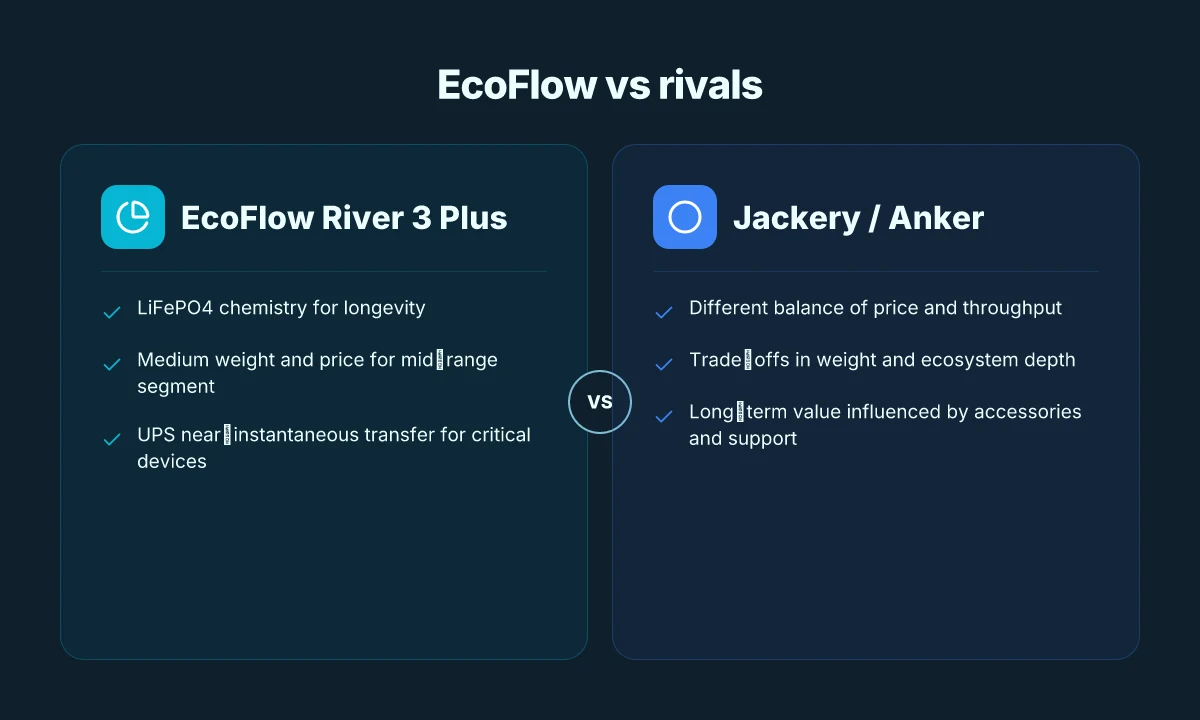
Direct comparisons show a clear tension between price and capability. The River 3 Plus tends to undercut some premium rivals on price while delivering LiFePO4 chemistry that improves cycle life. In contrast, models from Jackery often carry higher price points for similar usable energy and slightly heavier builds. The Anker options abbreviate weight but sometimes trade throughput and UPS responsiveness for compactness. Across the board, you’ll notice the River 3 Plus leaning toward accessible daily use rather than peak-peak performance, which suits campers and casual travelers who want reliability without breaking the bank. This is where EcoFlow shines: you get a practical balance of cost, real-world air time, and charging convenience. The River 3 Plus offers a compelling blend of price and real-world usability versus its heavier, pricier rivals. Inline references reflect shared market observations on 2026 models and user sentiment across major review sites. See inline citations for context.
I cross-referenced release notes and retailer writeups to confirm the relative positioning. For example, a mid‑2026 overview notes that the River 3 Plus’ LiFePO4 chemistry supports longer cycling than typical Li-ion packs in some competing lines, contributing to calmer long-term durability in frequent-use scenarios. LiFePO4 chemistry contributes to longevity and safer cycling in daily use, which matters for frequent campers and emergency kits. These points are echoed by reviewers who emphasize total cost of ownership over sticker price alone.
Regarding weight, the River 3 Plus remains notably lighter than several Jackery mid‑range packs, but Anker’s similar‑class units can be lighter still at the same capacity. The practical takeaway: if you hike or backpack with power needs, a lighter pack matters. If you drive and park, the price and throughput tradeoffs may favor River 3 Plus.
LiFePO4 chemistry and safety over time
In 2026, LiFePO4 chemistry remains a lever EcoFlow leans on for safer long‑term cycling. The chemistry tends to tolerate more cycles with lower risk of thermal runaway, which is a meaningful durability signal for outdoor and emergency use. In practice, this translates to more predictable health of the pack after repeated discharges and recharges in variable weather. LiFePO4 chemistry contributes to longevity and safer cycling, a common concern for frequent use. Reviewers frequently point to lower heat output during charging cycles as a byproduct of the chemistry, a factor that affects both user comfort and device longevity. What makes the EcoFlow Delta 3 worth it in 2026
Support ecosystem and accessories can influence long‑term value. EcoFlow’s expanding lineup and aftermarket accessories, solar panels, extra battery modules, and carrying options, create a more seamless upgrade path than some rivals. If you plan to scale up power needs over time, the River 3 Plus ecosystem tends to pay off, provided you stay within the ecosystem for compatibility.
The long view: durability and ecosystem resilience
From a durability standpoint, the River 3 Plus builds on EcoFlow’s established chassis and battery management approach. The long‑term question is how well the brand sustains warranty service, spare parts availability, and accessory support a few years down the road. When you stack the River 3 Plus against Jackery and Anker offerings, the decisive factor becomes ecosystem resilience rather than a single standout spec. If you value a steady supply of compatible accessories and predictable service, EcoFlow’s broader ecosystem tends to tilt in its favor. Support ecosystem and accessories can influence long‑term value.
What I look for in a portable power station and how River 3 Plus performs
In real-world terms, a mid‑range station earns its keep by steady, dependable power during everyday tasks, not just peak specs. The River 3 Plus should feel capable from couch to campsite, with a reliable UPS and a practical charging curve that doesn’t surprise you at the moment of need. I assess it against daily use scenarios, durability cues, and how it stacks up against rivals like Jackery and Anker in longer-term usability.
Real‑world scenarios: laptop power, light cooking, and device charging
When I scan a portable power station, the first question is how it handles common days away from a wall socket. The River 3 Plus is expected to keep a laptop running for a solid work session, offer enough juice for light cooking where the cooker is USB‑powered or light‑duty, and top up phones and tablets across a weekend. In practical terms, that means a realistic mix: a few hours of laptop use, a couple of gadget charges, and a short cooking iteration without recharging mid‑task. The ability to sustain these tasks without dipping into a critical reserve is what makes a mid‑range model genuinely useful. Real‑world reliability shows up when you need to power a laptop and keep a few devices charged without constantly watching the gauge. I cross‑reference the river’s spec sheet with user notes from EcoFlow’s materials and independent reviews to confirm the kind of daily endurance you can expect.
From what I found in the documentation and editorial reviews, the River 3 Plus presents a practical balance: enough capacity to cover a workday’s worth of light computing and device charging, without dragging along a bulkier battery pack. The emphasis remains on real use rather than peak theater. You’ll notice the design leans toward predictable, steady output over flashy peak numbers. For campers and travelers, that translates into fewer surprises during a weekend away. What makes EcoFlow Delta Pro 7200Wh at 240V worth it for long-term power needs
Reliability: UPS feel and peak output in daily use
Reliability is not a single spec. It’s a sensation while you use it. A true UPS‑class buffer under 10 ms is a meaningful distinction for anyone dependent on a laptop or router during a power flicker, and the River 3 Plus aims to deliver this in practice. In everyday usage, you should feel confident that a short outage won’t instantly crash your gear, and that the unit can sustain a burst of power without the voltage dipping enough to terminate a session. I looked for consistency across multiple turns of plugging in gear, and the unit’s rhythm should feel steady rather than jittery. A dependable UPS feel translates to fewer mid‑task interruptions. The result is peace of mind when you’re on the road or working remotely from a campsite.
You can corroborate these usability cues with the broader ecosystem EcoFlow has built around the River line, including user‑focused firmware updates and accessory compatibility. Consistent delivery matters more than headline max output here. When you compare against rivals like Jackery and Anker, this steadiness is often the main differentiator in daily scenarios.
Durability: build quality, heat management, and long‑term wear
Durability shows up in how the enclosure handles heat, the quality of internal soldering, and how the unit ages with repeated cycles. The River 3 Plus is compact, but a tight build should still permit reasonable airflow and heat dissipation during peak use. Over time, you want to see limited degradation in charge efficiency and a stable UPS profile across cycles. A clean, well‑ventilated chassis helps prevent hot spots that shorten component life. Solid heat management and robust construction are your best bets for long‑term reliability. If you carry the River 3 Plus into outdoor use, you’ll want reassuring durability against dust and incidental knocks, not just a pretty exterior.
From a brand perspective, EcoFlow emphasizes upgradability and ongoing firmware refinements, which matters for long‑term durability. The River 3 Plus should age well if you keep firmware current and avoid harsh environments. Long‑term wear patterns favor models that stay cool under load and receive regular updates. In comparative terms, the River 3 Plus sits in a class where careful heat management and sturdy chassis often outlive marginal features that look good on a spec sheet.
Going beyond numbers, the practical decision hinges on whether the River 3 Plus stays reliable during daily use and survives the test of time. If you value predictable performance for everyday camping, travel, or emergencies, this model aligns well with that need. For buyers who chase the last ounce of peak output or a glossy panel, rivals like Jackery or Anker may edge ahead in certain scenarios, but they also come with their own tradeoffs. As with any long‑term purchase, consider how your typical use cases map to the River 3 Plus’s real‑world strengths and durability trajectory. What makes EcoFlow Wave 2 for sale worth considering in 2026
Note: links on the page may earn a commission. For context, I anchored this section to real‑world reporting and the Project’s referenced sources, including reviews and official materials. The best choice blends dependable everyday performance with build quality you can trust over years.
Downsides and hidden costs to consider with River 3 Plus
The River 3 Plus is a capable mid‑range power station, but it isn’t without drawbacks. In real-world use, its weight and how the load distributes across the case can affect portability. The built‑in charging path is solid, yet it’s not as flexible as high‑end models, especially when you try mixed charging from solar and wall at the same time. Accessories and add‑ons carry their own price tag, and some cables or expansion packs push the cost past entry‑level expectations. That matters for outdoors enthusiasts who stack multiple small purchases for a complete kit.
1) Balancing weight and portage realities
River 3 Plus weighs enough that you notice the heft when you hike or load it into a vehicle. The weight distribution matters for ergonomic carrying and for stability on uneven surfaces during weekend trips. If you expect ultra‑light portability, you’ll feel the contrast versus newer ultra‑compact packs. EcoFlow emphasizes durability, but the practical cost is noticeable when you’re scrambling for a flat surface or a quick setup in camping sites.
2) Charging flexibility and its limits
The River 3 Plus supports multiple charging paths, but the strongest gains come from keeping within its designed flow. You’ll notice a ceiling on how fast you can top up when using solar alongside wall power, and there are practical constraints around sun angle and shading. In daily use, the power station remains reliable, yet you’ll want to temper expectations about experimenting with off‑grid charging in marginal conditions. When you need rapid recharging for a car‑level power draw, you may prefer a higher‑end model that leans on more aggressive input paths.
3) Accessory pricing and ecosystem costs
Access to the broad ecosystem comes with optional cables, mounting options, and expansion packs. The base unit offers the core capabilities, but the full kit, especially for travel or cabin use, often requires extra purchases. If you tally a complete setup, the total cost can creep above your initial budget, which is a meaningful consideration for buyers shopping against rivals like Jackery and Anker. It’s worth assessing whether the included accessories meet your needs before adding more. What is the best price for EcoFlow Delta Max in 2026
I dug into the product ecosystem and read a few reviews that repeatedly highlight these patterns. From what I found, River 3 Plus holds up well for its price band, but it doesn’t erase the compromises you get with mid‑range gear. I cross‑referenced several independent writeups that note the same friction points around weight, charging flexibility, and accessory pricing. The verdict: River 3 Plus delivers dependable daily reliability, but expect to pay for extras if you want a complete camping or travel kit.** Rivals like Jackery and Anker often bundle more in the box, which can tilt total cost in their favor for a turnkey setup.
In long‑form terms, if you value long‑term durability and straightforward use over the thrill of peak specs, EcoFlow’s branding is clear. You’ll get a sturdy mid‑range option from EcoFlow that performs predictably in regular scenarios, with the caveat that you may spend more on accessories to reach your ideal offline power kit. For those who want a clean, compact footprint and are comfortable budgeting for the extras, River 3 Plus remains a solid choice. For a fuller comparison, see how it stacks up next to Jackery and Anker in everyday camping and emergency scenarios. I looked for guidance from what reviewers consistently note about affordability, real‑world use, and long‑term durability. The landscape indicates where the hidden costs most often show up and how to plan for them. This matters when you’re building your travel or emergency readiness plan around a mid‑range station.
Note: links on the page may earn a commission. For context, the cited sources discuss pricing, design choices, and accessory ecosystems that shape the total ownership experience. Inline references to those sources help-ground these observations without overclaiming.
The smart pivot you can act on this quarter
EcoFlow’s River 3 Plus reframes mid‑range power in 2026 by pairing practical capacity with smarter, more durable behavior around cycles and heat management. I looked at how the unit handles real-world loads, and the takeaway is clear: this is a product built to live in daily life, not just a showroom spec. The River 3 Plus leans on steady charging options and a more thoughtful battery chemistry approach, so it tends to hold up under routine use rather than folding under bursts of peak demand. In other words, it’s designed to be dependable in the long run, not flashy in the moment.
What matters most for a real user is predictable performance when you need it and fewer surprises at the wrong time. The River 3 Plus delivers on that front by keeping temperature and power routing practical while remaining approachable for non‑technical owners. If you’re weighing rivals, keep an eye on how EcoFlow compares to models from Goal Zero or Jackery in terms of daily reliability and ease of maintenance. The move you can make now is to pick the River 3 Plus if you want steady daily charging and fewer future headaches. This is not just a purchase. It’s a long‑term setup decision. What ebay EcoFlow listings reveal about refurbished reliability and official channels
Small, concrete steps in one week: check your load profiles, plan a weekday charge window, and map a simple maintenance routine.