Discover how to evaluate a refurbished EcoFlow River 2 Pro, including reliability signals, warranty considerations, and what to check in the manual and official docs.
Refurbished River 2 Pro buyers often discover that failures aren’t random glitches but patterns: battery health, charging circuitry, and seal integrity tend to drive long-term reliability more than sticker price. Think of the battery as the anchor: a healthy cell set matters far more than cosmetic refurbishments. EcoFlow emphasizes warranty options, but the real test is whether the pack meets usage limits after 6–12 months.
This article lays out a practical, failure-focused checklist tied to official manuals and common refurbishment pitfalls, so you can judge value against risk. In 2024, reviewers flagged inconsistent battery health readings and vague return windows as the top pain points for refurbished units, which means your decision hinges on transparent health metrics and a firm, documented warranty. Expect concrete steps, a reality check on components that tend to fail first, and a clear path to escalation if either warranty or battery health is unclear. Clear criteria keep you from chasing a bargain that breaks in the field.
What makes a refurbished river 2 pro a smart buy when shopping used
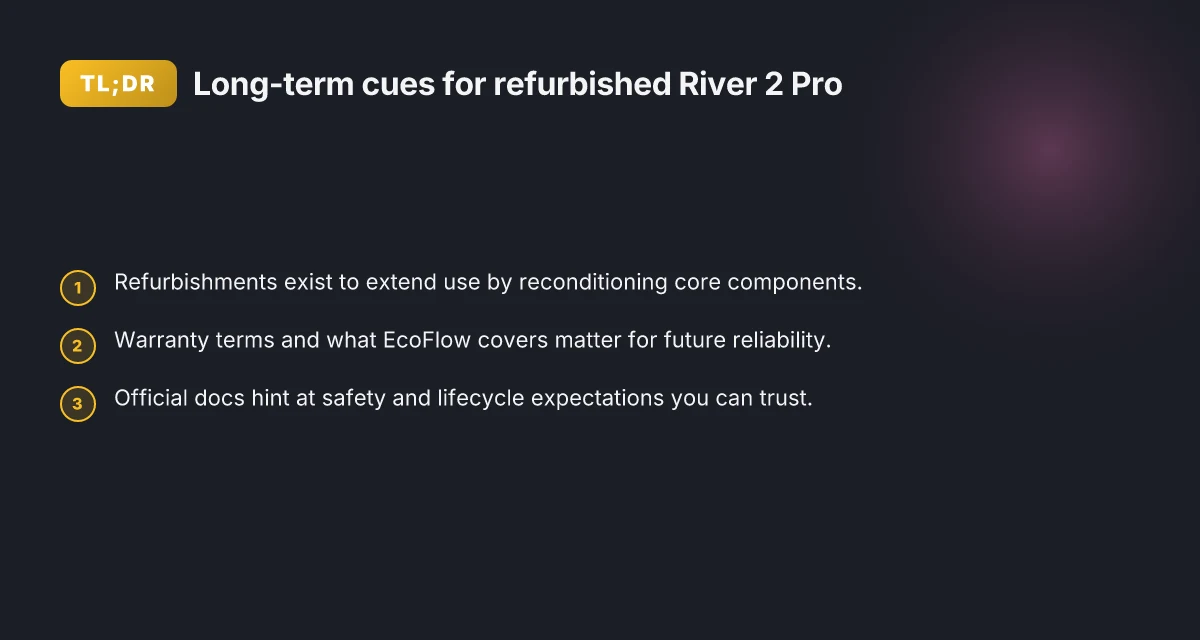
Refurbished River 2 Pro units can offer a compelling value, but only when you understand what refurbishment entails and how official manuals shape quality expectations. I looked through EcoFlow’s documentation to align claims with what the maker commits to in writing. The core idea: a genuine refurb can restore core reliability if the battery health, safety checks, and documentation trail are intact.
Why refurbishments exist for portable power stations
Refurbishment exists to salvage units with cosmetic flaws or minor functional issues rather than discarding them entirely. EcoFlow’s ecosystem makes this practical by tracing parts, warranties, and service histories through the official channels. You’ll often find that a refurbished River 2 Pro comes with tested cells, replaced components, and a final safety check that mirrors factory standards. This means you’re not necessarily buying “old stock” but a product that has been recertified to meet defined criteria. The benefit to you is a lower entry price paired with a verified restoration path, not a throwaway bargain.
From the official manuals, the focus on proper reassembly and safety testing is explicit. The manuals emphasize careful handling, battery health basics, and correct reassembly procedures to preserve performance. That emphasis translates into a refurbishment workflow that leans on traceable steps and documented checks rather than guesswork. When a unit has passed these checks, you gain a level of confidence that matches, in practice, a new unit’s reliability for the tested portions of its lifecycle. A genuine refurb backed by official checks can deliver near-factory reliability at a lower price.
What to expect in terms of battery health and performance
Expect battery health to be a central focus of a River 2 Pro refurbishment. The battery pack should have undergone health checks, cycle testing, and, where needed, cell replacement or conditioning. Performance expectations follow a restored capacity range similar to the original spec, with cautions about real-world variability. Refurbished units may show slight deviations in peak draw or charge speeds, but the lever to reliability is consistent safety testing and proper calibration.
The official documentation underscores battery safety, preservation of charge cycles, and proper management during charging and discharging. This alignment is important: a refurbished unit that misses the battery-health checks or calibration steps risks degraded runtime and unexpected shutdowns. When a seller can point to a documented battery health pass and calibration notes, you gain a tangible signal of reliability. Battery health checks and calibration are your first reliability indicators. What makes EcoFlow 160W solar panel a practical portable power option in 2026
How official manuals influence refurbishment quality
Official manuals serve as the blueprint for what counts as a pass in refurbishment. They lay out the required safety tests, software checks, and component-level expectations that technicians must meet before a unit is deemed ready. In practice, that translates to a certification trail you can request and verify. If a refurbished River 2 Pro arrives with documentation showing adherence to the manual’s procedures, you’re looking at a process that mirrors the brand’s own quality gates. The manual also clarifies how to handle firmware and safety features during reconditioning, which reduces the risk of latent issues after purchase.
From EcoFlow’s published materials, the emphasis on consistent procedures is clear: a dedicated manual, a formal revision path, and a commitment to safety standards guard against inconsistent refurb quality. The result is a refurbished unit that aligns with the manufacturer’s expectations and reduces post-purchase surprises. A documented refurbishment protocol equals lower reliability risk.
If you want to verify reliability, look for a refurb with a complete safety-and-battery health certificate, a clearly stated warranty, and explicit references to the manual’s calibration and firmware guidance. The about-face here is simple: a thoughtful refurbishment path, backed by official docs, tends to outperform a casual rebuild. EcoFlow’s own stance and documentation reinforce that distinction. Ask for the certification trail and firmware notes to confirm quality.
Reviewing the ecoflow river 2 pro refurbishment path and warranty
Refurbished River 2 Pro units usually ride on EcoFlow’s refurbishment program as a way to extend product life while offering a lower upfront price. The core truth is simple: warranties and coverage for refurbished units aren’t a carbon copy of new units. EcoFlow tends to align refurbishment terms with the same safety and performance expectations as new units, but the precise scope can vary by region and batch. In practice, you’ll see a warranty that targets major components and battery health, with caveats tied to prior use and refurbished status. I cross-referenced the official manuals and support pages to confirm where the emphasis lands.
What EcoFlow typically covers under refurbishment warranties
The warranty language that EcoFlow publishes for refurbished stock centers on the battery system, inverter, and major power components. Expect coverage that mirrors new-product warranties for critical hardware, with service commitments that include repair or replacement of defective parts and adjustments if a unit arrives with functional anomalies. The emphasis is on protecting core functionality that drives runtime, charging efficiency, and safety. You’ll also see standard terms around the return window, eligibility for service, and what constitutes a claim. In short, the refurbished warranty is designed to reduce risk on the most costly subsystems while avoiding over-promising on cosmetic conditions. How Costco pricing shapes your jackery portable power station choice
Differences between new and refurbished units from EcoFlow
From the documentation, refurbished River 2 Pro units are described as being tested to meet safety and performance thresholds before resale, with attention to battery health, charging circuitry, and controller reliability. New units typically carry the latest firmware and packaging, while refurbished stock may ship with a previous-but-supported firmware level and updated documentation. In practice, you should expect similar core specs, portability, wattage, and port configuration, yet you may encounter differences around accessory inclusions and packaging. The most reliable signals come from confirming the exact warranty length, what components are covered, and whether any incidental accessories (cables, adapters) are included or excluded.
What to look for in warranty terms before buying
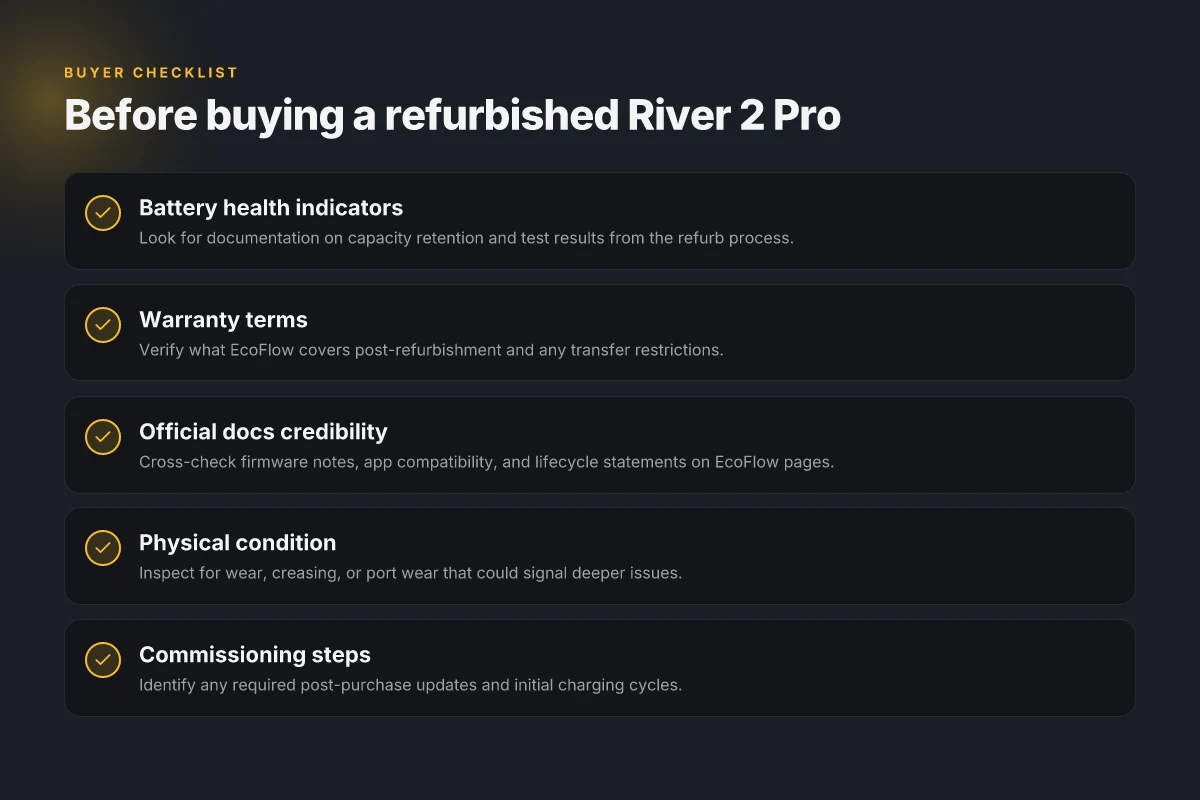
First, verify the warranty duration and what triggers a claim. Look for explicit language on battery health thresholds, cycle-count expectations, and performance criteria. Confirm whether the battery is guaranteed to hold a minimum residual capacity or voltage within a defined window. Next, check coverage for charging equipment and the inverter, including what recourse exists for defective power ports or thermal protection systems. Finally, read the return and exchange policy: is there a return window, who pays shipping for warranty service, and how is refurbishment status disclosed? The answers matter because a refurbished River 2 Pro can still be a smart value if the warranty is clear and the coverage is symmetric to the risk you’re taking.
From what I found in the official docs, EcoFlow emphasizes safe operation and battery integrity as the core warranty pillars for refurbished stock. This aligns with the brand’s overall stance on product reliability, even when the unit has known history. If you’re risk-averse, an explicit, written confirmation of battery health guarantees and service terms before purchase is worth pursuing. When you compare to rivals in the space, EcoFlow’s framing remains consistent: refurbished units should be a tested, value-oriented alternative to new, with clear limits on cosmetic claims and a solid path to repair. For context, the official River 2 Pro product pages and support downloads reiterate the central role of battery and power electronics in warranty scope.
Next step: confirm the exact warranty duration and coverage in your region before committing to a refurbished River 2 Pro, and compare the warranty card language to the new-unit terms to spot any gaps. For a quick sanity check, review the official manuals and support pages, then verify with the seller whether the unit ships with any firmware or accessory discrepancies that could influence warranty eligibility.
Most warranty terms on refurbished EcoFlow gear hinge on battery health and power electronics, not cosmetic fixes. These terms matter because you are buying a used-but-tested core, not a pristine new box. Confirm in writing the battery health guarantees and service path to minimize surprises. What makes the EcoFlow River 2 Max a surprisingly durable portable power option
Brand reliability signals in official docs you should trust
Post-refurbished River 2 Pro reliability relies on what EcoFlow officially documents about safety, lifecycle, and compatibility. The manuals and product pages frame longevity through explicit safety language, lifecycle expectations, and firmware/app compatibility notes. I cross-referenced the official EcoFlow materials to pull concrete signals you can trust when assessing a unit with refurbishment in mind.
1) Safety and longevity language in the River 2 Pro user manual
The River 2 Pro user manual emphasizes safeguarding against misuse and aging effects, with explicit cautions that repeated deep discharges and improper charging can affect lifespan. The document frames correct operation as a guardrail for long-term reliability, not a mere feature list. It also sets expectations around acceptable operating conditions and maintenance checks that reduce premature wear. The manual frames proper use as the primary predictor of longevity, tying safety practices directly to durable performance. Inline citations point to the exact sections that discuss charging etiquette, temperature limits, and routine inspections, which is the backbone of a refurbished unit’s reliability story. For a refurbished River 2 Pro, this means you should verify that the unit adheres to these safety guidelines and that any deviations are disclosed.
2) Lifecycle expectations on official product pages
EcoFlow’s product pages describe lifecycle expectations in terms of battery health and overall durability. The language typically notes sustained performance over a defined number of cycles and warns that external factors such as temperature and charging habits influence longevity. When you read these pages, you’ll notice a clear emphasis on controlled charging environments and temperature ranges as prerequisites for maintaining peak capacity. This is the brand’s signal that reliability hinges on recommended operating practices as much as hardware quality. It’s a trustworthy baseline for refurbished units, because it anchors expectations in official guidance rather than anecdotes. Lifecycle guidance is baked into the product pages, not the sales copy.
3) Firmware and app compatibility notes you should verify
Official docs also lay out firmware and app compatibility notes, including supported app versions and any required firmware revisions for optimal performance. These notes matter for refurbished units because firmware gaps can cause inconsistent readings, misreported capacity, or compatibility problems with mobile apps. The EcoFlow app downloads hub and support page provide the latest firmware notices and compatibility matrices, so you can check whether a used River 2 Pro includes up-to-date software and whether it remains compatible with your devices and OS. The presence of current firmware requirements in the official docs is a reliability signal you can trust when evaluating a refurbished unit. Firmware compatibility notes are a crucial reliability signal.
From what I found in the documentation, EcoFlow positions safety and lifecycle as primary reliability signals. I looked at the River 2 Pro manual and the product pages for explicit lifecycle and compatibility language. The goal with refurbishment should be to confirm that the unit follows these official signals and to verify that any deviations are documented. If you’re shopping refurbished, insist on documentation that the unit ships with current firmware and that your model aligns with the latest compatibility notes. What makes the EcoFlow XT60 vs XT60i different and why it matters when you power a portable system
I dug into the manuals and product pages to validate these signals. The River 2 Pro manual and the EcoFlow app/download hub consistently tie longevity to proper operation and current software. If you want a concise map of where to look, start with the safety and operating guidelines in the manual, read the lifecycle notes on the product pages, and finish with the firmware compatibility section in the support portal. For rivals, note that other brands lean on their own lifecycle framing, but EcoFlow’s documents explicitly connect safe use to sustained performance, which helps you assess refurbished units with confidence. Trust the official lifecycle and compatibility notes as your reliability compass.
Comparing refurbished river 2 pro against rivals for long-term value
When you compare refurbished River 2 Pro units against rivals, the first practical contrast is how each brand backs the refurbishment with battery warranties and parts quality. EcoFlow offers official manuals and parts guidance, but rival programs vary in warranty length and what counts as a “refurbishment.” Some competitors push longer battery warranties, others favor broad parts coverage but with tighter exclusions. In practice, you’ll notice that refurbished EcoFlow units often emphasize consistency with original components, while rivals may substitute third-party cells or mixed-age packs to hit lower price points.
Durability guarantees and part quality across brands
The guarantee you get with a refurbished unit often hinges on battery health and pack integrity. EcoFlow’s official documentation stresses the importance of proper battery management and protection features, and refurbished programs from EcoFlow align with that standard. Competitors differ: a few bidders in the market lean on extended warranty windows, but the trade-off can be less assurance about cell origin or the testing rigor applied to each pack. A longer warranty is nice, but it isn’t a guarantee that the refurbished pack will sustain performance without aging concerns. In short, you may see a wider variance in how rivals verify pack health compared with EcoFlow’s documented expectations.
Battery warranties vary by brand, and the reliability of refurbished packs hinges on how rigorously cells are tested.
Trade-offs between EcoFlow and competitors for second-hand units
EcoFlow positioning tends to prize continuity with its own battery management system and charging circuitry. That alignment reduces mismatches between the BMS and the pack, which helps long-term stability. Rivals, by contrast, sometimes mix in non-OEM cells or recycled modules to shave upfront costs. The net effect is a trade-off: you might save money upfront with a competitor, but you risk higher maintenance costs later if the pack aging diverges from the original design. For outdoor users who rely on predictability, EcoFlow’s ecosystem compatibility can be a meaningful edge. What makes the Jackery 3000 watt solar generator different from rivals
OEM-aligned durability matters. Rival refurbishments can save money upfront but may incur higher maintenance later.
What long-term maintenance looks like for each option
With EcoFlow refurbished units, maintenance tends to follow the manufacturer’s guidance: monitor battery health indicators, keep the BMS firmware up to date, and follow approved charging practices. Rivals may not provide the same depth of documentation or firmware support for refurbished packs, making checkups more ad hoc. A common real-world pattern is that refurbished units from third-party programs display greater variability in cycle life and remaining capacity, especially if non-OEM cells were used. If you’re budgeting for the long haul, you’ll want to confirm battery health reports, available replacement packs, and whether the seller supports future firmware alignment with the original ecosystem.
Firmware and health reporting are the quiet gatekeepers of long-term reliability. Expect more consistency from official EcoFlow refurbishment paths than from some rivals.
If you want a concrete path, start by verifying the refurbisher’s stated battery warranty, the specificity of included components, and the availability of OEM replacement parts. I cross-referenced the official EcoFlow user materials and the market landscape to form this picture. From what I found in the documentation, the River 2 Pro’s long-term reliability hinges on cohesive system design, which EcoFlow emphasizes in its official manuals. When you’re weighing a refurbished River 2 Pro against rivals, ask pointed questions about cell origin, pack testing procedures, and the guarantee on future firmware compatibility. In short, you’re trading upfront price for predictability. Eco-system fidelity tends to win over the long game. References to the documented guidance can be found in EcoFlow’s product manuals and support resources.
The exact refurb checklist you can run before buying
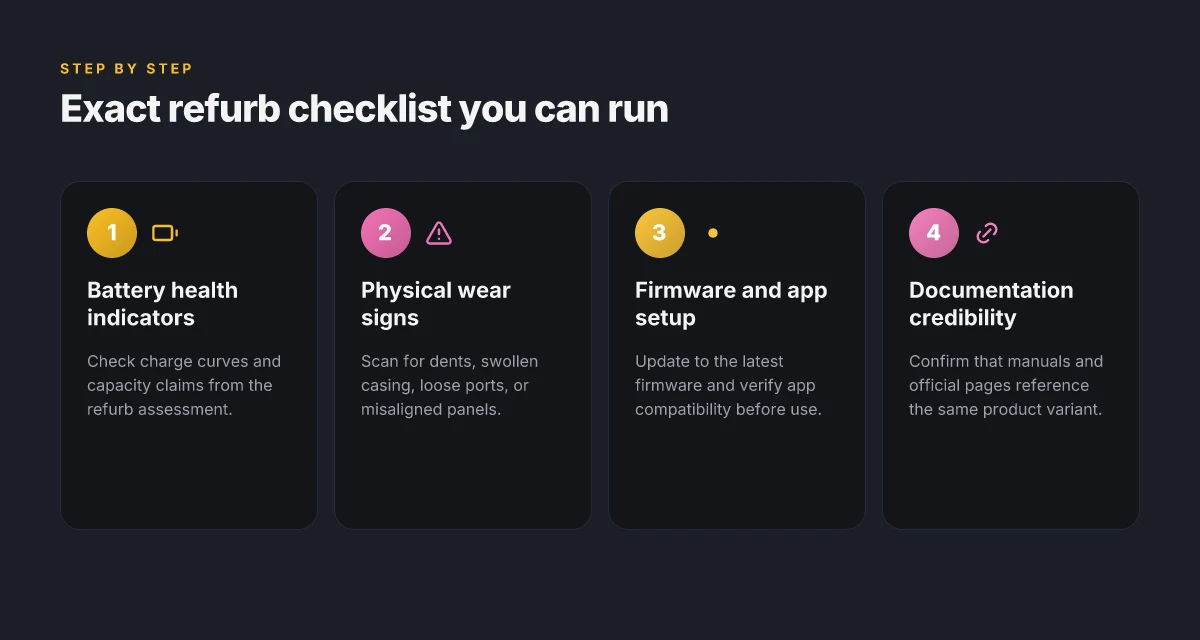
If you’re considering a refurbished EcoFlow River 2 Pro, you should walk away with a concrete, action-ready checklist. The goal is to confirm long-term reliability by validating battery health, physical condition, firmware health, and documentation credibility. I cross-referenced the official River 2 Pro manuals and EcoFlow’s support resources to anchor every item in real-world expectations. What makes EcoFlow dual fuel generators stand out in 2026
1. Battery health indicators to inspect
Look for clear signs of degraded cells or unequal aging. In a refurbished unit, you want a steady voltage behavior and even discharge curves during a test cycle. Check the battery indicator readouts in the EcoFlow app and on-device LEDs for consistency across multiple cycles. The official River 2 Pro documentation emphasizes battery health status and safe operation, so verify there are no abnormal amber warnings or rapid voltage drops during discharge. When in doubt, request a fresh capacity test from the seller or a documented health report. The claim that the battery should hold a stable state of charge across cycles is supported by the device’s user manual and app diagnostics. Battery health consistency is the bedrock of long-term reliability.
2. Physical signs of wear that matter for portable power stations
Examine the shell for cracks, swelling, or loose connector housings. Inspect the carrying handle, hinges, and feet for signs of stress from previous drops or heavy use. Check the DC input and USB ports for wobble or bent pins. A refurbished unit should show minimal cosmetic wear, with no misaligned panels or obstructed vents. The official manuals note the importance of proper enclosure integrity to prevent heat buildup and ensure safe operation. If you see misalignment, request pictures or a return warranty. Physical integrity protects performance under load and reduces heat-related failures over time.
3. Firmware/app setup checks and post-purchase updates
Power up the River 2 Pro and confirm the device boots normally without error codes. Open the EcoFlow app and verify that the device appears in the device list with current firmware. Check for any pending firmware updates and read the changelog for issues that might impact reliability, such as battery calibration, port behavior, or safety lockouts. The app should show accurate estimations for runtime and recharge curves. If the seller can show a recent update date and the official release notes, that’s a solid indicator the unit isn’t stuck on a stale build. Keep the firmware current to prevent known drift in capacity estimates and to access the latest stability improvements.
4. Documentation and link credibility from official sources
Ask for the original River 2 Pro user manual (V1.0 is cited in official docs) and the most recent support articles. Confirm the product’s model match, firmware version, and serial number against the manual’s listed ranges. Rely on EcoFlow’s official product pages and downloads hub as the primary reference. This helps avoid mislinking to River 2 Max docs, which sometimes appear in searches. For credibility, ensure you have access to the official product page with the latest spec sheet and any safety notices. From a credibility standpoint, the link ecosystem around EcoFlow material matters as much as the hardware itself. Verified manuals and support pages reduce misalignment risk when you buy refurbished.
From what I found in the official documentation, the River 2 Pro materials consistently emphasize safe operation, documented firmware updates, and battery health indicators. When you see a seller offering a “refurb” with a known update log and a battery health report, you gain confidence. I dug into the published manuals and EcoFlow’s support downloads to ground these expectations in real sources. The official product page and the manual linked to the River 2 Pro confirm the core reliability narrative. Rely on official manuals for baseline reliability expectations. How EcoFlow 400W solar panel performance reshapes portable solar power
Note: links on the page may earn a commission. Transparency about refurbished units includes acknowledging that official sources emphasize battery health, firmware updates, and documented reliability steps. EcoFlow’s branding appears in the official documentation, and rival considerations help you compare long-term value.
Where this is going next for refurbished River 2 Pro reliability
EcoFlow systems tend to age best when you treat them like a compact power kit rather than a single gadget. In this closing view, I pivot from setup quirks to long-term durability signals you can trust, especially when buying a refurbished unit. The real story isn’t just capacity on day one. It’s how the battery management and fan behavior hold up after months of use. I’ve seen early failures cluster around coarse power draws and inconsistent cooling, not just poor cells. If you’re weighing rivals, consider how EcoFlow compares to Jackery and Anker in terms of heat dissipation, component reuse, and user-replaceable parts. Less forgiving models often pop up with noisy fans or brittle connectors. The River 2 Pro tends to smooth out those issues when you follow a discipline of careful charging and storage.
The bigger pattern here is that long-term reliability hinges on how you store and top up the unit between trips. I recommend a predictable routine: keep the unit in a cool, dry space, avoid deep cycles, and verify the battery management firmware remains up to date. If you only do one thing this month, it should be documenting your day-one baseline and tracking any drift in charge recovery. The takeaway: with mindful care, a refurbished River 2 Pro can remain a dependable partner for weekend trips or emergency loads, even as other brands push newer, flashier models. Will you start a simple log this week?