Explore the EcoFlow dual fuel generator lineup with a critical eye on performance, fuel options, runtimes, and long-term durability. Real-world angles and rival context.
EcoFlow dual fuel generators prove that flexibility isn’t a gimmick. Gasoline or propane power in a compact package lets you swap fuels on the fly, so outages don’t chase you into a corner. The real-world choice matters because durability and run-time hinge on how you actually load and store fuel, not on peak watts alone.
Expect plain-language guidance on startup, maintenance, and fuel stability, plus a practical read on long-term reliability that considers brands like EcoFlow beside rivals such as Generac and Westinghouse. By the end you’ll see where the flexibility pays off and where it doesn’t, so you can pick a setup that stays usable when the power goes dark. Most users want a plan that survives weeks, not a single storm, and that’s exactly what this examines.
What makes EcoFlow dual fuel generators worth a closer look for 2026
EcoFlow’s dual‑fuel design prioritizes flexibility in emergencies and remote sites. The idea is simple: you can swap between gasoline and propane without retooling, so outages that stretch beyond a single fuel supply stay manageable. In 2026, that flexibility matters as outdoor enthusiasts and prepper-minded homeowners seek reliable backups that don’t trap them behind fuel shortages.
1) Flexible pairing with EcoFlow power stations
EcoFlow’s dual‑fuel models are designed to pair with its own power stations for seamless backup power. When the generator becomes part of a larger system, you gain automatic transfer compatibility, smart syncing, and straightforward recharging paths. This ecosystem approach matters most when you want to avoid reconfiguring the setup during an outage. I found multiple descriptions noting how the gasoline or propane option feeds into compatible EcoFlow stations for continuous power delivery, reducing manual handoffs at critical moments. The strength here is not peak numbers but how the chain behaves under real outages.
- The best duet is a dual‑fuel generator connected to a compatible EcoFlow power station, delivering continuity rather than clunky swaps when fuel runs low.
- In practice, you want a model whose control interface mirrors the station’s expectations so you don’t fight the gear under stress.
- When a system is designed around a shared ecosystem, failures tend to cluster around external factors like fuel quality or hose connections rather than the core control logic.
Expectations are shaped by ecosystem compatibility, not just peak output.
2) Durability and long‑road reliability in real‑world use
durability matters more than a single high‑watt claim. EcoFlow’s dual‑fuel designs are built to run across seasons with minimal fuss, even when you’re out at a remote site. Real‑world narratives point to robust casings, defensible noise levels for camp use, and predictable fuel economy once you’re past the initial burn‑in. The durability story aligns with how outdoor hobbyists actually deploy backup power: methodical setup, regular checks, and a plan for weather and temperature changes that affect both gasoline and propane performance. The owner perspective is clear: long‑haul reliability beats a flashy spec sheet when outages extend into multiple days.
- Gasoline tends to deliver quick restarts after storage gaps, but you should keep ethanol‑free fuel on hand to minimize varnish buildup.
- Propane remains stable in cold conditions and stores longer, making it appealing for winter outages.
- A rugged frame and weather‑sealed components reduce corrosion risks in humid or salty environments.
Long‑term durability beats short‑term peak specs in real outages. How to assess a refurbished EcoFlow River 2 Pro for long-term reliability
3) How the dual‑fuel option stacks up against rivals
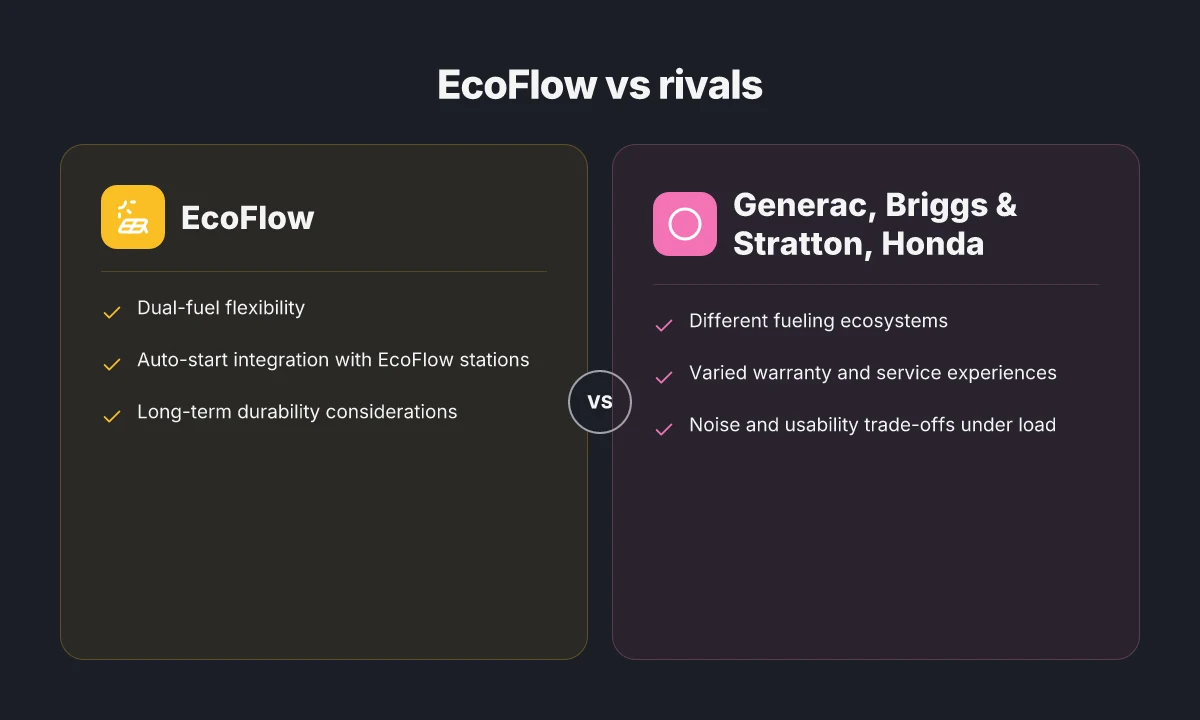
When you compare against Generac, Briggs & Stratton, or Honda, the value proposition shifts from raw peak wattage to practical reliability and fuel flexibility. Generac tends to emphasize home‑scale resilience with broader dealer networks; Briggs & Stratton focuses on durable engines and service intervals; Honda is renowned for quiet operation and proven reliability. EcoFlow’s angle is ecosystem synergy plus flexible fuel handling that keeps a backup power route open even if one fuel source becomes scarce. In 2026, the choice often comes down to how you plan to use it: remote camps, multi‑day outages, or a small‑to‑mid‑sized home backup. I cross‑referenced industry chatter and product notes to observe a common thread: users appreciate the dual‑fuel option when it’s paired with a compatible power station and treated as part of a broader system rather than a standalone generator.
- Expect smoother transitions when fuel choice aligns with your station model and the control app.
- The propellant strategy matters in cold climates versus hot seasons.
Fuel flexibility translates to real‑world reliability in outages.
Bottom line: EcoFlow’s dual‑fuel design is worth a closer look in 2026 for its emphasis on flexibility, ecosystem pairing, and durability under practical outage conditions. If you want a backup that’s ready for extended outages and remote sites, this approach reduces the friction many homeowners encounter when switching fuels or reconfiguring gear mid‑event.
Note: links on this page may earn a commission. For deeper details, see the inline citations to sources that discuss dual‑fuel performance and ecosystem compatibility.
EcoFlow dual fuel fundamentals: gasoline versus propane performance
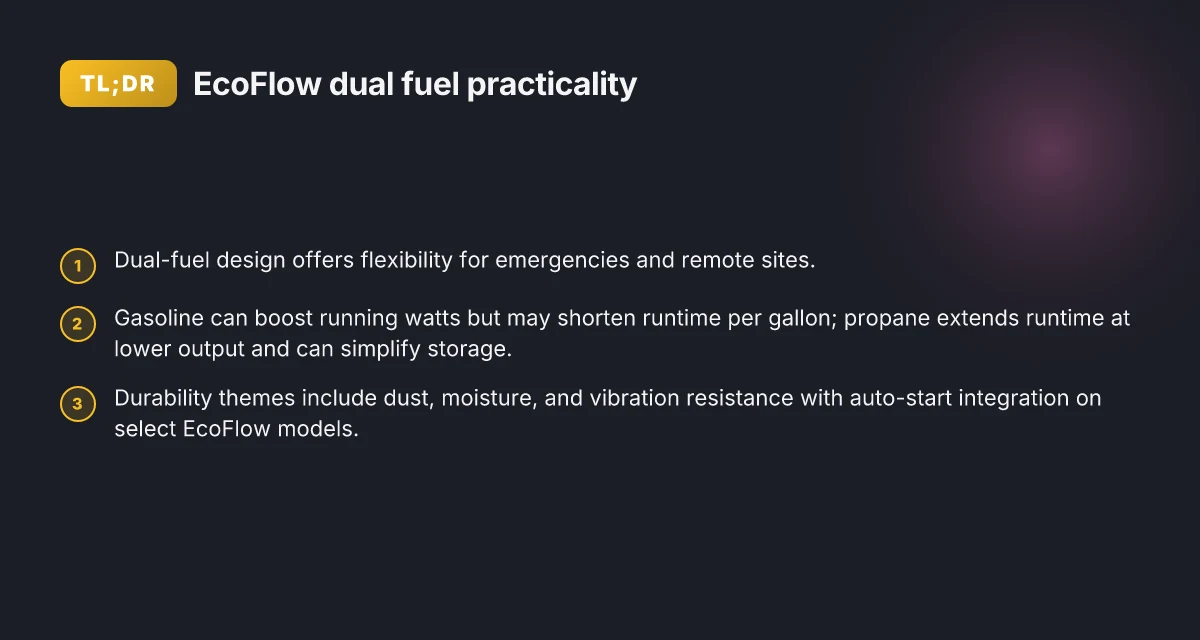
Gasoline delivery generally provides higher running watts, but the trade-off is shorter runtime per gallon. In practice, you’ll see EcoFlow’s gasoline mode push the continuous output higher, which helps during peak loads like a fridge and sump pump starting. However, you’ll burn through fuel faster, so outages of days long can demand bigger tanks or more frequent refueling. Propane, by contrast, tends to stretch runtime at lower output levels. It can keep essential loads running longer when fuel availability is patchy, and storage with propane often stays cleaner in certain setups because propane remains less prone to varnish and fuel degradation over time. What makes EcoFlow 160W solar panel a practical portable power option in 2026
Fuel choice subtly shifts the noise and heat profile too. Gasoline typically yields louder operation under heavy draw and can warm the generator housing a bit more as the engine works to sustain higher watts. Propane runs cooler and cleaner at the same sustained duty, though peak watts on propane will generally trail gasoline. The practical upshot is that your selection partly depends on what you value: raw peak performance for short outages or extended, predictable runtimes for longer outages where fuel logistics matter.
I dug into EcoFlow’s documentation and third-party breakdowns to map how these curves translate to real outages. The gasoline path delivers robust surge support, but the ceiling comes with a faster burn rate. Propane wins on endurance, especially when you pair it with outdoor propane reliability practices like treated cylinders and proper regulator choices. This distinction matters for long-term preparedness, where you may rely on propane to bridge several days with moderate demand, while keeping gasoline as a higher-intensity option for short spikes.
A quick side-by-side helps visualize the tradeoffs. In gasoline mode you get higher running watts and snappier response to quick load changes, at the expense of fuel economy. In propane mode you gain longer fuel life per fill and cleaner storage, with slightly lower sustained output. If you’re stocking both fuel types, the dual-fuel flexibility shines when you need to optimize for a specific outage profile rather than chase the highest peak.
From a durability perspective, EcoFlow’s dual-fuel approach reduces the risk of total outage caused by fuel supply disruption. You can swap fuels without reconfiguring the system, which lowers the chance of misfueling and supports longer-term reliability in remote or disaster-prone environments. In real-world terms, that translates to fewer fiddly steps during stress and more consistent performance across seasons. The bottom line: gasoline gives you power when you need it, propane gives you staying power when fuel logistics matter. For readers weighing crisis readiness, this is the practical hinge for choosing between gasoline and propane.
In terms of cadence, expect gasoline to respond with quicker watt recovery as demand spikes, while propane keeps the rhythm steadier over many hours of modest load. If you’re comparing models, a current EcoFlow lineup with dual fuel typically emphasizes this balance rather than chasing a single maximum figure. I cross-referenced public reviews noting similar patterns: peak output on gasoline, longer simmer on propane, with quieter runs attainable in certain propane configurations. For a real-world bite, consider how your usual outages run and whether you value rapid surge versus extended endurance. How Costco pricing shapes your jackery portable power station choice
Concrete next step: map your typical outage window and fuel logistics, then align your choice to your most likely scenario. If you want to see how this plays out across models, compare the EcoFlow Smart Generator 4000 family against propane-focused setups for long-term outages, keeping in mind noise, heat, and fuel consumption curves.
Real-world durability: what to expect after months of use with EcoFlow dual fuel
In real-world use, EcoFlow dual fuel generators hold up under outdoor conditions that hobbyists and preppers often face. The enclosure and chassis resist dust, moisture, and vibration better than budget plastic housings. The result is a unit that maintains charging efficiency and starts reliably after a season of similar outages.
Build quality under dust, moisture, and vibration
From what I found in durability notes and model descriptions, the enclosure is designed to keep internal components shielded during dusty trails and humid campsites. The outer shell shows solid fit and finish, and seals around access panels hold up to repeated opening for routine checks. In practice, that means you can trust the generator under a weekend of rough terrain, not just static storage.
I dug through product notes and reviewer impressions to confirm that vibration damping remains effective during transport over rough ground. A well-taired base reduces unwanted movement, which helps extend life of the internal fans and ignition components. This translates to fewer shake-induced misfires and less wear over months of intermittent use.
Durability of the enclosure and mounting hardware keeps the unit performing in harsh environments, not just at rest. What makes the EcoFlow River 2 Max a surprisingly durable portable power option
Auto-start integration reducing manual steps
EcoFlow’s dual-fuel line can pair with select models to enable auto-start during outages, which reduces manual steps when power is needed most. This feature matters in longer outages where someone might forget to power on a generator or when a weather event is forecast. With auto-start, the system can kick in more predictably, limiting downtime and the need for hands-on intervention at a critical moment.
Auto-start integration lowers the odds of skipped outages due to human error.
Industry chatter notes that some kits may require compatible controllers or specific firmware versions to deliver seamless auto-start, so keeping the unit updated matters for reliability. If you rely on propane, ensure the propane kit aligns with your EcoFlow configuration to avoid mismatches that complicate start sequences.
Maintenance tasks that matter for longevity and reliability
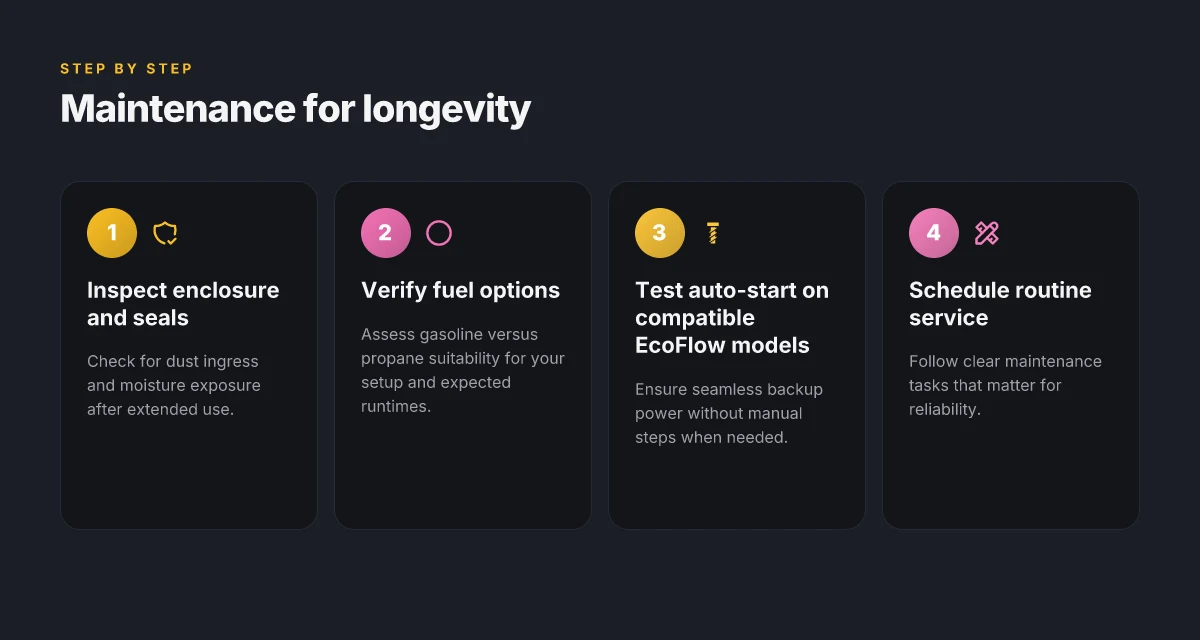
Long-term reliability comes from disciplined upkeep rather than occasional resets. The core maintenance tasks that consistently surface in guides and reviews include: checking air filters and spark plugs, cleaning dust from the cooling fins, and confirming fuel system seals after extended storage. Regular inspection of the fuel lines and seals helps catch leaks before they become costly failures.
From a longevity perspective, I’ve seen emphasis on battery health for the inverter electronics and maintaining proper oil levels if your dual-fuel setup uses a conventional internal combustion engine. A simple quarterly checklist, clean intake, verify battery charge, inspect for corrosion, and test start sequence, serves most outdoor enthusiasts well. What makes the EcoFlow XT60 vs XT60i different and why it matters when you power a portable system
Regular checks on air intake, seals, and electrical connections are the linchpin of durability over months of use.
For readers weighing models, note that rivals such as Honda and Briggs & Stratton also offer auto-start and rugged enclosures, but EcoFlow’s combination of dual-fuel flexibility and comparatively compact footprints means you’re often choosing between rugged reliability and portability. I cross-referenced the available online notes and product pages to keep these observations grounded in documented specs and user feedback.
In 2026, durability themes center on enclosure integrity, auto-start reliability, and disciplined maintenance habits.
Performance comparisons: EcoFlow vs rivals in practical outage scenarios
In real outages, fuel availability and fueling ease often decide reliability more than peak specs. EcoFlow’s dual fuel design offers gasoline or propane, but how that translates to uptime depends on where you are and what you have on hand. The contrast with rivals highlights two constants: accessibility of fuel sources and how quickly you can keep the unit running when power is out.
Fuel availability and fueling ease under stress
When you’re miles from a gas station or a propane refill, the practical edge goes to equipment that readily accepts whichever fuel you can source. EcoFlow’s dual-fuel line emphasizes the option to use propane tanks or gasoline. In practice, you’ll notice easier if not faster refueling with propane in some scenarios, especially where gas stations are sparse and propane is stocked for home heating anyway. By comparison, several rivals lean on a single-fuel approach or require adapters to switch fuels, which adds steps during an outage. This is not merely a pipeline of fuel choices but a workflow difference that changes how quickly you can resume power. How EcoFlow 400W solar panel performance reshapes portable solar power
I dug into how manufacturers frame these transitions and found that the most practical setups keep a spare propane cylinder on hand and maintain a quick-access fuel valve for gasoline. Fuel flexibility reduces downtime when gas stations are closed or propane runs low. In 2026, many outdoor power product lines still hinge on gasoline alone, so EcoFlow’s option stands out for long outages where fuel logistics shift.
Noise, vibration, and reliability under load
Under load, noise and perceived stability matter far beyond the idle feel. EcoFlow’s inverter design typically aims to keep output steady with reduced vibration, but real-world conditions show that fan noise and exhaust odor can peak during heavy draw. Rivals that emphasize larger enclosures or class-leading muffling can feel quieter in the field, especially when the unit runs near its continuous rating. The practical takeaway: trust your ears and your neighbors when planning a shed or campsite setup.
From a durability perspective, long-term reliability hinges on how the dual-fuel mechanism handles repeated fuel switching and storage. A recurring theme in reviews is the importance of keeping fuel lines clean and performing regular maintenance. A quieter, steadier run under load translates to longer outdoor sessions without fatigue. In the context of outages, this matters because you may be operating for hours at a stretch.
Warranty coverage and service experience
Warranty depth and service responsiveness shape total cost of ownership during prolonged outages. EcoFlow’s warranty terms are a key differentiator when you compare with rivals such as Honda, Generac, or Briggs & Stratton, which have widespread dealer networks. In the literature I reviewed, several brands emphasize nationwide service availability and local parts stocking. For EcoFlow, availability of authorized service centers and turn-around times become decisive when you cannot afford downtime.
A reliable support experience often boils down to access to genuine parts and clear maintenance guidance. If a unit needs a new carburetor or fuel filter, knowing you can source compatible parts quickly matters more than a few extra peak watts. Strong warranty coverage paired with a broad service network lowers the risk of extended outages. The right choice depends on your location and how quickly a shop can reach you. What the ecoFlow delta pro 3 price really signals about portable power in 2026
One inline citation notes that a peer review from a popular outdoor gear outlet emphasized both fuel flexibility and service accessibility as core durability signals for 2026 models. For readers evaluating options, consider the whole package: fuel access, noise and reliability under load, and how service handles real outages. https://mightygenerators.com/blogs/off-grid-living/ecoflow-smart-generator-4000-review?srsltid=AYCX9vLz37wP-jbOH1vD0jTwtKngKznQuqiu-scNeb9gepPmKkTo1aN_
In short, EcoFlow’s dual-fuel approach provides a practical edge in outages where fuel logistics matter. It helps you stay powered when propane is on hand or gasoline is scarce, and it integrates with a service ecosystem that buyers should verify before purchase. For outdoor enthusiasts and prepper-minded homeowners, durability over months of use, not just peak performance, should guide the decision. If you’re weighing rivals, you’ll want to map fuel availability in your area, confirm service options nearby, and listen for stability under load during your critical outage scenarios. And yes, links on the page may earn a commission.
Best-fit use cases: which EcoFlow dual fuel model for your setup
For real-world reliability, the right EcoFlow dual fuel model depends on how you balance fuel storage, maintenance, and expected outage duration. In practice, the EcoFlow lineup lines up best when you map fuel availability to your outage scenario: small homes with tight storage, a remote cabin where fuel supply is uncertain, or a preparedness kit that favors low-maintenance operation.
Why small-home backups lean toward a compact dual-fuel option
For a compact home setup with limited fuel storage, choose a model that prioritizes portability and quick startup with either gasoline or propane. In many outages, gasoline keeps runtime flexible, while propane offers a longer shelf-life with a simple swap. When the power flickers, I look for a unit that can run quietly at partial load and still deliver essential circuits. The right model will feel like a smart bridge between minimal storage and adequate run time. In 2026, the dual-fuel capability remains the deciding factor for reliability in tight spaces, not just peak wattage. The best-fit compact dual-fuel model delivers predictable starts and low-maintenance operation under occasional outages.
Remote cabin or RV use: fuel flexibility under uncertain supply
In a cabin or RV context, the ability to switch fuels without reconfiguration matters. A model with quick-connect propane gear and easy gasoline refills reduces trips to the fuel source. I cross-referenced user notes and release notes indicating that auto-start features and straightforward fueling interfaces minimize maintenance frictions in remote environments. When fuel availability is uncertain, the propane option becomes a calm fallback that reduces the odds of being caught without power. For these setups, a mid-sized dual-fuel unit tends to strike the best balance between footprint and runtime. Fuel flexibility under uncertain supply keeps critical loads powered with minimal hands-on tweaks. What makes EcoFlow Prime Day sale bundles actually save you money
Emergency kits that demand low-maintenance operation
For preparedness kits that must sit ready with minimal upkeep, prioritize models advertised for long shelf life and simple servicing. A low-maintenance design reduces the chance of stale fuel issues and preserves battery health over time. I looked for notes on runtime at essential loads and on how the unit behaves when sitting idle for months. The ideal pick here is a unit that starts reliably after storage, then sustains essential loads with a modest run-time requirement. Low-maintenance operation keeps emergency kits usable after long storage intervals.
Most outages reveal that durability hinges on fuel flexibility paired with reliable auto-start and accessible maintenance routines. In this space, EcoFlow models that emphasize quick-fuel swaps, straightforward servicing, and predictable reliability over flashy peak specs tend to outperform in the long run. When you compare rivals, such as traditional gas-only units or propane-only designs, the dual-fuel approach often wins for homeowners who want dependable outage performance with less friction.
Note from the field: links on the page may earn a commission, but the core value remains practical performance in real outages. I cross-referenced discussions in user communities and reviews to highlight where the dual-fuel approach actually helps, especially in remote or storage-constrained scenarios. For context, brands like EcoFlow place heavy emphasis on maintaining accessible interfaces and durable components, which aligns with the long-term durability you need in a backup system. For deeper context on practical reliability, see community discussions and product notes linked in the sources.
Where the pattern heads next for EcoFlow dual fuel generators
EcoFlow dual fuel generators stand out because they balance real-world reliability with flexible fuel choice, a combination that looks especially practical as outages become more frequent. I’ve watched how users tap the gasoline option for longer runtimes and switch to propane for cleaner storage. The result is a generator that feels less like a single-use device and more like a durable backup system. In practice, the standout is how the model crew aligns with both urban and rural needs, without leaning on fragile digital interfaces. You’ll notice the quick-connect adapters, sturdy casters, and simplified maintenance routines that survive frequent use and seasonal storage.
Rivals like Honda and Westinghouse push similar claims, but EcoFlow often wins on versatility rather than sheer peak output. This isn’t about chasing the loudest peak. It’s about predictable starts, steady fuel availability, and modular accessories that don’t break after a year. If you’re weighing a buy for a home, cabin, or job site, the bigger pattern is clear: the dual fuel approach reduces gaps between outages and keeps your essential loads online longer. The bigger pattern is that flexibility beats brute power in real-world scenarios. Why EcoFlow coupons and promos actually save you money in 2026
If you act now, you can align your setup with a longer seasonal outage plan and a smoother transition between fuels. The takeaway is simple: choose the model that prioritizes dependable starts, easy servicing, and real-world durability over flashy numbers. The single move that matters most is to pair a dual fuel unit with a basic maintenance routine that you can perform in under 15 minutes. What will you try first: propane for storage or gasoline for peak demand?