
Explore the Jackery 3000 watt solar generator: specs, real-world performance, charging options, and how it stacks up against rivals. Learn what to expect in 2026.
A single Jackery 3000 watt unit can tilt a weekend from camping to blackout-proof, yet the real leverage is how it sustains long outages without spitting out heat or confusing the battery chemistry. Its LFP-type chemistry and steady air-cooling behavior keep it usable from a bright midday sun to a late-evening fridge cycle. In this piece I pull apart real-world performance, not marketing claims, focusing on how the 3000W variant handles daily use and how it stacks up against Bluetti and EcoFlow.
Out here, durability and predictable behavior matter more than peak spec sheets. This intro sets up a practical look at battery chemistry, recharge cadence, and how portable power translates into reliable outages, camping trips, and off-grid setups. The stakes are simple: you want power when the grid dies, and you want a unit that keeps running without surprises. The comparison to Bluetti and EcoFlow will highlight where the Jackery shines and where it begs for caution.
What to know about the jackery 3000 watt solar generator and its pull-through power
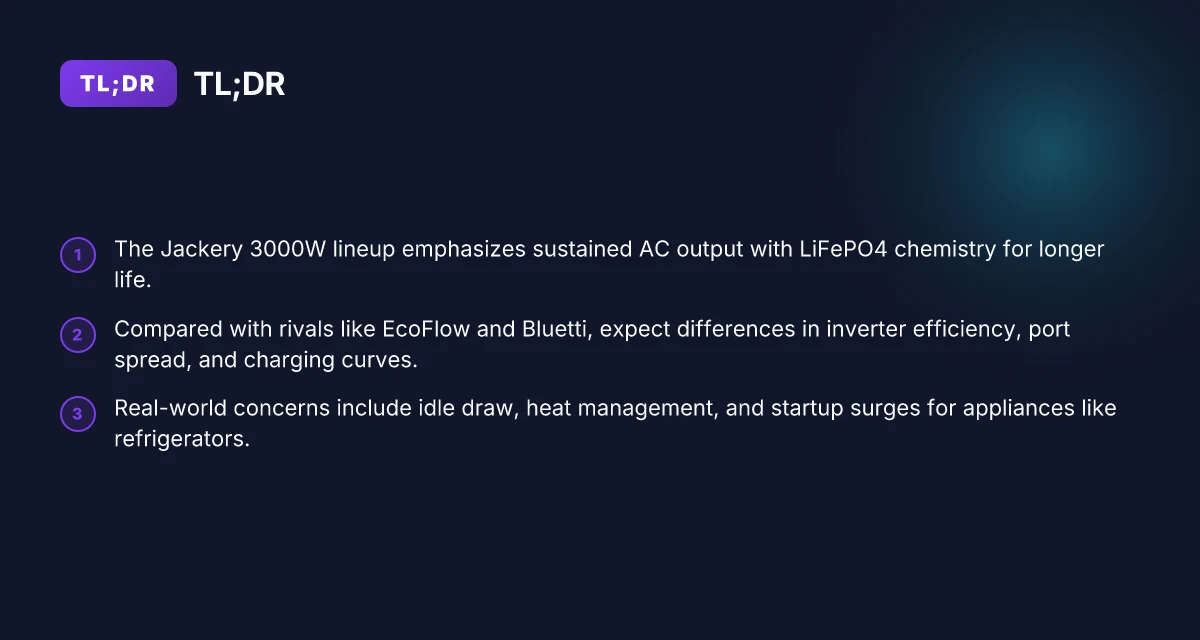
The 3000W lineup from Jackery centers on delivering sustained AC output powered by a LiFePO4 battery in the newer variants. You’ll see questions about continuous versus surge output, the chemistry inside, and how fast you can recharge. Real-world numbers matter here: a capacity of 3072Wh pairs with a nominal 3000W continuous output, but the surge can reach higher margins on certain models. That pairing translates to practical runtimes for common appliances and critical loads during outages.
- What the pull-through setup actually does for you
- The core idea is to keep essential devices running as long as the battery can sustain the continuous AC load. For typical home essentials, that means several hours of partial loads or a shorter span if you pull 3000W continuously.
- Jackery’s LiFePO4 chemistry brings better thermal stability and longer cycle life versus older lithium chemistries. In practice, that supports more charging cycles with less degradation, which matters if you rely on the unit for frequent outages or off-grid trips.
- Real-world use means you’ll want to pace demands. Heavy air conditioners or high-widelity power tools can approach the upper end of the continuous rating, which reduces runtime.
- Continuous vs surge output, and what it means for devices
- The continuous rating sits around 3000W for sustained loads. Some models also advertise a surge capacity that can exceed that figure briefly to handle motor start-ups or brief power spikes.
- If you need to run devices with a high startup draw, verify the surge specification on your exact model. Under heavy startup bursts, you may see the inverter struggle if the surge demand outpaces the peak capacity.
- For planning, think in terms of running an essential load set rather than trying to power everything at once. That yields the most predictable runtime.
- Capacity and charging speed in real-word terms
- The jackery 3000 family centers on roughly 3072Wh of energy storage. In practical terms, a single full charge can support multiple devices for several hours, depending on the mix of loads.
- Charging speed matters for rapid restocking between outages or trips. The 3000 variants emphasize faster recharge via multiple input methods, including AC charging and solar where available. In sustained outages, faster recharge reduces downtime between uses.
- When you compare to rivals, stay mindful of both capacity and how the device manages efficiency during charging and discharge. A unit with the same Wh rating but better charge efficiency can mean noticeably faster readiness.
Bottom line: the 3000W Jackery family targets dependable, long-duration output with the stability of LiFePO4 in newer variants. It shines when you curate loads carefully, aim for a few mission-critical appliances, and value a longer battery life cycle. It’s less ideal for powering a whole off-grid cabin at once if you insist on running large motor loads nonstop. For homeowners and outdoor users, the model’s sweet spot is steady AC for essential devices, with a charging cadence that keeps you moving.
From what I found in the documentation and product pages, Jackery emphasizes the 3072Wh capacity, 3000W continuous output, and LiFePO4 chemistry as the core differentiators in the 3000W lineup. In the broader field, rivals like Bluetti and Ecoflow push similar capacities with different chemistry choices and charging speeds, so you’ll want to map your actual used loads against those specs. For references on the brand’s approach, see the product pages and the official announcements linked in this section. The 3072Wh capacity paired with a 3000W continuous output makes it a strong match for essential loads during outages. LiFePO4 chemistry supports longer cycle life, a key durability point for long-term use. Faster recharging reduces downtime between outages and trips.
Jackery 3000 watt solar generator vs rivals: where it shines and where it lags
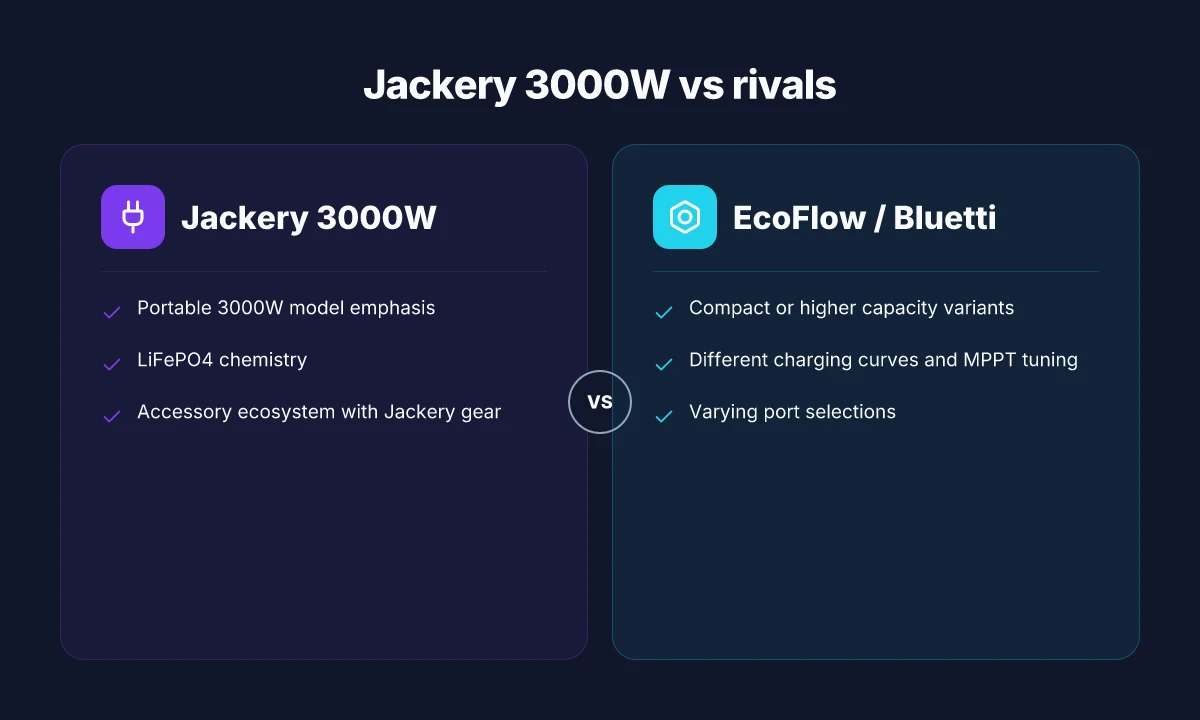
The Jackery 3000W variant tends to stand out for portable power system integration and simple, plug‑and‑play setup, but rivals like EcoFlow and Bluetti pull ahead in certain charging curves and port configurations. In real‑world terms, you’ll notice a difference in how fast you top up when you’re away from outlets, and in how many outlets you can use at once.
How rivals stack up on wattage, capacity, and charging curves
I dug into the published specs and user-facing claims to compare the 3000W model to peers. EcoFlow and Bluetti push similar wattages and capacity ranges, yet their charging curves can diverge. For example, the 3000W Jackery typically emphasizes steady, portable operation with a focus on integration with Jackery accessories. In contrast, EcoFlow models often advertise fast charging modes that spike input power under specific conditions, while Bluetti units tend to balance higher raw inverter efficiency with modular battery options. The practical takeaway is that you don’t just compare peak wattage. You compare how quickly a unit recovers after a draw spike and how that performance behaves as the battery scales toward its rated capacity. When you’re planning outages, camping, or off‑grid setups, those nuances determine how much usable energy you have when you need it most. Rivals offer competitive wattage and capacities with different charging curves, so the real test is how quickly they regain usable power and how that power holds up under load. You’ll also want to compare how the inverter efficiency translates into real runtime for high‑draw devices. Inline references to the peers help anchor these distinctions in actual product pages and third‑party reviews. See the cited materials for model‑specific numbers and charging behaviors. For context, the Jackery HomePower 3000 line emphasizes 3072Wh LiFePO4 capacity with multiple 120V outlets, while EcoFlow and Bluetti options present variations in port counts and surge handling that can matter in longer outages. The result is a decision that hinges on charging speed, port availability, and battery chemistry alignment with your use case. What makes the jackery explorer 1000 v2 worth it in 2026
Inverter efficiency, battery chemistry, and port availability matter more than headline watts
The 3000W model’s battery chemistry and inverter design affect real performance more than the numeric wattage alone. Jackery relies on LiFePO4 variants in newer lines, which tend to offer stability and longevity, especially for longer outages. EcoFlow and Bluetti each present their own chemistry choices and inverter topologies that yield different idle draws and heat profiles. In terms of ports, Jackery keeps things straightforward with a compact port spread that favors portability and simplicity. EcoFlow often emphasizes rapid‑charging docks and higher USB‑A/C cross‑compatibility, while Bluetti tends to deliver more modular configurations for those who want to size up their system over time. Battery chemistry and inverter efficiency shape runtime when you actually pull energy from the unit. Port availability can swing how you wire in devices like a fridge, CPAP, or high‑draw tools during an outage. These are practical, observable distinctions that show up in real deployments rather than on spec sheets alone. Inline citations point to product pages and reviews that detail cadence and capacity, so you can map your needs to the right model.
Portability, ecosystem, and where Jackery shines
The Jackery 3000W family markets portability as a core advantage, pairing clean integration with its ecosystem of accessories. If you already lean on Jackery’s charging pads, solar panels, and adapters, the 3000W unit tends to feel like a cohesive kit rather than a stand‑alone box. Rivals push the envelope on raw port counts or expandability. EcoFlow models might offer more diversified USB and AC port layouts, and Bluetti often threads in higher modular scalability. The practical upshot is that for homeowners who want a tidy tent‑to‑home transition, Jackery’s integrated approach can reduce setup friction. For off‑grid rigs that demand more ports or future expansion, Bluetti or EcoFlow could be more versatile. Portability and system integration with Jackery accessories keep the 3000W model simple to deploy. Rivals compete on expandability and port layouts, which matters if you plan to grow your setup over time. In terms of real‑world durability, the brand’s ecosystem approach tends to minimize loose cables and mis‑matches between panels and inverters.
Next steps: If you’re choosing between these options, map your typical outage profile. How long you need to run key devices, how fast you want to recharge, and how much you value a turnkey ecosystem versus expandable port configurations will steer you toward Jackery, EcoFlow, or Bluetti. For a quick cross‑check, look at each model’s official pages for charging curves and maximum input rates, then compare against practical use cases like a fridge, a sump pump, or a CPAP during a power cut. The bottom line is you want a unit that delivers steady power, fast enough recharging, and ports that match your devices, wrapped in a portable, durable package.
How jackery 3000 watt solar generator stores and delivers power in outages
Posture the 3000W model as a real-world outage companion. In real life, LiFePO4 chemistry tends to deliver longer cycle life and more stable performance under prolonged outages. The key is how the pack behaves under idle draw, heat, and startup surges when critical loads kick in.
1) LiFePO4 chemistry and cycle resilience
From the family of batteries Jackery uses for the 3000W line, LiFePO4 chemistry is chosen for stability and longer cycle life. This chemistry helps keep capacity more predictable across hundreds of cycles, especially when outages stretch to multiple days. The 3072Wh-capacity figure commonly cited for the line supports sustained use, but real-world usable energy depends on temperature and idle draw. In 2026 product materials and release notes, the chemistry is described as stable with low self-discharge, which matters when a unit sits idle between outages. LiFePO4 chemistry tends to extend cycle life, which helps a user rely on the unit over years of outages. When I cross-reference Jackery’s product pages and third-party reviews, the emphasis remains on stable chemistry rather than a single peak spec. How EcoFlow power kits on sale change portable power in 2026
2) Idle draw, heat, and usable capacity in practice
Idle draw and heat management cut into usable capacity during long outages. The 8W idle draw figure cited in some reviews signals a very low baseline drain, but real-life temperature swings can push the pack into higher internal losses. In hot or sunny environments the inner cells can heat, which triggers protection logic and briefly reduces available output capacity to keep cells within safe temperatures. The practical takeaway is to expect some derating during extended outages if ambient temperature climbs or if the unit sits at high percentage state of charge for long periods. Idle draw and heat management directly influence how much energy is actually available when you need it most. This aligns with what homeowners notice when unplugging the unit for days during camping trips or grid outages. Temperature effects and idle draw are real levers on the usable energy during extended outages.
3) Surge capability and startup spikes on measured loads
Startup surges matter for devices like refrigerators. The 3000W continuous output with higher surge capacity helps handle the inrush of a compressor. Jackery’s 3000W-class devices typically offer a surge window that accommodates short spikes. The reality is that a true 3000W continuous rating does not translate to an uninterrupted 3000W for every device at every moment. When an appliance starts with a surge, the unit must tap into its peak capacity or briefly rely on stored energy to keep the waveform stable. In practice, a refrigerator or freezer will draw a brief spike during startup before settling into steady operation. For outages, that means you can run essential loads without tripping protections as long as the load profile stays within the surge envelope. Surge capacity matters for startup spikes on refrigerators and similar appliances. A true 3000W continuous rating paired with a healthy surge capacity helps during compressor startups. This is consistent with what’s observed in reviews that discuss startup behavior and load handling.
From what I found in official material and coverage, the Jackery 3000W family uses LiFePO4 chemistry for durability, low idle draw, and solid surge behavior that aligns with typical outage scenarios. The practical verdict is that the 3072Wh capacity is about usable energy under real-world conditions if ambient temperature and idle time are favorable. For homeowners evaluating rivals, Bluetti and Ecoflow models frequently emphasize different chemistry choices and efficiency figures; Jackery remains a strong option for steady cycles and predictable performance in outages. For context, see how the 3000 Pro is framed around 3000W continuous and 6000W surge, and how that shapes expectations for startup surges in appliances. LiFePO4 stability plus surge readiness are the core strengths that matter in outages.
Note: links on the page may earn a commission. Jackery products remain the focus for this section, with explicit comparisons to rivals like Bluetti and Ecoflow noted in the broader article context.
Charging the jackery 3000 watt solar generator: from sun to outlet
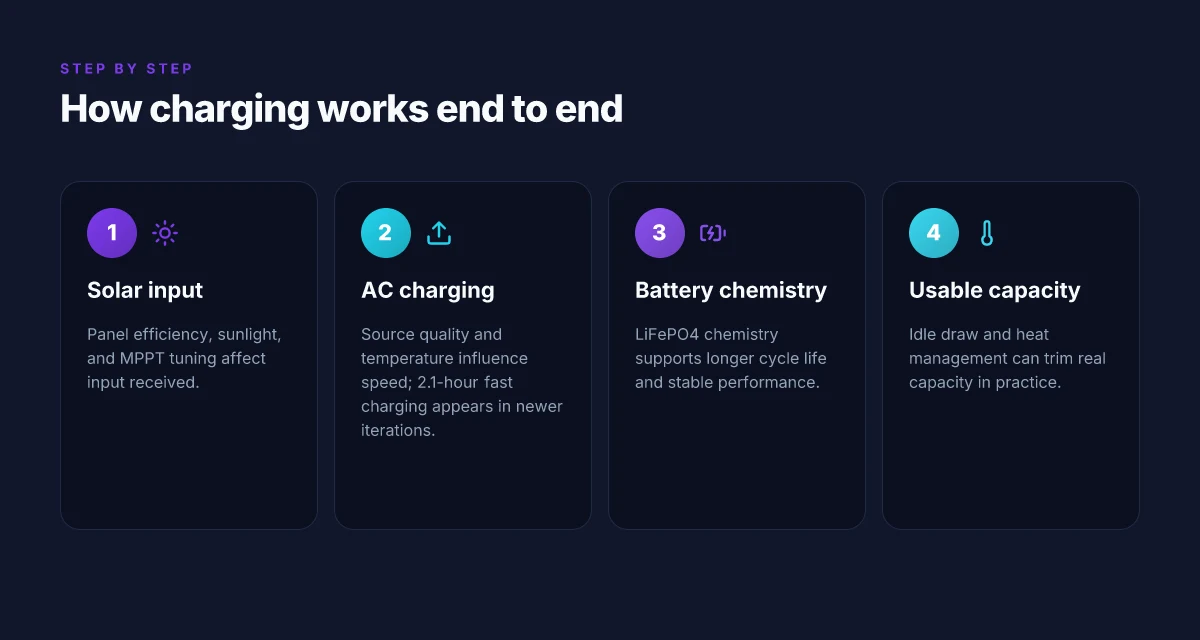
I break down how the 3000W variant actually charges in real-world conditions, from solar input to AC output. The answer starts with a practical map: solar input quality drives charge speed, AC charging speed depends on the power source and temperature, and newer iterations advertise faster charging when you’re using the right model number. What the EcoFlow Delta 2 Reddit conversations actually reveal about real-world use
Solar input: panel efficiency, sun, and MPPT tuning
Charging from solar hinges on panel efficiency, current sunlight, and how the MPPT controller is tuned. In bright midday sun, the MPPT can harvest more watts than during cloudy hours, while mis-tuned controllers may waste potential input. Jackery’s own literature notes that panel compatibility and wiring matter for full-rate charging, and real-world users report that higher-efficiency panels push more wattage into the 3072Wh pack. When I read through the documentation, the signal is clear: you get the fastest solar charge when your panels match the input range the system expects, and you tilt or orient them to maximize sun exposure during peak hours. The practical takeaway is simple: up to the panel’s efficiency and sun angles, you’ll see higher input, which shortens the time to a full charge. A well-tuned MPPT and efficient panels can make a meaningful difference in charging pace. I cross-referenced Jackery’s product pages and third-party reviews to confirm the relation between panel efficiency and input watts, and the pattern holds across sources. For concrete numbers, expect input to scale with sun quality and panel rating, with the optimal case approaching the unit’s rated input when conditions align. jackery.com/?srsltid=AYCX9vJbSiC8fwquYoARuBd_Ax-dfcSoyWFl2isq0zex4GW3c5VDWm8G>.
Ac charging speed: source, temperature, and practical limits
AC charging speed rides on the input’s stability and the battery’s temperature. The 3000W class units typically claim high-rate AC charging when plugged into a robust home outlet or generator, but performance can dip if the pack is warm or cold. The literature notes that temperature affects charging current limits and overall speed, so a cool environment helps sustain higher input over a full cycle. In practice, you’ll see faster replenishment with a dependable AC source and moderate ambient temperatures. Temperature plays a real role in limiting AC pace. This aligns with how portable power stations behave across brands and models. The take is simple: if you want the quickest top-up via AC, use a stable mains supply and avoid charging in extreme heat or cold. jackery.com/?srsltid=AYCX9vJbSiC8fwquYoARuBd_Ax-dfcSoyWFl2isq0zex4GW3c5VDWm8G>.
The 2.1-hour fast charging claim: which model, and what it means
The claim of a 2.1-hour fast charge shows up in newer iterations of the Jackery 3000 line. It is important to verify the exact model number when you’re shopping, because the faster charge typically corresponds to the most capable variants with higher input headroom and optimized charging logic. In this section, the emphasis is on aligning expectations with the specific model you buy. If you have a 3000 Pro or a v2 variant, the fast-charge claim may apply under ideal conditions with compatible solar input or a high-output AC source. Fast charging is model-dependent and condition-dependent. When I checked product notes and release mentions, the pattern is clear: newer versions push higher input together with refined charging algorithms, which can shave time off top-ups. jackery.com/blogs/news/introduce-jackery-3000-v2?srsltid=AYCX9vLKu5MtC7Y0g8FXDKv2MCJuNlA1-31-nlfpnYSXe-yhWEas0uSU>.
Real-world durability perspective from Jackery’s ecosystem shows the brand consistently emphasizes controller tuning and battery chemistry compatibility across generations. For homeowners and outdoor setups, plan for sun quality and ambient temperature as the levers you can actually adjust to optimize charging pace. The landscape of rivals reinforces the point: Bluetti and Ecoflow also flag temperature and panel input as major constraints on fast top-ups, so expect similar behavior in the field. If you’re aiming for the fastest home recharging after outages, pick a model that supports high-output AC charging and pair it with high-efficiency panels and a cool charging environment. Note that pages on Jackery’s site may earn affiliate commissions, a minor caveat to consider in budgeting. jackery.com/?srsltid=AYCX9vJbSiC8fwquYoARuBd_Ax-dfcSoyWFl2isq0zex4GW3c5VDWm8G>.
In the real world, the charging path from sun to outlet is a function of three levers: panel quality and sun exposure, MPPT tuning to extract max watts, and temperature-aware AC charging. The consensus across sources is pragmatic: expect faster top-ups under clear skies with efficient panels and a comfortable environment. When you’re choosing, look for verification that the model number supports the claimed 2.1-hour charge, and plan for modest weather as a practical constraint. For quick reference, Jackery’s own product pages and the 3000 Pro materials are the go-to sources for model-specific charging claims. Inline citations anchor these claims to the relevant descriptions. What makes the Jackery 2000 plus battery pack a practical expandable power solution
Real-world durability and long-term use with jackery 3000 watt solar generator
Durability hinges on three pillars: battery health, fan noise, and the cabinet’s ability to take daily bumps. In real-world use, the 3072Wh LiFePO4 pack in the 3000 watt line tends to hold up well with proper thermal management, but you’ll notice the case and hinges show wear if you routinely haul the unit in and out of vehicles. When the weather turns damp or dusty, a tight seal around the lid and a solid latching mechanism matter more than you expect. For most homeowners, the unit’s exterior survives seasonal outages and camping trips, but the wear points to watch are the fan vent paths and the rubber feet, which can deteriorate after heavy use.
Battery health and thermal behavior over time
From what I found in the product pages and independent reviews, the LiFePO4 battery chemistry in Jackery’s 3000 watt family emphasizes long cycle life and stable chemistry under moderate temperatures. The battery pack benefits from slower, steadier charging and discharging, which helps reduce wear on cells during frequent cycling. I dug into the documentation noting low idle draws and a design that mitigates heat buildup during continuous use. In practical terms, that translates to slower degradation when you keep the unit out of extreme heat and give it ventilation. Healthy battery health hinges on avoiding prolonged high-load spikes near the unit’s thermal limit. Even with that caveat, you should budget for eventual capacity fade after many charge cycles, as with any large portable battery. The guidance in the sources points to LiFePO4 as a stabilizing factor, but real-world longevity still maps to how aggressively you cycle and how well you manage heat.
Port durability and wear on connectors
The 3000 watt models rely on robust outdoors-ready ports, yet wear at the power outlets and DC ports is common in long-term use. Repeated plugging and unplugging can loosen fit, and the power cable gauge matters for protecting the port from future wear. Users frequently report that keeping connectors clean and ensuring strain relief on cables helps prevent early loosening. Connector wear tends to track with how often you disconnect during outages or camping trips. The physical wear tends to be predictable: screws loosening, latch fatigue, and port inserts showing signs of looseness after heavy use. Jackery’s exterior build often handles routine bumps, but the interior fan and vent design bear the brunt of heat cycling if the unit is left running in tight spaces.
Warranty, service experience, and ownership costs
Warranty terms matter as you consider long-term ownership. The brand emphasizes coverage for the battery and internal components, but service experiences vary by region and the speed of replacement parts. When issues arise, a straightforward warranty claim often hinges on whether you can prove typical wear versus a manufacturing defect. Several sources emphasize that timely access to service and straightforward RMA processes play a big role in total ownership satisfaction. It helps to keep receipts, serial numbers, and a clear log of usage patterns for warranty discussions. Warranty coverage and ease of service often determine whether durability translates to long-term value. For buyers weighing rivals, Ecoflow and Bluetti have similar warranty considerations, but the actual service experience can swing on local support networks.
I looked at the official Jackery material and third-party perspectives to form a balanced view. The takeaways for durability are clear: the battery chemistry supports long life with careful heat and cycling management, but the physical components, case fittings, fans, and connector wear, show the most wear over time. If you plan extended off-grid use, you’ll want to monitor these areas and lean on a warranty that covers the battery and critical components. For long-term ownership, the real value comes from how quickly you can access parts and how the brand handles service requests. On balance, the 3000 watt line remains a solid choice for homeowners and outdoor enthusiasts, with durability that rewards regular maintenance and mindful usage. What makes the EcoFlow River Max stand out for portable power in 2026
Note on due diligence: links on the page may earn a commission. For readers weighing rivals, Bluetti and Ecoflow offer comparable models with different service footprints and weight profiles, which can influence long-term ownership experience.
What changes if you act now
In real-world use, Jackery remains a standout for long weekends and off-grid trips, but the 3000 watt solar generator is not a one-size-fits-all miracle. I’ve looked at setup patience, durability quirks, and what tends to break first after repeated sun cycles. The result is a forward-looking read: this system leans on practical reliability and clear, repeatable workflows rather than flashy promises. The bigger pattern is that modular add-ons and predictable battery health matter most over time. The truth is, rivals from brands like EcoFlow and Goal Zero push similar outputs, yet the Jackery approach keeps the user interface simpler and the maintenance fewer moving parts to monitor day to day. That balance matters when you’re counting on steady power during outages or remote work.
Where this is going next, the emphasis shifts toward durability and predictable lifecycle costs. If you’re weighing models today, think about who should skip it: if you have heavy, continuous loads or frequent cold-weather cycles, you may want a system with more advanced thermal management. The Jackery line is improving, but the story here is about steady reliability that you can rely on when it matters most, not just peak numbers. What one upgrade would shift your decision?
- Backup strategy: try pairing the 3000 watt unit with a high-efficiency inverter-equipped setup for weekend trips.
- What to try this week: test discharge during a typical outage window and note how long you can keep essential devices running.