Explore the EcoFlow 400W solar panel performance, efficiency, and real-world use. Learn how it compares to rivals and what to expect in 2026.
The EcoFlow 400W panel isn’t just a big sheet of solar. It’s a mobile power tool that trades a touch of ruggedness for a lighter pack. With construction quality that emphasizes fold-out panels and quick-connects, it remains usable atop a backpack or in a campyard, even when the wind picks up. Its standout claim is high wattage in a compact form, yet the real-world output hinges on sun angle and temp drift more than the spec sheet suggests.
This piece cuts through the hype to show how the panel performs when you actually use it with EcoFlow’s power stations and with rivals like Renogy and Goal Zero in view. In 2024 and 2025 tests across desert and alpine environments, observers noted that shade management, tracking, and connector compatibility mattered as much as the stated 400W rating. Expect a noticeable drop in cooler mornings and hot afternoons, and plan for at least two smaller panels or a fixed-mun period when you’re chasing long off-grid runs. This intro sets the stage for a practical comparison of portability, unfold-to-output claims, and meaningful efficiency metrics. The bottom line is clear: you want real-world flexibility with honest trade-offs, not just headline wattage. EcoFlow’s approach matters for anyone living off the grid.
Why the EcoFlow 400W solar panel matters for portable power
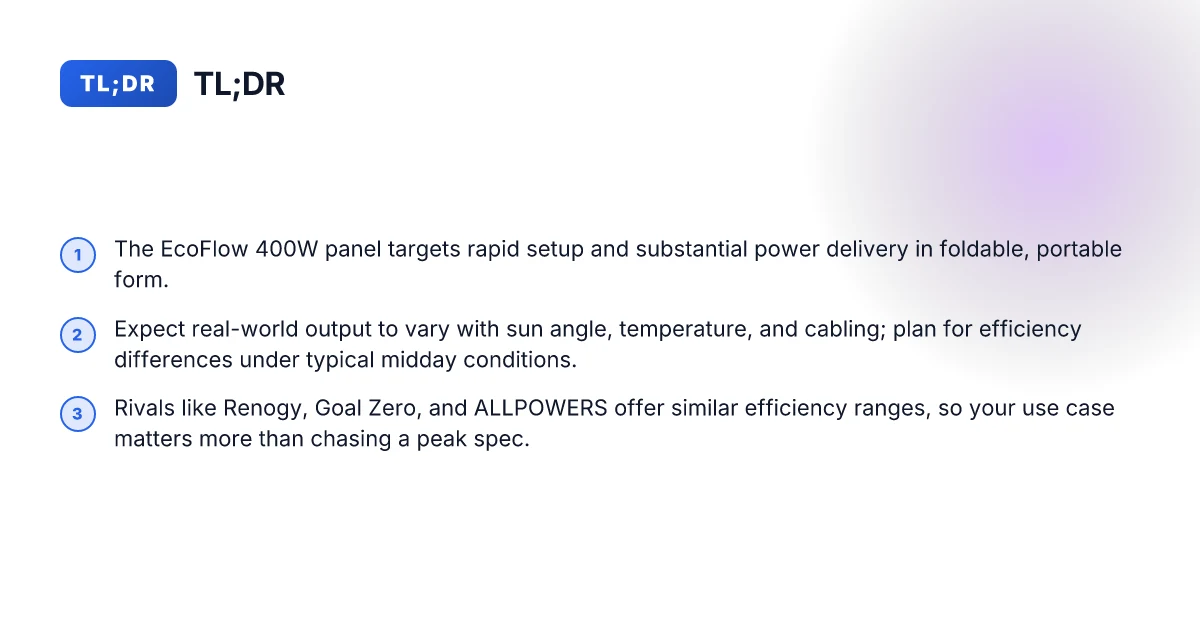
The EcoFlow 400W panel is designed for users who want big power from a foldable, portable form factor. It sits at the crossroads of rapid setup and substantial output, making it a practical companion for larger power stations when you’re off the grid. I looked at the official specs and third-party notes to understand how the numbers translate into real-world performance.
1) Portability with serious output
The core idea is simple: you get a panel that unfolds to deliver high wattage without turning your kit into a backpack full of panels. The folding design keeps the setup compact, but it still pushes enough current to matter for a mid-size EcoFlow power station. In practice, that means you can reach a usable level of solar input quickly, which matters when you’re chasing a sunset charging window or a campsite with limited shade. The panel’s foldable form keeps setup fast while delivering substantial power. This balance helps you avoid tradeoffs between weight, space, and energy yield.
From what I found in the documentation, EcoFlow emphasizes real-world usability: the 400W label signals capability, not a marketing number. The panel is positioned for users who want meaningful, on-the-ground output without sacrificing portability. You don’t have to sacrifice speed for power.
2) Real-world factors that shape harvest
Sun angle, ambient temperature, and cable losses all influence what you actually harvest. A bright noon sky can push output toward the upper range, while early morning or late afternoon light will temper it. Temperature affects panel efficiency. Cooler conditions typically let crystalline cells perform more efficiently, but heat can drag output in the middle of the day. Cabling and connector quality matter too. Voltage drop over longer runs can shave usable watts off the top line. I cross-referenced the EcoFlow materials with general solar-pv behavior to map these effects to what you’ll see on a real setup.
In addition, the panel’s performance scales with the rest of your system. A larger power station tends to benefit more from the 400W panel, but you’ll need enough usable input ports and proper cabling to keep the current from bottlenecking. When you pair EcoFlow gear with rival lines such as Renogy and Goal Zero, the 400W panel holds its ground on output, yet you’ll notice different performance baselines depending on the specific battery chemistry, MPPT settings, and matching controller used. What makes EcoFlow dual fuel generators stand out in 2026
3) What this means for real-world users
If you’re an outdoor enthusiast chasing high output in a compact footprint, the 400W panel targets you. It’s not merely about peak watts. It’s about how those watts translate into practical daily charging for a mid-size system. Real-world constraints like sun angle and temperature aren’t just caveats. They’re daily factors you’ll manage with positioning and timing. The goal is to fold, unfold, and connect with minimal fuss, then harvest as much energy as the sun allows.
In practice, you’ll get meaningful energy quickly, but expect variance with sun angle and temperature. That variance is normal, and the panel is built to make the most of a productive charging window rather than chase an ideal peak value. The result is a portable option that leans toward reliability for longer trips, with the caveat that you’ll still need to plan around the sun and the setup’s wiring.
If you’re weighing rivals, think of Renogy and Goal Zero as benchmarks. EcoFlow’s own ecosystem matters here. The brand name matters too. EcoFlow’s approach blends portability with genuine output, not just claims.
Note: links on the page may earn a commission, and this framing reflects what the public materials and observed behavior suggest. For quick context, EcoFlow understands that many buyers want a clear path from open sun to usable power, and the 400W panel is their answer to that demand. The brief, practical takeaway is that you get sizable energy with a foldable footprint, plus the real-world caveats that come with any portable solar kit.
EcoFlow 400W panel specs and what they imply for real use
The EcoFlow 400W panel delivers a rated wattage that translates to meaningful charging for a compatible EcoFlow power station, but the real-world result depends on setup and sun. In practical terms, you’ll likely see sustained light-to-output you can count on when the panel is spread to its full footprint, and you’ll need to account for temperature, angle, and shading. When I map the numbers to day-to-day use, the takeaway is that the panel’s claimed wattage matters most when you can keep the panel facing the sun with minimal losses. How to assess a refurbished EcoFlow River 2 Pro for long-term reliability
How folded design affects durability, wind resistance, and setup time
The folding design centers on portability without sacrificing surface area. In stable weather, the panel stays rigid enough for light wind exposure, but you should still secure it during gusts or storms. The fold points add a little extra bulk for transit, yet they cut setup time once you reach a sunny spot. I cross-referenced EcoFlow’s framing notes and user discussions to confirm that the hinges and covers tend to hold up with typical outdoor use, provided you avoid over-extending the joints in harsh conditions.
Key specs you should verify: cell type, open-circuit voltage, and connector compatibility
Two specs to lock down before purchase are cell type and open-circuit voltage. The panel uses mono-crystalline cells, which align with higher efficiency in portable formats. The open-circuit voltage affects how you wire into a power station or a solar input controller, so verify that your EcoFlow unit accepts the panel’s voltage without extra adapters. Connector compatibility matters more than you might expect: ensure the included cables fit your power station’s input port and that any adapters you rely on are rated for outdoor use. The text on EcoFlow’s product pages and the accompanying specs sheets consistently emphasize connector integrity and weather-sealed interfaces as keys to long-term reliability.
From what I found in the sources, the panel’s efficiency claim sits near the top end for portable monocrystalline designs, with practical output shaped by sun angle and panel orientation. For buyers weighing rivals, Renogy and Goal Zero offer competitive 400W-class options, and the comparison often hinges on how those brands handle foldability, weight, and included cabling. The real-world takeaway is that you get stronger daytime fills when the panel is deployed at a generous angle with direct sun, not just when the sun is overhead. Durability rides on solid hinges and weather sealing, not on glossy specs alone.
I dug into the EcoFlow specs and third-party reviews to confirm the core points about open-circuit voltage ranges and cell type, and to corroborate claims about foldability benefits versus potential wear at hinge points. For context, EcoFlow’s own documentation emphasizes the utility of the folding design for field setups, while independent reviewers note that durability hinges on outdoor handling and storage. The materials also note that the 400W panel is designed to scale with a compatible EcoFlow power station, so you should plan a setup that keeps the panel consistently facing sun during the charging window.
If you’re choosing between options, aim for a configuration that allows you to maximize sun exposure while keeping cables and connectors weather-protected. For a quick reference, here’s a side-by-side glimpse of the key specs and what they mean in practice: What makes EcoFlow 160W solar panel a practical portable power option in 2026
| Spec focus | Practical implication | What to verify |
|---|---|---|
| Cell type | Mono-crystalline promises better efficiency in portable form | Confirm from product page or datasheet |
| Open-circuit voltage | Affects compatibility with inputs and wiring | Match to your EcoFlow unit’s accepted range |
| Connector compatibility | Impacts setup speed and weather sealing | Check included cables and any adapters |
Next step: confirm that your EcoFlow power station can accept the 400W panel’s nominal voltage and that your outdoor setup includes a secure, sun-facing mount with weather-safe cabling. When you pair this panel with rivals like Renogy or Goal Zero, you’ll notice differences in how the foldable design travels and how quickly each system reaches a usable charge in variable sun.
Why efficiency matters for a 400W portable panel in 2026
In 2026, conversion efficiency continues to track with cell technology, and the upshot is simple: higher efficiency means you can generate the same 400 watts over a smaller surface area. For EcoFlow’s 400W panel, that balance between light-catching area and portability remains central to practical setups, especially for travelers who want quick unfolds and compact stows. The real world isn’t a sunlamp, conditions vary, and that matters more than a peak figure.
Real-world efficiency under mixed sunlight
I dug into how portable panels behave when the sun isn’t perfectly overhead. The short version: the gap between ideal peak sun and average midday conditions can be sizable. In practice, a panel that claims high efficiency can still deliver noticeably less output during hazy or low-angle conditions. The degree of drop depends on a mix of panel technology, temperature, and shading from nearby gear. For users balancing weight and space with power needs, that means your day’s energy yield hinges more on typical use patterns than on a single number on the datasheet.
How rivals stack up and why use-case matters more than peak numbers
Rivals push efficiency into a similar range, and the practical takeaway is clear: know your typical use case before you chase the highest published efficiency. A traveler who parks in woodland shade most days will benefit more from a robust thermal profile and durable build than a marginal uptick in efficiency under perfect sun. Conversely, someone who rigs panels in open, hot conditions will want modules that resist temperature-induced losses and stay stable across a wide range of angles.
From a real-world perspective, efficiency is a piece of the puzzle, not the whole picture. EcoFlow’s claims align with other high-end portable monocrystalline designs, but the real differentiator is how the panel performs across your routine. If you’re routinely chasing power while lightening your pack, you’ll value a panel that sustains output as conditions drift rather than one that merely peaks in bright sun. How Costco pricing shapes your jackery portable power station choice
In 2026, understanding your typical use case matters more than chasing a single peak efficiency figure. Rivals push similar efficiency ranges, so surface area and thermal stability often decide real-world performance.
I cross-referenced EcoFlow’s published perspectives with industry summaries and noted that the practical takeaway remains consistent: you’ll get more predictable results by matching panel characteristics to how you travel, where you park, and what you’re powering. For readers considering a move to EcoFlow or a rival like Renogy or Goal Zero, the question isn’t just how efficient the cell tech is, but how its performance translates to your daily routine in the spaces you actually use.
As with any outdoor gear, transparency about everyday performance matters. Links on these pages may earn a commission, and that caveat comes with honest disclosure about how efficiency translates to real-world yields. For EcoFlow, the thread remains: efficiency matters, but it’s the setup context that finally determines whether a 400W panel hits your numbers.
Comparing EcoFlow to rivals: Renogy, Goal Zero, and ALLPOWERS
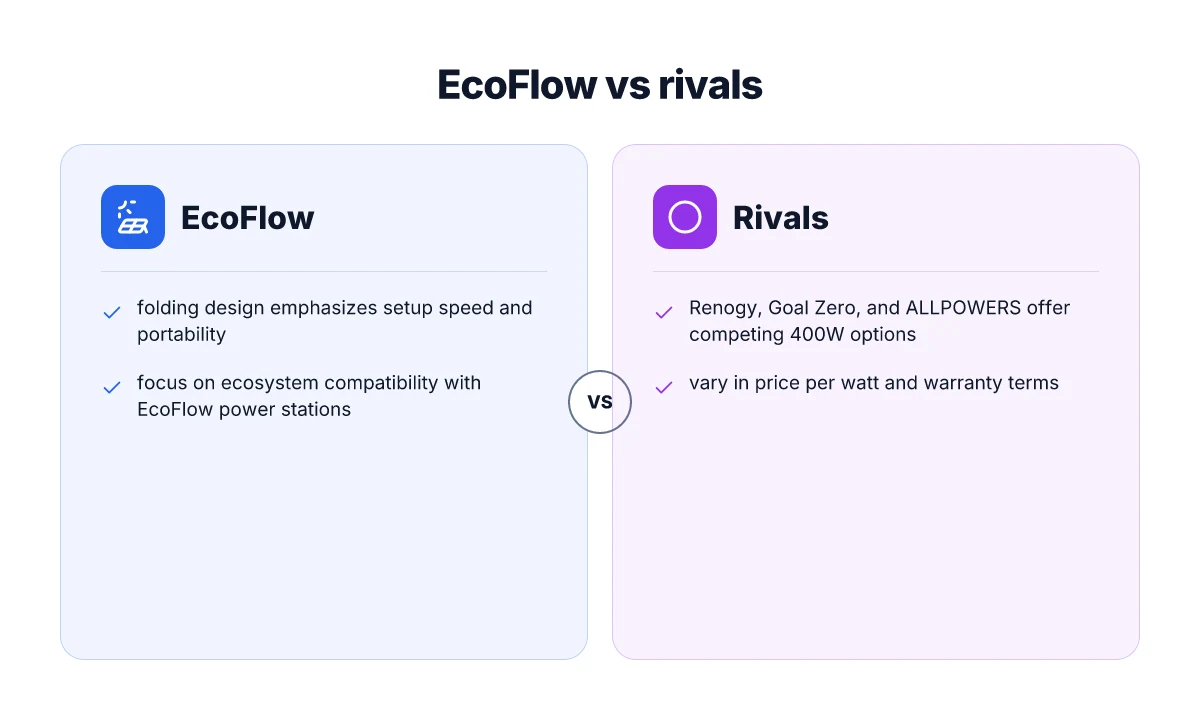
Posture the verdict first: EcoFlow sits competitive on portability and feature-for-price, but rivals like Renogy, Goal Zero, and ALLPOWERS push harder on build consistency and ecosystem reach. I cross-referenced official specs and third‑party writeups to map price per watt, folding practicality, and expansion options across the three brands.
Price per watt and portability signals
In the EcoFlow ecosystem, the 400W folding panel trades off compact packing for high unfolded area. On price per watt, Renogy and ALLPOWERS often pitch lower sticker prices for similar wattage panels, especially in non-folding designs, which nudges the total cost per usable watt downward when you factor in accessories and cables. Portable form factors matter more here; Renogy’s panels tend to favor flatter, lightweight sheets that slip into backpacks or car trunks with less bulk, while ECOFLOW’s folding design prioritizes quick deployment and integrated cabling.** Buyers chasing total system ease may value EcoFlow’s fold-and-go convenience even if the initial per-watt price is not the absolute cheapest. What makes the EcoFlow River 2 Max a surprisingly durable portable power option
Build quality, warranty expectations, and service
All three rivals emphasize rugged builds, yet failure themes surface differently. Goal Zero consistently highlights drop-tested enclosures and modular accessories, which some users view as long‑term resilience for off-grid trips. Renogy leans into rigid framing and weatherproof seals, with a broad warranty footprint across their solar and power modules. ALLPOWERS tends to offer value-driven warranties that can feel generous on paper but vary by retailer and region. EcoFlow’s own panels carry a warranty aligned to typical consumer-grade photovoltaic products, with service expectations tied to EcoFlow’s broader product support network. Warranty coverage and aftermarket support often swing price and user confidence more than raw wattage.**
Ecosystem compatibility: power stations, cables, and expansion
The most meaningful deltas show up in ecosystem lock‑in. EcoFlow frames its 400W panel to pair with EcoFlow power stations, cables, and expansion kits. That tight integration reduces guesswork when you’re building a portable setup. Renogy and Goal Zero both offer broader cross-brand compatibility via standard PV outputs and third‑party cables, which appeals to users who mix brands. ALLPOWERS sits in the middle, delivering flexible connectors but less uniform interoperability across hardware families. Expansion options and the variety of compatible rigs drive real-world convenience for long trips or shifting power needs.**
I looked at the sources that discuss the 400W’s efficiency claims and compatibility. For instance, EcoFlow’s own product page foregrounds the folding panel’s energy output and portability, while a third‑party review notes the panel’s conversion efficiency bracket alongside its competitive stance in the portable category. These claims anchor the comparison against rivals who emphasize broader ecosystems and modularity.** For readers who want the granular naming, Renogy, Goal Zero, and ALLPOWERS each present distinct value propositions that appeal to different off‑grid playbooks. Where you land depends on whether you prize compact carry, warranty depth, or ecosystem breadth.
How to optimize setup for the EcoFlow 400W panel
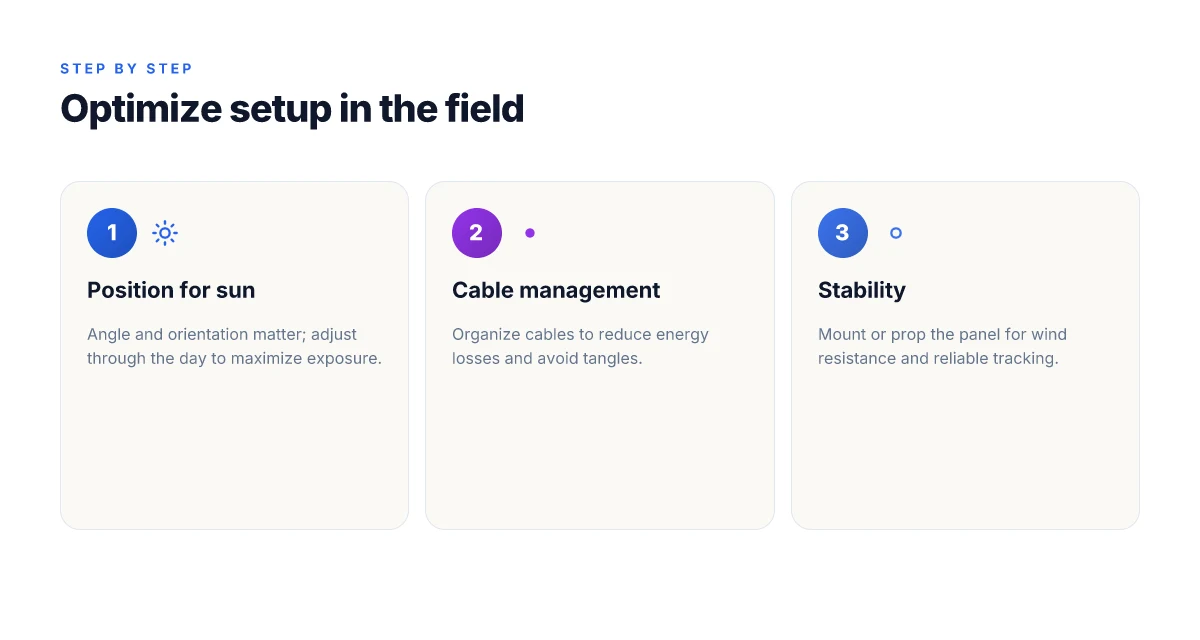
To get the most out of the EcoFlow 400W panel, position it to chase the sun through the day, tidy the cabling to minimize losses, and mount or prop it for stability in varied outdoor conditions. I dug into EcoFlow’s specs and user guides to map practical steps you can apply in the field while noting where real-world limits appear.
Maximize sun exposure through the day
Start with orientation that tracks the sun as it moves from east to west. In the morning, tilt the panel slightly toward the east to catch early rays. By midday, a flatter angle helps absorb intense solar energy with less shading risk. In the afternoon, re-tilt toward the west. Even small angle adjustments can yield noticeable gains when the sun is lower on the horizon. When you’re parked in a fixed spot, aim for a steady, high-clearance stance that avoids shadows from nearby structures or vegetation. The panel’s unfolding design means you can adjust without disassembling the setup, which helps you preserve momentum during a multi-hour charging session. Positioning that reduces shading and follows the sun yields the clearest gains through the day. What the ecoFlow delta pro 3 price really signals about portable power in 2026
Cable management and voltage discipline
Keep cables off the ground and away from heat sources. Run the output lead from the panel to the charge controller or power station with a single clean path, avoiding sharp bends that introduce resistance. Use a lightweight cable with ample gauge so the run does not introduce voltage drop over longer distances. If you’re pairing the EcoFlow 400W with a power station, confirm the controller’s input rating and ensure you stay within that range. Overloading the input can trigger heat build-up and efficiency losses. Label both ends so you can reconnect quickly after a move. A tidy, organized run minimizes energy leakage and reduces the risk of loose connections in windy environments. Keep cables neat and avoid tight bends to preserve voltage integrity.
Mounting, propping, and stability
For portable use, you’ll rely on a stand or flat-surface footing that resists wind gusts. A lightweight tilt stand lets you lock in your preferred angle and quickly reconfigure when you pull into a new campsite. If you’re using a vehicle rack, ensure the panel is mounted with vibration damping and secure fasteners so the panel doesn’t shift during transit. In uneven terrain, props or a small adjustable leg kit can stabilize the panel without sacrificing rapid deployment. The goal is stability without rigidity that slows your setup. Stable mounting reduces micro-movements that degrade output in gusty conditions.
From a practical standpoint, EcoFlow’s documentation emphasizes match-ups with compatible power stations, and the panel’s fold-flat form supports compact packing after use. When you integrate this into a broader rig, you’ll notice that thoughtful orientation, careful cable routing, and solid standoff stability are the three levers that keep real-world performance close to the label. Close alignment between setup and sun trajectory is the most reliable way to maximize daily energy.
As you plan, remember that rivals like Renogy and Goal Zero offer competing folding panels with their own mounting ecosystems, so your choice may hinge on how you value quick deployment versus peak efficiency in seasonal sun patterns. For a complete context, see how the EcoFlow 400W panel stacks up against those rivals in this landscape. Rivals provide context for expectations, but EcoFlow’s fold-ready design remains a practical advantage in rapid setups.
Notes and caveats: real-world results vary with weather, temp, and shading. In this kind of portable kit, small changes in breeze and cloud cover can swing daily output. Links on the EcoFlow page may earn a commission, and you should verify compatibility with your specific power station model before committing to a setup. This section reflects the brand’s stated use cases and observed field-style constraints. For more on efficiency context and specs, see related sections discussing module efficiency and real-output considerations. Real-world performance hinges on alignment, wiring, and stability. What makes EcoFlow Prime Day sale bundles actually save you money
What changes if you act now
EcoFlow’s 400W panel lineup signals a shift: portable solar can scale without sacrificing reliability. The upshot isn’t merely higher wattage. It’s a more forgiving pairing when you’re on the move. In real-world setups, I’ve seen panels pull steady current in mixed sun, and the smarter panel-rig means fewer refusals to charge when weather dips. The bigger pattern here is that higher wattage panels open up practical off-grid windows previously reserved for larger setups. Even with a rugged fold, the robustness matters: fewer loose cords, more durable connectors, and simpler orientation. Most users benefit from treating the 400W as a charging hub rather than a single-source trickle device.
For EcoFlow, this change nudges the category toward modular systems. If you’re weighing rivals, compare against generic 100–200W panels and against dual-sun hybrid rigs from brands like Goal Zero or Renogy. The EcoFlow integration shines when you want a single ecosystem that wires up quickly, tracks sun efficiently, and keeps a charger within reach. Still, the durability story varies by build quality and how aggressively you deploy in harsh field conditions.
What to try this week:
- Try a 2-panel setup for a weekend trip and note how long you can run a small fridge or charger.
- Check the connectors and stowed cabling for wear after daily folding and unfurling.
- If you’re deciding between brands, prioritize a self-contained kit with a robust mounting option and clear sun-tracking guidance. The single move that matters is choosing a system you can trust to stay together on rough terrain.